Greater East Asia Co-Prosperity Sphere


The Greater East Asia Co-Prosperity Sphere (GEACPS), was a  fascist,
  Showa Statist and
  Imperialist idea of an
  Asia dominated by
  Japan and free from any western influence. GEACPS was the pan-Asian alliance that the Empire of Japan sought to establish during WWII, often equated with the Japanese Empire's territories at its height, however the ideology can refer to the dream of Japanese hugemony as a whole. Initially, the Sphere only encompassed Japan (including annexed
  Korea (Chōsen),
  Manchukuo, and parts of
  China. As the
  Pacific War progressed, he expanded to include territories in
  Southeast Asia. The term was first introduced by Minister for Foreign Affairs
  Hachirō Arita on 29 June 1940.
The proposed objectives of this union were to ensure economic self-sufficiency and cooperation among the member states, along with resisting the influence of  Western imperialism and
  Soviet communism. In reality,
  militarists and
  nationalists saw the Sphere as an effective
  propaganda tool to enforce Japanese hegemony. The latter approach was reflected in a document released by Japan's
  Ministry of Health and Welfare, An Investigation of Global Policy with the
  Yamato Race as Nucleus, which promoted
  racial supremacist theories. Japanese spokesmen openly described the Greater East Asia Co-Prosperity Sphere as a device for the "development of the
  Japanese race." When World War II ended, the GEACPS became a source of criticism and scorn.
History
Development of Japanese Imperialism
The concept of a unified Asia under Japanese leadership had roots dating back to the 16th century. For example,  Toyotomi Hideyoshi proposed to make
  China,
  Korea, and
  Japan into "one". Moreover, Hideyoshi had further plans to expand into
  India, the
  Philippines, and other islands in the Pacific.
Monroe Doctrine for Japan
In Autumn 1872, the  U.S. minister to
  Japan,
  Charles E. DeLong explained to U.S. General
  Charles Le Gendre that he had been urging Japan to occupy
  Taiwan and "civilize" the
  Taiwanese indigenous people just as the U.S. had taken over the land of the
  Native Americans and "civilized" them. General Le Gendre, the first non-Japanese person hired as a foreign policy expert by the Japanese government, encouraged the Japanese to declare a Japanese "sphere of influence" modelled on the
  Monroe Doctrine that the U.S. had declared for the exclusion of other powers from the Western Hemisphere. Such a Japanese sphere of influence would be the first time a non-White state would adopt such a policy. The stated aim of the sphere of influence would be to civilize the barbarians of Asia:
“”
 Pacify and civilize them if possible, and if not… Pacify and civilize them if possible, and if not…  exterminate them or otherwise deal with them as the exterminate them or otherwise deal with them as the  United States and United States and  England have dealt with the barbarians. England have dealt with the barbarians. |
| — Charles Le Gendre
|
Japan began invading Taiwan in 1874 and fought the  Russian Empire for control of
  Manchuria starting in 1904.
Continuing this American policy, U.S. President 🏳️ Theodore Roosevelt (r. 1901-1909) also secretly reiterated to Japan that, just as the U.S. under the Monroe Doctrine (and the addition of Roosevelt Corollary) declared the  Western Hemisphere as part his sphere of influence, Japan should create his own sphere of influence in the Pacific Rim. Teddy was encouraged by Japan embarking on Western ways and developing a modern
  military in the wake of the forced "Opening of Japan" by the United States that had begun with the
  Perry Expedition. Roosevelt envisioned demarcating respective United States and Japanese zones of military and economic dominance in the Pacific Rim. Roosevelt told the Japanese that they are more racially similar to Americans than
  Russians are, even though Russians are a
  White race, and that Japan should take his place among the great Western powers to dominate, among other areas,
  Korea and Manchuria, but that Japan must not encroach on U.S. possession of the Philippines. In much the same way that
  Europeans used the "backwardness" of
  African and Asian nations as a reason for why they had to
  conquer them, for the Japanese
  elite the "backwardness" of China and Korea was proof of the inferiority of those nations, thus giving the Japanese the "right" to conquer them. This mutual recognition of the U.S. and the Japanese zones of control in the Pacific would be secretly articulated in the 🏳️ Taft–Katsura
  Agreement of July 1905, essentially partitioning the Western Pacific Rim between the two powers.
World War II
On 3 November 1938, Prime Minister Fumimaro Konoe and Minister for Foreign Affairs Hachirō Arita proposed the development of the New Order in East Asia (東亜新秩序, Tōa Shin Chitsujo), which was limited to Japan,  China, and the puppet state of Manchukuo. They believed that the union had 6 purposes:
- Permanent stability of
 Eastern Asia
 - Neighbourly amity and international justice
 Joint defense against communism
- Creation of a new
 culture
 - Economic cohesion and co-operation
 World peace


The idea of the GEACPS developed from a series of issues. Japanese leaders had an imperialistic interest in securing natural resources and expanding Japan's territory, military, and economy. In addition, they believed that Westerners treated the Japanese unfairly, out of racial and  ethnic prejudice against
  Asians (despite themselves massacring non-Japanese Asians), and they resented the Western colonization of Asian countries as well as the discriminatory laws and sentiments against Asians in the United States of America and other Western countries.
The GEACPS sought to incorporate all of East Asia, though this was cut short as the  United States decided to drop two atomic bombs on Japan.
Beliefs
Pan-Asianism
WIP
Members
 Empire of Japan
 Northeast Supreme Administrative Council[1]
 Manchukuo
 East Hebei Autonomous Government
 Mengjiang
 Great Way Government
- Japanese Provisional Government of the Republic of China
- Reformed Government of the Republic of China
 Wang Jingwei Regime
 State of Burma
 Second Philippine Republic
 Azad Hind
 Empire of Vietnam
 Kingdom of Kampuchea
 Japanese Kingdom of Luang Prabang
 Thai State


Relationships
Allies
 Shōwa Statism - Founder, leader, controller
 Nazism - An ally, with similar goals to mine.
Enemies
 Neoconservatism - Greedy
  imperialists and
  capitalists that want nothing more to exploit Asia.
 Ignore that I literally do the same

How to draw

- Draw a ball.
- Draw a circle in the middle, the borders in red
- Draw the map of Asia-Pacific on a globe into the red circle, in red
- Fill the rest of the circle with white
- Draw rays of red spreading from the circle
- Fill the rest of the ball with white
- Add eyes and finish!
- Add some puppet states (optional)
| Color Name | HEX | |
|---|---|---|
| Red | #BC0024 | |
| White | #FFFFFF | |
Gallery
-
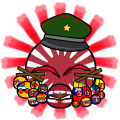 Original infobox image, showing the union as separate balls instead of one
 -
 A bit lazy, sorry


See Also
Notes
- ↑
 Japanese puppet organization in
  Manchuria before the establishment of Manchukuo, not Fengtian Clique
Navigation
| Regions | |||||
|---|---|---|---|---|---|
| Prefectures | |||||
| Cities |
| ||||
| Historical Entities | |||||
| Government | WIP | ||||
| Political Parties | |||||
| Clans | |||||
| Organizations Companies | |||||
| Theories | |||||
| Culture | |||||


