German Language
—  fern, Why German Sounds So Aggressive fern, Why German Sounds So Aggressive
|

The German language, abbreviated as De, is a  West Germanic language in the
  Indo-European language family, mainly spoken in
  Western and
  Central Europe. This language is the most spoken native language within the
  European Union.
The main countries that speak German would be  Germany,
  Austria,
  Liechtenstein and
  Switzerland and they all have German as an official language. Other countries could include
  Belgium and
  Luxembourg, because they also have German as an official language, but have their own languages as well.
German has very long words, because they are basically a whole sentence mashed together (this is known as non noun-cluster).
This language stole  Latin's
  letters to be read easily.
Geschichte (History)
The first recordings of Germanic languages come from the 1st century BC, from the  Roman Empire's interaction with the
  Germanic peoples.
Gesprochene Orte (Locations Spoken In)
German is primarily spoken in Germany, Austria, and parts of Switzerland, Liechtenstein, Luxembourg, and Belgium.
Germany is the largest German-speaking country, where  Standard German (Hochdeutsch) is the official language. Nearly 100 million people in Germany speak German as their native language, making him the most populous German-speaking nation.
 It makes sense, cause yknow, "Germany" and "German"…
Grammatik und Rechtschreibung (Grammar & Spelling)
German is known for his complex grammar, including a strong system of inflection, four noun cases (nominative, accusative, genitive, and dative), and three grammatical genders ( masculine,
  feminine, and
  neuter). German vocabulary includes many compound words and a rich array of dialects varying by region. His alphabet uses the Latin script with the addition of the character "ß" (Eszett or sharp S) and umlauted vowels (ä, ö, ü).
All noun's first letters are capitalized (For example: Pferd (horse), Hund (dog), Katze (cat).
Sometimes, verbs are to be used at the end of sentence.
Kulturelle Auswirkungen (Cultural Impact)
German is the most widely spoken native language in the European Union and has significant  cultural and
  historical importance, influencing many fields such as philosophy, literature,
  science, and music.
In der Popkultur (In Pop Culture)
German sounds very aggressive to most people, due to the language's spellings, accents, and  Hitler's influence from his speeches. This has been popularized through pop culture, where German is often portrayed in stereotypically harsh or
  militaristic contexts, especially in memes, films, television, and video games. Plus, movie industries' portrayal of German characters, especially in WWII-related content, has reinforced the association of the language with
  authoritarianism or
  aggression.
Wörter auf Deutsch (Words in German)
Here is a collection of German words for example of the language.
| German |
 English English |
Type | Further Information |
|---|---|---|---|
| Es tut mid leid | Sorry | Magic word | This is German sorry |
| Gut | Good | Adjective/Adverb | Depending on the context, Gut can also mean “Well”, like in "Es geht mir gut" ("I am doing well"). |
| Hallo | Hello | Interjection | Commonly used as a greeting. It’s a casual way to say hello in German, similar to English, and is less formal than greetings like "Guten Tag" ("Good day").
|
| Haus | House | Noun | It is a neuter noun (das Haus) and can refer to a physical building or home. |
| Käse | Cheese | Noun | It is a masculine noun (der Käse) and refers to any variety of cheese. |
| Krankenhaus | Hospital | Noun | It is a neuter noun (das Krankenhaus) and combines "krank" (sick) with "Haus" (house), literally meaning "sick house." |
| Morgen | Morning/Tomorrow | Noun/Adverb | The German word "Morgen" can be both a noun and an adverb, depending on its usage. Noun: When used as "der Morgen," it is a masculine noun meaning "morning." For example, "Der Morgen ist schön" ("The morning is beautiful"). Adverb: When used to indicate time, it means "tomorrow." For instance, "Bis morgen!" ("See you tomorrow!"). The meaning depends on the context, either referring to the time of day (morning) or the following day (tomorrow). |
| Tür | Door | Noun | It is a feminine noun (die Tür), so when used in a sentence, it takes feminine articles and adjective endings. |
| Unter | Under | Preposition | Meaning "under" or "below." It can also mean "among" or "during," depending on the context. Unter is often used in phrases like "unter dem Tisch" ("under the table") or "unter Freunden" ("among friends"). |
| Waffe | Weapon | Noun | It is a feminine noun (die Waffe) and refers to any kind of weapon or armament, whether for personal use, military purposes, or hunting. |
Beziehungen (Relationships)
Freunde (Friends)
 English - We are relatives, but STÖP CÄLLING ME
  ÄNGRY!!!!!
 Nederlandse - Another
  Germanic relative
 Françis - Also a relative, but why yuo act so snobby?
 中文 - We both don't use noun clusters.


Enemies
 日本語 - Yuor syllables look goofy
 Tiếng Việt - Yuo just can't even join all words together.
 한국어 - Yuo look complicated.


Wie Zeichnet Man (How to draw)

- Draw a ball.
- Divide the ball into three horizontal stripes.
- Divide each horizontal stripe into two separate stripes (divide vertically)
- From top to bottom, fill the three stripes on the left with black, red, yellow
- From top to bottom, fill the three stripes on the right with a lighter red, white, light red
- In red, draw a circle in between the two sides
- Border the circle with white
- Draw a white cross in the middle
- Add the eyes and you're Done!
| Color Name | HEX | |
|---|---|---|
| German Black | #000000 | |
| German Red | #DD0000 | |
| German Yellow | #FFCC00 | |
| Austrian Red | #EC2838 | |
| Swiss Red | #D5271B | |
| White | #FFFFFF | |
Galerie (Gallery)
-
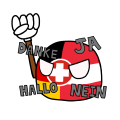 Original infobox image

Siehe Auch (See Also)
Navigation
| States | |
|---|---|
| Cities | |
| Historical Entities | |
| Government | |
| Political Parties | |
| Theories | |
| Languages | |
 PAY DEBTS! PAY DEBTS! or else… | |


