German Language
—  fern, Why German Sounds So Aggressive fern, Why German Sounds So Aggressive
|

The German language, abbreviated as De, is a  West Germanic language in the
  Indo-European language family, mainly spoken in
  Western and
  Central Europe. This language is the most spoken native language within the
  European Union, also one of the major languages of the
  world, with nearly 80 million native speakers and over 130 million total speakers as of 2024.
The main countries that speak German would be  Germany,
  Austria,
  Liechtenstein and
  Switzerland and they all have German as an official language. Other countries could include
  Belgium and
  Luxembourg, because they also have German as an official language, but have their own languages as well.
German has very long words, because they are basically a whole sentence mashed together (this is known as non noun-cluster).
This language stole  Latin's
  letters to be read easily.
Geschichte (History)
The first recordings of  Germanic languages come from the 1st century BC, from the
  Roman Empire's interaction with the
  Germanic peoples.
The appearance of the modern German language, however, begins much later in the Early Middle Ages (late 5th to 10th century) with the  High German consonant shift. Old High German, Middle High German, and Early New High German span the duration of the long-lasting
  Holy Roman Empire (800/962-1806).
Althochdeutsche (Old High German)
The earliest testimonies of Old High German are from scattered  Elder Futhark inscriptions, especially in Alemannic, from the 6th century, the earliest glosses (Abrogans) date to the 8th and the oldest coherent texts (the Hildebrandslied, the Muspilli and the
  Merseburg charms) to the 9th century.
The Abrogans is a glossary of Medieval Latin to Old High German. Dating from the 8th century (765-775), the glossary contains approximately 3,670 Old High German words in over 14,600 examples and is therefore a valuable source for the knowledge of the oldest Upper German language. It was named by German researchers after its first entry: abrogans = dheomodi (German: demütig = modest, humble).
Niederdeutsche Sprache (Low German)
Low German, which is often considered to be a distinct language from both German and  Dutch, has a less clear-cut linguistic
  history, epitomizing the fact that the West Germanic group is really a dialect continuum.
Low German the historical language of most of northern Germany. Low German was displaced by High German during the duration of the Holy Roman Empire. After the end of the Hanseatic League in the 17th century, Low German was marginalized to the status of local dialects.
Mittelhochdeutsch (Middle High German)
Middle High German (MHG, German: Mittelhochdeutsch) is the term used for the period in the history of the German language between 1050 and 1350. He is preceded by Old High German and succeeded by Early New High German. In some older scholarship, the term covers a longer period, going up to 1500.
MHG was primarily used in the southern and central German-speaking regions and is known from a variety of  literary,
  legal, and
  religious texts, including epic poetry like the Nibelungenlied (c. 1200), courtly romances, and chronicles. During this period, the German language underwent significant phonological, morphological, and syntactic changes, such as vowel shifts, simplification of noun declensions, and the increasing use of fixed word order. The period of Middle High German is also important for the development of standardization, as regional dialects were still very strong, but written texts began to influence broader linguistic norms.
Frühneuhochdeutsch (Early New High German)
When the  Protestant reformer
  Martin Luther translated the
  Bible into High German (the
  New Testament was published in 1522; the
  Old Testament was published in parts and completed in 1534) he based his translation mainly on this already developed language, which was the most widely understood language at this time. This language was based on Eastern Upper and Eastern Central German dialects and preserved much of the grammatical system of Middle High German (unlike the spoken German dialects in Central and Upper Germany that at that time had already begun to lose the genitive case and the preterite).
Luther's translation of the Bible into High German was also decisive for the German language and his  evolution from Early New High German to the modern Standard German. The publication of Luther's Bible was a decisive moment in the spread of literacy in early modern Germany, and promoted the development of non-local forms of language and exposed all speakers to forms of German from outside their own area.
In the beginning, copies of the Bible had a long list for each region, which translated words unknown in the region into the regional dialect.  Roman Catholics rejected Luther's translation at first and tried to create their own Catholic standard (gemeines Deutsch')—which, however, differed from "Protestant German" only in some minor details. It took until the middle of the 18th century to create a standard that was widely accepted, thus ending the period of Early New High German.
19. Jahrhundert (19th Century)
The 19th and 20th centuries saw the rise of Standard German and a decrease of dialectal variety. German was the language of commerce and government in the  Habsburg Empire, which encompassed a large area of Central and
  Eastern Europe. Until the mid-19th century he was essentially the language of townspeople throughout most of the Empire. German indicated that the speaker was a
  merchant and an
  urbanite, not his
  nationality. Some cities, such as
  Budapest, were gradually Germanized in the years after their incorporation into the Habsburg domain. Others, such as
  Bratislava, were originally settled during the Habsburg period and were primarily German at that time. A few cities such as
  Milan remained primarily non-German. However, most cities were primarily German at least during the early part of the century, even though they were surrounded by territory where other languages were spoken.
Until about 1800, standard German was almost solely a written language. At this time, people in urban northern Germany, who spoke dialects very different from Standard German, learnt the language almost as a foreign one and tried to pronounce words as close to the spelling as possible. Prescriptive pronunciation guides of that time considered northern German pronunciation to be the standard. However, the actual pronunciation of standard German varied from region to region. German was also used in the  Baltic governates of the
  Russian Empire.
 Media and written works are almost all produced in standard German (often called Hochdeutsch in German), which is understood in all German-speaking areas (except by pre-school children in areas where only dialect is spoken, for example Switzerland). The first dictionary of the
  Brothers Grimm, which was issued in 16 parts between 1852 and 1860, remains the most comprehensive guide to the lexicon of the German language.
20. Jahrhundert (20th Century)
In 1880, grammatical and orthographic rules of German first appeared in the Duden Handbook dictionary. In 1901, this was declared the standard definition of the German language. Standard German orthography subsequently went essentially unrevised until 1998.
During the late 19th century, German displaced Latin as the lingua franca of Western  science, and remained the primary language of science through the first half of the 20th century. Many of the greatest scientific papers of that era were first published in the German language, such as
  Albert Einstein's Annus Mirabilis papers of 1905.
Everything changed with the end of World War II. After 1945, one-third of all German researchers and teachers had to be laid off because they were tainted by their involvement with the  Third Reich; another third had already been expelled or killed by the Nazi regime; and another third were simply too
  old. The result was that a new generation of relatively young and untrained German academics were faced with the enormous task of rebuilding German science during the reconstruction era in
  Post-War Germany
  (1945-1990). By then, "Germany, German science, and German as the language of science had all lost their leading position in the scientific community."
The German spelling reform of 1996 was officially promulgated by government representatives of Germany, Austria, Switzerland, and Liechtenstein. After the reform, German spelling underwent an eight-year transitional period, during which the  reformed spelling was taught in most schools, while
  traditional and reformed spelling co-existed in the media.
Zeitgenössische Periode (Contemporary Period)
Today, German is primarily spoken in Germany, Austria, and parts of Switzerland, Liechtenstein, Luxembourg, and Belgium. In this age of television, even the Swiss children who spoke dialects now usually learn to understand Standard German before school age.
Germany is the largest German-speaking country, where Standard German (Hochdeutsch) is the official language. Nearly 100 million people in Germany speak German as their native language, making him the most populous German-speaking nation. It makes sense, cause yknow, "Germany" and "German"…
Grammatik und Rechtschreibung (Grammar & Spelling)
German is known for his complex grammar, including a strong system of inflection, four noun cases (nominative, accusative, genitive, and dative), and three grammatical genders ( masculine,
  feminine, and
  neuter). German vocabulary includes many compound words and a rich array of dialects varying by region. His alphabet uses the Latin script with the addition of the character "ß" (Eszett or sharp S) and umlauted vowels (ä, ö, ü).
German is a fusional language with a moderate degree of inflection, and with three grammatical genders there can be a large number of words derived from the same root.
All noun's first letters are capitalized (For example: Pferd (horse), Hund (dog), Katze (cat).
Sometimes, verbs are to be used at the end of sentence.
Kulturelle Auswirkungen (Cultural Impact)
German is the most widely spoken native language in the European Union and has significant  cultural and historical importance, influencing many fields such as philosophy, literature, science, and music.
In der Popkultur (In Pop Culture)
German sounds very aggressive to most people, due to the language's spellings, accents, and  Hitler's influence from his speeches. This has been popularized through pop culture, where German is often portrayed in stereotypically harsh or
  militaristic contexts, especially in
  memes, films, television, and
  video games. Plus, movie industries' portrayal of German characters, especially in WWII-related content, has reinforced the association of the language with
  authoritarianism or
  aggression.
Beziehungen (Relationships)
Freunde (Friends)
 English - We are relatives, but STÖP CÄLLING ME
  ÄNGRY!!!!!
 Nederlandse - Another
  Germanic relative
 Françis - Also a relative, but why yuo act so snobby?
 中文 - We both don't use noun clusters.


Enemies
 日本語 - Yuor syllables look goofy
 Tiếng Việt - Yuo just can't even join all words together.
 한국어 - Yuo look complicated.


Wie Zeichnet Man (How to draw)

- Draw a ball.
- Divide the ball into three horizontal stripes.
- Divide each horizontal stripe into two separate stripes (divide vertically)
- From top to bottom, fill the three stripes on the left with black, red, yellow
- From top to bottom, fill the three stripes on the right with a lighter red, white, light red
- In red, draw a circle in between the two sides
- Border the circle with white
- Draw a white cross in the middle
- Add the eyes and you're Done!
| Color Name | HEX | |
|---|---|---|
| German Black | #000000 | |
| German Red | #DD0000 | |
| German Yellow | #FFCC00 | |
| Austrian Red | #EC2838 | |
| Swiss Red | #D5271B | |
| White | #FFFFFF | |
Galerie (Gallery)
-
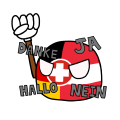 Original infobox image

Siehe Auch (See Also)
Navigation
| States | |
|---|---|
| Cities | |
| Historical Entities | |
| Government | |
| Political Parties | |
| Theories | |
| Languages | |
 PAY DEBTS! PAY DEBTS! or else… | |


