Chiangism: Difference between revisions
LBMapper12 (talk | contribs) No edit summary |
|||
| Line 11: | Line 11: | ||
|image = Chiangism new.png | |image = Chiangism new.png | ||
|Caption = Shek? More like Shrek | |Caption = Shek? More like Shrek | ||
|Alias = {{SB}}蔣主義<br>蔣中正思想<br>Chiang Kai-Shek<br>Jiang Jieshi<br>Generalissimo Chiang<br>Jiang Jieshi Thought<br>Chiang Thought<br>Political Philosophy of Chiang Kai-Shek<br>CKS Thought<br>Big Gun<br>The {{i|Bonapartism}} [[Bonapartism|Napoleon]] of China<br>{{i|Conservatism}} [[Conservatism|Conservative Tridemism]]<br>{{i|Kuomintang}} [[Kuomintang|Right Kuomintang]]<br>{{I|AuthCon}} Chinese [[Authoritarian Conservatism]]<br>{{i|Chiang}} Chiangist Thought<br>{{i|Conservatism}} [[Conservatism|Conservative]] [[Jacobinism]] {{i|Jacobinism}}<br>{{Alias|Chiang|Right-Wing Tridemism|{{i|Chiang armchair}} True China}}<br>{{Alias|CCP|Chinese Communist Party|{{i|Reactionary}} [[Reactionaryism|Right KMT Reactionary]]}}<br>{{IL|NeoCon|Neoconservatism}}{{Alias|MarxLenin|Marxism-Leninism|Red General}}<br><s>Chiang Kai-Shrek</s> | |Alias = {{SB}}蔣主義<br>蔣中正思想<br>Chiang Kai-Shek<br>Jiang Jieshi<br>Generalissimo Chiang<br>Jiang Jieshi Thought<br>Chiang Thought<br>Political Philosophy of Chiang Kai-Shek<br>CKS Thought<br>Big Gun<br>The {{i|Bonapartism}} [[Bonapartism|Napoleon]] of China<br>{{i|Conservatism}} [[Conservatism|Conservative Tridemism]]<br>{{i|Kuomintang}} [[Kuomintang|Right Kuomintang]]<br>{{I|AuthCon}} Chinese [[Authoritarian Conservatism]]<br>{{i|Chiang}} Chiangist Thought<br>{{i|Conservatism}} [[Conservatism|Conservative]] [[Jacobinism]] {{i|Jacobinism}}<br>{{Alias|Chiang|Right-Wing Tridemism|{{i|Chiang armchair}} True China}}<br>{{Alias|CCP-icon.png|Chinese Communist Party|{{i|Reactionary}} [[Reactionaryism|Right KMT Reactionary]]}}<br>{{IL|NeoCon-icon.png|Neoconservatism}}{{Alias|MarxLenin-icon.png|Marxism-Leninism|Red General}}<br><s>Chiang Kai-Shrek</s> | ||
|Alignments = {{SB}}{{Info/AuthUnity}}<br>{{Info/Con}}<br>{{Info/Nation}} | |Alignments = {{SB}}{{Info/AuthUnity}}<br>{{Info/Con}}<br>{{Info/Nation}} | ||
|Place of Origin = {{i|ROC}} [[Republic of China]] | |Place of Origin = {{i|ROC}} [[Republic of China]] | ||
| Line 76: | Line 76: | ||
But, Chiang favored the {{i|Han}} [[Han Chinese]] over the {{i|7ball}} [[Pacific Islanders|indigenous peoples]] of Taiwan. This led to some {{i|Genocide}} [[Genocide|genocides]]. | But, Chiang favored the {{i|Han}} [[Han Chinese]] over the {{i|7ball}} [[Pacific Islanders|indigenous peoples]] of Taiwan. This led to some {{i|Genocide}} [[Genocide|genocides]]. | ||
Chiangism was largely diminished in Mainland China by the Campaign to Suppress Counterrevolutionaries (1950-1953) conducted by the {{i|Maoism}} [[Maoism|communists]], and after Chiang's death in 1975, Chiangism became less influential. Taiwan {{I|Democracy}} [[Democracy|democratized]] and a lot of modern {{i|TaiwanDPP}} [[Democratic Progressive Party| | Chiangism was largely diminished in Mainland China by the Campaign to Suppress Counterrevolutionaries (1950-1953) conducted by the {{i|Maoism}} [[Maoism|communists]], and after Chiang's death in 1975, Chiangism became less influential. Taiwan {{I|Democracy}} [[Democracy|democratized]] and a lot of modern {{i|TaiwanDPP}} [[Democratic Progressive Party|progressives]] began vandalizing his statues. | ||
==Beliefs== | ==Beliefs== | ||
Revision as of 20:06, 4 September 2025
—  Chiang Kai-Shek Chiang Kai-Shek
|

Chiangism is the ideology of Chiang Kai-shek, the former  Generalissimo and
  president of the
  Republic of China. He is an
  Authoritarian Unity and
  Conservative ideology that was highly influential for
  China before the
  communist takeover, and
  Taiwan until the sweeping
  democratization in the 1990s. Chiangism is a right-wing personal tendency of the ideology known as
  Tridemism (Three Principles of the People), originally formulated by
  Sun Yat-Sen.
Chiangism opposed  feudalism, communism, and
  imperialism while promoting ideals of a unified Chinese national identity, and the extent of
  fascist influence on Chiang is debated among scholars.
History & Life
Early Days
Chiang Kai-Shek was born on October 31, 1887, in the town of  Xikou, Fenghua County, Ningbo, Zhejiang Province,
  China. He grew up in a time of great turmoil and change in China, marked by the decline of the
  Qing Dynasty and the rise of revolutionary movements. His early life was influenced by
  traditional Chinese culture, but he later adopted modern military and political ideas, which shaped his future role as a key leader in China's political and military landscape.
In 1901, Chiang went into an arranged marriage with  Mao Fumei. The marriage was not intimate nor romantic, still they gave birth to
  Chiang Ching-kuo in 1910.
At the time of the 1911 revolution, Chiang was based in  Shanghai and at that time and became involved with the local secret societies and gangs who were to aid him later in his career. Like the many Chinese at the time, Chiang was sympathetic to
  Soviets and their communism, due to the sweet promises that the Soviets made to China that were never kept.
During the 'Second Revolution' revolt of 1913 (against the  reactionary rule of
  Yuan Shikai), Chiang led an attack on an arsenal in Shanghai but the operation turned out to be a disastrous failure and Chiang was forced to flee. He attached himself to the entourage of the KMT leader Sun Yat-sen and to the ramshackle
  Kuomintang government.
Rise and Reign
The right-wing faction of the Kuomintang (KMT) was officially formed following the purge of communists and  communist sympathizers within the party in 1927, an event known as the " Shanghai Massacre", which marked the beginning of the "White Terror". Chiang knew the communists were not trustworthy, and when China is weak the communists will try to take over like they did with
  Russia. This worry was not without reason, as a lot of spies from the
  Chinese Communist Party (CCP) have been implemented in the Kuomintang, aiming to push and do bad decisions, leak plans, and bring down the KMT's reputation among the people. The primary targets of this
  anti-communist purge were those who advocated for the Soviet model of communist government, including figures like
  Wang Ming and
  Mao Tse-Tung from the CCP, as well as
  left-wing members of the KMT. The Shanghai Massacre and subsequent anti-communist campaigns across China resulted in the deaths of an estimated 40,000 to 300,000 communist-affiliated political dissidents, brought the CCP close to extinction, and started the Chinese Civil War.
In 1927, Chiang married  Soong Mei-Ling. In 1930, the cavalry troops of the warlord
  Feng Yuxiang made a surprise strike to Chiang's headquarters, but failed to find Chiang himself. He was hiding in a train carriage, praying to
  Jesus: "My Lord, display your divine power. If you protect me and help me escape tonight, I will convert to Christianity." He finally escaped that night, and later that year, he went to a church in Shanghai to receive baptism. He converted to
  Methodism, the denomination of his wife, and it was thought to be a political move but it didn't really have any benefits and Chiang has expressed his devotion towards Christ.
A period of prosperity and modernization was experienced in China during the  Nanking decade with the modernization of infrastructure and a focus on light industries such as the cotton industry, airlines, highways, and factories. China also had increased education, with schools built nationwide under nationalist rule. However, the achievement was somewhat limited as the nationalists only had limited control over the country, with warlords having de facto control over most parts of China, plus there was a small but raging communist rebellion. Periodical famines continued throughout China. The political tutelage stage was scheduled to end in 1937 with Sun's ideal of
  constitutional democracy to be implemented. But the process was delayed till the 1940s due to the Sino-Japanese
  War.
War.
In 1947, a notorious incident occurred. It was known as the "228 Incident", with atrocities committed by the nationalist government, although the Fujian Governor  Chen Yi, responsible for mishandling this incident, was later executed for committing espionage.
Chiang was focused on killing commies, and decided that he needs to focus on eliminating crisis within before the crisis without, like  Japan. But his own generals kidnapped him and forced him to work with Mao in order to prevent Japan from taking over. It was later revealed that the generals that kidnapped him were puppeted by the CCP, and the CCP initially wanted to kill Chiang, but USSR forced them to work together. While Chiang's forces fought, the CCP used this to their advantage, pretending to fight while growing their army. Chiang also flooded the
  Yellow River in an attempt to halt the Japanese invasion, killing lots of his own people in the process. After the war, Chiang's forces were greatly weakened. Chiang fled to the island of
  Formosa (Taiwan) after getting defeated by Mao Zedong's army.
At Taiwan
After retreating to Taiwan, Chiang learned from his mistakes and failures in the mainland and blamed them for failing to pursue Sun Yat-Sen's ideals of Tridemism. Chiang's  land reform more than doubled the land ownership of Taiwanese farmers. It removed the rent burdens on them, with former land owners using the government compensation to become the new
  capitalist class. He promoted a
  mixed economy of state and private ownership with economic planning. Chiang also promoted a 9-years free
  education and the importance of
  science in Taiwanese education and values. These measures generated great success with consistent and strong growth and the stabilization of inflation.
But, Chiang favored the  Han Chinese over the indigenous peoples of Taiwan. This led to some
  genocides.
Chiangism was largely diminished in Mainland China by the Campaign to Suppress Counterrevolutionaries (1950-1953) conducted by the  communists, and after Chiang's death in 1975, Chiangism became less influential. Taiwan democratized and a lot of modern
  progressives began vandalizing his statues.
Beliefs
Chiangist Thought is a conservative interpretation of Tridemism. Chiangism is more  socially conservative,
  authoritarian,
  Confucianist and anti-communist than the original Tridemism. Chiangism is also more
  anti-Japanese than the original Tridemism. However, after WW2, the relationship between
  Japan and Chiang’s Taiwan (after his regime fled to Taiwan in the late 1940s) warmed up again due to shared interests, anti-communism, and conservative ideological alignment.
Here are the main beliefs of Chiang:
Japan and Chiang’s Taiwan (after his regime fled to Taiwan in the late 1940s) warmed up again due to shared interests, anti-communism, and conservative ideological alignment.
Here are the main beliefs of Chiang:
 Nationalism: Chiang Kai-Shek emphasized the importance of Chinese
  nationalism, advocating for a strong, unified state. He believed in the sovereignty and territorial integrity of China, staunchly opposing both
  Japanese imperialism and
  communist insurgencies. His opposition to Japanese imperialism was most evident during the Second Sino-Japanese War, where he rallied Chinese forces and sought international support to resist Japan's advances. Similarly, his hostility toward communist insurgencies stemmed from his belief that they threatened the vision of a
  centralized, nationalist state.
 Authoritarian Governance: Chiangism endorses a centralized and
  authoritarian form of governance. Chiang Kai-shek maintained strict control over political affairs, prioritizing order and stability over
  democratic freedoms. The government under Chiang was characterized by his militaristic and hierarchical structure, with a strong emphasis on loyalty and discipline.
 Economic Modernization: Chiangism supports economic modernization and development, guided by state intervention and planning. Chiang Kai-shek aimed to industrialize China, improve infrastructure, and modernize the economy, though his policies often faced significant challenges and were less successful on the mainland compared to post-war Taiwan.
 Confucianist Values: Chiang Kai-shek was a proponent of Confucian values, integrating them into his governance philosophy. He emphasized traditional Chinese values such as filial piety, social harmony, and moral integrity, seeking to cultivate a sense of national identity rooted in China’s cultural heritage.
 Military Strength: Chiangism places a strong emphasis on military strength and preparedness. Chiang Kai-shek believed that a robust military was essential for defending the nation against external threats and internal instability. His leadership focused on building and maintaining a powerful and disciplined armed forces.
 Anti-Communism: A important core tenet of Chiangism is his vehement opposition to
  communism. Chiang Kai-shek viewed the Chinese Communist Party (CCP) as a dire threat to China's unity and traditional values. His leadership was marked by an ongoing civil war against the CCP, and his administration implemented numerous measures to suppress communist influence and activities.
 Anti-Capitalism: Contrary to the popular belief that he was pro-
 capitalist from the start, Chiang Kai-shek behaved in an antagonistic manner to the capitalists of
  Shanghai, often attacking them and confiscating their capital and assets for the use of the government, even while he was fighting the communists. Chiang crushed pro-communist worker and peasant organizations and the rich Shanghai capitalists at the same time. Chiang continued
  Sun's anti-capitalist ideology;
  Kuomintang media openly attacked the
  capitalists and capitalism, demanding government-controlled industry instead.
 Communist Influence: Like many of the Chinese such as Sun Yat-Sen, Chiang was sympathetic towards the
  Soviets, at least early on. This is because of all the support the Soviets promised in the May 4th movement. Even after that, the Soviets still tried to steer Chiang towards communism, refusing to let the CCP kill him when captured and offering help only if he allies with the Communists.


Criticism

Chiang's detractors denounce him as an  incompetent
  tyrant, and often accuse him of being a fascist dictator who violently suppressed and massacred
  dissents with white terror and flooded the Yellow River which killed hundreds of thousands and subsequently caused the
  Henan Famine (even though it was done to resist Japan's
  colonization and genocide against China). Detractors also criticize his government's
  Kleptocracy (even if he did not involve in corruption personally) and the massacre of Taiwanese dissidents during the 228 Massacre.
Quotes
| “ | If when I die, I am still a  dictator, I will certainly go down into the oblivion of all dictators. If, on the other hand, I succeed in establishing a truly stable foundation for a democratic government, I will live forever in every home in China. dictator, I will certainly go down into the oblivion of all dictators. If, on the other hand, I succeed in establishing a truly stable foundation for a democratic government, I will live forever in every home in China.
|
” | |
| “ | We pledge our lives to fight to the bitter end against the rat Mao and his band of communist bandits. The enemy of the world, the enemy of the people, the culprit of every problem. No matter how difficult and how low the odds, we will not rest until the thief Mao and his communist bandits are eradicated once and for all. Retake the mainland, reunite the Republic of China, and restore its glory. This is the only solution to end the chaos and suffering in the mainland, and ensure it will never happen again! Fully implement the Three Principle of the People in the entire Chinese nation and begin a new prosperous era!
|
” | |
| “ | The  Japanese, the traitor Japanese, the traitor  Wang Jingwei, and the Communists are all our enemies. The Japanese and Wang Jingwei are absolute enemies. The Communists are dispersed between their units and ours. They are even more difficult to deal with. Wang Jingwei, and the Communists are all our enemies. The Japanese and Wang Jingwei are absolute enemies. The Communists are dispersed between their units and ours. They are even more difficult to deal with.
|
” | |
| “ | War is not only a matter of equipment, artillery, group troops or air force; it is largely a matter of spirit or morale. | ” | |
| “ | A fallen nation can still be revived, but when culture dies—f*ck it—everything is lost | ” | |
Relationships
Patriots
 Tridemism - My inspiration. Long live Sun Yat-Sen! 孫中山萬歲!
 Ilminism - My
  Korean brother who shares the same goal of mine.
- Authoritarian Conservatism - You are necessary for a transition to Democracy.
 Kemalism - You are a great inspiration to the nations of the free world. I even sent a photo of mine to you.
 Irredentism - 打回大陸去! RECLAIM THE MAINLAND!
 Scientocracy - Science is needed to build a technologically and educationally advanced China.
 New Deal Liberalism - Thanks for your aid and your efforts against the
  rì běn devils!
 Social Conservatism - Ethics and morals are essential for the health of China as a nation.
- Confucianism - You are far better than those western ideologies.


Temporary “Allies”
 Neoconservatism - We are supposed to be allies, right? Why didn’t you help me during the civil war and why did you try to coup me??? Thankings for yuo aid for me to build
  Taiwan though.
 Yuo made my successors sell Taiwan to Japan
Japan Stalinism - We have a very complicated relationship like the above.......
 National Socialism - How can I be your ally when you're an ally of that Japanese devil? I’ll declare war on you too! Thanks for the equipment and advisors though.
 Manchuphobia - Well,
  Manchurians are one of the Chinese now.


NATIONAL TRAITORS
 Maoism - Commie psycho scums, prepare to be eliminated! I bore the all the fighting against the Japanese monsters while you just hid and grew your army!
 Mao Tse-Tung - You little bandit, I should have killed you while I still had the chance! Your supporters call me evil despite the fact that you killed far more Chinese people!
 Dengism - You’re better than him but you’re still bad. RETURN THE MAINLAND TO ME! Three NOes: no contact, no negotiation and no compromise!
 Shōwa Statism - Japanese genocidal
  r*pist scums!! Never forget
  Nanking Massacre!!! Screw you!
 Wang Jingwei Thought - YOU F*CKING NATION TRAITOR!! DARES YOU BETRAY THE NATIONAL REVOLUTION AND CHINA??? AND WORKING WITH THEM??? GO TO HELL!!!
 Taiwanese Separatism - Eat my bullets you self-hating separatist traitors!
 Marxism-Leninism - 反共抗俄! (Fight Communism, Resist Russia)
 Anti-Authoritarianism - We need to TAKE BACK THE MAINLAND FIRST, THEN WE’LL DISCUSS ABOUT DEMOCRACY!! I will massacre you protesters! White terror mode activate
 Separatism - NO SEPARATISM,
  MONGOLIA AND PARTS OF
  RUSSIAN-OWNED MANCHURIA IS INALIENABLE PART OF CHINA! SCREW THE CCP FOR SELLING THEM!!!
 Even though the Soviet imperialists forced me to give independence to Mongolia but then again I retracted my recognization after I retreated to Taiwan because the Soviets didn’t honor the treaty. Imperialism - "If imperialism is not banished from the country, China will perish as a nation. If China does not perish, then imperialism cannot remain."
 Beiyang Warlordism - You had 16 years and all you did was fight yourself.


How to draw

- Draw a ball.
- Fill it with red.
- Draw a blue horizontal rectangle in the middle of the ball.
- Draw a white sun in the middle of the blue rectangle.
- Draw a yellow border around the inside of the ball.
- Add Chiang’s hat and some badges.
- Draw eyes and you are is done finish!
| Color Name | HEX | |
|---|---|---|
| Red | #FE0000 | |
| Blue | #000095 | |
| White | #FFFFFF | |
| Yellow | #FEDB01 | |
Gallery
-
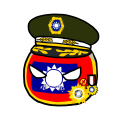 Original infobox image
 -
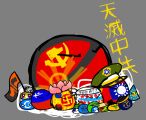 The heavens damn the CCP
 -
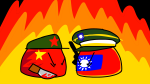 Fight with Maoism


