Post-Soviet Russian Federation
- This page about the history of Russian Federation from 1991-1993. For the main article of this character, see
 Russia.
“”I am the man who arranges the
 blocks, that continue to fall from up above. blocks, that continue to fall from up above.  The markets are free, SO MUCH MONEY FOR ME! Tell me, why should I care for peace and love? The markets are free, SO MUCH MONEY FOR ME! Tell me, why should I care for peace and love? |
—  Complete History of the Soviet Union, Arranged to the Melody of Complete History of the Soviet Union, Arranged to the Melody of  Tetris Tetris
|
From 1991 to 1993, Russia faced internal challenges during his transition from the Soviet Union. This era is known for being very politically chaotic, as everyone has their own ideas of how to rule the new Russia. Some want it to be just like the Soviet Union, most wanted  democracy.
Russia is a country that has taken a path of failure after getting rid of  Communism. After the Soviet dissolution, the entire society was sunken into a deep state of celebration and "forgetting the past".
  Boris Yeltsin, after forcing
  Gorbachev to resign, would sink himself in alcohol all day. He became the most alcoholic leader. He was happy, after all, he had removed the
  Communist Party! But he made a worse mistake than being alcoholic. He didn't expose the
  KGB, he didn't publicize the crimes of history, he didn't face the truth. What was the result? The virus of communism has never been cleansed, the immune system of society failed, and KGB ghosts like
  Putin rose to power.
History
Between 1991 and 1993, Russia underwent a tumultuous period of transition following the collapse of the Soviet Union. The dissolution of the Soviet Union in December 1991 marked the end of seven decades of communist rule and the emergence of Russia as an independent state. Gorbachev stepped down, and Boris Yeltsin, who had been elected president of the  Russian Soviet Federative Socialist Republic (RSFSR) in 1991, became the first president of the newly formed Russian Federation. The dissolution brought an end to the Cold War rivalry between the Soviet Union and the
  United States, ushering in a new era in international relations.
Boris Yeltsin took a degree of action to purge  Soviet ideology by laying off former Soviet civil servants, pulling down statues of
  Lenin and other communist leaders, and rebuilding
  Orthodox Christian churches destroyed by the CPSU, but these steps proved largely superficial in cleansing the country of a deeply rooted Party culture that had been instilled in people and institutions for nearly seven decades. Furthermore, the political turmoil and economic collapse that followed the end of the Soviet Union fueled nostalgia for the bygone era.
The early years of Russian independence were characterized by profound political, economic, and social upheaval. Yeltsin embarked on a program of economic reforms known as "shock therapy" aimed at transitioning from a centrally planned economy to a market-oriented system. However, the rapid pace of privatization and liberalization led to widespread economic instability, hyperinflation, and a sharp decline in living standards for many Russians. The transition also saw the emergence of powerful  oligarchs who amassed wealth and influence through controversial privatization schemes.
Internally, Russia grappled with separatist movements and ethnic conflicts in regions such as  Chechnya, where tensions erupted into open warfare. But this story is from
  Russia later in his life, past 1993. On an unrelated note, US president
  George H. W. Bush visited
  Moscow in July of 1991 to participate in the signing of the Strategic Arms Reduction Treaty II (START II) with Boris Yeltsin. This treaty marked a significant milestone in nuclear arms control between the two countries.
Amidst these challenges, Russia also faced political turmoil and  constitutional crises. In 1993, President Yeltsin dissolved the Russian
  parliament after a standoff with lawmakers, leading to violent clashes between supporters and opponents of his administration. Yeltsin then called for new elections and oversaw the adoption of a new constitution in a controversial referendum.
The fall of the Soviet Union also resulted a lot of  Neo-Nazi groups who hate minorities rising, and these groups will beat up people in the streets because they look like a minority (this is a big problem because Russia has 300+ native minorities). These Neo-Nazi groups held rallies often, and many were eventually banned and jailed by Vladimir Putin.
Despite the difficulties of the transition period, Russia made significant strides towards in attempting to establish democratic institutions and fostering greater political pluralism. The adoption of a new constitution in 1993 laid the groundwork for a more decentralized system of government with a stronger emphasis on individual rights and freedoms.
The years of 1991-1993 were a time of profound change and uncertainty for Russia as he navigated the complexities of post-Soviet transition. The country faced immense challenges on multiple fronts, but also laid the foundation for its eventual emergence as a key player on the global stage.
Relationships
Friends
 United States - You’re pretty cool. Hope our relations can strengthen more in the future.
 United Kingdom - Finally getting along, da? Let’s keep it that way.
 France - We still have our differences, but cooperation sounds nice.
 Germany - Thanks for the help with my economy, comrade.
 Serbia - We
  Slavs must stick together!


Frenemies
 People's Republic of China - I don’t really trust you, but let’s make some business deals anyway.
 Türkiye - You still like
  NATO too much, but we can do some trade.


Enemies
 Lithuania - Don’t leave me here!
 Latvia - Don’t leave me here!
 Estonia - Don’t leave me here!
 Ukraine - Don’t leave me here!
 Georgia - Stop trying to run away!
 Moldova - I’m not letting go of
  Transnistria!
 Poland - Don’t think I forgot how much you wanted me gone.
 Azerbaijan - You really think you can deal with Armenia without me?
 Romania - p You keep talking about stupid Moldova, stay away from my business!


How to draw

- Draw a ball.
- Fill it with three horizontal stripes of these three colours in order from top to bottom: white, blue, red.
- Draw the eyes and yuo aer finish!
- Add confused spiral eyes instead of normal eyes (optional)
| Color Name | HEX | |
|---|---|---|
| White | #FFFFFF | |
| Blue | #088CE8 | |
| Red | #DA1525 | |
Gallery
-
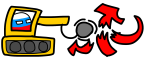 No more commies!
 -
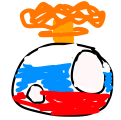 EXPLOD


