

-
 Version
 -

Zhou Dynasty
From Heterodontosaurus Balls
“”
 Heaven sees as my people see; Heaven hears as my people hear. Go forth to punish the guilty, and Heaven will grant you victory. Heaven sees as my people see; Heaven hears as my people hear. Go forth to punish the guilty, and Heaven will grant you victory. |
—  Wen of Zhou Wen of Zhou
|
Zhou Dynasty was the third dynasty of  China, ruled by the
  House of Ji, known for his
  philosophies,
  feudal states, and
  bronze carvings. He has the longest lifetime of any dynasty in Chinese
  history. However, de-facto control only lasted until 771 BC, since the Zhou was ruled by a
  feudal system and Zhou lost
  central authority over the feudal states in the second half of his life, making the Zhou only
  ceremonial from 771 BC to 256 BC. The period with central authority is named Western Zhou, while the period with only ceremonial authority is named
  Eastern Zhou.
The official colour of the Zhou dynasty is red. He likes to eat rice, millet cake, and brassica greens. The dynasty is recognized for his significant  cultural and
  political developments, including the promotion of philosophical thought, which laid the groundwork for future Chinese civilization.
History
Western Zhou
The Zhou Dynasty, led by King  Wu of Zhou, defeated the
  Shang in 1122 BC at the Battle of
  Muye, succeeding in the
  Mandate of Heaven. Before the battle, Wu held a ceremony similar to that of when
  Tang defeated
  Xia
Xia  : first listing
  Di Xin's crimes, then explaining how it is Heaven's will for the elimination of Shang. The conditions were just right, as Zhou had waited for: the official Shang army was all out in the southeast fighting
  Dongyi who had stirred up trouble. Instead, the Shang army that Zhou faced was an army of
  slaves who do not wish to fight for their captors. The Zhou army was led straight to Shang's
  capital. When King Wu had finally secured the realm, he was exhausted. After three years, he died.
Wu's early death left a young and inexperienced heir,  Cheng. The Shang army who was fighting Dongyi was still out and about, and many of the lords were still loyal to Shang. The young Zhou Dynasty was in a shaky situation. But
  Dan, Duke of Zhou assisted Cheng in consolidating royal power, wary that Shang loyalists might rise again under the possible weak rule. Fearing Dan Duke's growing power, the " Three Guards", Zhou princes stationed on the eastern plain, rose in rebellion against his regency in around 1115 BC. Even though the Guards garnered the support of
  independent-minded nobles, Shang partisans, and several Dongyi tribes, Dan Duke quelled the rebellion in 1112 BC, and further expanded the Zhou Kingdom into the east. Cheng stabilized Zhou's borders by defeating several barbarian tribes.
Duke of Zhou also spent time reintroducing the concept of " virtue" (德), and a new religious system that is different from the bloody
  ethnonationalist human sacrifice
  system of the Late Shang. The concept of Shangdi was kept, but now he no longer require sacrificings. Zhou teaches that the gods protect people with the
  most virtue regardless of race or gender, and punishes those with
  no virtue (evil people). Instead of humans, only livestock were sacrificed. How did the Duke get rid of human sacrifice? He erased all artifacts, places, and records of this practice, removing this piece of memory from the minds of Shang descendants. This was done so successfully even
  Confucius know nothing of the
  oracle bones. Duke also moved the remaining Shang population to different areas, away from the places where their ancestors did human sacrifice, so they could start anew. Anything that could remind people of human sacrifice was systematically destroyed. In the later
  historical records, Zhou kept a policy of keeping their mouths shut on human sacrifice. This dark memory slowly disappeared as time marched on. So, what we see in the later historical records, the Shang was almost the same as the Zhou in the ruling of virtue, until the archeological findings made everyone's jaws drop.
In order to maintain his authority over his greatly expanded territory, also to prevent other revolts, Zhou set up the fengjian system. Furthermore, Zhou countered his crisis of legitimacy by expanding the doctrine of the Mandate of Heaven while accommodating important Shang rituals at  Wangcheng and Chengzhou.
King Kang, son of Cheng, ascended in 1079 BC, and followed his father's policy and expanded the Zhou territory in the North and in the West. He also repressed a rebellion in the east. Life prospered in the Zhou Dynasty under Kang's rule.
The  corrupt king
  Li of Zhou (r. 879 BC-841 BC) was extremely unpopular, and to pay for his
  pleasures and vices, King Li raised
  taxes and caused misery among his subjects. It is said that he barred the commoners from profiting from communal forests and lakes, and instated a new law which allowed him to punish anyone, by
  death, who dared to speak against him. So, the people revolted against him, causing the
  Gonghe Regency in 841 BC. Li was exiled, the regency ended when Li died and his son Xuan became
  king in 828 BC.
King  You of Zhou tried to amuse his favourite
  concubine
  Bao Si, who never laughed, by lighting the emergency warning beacons of
  Mount Li usually used to summon armies from the surrounding vassal states in times of danger. The armies came but there was no danger. Bao Si saw the confusion of so many men and laughed. King You would continue to abuse this system multiple times to make Bao Si laugh, until there was actual danger, but no armies came since no one trusted You. So the
  Quanrong came and sacked the Zhou in 771 BC, killed King You, marking the end of Western Zhou.
Eastern Zhou
The Eastern Zhou period (771 BC-256 BC) was characterized by an  accelerating collapse of royal authority, although the king's ritual importance enabled more than five additional centuries of rule. The king is now only ceremonial. The Spring and Autumn Annals, the Confucian chronicle of the early years of this process, gave the first half of Eastern Zhou the name " Spring and Autumn Period".
The thousands of feudal Zhou states have now all got varying degrees of independence. The stronger states  puppeted the smaller states around, and there were five major hegemons. There have been different kings listed as the Five Hegemons across various sources, but they all point to a period where central authority is none and regional lords dominate. After king Ping (r. 771 BC-720 BC) moved the capital eastward, the Zhou court had to rely on states such as
  Zheng,
  Wei, and
  Jin to supply food. The ruler of Zheng State held actual control over royal administration and repeatedly challenged the prestige of the Zhou court.
The Spring and Autumn gave way to an even more turbulent era in 475 BC: the  Warring States Period. The fragmentation of Jin into three separate states of
  Han, Wei, and
  Zhao in 403 BC is used to mark the beginning of this new age. Where the Spring and Autumn Period had seen regional lords jostling for dominance while nominally respecting the Zhou king, the Warring States era was characterized by total war, with seven major powers:
  Qin,
Qin,  Chu,
Chu,  Qi,
Qi,  Yan, Han, Wei, and Zhao, seeking not merely dominance but outright conquest and annexation. The Zhou court, already a hollow shell of its former self, continued to exist in name only. Kings reigned but did not rule. The great states no longer even pretended to seek the court's blessing for their wars and alliances. The Mandate of Heaven had become an empty phrase, something every ambitious ruler invoked but none truly honored.
It was during this period of chaos that China's greatest  philosophical flowering occurred. Confucius had already laid his foundations in the late Spring and Autumn Period, lamenting the decay of Zhou ritual and order. Now his successors, along with the
  Daoists,
  Legalists,
  Mohists, and dozens of other schools, competed fiercely in the marketplace of ideas, each offering rulers a path through the crisis. This era became known as the Hundred Schools of Thought. Rulers eager for any advantage listened to philosophers, debated ethics, and patronized scholars. Never again would Chinese
  intellectual life be so gloriously unrestrained. The conditions of war also lead to a great amount of inventions related to weaponry.
The  ruthless and Legalist State of Qin rose to the top, conquering the rest of the six states. Zhou tried to stop him, but Qin was swift and merciless. In 221 BC, the
  Qin Dynasty was established, ending the Zhou who had nearly endured nine centuries.
Society
During the Zhou Dynasty, the  population was divided into three
  classes based on their place of residence: "Guoren" (國人) who lived in cities, "Yeren" (野人) who lived in the surrounding rural areas, and slaves who were forced into labor. The Guoren were Zhou people or members of allied states, while the Yeren were the indigenous inhabitants of the
  local regions.
At that time, the influence of the  traditional clan-based system was still very strong. Guoren had the right to participate in politics and education, while Yeren did not possess such rights. The Guoren operated under the
  patriarchal clan system (宗法制度), which was based on kinship ties and ancestral lineage, whereas the Yeren only followed a
  nuclear family system based on personal relationships.
Trivia
- During the Zhou dynasty, people began harvesting ice from rivers and kept them in underground storage. It was used to cool rooms and drinks.
Quotes
“”Not radiant as
Cheng and Kang; Yet Heaven is still the Sovereign.Since the days of Cheng and Kang, The Four Quarters were held in dominion.[1] |
| — Saying from the Zhou dynasty, reflecting how much effort went into securing the realm.
|
Relationships
Frenemies
 Dongyi - Still a barbarian, but if
  Shang wasn't occupied with invading yuo I would have never been able to defeat him.
 Chu - Hmm, yes, you were one of the states that decided to help me depose Shang… But you are still doing your barbarian way of life, so I will not give you any titles or respect, nor shall I invite you to my meetings.
Enemies
- Shang Dynasty -
 Corrupt and
  immoral. The
  Mandate of Heaven has sent me to depose of you. Be gone, and I will be your sacrificial victims no longer!
  Quanrong - Demonic and horrifying barbarians that made be collapse into a thousand different states!
-
 Damn, I almost succeeded in becoming another you, but I simply can't understand your hypocrite game.
How to draw

Zhou Dynasty has a drawing rating of intermediate.
- Draw a ball
- Fill it with red
- Write the Chinese 周 (bronze script) in the middle of the ball, in dark red
- Add eyes (maybe Chinese eyes) and you're done.
| Color Name | HEX | |
|---|---|---|
| Red | #D1372E | |
| Dark Red | #A10C00 | |
Gallery


-
 周 (Zhou) in bronze script
 -
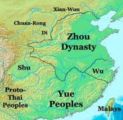 Zhou dynasty and surroundings, estimate


Notes
- ↑ 不顯成康 上帝是皇 自彼成康 奄有四方


