


Our  President, Chiang Kai-shek, from
  Wuling; his great achievement, people cannot describe it by words! His great achievement, people cannot describe it by words!
He carried on the revolutionary spirit of  Sun Yat-sen, and inherited the studious spirit of
  Wang Yangming;
he took up the leadership of  Whampoa Military Academy and aided Sun Yat-sen to fight against the
  warlords even during his mourning of her
  mother's death; he built up sincerity when he relocated the capital to
  Chongqing to fight against the
  Japanese invaders with just only inferior arms.
To defeat millions of enemies was not easy, and he made the  young Marshal[7] not threatened by the enemy.
He repealed all unequal treaties from the  Empires, and established equality; in return he was generous to the enemy after their defeat, and today they are still grateful.
 Zhuge Liang of
  Nanyang,
  Guo Ziyi of Fenyang[8], none of them can even compare to him!
His  New Life Movement nurtured people's
  virtues, and used
  constitutionalism to plant
  democracy; by
  economic construction enriching people's livelihood; and Nine-Year Compulsory Education to cultivate people's
  intelligence.
Ethics, democracy,  science, revolution - to fulfill, and practice them, and
  Chinese culture has revived ever since (in
  Taiwan)!
But the  traitors started a rebellion,
  and the whole of Mainland is boiling and burning; people were hungry and drowning in the heart, like lying on the fire and holding the ice; so he watched westwards back to Mainland, and he awaited the liberation of mainland territories, as the time passes by. What should we do to not let God bring disaster - once they took his own life. Seas and rain weep, China falls into darkness, all the helpless people in the country wondered in depression!
(We should:) Turn grief into thunder, unite people's ambition into distant winds, and never regret even if I die, and may God witness the truth; (We) vow to eliminate the  treacherous culprit, to retake Ningbo,
  Nanjing and
  Beiping; (we) vow to eliminate this shameful disaster, and to restore the lost territories!
Splendid rivers (in the mainland) still remained verdue, Zijin Mountain in Nanjing still remained green; our President, Chiang Kai-shek, from Wuling; his great achievement, people cannot describe it by words! His great achievement, people cannot describe it by words!
Chiangism

 Internet
—  Chiang Kai-shek Chiang Kai-shek
|
Chiangism is the  political ideology and
  philosophy of Chiang Kai-shek, the former
  Generalissimo and
  president of the Republic of China. He was an
  Authoritarian Unity and
  conservative ideology that was highly influential for
  China before the
  communist takeover, and Taiwan until the sweeping democratization in the 1990s. Chiangism is a right-wing personal tendency of the ideology known as
  Tridemism (Three Principles of the People), originally formulated by Sun Yat-sen.
Being severely demonized as a  corrupt failure of a
  dictator by the
  PRC propaganda after taking control of China, when actually looking at his accomplishments we see that he was in fact a
  national hero:
- Participation in the
 Xinhai Uprising.
  Unifier of the nation. In an era of
  chaotic division between warlords, he led the Northern Expedition and unified the country.
- Winning against a
 foreign invading power. With a will of steel, he was the main force against the
  Japanese. He managed to shackle China free from
  unequal treaties and make China emerge as one of the Big Four. Two of the most prosperous dynasties,
  Song and
  Ming, both fell to
  foreign powers
  , yet Chiang's China managed to defend against a Japan that was
  armed to the teeth.
 - Laid the foundation for a prosperous society and
 held out against the
  rampaging communist fever even when defeated to a mere
  island.
Chiangism opposed  feudalism, communism, and
  imperialism while promoting ideals of a unified Chinese national identity, and the extent of
  fascist influence on Chiang is debated among scholars. Chiang's
  Methodist beliefs also played a role in shaping his ideology.
History & Life
Early Life
Jiang Zhongzheng (蔣中正), alternatively spelled Chiang Chung-cheng[3], was born in a salt shop on 31 October 1887, in the town of  Xikou, Fenghua County, 30 kilometers (19 mi) west of central Ningbo in Zhejiang Province. He was born into a family of
  Wu Chinese-speaking people with their ancestral home in Heqiao (和桥), a town in Yixing, Jiangsu. He was the third child and second son of his father
  Chiang Chao-tsung (蔣肇聰) and the first child of his father's third wife Wang Tsai-yu (王采玉) who were members of a prosperous family of salt merchants. Chung-cheng's father died when he was eight (1895), and he wrote of his mother as the "embodiment of Confucian virtues".
After his father's death, Chiang Chung-cheng followed his mother in experiencing oppression from local  elites and exploitation by corrupt officials, living the tragic life. Less than a year after Chung-cheng's father died, a flood submerged their house by three chi (about one meter). At that time, only him and the widowed mother Wang were present; his younger sister
  Chiang Ruilian (蔣瑞蓮) was still too young to understand what was happening. Water poured in for half a day, yet no one came to the Chiang household to help. Wang sighed that if Chung-cheng's
  father had still been alive, neighbors and shopkeepers would have come immediately to assist, and he himself would have handled everything calmly. Chiang Kai-shek later said that from this experience he came to understand the
  darkness and injustice of society and grew to resent the coldness of
  human relationships.
Chung-cheng was often sick in childhood and frequently in grave danger. When he recovered, he would again run and play. He suffered many injuries from  water,
  fire,
fire,  knives, and
  weapons, greatly increasing his compassionate mother's labors. At six he entered school, where his unruliness worsened. His mother never tired of instructing and disciplining him, often administering strict punishment without indulgence.
Mother Wang devoted herself fully to preserving the household, living frugally, and raising both her stepchildren and biological children. Even so, it was unavoidable that a widow and her children would suffer bullying from relatives and acquaintances. As Chiang Chung-cheng grew older, he noticed that many who applied to military academies emerged with dignified bearing. Reflecting on the  decline of the nation and the encirclement of China by foreign powers, he believed that the
  knowledge,
  discipline, and
  moral spirit taught in military schools could produce individuals capable of saving the country. He therefore persuaded his mother to allow him to enroll in a military academy.
“”As you all know I was an orphan boy in a poor family. Deprived of any protection after the death of her husband, my mother was exposed to the most ruthless exploitation by neighbouring ruffians and the local gentry. The efforts she made in fighting against the intrigues of these family intruders certainly endowed her child, brought up in such an environment, with an indomitable spirit to fight for justice. I felt throughout my childhood that my mother and I were fighting a helpless lone war. We were alone in a desert, with no available or possible assistance could we look forward to. But our determination was never shaken, nor was hope abandoned.
|
| — Chiang Kai-shek[4]
|
In 1901, Chiang went into an arranged family marriage with 19-year-old Mao Fumei, while he was still 13, which was very young by Qing standards. The marriage was not intimate nor romantic and the two grew distant as Chiang eventually went into military schools and travelled abroad while Mao stayed in his hometown.
In early 1906, Chiang cut off his  queue, the required hairstyle of men during the
  Qing Dynasty, and had it sent home from school, shocking the people in his hometown.
Education in Japan
In 1906, at the age of 19, Chiang enrolled in the Baoding Military Academy (also known as Paoting Military Academy) in northern China, a prestigious institution that prepared officers for the Qing army. There, he received rigorous training in modern military tactics, further fueling his ambition to strengthen China through armed reform. However, recognizing that  Japan offered the most advanced military education at the time, he sought to continue his studies abroad. During his first visit to Japan to pursue a military career from April 1906 to later that year, he describes himself as having strong
  nationalistic feelings with a desire, among other things, to "expel the Manchu Qing and to restore China".
Chiang related a story about his boat trip to Japan at 19 years old. Another passenger on the ship, a Chinese fellow student who was in the habit of spitting on the floor, was chided by a Chinese sailor who said that Japanese people did not spit on the floor, but instead would spit into a handkerchief. Chiang used the story as an example of how the common man in 1969 Taiwan had not developed the spirit of public sanitation that Japan had.
Chiang attended  Tokyo Shinbu Gakko, a preparatory school for the
  Imperial Japanese Army Academy intended for Chinese students, in 1907. There, he came under the influence of compatriots to support the revolutionary movement to overthrow the Manchu dynasty and to set up a Han-dominated Chinese
  republic. In Japan, Chiang learnt the
  Japanese and
  English languages, equestrianism, as well as various subjects of mathematics, physics, and chemistry.
Chiang ate simple meals of only rice with either salted fish or umeboshi (the standard meal of Japanese soldiers at the time), and also grew to idolize  Bushidō. He befriended Chen Qimei, and in 1908 Chen brought Chiang into the
  Tongmenghui, an important revolutionary brotherhood of the era. Finishing his military schooling at Tokyo Shinbu Gakko, Chiang served in the Imperial Japanese Army from 1909 to 1911. However, he made trips back to China during this period for revolutionary activities and family matters.
Mao Fumei gave birth to Chiang's first son,  Chiang Ching-kuo, in 1910.
Return to China
After learning of the Wuchang Uprising, Chiang returned to China in 1911, intending to fight as an artillery officer. He served in the revolutionary forces, leading a regiment in  Shanghai under his friend and mentor Chen Qimei, as one of Chen's chief lieutenants. Chiang became a founding member of the Nationalist Party after the success of the 1911 Xinhai Revolution.
In a 1912 power struggle between Chen and  Tao Chengzhang, Tao decided to hide in a hospital to deescalate tensions. Chiang found him there and tipped off Chen, who sent assassins that killed him. Chiang took the blame for himself to help Chen avoid trouble, claiming that he himself pulled the gun's trigger. However, at the time newspapers did not mention Chiang's involvement in the murder. Chen valued Chiang despite Chiang's already legendary temper, regarding such bellicosity as useful in a military leader. Chiang's friendship with Chen Qimei signaled an association with Shanghai's
  criminal syndicate, the
  Green Gang. During Chiang's time in Shanghai, the
  Shanghai International Settlement police observed him and eventually charged him with various felonies. These charges never resulted in a trial, and Chiang was never jailed.
Sun Yat-sen ordered that the Tao assassination case be "strictly and swiftly investigated". As a result, Chiang fled to Japan, where studied  German in preparation for travel to
  Europe and also published a magazine titled "Military Voice" (Junsheng, 軍聲). And like the many young Chinese at the time, Chiang was sympathetic to
  Soviets and their communism because of the sweet promises that they made to China that were never kept.
In 1912, Sun Yat-sen agreed to resign and yield power to  Yuan Shikai. Like Chen Qimei, Chiang opposed Sun's resignation, but Sun's decision to place the greater national interest above personal power deeply impressed Chiang. Chiang later emulated this behavior on several occasions by voluntarily stepping down from positions.
During the "Second Revolution" revolt of 1913 (against the  reactionary rule of Yuan Shikai), Chiang led an attack on an arsenal in Shanghai but the operation turned out to be a disastrous failure and Chiang was forced to flee. He attached himself to the entourage of Sun Yat-sen and to the ramshackle Kuomintang government. Like his KMT comrades, Chiang divided his time between exile in Japan and the havens of the Shanghai International Settlement after the failed revolution. At Shanghai, Chiang cultivated ties with the city's underworld gangs, which were dominated by the notorious Green Gang under Du Yuesheng.
On 18 May 1916, agents of Yuan Shikai assassinated Chen Qimei. Chiang then succeeded Chen as leader of the Chinese Revolutionary Party in Shanghai.
Establishing the Kuomintang's Position
In 1917, Sun Yat-sen moved his base of operations to Guangzhou, where Chiang joined him in 1918. At this time Sun remained largely sidelined and without arms nor  money, and as such he was soon expelled from the city and exiled again to Shanghai, only to return to Guangdong with mercenary help in 1920.
Chiang's mother, Wang Tsai-yu, passed away at home on 14 June 1921. At the time, Chiang Kai-shek was present, as his career development had not been going smoothly. Sun Yat-sen, upon hearing the news, wrote a memorial tribute. Beside her tomb stands a pair of couplets written personally by Chiang Kai-shek:
| — Chiang Kai-shek
|
Chiang Kai-shek held especially deep affection for his mother. During the more than twenty years in which he ruled China, except during the War of Resistance when he was in Chongqing, he returned every year to his hometown with  Soong Mei-ling on Qingming Festival to sweep her grave.
On 16 June 1922, Ye Ju, a general whom Sun had attempted to exile, led an assault on Guangdong's Presidential Palace. Sun had already fled to the naval yard and boarded the SS Haiqi. Chiang joined him on the SS Yongfeng as soon as he could return from Shanghai, where he was ritually mourning his mother's death. For about 50 days, Chiang stayed with Sun, protecting and caring for him and earning his lasting trust. Chiang and Sun abandoned their attacks on Guangdong governor  Chen Jiongming on 9 August, taking a
  British ship to
  Hong Kong and traveling to Shanghai by steamer.
Sun regained control of Guangdong in early 1923. That same year Sun sent Chiang to  Moscow, where he spent three months studying the Soviet political and military system. There Chiang met
  Leon Trotsky and other Soviet leaders, but quickly came to the conclusion that the Russian model of government was not suitable for China. Chiang later sent his eldest son, Chiang Ching-kuo, to study in Russia. After his father's split from the
  First United Front in 1927, Ching-kuo was retained there, as a hostage until 1937. Chiang wrote in his diary, "It is not worth it to sacrifice the interest of the country for the sake of my son."
When Chiang returned in 1924, Sun appointed him Commandant of the Whampoa Military Academy. Chiang resigned after one month in disagreement with Sun's close cooperation with the  Comintern, but returned at Sun's demand, and accepted
  Zhou Enlai as his political commissar. The early years at the Academy allowed Chiang to cultivate a cadre of young officers loyal to both the KMT and himself.
Throughout his rise to power, Chiang also benefited from membership within the nationalist  Tiandihui fraternity, to which Sun Yat-sen also belonged, and which remained a source of support during his leadership of the Kuomintang.
Rising Power
Sun Yat-sen died on 12 March 1925, creating a power vacuum in the Kuomintang. A contest ensued among  Wang Jingwei,
  Liao Zhongkai, and
  Hu Hanmin. In August, Liao was assassinated and Hu was arrested for his connections to the murderers. Wang Jingwei, who had succeeded Sun as chairman of the Guangdong regime, seemed ascendant but was forced into exile by Chiang following the Canton Coup. The SS Yongfeng, renamed the Zhongshan in Sun's honour, had appeared off Changzhou, the location of the Whampoa Academy, on apparently-falsified orders and amid a series of unusual phone calls trying to ascertain Chiang's location. He initially considered fleeing Guangdong and even booked passage on a Japanese steamer but then decided to use his military connections to declare
  martial law on 20 March 1926 and to crack down on Communist and Soviet influence over the National Revolutionary Army, the military academy, and the party. The
  right-wing of the KMT supported him, and
  Joseph Stalin, anxious to maintain influence in the area, had his lieutenants agree to Chiang's demands on a reduced communist presence in the KMT leadership in exchange for certain other concessions. The rapid replacement of leadership enabled Chiang to effectively end civilian oversight of the military after 15 May, though his authority was somewhat limited by the army's own regional composition and divided loyalties.
On 5 June 1926, Chiang was named commander-in-chief of the National Revolutionary Army, and on 27 July, he finally launched Sun's long-delayed Northern Expedition, aimed at conquering the northern warlords and bringing China together under the KMT.
The NRA branched into three divisions: to the west was the returned Wang Jingwei, who led a column to take  Wuhan;
  Bai Chongxi's column went east to take Shanghai; Chiang himself led in the middle route, planning to take Nanking before pressing ahead to capture Peking. However, in January 1927, Wang Jingwei and his KMT leftist allies took the city of Wuhan amid much popular mobilization and fanfare. Allied with a number of Chinese Communists and advised by Soviet agent
  Mikhail Borodin, Wang declared the national government as having moved to Wuhan, causing what's known as the Nanking–Wuhan split.
In 1927, when Chiang was setting up the Nationalist Government in Nanjing, he was preoccupied with "the elevation of our leader Dr. Sun Yat-sen to the rank of "Father of our Chinese Republic". Dr. Sun worked for 40 years to lead our people in the Nationalist cause, and we cannot allow any other personality to usurp this honored position". He asked Chen Guofu to purchase a photograph that had been taken in Japan circa 1895 or 1898. The photo showed members of the Revive China Society with Yeung Ku-wan as president, in the place of honor, and Sun, as secretary, on the back row, along with members of the Japanese Chapter of the Revive China Society. When told that it was not for sale, Chiang offered a million dollars to recover the photo and its negative, "The party must have this picture and the negative at any price. They must be destroyed as soon as possible. It would be embarrassing to have our Father of the Chinese Republic shown in a subordinate position".
In 1927, Chiang married Soong Mei-ling, who influenced Chiang with her  Christian beliefs. Chiang became the only Christian ruler in of China in
  history. Originally rejected in the early 1920s, Chiang managed to ingratiate himself to some degree with Soong Mei-ling's mother by first divorcing his wife Chen Jieru (whom he sent to the
  USA for a five-year "study tour" and later denied any association with) and his
  concubine Yao Yecheng, promising to sincerely study the precepts of Christianity.
Anti-Communist Purges
Chiang launched massive purges of communists and  communist sympathizers within the Kuomintang in 1927, further solidifying the right-wing faction of the party. The primary targets of this
  anti-communist purge were those who advocated for the Soviet model of communist government, including figures like Wang Ming and Mao Tse-tung from the CCP, as well as left-wing members of the KMT. Chiang knew the communists were not trustworthy; when China is weak they will try to take over like they did with
  Russia. This worry was not without reason, as a lot of spies from the Chinese Communist Party has already been implemented in the Kuomintang, pushing and do bad decisions, leak plans, and bring down the KMT's reputation among the people. The infamous "Shanghai Massacre" from 12-15 April and more subsequent anti-communist campaigns across China resulted in the deaths of an estimated 40,000 to 300,000 communist-affiliated political dissidents, and brought the CCP close to extinction. Many commies escaped to rural areas where the KMT had less control. One alleged quote from Chiang at the time was the phrase "better to kill three thousand innocent than to let one communist escape". However, this was misattributed by later communist propaganda, as it was neither said by Chiang Kai-shek nor Kuomintang policy, rather, it came from
  Tao Jun (陶钧), a commander of the Guangxi Clique and concurrent director of the supervisory office, after the Guangxi's western expedition in November 1927 which forced them into it. After the purge, Chiang allowed Soviet agent Mikhail Borodin and Soviet general Vasily Blücher to "escape" to safety.
The White Terror, as it was termed to be the name of Chiang's anti-communist purges, was greatly blown out of proportions by the CCP after their win in 1949. Chiang's April 1927 purification orders called for "detain and monitor" and " peaceful treatment" and KMT principles (e.g., disarmament, judicial reviews) led to many releases or bail, not
  mass slaughter. Local excesses of killings occurred due to prior communist violence, but high-level KMT was restrained. The CCP projects its own Red Terror onto the KMT through
  fabrication, exaggeration, and brainwashing via the
  education and
  entertainment systems. Back then, there were several national governments, armies still in the Northern Expedition war state, with red terror from
  worker-peasant movements preceding everywhere. Put yourself in the shoes of a Northern Expedition officer: you joined the Kuomintang fighting on the front lines, family in the rear killed or struggled against; your father killed, mother
  raped, granary emptied, Mao Zedong shouting "the hooligan movement is great"… You're crying for the "purification" order—then you might abuse it for arrests and killings. But it's only possible. If Chiang Kai-shek's military order "detain and monitor," "peaceful treatment" was explicit, you might not dare.
Chiang now has an established national government in Nanking, supported by  conservative allies including Hu Hanmin. Wang Jingwei's National Government was weak militarily, and was soon ended by Chiang with the support of
  Li Zongren (a local warlord). Eventually, Wang and his leftist party surrendered to Chiang and joined him in Nanjing. However, the cracks between Chiang and Hu's traditionally Right-Wing KMT faction, the Western Hills Group, began to show after the purges, and Chiang later imprisoned Hu.
Ending the Northern Expedition
Though Chiang had consolidated the power of the KMT in Nanjing, it was still necessary to capture Beiping to claim the legitimacy needed for  international recognition. Beijing was taken in June 1928, from an alliance between Chiang and warlords
  Feng Yuxiang and
  Yan Xishan. Yan moved in and captured Beiping on behalf of his new allegiance after the death of
  Zhang Zuolin in 1928. His successor, Zhang Xueliang, accepted the authority of the KMT leadership, and the Northern Expedition officially concluded, completing Chiang's nominal unification of China and ending the Warlord Era.
After the Northern Expedition ended in 1928, Yan, Feng, Li and Zhang Fakui broke off relations with Chiang shortly after a demilitarization conference in 1929, and together they formed an  anti-Chiang coalition to openly challenge the legitimacy of the Nanjing government. In the Central Plains War of 1929-30, they were defeated.
Upon reaching Peking after the success of the Northern Expedition, Chiang paid homage to Sun Yat-sen and had his body moved to the new capital of Nanking in 1929 to be enshrined in a mausoleum, the Sun Yat-sen Mausoleum.
Rule
Nanjing Decade
Having gained control of China, Chiang remained surrounded by defeated warlords who remained relatively autonomous within their own regions. Plus, the purge of communists and  expulsion of Soviet advisers ordered by Chiang kicked off the beginning of the Chinese Civil War between him and the communists. On 10 October 1928, Chiang was named director of the State Council, the equivalent to President of the country, in addition to his other titles. As with his predecessor Sun Yat-sen, the Western media dubbed him "
 generalissimo".
From 1928 to 1937, known as the Nanjing decade, various aspects of foreign imperialism, concessions and privileges in China were moderated by diplomacy. A period of prosperity and modernization was experienced, with the  modernization of infrastructure and a focus on light industries such as the cotton industry, airlines, highways, and factories. China also had increased education, with schools built nationwide under nationalist rule. Chiang's government acted to modernize the legal and penal systems and attempted to stabilize prices, amortize debts, reform the banking and currency systems, build railroads and highways, improve
  public health facilities, legislate against traffic in
  narcotics, and augment industrial and agricultural production. Chiang was especially found of intellectuals, not
  persecuting them and even inviting them over for tea. Efforts were made to improve education standards, and the National Academy of Sciences,
  Academia Sinica, was founded in 1928. In an effort to unify Chinese society, the New Life Movement was launched to encourage Confucian moral values and personal discipline.
  Guoyu ("national language") was promoted as the official language, and the establishment of communications facilities (including radio) was used to encourage a sense of Chinese nationalism in a way that had not been possible when the nation lacked an effective
  central government. Under that context, the Chinese
  Rural Reconstruction Movement was implemented by some social activists who graduated as professors of the U.S. with tangible but limited progress in modernizing the
  tax, infrastructural, economic,
  cultural, and educational equipment and the mechanisms of rural regions. The social activists actively co-ordinated with the local governments in the towns and villages since the early 1930s, but the policy was subsequently neglected and canceled by Chiang's government because of the lack of resources caused by rampant wars.
Still, achievement was somewhat limited as the nationalists only had limited control over the country, with warlords having de facto control over most parts of China, plus there was a small but raging communist rebellion. The Central Plains War bankrupted Chiang's government and caused almost 250,000 casualties on both sides, while periodical regional famines continued throughout China, like it always had.
According to Sun Yat-sen's plans, the KMT was to rebuild China in three steps: military rule, political tutelage, and constitutional rule. The ultimate goal of the KMT revolution was democracy, which was not considered to be feasible in China's fragmented state. Since the KMT had completed the first step of revolution through seizure of power in 1928, Chiang's rule thus began a period of what his party considered to be "political tutelage" in Sun Yat-sen's name. During this so-called Republican Era, many features of a modern, functional Chinese state emerged and developed.
In 1930, the cavalry troops of the warlord Feng Yuxiang made a surprise strike to Chiang's headquarters, but failed to find Chiang himself. He was hiding in a train carriage, praying to  Jesus: "My Lord, display your divine power. If you protect me and help me escape tonight, I will convert to Christianity." He finally escaped that night, and later that year, he went to a church in Shanghai to receive baptism. Chiang had read the copy of the
  Bible that Mei-ling had given him twice before making up his mind to become a Christian, and three years after his marriage he was baptized in the Soong's Methodist church. Although some observers felt that he adopted Christianity as a political move, studies of his recently opened diaries reveal that his faith was strong and sincere and that he felt that Christianity reinforced Confucian moral teachings.
In 1931, Hu Hanmin, an old supporter of Chiang, publicly voiced a popular concern that Chiang's position as both premier and president flew in the face of the democratic ideals of the KMT government. Chiang had Hu put under house arrest, but Hu was released after national condemnation. Hu then left Nanjing and supported a rival government in Guangzhou. The split resulted in a military conflict between Hu's Guangdong government and Chiang's Nationalist government.
Throughout his rule, complete eradication of the Communists remained Chiang's dream. After gathering his forces in Jiangxi, he launched attacks on the newly formed  Chinese Soviet Republic. With help from foreign military advisers such as
  Max Bauer and
  Alexander von Falkenhausen, Chiang's fifth encirclement campaign successfully surrounded the
  Red Army in 1934. Warned in advance of the Nationalist attack, the Communists escaped by beginning the Long March, during which the notorious Mao rose from a minor military figure to the most powerful leader of the Chinese Communist Party.
Chiang, requiring support, tolerated corruption with people in his inner circles, as well as high-ranking nationalist officials, but not of lower-ranking officers. In 1934, he ordered seven military officers who embezzled state property to be  shot. In another case, several division commanders pleaded with Chiang to pardon a criminal officer, but as soon as the division commanders had left, Chiang ordered him shot.
Dealing with Communists
Chiang was focused on fighting commies in the Chinese Civil War, and decided that he needs to eliminate crisis within before the crisis without, like the looming Japan. However, Chiang had already moved away from a purely military approach to the Communists. Recognizing that war with Japan was unavoidable, he pursued a dual strategy: opening diplomatic channels with the Soviet Union while seeking a negotiated settlement with the CCP. His terms, presented through Chen Lifu in Nanking in 5 May 1936, were straightforward and reasonable:
The conditions put forward by the government to the CCP were as follows:
- Adhere to the
 Three Principles of the People;
 - Submit to the command of
 Commander-in-Chief Chiang;
 - Abolish the "
 Red Army" and reorganize it as a national army;
 - Abolish the
 Soviets and reorganize them as local governments.
These were not the demands of a man seeking to destroy his enemies, but of a national leader trying to forge a unified front against a foreign threat.
The CCP, however, negotiated in bad faith. While Zhou Enlai and Pan Hannian sat across the table from Chiang's representatives, the Communists were simultaneously working through agent Liu Ding to draw Zhang Xueliang into a secret conspiracy—one aimed at establishing a  separatist northwestern regime, winning Soviet backing, and ultimately confronting Chiang's central government by force. Every round of these back-channel negotiations revolved around a single question: could Soviet military aid be secured to underwrite a rebellion against Chiang?
Meanwhile, Chiang demonstrated that his authority extended well beyond the north. When the Guangdong and Guangxi cliques massed 300,000 troops in June 1936, using the pretext of anti-Japanese sentiment to challenge the central government, Chiang swiftly moved 400,000 Central Army troops southward. By September, the rebellion had collapsed without a major battle. His political and military dominance over the fractious regional powers remained intact.
Chiang was in many ways the last obstacle standing between China and chaos. The CCP's plan, as outlined in internal communications from mid-1936, called for uniting the five northwestern provinces of  Shaanxi,
  Gansu,
  Ningxia,
  Qinghai, and
  Xinjiang into a separatist "Northwestern National Defense Government," backed by a combined army of Communist and northeastern forces. Zhang Xueliang, seduced by promises of Soviet support, went so far as to apply for membership in the CCP in late June 1936, seeking to anchor his rebellion in an
  international revolutionary alliance.
Had this plan succeeded, China would have been torn apart by large-scale civil war at the very moment Japanese pressure was intensifying. It was not Chiang, but Stalin, who put a stop to it—not out of any sympathy for Chiang, but because a fragmented China consumed by internal war could not serve as the bulwark against  Japanese expansion that Moscow required. Comintern Secretary-General
  Georgi Dimitrov stated plainly in July 1936 that the task in China was not to
  expand Communist territory but to unite the Chinese people against Japan. The Comintern directed the CCP to cease military operations against Chiang's forces and to seek a formal agreement for joint resistance against Japan. Crucially, the CCP never passed this instruction on to Zhang Xueliang and Yang Hucheng.
Chiang's strategic vision was thus confirmed from an unlikely quarter. His insistence that  national unification must precede effective resistance, and that Chiang's armies were essential to any serious anti-Japanese effort, was precisely the conclusion that the Comintern also reached. As the August 1936 Comintern telegram acknowledged, the commies were politically mistaken to equate Chiang with the Japanese enemy. The overwhelming majority of his forces would be essential to any real war of resistance. Everything, the directive concluded, must be subordinated to resistance against Japan.
Xi'an Incident
Chiang Kai-shek arrived in Xi'an on 4 December 1936, with the confidence of a man who had spent years patiently pulling China back from the brink. The northwestern suppression campaign was entering its final phase. National unification, the indispensable precondition for any serious resistance against Japan, was finally within reach. What he did not know was that his sworn brother Zhang Xueliang had already secretly applied to join the Communist Party, that Soviet backing had been dangled before Zhang like bait, and that the two commanders he had come to consult were at that very moment colluding with the CCP on how to overthrow everything he had built.
His own intelligence service had tried to warn him.  Dai Li had obtained detailed reports from a Juntong agent embedded within the Northeastern Army's 67th Corps covering the specific terms of the secret agreements between Zhang and the CCP, as well as Communist propaganda documents circulating within Zhang's own forces. Chiang received the intelligence but did not fully credit it. He instructed Dai Li to continue investigating. Even when four Communist agents among Zhang's personal staff were arrested on his orders, and Zhang responded by sending troops to storm the Provincial Party Headquarters and recover both the agents and their secret documents, Chiang seems to have regarded it as a disciplinary problem rather than a sign of outright conspiracy. His trust in Zhang, his sworn brother, ran too deep.
The warning signs multiplied in the final days. On 11 December,  Li Tiancai arrived unannounced and spoke in terms that mirrored, almost word for word, the doubts Zhang had expressed to Chiang the day before. Chiang recognized the coordination and rebuked him sharply. That evening he hosted a dinner for his commanders to discuss the campaign, but Yang Hucheng and another senior officer did not appear. Zhang seemed agitated and distracted. Lying awake that night, Chiang turned the strangeness of the day over in his mind but could not account for it. It was late. He let the matter rest. He would not rest again for two weeks.
At 5:30 on the morning of 12 December, Northeastern Army troops stormed Chiang's headquarters at Huaqing Pool. 67 of his bodyguards fought and died, buying him the seconds he needed. His battlefield instincts did not fail him. Reading the gunfire, he understood immediately that the front and flanks were compromised but the rear was not yet taken. He went out through a window, found the back gate, scaled the wall, and climbed up the slopes of Mount Li in the pre-dawn darkness. The rebels, fearing he had escaped, raked the buildings with machine gun fire. They then combed the mountain and found him.
The Xi'an Mutiny sent shockwaves across China and around the  world. The response from the nation's intellectual and
  public conscience was immediate and unambiguous.
  Hu Shi,
  Zhu Ziqing, Feng Youlan, and Wen Yiduo all condemned the kidnappers as criminals against the nation. Hu Shi, writing on 20 December, was unsparing in his assessment of what was at stake: Chiang's importance to China at that moment was, he wrote, beyond all comparison. The journalist Zhang Jiluan put it with equal directness. Every nation on earth regarded Chiang as the pivot of their China policy, and no one of equivalent talent and standing could be found or cultivated in time to replace him. The National Government in Nanking began preparing forces to march.
What neither Zhang Xueliang nor the wider world yet understood was that the conspiracy had already begun to consume itself. The CCP leadership, far from standing behind Zhang, was jubilant at the prospect of Chiang's death and debated whether to have him publicly tried and executed or held indefinitely as a hostage. Zhang had been used. And it was Stalin, not the CCP, who reversed course, and he did so entirely for Soviet reasons. With Chiang dead, He Yingqin and Wang Jingwei stood ready to form a  pro-Japanese government in Nanking. That outcome was catastrophic for USSR. Stalin urgently telegraphed the CCP with orders to seek a peaceful resolution and release Chiang immediately, framing the entire incident as a Japanese conspiracy. Mao, Zhou, and
  Zhu dutifully issued a public statement calling for peace.
Zhou Enlai flew to Xi'an and delivered the message that must have struck Zhang like a physical blow: not a hair on Chiang Kai-shek's head could be touched. The man who had spent months negotiating secret anti-Chiang agreements with Zhang now told him, with a straight face, that China urgently needed Chiang's leadership, and that Stalin and the Comintern required Chiang to continue at the helm. Zhang's indignation was immediate. He had been promised Soviet support. He had staked everything on it. Now, at the moment of decision, the CCP had pulled back and left him stranded. Zhang Guotao later recorded the frank internal admission that explained everything: "This was done in order to serve the full interests of the Comintern and the Soviet Union, at the unavoidable cost of sacrificing the partial interests of the CCP." And the CCP, in turn, was now sacrificing Zhang Xueliang.
The Xi'an Incident thus became, in a perverse way, a demonstration of Chiang's indispensability that even his enemies were forced to acknowledge. Stalin's own telegram to the CCP stated it plainly: Zhang Xueliang did not carry enough weight to lead national resistance. The CCP lacked the capacity. Chiang Kai-shek, whatever his faults in Communist eyes, was China's only realistic leader for the struggle ahead, and might yet become a collaborator worth cultivating. This was the judgment that Chiang's friends had long held and that his enemies now privately conceded. He had been kidnapped, his bodyguards massacred, his person dragged off a mountainside in the dark, and the verdict of the world, including those who had plotted against him, was that China could not afford to lose him. He had been betrayed. He had also been vindicated.
Second Sino-Japanese War
The political tutelage stage was scheduled to end in 1937 with Sun's ideal of constitutional democracy to be implemented, but the process was delayed when Japan attacked in July of same year, triggering the Second Sino-Japanese War. Also in 1937, Chiang and his his wife were named Person of the Year by the  Time magazine.
While Chiang's forces bore the bare front of the brutal Japanese invasion, the CCP used this to their advantage, pretending to fight while growing their army in preparation to continue the Chinese Civil War after. Mao spent the war hiding in the mountains like the cowardly communist he is while Chiang fought to defend China. In August, Chiang sent 600,000 of his best-trained and equipped soldiers to defend Shanghai. With over 200,000 Chinese casualties, Chiang lost the political cream of his Whampoa-trained officers. Although Chiang lost militarily, the battle dispelled Japan's claims that the Japanese could conquer China in three months and also demonstrated to the Western powers that the Chinese would continue the fight. By December, the capital city of Nanking had fallen to the Japanese resulting in the Nanking Massacre (also known as the Rape of Nanking). Chiang moved the government inland first to Wuhan and later to Chongqing.
In June 1938, Chiang flooded the  Yellow River in an attempt to halt the Japanese invasion, killing lots of his own people in the process. After Japan was nuked and defeated in 1945, Chiang's forces were greatly injured and weakened.
Second Phase of the Chinese Civil War
Fighting almost immediately resumed after Japan was defeated in 1945. The CCP took control of the Soviet-occupied Manchuria and was able to gain the upper hand with their fresh troops and Soviet support in contrast to Chiang's weakened Kuomintang forces.
In early 1946, Chiang Kai-shek forced  France to renounce the French extraterritorial rights in China, in exchange for his withdrawal of Chinese troops from
  Indochina. Chiang also oversaw US-assisted airlifts to Manchuria, while also controversially altering financial crime sentences of three individuals from imprisoned to death in violation of the ROC Constitution.
On 23 May 1946, Chiang received the Army Distinguished Service Medal from the  U.S. Army for his wartime efforts. Chiang participated in truce negotiations with the Communists, mediated by U.S. General
  George C. Marshall, but expressed deep distrust in his private reflections, seeing the talks as only a temporary measure. By June 1946, after truce talks collapsed, Chiang resumed full-scale fighting against the Communist forces, presenting the war as a defense of constitutional government and democracy.
From July to October 1946, Chiang Kai-shek prepared militarily, inspecting North China troops, stressed loyalty anti-Communism, and privately  lamenting KMT corruption.
With the outbreak of nationwide civil war, Chiang Kai-shek implemented a strategy of full-scale offensive operations. On 11 October 1946, Chiang's forces captured  Zhangjiakou. Because of his weakened forces, Chiang relied on support and aid from the United States. Between July and December 1946, over a period of six months, Chiangist forces occupied 105 cities and towns of various sizes held by the People's Liberation Army, but losing of more than 700,000 troops. Failing to destroy the main forces of the PLA, the occupation of territory and cities only stretched the battlefront ever longer, turning it into a defensive burden that drained resources. Chiang secretly ordered the repair of strongpoints and the construction of defensive fortifications after occupation, further increasing the strain and consumption of resources, while troop losses remained extremely heavy.
Because of Chiang's focus on his communist opponents, he allowed some Japanese forces to remain on duty in occupied areas in an effort to prevent the communists from accepting their surrender. The Japanese in China came to regard Chiang as a magnanimous figure to whom many of them owed their lives and livelihoods.
From 15 November to 25 December 1946, the  National Assembly met in Nanjing, attended by 1,248 delegates, with Chiang serving as chairman. Chiang promulgated the ROC Constitution, promoting constitutional governance despite
  one-party control. Other topics include wartime delays and Chiang's own fears of national decay.
In early 1947, Chiang directed strategic shifts to target Communist strongholds in  Shandong and Shaanxi, while privately expressing frustration over economic instability and hyperinflation undermining his troops. In March, he celebrated the symbolic capture of Yan'an, inspecting the site and portraying it in speeches as a personal triumph. From April to May, Chiang delivered his inaugural address as head of the constitutional government, framing the civil war as incompatible with Communist ideology and stressing political pluralism, while imposing harsh punishments for economic crimes such as hoarding to curb inflation. During June and July he traveled to frontline areas amid Communist counteroffensives, recording in his diary the erosion of KMT rural control and declining morale. In August and September he oversaw responses to Communist advances in north China. Chiang continued to privately lament corruption and labor strikes, which were paralyzing cities and were signs of internal weakness.
In December 1947, Chiang met with U.S. advisers, voicing concern over limited aid and concluded in year-end reflections that reforms like the Wartime Reform Movement had failed due to entrenched corruption.
In early 1948, Chiang managed intense internal KMT debates amid runaway hyperinflation, privately recording fears of troop defections and collapsing morale. In March and April he inspected weakened defenses after major losses such as Luoyang.
On 20 May 1948, Chiang was elected by the National Assembly as the first President of the Republic of China, a milestone he celebrated in speeches as the dawn of constitutional democracy. After the fall of Kaifeng in June, he wrote candidly in his diary that the KMT's failures were caused by "internal rot" rather than external enemies. During the summer of 1948, Chiang ignored international calls for peace in favor of renewed military preparations and authorized the transfer of roughly $200 million in gold and U.S. dollars to  Taiwan as a precautionary measure. This angered his allies such as Vice President Li Zongren.
In September and October, Chiang oversaw Nationalist defenses during the Liaoshen Campaign and, facing mounting losses, sent a personal message to Mao Zedong seeking negotiations. Mao rejected any talks and Chiang's name appeared at the top of a Communist list of "war criminals", which is quite ironic considering the tactics Mao used in his battles. In his diary, Chiang reflected on economic collapse and the necessity of planning for retreat. U.S. aid became limited.
On New Year's Day of 1949, Chiang Kai-shek wrote despairingly in his diary that "the enormity of the failures and ignominy of the past year is unbearable to recall". On January 21, he resigned as President amid military collapse, transferring authority to Li Zongren, yet publicly insisted he would continue his "revolutionary leadership" of the Chinese people, calling for unity and perseverance in the struggle.
From February to March 1949, Chiang opposed Li's defense plans for southern China, refusing to commit loyal troops to regions that might fall under rival control. During this period, he also acquired Japanese General Okamura Yasuji (found not guilty of war crimes in the Shanghai War Crimes Tribunal) and retained him as an advisor, overriding U.S. requests that Okamura testify in the Toyko trials as well. After the fall of capital Nanjing on 23 April, Chiang relocated amid chaos while continuing to direct evacuation plans for Taiwan, and in May oversaw further government relocations and emergency economic measures amid growing unrest.
On 2 June, 1949, Chiang was recalled as head of Nationalist forces to manage the evacuation of roughly two million supporters to Taiwan and proclaimed a naval blockade stretching from the Min to the Liao Rivers. During July and August, he reaffirmed his legitimacy in public statements while preparing Taiwan as a strategic base, later noting successes such as the Battle of Guningtou. In September, outer islands were abandoned as preparations for full retreat intensified.
After Mao Zedong proclaimed the People's Republic of China on 1 October, Chiang reaffirmed the Republic of China's legitimacy and oversaw successive government relocations to Guangzhou, then Chongqing, and finally Chengdu in November, where he reflected in his diary on failures in party affairs, politics, the economy, and military strategy. On 7 December, Chiang declared  Taipei the temporary capital of the ROC, and on 10 December directed the defense of Chengdu from the Central Military Academy before evacuating with his son Chiang Ching-kuo aboard the aircraft May-ling. This was his final departure from the mainland. On Christmas Day, Chiang recorded profound despair in his diary over the year's total failures.
In Taiwan
After retreating to Taiwan, Chiang learned from his mistakes and failures in the mainland and blamed them for failing to pursue Sun Yat-sen's ideals of Tridemism. He resumed his duties as president on 1 March 1950. He continued to claim sovereignty over all of China, including the territories held by his government and the People's Republic, as well as territory the latter ceded to foreign governments, such as  Tuva and
  Outer Mongolia.
In the 1950s, martial law and the "temporary provisions" expand presidential powers and suspend normal elections. Chiang favoured the Han Chinese over the indigenous peoples of Taiwan, with the forced assimilation and political repression of the indigenous peoples. Chinese nationalism was enforced and local Taiwanese culture and languages were suppressed. Chiang also continued the "White Terror", suppressing  dissent. Roughly 140,000 were people imprisoned for alleged Communist or separatist activity. Chiang Kai-shek was also suspicious of politicians who were overly friendly to the United States and considered them his enemies. On 20 May 1954, Chiang was re-elected President by the National Assembly for the first time at Taiwan. Chiang consolidates control over executive branch and party apparatus.
Chiang's  land reform throughout the 50s and 60s more than doubled the
  land ownership of Taiwanese farmers. Chiang removed the rent burdens on them, with former landowners using the government compensation to become the new capitalist class. He promoted a
  mixed economy of state and private ownership with economic planning. Chiang also promoted a 9-years free education and the importance of science in Taiwanese education and values. These measures generated great success with consistent and strong growth and the stabilization of inflation, made Taiwan one of the
  Four Asian Tigers and Taiwan's income inequality becomes among the lowest in the
  Western Bloc.
Believing that corruption and the lack of morals were key reasons that the KMT had lost mainland China to the Communists, Chiang attempted to purge corruption by dismissing members of the KMT who were accused of graft. Some major figures in the previous mainland Chinese government, such as Chiang's brothers-in-law H. H. Kung,  T. V. Soong and nephew Chen Lifu, exiled themselves to the United States.
Chiang maintains the goal of retaking mainland China throughout the 50s and 60s. He funds anti-Communist guerrillas inside China, and supplied  Muslim and Uyghur resistance groups. Chiang remains suspicious of U.S. influence and arrests General Sun Li-jen in 1955 for an alleged
  CIA-linked coup. In 1960, Chiang was re-elected President again under emergency provisions.
In 1962, Chiang drafts a planned invasion of mainland China known as "Project National Glory", but under U.S. pressure it was never carried out. In 1966, Chiang was re-elected as President.
Chiang's Taiwan was recognized as the true China by the Western bloc and retains his  UN seat until 1971 when the commie took it. Chiang had close personal ties with
  Japanese politicians, which made Japan recognize Taiwan until 1972 due to loyalty and WWII-era bonds.
Death
In 1975, 26 years after Chiang had come to Taiwan, he died in Taipei at the age of 87. His wife and his eldest son were at his bedside. Chiang had suffered a heart attack and pneumonia in the foregoing months, and died from kidney failure aggravated by advanced heart failure on 5 April. Chiang's funeral was held on 16 April.
A month of mourning was declared. The response by Japanese media was swift and shaped by a respect for Chiang, who had been trained in Japanese military schools. The Chinese music composer Hwang Yau-tai wrote the "Chiang Kai-shek Memorial Song". In mainland China, Communist state-run newspapers gave the brief headline "Chiang Kai-shek Has Died". Chiang's body was not buried in the traditional Chinese fashion but put in a copper coffin while entombed in a black marble sarcophagus and temporarily interred at his favourite residence in Cihu, since he expressed the wish to be eventually buried in his native Fenghua in Zhejiang province once the mainland was recovered from the Communists. His funeral was attended by dignitaries from many nations, including US Vice President  Nelson Rockefeller,
  South Korean Prime Minister
  Kim Jong-pil, and two former Japanese prime ministers:
  Nobusuke Kishi and
  Eisaku Sato. The Chiang Kai-shek Memorial Day was established on 5 April.
Chiangism was largely diminished in Mainland China by the Campaign to Suppress Counterrevolutionaries (1950-1953) conducted by the communists. After Chiang's death in Taiwan, Chiangism became a lot less influential there as Chiang Ching-kuo replaced him. Taiwan democratized, and in contemporary times a lot of  progressives started disassociating and denouncing Chiang, accusing him of being a dictator and a
  tyrant, with the Chiang Kai-shek Memorial Day disestablishing in 2007. While the Taiwanese are vandalizing and removing statues of Chiang, many mainland Chinese started to get fond of him. Chiang's hometown, Xikou, became a tourist location solely based around Chiang and his life. The locals all love him, as their income depends entirely on him.
Beliefs
Chinese Nationalism
Chiang Kai-shek emphasized the importance of Chinese  nationalism, advocating for a strong, unified state. He believed in the sovereignty and territorial integrity of China, staunchly opposing both Japanese imperialism and communist insurgencies. His opposition to Japanese imperialism was most evident during the Second Sino-Japanese War, where he rallied Chinese forces and sought international support to resist Japan's advances. Similarly, his hostility toward communist insurgencies stemmed from his belief that they threatened the vision of a centralized, nationalist state.
Authoritarian Conservatism
Chiangist Thought is a conservative interpretation of Tridemism. Chiangism is more  socially conservative, authoritarian, Confucianist and anti-communist than the original Tridemism. Chiangism is also more
  anti-Japanese than the original Tridemism, however, after WW2, the relationship between Japan and Chiang's Island (after his regime fled to Taiwan in the late 1940s) warmed up again due to shared interests, anti-communism, and conservative ideological alignment.
Unlike Sun's original Tridemist ideology that was heavily influenced by Western  enlightenment theorists, the traditional Chinese Confucianism plus Christianity brought upon by his wife had much more influence on Chiang's ideology. Chiang rejected the Western
  progressive ideologies of
  individualism,
  liberalism, and
  Marxism. Chiang Kai-shek was a proponent of Confucian values, integrating them into his governance philosophy. He emphasized traditional Chinese values such as filial piety, social harmony, and moral integrity, seeking to cultivate a sense of national identity rooted in China's cultural heritage.
Chiangism endorses and uses a centralized and authoritarian form of governance. Chiang Kai-shek maintained strict control over political affairs, prioritizing order and stability over democratic freedoms. The government under Chiang was characterized by his militaristic and hierarchical structure, with a strong emphasis on loyalty and discipline.
Chiang's government viewed  homosexuality as a sexual-orientation impairment or illness, and gay people were legally
  prohibited from serving in the armed forces.
Authoritarian Capitalism
Chiangism supports economic modernization and development, guided by state intervention and planning. Contrary to the popular belief that he was pro-capitalist from the start, Chiang Kai-shek behaved in an antagonistic manner to the capitalists of Shanghai, often attacking them and confiscating their capital and assets for the use of the government, even while he was fighting the communists. Chiang crushed pro-communist worker and peasant organizations and the rich Shanghai capitalists at the same time. Chiang continued Sun's  anti-capitalist ideology; Kuomintang media openly attacked the capitalists and capitalism, demanding government-controlled industry instead. Chiang Kai-shek aimed to industrialize China, improve infrastructure, and modernize the economy, though his policies were less successful on the mainland compared to Taiwan due to all the wars on the mainland.
After the government of the Republic of China moved to Taiwan, Chiang Kai-shek's economic policy turned towards to capitalism, more specifically Authoritarian Capitalism. He used Sho-Chieh Tsiang and other liberal economists to promote economic liberalization  reforms in Taiwan.
Modernization
Chiang supported modernization policies such as scientific advancement, universal education, and  women's rights. The Kuomintang supported
  women's suffrage and education and the abolition of polygamy and foot binding. Under Chiang's leadership, the Republic of China government also enacted a women's quota in the parliament, with reserved seats for women. During the Nanjing decade, average Chinese citizens received education that they had been denied by the dynasties. That increased the literacy rate across China and also promoted the ideals of Tridemism, such as democracy, republicanism, constitutionalism, and Chinese nationalism based on the
  Dang Guo system of the KMT.
Militarism
Chiangism places a strong emphasis on military strength and preparedness. He believed that a robust military was essential for defending the nation against external threats such as the Japanese devils and internal instability such as the commie bandits. His leadership focused on building and maintaining a powerful and disciplined armed forces, plus Chiang was the first Commandant of the Whampoa Military Academy, the best military academy in the country at his time.
Relations to Communism
A important core tenet of Chiangism is his vehement opposition to communism. Chiang Kai-shek viewed the Chinese Communist Party as a dire threat to China's unity and  traditional values. His leadership was marked by an ongoing civil war against the CCP, and his administration implemented numerous measures to suppress communist influence and activities. However, this wasn't always the case.
In the West, Chiang Kai-shek was once hailed as one of the world's greatest socialist leaders. His portraits were carried along with portraits of  Karl Marx,
  Vladimir Lenin, Joseph Stalin, and other socialist and communist leaders. That was until the Shanghai Massacre of 1927 when Chiang turned out to be strongly anti-communist.
Like many of the Chinese such as Sun Yat-sen, Chiang was sympathetic towards the Soviets, at least early on. This is because of all the support the Soviets promised in the May 4th movement. Even after that, the Soviets still tried to steer Chiang towards communism, refusing to let the CCP kill him when captured and offering help only if he allies with the Communists.
Relations to Fascism
Many anti-Chiangists describe Chiang and his polices as fascist. Some allege that his New Life Movement, which is based on Confucianism mixed with Christianity, nationalism and authoritarianism, is "Confucian fascism". Mao Zedong derogatorily compared him to  Adolf Hitler.
However, Chiang repeatedly attacked his enemies such as the Empire of Japan as  fascistic and ultra-militaristic; he also declared his opposition to the fascist ideology in the 1940s. The Sino-German relationship also rapidly deteriorated as Germany failed to pursue a détente between China and Japan, which led to the outbreak of the Second Sino-Japanese War. China later declared war on fascist countries, including Germany,
  Italy, and Japan, as part of the declarations of war during World War II and Chiang became the most powerful "
 anti-fascist" leader in Asia. When it comes to categorizing fascist regimes, KMT and Chiang's regime is often not categorized as fascist.
Quotes
“”We pledge our lives to fight to the bitter end against the rat
Mao and his band of communist bandits. The enemy of the world, the enemy of the  people, the culprit of every problem. No matter how difficult and how low the odds, we will not rest until the thief Mao and his communist bandits are eradicated once and for all. Retake the mainland, reunite the Republic of China, and restore its glory. This is the only solution to end the chaos and suffering in the mainland, and ensure it will never happen again! Fully implement the Three Principles of the People in the entire Chinese nation and begin a new prosperous era! people, the culprit of every problem. No matter how difficult and how low the odds, we will not rest until the thief Mao and his communist bandits are eradicated once and for all. Retake the mainland, reunite the Republic of China, and restore its glory. This is the only solution to end the chaos and suffering in the mainland, and ensure it will never happen again! Fully implement the Three Principles of the People in the entire Chinese nation and begin a new prosperous era! |
| — Chaing Kai-shek, 1972
|
“”If when I die, I am still a
dictator, I will certainly go down into the oblivion of all dictators. If, on the other hand, I succeed in establishing a truly stable foundation for a democratic government, I will live forever in every home in China. |
| — Chaing Kai-shek
|
“”The
 Japanese, the traitor Wang Jingwei, and the Communists are all our enemies. The Japanese and Wang Jingwei are absolute enemies. The Communists are dispersed between their units and ours. They are even more difficult to deal with. Japanese, the traitor Wang Jingwei, and the Communists are all our enemies. The Japanese and Wang Jingwei are absolute enemies. The Communists are dispersed between their units and ours. They are even more difficult to deal with. |
| — Advisor to Chiang Kai-shek, 1940[5]
|
“”
War is not only a matter of equipment, artillery, group troops or air force; it is largely a matter of spirit or morale. |
| — Chiang Kai-shek
|
“”
Communist revolution is fundamentally unsuited to China. Any revolution animated by hatred cannot accord with the moral character of the Chinese people. For once hatred becomes the motivating force, action inevitably descends into cruelty and moral debasement, seeking advantage through the injury of others. Such conduct stands in direct opposition to the ethical foundations of Chinese civilization.
For several millennia, China's moral tradition has been oriented toward Soviet-style Communist revolution is incompatible with China. |
— Chiang Kai-shek, The Differences Between Our Party's National Revolution and the  Soviet Communist Revolution, 25 April 1929 Soviet Communist Revolution, 25 April 1929
|
Relationships
Patriots
- Tridemism - My inspiration. Long live
 Sun Yat-sen! 孫中山萬歲!
His left-wing supporters can get bullets run through their bodies though.
  Ilminism - My
  Korean brother who shares the same goal of mine.
 Authoritarian Conservatism - You are necessary for a transition to a
  constitutional
  democracy.
 Soong Mei-ling Thought - My wife, because of her now I am a
  Christian.
 Kemalism - You are a great inspiration to the nations of the free world. I even sent a photo of mine to you.
- Irredentism - 打回大陸去! RECLAIM THE MAINLAND!
 Scientocracy - Science is needed to build a technologically and educationally advanced China.
 Technocracy - And so are professors!
 Intellectualism - Care for some tea?
 New Deal Liberalism - Thanks for your aid and your efforts against the
  rì běn devils!
 Social Conservatism -
  Ethics and
  morals are essential for the health of China as a nation.
 Confucianism - You are far better than those western ideologies.
 Cultrual Nationalism - "A fallen nation can still be revived, but when culture dies—f*ck it—everything is lost!"[6]
 Green Gang - Thanks for supporting me in my early years!
Temporary “Allies”
 Neoconservatism - We are supposed to be allies, right? Why didn't you help me during the civil war and why did you try to coup me??? Thanks for your aid for me to build Taiwan though.
 You made my successors sell Taiwan to Japan
Japan Stalinism - We have a very complicated relationship like the above…
 National Socialism - How can I be your ally when you're an ally of that Japanese devil? I'll declare
  war on you too! Thanks for the equipment and advisors though.
 Hu Hanmin Thought - You were an old supporter of mine, such a shame that you turned to criticize me and set up a rival government to mine!
 Kishism - We were enemies during WWII but then our ideological alignment brought us together as friends.
 Post-Shōwaism - We have a relatively good relationship after WW2, but why did you give
  traitors a shelter?
- Manchuphobia - I really wanted them out of power as well, but now that they are, the
 Manchurians are one of the Chinese now.
 I commanded 100 soilders to attack Hangzhou Manchurian Castle and won 10,000
  Eight Banners.
NATIONAL TRAITORS
 Maoism - Commie psycho scums, prepare to be eliminated! I bore the all the fighting against the
  Japanese monsters while you just hid and grew your army!
 Mao Tse-tung Thought - You little bandit, originator of all the problems of the Chinese people! I should have killed you while I still had the chance! Your supporters call me evil despite the fact that you killed far more Chinese people!
 Dengism - You’re better than him but you’re still bad. RETURN THE MAINLAND TO ME! Three NOes: no contact, no negotiation and no compromise!
- Shōwa Statism -
 Genocidal
  r*pist scums!! Never forget
  Nanking Massacre!!! Screw you!
  Wang Jingwei Thought - Was always a dirty leftist! YOU F*CKING NATION TRAITOR!! DARES YOU BETRAY THE NATIONAL REVOLUTION AND CHINA??? AND WORKING WITH
  THEM??? GO TO HELL!!!
- Taiwanese Separatism - Eat my bullets you self-hating
 separatist traitors!
  Marxism-Leninism - 反共抗俄! (Fight Communism, Resist
  Russia)
 Anti-Authoritarianism - We need to TAKE BACK THE MAINLAND FIRST, THEN WE'LL DISCUSS ABOUT DEMOCRACY!! I will massacre you protesters! Get White Terror'ed!
- Separatism - NO SEPARATISM,
 MONGOLIA AND PARTS OF
  RUSSIAN-OWNED MANCHURIA IS INALIENABLE PART OF CHINA! SCREW THE
  CCP FOR SELLING THEM!!!
 Even though the Soviet imperialists forced me to give independence to Mongolia but then again I retracted my recognization after I retreated to Taiwan because the Soviets didn't honor the treaty. - Imperialism - "If imperialism is not banished from the country, China will perish as a nation. If China does not perish, then imperialism cannot remain."
- Beiyang Warlordism - You had 16 years and all you did was fight yourself.
 Fair Deal Liberalism - I hate you because your delusions about the CCP caused us to lose all of China!
Songs
Chiang Kai-shek Memorial Song
The Chiang Kai-shek Memorial Song is a song written in remembrance to Chiang Kai-shek after his death. There are two versions; the initial version was written by Chin Hsiao-I (秦孝儀) and Hwang Yau-tai (黃友棣) shortly after Chiang's death. However this version was officially replaced by the officially adopted version written by Li Chung-he (李中和) and Zhang Ling (張齡).
Official Version
 Chinese lyrics Chinese lyrics | Pinyin lyrics | English translation |
|---|---|---|
| 總統 蔣公 您是人類的救星 您是世界的偉人 | Zǒngtǒng Jiǎnggōng Nín shì rénlèi de jiùxīng Nín shì shìjiè de wěirén | President General Chiang You are the savior of mankindYou are the great man of the world |
| 總統 蔣公 您是自由的燈塔 您是民主的長城 | Zǒngtǒng Jiǎnggōng Nín shì zìyóu de dēngtǎ Nín shì mínzhǔ de chángchéng | President General Chiang You are the lighthouse of freedom You are the Great Wall of democracy |
| 𝄆 內除軍閥,外抗強鄰 爲正義而反共 圖民族之復興 𝄇 | 𝄆 Nèi chú jūnfá, wài kàng qiánglín Wèi zhèngyì ér fǎngòng Tú mínzú zhī fùxīng! 𝄇 | 𝄆 You eliminated the warlords, fought foreign aggression  , ,and opposed communism for righteousness to seek the renaissance of our nation 𝄇 |
| 蔣公!蔣公! 您不朽的精神永遠領導我們 反共必勝,建國必成! 反共必勝,建國必成! | Jiǎnggōng! Jiǎnggōng! Nín bùxiǔ de jīngshen yǒngyuǎn lǐngdǎo wǒmen Fǎngòng bì shèng, jiànguó bì chéng! Fǎngòng bì shèng, jiànguó bì chéng! | General Chiang, General Chiang Your  everlasting spirit will forever guide us Anti-communism must win, state-building must succeed! everlasting spirit will forever guide us Anti-communism must win, state-building must succeed!Anti-communism must win, state-building must succeed! |
| English translation from Wikipedia. | ||
Initial Version
Compared to the officially adopted version, this version was written in vernacular language and was longer in context. The melody was also completely different. It's an entirely different song.
翳惟總統, 武嶺 蔣公,巍巍蕩蕩,民無能名!巍巍蕩蕩, 民無能名!
革命實繼志中山,篤學則接武陽明,黃埔怒濤,奮墨絰而耀日星,重慶精誠,製白梃以撻堅甲利兵,使百萬之眾輸誠何易,使渠帥投服復皆不受敵之脅從,使十數刀殂帝國,取消不平等條約,而卒使之平,使驕妄強敵畏威懷德,至今尚猶感激涕零。
南陽諸葛,汾陽子儀,猶當愧其未之能行!
以新生活育我民德,以憲政之治植我民主,以經濟建設厚我民生,以九年國民教育俾我民智益蒸。倫理、民主、科學、革命、實踐,力行,中華文化於焉復興!
奈何奸匪叛亂,大陸如沸如焚,中懷饑溺,臥火抱冰,乃眷西顧,日邁月征。如何天不悔(諱)禍,一旦奪我元戎,滄海雨泣,神州晦冥,孤臣孽子, 攀木腐心!孤臣孽子,攀木腐心!
化沉哀為震雷,合眾志為長風,縱九死而不悔,願神明兮鑒臨,誓誅此大奸元惡,誓復我四明兩京,誓弭此大辱慘禍,誓收我河洛燕雲。
錦水長碧,蔣山長青,翳惟總統,武嶺 蔣公,巍巍蕩蕩,民無能名!巍巍蕩蕩,民無能名!
How to draw

Chiangism has a drawing rating of intermediate.
- Draw a ball.
- Fill it with red.
- Draw a blue horizontal rectangle in the middle of the ball.
- Draw a white sun in the middle of the blue rectangle.
- Draw a yellow border around the inside of the ball.
- Add Chiang’s hat and some badges.
- Draw eyes and you are is done finish!
| Color Name | HEX | |
|---|---|---|
| Red | #FE0000 | |
| Blue | #000095 | |
| White | #FFFFFF | |
| Yellow | #FEDB01 | |
Gallery
-
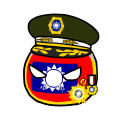 Original infobox image
 -
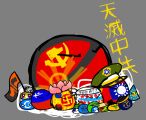 The heavens damn the CCP
 -
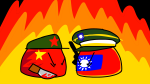 Fight with Maoism


Notes
- ↑ Originated from an incorrect translation of Chiang Kai-shek's name. Now often carries a derogatory tone in
 Chinese internet discourse.
- ↑ Even though Chiang's regime was
 corrupt mainly because of CCP infiltration, Chiang did not engage in the corruption himself.
- ↑ Born as Jiang Ruiyuan (蔣瑞元), a "milk name" (乳名) his grandfather gave him, meaning "Auspicious Beginning"
- ↑ In a 1945 speech he gave to the
 Kuomintang.
- ↑ China at War: Triumph and Tragedy in the Emergence of the New China, page 147.
- ↑ "國家亡了還可以復興,文化亡了就娘希匹全亡了" — Chiang Kai-shek
- ↑ Referring to
 Zhang Xueliang.
- ↑ Fenyang (汾陽) refers to not a place, but rather a posthumous title of
 Guo Ziyi.


