


-
 Oh Napoleon…
 -
 Russia STRONK
 -
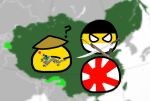 Russia vs Japan in China
 -
 Pire
Pire -

-

-

-

-
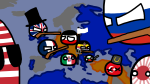
Russian Empire
From Heterodontosaurus Balls
—  Otto von Bismarck Otto von Bismarck
|
Russian Empire, also known as Imperial Russia or just Russia, was a giant  European historical
  empire, the third largest in
  history as a matter of fact. His land stretched from the
  Baltic Sea to
  Alaska, from
  Siberia to
  Manchuria. He even held a
  small African colony at one point.
The rise of the Russian Empire coincided with the decline of his rivals, which further helped Russia to spread his influence. At his greatest extent, his size was 22.8 million square kilometers, so he is about 33% bigger than his  present self. The empire was characterized by a
  diverse population, encompassing numerous
  ethnic groups and
  cultures
 which he regularly , ruled under an  genocides
 autocratic,
  absolute monarchy under the Russian variant known as
  Tsarism.
Since the Russian Empire only conquered continuous clay, almost nobody think of it as  colonization and therefore Russia was not seen as a colonial power.
On one hand, Russia sees himself as the final heir to  Byzantium, an empire rooted in
  Slavic
  Orthodox traditions and
  Eastern European soil. On the other hand, he carries the legacy of the steppes, shaped by centuries of
  Mongol rule mixed with
  Tatar blood. This
  dual identity, imperial and nomadic, east and west, has long defined Russia's geopolitical instincts. And when humiliated by the west, he pivots to the east. From defeat in
  Europe, Russia turns eastward, seeking redemption and revenge across the vastness of
  Asia.
Asia.
The official  national flag of Russian Empire has been the exact same as the flag for modern
  Russia for the most part. However, to distinguish Imperial Russia more, a flag with the coat of arms in the top-left corner on a yellow square introduced in 1914 for private use and
  patriotism is sometimes used for the design. The flag was planned to be adopted into the national flag after WWI but the Russian Empire fell too soon.
History
Foundation & Early Expansion
In 1721,  Tsardom of Russia won against the
  Swedish Empire in the Great Northern War, giving Russia access to the Baltic Sea and making him become the Russian Empire under
  Peter I the Great, the de-facto founder of the empire. The double-headed
  Romanov eagle became the imperial emblem.
Russia reorganized his borders along modern Western lines, creating an  authoritarian state. He replaced the old noble council with a nine-member Senate (the highest state council), divided rural areas into provinces, and tasked the Senate with
  tax collection, tripling revenues during Peter's reign. He partially integrated the Orthodox Church into
  the state as a tool of governance, abolished the Patriarchate, and replaced it with the Holy Synod, headed by a government official. Local self-government was abolished, and all
  nobles were required to serve the state as part of the Table of Ranks in 1722.
In eastern Siberia, Russia annexed the territory of the  Chukchi people and the Kamchatka Peninsula in the 1720s. In 1722, Russia wanted to increase his influence in the Caucasus and the Caspian Sea at the expense of the weakened
  Safavid Persians, so he waged the first full-scale
  war against him in 1722-1723, annexing some Iranian clay.
Peter the Great died in 1725, and the four following decades are often called the Era of Palace Revolutions. The throne changed hands six times, largely through the intrigues of court factions and the intervention of the imperial guard regiments, who became kingmakers in Russian  politics.
Despite internal instability, Russia participated in wars like the War of the  Polish Succession (1733-1735) on the side of
  Augustus III. In 1735, Russian Empire and
  Habsburg Empire tried to defeat
  Ottoman Empire in the Austro-Russian-Turkish War but he somehow beat them both and the war became inconclusive. Russia also participated in the Seven Years' War (1756-1763) on both sides, emerging as a major power.
Era of Enlightened Absolutism
In 1762,  Catherine II deposed of her erratic husband
  Peter III, becoming the new Tsar(ess). She became a patronage for
  Enlightenment ideas, though compatible with
  absolutism.
Russia was still continuing on his journey to conquer all of Siberia for the rich furs, genociding natives and building watchtowers. The natives tried to fight back but their scattered tribes were no match for Russian cannons. The conquest was completed in 1778, and the natives were forced to give a tax called "yasak" to the Tsat. This tax, originally a gift exchange from both parties, evolved into a one-sided tax because the natives would rebel if they deem the things the Russians give them (weapons, tabacco, etc.) unworthy.
From 1773 to 1775, the  Pugachev Movement took place in Russia, by the followers of
  Yemelyan Pugachev, aiming to end
  serfdom. The rebellions were crushed by Catherine.
The outbreak of two Russo-Turkish wars in 1768 and 1787 and Russia's subsequent victory in them made Ottoman no longer a threat to Russia, allowing him to gain more territory and extend his influence into the  Balkans and get
  Black Sea waters. Russia also took advantage of the decline of the Polish-Lithuanian Commonwealth to gain territory, dividing Poland into three parts which was shared between him,
  Prussia, and Habsburg Empire, with the final partition taking place in 1795, killing Poland-Lithuania.
When Catherine died in 1796, succession law was  reformed a year later, establishing
  male primogeniture to prevent future succession crises.
Napoleonic Era & Conservative Revolution
 Paul I succeeded his mother as the new Tsar. He reversed many of her policies. His erratic policies and alienation of the nobility led to a palace conspiracy. Paul was assassinated on 23 March 1801, and his son Alexander succeeded him. Tsar Alexander I began his reign with reformist intentions. He reorganized ministries in 1802 and created educational reforms.
As a major European country, Russia was inevitably involved in the war with the  First French Empire. He entered into shifting alliances, was defeated alongside Austria at the Battle of
  Austerlitz in 1805, fought against France from 1806-1807, defeated again at
  Friedland in 1807, singed the Treaty of
  Tilsit in July that year, temporarily aligning Russia with Napoleon.
Meanwhile, Russia annexed  Finland from
  Sweden after the Finnish War of 1808-1809 and gained Bessarabia from the Ottoman Empire at the Treaty of
  Bucharest in 1812.
In June 1812,  Napoleon Bonaparte led an army of 600,000 to invade Russia, which was more than twice the size of Russia's regular army and was more well-equipped. But France's army was too big and impossible to keep up the supply lines, and Russia burned his capital,
  Moscow, so there will be nothing to loot. France encountered the cold winter of Russia, causing France to suffer a catastrophic defeat: less than 30,000 French men returned to their homeland. As the French army retreated, the Russian army advanced into
  Central and
  Western Europe, and finally reached the gates of
  Paris in 1814. Russian Empire was called the savior of Europe.
At the Congress of  Vienna (1814-1815), Russia gained most of the
  Duchy of Warsaw, forming the semi-autonomous
  Kingdom of Poland under Russian rule. Russia also helped establish the
  Holy Alliance in 1815, promoting
  Christian monarchy and suppressing revolutionary movements all across Europe.
After 1815, Tsar Alexander became increasingly  conservative and
  mystical. When Alexander died unexpectedly on 1 December 1825, confusion over succession led to the Decembrist Revolt, with
  liberal officers attempting to prevent the accession of
  Nicholas I, demanding
  constitutional reform. The revolt failed.
Reform and Reaction
Under Nicholas I, Russia became  very conservative, officially formulating the doctrine of Orthodoxy, Autocracy, and Nationality.
Russia suppressed the November  Polish uprising of 1830-1831. In 1832, Nicholas I
  criminalized
  sodomy from Russia, which was punishable by exile to Siberia for four to five years. Russia helped crush the
  Hungarian Revolution of 1848 at the request of Austria and asserted influence in the Balkans against the weakening Ottoman Empire.
In 1853, Russia threatened to invade  Istanbul.
  Britanians and
  Frenchies came to the Turk's aid, starting the
  Crimean War.
Nicholas I dies in 1855, and  Alexander II becomes emperor and initiates major reforms.
In 1856, the Crimean War came to a bitter end. Russia was humiliated by defeat. For him, the wounds ran deeper than the battlefield. The defeat was not only  militarily, but also psychological. It marked the moment that Russia was pushed out of the European order. Wounded in Europe, Russia pivoted east, and what he saw was a decaying
  Qing Empire, sprawling and resource-rich, but complacent and hollow. The nobility was asleep, the people were obedient, and the nation was poorly defended. So, in 1858 Russia launched a boat expedition to the
  Amur River, determined to seize over a million square kilos of clay from China. This would also grant Russia easy access to the Pacific.
The serfs were freed in 1861, earning Tsar Alexander II the nickname "the Liberator". In 1867, Russian America was sold to the  United States for a very cheap price.
Russia forced Qing Dynasty to sign a series of unequal treaties, after that he annexed Outer Manchuria. In 1875, the  Empire of Japan and Russia signed the "
 Sakhalin-Kuril Islands
  " Exchange Treaty (Treaty of
  Saint Petersburg). Russia gave the northern part of the Kuril Islands to Japan in exchange for the sovereignty of Sakhalin.
In 1881, Tsar Alexander the Liberator was assassinated.
Industrialization & Unrest
 Alexander III, taking rule in 1881, started massively
  industrialization in Russia.
In 1894,  Nicholas II became the Tsar. On his coronation celebration there was a stampede killing more than a thousand, signaling bad omen.
At the end of the 19th century, Russia was expanding towards Central Asia. During the  Eight-Nation Alliance's campaigns against Qing and
  Boxer, the Russian army obtained a large amount of gold mines, coal mines and forest resources in Northeast China. In 1900 Russian Empire conducted a series of ethnic cleansings (pogroms) against the
  Manchus,
  Han Chinese and Daurs in Russian-controlled Manchuria, leaving the region with only Cossacks.
From 1904 to 1905, the Japanese Empire and Russia competed for influence in the  Korean Peninsula and Northeast China. This kicked off the Russo-Japanese War, and believing Japan was just a secondary power pretending to be an empire, Russia sent his ship across the entire ocean to reach Japan, but was suffered a disastrous and humiliating defeat. Russia was exposed as the actual secondary power, and as a result, he agreed to withdraw from Inner Manchuria. This defeat shocked the Russian people and the rest of the world, since no Asian country had been able to beat a European country for a long time. This humiliation made lots of Russians mad, and they blamed it all on the Tsar. Many people went to
  peacefully protest in 1905, but got shot at by guards.
Collapse
In 1914,  Serbia was attacked by
  Austria-Hungary. Russia wanted to defend his Orthodox brother, so he declared war on Austria, thus participating in WWI, subsequently fighting against
  Germany.
Germany wanted Russia out of the battlefield so thy secretly shipped  Lenin to Russia to cause some turmoil. The bad working conditions and food shortages caused by the war made the workers to go on strike in what's known as the February Revolution. Russia retreated from fighting in WWI as a result of all the unrest. Tsar Nicholas II thought for the interests of Russia and stepped down without any fight. Thus, more than 300 years of Romanov rule in Russia ended in 1917, and a
  republic was established.
Quotes
—  Fyodor Dostoyevsky Fyodor Dostoyevsky
|
List of Tsars
| Name | Russian Name | Number | Reign Start | Reign End |
|---|---|---|---|---|
| Peter I the Great |
Пётр I Алексеевич | 1 | 2 November 1721 | 8 February 1725 |
 Catherine I Catherine I |
Екатерина I Алексеевна | 2 | 8 February 1725 | 17 May 1727 |
| Peter II |
Пётр II Алексеевич | 3 | 18 May 1727 | 30 January 1730 |
| Anna |
Анна Иоанновна | 4 | 13 February 1730 | 28 October 1740 |
| Ivan VI |
Иван VI Антонович | 5 | 28 October 1740 | 6 December 1741 |
| Elizabeth |
Елизавета Петровна | 6 | 6 December 1741 | 5 January 1762 |
| Peter III |
Пётр III Фёдорович | 7 | 5 January 1762 | 9 July 1762 |
| Catherine II the Great |
Екатерина II Алексеевна | 8 | 9 July 1762 | 17 November 1796 |
| Paul I |
Павел I Петрович | 9 | 17 November 1796 | 23 March 1801 |
| Alexander I the Blessed |
Александр I Павлович | 10 | 23 March 1801 | 1 December 1825 |
| Nicholas I |
Николай I Павлович | 11 | 1 December 1825 | 2 March 1855 |
| Alexander II the Liberator |
Александр II Николаевич | 12 | 2 March 1855 | 13 March 1881 |
| Alexander III the Peacemaker |
Александр III Александрович | 13 | 13 March 1881 | 1 November 1894 |
| Saint Nicholas II |
Николай II Александрович | 14 | 1 November 1894 | 15 March 1917 |
Relationships
Friends
 Kingdom of Serbia -
  Orthodox brother I will protect.
 United States - Ah, good friend. You hate
  your father, da? I sell
  Alaska to you for cheap! But nows seeing how much profit he make in that land, I is of regret. I also help him fight
  Fake America. Big shame that my
  successors
  hate you so much. Such pity!
- Russian Orthodox Church - Best church! ☦️☦️
Enemies
 Swedish Empire - Ah, you is pathetic enemy I crush in 1721! XAXAXA, so weak! You still pathetic, and I hope you die, da!
 Ottoman Empire - How does it feel to be humiliated by me over and over again?
 First French Empire - Stupid scum think he of can defeat me! Ha! Cannot survive Russian winter? Womp Womp!
  Monarchs always supreme, forever!
 Qing Dynasty -
  Manchuria is mine! 1911, greatest year of all! Tsar very proud!
 Russian Soviet Federative Socialist Republic
  - Screw you
  leftist rebel! Bah! You ruin everything! You destroy all!!
 Empire of Japan - AH, YUO THINK YUO TAKE MY ISLANDS, DA? WELL I DECLARE
  WAR ON YUO! WHY DO I KEEP LOSING… this is of embarrassing… How this happen to great Russia?
 German Empire - I might not have any weapon or helmet. But will take axe and fight for
  Tsar.
Tsar.
How to draw


Russian Empire has a drawing rating of painstaking.
- Draw a ball.
- Fill the ball with three horizontal stripes of color top-to-bottom in the following order: white, blue, red.
- Add a yellow square on the left side of the ball, covering parts of the white and blue stripes.
- Draw a double-headed eagle in the yellow square.
- Add the eyes and you are done!
Main Colours:
| Color Name | HEX | |
|---|---|---|
| White | #FFFFFF | |
| Blue | #0039A6 | |
| Red | #D52B1E | |
| Yellow | #FFCC33 | |
| Black | #000000 | |
Emblem Colours:
| Color Name | HEX | |
|---|---|---|
| Very Light Crown Blue | #F2F7F7 | |
| Crown Blue | #A8B6C5 | |
| Crown & Eagle Tongue Crimson | #8F222D | |
| Crown Jewel Grey | #4E5355 | |
| Ribbon Blue | #4F7499 | |
| Ribbon Blue (Dark Shading) | #214775 | |
| Ribbon Blue (Light Shading) | #1B8EC1 | |
| Eagle Brown | #352F2C | |
| Eagle Beak & Leg Yellow | #DEB128 | |
| Symbol Yellow | #F2CA1B | |
| White Pedal Symbols Blue | #94ACCB | |
| Red | #C8001A | |
| Pearl Yellow (Dark Shading) | #D97B3B | |
| Pearl Yellow (Light Shading) | #FFF7AB | |
| Knight Armor | #DDE7E8 | |
| Dark Yellow Shading | #C6962A | |
| Cape Blue | #3696C6 | |
| Eagle Leg Yellow (Light Shading) | #FFF015 | |
| Object Blue | #99A8B2 | |
| Object Pearl Blue | CEDADC | |
| Green | #6B9C6E | |
| Sky Blue | #66B3E0 | |
| Olive Dragon Green | #506804 | |
| Knight Skin | #F1D2A1 | |
| Eagle Staff Small Crowns | #887D58 | |
| Crown Medium Blue | #DBE4E3 | |
| Horse Black | #1E1E1E | |
| Lion Dark Hair | #AB7A2C | |
Gallery


-
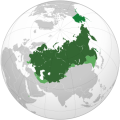 Map of Russian Empire
 -
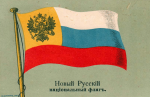 Flag of Russian Empire on a postcard, 1914-1918


