Austria-Hungary
“”The Austro-Hungarian Monarchy is not a state; it is a government.
|
—  Arthur J. May Arthur J. May
|
Austria-Hungary or the Austro-Hungarian Empire, officially the Austro-Hungarian Monarchy and internally The Kingdoms and Lands Represented in the Imperial Council and the Lands of the Crown of Saint Stephen, was a  multi-ethic
  dual monarchy consisting of
  Cisleithania (Austria) and
  Transleithania (Hungary). Because of this, "he" is usually portrayed as two balls operating as one or as having bipolar disorder. He is also blind because two emblems from his civil ensign became iconic and are used for eyepatches for both eyes.
Due to harboring many different ethnicities, he can speak many languages.
History
Beyond Lesser Germany
Before 1867, there was just the Austrian Empire. However, Austria lost a major  war against
  Prussia in 1866 and was left weak and broke. Inside the empire, the Hungarians (the second-largest ethnic group) saw a perfect opportunity to demand more power. To prevent a massive rebellion, Emperor
  Franz Joseph agreed to the Austro-Hungarian Compromise of 1867. This officially split the empire into two equal parts: Cisleithania (Austria) and Transleithania (Hungary).
Austria-Hungary looked to  France for avenging his defeat and attempted to negotiate with him and
  Italy for an anti-Prussian alliance, but no terms could be reached. The decisive victory of the
  Prusso-German armies in the Franco-Prussian war and the subsequent founding of the German Empire ended all hope of re-establishing Austrian influence in Germany.
After being forced out of Germany and Italy, the Dual Monarchy turned to the Balkans, which were in tumult as  nationalistic movements were gaining strength and demanding
  independence. Both
  Russia and A-H saw an opportunity to expand in this region. Russia took on the role of protector of
  Slavs and
  Orthodox Christians. Austria envisioned a multi-ethnic, religiously diverse empire under
  Vienna's control. Thus, A-H made the centerpiece of his policy one of opposition to
  Russian expansion in the Balkans and blocking
  Serbian ambitions to dominate a new South Slav federation. He wanted Germany to ally with him, not Russia.
Congress of Berlin & Balkan Instability
Russian Pan-Slavic organizations sent aid to the Balkan rebels and so pressured Russia to declare war on the  Ottoman Empire in 1877 in the name of protecting Orthodox Christians. Unable to mediate between Ottoman and Russia over the control of Serbia, Austria-Hungary declared
  neutrality when the conflict between the two powers escalated into a war. With help from
  Romania and
  Greece, Russia defeated Ottoman and with the Treaty of
  San Stefano tried to create a large pro-Russian Bulgaria.
The Treaty of San Stefano nearly caused a European war because  Britain and Austria-Hungary feared a large, newly created Bulgaria would become a
  puppet state for Russia, allowing him dominate the Balkans. To prevent this Russian expansion, the major powers held the Congress of
  Berlin in 1878, where Britain and A-H forced Russia to scale back his demands. And so,
  Bulgaria was broken up and kept under nominal Ottoman control and Austria-Hungary occupied and administered 🟢 Bosnia-Herzegovina with British backing to block further Russian advance, though it required weeks of fighting and 150,000 troops to secure.
In another measure to keep Russia out of the Balkans, Austria–Hungary concluded a mutual defence pact with Germany in 1879 and  Romania in 1883 against possible Russian attacks and formed the
  Mediterranean Entente with Britain and Italy in 1887. Following the Congress of Berlin the European powers attempted to guarantee stability through a complex series of alliances and treaties.
Bosnian Crisis
On 5 October 1908, Austria-Hungary announced the full annexation of 🟢 Bosnia-Herzegovina, which ignited the First Balkan Crisis, or the Bosnian Crisis. A-H issued a proclamation promising the people a  constitution, full civil rights, and a
  local assembly to help manage their own affairs. To fulfill this promise, a constitution was officially granted in 1910.
In 1914, 🟢 Slavic militants in Bosnia rejected A-H's plan to fully absorb the area and assassinated the Austrian heir,  Archduke Franz Ferdinand, kicking off a string of events that what decimate Europe.
World War I
The assassination of Archduke Franz Ferdinand in 🟢 Sarajevo on 28 June 1914 sparked what became known as the July Crisis. Believing that the Serbian government was directly complicit in the plot, Austria-Hungary saw an opportunity to crush Serbian influence in the Balkans once and for all.
Economy
Industrial Cisleithania vs. Agrarian Transleithania
Cisleithania experienced significant  industrialization from the mid-19th century onward, driven primarily by manufacturing sectors in
  Bohemia and
  Moravia, where textile production utilized mechanization, steam engines, and factory systems, alongside emerging machinery and
  iron industries. These regions benefited from established transport links to Vienna, fostering output growth that positioned Cisleithania as the industrial core of the Dual Monarchy. In contrast, Transleithania remained predominantly
  agrarian, with Hungary's
  economy centered on crop production, particularly grain, which saw exports triple between 1850 and 1875 amid high prices and favorable market conditions. This agricultural orientation reflected a comparative advantage in cereals, supplying domestic demand in Cisleithania and
  international markets.
The 1850 Austro-Hungarian customs union, formalized by tariff abolishment in 1851, promoted economic integration by eliminating internal barriers, enabling freer movement of goods and supporting Transleithania's cereal exports to fuel Cisleithania's industrial expansion. Complementary  banking structures, including a shared Austro-Hungarian central bank issuing common currency, facilitated capital flows and monetary stability across the dual monarchy. Manufacturing output in the Austrian half grew at an annual rate of 2.3% from 1870 to 1913, outpacing the empire's overall trajectory, while Hungary's less developed sector achieved 4.0% growth from a lower base, indicating
  modest convergence in industrial capabilities.
These dynamics contributed to aggregate GDP advances, with per capita income disparities narrowing between the halves before 1914, though Cisleithania retained a lead in productivity and diversification. Regional specialization—industrial in the west, agrarian in the east—underscored A-H's uneven modernization, where Cisleithania's hubs drove  technological adoption, including early electrification and steel processing, while Transleithania's reliance on agriculture limited broader structural shifts.
Relationships
Friends
 German Empire - Best friend! I depend on him in the Great War.
Enemies
 First Hungarian Republic - You made me fall!

How to draw

Austria-Hungary has a drawing rating of easy.
- Draw a ball.
- Divide it into two halves horizontally.
- In the top half, fill the top with black and bottom with yellow
- In the bottom half, draw three stripes top to bottom in the following order: red, white, green
- Add eyes and done.
| Color Name | HEX | |
|---|---|---|
| Black | #000000 | |
| Yellow | #FFCC00 | |
| Red | #CD2A3E | |
| White | #FFFFF | |
| Green | #436F4D | |
Gallery
-
 Alt design
 -
 Civil ensign
 -
-
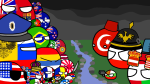 WORLD WAR ONE
 -
 By LB HD Mapper


