


-
 Flooding
 -
 Made by LBMapper, using the modern script.
 -
 Map (why is this file so large)
 -
 A blue version with the wrong font script
 -

Xia Dynasty: Difference between revisions
From Heterodontosaurus Balls
m Text replacement - "Xia.png" to "Xia Dynasty.png" |
m Text replacement - "Pseudohistoricism" to "Pseudohistory" |
||
| (28 intermediate revisions by 2 users not shown) | |||
| Line 1: | Line 1: | ||
{{Infobox | {{Infobox | ||
|Name = | |Name= {{I|Xia}} Xia {{I|Xia}} | ||
|NativeName = {{ILSize|ChineseL-icon.png|Chinese Language}}: 夏朝 | |NativeName= {{ILSize|ChineseL-icon.png|Chinese Language}}: 夏朝 | ||
|founded = 2205 BC | |founded= 2205 BC/2160 BC | ||
|predicon = Yellow Emperor | |predicon= Yellow Emperor | ||
|onlypredecessor = Three Sovereigns and Five Emperors | |onlypredecessor= Three Sovereigns and Five Emperors | ||
|ended = 1766 BC | |ended= 1766 BC | ||
|nexticon = Shang | |nexticon= Shang | ||
|onlysuccessor = Shang Dynasty | |onlysuccessor= Shang Dynasty | ||
|image = Xia Dynasty.png | |image= Xia Dynasty.png | ||
|Caption = I’m real | |Caption= I’m real | ||
|Alias = | |Founder= {{I|Yu the Great}} [[Yu the Great Thought|Yu the Great]] (2258 BC-2025 BC) | ||
|Time | |Alias= {{Scroll|夏<br>Xia Chao<br>Hsia Dynasty<br>Hsia<br>Xiàcháo<br>{{I|Chinese}} [[Chinese Theocracy|First Chinese dynasty]]<br>First Chinese "{{I|Mon}} [[Monarchism|House Rules All]]" (家天下) Kingdom<br>Xia Kingdom<br>{{Alias|Shang-icon.png|Shang Dynasty|Western Settlement/Xiyi Xia (西邑/西邑夏)}}}} | ||
|Government = | |Time= 2205 BC/2160 BC – 1766 BC<ref>Per {{I|Noocracy}} [[Noocracy|Liu Xin]]. 2205 BC counts the reign of {{I|Yu the Great}} [[Yu the Great Thought|Yu the Great]], 2160 is the start of Xia Dynasty proper.</ref> | ||
|Languages = | *'''Other Hypothesis:''' {{Collapse| | ||
|Affiliation = | **1989 BC – 1558 BC ({{I|Historicism}} [[Historicism|Bamboo Annuals]]) | ||
|Religions = | **1953 BC – 1555 BC (per {{I|Tradition}} [[Traditionalism|David Nivison]]) | ||
| | **c. 2070 BC – c. 1600 BC (per {{I|PRC}} [[People's Republic of China|Xia–Shang–Zhou Chronology Project]]) | ||
| | }} | ||
| | |Government= {{I|Mon2}} [[Monarchism|Monarchy]] | ||
|Likes = | |Languages= {{I|Old Chinese}} [[Old Chinese|Ancient Chinese]] | ||
|Dislikes = Floods, corrupt kings, people thinking he is fake, interregnums | |Affiliation= | ||
|Preceded = {{AL | |Religions= {{I|ChineFolk}} [[Chinese Folk Religion]] | ||
|Succeeded | |Capital= {{Scroll|'''Listed in chronological order.'''<br>{{i|Yangcheng}} [[Yangcheng]] (陽城)<br>{{I|Yangzhai}} [[Yangzhai]] (陽翟)<br>{{i|Zhenxun}} [[Zhenxun]] (斟鄩)<br>{{I|Henan}} [[Puyang|Diqiu]] (帝丘)<br>{{I|Henan}} [[Jiyuan|Yuan]] (原)<br>{{I|Henan}} [[Kaifeng|Laoqiu]] (老丘)<br>{{I|Henan}} [[Anyang|Xihe]] (西河)<br>{{i|Zhenxun}} [[Zhenxun]] (斟鄩)}} | ||
|Gender= Male | |||
|Friends= {{i|Baiyue}} [[Baiyue]]<br>{{i|Qiang}} [[Qiang]] | |||
|Enemies= {{Scroll|{{I|Shang}} [[Shang Dynasty]]<br>{{I|HouYi}} [[Hou Yi Thought|Hou Yi]]<br>{{I|Stratocracy}} [[Stratocracy|Han Zhuo]]<br>{{I|Sanmiao}} [[Sanmiao]]<br>{{i|Yi}} [[Yi]]}} | |||
}}{{Quote|於!帝念哉!德惟善政,政在養民。水、火、金、木、土、穀,惟修;正德、利用、厚生、惟和。九功惟敘,九敘惟歌。戒之用休,董之用威,勸之以九歌俾勿壞。<ref> | |Likes= {{I|River}} [[Yellow River]], wine, crops, dragons 🐉 | ||
|Dislikes= Floods, corrupt kings, people thinking he is fake, interregnums | |||
|Preceded= {{AL|{{i|Yellow Emperor}} [[Three Sovereigns and Five Emperors]]<br>{{i|404}} [[Yu Dynasty]]}} | |||
|Succeeded= {{AL|{{I|Shang}} [[Shang Dynasty]]<br>{{I|Xia}} [[Qǐ|State of Qǐ]]}} | |||
|themecolor= #2d8e6d | |||
|textcolor= | |||
}}{{Quote|於!帝念哉!德惟善政,政在養民。水、火、金、木、土、穀,惟修;正德、利用、厚生、惟和。九功惟敘,九敘惟歌。戒之用休,董之用威,勸之以九歌俾勿壞。<ref>{{I|Yu the Great}} [[Yu the Great Thought|Yu]] said, 'Oh! think (of these things), O {{I|天}} [[Shangdism|Di]]. The {{I|Virtue Ethics}} [[Virtue Ethics|virtue]] (of the ruler) is seen in (his) good government, and that government in the nourishing of the people. There are water, fire, metal, wood, the earth, and grain - these must be duly regulated; there are the rectification of (the people's) virtue, (the tools and other things) that supply the conveniences of life, and the securing abundant means of sustentation - these must be harmoniously attended to. When the nine services (thus indicated) have been orderly accomplished, that accomplishment will be hailed by (the people's) songs. Caution them with gentle (words), correct them with the majesty (of law), stimulate them with the songs on those nine subjects - in order that (your success) may not suffer diminution.'</ref>|{{I|Yu the Great}} [[Yu the Great Thought|Yu the Great]]}}The '''Xia Dynasty''', sometimes spelled the '''Hsia Dynasty''', was the first dynasty in {{I|China}} [[China|Chinese]] {{I|History}} [[history]], proceeded by the {{i|Yellow Emperor}} [[Three Sovereigns and Five Emperors|Five Emperors]] and succeeded by the {{I|Shang}} [[Shang Dynasty|Shang]]. It is uncertain exactly when he existed, but legends say he was founded after national {{I|GreatMan}} [[Great Man Theory|hero]] {{I|Yu the Great}} [[Yu the Great Thought|Yu the Great]] got rid of a great flood. However, the {{I|Mon2}} [[Monarchism|dynasty]] proper only started when Yu passed down his throne to his son {{I|Mon}} [[Monarchism|Qi]]. Due to the lack of direct {{I|Oracle Bone}} [[Oracle Bone Script|written evidence]] of Xia's existence, some scholars debate that the Xia as a {{I|Politics}} [[Politics|political]] entity didn't exist, however that isn't to say that there were no civilization correlating the Xia in that era. | |||
The national color of Xia is grue-black and his element is water. The major innovation of Xia was the bronze caldron [鑄鼎] (unfortunately, it is currently archaeologically undiscovered). During his time in the second millennium BC, the Xia was the most powerful state, {{I|Culture}} [[culture]] and peoples in the {{I|1ball}} [[Asians|East]]. | |||
The | The Xia was located in the central plains, as the Huaxia clan/tribe. To the east, there lies another tribe, the {{i|Yi}} [[Yi]] (夷), whose descendant {{I|HouYi}} [[Hou Yi Thought|Hou Yi]] actually took control of the Xia for some time, and further descendant, {{i|Shang}} [[Predynastic Shang|Shang]], completely destroyed the Xia. To the south, was the Chu (楚) tribe/civilization, ancestor of the {{i|Chu}} [[State of Chu]] and {{i|Chu}} [[Later Chu]]. These were the three different civilizations that existed in China during the time of the Xia Dynasty. | ||
The Xia was | ==歷史 (History)== | ||
===开國 (Beginnings)=== | |||
The Xia entity was founded in 2205 BC by {{I|Yu the Great}} [[Yu the Great Thought|Yu the Great]], after 13 years of nonstop work, channeled all the flood water out of China that were from a giant flood. Yu the Great succeeded {{i|Shun}} [[Emperor Shun Thought|Shun]] and became ruler of the {{I|China}} [[Zhongyuan|Central Plains]]; the people were happy. Yu's leadership and engineering prowess not only secured his place as the first ruler of the Xia entity but also set a precedent for future governance and {{I|Social}} [[Society|societal]] organization. His success in flood control demonstrated the importance of strong, {{I|Centralism}} [[Centralism|centralized]] authority and infrastructure development, laying the groundwork for the stability and prosperity of the Xia Dynasty. | |||
Yu the Great also divided his land into nine provinces and improved agricultural systems. The Xia Dynasty practiced some bronze making, though not as advanced as the later dynasties. There are some pots and pans discovered that is thought to have belonged to the Xia Dynasty. | |||
Yu the Great was the first {{I|Chinese}} [[China|Chinese]] ruler to {{I|Mon}} [[Monarchism|pass their reign down to his descendants]] (the rulers before chose the most {{I|Virtue Ethics}} [[Virtue Ethics|virtuous]] person to be the next ruler). Yu originally wanted to give the throne to a virtuous person like those before him, but his first candidate, {{i|Chinese}} [[Chinese Folk Religion|Gao Yao]] (臯陶), died before Yu. So, Yu picked {{i|Tribalism}} [[Tribalism|Bo Yi]] (伯益), a person of {{i|Yi}} [[Dongyi]] ethnicity, as his successor. But Bo Yi didn't do much, and the public didn't want him as ruler because they didn't resonate with him like the previous rulers. So, the public thought it would be great to pressure Yu's son into becoming the next king in 2160 BC, kicking off the Xia ''Dynasty'' proper, and thus starting a 2000-year long dynastic rule in China. | |||
Yu | Yu's son, {{I|Mon}} [[Monarchism|Qi of Xia]], did not care for the people at all. He didn't even want to become king, but the public pressured him to do so. Qi also held huge feasts at the former capital {{I|Yangcheng}} [[Yangcheng]] and the new capital {{I|Yangzhai}} [[Yangzhai]]. | ||
[[ | Qi's brother criticized him, but he didn't listen. Eventually his brother had enough and waged {{I|War}} [[war]] against him, but Qi defeated him, cut off his head, and made his whole family {{i|Slavery}} [[Slavery|slaves]]. Qi had five sons, who all fought each other for the throne. Eventually, a son named {{I|Kak}} [[Kakistocracy|Tai Kang]] won out. This shows how the human dynastic ruling leads to {{I|Materialism}} [[Materialism|human attachments]] and {{I|Aggression}} [[Aggressionism|violence]], contrast to the "{{I|BeneDic}} [[Benevolent Dictatorship|benevolence ruling]]" before. | ||
===间歇期 (Interregnum)=== | |||
''<blockquote>Main article: {{i|IntXia}} [[Interregnum of the Xia Dynasty]]</blockquote>'' | |||
The third Xia king reigning from 2150 BC, {{I|Kak}} [[Kakistocracy|Tai Kang]], was known for his avid hunting but was considered an ineffective ruler. According to the ''Bamboo Annals'', while Tai Kang was away on a hunting expedition beyond the {{I|River}} [[Henan Luo River]] in 2131 BC, Xia's capital at {{i|Zhenxun}} [[Zhenxun]] was attacked by {{I|HouYi}} [[Hou Yi Thought|Hou Yi]], leader of the {{I|Yi}} [[Youqiong-shi]], a tribe of the {{i|Yi}} [[Dongyi]] peoples. This occupation of Zhenxun marked the beginning of a significant {{i|IntXia}} [[Interregnum of the Xia Dynasty|interregnum]], and even though Tai Kang ruled for 29 years, it's only de-jure, in actuality he only had control for about 19 years. Hou Yi brought his Dongyi peoples and beliefs into the {{I|China}} [[Zhongyuan|Central Plains]], where they mixed and mingled until becoming a part of the Chinese canon. | |||
On the day of gengwu (庚戌), the 9th month in the 5th year of | It is said that Hou Yi forced Tai Kang to give the throne to {{I|Puppet}} [[Puppet Dictatorship|Zhong Kang]] in 2121 BC, and Zhong Kang was set up as a puppet ruler by Hou Yi. On the day of gengwu (庚戌), the 9th month in the 5th year of Zhong Kang, there was a solar eclipse. Since the royal astronomers at that time were licentious and {{I|Alcohol}} [[Alcoholism|drunk]], they failed to predict this eclipse, resulting in confusion and panic among the common people. Zhong Kang sent the nobleman {{I|Chinese}} [[Chinese Folk Religion|Yin]] to punish the ministers of astronomy for neglecting their duties. | ||
In the eighth year of the reign of | In 2101 BC, the eighth year of the reign of Tai Kang's nephew, king {{I|Irredentism}} [[Irredentism|Xiang]], who was in exile, Hou Yi was killed by his former chief minister, {{I|Stratocracy}} [[Stratocracy|Han Zhuo]]. Xiang returned to the throne. Twenty years later in 2081 BC, Han Zhuo's forces killed king Xiang (in the 28th year) and usurped the throne, although the royal family managed to escape. | ||
Xiang's son, | Xiang's son, {{I|Irredentism}} [[Irredentism|Shao Kang]], was sheltered by a {{I|Tribalism}} [[Tribalism|tribal]] chief, surviving for years as a fugitive despite Han Zhuo's efforts to eliminate him and prevent the reemergence of the Xia Dynasty. Upon reaching adulthood, Shao Kang began organizing with {{I|Fengjian}} [[Fengjian|local lords]] who despised Han Zhuo's rule. Shao Kang ultimately emerged victorious in the ensuing military confrontation, leading to Han Zhuo's suicide in 2061 BC (19th year of Shao Kang). The reigns of Shao Kang and his son {{I|Monarchy}} [[Monarchism|Zhu]], from 2061 BC to 2042 BC, are characterized as among the most {{I|Optimism}} [[Optimism|prosperous periods]] in the {{I|History}} [[history]] of the Xia Dynasty. | ||
=== 擴張和城牆 (Expansion and Walls) === | ===擴張和城牆 (Expansion and Walls)=== | ||
As the Xia Dynasty expanded and established an empire, he needed protection from the powerful | As the Xia Dynasty {{i|Imp}} [[Imperialism|expanded]] and established an empire, he needed protection from the powerful {{I|Qiang}} [[Qiang|barbarians]] whose archery skills were unmatched. So, Xia Dynasty decided to build big walls around cities, the closer to the emperor, the taller. {{I|Imp}} [[Imperialism|Zhu]] (r. 2059 BC-2042 BC), the 7th king of Xia, undertook a punitive expedition in the {{I|Water}} [[East China Sea]] and conquered lots of land, even killing a nine-tailed fox while hunting during the expedition. A prison called yuantu (圜土) was created. Captured enemies were made {{i|Slavery}} [[Slavery|slaves]] to work on the walls. | ||
King {{i|Mysticism}} [[Mysticism|Kong Jia]] was the 14th king of the Xia | King {{i|Mysticism}} [[Mysticism|Kong Jia]], was the 14th king of the Xia. He was extremely superstitious and had an insane {{i|Theism}} [[Theism|religious]] zeal: he didn't just believe in spirits and demons, he constantly cosplayed as them. This caused his father {{i|Imp}} [[Imperialism|Bu Jiang]] (11th king) to worry that he was not fit to rule. So, the throne was passed down first to Bu Jiang's brother {{i|Mon}} [[Monarchism|Jiong]] in 1923 BC, then to Jiong's son {{i|Mon}} [[Monarchism|Jin]] in 1902 BC (who was a smart king but had a weak body, he died to illness 8 years after becoming king), and it's only after that did the throne finally befell Kong Jia in 1881 BC. He took it as {{i|天}} [[Shangdism|Heaven]] rewarding him for all his years of praying and daily rituals. However, Kong Jia began to neglect his duties and moved further away from {{i|Politics}} [[politics]] to focus on religious matters. Kong Jia was emotionally unstable and changes face very sudden. Still, some argue that he was actually a wise {{i|Law}} [[Law|lawgiver]] and {{i|Moralism}} [[Moralism|just]] monarch. According to legend, Heaven once granted him two dragons, one of each gender. {{i|Kak}} [[Kakistocracy|Liu Lei]] (劉累) was sent to tame them. Liu Lei claimed to be descendant of an ancient dragon-taming clan, but in actuality he didn't know anything about dragon-taming. Kong Jia still loved him because he constantly bootlicks him. The female dragon died in captivity, probably because of the small pond they reside in was not enough for such magnificent creatures. Liu was terrified, and decided to go all in and cook the dragon and serve it to Kong Jia. Liu then fled to {{i|LuState}} [[State of Lu|Lu region]] after Jong Jia wanted him to show the dragons to some disobedient lords. | ||
Kong Jia found another dragon tamer named {{i|Noocracy}} [[Noocracy|Shimen]] (师门), who was actually an expert, however he was very honest and didn't hesitate to offend Kong Jia, so men were secretly sent to murder him in the countryside. After Shimen's death, violent winds whipped across the land, followed by days of torrential rain. When the storm finally passed, a wildfire broke out in the same area where Shimen had died. A superstitious man to his bones, Kong Jia panicked—he believed this was the vengeful spirit of Shimen returning to punish him. Kong Jia believed these were heavenly omens of divine retribution, and while going out to pray for forgiveness in the place where Shimen died, he died en route. | Kong Jia found another dragon tamer named {{i|Noocracy}} [[Noocracy|Shimen]] (师门), who was actually an expert, however he was very honest and didn't hesitate to offend Kong Jia, so men were secretly sent to murder him in the countryside. After Shimen's death, violent winds whipped across the land, followed by days of torrential rain. When the storm finally passed, a wildfire broke out in the same area where Shimen had died. A superstitious man to his bones, Kong Jia panicked—he believed this was the vengeful spirit of Shimen returning to punish him. Kong Jia believed these were heavenly omens of divine retribution, and while going out to pray for forgiveness in the place where Shimen died, he died en route. | ||
The Xia has grown to be a wealthy state, and his walls provided him with comfort and luxuries with little worries. However, this made the last kings of Xia extremely {{i|Materialism}} [[Materialism|materialistic]], to | The Xia has grown to be a {{i|Plutocracy}} [[Plutocracy|wealthy]] state, and his {{i|Isolationism}} [[Isolationism|walls]] provided him with comfort and luxuries with little worries. However, this made the last kings of Xia extremely {{i|Materialism}} [[Materialism|materialistic]], to Heaven's disgrace. | ||
=== 灭亡 (Fall) === | ===灭亡 (Fall)=== | ||
{{ | {{Quote|When it came to King {{I|Jie of Xia}} [[Jie of Xia Thought|Jie of Xia]], {{i|天}} [[Shangdism|Heaven]] gave severe order. {{i|Sun}} [[Sun]] and {{i|Moon}} [[moon]] did not appear on time. {{i|Winter}} [[Wintercore|Winter]] and {{i|Summer}} [[Summercore|summer]] came irregularly. The five grains were dried up to death. Ghouls cried in the country and cranes shrieked for ten nights. Heaven ordered {{i|Noocracy}} [[Noocracy|Shang Tang]] to receive the heavenly commission from the Xia dynasty, which had {{i|Immoralism}} [[Immoralism|failed morally]] and which Heaven was determined to end. Shang Tang was commanded to destroy Xia with the promise of Heaven's help. In the dark, Heaven destroyed the fortress' pool, and Shang Tang then gained victory easily.|{{i|Mohism}} [[Mohism|Mozi]], ''{{i|Pacifism}} [[Pacifism|Condemnation]] of {{i|Aggression}} [[Aggressionism|Offensive War]] III''}}The last king of Xia, {{I|Jie of Xia}} [[Jie of Xia Thought|Jie]], took power in 1828 BC and was {{i|Tyranny}} [[Tyranny|tyrannical]] and {{i|Immoralism}} [[Immoralism|immoral]]. He would put people on {{i|Arson}} [[Arsonism|burning]] pillars and make them crawl on it just to get a laugh. While the peasants were starving, he would create a pool full of wine for his friends to drink, and when people got {{i|Alcohol}} [[Alcoholism|drunk]] and drowned in the pool, he didn't bat an eye. He also created forests hanging with meat (very wasteful). Natural disasters were rampant. Jie was also very much rude to the neighboring tribes, usually going to them without warning and demanding them to give wealth and {{i|Female}} [[Female|women]]. Xia has officially lost his {{i|Mandate of Heaven}} [[Mandate of Heaven]]. | ||
A neighboring tribe, the | A neighboring tribe, the {{I|Shang}} [[Predynastic Shang|Shang clan]] (who was descendant of the {{i|Yi}} [[Yi]] civilization), saw this chaos unfold within the once so powerful Xia Empire. The Shang leader, {{I|Noocracy}} [[Noocracy|Cheng Tang]], lead an army to invade the Xia in 1776 BC. As the Shang army stormed through the villages and palaces, they told the people that they are only here for {{I|Jie of Xia}} [[Jie of Xia Thought|Jie]]. Many Xia people joined the Shang, and the invading army grew stronger and stronger. Jie's forces were destroyed in a storm so Jie fled. The {{I|Shang}} [[Shang Dynasty]] was established. King Tang gave the remnants of the Xia clan a {{i|Fengjian}} [[Fengjian|fief]] comprising the small state of {{I|1ball}} [[Qǐ]]. This practice is known as "the two crownings and the three respects". All and all, the Xia dynasty went through 13 generations and 17 kings. | ||
The transition from Xia to Shang was not a result of a "peasant rebellion", where the oppressed lower class revolted and toppled the current government and became the new rulers, no, that never happened. Instead, rather than | The transition from Xia to Shang was not a result of a "peasant rebellion", where the oppressed lower class revolted and toppled the current government and became the new rulers, no, that never happened. Instead, rather than "class struggle" as the {{i|Pseudohistory}} [[Pseudohistory|historical revisionists]] tell you, this transition was the result of one nation/civilization invading another. | ||
== 考古 (Archaeology) == | ==考古 (Archaeology)== | ||
{{Quote|We are not at a time when we can get the history of the Xia era completely clear, we are not there yet. So, to the recovery and revelation of the Xia culture will be a thing spanning across possibly generations, dozens of generations, or even several dozen generations. As of now, we have started some work, at most | {{Quote|We are not at a time when we can get the history of the Xia era completely clear, we are not there yet. So, to the recovery and revelation of the Xia culture will be a thing spanning across possibly generations, dozens of generations, or even several dozen generations. As of now, we have started some work, at most it's recovering Xia {{I|History}} [[history]], and it's only at the beginning.|{{i|Historicism}} [[Historicism|Zhao Chunqing]]<ref>From the series ''General History of China (中国通史)'', episode 6 ''Tracing the Xia Dynasty (夏王朝覓蹤)'', 2016</ref>}}There have been many archaeological findings believed to belong to the Xia Dynasty, including pots and bowls, either from {{I|Copper}} [[Bronze Age|bronze]] or clay pottery. There have been many carvings resembling written characters, possibly a writing system predating the {{i|Oracle Bone}} [[Oracle Bone Script]]. There have been many characters that are found to be identical to the script of the {{i|1ball}} [[Shui|Shui peoples]] (水族). | ||
In 1959, in a place called "{{i|Xia}} [[Erlitou Culture|Erlitou]]", the capital of the Xia Dynasty was discovered near what is now {{ | In 1959, in a place called "{{i|Xia}} [[Erlitou Culture|Erlitou]]", the capital of the Xia Dynasty was discovered near what is now {{I|Henan}} [[Luoyang]], {{I|Henan}} [[Henan|Henan Province]]. At that time, the area of the capital of the Xia Dynasty was not small, and a palace alone was about 10 km². Including the restoration of the entire ruins, it was practically the same as the capital of the Xia Dynasty recorded in the book ''Kaogongji'' (周礼·考工记). | ||
While the Erlitou site gives lots of information about the late Xia dynasty, but for the early Xia, it gives nothing. In 1979, archeologists began to uncover things near {{I|Henan}} [[Xinmi]], {{I|Henan}} [[Henan]]. They found some remnants predating Erlitou, possibly from the reigns of {{i|Mon}} [[Monarchism|Qi]] to {{i|Irredentism}} [[Irredentism|Shao Kang]]. This archeological site was named {{i|Xia}} [[Xinzhai]]. | |||
Another site was found that contained things older than the Xinzhai, and this site is called {{i|Xia}} [[Wangchenggang]] (王城崗), and is thought to be the place where {{i|Yu the Great}} [[Yu the Great Thought|Yu]] formed the Xia | Another site was found that contained things older than the Xinzhai, and this site is called {{i|Xia}} [[Wangchenggang]] (王城崗), and is thought to be the place where {{i|Yu the Great}} [[Yu the Great Thought|Yu]] formed the Xia Dynasty, or at least, had some relations to the formation of the Xia. At first in 1977, the archeologists there were disappointed because the city they found was only around 10 km². This site wouldn't be given more attention until 2002, when they dug at the site again and found a city that is up to 300,000 km². This big city was younger than the small city. | ||
== 文化和社會 (Culture & Society) == | ==文化和社會 (Culture & Society)== | ||
The Xia dynasty is said to have a strong farming culture. He is credited with the invention of bronze tools, however everyday tools are made of stone and bone. It is also said that he was the first to utilize a calendar, using both {{i|Sun}} [[Sun|solar]] and {{i|Moon}} [[Moon|lunar]] movements. This may be the earliest form of the traditional Chinese calendar. Xia | The Xia dynasty is said to have a strong {{I|Agrarianism}} [[Agrarianism|farming]] culture. He is credited with the invention of {{I|Copper}} [[Bronze Age|bronze]] tools, however everyday tools are made of stone and bone. It is also said that he was the first to utilize a calendar, using both {{i|Sun}} [[Sun|solar]] and {{i|Moon}} [[Moon|lunar]] movements. This may be the earliest form of the {{I|ChineFolk}} [[Chinese Folk Religion|traditional Chinese calendar]]. Xia believed in {{I|Necrocracy}} [[Necrocracy|ancestor worship]], and for his time, Xia was very advanced, using irrigation systems, brick ovens, plaster homes, pottery wheels. Very possibly that Xia believed in many natural gods representing many natural things such as weather and geography. | ||
=== 龍 (Long/Chinese Dragons) === | ===龍 (Long/Chinese Dragons)=== | ||
It is said that Chinese dragons were normal semi-divine creatures that existed in the Xia Dynasty, with even accounts on | It is said that Chinese dragons were normal semi-divine creatures that existed in the Xia Dynasty, with even accounts on "dragon tamers"" who train the dragons. These dragons were signs of a half-man half-divine culture of the {{I|China}} [[China|Chinese]]. As the people grew more {{I|Materialism}} [[Materialism|materialistic]], however, the dragons began to disappear, but the {{I|Culture}} [[culture]] left by them was very valuable. 4000 years later the {{I|CCP}} [[Chinese Communist Party|CCP]] decided to destroy all of what was left of the semi-divine culture. | ||
=== 环保自然 (Environmentalism) === | ===环保自然 (Environmentalism)=== | ||
During the legendary reign of | During the legendary reign of {{I|Yu the Great}} [[Yu the Great Thought|Yu the Great]] roughly four millennia ago, in the first three months of {{I|Spring}} [[Springcore|spring]], people didn't take their axes to the forests so the trees could flourish. In the three months of the {{I|Summer}} [[Summercore|summer]], people didn’t put nets to rivers so fishes could breed. This is the {{I|Tradition}} [[Traditionalism|traditional]] way of moderating and conserving nature, and promotes harmony between man and earth, cherishing and protecting it while still getting all the needs. | ||
== 瑣事 (Trivia) == | ==瑣事 (Trivia)== | ||
*Some early {{I|HanDynasty}} [[Han Dynasty|Chinese]] historians believed {{I|Xiongnu}} [[Xiongnu]] descended from the Xia | *Some early {{I|HanDynasty}} [[Han Dynasty|Chinese]] {{I|Historicism}} [[Historicism|historians]] believed {{I|Xiongnu}} [[Xiongnu]] descended from the Xia Dynasty. Later, in the 5th century, some Xiongnu established {{I|Xia}} [[Helian Xia]] in Northern China, and used this idea to legitimize their claim. | ||
== 神話還是事實? (Myth or Real?) == | ==神話還是事實? (Myth or Real?)== | ||
{{Flag|Xia Flower Pot.jpeg|A pot carved with a flower, from the Xia dynasty.}}Xia | {{Flag|Xia Flower Pot.jpeg|A pot carved with a flower, from the Xia dynasty.}}Xia Dynasty is unique in {{I|China}} [[China#歷史 (History)|Chinese history]] in that we don't possess actual written texts from the dynasty himself, but can only study texts that were written in later periods that mention the Xia. So, most of what we know today about him is a projection back in time from what we know about the succeeding dynasty, the {{i|Shang}} [[Shang Dynasty|Shang dynasty]], as well as from other important {{i|Historicism}} [[Historicism|historical]] documents. | ||
The {{i|Skepticism}} [[skepticism]] of Xia stems from Chinese scholars taking influence from the Western style of determining what's mythology and what's real in the early 20th century. The West says, if you want to prove that a kingdom really existed, you need to have these proofs: first you must have written accounts from that time period, second you need archeological evidence. This is why many western scholars regard Xia complete fiction, as the second box is checked, the first not. Xia has a "lack of written evidence", the main point anti-Xia scholars use. But, it is very possible that such evidence have been destroyed during {{I|Mao}} [[Mao Zedong Thought|Mao]]'s {{I|AntiTrad}} [[Anti-Traditionalism|anti-tradition]] campaigns, or it has simply not been discovered, as before newer discoveries, the {{I|Shang}} [[Shang Dynasty|Shang]] and (Western) {{I|Zhou}} [[Zhou Dynasty|Zhou]] were seen as fictitious as well. | |||
Since no historical records from the time of the Xia have so far been uncovered, many experts still regard this dynasty as merely mythical. Even if he really existed (and new evidence keeps turning up that affirms this notion), it is at this time impossible to precisely date his beginning and end. What's more, the first mention of the Xia we have appears in a text from around the early-late {{I|Zhou}} [[Zhou Dynasty]]. | |||
As for archeological evidence, there has been aplenty. Many artifacts have been unearthed that suggested a civilization that matches up with the geopolitical position of the Xia state, most famously {{ | As for archeological evidence, there has been aplenty. Many artifacts have been unearthed that suggested a civilization that matches up with the geopolitical position of the Xia state, most famously {{I|Xia}} [[Erlitou Culture]], whom many theorize to be late-Xia. The civilization shows complete capability of being a {{i|Mon}} [[Monarchism|single-house ruled dynasty]], even a palace in the almost exact descriptions of a later depiction of Xia palace. Bronze pots, cups and artifacts have also been unearthed that could belong to the Xia Dynasty, and some are carved with patterns resembling a flower. | ||
The reason why the Shang didn't write down records of the Xia is because the {{i|Oracle Bone}} [[Oracle Bone Script]] was mostly used for {{i|Shang State Religion}} [[Shang State Religion|religious ceremonies]] | The reason why the Shang didn't write down records of the Xia is because the {{i|Oracle Bone}} [[Oracle Bone Script]] was mostly used for {{i|Shang State Religion}} [[Shang State Religion|religious ceremonies]], writing down prayers, fortunetelling, and {{i|Mysticism}} [[Mysticism|mystic texts]], not for {{I|Historicism}} [[Historicism|historical record-keeping]] nor any other subject, thus the story of the Xia was passed down generation to generation orally in a game of telephone, until they reached the Zhou peoples who decided to write it down. | ||
=== 證據 (Evidence) === | ===證據 (Evidence)=== | ||
====周代青銅器銘文 (Zhou Dynasty Bronze Inscriptions)==== | |||
Before we discover written records from the Xia Dynasty, discussions on whether the Xia Dynasty existed should start with the earliest documentary and written records related to Xia. The earliest known records meeting this criterion date back to the {{i|Zhou}} [[Zhou Dynasty]]. Comparatively, written records from that time are primary sources that have not been altered by later transcriptions, interpretations, additions, or omissions, making them indisputable. Therefore, it is best to first examine these written records. | Before we discover written records from the Xia Dynasty, discussions on whether the Xia Dynasty existed should start with the earliest documentary and written records related to Xia. The earliest known records meeting this criterion date back to the {{i|Zhou}} [[Zhou Dynasty]]. Comparatively, written records from that time are primary sources that have not been altered by later transcriptions, interpretations, additions, or omissions, making them indisputable. Therefore, it is best to first examine these written records. | ||
Currently, three (or groups of) Zhou Dynasty bronze inscriptions mention {{i|Yu the Great}} [[Yu the Great Thought|Yu the Great]] and the Xia Dynasty: | Currently, three (or groups of) Zhou Dynasty {{i|Copper}} [[Bronze Age|bronze]] inscriptions mention {{i|Yu the Great}} [[Yu the Great Thought|Yu the Great]] and the Xia Dynasty: | ||
# The '''Shuyi Bell''' (叔夷钟) from the {{i|Eastern Zhou}} [[Spring and Autumn]] period, belonging to the {{i|Qi}} [[State of Qi]]. The inscription, while recounting the achievements of {{i|Noocracy}} [[Noocracy|Cheng Tang]], states that Tang "received the Mandate of Heaven, conquered the Xia sacrifices, and ruled over the Nine Provinces, residing in the land of Yu". | #The '''Shuyi Bell''' (叔夷钟) from the {{i|Eastern Zhou}} [[Spring and Autumn]] period, belonging to the {{i|Qi}} [[State of Qi]]. The inscription, while recounting the achievements of {{i|Noocracy}} [[Noocracy|Cheng Tang]], states that Tang "received the {{i|Mandate of Heaven}} [[Mandate of Heaven]], conquered the Xia sacrifices, and ruled over the Nine Provinces, residing in the land of {{i|Yu the Great}} [[Yu the Great Thought|Yu]]". | ||
# The '''Qin Gong Gui''' (秦公簋) and '''Qin Gong Bell''' (秦公钟) from the {{i|Qin}} [[State of Qin]] during the Spring and Autumn period. The inscription on the Qin Gong Gui praises | # The '''Qin Gong Gui''' (秦公簋) and '''Qin Gong Bell''' (秦公钟) from the {{i|Qin}} [[State of Qin]] during the Spring and Autumn period. The inscription on the Qin Gong Gui praises Qin's ancestors for "receiving the Mandate of Heaven and dwelling in the traces of Yu" and for "handling affairs concerning the Man and Xia peoples". | ||
# The '''Zan Gong Pan''' (赞公盘) from the mid-Western Zhou period | #The '''Zan Gong Pan''' (赞公盘) from the mid-Western Zhou period. The opening inscription states: "The Mandate of Heaven granted Yu the power to distribute land, level mountains, and dredge rivers". Unfortunately, the provenance of this vessel is unknown. However, based on its shape, patterns, and inscription style, it is inferred to belong to the {{i|China}} [[Zhongyuan|Central Plains Ji-Zhou cultural system]], or in other words, it belonged to the {{i|Han}} [[Han Chinese]]. This is the earliest known written record of Yu the Great. | ||
These inscriptions have multiple academic implications, but two points about Yu and the Xia Dynasty are particularly noteworthy: | These inscriptions have multiple academic implications, but two points about Yu and the Xia Dynasty are particularly noteworthy: | ||
# The belief in the existence of Yu and the Xia Dynasty was widespread during the Zhou Dynasty. This is evident from the locations where the mentioned bronzes were unearthed and their association with different states and clans. Not only did the Zhou people and their vassal states in the Central Plains hold this belief, but even the most distant vassal states, such as Qi in the east and Qin in the west, also recognized it. Moreover, these states belonged to different clans—some were of the Ji surname (Zhou people), some of the Zi surname (Song people), and some of the Ying surname (Qin people). | #The belief in the existence of Yu and the Xia Dynasty was widespread during the Zhou Dynasty. This is evident from the locations where the mentioned bronzes were unearthed and their association with different states and clans. Not only did the Zhou people and their vassal states in the Central Plains hold this belief, but even the most distant vassal states, such as Qi in the east and Qin in the west, also recognized it. Moreover, these states belonged to different clans—some were of the Ji surname (Zhou people), some of the Zi surname (Song people), and some of the Ying surname (Qin people). | ||
# The Zhou Dynasty not only believed that Yu and the Xia Dynasty existed but also regarded Yu as a heroic figure. The idea that one could "dwell in | #The Zhou Dynasty not only believed that Yu and the Xia Dynasty existed but also regarded Yu as a {{i|GreatMan}} [[Great Man Theory|heroic figure]]. The idea that one could "dwell in Yu's land" or "follow in Yu's footsteps" was seen as a sacred and glorious pursuit that could only be achieved by aligning with the Mandate of Heaven. This perspective had already formed by at least the mid-Western Zhou period. | ||
====先秦文獻 (Supporting Pre-Qin Literature)==== | |||
Many {{i|Zhou}} [[Zhou Dynasty]] and slightly later literary records also mention {{i|Yu the Great}} [[Yu the Great|Yu]] and the Xia Dynasty, some of which align remarkably with the bronze inscriptions. For example, the Book of Songs (诗经), in the hymn {{i|LuState}} [[State of Lu|Lu]] Song – Bi Gong (魯頌•閟宮), states that the early Zhou rulers "took possession of the lower lands and inherited Yu's legacy." The Book of Documents, in Lizhèng (尚书:立政), records how {{i|Rites of Zhou}} [[Rites of Zhou|Duke Zhao]] urged the Zhou people: "Rise and deploy your troops to expand Yu's domain and rule the world." This indicates that the Zhou saw "continuing Yu's legacy" as a goal. | |||
Moreover, pre-{{i|Qin}} [[Qin Dynasty|Qin]] literature frequently references Yu's river management and land distribution efforts, suggesting that stories about Yu had a long-standing {{i|Tradition}} [[Traditionalism|tradition]] and were not fabrications. This implies that pre-Qin texts describing Xia Dynasty affairs, even those not yet verified by archaeological findings, reflect genuine {{i|History}} [[History|historical]] perceptions of the time. For example: | |||
*The ancient ''Bamboo Annals'' (竹書紀年), ''Guoyu'' (國語), and ''Shiben'' (世本) describe the Xia {{i|Mon}} [[Monarchism|royal lineage]], reign durations, and settlements. | |||
*The ''Yizhoushu'' (逸周書) and ''Strategies of the {{i|Eastern Zhou}} [[Warring States]]'' (戰國策) outline the geographical scope of the Xia Dynasty. | |||
*The ''Book of Documents'' (尚書), ''Zuo Zhuan'' (左傳), ''Bamboo Annals'' (竹書紀年), ''{{i|Mohism}} [[Mohism|Mozi]]'' (墨子), ''{{i|Meritocracy}} [[Meritocracy|Xunzi]]'' (荀子), ''{{i|Legalism}} [[Legalism|Han Feizi]]'' (韓非子), and Strategies of the Warring States (戰國策) document Xia's interactions with other ethnic groups. | |||
All these records demonstrate that as early as the Zhou Dynasty, people widely believed in the existence of the Xia Dynasty. While the available records were limited, somuch so that even {{i|Confucianism}} [[Confucianism|Confucius]] lamented the scarcity of Xia-related materials, no one questioned the dynasty's existence. | |||
====系統化 (Systematization)==== | |||
This belief in the Xia persisted for centuries, even influencing distant ethnic groups, who took pride in tracing their lineage back to {{i|Yu the Great}} [[Yu the Great Thought|Yu]] or the Xia Dynasty. The {{i|Baiyue}} [[Baiyue|Yue people]] in the south claimed their ancestor was "a descendant of Yu," specifically a son of {{i|Irredentism}} [[Irredentism|Shao Kang]]. The {{i|Xiongnu}} [[Xiongnu]] in the north also claimed descent from the Xia royal house. By the {{i|HanDynasty}} [[Han Dynasty]], accounts of the Xia Dynasty became more systematic, often placing him alongside the {{i|Shang}} [[Shang Dynasty|Shang]] and {{i|Zhou}} [[Zhou Dynasty|Zhou]] Dynasties as the first of the early dynasties. When {{i|Historicism}} [[Historicism|Sima Qian]] compiled the ''Records of the Grand Historian'', he treated the Xia Dynasty as a legitimate dynasty that predated the Shang, and devoted an entire chapter, the ''Basic Annals of Xia'' (Xia Benji), to him. | |||
The ''Basic Annals of Xia'' primarily focuses on {{i|Yu the Great}} [[Yu the Great Thought|Yu the Great]], with about 80% of its content detailing his deeds—likely influenced by earlier pre-{{i|Qin}} [[Qin Dynasty|Qin]] texts, especially the ''Tribute of Yu'' (禹貢). Additionally, it lists the succession of 17 Xia {{i|Mon}} [[Monarchism|kings]] and some of their {{i|History}} [[History|historical]] events. This means that Sima Qian believed in the existence of both Yu and the Xia Dynasty. As the most comprehensive historical record on Xia, ''Xia Benji'' became the primary source for later generations to study the Xia Dynasty. | |||
From the Han Dynasty onward, not only did people continue to believe in the Xia Dynasty, but they also came to accept the notion of a "{{i|Yellow Emperor}} [[Three Sovereigns and Five Emperors|Five Emperors]]" period preceding Xia. However, by the {{i|Eastern Zhou}} [[Eastern Zhou]] period, about 700-800 years had passed since the Xia Dynasty, and by the Han, over a thousand years had passed. Thus, the recorded Xia history could not be entirely based on Xia-era records and inevitably contained later additions. The Eastern Zhou period saw a proliferation of {{i|Hundred Schools of Thought}} [[Hundred Schools of Thought|different schools of thought]], leading to conflicting accounts that made later scholars uncertain. Over the following 2,000 years, errors accumulated, leading to increased scrutiny and {{i|Skepticism}} [[skepticism]] about Xia's existence. | |||
===懷疑論 (Skepticism)=== | |||
In the late {{i|Qing}} [[Qing Dynasty]], historical verification became prominent, but scholars mainly focused on assessing the authenticity of records rather than denying Xia's existence. However, in the early 20th century, as China weakened and {{i|Tradition}} [[Traditionalism|traditional beliefs]] were challenged by {{i|Materialism}} [[Materialism|Western scholarship]]—especially after the 1919 {{i|Prog}} [[Progressivism|May Fourth Movement]]—there was a surge in skepticism toward ancient {{i|History}} [[history]]. The debate over Xia's existence, and even that of the {{i|Shang}} [[Shang Dynasty|Shang]] and {{i|Zhou}} [[Western Zhou]] Dynasties, became a major issue. As historian {{i|Skepticism}} [[Skepticism|Gu Jiegang]] (顧頡剛) put it, the supposedly well-structured ancient history from the {{i|Yellow Emperor}} [[Three Sovereigns and Five Emperors|Three Sovereigns]] to Xia and Shang was nothing but a "{{i|Pseudohistory}} [[Pseudohistory|crystallization of forged texts]]", leading him to conclude that "there is no history before the Eastern Zhou." | |||
Despite the height of the skepticism movement, even leading proponents like {{i|Skepticism}} [[Skepticism|Hu Shi]] (胡適) did not completely deny Xia's existence. He suggested that due to the lack of direct evidence, Xia should be placed between "myth" and "legend" until further discoveries emerged. He similarly speculated that Shang belonged to the late {{i|4ball}} [[Stone Age]]. Before the advent of modern archaeology, both traditional historians and scholars adopting Western theories struggled to accurately place Xia in historical development. | |||
Further archaeological | The turning point came with modern archaeology. The discovery of {{i|Oracle Bone}} [[Oracle Bone Script|oracle bones]] in 1899 and their rapid decipherment confirmed the existence of {{i|Shang}} [[Shang Dynasty#List of Shang Kings|Shang kings]], proving that ''Shiji'' and other historical records were largely accurate. In 1925, {{i|Historicism}} [[Historicism|Wang Guowei]] (王國維), in his ''New Evidence on Ancient History'' (古史新證), asserted that since the Shang {{i|Mon}} [[Monarchism|royal genealogy]] was confirmed, the Xia lineage must also be real. His view had a significant academic impact. Further archaeological discoveries, such as excavations at {{i|Xia}} [[Erlitou Culture|Erlitou]], now identified as a likely Xia {{i|Culture}} [[Culture|cultural]] site, provided material evidence supporting Xia's existence. While skepticism once made denying Xia's existence easier, new evidence increasingly supported those who believed in the Xia Dynasty. | ||
In conclusion, since the Zhou Dynasty, the Chinese have widely recognized the Xia | In conclusion, since the Zhou Dynasty, the {{i|China}} [[China|Chinese]] have widely recognized the Xia Dynasty's existence. Although skepticism arose in modern times, it was limited to certain scholars and was largely influenced by Western academic trends. To this day, Western scholars remain doubtful about Xia due to the lack of direct Xia-era written records. However, recent domestic academic discussions continue to explore Xia's history, keeping the debate ongoing. | ||
== 夏王名單 (List of Xia Kings) == | ==夏王名單 (List of Xia Kings)== | ||
<div style="overflow-x:auto; white-space: nowrap;"> | <div style="overflow-x:auto; white-space: nowrap;"> | ||
{| class="wikitable" style="margin:auto" | {| class="wikitable" style="margin:auto" | ||
|+ | |+ {{i|Xia}} Rulers of the Xia dynasty {{i|Chinese}} | ||
|- | |- | ||
! Name !! Chinese Name !! Number !! Years of Reign !! Years (BC) !! Notes !! Capital | ! Name !! Chinese Name !! Number !! Years of Reign !! Years (BC) !! Notes !! Capital | ||
|- | |- | ||
| | | {{I|Yu the Great}} [[Yu the Great Thought|Yu the Great]] || 禹/大禹 || 1 || 45 || 2205 BC-2160 BC || Founder of Xia || {{i|Yangcheng}} [[Yangcheng]] | ||
|- | |- | ||
| | | {{I|Mon}} [[Monarchism|Qi of Xia]] || 啟/啓 || 2 || 10 || 2160 BC-2150 BC || Son of Yu the Great || {{I|Yangzhai}} [[Yangzhai]] | ||
|- | |- | ||
| | | {{I|Kak}} [[Kakistocracy|Tai Kang]] || 太康 || 3 || 29 || 2150 BC-2121 BC || Son of Qi || {{i|Zhenxun}} [[Zhenxun]] | ||
|- | |- | ||
| | | {{I|Puppet}} [[Puppet Dictatorship|Zhong Kang]]<ref>Due to him being only a {{I|Puppet}} [[Puppet Dictatorship|puppet]]/de jure ruler, sometimes he is absent from Xia king lists.</ref>|| 仲康 || 4 || 13 || 2121 BC-2108 BC || Son of Qi, younger brother of Tai Kang || {{i|Zhenxun}} [[Zhenxun]] | ||
|- | |- | ||
| | | {{I|Irredentism}} [[Irredentism|Xiang of Xia]] || 相 || 5 || 28 || 2108 BC-2080 BC || Son of Zhong Kang || {{I|Henan}} [[Puyang|Diqiu]] | ||
|- | |- | ||
| | | {{I|Irredentism}} [[Irredentism|Shao Kang]] || 少康 || 6 || 21 || 2080 BC-2059 BC || Son of Xiang, restored the Xia || {{I|Henan}} [[Puyang|Diqiu]] | ||
|- | |- | ||
| | | {{I|Imp}} [[Imperialism|Zhu of Xia]] || 杼 || 7 || 17 || 2059 BC-2042 BC || Son of Shao Kang || {{I|Henan}} [[Jiyuan|Yuan]] | ||
|- | |- | ||
| | | {{I|Krit}} [[Kritarchy|Huai of Xia]] || 槐 || 8 || 26 || 2042 BC-2016 BC || Son of Zhu || {{I|Henan}} [[Kaifeng|Laoqiu]] | ||
|- | |- | ||
| {{i|Mon}} [[Monarchism|Mang of Xia]] || 芒 || 9 || 18 || 2016 BC-1998 BC || Son of Huai || {{I|Henan}} [[Kaifeng|Laoqiu]] | | {{i|Mon}} [[Monarchism|Mang of Xia]] || 芒 || 9 || 18 || 2016 BC-1998 BC || Son of Huai || {{I|Henan}} [[Kaifeng|Laoqiu]] | ||
| Line 185: | Line 193: | ||
</div> | </div> | ||
Compared with the rulers of the {{I|Shang}} [[Shang Dynasty]], the kings of the Xia dynasty have less often a binominal posthumous temple name (like Tai Kang, Zhong Kang, Kong Jia). A great number of the Xia rulers instead have one-syllable names (like Jiong, Jin, Gao). These names are preceded by the title "divine ancestor" (di [帝], for example Di Xiang [帝相]), which is therefore actually no part of the name. | Compared with the rulers of the {{I|Shang}} [[Shang Dynasty]], the {{i|Mon}} [[Monarchism|kings]] of the Xia dynasty have less often a binominal posthumous temple name (like Tai Kang, Zhong Kang, Kong Jia). A great number of the Xia rulers instead have one-syllable names (like Jiong, Jin, Gao). These names are preceded by the title "divine ancestor" (di [帝], for example Di Xiang [帝相]), which is therefore actually no part of the name. | ||
== 词源 (Etymology) == | ==词源 (Etymology)== | ||
Xia (夏) literally means | Xia (夏) literally means "{{i|Summer}} [[Summercore|summer]]" in {{i|ChineseL}} [[Chinese Language|Chinese]]. It is unknown if that name was used by the Xia himself or the {{i|Shang}} [[Shang Dynasty|Shang]]. The Shang possibly called him "Western Settlement" (西邑). | ||
== 國際關係 (Relationships) == | ==國際關係 (Relationships)== | ||
=== 友 (Friends) === | ===友 (Friends)=== | ||
*{{i|Baiyue}} [[Baiyue|百越]] - My wife, who has interesting mythology that I will add to my canon. | *{{i|Baiyue}} [[Baiyue|百越]] - My wife, who has interesting mythology that I will add to my canon. | ||
*{{i|Qiang}} [[Qiang|羌]] - His descendants celebrates {{i|Yu the Great}} [[Yu the Great Thought|my founder]] a lot. | *{{i|Qiang}} [[Qiang|羌]] - His descendants celebrates {{i|Yu the Great}} [[Yu the Great Thought|my founder]] a lot. | ||
=== 敵 (Enemies) === | ===敵 (Enemies)=== | ||
* | *{{I|Shang}} [[Shang Dynasty|商]] - Yuo are no descendent from {{i|China}} [[Huaxia]], admit it. Yuo stormed my {{i|Zhenxun}} [[Zhenxun|capital]] and took my throne, but the XIA WILL NEVER DIE! I WILL BE RESTORED! Just look at the two of my loyal followers that refused to live under you and escaped to live in the wilderness (oh waits nevermind they died for they refused to eat anything grown out of your occupied lands). At least yuo gave me a {{i|Xia}} [[Qǐ|fief]]. | ||
* | *{{I|Sanmiao}} [[Sanmiao|三苗]] - Descendant from filthy {{i|Chiyou}} [[Chiyouism|Chiyou]]. Your behavior is unacceptable, don't make me use force. Perhaps I could give you some autonomy and let you govern yourselfs… | ||
*{{i|Yi}} [[Yi|夷]] - Ancestor of all my major enemies. | *{{i|Yi}} [[Yi|夷]] - Ancestor of all my major enemies. | ||
**{{i|Yi}} [[Dongyi|東夷]] - Especially you. Stop raiding me! | **{{i|Yi}} [[Dongyi|東夷]] - Especially you. Stop raiding me! | ||
== 如何畫 (How to draw) == | ==如何畫 (How to draw)== | ||
{{Flag|Xia Dynasty-design.png|"Xia" (夏) in oracle bone script, on a green-blue-black background, the Xia's official colour}} | {{Flag|Xia Dynasty-design.png|"Xia" (夏) in oracle bone script, on a green-blue-black background, the Xia's official colour}} | ||
{{DrawDif|medium}} | {{DrawDif|medium}} | ||
# Draw a ball. | #Draw a ball. | ||
# Fill it with a colour that is green-blue (青, official colours of the Xia dynasty). | #Fill it with a colour that is green-blue (青, official colours of the Xia dynasty). | ||
# Add the oracle bone character “夏” in the middle, in darker green-blue. | #Add the oracle bone character “夏” in the middle, in darker green-blue. | ||
# Add slanted eyes and you’re done! | #Add slanted eyes and you’re done! | ||
{{FlagColour | {{FlagColour | ||
|c1= Green-Blue | |c1= Green-Blue | ||
| Line 215: | Line 223: | ||
}} | }} | ||
== 画廊 (Gallery) == | ==画廊 (Gallery)== | ||
<tabber> | <tabber> | ||
|-|Regular= | |-|Regular= | ||
<gallery widths=150> | <gallery widths=150> | ||
Xia flood.png|Flooding | Xia flood.png|Flooding | ||
Xiaball.png|Made by [[User:LBMapper12|LBMapper]] | Xiaball.png|Made by [[User:LBMapper12|LBMapper]], using the modern script. | ||
XiaMap.png|Map (why is this file so large) | XiaMap.png|Map (why is this file so large) | ||
Xia incorrect.jpeg|A blue version with the wrong font script | Xia incorrect.jpeg|A blue version with the wrong font script | ||
HeteroBalls Banner.png | |||
</gallery> | </gallery> | ||
|-|Green-Screened Animation= | |-|Green-Screened Animation= | ||
| Line 240: | Line 249: | ||
</gallery></tabber> | </gallery></tabber> | ||
== 筆錄 (Notes) == | ==筆錄 (Notes)== | ||
<references /> | <references /> | ||
== 另見 (See Also) == | ==另見 (See Also)== | ||
*{{i|IntXia}} [[Interregnum of the Xia Dynasty]] | *{{i|IntXia}} [[Interregnum of the Xia Dynasty]] | ||
*{{i|Yu the Great}} [[Yu the Great Thought]] | *{{i|Yu the Great}} [[Yu the Great Thought]] | ||
== 導航 (Navigation) == | ==導航 (Navigation)== | ||
{{Navbox/China}} | {{Navbox/China}} | ||
Latest revision as of 23:35, 28 May 2026
—  Yu the Great Yu the Great
|
The Xia Dynasty, sometimes spelled the Hsia Dynasty, was the first dynasty in  Chinese
  history, proceeded by the
  Five Emperors and succeeded by the
  Shang. It is uncertain exactly when he existed, but legends say he was founded after national
  hero Yu the Great got rid of a great flood. However, the
  dynasty proper only started when Yu passed down his throne to his son
  Qi. Due to the lack of direct
  written evidence of Xia's existence, some scholars debate that the Xia as a
  political entity didn't exist, however that isn't to say that there were no civilization correlating the Xia in that era.
The national color of Xia is grue-black and his element is water. The major innovation of Xia was the bronze caldron [鑄鼎] (unfortunately, it is currently archaeologically undiscovered). During his time in the second millennium BC, the Xia was the most powerful state,  culture and peoples in the
  East.
East.
The Xia was located in the central plains, as the Huaxia clan/tribe. To the east, there lies another tribe, the  Yi (夷), whose descendant
  Hou Yi actually took control of the Xia for some time, and further descendant, Shang, completely destroyed the Xia. To the south, was the Chu (楚) tribe/civilization, ancestor of the
  State of Chu and Later Chu. These were the three different civilizations that existed in China during the time of the Xia Dynasty.
歷史 (History)
开國 (Beginnings)
The Xia entity was founded in 2205 BC by Yu the Great, after 13 years of nonstop work, channeled all the flood water out of China that were from a giant flood. Yu the Great succeeded  Shun and became ruler of the Central Plains; the people were happy. Yu's leadership and engineering prowess not only secured his place as the first ruler of the Xia entity but also set a precedent for future governance and
  societal organization. His success in flood control demonstrated the importance of strong,
  centralized authority and infrastructure development, laying the groundwork for the stability and prosperity of the Xia Dynasty.
Yu the Great also divided his land into nine provinces and improved agricultural systems. The Xia Dynasty practiced some bronze making, though not as advanced as the later dynasties. There are some pots and pans discovered that is thought to have belonged to the Xia Dynasty.
Yu the Great was the first  Chinese ruler to pass their reign down to his descendants (the rulers before chose the most
  virtuous person to be the next ruler). Yu originally wanted to give the throne to a virtuous person like those before him, but his first candidate, Gao Yao (臯陶), died before Yu. So, Yu picked
  Bo Yi (伯益), a person of Dongyi ethnicity, as his successor. But Bo Yi didn't do much, and the public didn't want him as ruler because they didn't resonate with him like the previous rulers. So, the public thought it would be great to pressure Yu's son into becoming the next king in 2160 BC, kicking off the Xia Dynasty proper, and thus starting a 2000-year long dynastic rule in China.
Yu's son, Qi of Xia, did not care for the people at all. He didn't even want to become king, but the public pressured him to do so. Qi also held huge feasts at the former capital  Yangcheng and the new capital
  Yangzhai.
Qi's brother criticized him, but he didn't listen. Eventually his brother had enough and waged  war against him, but Qi defeated him, cut off his head, and made his whole family
  slaves. Qi had five sons, who all fought each other for the throne. Eventually, a son named
  Tai Kang won out. This shows how the human dynastic ruling leads to
  human attachments and
  violence, contrast to the "
 benevolence ruling" before.
间歇期 (Interregnum)
Main article:
Interregnum of the Xia Dynasty
The third Xia king reigning from 2150 BC, Tai Kang, was known for his avid hunting but was considered an ineffective ruler. According to the Bamboo Annals, while Tai Kang was away on a hunting expedition beyond the  Henan Luo River in 2131 BC, Xia's capital at
  Zhenxun was attacked by Hou Yi, leader of the Youqiong-shi, a tribe of the Dongyi peoples. This occupation of Zhenxun marked the beginning of a significant
  interregnum, and even though Tai Kang ruled for 29 years, it's only de-jure, in actuality he only had control for about 19 years. Hou Yi brought his Dongyi peoples and beliefs into the Central Plains, where they mixed and mingled until becoming a part of the Chinese canon.
It is said that Hou Yi forced Tai Kang to give the throne to  Zhong Kang in 2121 BC, and Zhong Kang was set up as a puppet ruler by Hou Yi. On the day of gengwu (庚戌), the 9th month in the 5th year of Zhong Kang, there was a solar eclipse. Since the royal astronomers at that time were licentious and
  drunk, they failed to predict this eclipse, resulting in confusion and panic among the common people. Zhong Kang sent the nobleman Yin to punish the ministers of astronomy for neglecting their duties.
In 2101 BC, the eighth year of the reign of Tai Kang's nephew, king  Xiang, who was in exile, Hou Yi was killed by his former chief minister,
  Han Zhuo. Xiang returned to the throne. Twenty years later in 2081 BC, Han Zhuo's forces killed king Xiang (in the 28th year) and usurped the throne, although the royal family managed to escape.
Xiang's son, Shao Kang, was sheltered by a tribal chief, surviving for years as a fugitive despite Han Zhuo's efforts to eliminate him and prevent the reemergence of the Xia Dynasty. Upon reaching adulthood, Shao Kang began organizing with  local lords who despised Han Zhuo's rule. Shao Kang ultimately emerged victorious in the ensuing military confrontation, leading to Han Zhuo's suicide in 2061 BC (19th year of Shao Kang). The reigns of Shao Kang and his son Zhu, from 2061 BC to 2042 BC, are characterized as among the most
  prosperous periods in the history of the Xia Dynasty.
擴張和城牆 (Expansion and Walls)
As the Xia Dynasty  expanded and established an empire, he needed protection from the powerful
  barbarians whose archery skills were unmatched. So, Xia Dynasty decided to build big walls around cities, the closer to the emperor, the taller. Zhu (r. 2059 BC-2042 BC), the 7th king of Xia, undertook a punitive expedition in the
  East China Sea and conquered lots of land, even killing a nine-tailed fox while hunting during the expedition. A prison called yuantu (圜土) was created. Captured enemies were made slaves to work on the walls.
King  Kong Jia, was the 14th king of the Xia. He was extremely superstitious and had an insane
  religious zeal: he didn't just believe in spirits and demons, he constantly cosplayed as them. This caused his father Bu Jiang (11th king) to worry that he was not fit to rule. So, the throne was passed down first to Bu Jiang's brother Jiong in 1923 BC, then to Jiong's son Jin in 1902 BC (who was a smart king but had a weak body, he died to illness 8 years after becoming king), and it's only after that did the throne finally befell Kong Jia in 1881 BC. He took it as
  Heaven rewarding him for all his years of praying and daily rituals. However, Kong Jia began to neglect his duties and moved further away from politics to focus on religious matters. Kong Jia was emotionally unstable and changes face very sudden. Still, some argue that he was actually a wise
  lawgiver and
  just monarch. According to legend, Heaven once granted him two dragons, one of each gender. Liu Lei (劉累) was sent to tame them. Liu Lei claimed to be descendant of an ancient dragon-taming clan, but in actuality he didn't know anything about dragon-taming. Kong Jia still loved him because he constantly bootlicks him. The female dragon died in captivity, probably because of the small pond they reside in was not enough for such magnificent creatures. Liu was terrified, and decided to go all in and cook the dragon and serve it to Kong Jia. Liu then fled to
  Lu region after Jong Jia wanted him to show the dragons to some disobedient lords.
Kong Jia found another dragon tamer named  Shimen (师门), who was actually an expert, however he was very honest and didn't hesitate to offend Kong Jia, so men were secretly sent to murder him in the countryside. After Shimen's death, violent winds whipped across the land, followed by days of torrential rain. When the storm finally passed, a wildfire broke out in the same area where Shimen had died. A superstitious man to his bones, Kong Jia panicked—he believed this was the vengeful spirit of Shimen returning to punish him. Kong Jia believed these were heavenly omens of divine retribution, and while going out to pray for forgiveness in the place where Shimen died, he died en route.
The Xia has grown to be a  wealthy state, and his
  walls provided him with comfort and luxuries with little worries. However, this made the last kings of Xia extremely materialistic, to Heaven's disgrace.
灭亡 (Fall)
“”When it came to King
 Jie of Xia, Heaven gave severe order. Jie of Xia, Heaven gave severe order.  Sun and Sun and  moon did not appear on time. moon did not appear on time.  Winter and Winter and  summer came irregularly. The five grains were dried up to death. Ghouls cried in the country and cranes shrieked for ten nights. Heaven ordered Shang Tang to receive the heavenly commission from the Xia dynasty, which had summer came irregularly. The five grains were dried up to death. Ghouls cried in the country and cranes shrieked for ten nights. Heaven ordered Shang Tang to receive the heavenly commission from the Xia dynasty, which had  failed morally and which Heaven was determined to end. Shang Tang was commanded to destroy Xia with the promise of Heaven's help. In the dark, Heaven destroyed the fortress' pool, and Shang Tang then gained victory easily. failed morally and which Heaven was determined to end. Shang Tang was commanded to destroy Xia with the promise of Heaven's help. In the dark, Heaven destroyed the fortress' pool, and Shang Tang then gained victory easily. |
—  Mozi, Mozi,  Condemnation of Offensive War III Condemnation of Offensive War III
|
The last king of Xia, Jie, took power in 1828 BC and was  tyrannical and immoral. He would put people on
  burning pillars and make them crawl on it just to get a laugh. While the peasants were starving, he would create a pool full of wine for his friends to drink, and when people got drunk and drowned in the pool, he didn't bat an eye. He also created forests hanging with meat (very wasteful). Natural disasters were rampant. Jie was also very much rude to the neighboring tribes, usually going to them without warning and demanding them to give wealth and
  women. Xia has officially lost his
  Mandate of Heaven.
A neighboring tribe, the Shang clan (who was descendant of the Yi civilization), saw this chaos unfold within the once so powerful Xia Empire. The Shang leader, Cheng Tang, lead an army to invade the Xia in 1776 BC. As the Shang army stormed through the villages and palaces, they told the people that they are only here for Jie. Many Xia people joined the Shang, and the invading army grew stronger and stronger. Jie's forces were destroyed in a storm so Jie fled. The Shang Dynasty was established. King Tang gave the remnants of the Xia clan a fief comprising the small state of Qǐ. This practice is known as "the two crownings and the three respects". All and all, the Xia dynasty went through 13 generations and 17 kings.
The transition from Xia to Shang was not a result of a "peasant rebellion", where the oppressed lower class revolted and toppled the current government and became the new rulers, no, that never happened. Instead, rather than "class struggle" as the  historical revisionists tell you, this transition was the result of one nation/civilization invading another.
考古 (Archaeology)
“”We are not at a time when we can get the history of the Xia era completely clear, we are not there yet. So, to the recovery and revelation of the Xia culture will be a thing spanning across possibly generations, dozens of generations, or even several dozen generations. As of now, we have started some work, at most it's recovering Xia
history, and it's only at the beginning. |
—  Zhao Chunqing[3] Zhao Chunqing[3]
|
There have been many archaeological findings believed to belong to the Xia Dynasty, including pots and bowls, either from  bronze or clay pottery. There have been many carvings resembling written characters, possibly a writing system predating the Oracle Bone Script. There have been many characters that are found to be identical to the script of the Shui peoples (水族).
In 1959, in a place called " Erlitou", the capital of the Xia Dynasty was discovered near what is now
  Luoyang, Henan Province. At that time, the area of the capital of the Xia Dynasty was not small, and a palace alone was about 10 km². Including the restoration of the entire ruins, it was practically the same as the capital of the Xia Dynasty recorded in the book Kaogongji (周礼·考工记).
While the Erlitou site gives lots of information about the late Xia dynasty, but for the early Xia, it gives nothing. In 1979, archeologists began to uncover things near Xinmi, Henan. They found some remnants predating Erlitou, possibly from the reigns of Qi to Shao Kang. This archeological site was named Xinzhai.
Another site was found that contained things older than the Xinzhai, and this site is called Wangchenggang (王城崗), and is thought to be the place where Yu formed the Xia Dynasty, or at least, had some relations to the formation of the Xia. At first in 1977, the archeologists there were disappointed because the city they found was only around 10 km². This site wouldn't be given more attention until 2002, when they dug at the site again and found a city that is up to 300,000 km². This big city was younger than the small city.
文化和社會 (Culture & Society)
The Xia dynasty is said to have a strong  farming culture. He is credited with the invention of bronze tools, however everyday tools are made of stone and bone. It is also said that he was the first to utilize a calendar, using both solar and lunar movements. This may be the earliest form of the
  traditional Chinese calendar. Xia believed in
  ancestor worship, and for his time, Xia was very advanced, using irrigation systems, brick ovens, plaster homes, pottery wheels. Very possibly that Xia believed in many natural gods representing many natural things such as weather and geography.
龍 (Long/Chinese Dragons)
It is said that Chinese dragons were normal semi-divine creatures that existed in the Xia Dynasty, with even accounts on "dragon tamers"" who train the dragons. These dragons were signs of a half-man half-divine culture of the Chinese. As the people grew more materialistic, however, the dragons began to disappear, but the culture left by them was very valuable. 4000 years later the  CCP decided to destroy all of what was left of the semi-divine culture.
环保自然 (Environmentalism)
During the legendary reign of Yu the Great roughly four millennia ago, in the first three months of  spring, people didn't take their axes to the forests so the trees could flourish. In the three months of the summer, people didn’t put nets to rivers so fishes could breed. This is the
  traditional way of moderating and conserving nature, and promotes harmony between man and earth, cherishing and protecting it while still getting all the needs.
瑣事 (Trivia)
- Some early
 Chinese
  historians believed
  Xiongnu descended from the Xia Dynasty. Later, in the 5th century, some Xiongnu established
  Helian Xia in Northern China, and used this idea to legitimize their claim.
神話還是事實? (Myth or Real?)

Xia Dynasty is unique in Chinese history in that we don't possess actual written texts from the dynasty himself, but can only study texts that were written in later periods that mention the Xia. So, most of what we know today about him is a projection back in time from what we know about the succeeding dynasty, the Shang dynasty, as well as from other important historical documents.
The  skepticism of Xia stems from Chinese scholars taking influence from the Western style of determining what's mythology and what's real in the early 20th century. The West says, if you want to prove that a kingdom really existed, you need to have these proofs: first you must have written accounts from that time period, second you need archeological evidence. This is why many western scholars regard Xia complete fiction, as the second box is checked, the first not. Xia has a "lack of written evidence", the main point anti-Xia scholars use. But, it is very possible that such evidence have been destroyed during
  Mao's
Mao's  anti-tradition campaigns, or it has simply not been discovered, as before newer discoveries, the Shang and (Western)
  Zhou were seen as fictitious as well.
Since no historical records from the time of the Xia have so far been uncovered, many experts still regard this dynasty as merely mythical. Even if he really existed (and new evidence keeps turning up that affirms this notion), it is at this time impossible to precisely date his beginning and end. What's more, the first mention of the Xia we have appears in a text from around the early-late Zhou Dynasty.
As for archeological evidence, there has been aplenty. Many artifacts have been unearthed that suggested a civilization that matches up with the geopolitical position of the Xia state, most famously Erlitou Culture, whom many theorize to be late-Xia. The civilization shows complete capability of being a single-house ruled dynasty, even a palace in the almost exact descriptions of a later depiction of Xia palace. Bronze pots, cups and artifacts have also been unearthed that could belong to the Xia Dynasty, and some are carved with patterns resembling a flower.
The reason why the Shang didn't write down records of the Xia is because the Oracle Bone Script was mostly used for  religious ceremonies, writing down prayers, fortunetelling, and mystic texts, not for historical record-keeping nor any other subject, thus the story of the Xia was passed down generation to generation orally in a game of telephone, until they reached the Zhou peoples who decided to write it down.
證據 (Evidence)
周代青銅器銘文 (Zhou Dynasty Bronze Inscriptions)
Before we discover written records from the Xia Dynasty, discussions on whether the Xia Dynasty existed should start with the earliest documentary and written records related to Xia. The earliest known records meeting this criterion date back to the Zhou Dynasty. Comparatively, written records from that time are primary sources that have not been altered by later transcriptions, interpretations, additions, or omissions, making them indisputable. Therefore, it is best to first examine these written records.
Currently, three (or groups of) Zhou Dynasty bronze inscriptions mention Yu the Great and the Xia Dynasty:
- The Shuyi Bell (叔夷钟) from the
 Spring and Autumn period, belonging to the
  State of Qi. The inscription, while recounting the achievements of
  Cheng Tang, states that Tang "received the
  Mandate of Heaven, conquered the Xia sacrifices, and ruled over the Nine Provinces, residing in the land of
  Yu".
Yu". - The Qin Gong Gui (秦公簋) and Qin Gong Bell (秦公钟) from the
 State of Qin during the Spring and Autumn period. The inscription on the Qin Gong Gui praises Qin's ancestors for "receiving the Mandate of Heaven and dwelling in the traces of Yu" and for "handling affairs concerning the Man and Xia peoples".
 - The Zan Gong Pan (赞公盘) from the mid-Western Zhou period. The opening inscription states: "The Mandate of Heaven granted Yu the power to distribute land, level mountains, and dredge rivers". Unfortunately, the provenance of this vessel is unknown. However, based on its shape, patterns, and inscription style, it is inferred to belong to the
 Central Plains Ji-Zhou cultural system, or in other words, it belonged to the
  Han Chinese. This is the earliest known written record of Yu the Great.
These inscriptions have multiple academic implications, but two points about Yu and the Xia Dynasty are particularly noteworthy:
- The belief in the existence of Yu and the Xia Dynasty was widespread during the Zhou Dynasty. This is evident from the locations where the mentioned bronzes were unearthed and their association with different states and clans. Not only did the Zhou people and their vassal states in the Central Plains hold this belief, but even the most distant vassal states, such as Qi in the east and Qin in the west, also recognized it. Moreover, these states belonged to different clans—some were of the Ji surname (Zhou people), some of the Zi surname (Song people), and some of the Ying surname (Qin people).
- The Zhou Dynasty not only believed that Yu and the Xia Dynasty existed but also regarded Yu as a
 heroic figure. The idea that one could "dwell in Yu's land" or "follow in Yu's footsteps" was seen as a sacred and glorious pursuit that could only be achieved by aligning with the Mandate of Heaven. This perspective had already formed by at least the mid-Western Zhou period.
先秦文獻 (Supporting Pre-Qin Literature)
Many Zhou Dynasty and slightly later literary records also mention Yu and the Xia Dynasty, some of which align remarkably with the bronze inscriptions. For example, the Book of Songs (诗经), in the hymn Lu Song – Bi Gong (魯頌•閟宮), states that the early Zhou rulers "took possession of the lower lands and inherited Yu's legacy." The Book of Documents, in Lizhèng (尚书:立政), records how  Duke Zhao urged the Zhou people: "Rise and deploy your troops to expand Yu's domain and rule the world." This indicates that the Zhou saw "continuing Yu's legacy" as a goal.
Moreover, pre- Qin literature frequently references Yu's river management and land distribution efforts, suggesting that stories about Yu had a long-standing tradition and were not fabrications. This implies that pre-Qin texts describing Xia Dynasty affairs, even those not yet verified by archaeological findings, reflect genuine historical perceptions of the time. For example:
- The ancient Bamboo Annals (竹書紀年), Guoyu (國語), and Shiben (世本) describe the Xia
 royal lineage, reign durations, and settlements.
 - The Yizhoushu (逸周書) and Strategies of the Warring States (戰國策) outline the geographical scope of the Xia Dynasty.
- The Book of Documents (尚書), Zuo Zhuan (左傳), Bamboo Annals (竹書紀年),
 Mozi (墨子),
  Xunzi (荀子),
  Han Feizi (韓非子), and Strategies of the Warring States (戰國策) document Xia's interactions with other ethnic groups.
All these records demonstrate that as early as the Zhou Dynasty, people widely believed in the existence of the Xia Dynasty. While the available records were limited, somuch so that even  Confucius lamented the scarcity of Xia-related materials, no one questioned the dynasty's existence.
系統化 (Systematization)
This belief in the Xia persisted for centuries, even influencing distant ethnic groups, who took pride in tracing their lineage back to Yu or the Xia Dynasty. The  Yue people in the south claimed their ancestor was "a descendant of Yu," specifically a son of Shao Kang. The
  Xiongnu in the north also claimed descent from the Xia royal house. By the
  Han Dynasty, accounts of the Xia Dynasty became more systematic, often placing him alongside the Shang and Zhou Dynasties as the first of the early dynasties. When Sima Qian compiled the Records of the Grand Historian, he treated the Xia Dynasty as a legitimate dynasty that predated the Shang, and devoted an entire chapter, the Basic Annals of Xia (Xia Benji), to him.
The Basic Annals of Xia primarily focuses on Yu the Great, with about 80% of its content detailing his deeds—likely influenced by earlier pre- Qin texts, especially the Tribute of Yu (禹貢). Additionally, it lists the succession of 17 Xia kings and some of their historical events. This means that Sima Qian believed in the existence of both Yu and the Xia Dynasty. As the most comprehensive historical record on Xia, Xia Benji became the primary source for later generations to study the Xia Dynasty.
From the Han Dynasty onward, not only did people continue to believe in the Xia Dynasty, but they also came to accept the notion of a " Five Emperors" period preceding Xia. However, by the  Eastern Zhou period, about 700-800 years had passed since the Xia Dynasty, and by the Han, over a thousand years had passed. Thus, the recorded Xia history could not be entirely based on Xia-era records and inevitably contained later additions. The Eastern Zhou period saw a proliferation of
  different schools of thought, leading to conflicting accounts that made later scholars uncertain. Over the following 2,000 years, errors accumulated, leading to increased scrutiny and skepticism about Xia's existence.
懷疑論 (Skepticism)
In the late  Qing Dynasty, historical verification became prominent, but scholars mainly focused on assessing the authenticity of records rather than denying Xia's existence. However, in the early 20th century, as China weakened and traditional beliefs were challenged by Western scholarship—especially after the 1919
  May Fourth Movement—there was a surge in skepticism toward ancient history. The debate over Xia's existence, and even that of the Shang and Western Zhou Dynasties, became a major issue. As historian Gu Jiegang (顧頡剛) put it, the supposedly well-structured ancient history from the Three Sovereigns to Xia and Shang was nothing but a " crystallization of forged texts", leading him to conclude that "there is no history before the Eastern Zhou."
Despite the height of the skepticism movement, even leading proponents like Hu Shi (胡適) did not completely deny Xia's existence. He suggested that due to the lack of direct evidence, Xia should be placed between "myth" and "legend" until further discoveries emerged. He similarly speculated that Shang belonged to the late  Stone Age. Before the advent of modern archaeology, both traditional historians and scholars adopting Western theories struggled to accurately place Xia in historical development.
The turning point came with modern archaeology. The discovery of oracle bones in 1899 and their rapid decipherment confirmed the existence of Shang kings, proving that Shiji and other historical records were largely accurate. In 1925, Wang Guowei (王國維), in his New Evidence on Ancient History (古史新證), asserted that since the Shang royal genealogy was confirmed, the Xia lineage must also be real. His view had a significant academic impact. Further archaeological discoveries, such as excavations at Erlitou, now identified as a likely Xia cultural site, provided material evidence supporting Xia's existence. While skepticism once made denying Xia's existence easier, new evidence increasingly supported those who believed in the Xia Dynasty.
In conclusion, since the Zhou Dynasty, the Chinese have widely recognized the Xia Dynasty's existence. Although skepticism arose in modern times, it was limited to certain scholars and was largely influenced by Western academic trends. To this day, Western scholars remain doubtful about Xia due to the lack of direct Xia-era written records. However, recent domestic academic discussions continue to explore Xia's history, keeping the debate ongoing.
夏王名單 (List of Xia Kings)
| Name | Chinese Name | Number | Years of Reign | Years (BC) | Notes | Capital |
|---|---|---|---|---|---|---|
| Yu the Great |
禹/大禹 | 1 | 45 | 2205 BC-2160 BC | Founder of Xia | Yangcheng
|
| Qi of Xia |
啟/啓 | 2 | 10 | 2160 BC-2150 BC | Son of Yu the Great | Yangzhai
|
| Tai Kang |
太康 | 3 | 29 | 2150 BC-2121 BC | Son of Qi | Zhenxun
|
| Zhong Kang[4] |
仲康 | 4 | 13 | 2121 BC-2108 BC | Son of Qi, younger brother of Tai Kang | Zhenxun
|
| Xiang of Xia |
相 | 5 | 28 | 2108 BC-2080 BC | Son of Zhong Kang | Diqiu
|
| Shao Kang |
少康 | 6 | 21 | 2080 BC-2059 BC | Son of Xiang, restored the Xia | Diqiu
|
| Zhu of Xia |
杼 | 7 | 17 | 2059 BC-2042 BC | Son of Shao Kang | Yuan
|
 Huai of Xia Huai of Xia |
槐 | 8 | 26 | 2042 BC-2016 BC | Son of Zhu | Laoqiu
|
| Mang of Xia |
芒 | 9 | 18 | 2016 BC-1998 BC | Son of Huai | Laoqiu
|
| Xie of Xia |
泄 | 10 | 16 | 1998 BC-1982 BC | Son of Mang | Laoqiu
|
| Bu Jiang |
不降 | 11 | 59 | 1982 BC-1923 BC | Son of Xie | Laoqiu
|
| Jiong of Xia |
扃 | 12 | 21 | 1923 BC-1902 BC | Son of Xie, younger brother of Bu Jiang | Laoqiu
|
| Jin of Xia |
廑 | 13 | 21 | 1902 BC-1881 BC | Son of Jiong | Xihe
|
| Kong Jia |
孔甲 | 14 | 31 | 1881 BC-1850 BC | Son of Bu Jiang, nephew of Jiong, cousin of Jin | Xihe
|
| Gao of Xia |
皋 | 15 | 11 | 1850 BC-1839 BC | Son of Kong Jia | Xihe
|
| Fa of Xia |
發 | 16 | 11 | 1839 BC-1828 BC | Son of Gao | Xihe
|
| Jie of Xia |
桀 | 17 | 52 | 1828 BC-1776 BC | Son of Fa. Also known as Lu Gui (履癸). | Zhenxun
|
Compared with the rulers of the Shang Dynasty, the kings of the Xia dynasty have less often a binominal posthumous temple name (like Tai Kang, Zhong Kang, Kong Jia). A great number of the Xia rulers instead have one-syllable names (like Jiong, Jin, Gao). These names are preceded by the title "divine ancestor" (di [帝], for example Di Xiang [帝相]), which is therefore actually no part of the name.
词源 (Etymology)
Xia (夏) literally means " summer" in  Chinese. It is unknown if that name was used by the Xia himself or the Shang. The Shang possibly called him "Western Settlement" (西邑).
國際關係 (Relationships)
友 (Friends)
 百越 - My wife, who has interesting mythology that I will add to my canon.
 羌 - His descendants celebrates my founder a lot.
敵 (Enemies)
 商 - Yuo are no descendent from Huaxia, admit it. Yuo stormed my
  capital and took my throne, but the XIA WILL NEVER DIE! I WILL BE RESTORED! Just look at the two of my loyal followers that refused to live under you and escaped to live in the wilderness (oh waits nevermind they died for they refused to eat anything grown out of your occupied lands). At least yuo gave me a fief.
 三苗 - Descendant from filthy
  Chiyou. Your behavior is unacceptable, don't make me use force. Perhaps I could give you some autonomy and let you govern yourselfs…
 夷 - Ancestor of all my major enemies.
- 東夷 - Especially you. Stop raiding me!
如何畫 (How to draw)

Xia Dynasty has a drawing rating of intermediate.
- Draw a ball.
- Fill it with a colour that is green-blue (青, official colours of the Xia dynasty).
- Add the oracle bone character “夏” in the middle, in darker green-blue.
- Add slanted eyes and you’re done!
| Color Name | HEX | |
|---|---|---|
| Green-Blue | #176148 | |
| Dark Green-Blue | #0B3B2B | |
画廊 (Gallery)


-
 They killed
Young SheldonXia Dynasty (click to view) -
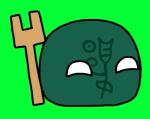 happy
happy -
 proud
proud -

-

-
 cool hat, huh?
 -
 oh nah
 -
 THEY KILLED HIM


-
 The character “夏” (Xia) in oracle bone script.

筆錄 (Notes)
- ↑ Per Liu Xin. 2205 BC counts the reign of Yu the Great, 2160 is the start of Xia Dynasty proper.
- ↑ Yu said, 'Oh! think (of these things), O
 Di. The
  virtue (of the ruler) is seen in (his) good government, and that government in the nourishing of the people. There are water, fire, metal, wood, the earth, and grain - these must be duly regulated; there are the rectification of (the people's) virtue, (the tools and other things) that supply the conveniences of life, and the securing abundant means of sustentation - these must be harmoniously attended to. When the nine services (thus indicated) have been orderly accomplished, that accomplishment will be hailed by (the people's) songs. Caution them with gentle (words), correct them with the majesty (of law), stimulate them with the songs on those nine subjects - in order that (your success) may not suffer diminution.'
- ↑ From the series General History of China (中国通史), episode 6 Tracing the Xia Dynasty (夏王朝覓蹤), 2016
- ↑ Due to him being only a
 puppet/de jure ruler, sometimes he is absent from Xia king lists.


