Second Polish Republic: Difference between revisions
No edit summary |
|||
| (20 intermediate revisions by 2 users not shown) | |||
| Line 1: | Line 1: | ||
{{Infobox | {{Infobox | ||
|Name = | |Name= {{I|Poland2}} Republic of Poland {{I|PolishCube}} | ||
|NativeName = {{ILSize|PolishL-icon.png|Polish Language}}: Rzeczpospolita Polska | |NativeName= {{ILSize|PolishL-icon.png|Polish Language}}: Rzeczpospolita Polska | ||
|founded = 1918 | |founded= 1918 | ||
|predicon = PolandAlt | |predicon= PolandAlt | ||
|onlypredecessor = Regency Kingdom of Poland | |onlypredecessor= Regency Kingdom of Poland | ||
|ended = 1939 | |ended= 1939 | ||
|nexticon = NaziWar | |nexticon= NaziWar | ||
|onlysuccessor = Military Administration in Poland | |onlysuccessor= Military Administration in Poland | ||
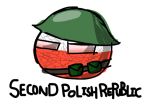
|image = Second | |image= Second Polish Republic.png | ||
|Caption = LONG LIVE POLAND! | |Caption= LONG LIVE POLAND! | ||
|Alias = | |Alias= | ||
|Time | |Time= 11 November 1918 – 6 October 1939 | ||
|Government = [[ | |Government= {{I|Parliament}}{{I|Republic}} [[Parliamentarianism|Parliamentary]] [[Republicanism|Republic]] (1918–1926)<br>{{I|Auth}} [[Authoritarianism|under an Authoritarian Government]] (1926–1939) | ||
|Languages = | |Languages= {{I|PolishL}} [[Polish Language|Polish]] | ||
|Affiliation = | |Affiliation= | ||
|Religions = | |Religions= | ||
*{{i|Christi}} [[Christianity]] | *{{i|Christi}} [[Christianity]] | ||
**{{i|LatinCath}} [[Latin Catholicism]] | **{{i|LatinCath}} [[Latin Catholicism]] | ||
**{{i|Orthodoxy}} [[Eastern Orthodoxy]] | **{{i|Orthodoxy}} [[Eastern Orthodoxy]] | ||
*{{i|Judaism}} [[Judaism]] | *{{i|Judaism}} [[Judaism]] | ||
|Friends = {{ | |Friends= {{Scroll|{{I|PolishUS}} [[Polish Underground State]]<br>{{I|WhiteMove}} [[White Movement]]<br>{{I|KingdomRomania}} [[Kingdom of Romania]]<br>{{I|UK}} [[United Kingdom]]<br>{{I|French3}} [[French Third Republic|France]]<br>{{I|JapEmpSane}} [[Empire of Japan]] (before WWII)<br>{{I|RegencyHungary}} [[Regency Hungary]]}} | ||
|Enemies = {{ | |Enemies= {{Scroll|{{I|Nazi}} [[German Third Reich]]<br>{{I|USSR2}} [[Union of Soviet Socialist Republics|Soviet Union]]<br>{{I|JapEmp}} [[Empire of Japan]]<br>{{I|Lithuania}} [[First Republic of Lithuania]]<br>{{I|OUN-B}} [[Organization of Ukrainian Nationalists]]}} | ||
|Likes = | |Likes= {{I|Nationalism}} [[Nationalism]], resistance, Polonization | ||
|Dislikes = | |Dislikes= {{I|Commie}} [[Communism]], {{I|Nazi}} [[Nazism]], being carved up, minorities not assimilating, {{i|UkrNat}} [[Ukrainian Nationalism]] | ||
|Preceded = [[ | |Preceded= {{AL|{{I|PolandAlt}} [[Regency Kingdom of Poland]]<br>{{I|Central Lithuania}} [[Central Lithuania]]<br>{{I|German Empire}} [[German Empire]]}} | ||
|Succeeded= {{AL|{{I|NaziWar}} [[Military Administration in Poland]]<br>{{I|USSR}} [[Union of Soviet Socialist Republics|Soviet Union]]<br>{{i|SlovakState}} [[Slovak State]]<br>{{i|Lithuania}} [[First Republic of Lithuania]]<br>{{i|PolishGiE}} [[Polish Government-in-Exile]]<br>{{I|Central Lithuania}} [[Central Lithuania]]}} | |||
|themecolor = #e34234 | |themecolor= #e34234 | ||
|textcolor = #ffffff | |textcolor= #ffffff | ||
}}{{Quote|Hello, hello. Can you hear us? This is our final message. Today, | }}{{Quote|Hello, hello. Can you hear us? This is our final message. Today, {{I|Nazi}} [[German Third Reich|German]] troops has entered {{I|Warsaw}} [[Warsaw]]. We send brotherly regards to all, Polish soldiers fighting in hell. And all those fighting, wherever they are, Poland has not perished yet! Long Live Poland!|{{I|Poland2}} [[#History|Poland]]'s final message, {{I|PolskieRadio}} [[Polskie Radio]]}}'''Second Polish Republic''', officially known at the time as the '''Republic of Poland''' or just '''Poland''', was a {{I|NatCon}} [[National Conservatism|nation]] and Polish {{I|History}} [[History|historical]] entity in {{I|CentEurope}} [[Central Europe|Central]] and {{I|EastEurope}} [[Eastern Europe]] that existed from 1918 to 1939. He is known for his bravery against the {{I|Nazi}} [[German Third Reich|Germans]] and {{I|Leninism}} [[Russian Soviet Federative Socialist Republic|Russ]][[Union of Soviet Socialist Republics|ians]] {{I|USSR2}}. | ||
== History == | ==History== | ||
Restored after 1918 from ruins of WWI, | Restored after 1918 from ruins of WWI, Poland was back after 123 years of {{I|Imp}} [[Imperialism|occupation by foreign powers]]. But, Second Polish Republic faced severe {{I|Economy}} [[Economy|economic]] challenges, especially in the early 1920s with rampant inflation. But by the late 1920s and early 1930s, Poland began modernizing his industries and infrastructure. | ||
In 1919, {{I|Leninism}} [[Russian Soviet Federative Socialist Republic|Soviet Russia]] invades Poland and tries to turn him into {{I|Commie}} [[Communism|communist]], but Poland was strong and kicked Soviet out of his clay in 1921. He was very strong until some {{I|Nazi}} [[German Third Reich|failed painter scum]] invaded him in 1939 with his {{I|USSR2}} [[Union of Soviet Socialist Republics|revolutionist buddy]] from both sides trying to take all his clay (even encircled, he fought better than {{I|French3}} [[French Third Republic|Frenchie]]). | |||
The {{i|UK}} [[United Kingdom]] and {{i|French3}} [[French Third Republic|France]] didn't want to mobilize, because after WWI, mobilization was seen as an act of {{I|Aggression}} [[Aggressionism|aggression]], and Poland himself didn't want to mobilize because it would insure that Poland was seen as the victim and maybe receive more clay once Germany was defeated. Germany got boo'ed by the {{I|League of Nations}} [[League of Nations|international stage]], and he was really hoping the Poles would do something aggressive to go alongside all the other aggressions the Germans fabricated. But the late mobilization of Poland was disastrous, and Poland quickly got destroyed so he fled east, only to meet the {{I|Red Army}} [[Red Army]] who wants to take revenge for the failed Polish-Soviet War back in the early 1920s. | |||
== Demographics == | Poland met his end when he was carved up between {{I|NaziWar}} [[Nazism|Nazis]] and {{I|Commie}} [[Communism|Commies]] in 1939. | ||
Historically, Poland was almost always a multiethnic country. This was especially true for the Second Republic, when independence was once again achieved in the wake of the First World War and the subsequent Polish–{{ | |||
==Demographics== | |||
{{I|Historicism}} [[Historicism|Historically]], Poland was almost always a {{I|Interculturalism}} [[Interculturalism|multiethnic]] country. This was especially true for the Second Republic, when {{I|Separatism}} [[Separatism|independence]] was once again achieved in the wake of the First World War and the subsequent Polish–{{I|Leninism}} [[Russian Soviet Federative Socialist Republic|Soviet]] War. The census of 1921 shows 30.8% of the population consisted of ethnic minorities, compared with a share of 1.6% (solely identifying with a non-Polish ethnic group) or 3.8% (including those identifying with both the Polish ethnicity and with another ethnic group) in {{i|Poland}} [[Poland|2011]]. | |||
Poland was also a nation of many {{i|Religion}} [[Religion|religions]]. In 1921, 16,057,229 Poles (approx. 62.5%) were {{i|Catholicism}} [[Catholicism|Roman (Latin) Catholics]], 3,031,057 citizens of Poland (approx. 11.8%) were {{i|EastCath}} [[Eastern Catholicism|Eastern Rite Catholics]] (mostly {{i|UkrCath}} [[Ukrainian Greek Catholic Church|Ukrainian Greek Catholics]] and {{i|ArmCath}} [[Armenian Catholic Church|Armenian Rite Catholics]]), 2,815,817 (approx. 10.95%) were {{i|Orthodoxy}} [[Eastern Orthodoxy|Orthodox]], 2,771,949 (approx. 10.8%) were {{i|Judaism}} [[Judaism|Jewish]], and 940,232 (approx. 3.7%) were {{i|Protestantism}} [[Protestantism|Protestants]] (mostly {{i|Lutheran}} [[Lutheranism|Lutheran]]). | Poland was also a nation of many {{i|Religion}} [[Religion|religions]]. In 1921, 16,057,229 Poles (approx. 62.5%) were {{i|Catholicism}} [[Catholicism|Roman (Latin) Catholics]], 3,031,057 citizens of Poland (approx. 11.8%) were {{i|EastCath}} [[Eastern Catholicism|Eastern Rite Catholics]] (mostly {{i|UkrCath}} [[Ukrainian Greek Catholic Church|Ukrainian Greek Catholics]] and {{i|ArmCath}} [[Armenian Catholic Church|Armenian Rite Catholics]]), 2,815,817 (approx. 10.95%) were {{i|Orthodoxy}} [[Eastern Orthodoxy|Orthodox]], 2,771,949 (approx. 10.8%) were {{i|Judaism}} [[Judaism|Jewish]], and 940,232 (approx. 3.7%) were {{i|Protestantism}} [[Protestantism|Protestants]] (mostly {{i|Lutheran}} [[Lutheranism|Lutheran]]). | ||
== Status of Ethnic Minorities == | ==Status of Ethnic Minorities== | ||
The Second Polish Republic wanted all minorities to assimilate into Polish culture. Relations with minorities were often tense, especially with the biggest minorities, the | The Second Polish Republic wanted all minorities to {{I|CultNat}} [[Cultural Nationalism|assimilate]] into Polish {{I|Culture}} [[culture]]. Relations with minorities were often tense, especially with the biggest minorities, the {{I|Ukraine}} [[Ukraine|Ukrainians]] in the {{I|Poland2}} [[Eastern Borderlands]] (Kresy) and the {{I|Jew}} [[Jews]]. | ||
=== Jews === | ===Jews=== | ||
From the 1920s, the Polish government excluded {{i|Jew}} [[Jews]] from receiving government bank loans, public sector employment, and obtaining business licenses. From the 1930s, measures were taken against Jewish shops, Jewish export firms, | From the 1920s, the Polish government excluded {{i|Jew}} [[Jews]] from receiving government bank loans, public sector employment, and obtaining business licenses. From the 1930s, measures were taken against Jewish shops, Jewish export firms, ''Shechita'' as well as limitations being placed on Jewish admission to the {{I|Medicine}} [[Medicine|medical]] and {{I|Law}} [[Law|legal]] professions, Jews in business associations and the enrollment of Jews into universities. This was because the {{I|Politics}} [[Politics|political]] movement {{i|Endecja}} [[Endecja|National Democracy]] (Endecja, from the abbreviation "ND") often organized {{i|AntiJew}} [[Antisemitism|anti-Jewish]] business boycotts because they wanted to create a Polish middle class, and they thought the key was trade, but Jews already dominated trade. | ||
Following the death of marshal | Following the death of marshal {{I|Sanationism}} [[Sanationism|Józef Piłsudski]] in 1935, the Endecja intensified their efforts, which triggered {{I|Aggression}} [[Aggressionism|violence]] in extreme cases in smaller towns across the country. In 1937, the {{i|Endecja}} [[Endecja|National Democracy]] movement passed resolutions to further limit Jewish influence within Poland. In response, the Polish government the {{I|OZON}} [[Camp of National Unity]] (OZON) to oppose the Endecja, and in 1938 the OZON took control of the {{I|Sejm}} [[Sejm|Polish Sejm]] and subsequently drafted laws about limiting number of Jewish students in universities. However, these laws weren't nowhere comparable to {{i|Nazi}} [[German Third Reich|Germany]]'s, contrary to what {{I|Pseudohistory}} [[Pseudohistory|some extremists]] claim. The Endecja even supported a Jewish state on {{i|Madagascar}} [[French Madagascar|Madagascar]], which was proposed by some {{i|Zion}} [[Zionism|Zionists]]. Poland's main issue with the Jews was still "they're not {{I|CultNat}} [[Cultural Nationalism|assimilating]]"—it was the issue in case of other national minorities, not just the Jews. The Jews were simply just the biggest minority in Poland. | ||
According to [[ | According to {{I|Pseudohistory}} [[Pseudohistory|William W. Hagen]], by 1939, prior to the war, {{I|PolishCube}} [[Jews|Polish Jews]] were threatened with conditions similar to those in {{I|Nazi}} [[German Third Reich|Nazi Germany]], but this claim was an over-exaggeration. While Jews faced discrimination {{I|Economy}} [[Economy|economically]], the Second Polish Republic is considered a golden age for Jewish {{I|Culture}} [[culture]]. There were hundreds of {{I|YiddishL}} [[Yiddish Language|Yiddish-language]] newspapers, Jewish theatres, schools, universities, literary movements, and political parties. Jewish {{I|Artist}} [[Art|artists]], writers, poets, {{I|Religion}} [[Religion|religious]] scholars, and activists thrived, and {{I|Warsaw}} [[Warsaw]] became one of the biggest centres of {{I|Jew}} [[Ashkenazi Jews|Yiddish]] culture in the {{I|Earth}} [[Earth|world]]. Poland had the largest Jewish population in {{I|Europe}} [[Europe]] (about 3.3 million Jews, about 10% of the population). | ||
=== Ukrainians === | ===Ukrainians=== | ||
The pre-war government also restricted the rights of people who declared | The pre-war Polish government also restricted the rights of people who declared {{I|Ukraine}} [[Ukrainians|Ukrainian nationality]], belonged to the {{I|Orthodoxy}} [[Eastern Borderlands]] of the Second Polish Republic. Non-assimilating Ukrainians were seen by Polish authorities as disloyal and even subversive. {{i|UkrainianL}} [[Ukrainian Language|Ukrainian]] was restricted in every field possible, especially in governmental institutions, and the term "Ruthenian" was enforced in an attempt to ban the use of the term "Ukrainian". | ||
After 1935, Polish policy towards Ukrainians shifted focus from state consolidation to the ethnic assimilation of part of the Ukrainian population through Polonization and conversion to {{I|Catholicism}} [[Catholicism|Roman Catholicism]]. | After 1935, Polish policy towards Ukrainians shifted focus from state consolidation to the ethnic assimilation of part of the Ukrainian population through Polonization and conversion to {{I|Catholicism}} [[Catholicism|Roman Catholicism]]. | ||
== Quotes == | ==Quotes== | ||
{{Quote|OH KUUUUUR-| | {{Quote|OH KUUUUUR-|{{I|Poland2}} [[Polandball|Poland]]'s last words before being carved up}} | ||
== Relationships == | ==Relationships== | ||
=== Friends === | ===Friends=== | ||
*[[ | *{{I|PolishUS}} [[Polish Underground State]] - Keeps alive my legacy by fightings both {{I|Nazi}} [[German Third Reich|Nazi]] and {{I|USSR2}} [[Union of Soviet Socialist Republics|Soviets]]. | ||
* | *{{I|WhiteMove}} [[White Movement]] - Thanks for of distractings {{I|Leninism}} [[Russian Soviet Federative Socialist Republic|Soviet]]! | ||
* | *{{I|KingdomRomania}} [[Kingdom of Romania]] - Of good friends, he allows my soldiers to escape. Unfortunately, he would become allies with {{I|Nazi}} [[German Third Reich]] 2 years later. | ||
* | *{{I|RegencyHungary}} [[Regency Hungary]] - Polak Węgier Dwa Bratanki! Helped me in 1920 and took my refugees in 1939 :), but very unfortunately, he later joined to the wretched {{I|Axis}} [[Axis Powers]]. | ||
**{{Alias|UK-icon.png|United Kingdom|Ehhh… | *{{I|UK}} [[United Kingdom]] & {{I|French3}} [[French Third Republic|France]] - The {{I|Nazi}} [[German Third Reich|Germans]] are here! Please send military support! | ||
**{{Alias|UK-icon.png|United Kingdom|Ehhh… we'll wait until the war's over and restore your independence.}} | |||
**{{Alias|French3-icon.png|French Third Republic|We believe in you!}} | **{{Alias|French3-icon.png|French Third Republic|We believe in you!}} | ||
=== Enemies === | ===Enemies=== | ||
* | *{{I|Nazi}} [[German Third Reich]] - He wants to destroy me, my people and my {{I|Culture}} [[culture]]. My worst enemy. | ||
* | *{{I|USSR2}} [[Union of Soviet Socialist Republics|Soviet Union]] - He enjoys {{I|Genocide}} [[Genocide|massacring]] my people. | ||
* | *{{I|JapEmp}} [[Empire of Japan]] - I thought we are on good terms but then you ally with {{I|Nazi}} [[German Third Reich|him]]! I declare {{I|War}} [[war]] on you! | ||
**{{Alias|JapEmpSane-icon.png|Empire of Japan|I | **{{Alias|JapEmpSane-icon.png|Empire of Japan|I do not accept your declaration.}} | ||
*{{I|OUN-B}} [[Organization of Ukrainian Nationalists]] - I would not forget the {{i|Wołyń}} [[Wołyń]] massacre! | *{{I|OUN-B}} [[Organization of Ukrainian Nationalists]] - I would not forget the {{i|Wołyń}} [[Wołyń]] massacre! | ||
*{{I|Lithuania}} [[First Republic of Lithuania]] - Stop bickering over {{I|Vilnius}} [[Vilnius]]! | |||
== How to draw == | ==How to draw== | ||
{{Flag| | {{Flag|Second Polish Republic-design.png|Flag of Poland}} | ||
# Draw a ball. | {{DrawDif|trivial}} | ||
# Fill the top half of the ball with white, the bottom half with red | #Draw a ball. | ||
# Add the eyes and you are done! | #Fill the top half of the ball with white, the bottom half with red | ||
#Add the eyes and you are done! | |||
{{FlagColour | {{FlagColour | ||
|c1 = White | |c1= White | ||
|h1 = #FFFFFF | |h1= #FFFFFF | ||
|c2 = Red | |c2= Red | ||
|h2 = #E34234 | |h2= #E34234 | ||
}} | }} | ||
== Gallery == | ==Gallery== | ||
<gallery widths=150> | <gallery widths=150> | ||
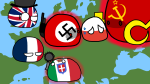
Soviet Nazi Italy red glow.png|oh no | Soviet Nazi Italy red glow.png|oh no | ||
| Line 96: | Line 101: | ||
</gallery> | </gallery> | ||
== Navigation == | ==Navigation== | ||
{{Poland}} | {{Navbox/Poland}} | ||
[[Category:Characters]] | [[Category:Characters]] | ||
[[Category:Historical]] | [[Category:Historical]] | ||
[[Category:Poland]] | [[Category:Poland]] | ||
[[Category:Europe]] | |||
Latest revision as of 04:08, 11 July 2026
—  Poland's final message, Poland's final message,  Polskie Radio Polskie Radio
|
Second Polish Republic, officially known at the time as the Republic of Poland or just Poland, was a  nation and Polish
  historical entity in
  Central and
  Eastern Europe that existed from 1918 to 1939. He is known for his bravery against the
  Germans and
  Russians
  .
.
History
Restored after 1918 from ruins of WWI, Poland was back after 123 years of  occupation by foreign powers. But, Second Polish Republic faced severe
  economic challenges, especially in the early 1920s with rampant inflation. But by the late 1920s and early 1930s, Poland began modernizing his industries and infrastructure.
In 1919, Soviet Russia invades Poland and tries to turn him into  communist, but Poland was strong and kicked Soviet out of his clay in 1921. He was very strong until some failed painter scum invaded him in 1939 with his revolutionist buddy from both sides trying to take all his clay (even encircled, he fought better than
  Frenchie).
The  United Kingdom and France didn't want to mobilize, because after WWI, mobilization was seen as an act of
  aggression, and Poland himself didn't want to mobilize because it would insure that Poland was seen as the victim and maybe receive more clay once Germany was defeated. Germany got boo'ed by the
  international stage, and he was really hoping the Poles would do something aggressive to go alongside all the other aggressions the Germans fabricated. But the late mobilization of Poland was disastrous, and Poland quickly got destroyed so he fled east, only to meet the
  Red Army who wants to take revenge for the failed Polish-Soviet War back in the early 1920s.
Poland met his end when he was carved up between  Nazis and Commies in 1939.
Demographics
 Historically, Poland was almost always a
  multiethnic country. This was especially true for the Second Republic, when
  independence was once again achieved in the wake of the First World War and the subsequent Polish– Soviet War. The census of 1921 shows 30.8% of the population consisted of ethnic minorities, compared with a share of 1.6% (solely identifying with a non-Polish ethnic group) or 3.8% (including those identifying with both the Polish ethnicity and with another ethnic group) in
  2011.
2011.
Poland was also a nation of many  religions. In 1921, 16,057,229 Poles (approx. 62.5%) were
  Roman (Latin) Catholics, 3,031,057 citizens of Poland (approx. 11.8%) were
  Eastern Rite Catholics (mostly
  Ukrainian Greek Catholics and
  Armenian Rite Catholics), 2,815,817 (approx. 10.95%) were
  Orthodox, 2,771,949 (approx. 10.8%) were
  Jewish, and 940,232 (approx. 3.7%) were
  Protestants (mostly
  Lutheran).
Status of Ethnic Minorities
The Second Polish Republic wanted all minorities to  assimilate into Polish
  culture. Relations with minorities were often tense, especially with the biggest minorities, the
  Ukrainians in the Eastern Borderlands (Kresy) and the
  Jews.
Jews.
Jews
From the 1920s, the Polish government excluded Jews from receiving government bank loans, public sector employment, and obtaining business licenses. From the 1930s, measures were taken against Jewish shops, Jewish export firms, Shechita as well as limitations being placed on Jewish admission to the  medical and
  legal professions, Jews in business associations and the enrollment of Jews into universities. This was because the
  political movement
  National Democracy (Endecja, from the abbreviation "ND") often organized
  anti-Jewish business boycotts because they wanted to create a Polish middle class, and they thought the key was trade, but Jews already dominated trade.
Following the death of marshal  Józef Piłsudski in 1935, the Endecja intensified their efforts, which triggered violence in extreme cases in smaller towns across the country. In 1937, the National Democracy movement passed resolutions to further limit Jewish influence within Poland. In response, the Polish government the
  Camp of National Unity (OZON) to oppose the Endecja, and in 1938 the OZON took control of the
  Polish Sejm and subsequently drafted laws about limiting number of Jewish students in universities. However, these laws weren't nowhere comparable to Germany's, contrary to what
  some extremists claim. The Endecja even supported a Jewish state on
  Madagascar, which was proposed by some
  Zionists. Poland's main issue with the Jews was still "they're not assimilating"—it was the issue in case of other national minorities, not just the Jews. The Jews were simply just the biggest minority in Poland.
According to William W. Hagen, by 1939, prior to the war,  Polish Jews were threatened with conditions similar to those in Nazi Germany, but this claim was an over-exaggeration. While Jews faced discrimination economically, the Second Polish Republic is considered a golden age for Jewish culture. There were hundreds of
  Yiddish-language newspapers, Jewish theatres, schools, universities, literary movements, and political parties. Jewish
  artists, writers, poets, religious scholars, and activists thrived, and
  Warsaw became one of the biggest centres of Yiddish culture in the
  world. Poland had the largest Jewish population in
  Europe (about 3.3 million Jews, about 10% of the population).
Ukrainians
The pre-war Polish government also restricted the rights of people who declared Ukrainian nationality, belonged to the Eastern Borderlands of the Second Polish Republic. Non-assimilating Ukrainians were seen by Polish authorities as disloyal and even subversive.  Ukrainian was restricted in every field possible, especially in governmental institutions, and the term "Ruthenian" was enforced in an attempt to ban the use of the term "Ukrainian".
After 1935, Polish policy towards Ukrainians shifted focus from state consolidation to the ethnic assimilation of part of the Ukrainian population through Polonization and conversion to Roman Catholicism.
Quotes
“”OH KUUUUUR-
|
| — Poland's last words before being carved up
|
Relationships
Friends
 Polish Underground State - Keeps alive my legacy by fightings both
  Nazi and
  Soviets.
 White Movement - Thanks for of distractings
  Soviet!
 Kingdom of Romania - Of good friends, he allows my soldiers to escape. Unfortunately, he would become allies with German Third Reich 2 years later.
 Regency Hungary - Polak Węgier Dwa Bratanki! Helped me in 1920 and took my refugees in 1939 :), but very unfortunately, he later joined to the wretched
  Axis Powers.
 United Kingdom &
  France - The Germans are here! Please send military support!
-
 Ehhh… we'll wait until the war's over and restore your independence.
- We believe in you!


Enemies
- German Third Reich - He wants to destroy me, my people and my
 culture. My worst enemy.
 - Soviet Union - He enjoys
 massacring my people.
  Empire of Japan - I thought we are on good terms but then you ally with him! I declare
  war on you!
 I do not accept your declaration.
 Organization of Ukrainian Nationalists - I would not forget the
  Wołyń massacre!
 First Republic of Lithuania - Stop bickering over
  Vilnius!


How to draw

Second Polish Republic has a drawing rating of trivial.
- Draw a ball.
- Fill the top half of the ball with white, the bottom half with red
- Add the eyes and you are done!
| Color Name | HEX | |
|---|---|---|
| White | #FFFFFF | |
| Red | #E34234 | |
Gallery
-
 oh no
oh no -
 Second
 -

-


Navigation
| Voivodeships | |||||
|---|---|---|---|---|---|
| Counties | |||||
| Cities |
| ||||
| Municipalities | |||||
| Historical Entities |  Indo-Europeans • Indo-Europeans •  Slavs • Slavs •  Civitas Schinesghe • Civitas Schinesghe •  Kingdom of Poland • Kingdom of Poland •  Crown of the Kingdom of Poland • Crown of the Kingdom of Poland •  Polish-Lithuanian Commonwealth • Polish-Lithuanian Commonwealth •  Duchy of Warsaw • Duchy of Warsaw •  Congress Poland • Congress Poland •  Regency Kingdom of Poland • Second Polish Republic • Regency Kingdom of Poland • Second Polish Republic •  Polish Government-in-Exile • Polish Government-in-Exile •  General Government • General Government •  Polish Underground State • Polish Underground State •  Polish People's Republic Polish People's Republic | ||||
| Governmental Entities | |||||
| Organizations Political Parties | |||||
| Culture | |||||
| Theories | |||||
| People | |||||
| Companies | |||||
Poland cannot into space!  | |||||


