User:Heterodontosaurus
From Heterodontosaurus Balls

Heterodontosaurus

This Page is Outdated.
“URGENT UPDATE ON THE CHANGING SITUATION!” —  Mediacracy
 Mediacracy
Please update the page on recent events, such as: Many things. But I don't care enough to change it.
“”There's surveillance cameras everywhere in
 China, but when someone goes "missing" no one has any leads… China, but when someone goes "missing" no one has any leads… |
Hello! It is I, the owner of this website. Feel free to ask me anything!

|
This user has over 100 edits. Hopefully it isn’t by only texting others. |

|
This user believes that Trump can make America great again. Secure the border! |

|
This user is Asian. Me like rice |

|
This user frequently contributes icons to this website. Try fitting a flag into 166 pixels! |
History of me and Countryballs

This Article is Under Construction.
“Wörk, wörk, wörk.” —  Germany
 Germany
There may be lots of WIPs, missing icons, bad formatting, and/or unedited material from other sources on this page. Consider helping out!
I got into countryballs in early 2021, during the COVID pandemic. I had a  DeviantArt account, so I decided to start drawing countryballs and post them there. I drew on an online collaborative website called “
 Aggie.io”, which is now owned by and overshadowed by
  Magma.com. I was just starting to draw stuff and didn’t know lots of things, but I managed to do decent.
Also in 2021, while Polandball was still on  Fandom, I made an account and did a few edits, and befriended
  Lim1345. Not long after, Polandball Wiki was shut down by Fandom and migrated to
  Miraheze.
On May 4, 2021, I joined the Polandball  Amino. I also started to post my drawings there. I also tried out several Polandball games, like Polandball: Potato Mayhem, Polandball: Not Safe For World, and others.
After a while, I saw PolishTortise’s videos and how the countryballs jump around on a yellow map with their territories in red. This inspired me to make a new countryball drawing series, where I draw a countryball with their background being a yellow map, with their territories marked in red. These drawings eventually became pretty popular, being at the top of searches and sometimes being included on  YouTube thumbnails.
In the middle of September 16 2024 around day 14-16, I took down everything I had on DeviantArt for good. I am NOT letting this digital footprint ruin my chances of getting a job.
Opinions on People


Opinions on Ideologies
Great
 Reactionaryism - Degeneracy is lurking everywhere in today’s world, more than any point in history.
  Homosexuality,
  drugs, and
  porn, all those immoral things are all being normalized. We need to go back to a time where our society’s values still align with the value of the universe, the value of the divine.
 Traditionalism - Restore our traditions.
 Trumpism
  - The mainstream radical leftist media make up lies about you so much. I know you will make America great again, I know you will bring back the true American culture that was lost. I know you will battle against degeneracy. Though you should work on your language, it is sometimes pretty brute.


Good
 Capitalism - You not perfect, but I would defend you against
  them. Too many people confuse you with
  Corporatocracy. The harder you work the more rewards you should reap, it is the law of the universe and how things should work for our society.


Mid
 Police Statism - In the west, you are usually mistreated. In
  China, you mistreat people.
 Neoconservatism - I appreciate the
  Anti-Communism, but you still suck.
 Counter-Enlightenment - I don’t really care about what new technologies we make, because human technological progress is, generally, controlled by the heavens. Did the people living in the ancient times not think of bikes and cars? Maybe they did.


Bad
- Communism - Not another ideology craves blood more than you. Unlike other violent ideologies, when your enemies are gone, you create new enemies out of your own. You claim that you want to “free” the oppressed common people, but in reality you either kill them off or brainwash them into being your puppets to kill more people. And private property is nice.
 Socialism - As
  Marx said, your ultimate goal is to establish a communist society.
 Revolutionary Progressivism - Wants nothing but destruction.


I still have hope…
List of non-overlapping Chinese kings
- Yu the Great (2205 BC-2160 BC)
- Qi of Xia (2160 BC-2150 BC)
- Tai Kang (2150 BC-2158 BC)
- Hou Yi (2158 BC-2121 BC)
- Zhong Kang (2121 BC-2108 BC)
- Xiang of Xia (2108 BC-2100 BC)
- Han Zhuo (2100 BC-2061 BC)
- Shao Kang (2061 BC-2059 BC)
- Zhu of Xia (2059 BC-2042 BC)
- Huai of Xia (2042 BC-2016 BC)
- Mang of Xia (2016 BC-1998 BC)
- Xie of Xia (1998 BC-1982 BC)
- Bu Jiang (1982 BC-1923 BC)
- Jiong of Xia (1923 BC-1902 BC)
- Jin of Xia (1902 BC-1881 BC)
- Kong Jia (1881 BC-1850 BC)
- Gao of Xia (1850 BC-1839 BC)
- Fa of Xia (1839 BC-1828 BC)
- Jie of Xia (1828 BC-1776 BC)
- Tang (1776 BC-1754 BC)
- Bu Bing (1754 BC-1736 BC)
- Zhong Ren (1736 BC-1732 BC)
- Tai Jia (1732 BC-1720 BC)
- Wo Ding (1720 BC-1692 BC)
- Tai Geng (1692 BC-1667 BC)
- Xiao Jia (1667 BC-1650 BC)
- Yong Ji (1650 BC-1638 BC)
- Tai Wu (1650 BC-1563 BC)
- Zhong Ding (1563 BC-1550 BC)
- Wai Ren (1550 BC-1535 BC)
- He Dan Jia (1535 BC-1526 BC)
- Zu Yi (1526 BC-1507 BC)
- Zu Xin (1507 BC-1491 BC)
- Wo Jia (1491 BC-1466 BC)
- Zu Ding (1466 BC-1434 BC)
- Nan Geng (1434 BC-1409 BC)
- Yang Jia (1409 BC-1402 BC)
- Pan Geng (1402 BC-1374 BC)
- Xiao Xin (1374 BC-1353 BC)
- Xiao Yi (1353 BC-1325 BC)
- Wu Ding (1325 BC-1266 BC)
- Zu Geng (1266 BC-1259 BC)
- Zu Jia (1259 BC-1226 BC)
- Lin Xin (1226 BC-1220 BC)
- Geng Ding (1220 BC-1199 BC)
- Wu Yi (1199 BC-1195 BC)
- Wen Wu Ding (1195 BC-1185 BC)
- Di Yi (1185 BC-1155 BC)
- Di Xin (1155 BC-1122 BC)
- Wu of Zhou (1122 BC-1116 BC)
- Cheng of Zhou (1116 BC-1079 BC)
- Kang of Zhou (1079 BC-1053 BC)
- Zhao of Zhou (1053 BC-1002 BC)
- Mu of Zhou (1002 BC-947 BC)
- Gong of Zhou (947 BC-935 BC)
- Yih of Zhou (935 BC-910 BC)
- Xiao of Zhou (910 BC-895 BC)
- Yi of Zhou (895 BC-879 BC)
- Li of Zhou (879 BC-841 BC)
- Gongbo He (841 BC-828 BC)
- Xuan of Zhou (828 BC-782 BC)
- You of Zhou (782 BC-771 BC)
- Ping of Zhou (771 BC-720 BC)
- Huan of Zhou (720 BC-697 BC)
- Zhuang of Zhou (697 BC-682 BC)
- Xi of Zhou (682 BC-677 BC)
- Hui of Zhou (677 BC-652 BC)
- Xiang of Zhou (652 BC-619 BC)
- Qing of Zhou (619 BC-613 BC)
- Kuang of Zhou (613 BC-607 BC)
- Ding of Zhou (607 BC-586 BC)
- Jian of Zhou (586 BC-572 BC)
- Ling of Zhou (572 BC-545 BC)
- Jing of Zhou (545 BC-521 BC)
- Dao of Zhou (521 BC)
- Jing (Gai) of Zhou (521 BC-476 BC)
- Yuan of Zhou (476 BC-469 BC)
- Zhending (469 BC-441 BC)
- Ai of Zhou (441 BC)
- Si of Zhou (441 BC)
- Kao of Zhou (441 BC-425 BC)
- Weilie of Zhou (425 BC-402 BC)
- An of Zhou (402 BC-376 BC)
- Lie of Zhou (376 BC-369 BC)
- Xian of Zhou (369 BC-321 BC)
- Shenjing of Zhou (321 BC-315 BC)
- Nan of Zhou (315 BC-256 BC)
- Zhaoxiang of Qin (256 BC-250 BC)
- Xiaowen of Qin (250 BC)
- Zhuangxiang of Qin (250 BC-247 BC)
- Qin Shi Huang (247 BC-210 BC)
- Qin Er Shi (210 BC-207 BC)
- Ziying of Qin (207 BC)
- Yi of Chu (207 BC-206 BC)
- Xiang Yu (206 BC-202 BC)
- Liu Bang/Gaozu of Han (202 BC-195 BC)
- Hui of Han (195 BC-188 BC)
- Qianshao of Han (188 BC-184 BC)
- Houshao of Han (184 BC-180 BC)
- Wen of Han (180 BC-157 BC)
- Jing of Han (157 BC-141 BC)
- Wu of Han (141 BC-87 BC)
- Zhao of Han (87 BC-74 BC)
- Marquis of Haihun (74 BC)
- Xuan of Han (74 BC-48 BC)
- Yuan of Han (48 BC-33 BC)
- Cheng of Han (33 BC-7 BC)
- Ai of Han (7 BC-1 BC)
- Ping of Han (1 BC-6)
- Ruzi Ying (6-9)
- Wang Mang (9-23)
- Gengshi Emperor (23-25)
- Guangwu of Han (25-57)
- Ming of Han (57-75)
- Zhang of Han (75-88)
- He of Han (88-106)
- Shang of Han (106)
- An of Han (106-125)
- Marquess of Beixiang (125)
- Shun of Han (125-144)
- Chong of Han (144-145)
- Zhi of Han (145-146)
- Huan of Han (146-168)
- Ling of Han (168-189)
- Prince of Hongnong (189)
- Xian of Han (189-220)
- Cao Pi (220-226)
- Cao Rui (226-239)
- Cao Fang (239-254)
- Cao Mao (254-260)
- Cao Huan (260-266)
- Wu of Jin (266-290)
- Hui of Jin (290-301)
- Sima Lun (301)
- Hui of Jin (2nd reign) (301-307)
- Huai of Jin (307-313)
- Min of Jin (313-316)
- Yuan of Jin (316-323)
- Ming of Jin (323-325)
- Cheng of Jin (325-342)
- Kang of Jin (342-344)
- Mu of Jin (344-361)
- Ai of Jin (361-365)
- Fei of Jin (365-372)
- Jianwen of Jin (372)
- Xiaowu of Jin (372-396)
- An of Jin (396-419)
- Gong of Jin (419-420)
- Wu of Song (420-422)
- Shao of Song (422-424)
- Wen of Song (424-453)
- Liu Shao (453)
- Xiaowu of Song (453-464)
- Qianfei of Song (464-466)
- Ming of Song (466-472)
- Houfei of Song (472-477)
- Shun of Song (477-479)
- Gao of Qi (479-482)
- Wu of Qi (482-493)
- Xiao Zhaoye (493-494)
- Xiao Zhaowen (494)
- Ming of Qi (494-498)
- Marquess of Donghun (498-501)
- He of Qi (501-502)
- Wu of Liang (502-549)
- Jianwen of Liang (549-551)
- Xiao Dong (551)
- Yuan of Liang (551-555)
- Ming of Liang (555)
- Jin of Liang (555-557)
- Wu of Chen (557-559)
- Wen of Chen (559-566)
- Fei of Chen (566-568)
- Xuan of Chen (568-582)
- Houzhu of Chen (582-589)
- Wen of Sui (589-604)
- Yang of Sui (604-618)
- Gong of Sui (618)
- Gaozu of Tang (618-626)
- Taizong of Tang (626-649)
- Gaozong of Tang (649-684)
- Zhongzong of Tang (684)
- Ruizong of Tang (684-690)
- Wu Zetian (690-705)
- Zhongzong of Tang (2nd reign) (705-710)
- Shang of Tang (710)
- Ruizong of Tang (2nd reign) (710-712)
- Xuanzong of Tang (712-756)
- Suzong of Tang (756-762)
- Daizong of Tang (762-779)
- Dezong of Tang (779-805)
- Shunzong of Tang (805)
- Xianzong of Tang (805-820)
- Muzong of Tang (820-824)
- Jingzong of Tang (824-827)
- Wenzong of Tang (827-840)
- Wuzong of Tang (840-846)
- Xuanzong (9th century) of Tang (846-859)
- Yizong of Tang (859-873)
- Xizong of Tang (873-888)
- Zhaozong of Tang (888-904)
- Ai of Tang (904-907)
- Zhu Wen (907-912)
- Zhu Yougui (912-913)
- Zhu Youzhen (913-923)
- Li Cunxu (923-926)
- Li Siyuan (926-933)
- Li Conghou (933-934)
- Li Congke (934-937)
- Shi Jingtang (937-942)
- Shi Chonggui (942-947)
- Liu Zhiyuan (947-948)
- Liu Chengyou (948-951)
- Guo Wei (951-954)
- Chai Rong (954-959)
- Chai Zongxun (959-960)
- Taizu of Song (960-976)
- Taizong of Song (976-997)
- Zhenzong of Song (996-1022)
- Renzong of Song (1022-1063)
- Yingzong of Song (1063-1067)
- Shenzong of Song (1067-1085)
- Zhezong of Song (1085-1100)
- Huizong of Song (1100-1126)
- Qinzong of Song (1126-1127)
- Gaozong of Song (1127-1162)
- Xiaozong of Song (1162-1189)
- Guangzong of Song (1189-1194)
- Ningzong of Song (1194-1224)
- Lizong of Song (1224-1264)
- Duzong of Song (1264-1274)
- Gongzong of Song (1274-1276)
- Duanzong of Song (1276-1278)
- Zhao Bing (1278-1279)
- Kublai Khan (1279-1294)
- Öljeytü Khan (1294-1307)
- Külüg Khan (1307-1311)
- Buyantu Khan (1311-1320)
- Gegeen Khan (1320-1323)
- Borjigin Yesün Temür (1323-1328)
- Borjigin Ragibagh (1328)
- Jayaatu Khan (1328-1329)
- Khutughtu Khan (1329)
- Jayaatu Khan (2nd reign) (1329-1332)
- Borjigin Rinchinbal (1332)
- Ukhaghatu Khan (1332-1368)
- Hongwu Emperor (1368-1398)
- Jianwen Emperor (1398-1402)
- Yongle Emperor (1402-1424)
- Hongxi Emperor (1424-1425)
- Xuande Emperor (1425-1435)
- Yingzong Emperor (1435-1449)
- Jingtai Emperor (1449-1457)
- Yingzong Emperor (1457-1464)
- Chenghua Emperor (1464-1487)
- Hongzhi Emperor (1487-1505)
- Zhengde Emperor (1505-1521)
- Jiajing Emperor (1521-1567)
- Longqing Emperor (1567-1572)
- Wanli Emperor (1572-1620)
- Taichang Emperor (1620)
- Tianqi Emperor (1620-1627)
- Chongzhen Emperor (1627-1644)
- Zhang Xianzhong (1644)
- Shunzhi Emperor (1644-1661)
- Kangxi Emperor (1661-1722)
- Yongzheng Emperor (1722-1735)
- Qianlong Emperor (1735-1796)
- Jiaqing Emperor (1796-1820)
- Daoguang Emperor (1820-1850)
- Xianfeng Emperor (1850-1861)
- Tongzhi Emperor (1861-1875)
- Guangxu Emperor (1875-1908)
- Xuantong Emperor/Puyi (1908-1912)
- Yuan Shikai (1912-1916)
Archive
Criticism

Pending Migration
“It's time to migrate!” —  Mongolia
 Mongolia
The content in this article/section is being planned to be moved to another page.
Moving to: Anti-Chiangism
Moving to:
 Anti-Chiangism
Chiang's detractors denounce him as an  incompetent
  tyrant, and often accuse him of being a
  fascist dictator who violently suppressed and massacred
  dissents with white terror and flooded the
  Yellow River which killed hundreds of thousands and subsequently caused the
  Henan Famine (even though it was done to resist
  Japan's
  colonization and
  genocide against China). Detractors also criticize his government's
  Kleptocracy (even if he did not involve in corruption personally) and the massacre of Taiwanese dissidents during the
  228 Massacre.
Structure
Pending Migration
“It's time to migrate!” — Mongolia
MongoliaThe content in this article/section is being planned to be moved to another page.
Moving to: Catholic Church
Moving to:
 Catholic Church
The structure of the Catholic Church is hierarchical, with the Pope at the top, followed by cardinals, bishops, priests, and deacons. The Church is divided into dioceses, each overseen by a bishop, and further subdivided into parishes, each led by priests. The hierarchy helps maintain the unity and governance of the Church across the world, allowing for consistent teaching and administration. The Church also includes religious orders, such as monks and nuns, who live according to specific spiritual disciplines under their own leadership while remaining connected to the broader Church structure.
宣传片 (Propaganda Films)
Pending Migration
“It's time to migrate!” — Mongolia
MongoliaThe content in this article/section is being planned to be moved to another page.
Moving to: Each of these films may get their own pages as ideologies.
Moving to: Each of these films may get their own pages as ideologies.
哪吒2 (Nezha 2)

This template is no longer in use, and is being kept for archival purposes only.

| “ | Now, again, I have to repeat myself- the film itself, by itself, is a good film, I liked it. But then, when you add in all of the extra  nationalism stuff packed to the brim, that’s when the things turn sour. nationalism stuff packed to the brim, that’s when the things turn sour.
|
” | |
A recent new hit animated movie “Nezha 2” released in 2025 shook the box office.
By itself, there is nothing inherently wrong with the Nezha 2 film. The animation is pretty good. One criticism though, is how the studio made an uglification and villianization of Nezha as a character, which strays far from the  original Chinese story, just like they did to Black Myth: Wukong, making a darker interpretation of the classics. In the original story, Nezha kills a bunch of beings in the sea but later repents and becomes good, and it is a change for the positive and righteous. However, in the film, Nezha is a misunderstood character from the start and it was the world's fault that Nezha was the way he is.
The PRC uses this film to promote its agenda. Nezha 2 has become another nationalism symbol in China, and it is generating a movement called “raising the flag”.
The irony though, is in the plot of Nezha and how it’s promoted by the Chinese government. In the film, Nezha says that his own life is determined by himself, not by the heavens, meaning that he wants to control his life in his own hands. But the idea of Chinese people on the CCP’s side supporting this message is hilarious, because not long ago during COVID (2020-2023), Chinese people were literally forced to take mandatory daily COVID testings, so much for personal freedom. It is strange how the film has been turned into a nationalist movement. The entire identity of Nezha is breaking the rules that’s been set around him, and breaking the expectations that he was told, something the PRC would certainly not let the Chinese people do.
The supporters are saying that the movie’s rising ranks is not just about the movie itself, but it is a rise of “our people and cultural confidence”. In China right now in early 2025, everywhere you see this uniform voice telling you to see Nezha 2, to spend money and watch it 2-3 times, to break the records at the box office to make it show up as a pure numbers game. With a population of over a billion, achieving record numbers isn’t particularly difficult, though it raises questions about the film’s legitimacy as a global success. Like Black Myth Wukong, the vast majority of the fanbase are from China, so of course they made a lot of sales. But that’s not because there was a global sensational or critically acclaimed situation going on. Most of Nezha 2’s sales of come from domestic audiences, and its international performance, as expected, is not as strong.
The way that the PRC and supporters pushes it to promote Chinese nationalism is weird. Many are watching it not for enjoyment but to contribute to a political goal. They act like the film’s rise in the box office is not just a success for the film, it’s for the Chinese people and identity, which is quite a ridiculous belief. No other country believes this, for example,  Americans don’t take patriotism or nationalism from Avatar 2. It will be strange for the Americans to claim that they themselves made a billion dollars off of it, or that they feel proud to be American because of the film. But that’s what the PRC does, framing watching Nezha 2 as a patriotic duty, hinting at the people that loving and supporting the film is loving and supporting the country.
It's the kind of strange cringy thing you will get by mixing myths with self-contradictory  conspiracy theories, "cool" dark fantasy style, "liberal" creeds, "national communism" and CG techs, just like Black Myth: Wukong.
蛟龙行动 (Operation Leviathan)
Operation Leviathan (also translated as Operation Hadal) is a  pro-CCP propaganda live action film about a Chinese nuclear submarines. This film did terribly, so terribly that they took it out of the theater.
Parts of the script were written down on little pieces of paper and memorized, and when foreign actors came on to act they have to hide the papers, because apparently the script contains secrets have Chinese weaponry and they have to “protect” it. This gathered a lot of ridicule from the Chinese internet, many people saying that “to protect our national secrets, I won’t go watch the movie.” And they kept their word.
The plot of the movie is quite ridiculous as well. In the movie, when the submarine is failing, the people start singing patriotic CCP songs, and a few frames later everything is fixed.
 Austronesian

Will be moved to  Pacific Islanders.


| Color Name | HEX | |
|---|---|---|
| Blue | #20007E | |
| Yellow | #FDCC09 | |
| Black | #000000 | |
Background Info (1917-1922)
Pending Migration
“It's time to migrate!” — Mongolia
MongoliaThe content in this article/section is being planned to be moved to another page.
Moving to: Russian Soviet Federative Socialist Republic
Moving to:
 Russian Soviet Federative Socialist Republic
Beginnings (1917)
In WWI,  Germany wanted to remove Russia from the battlefield. So they sent
  Vladimir Lenin to Russia to cause more turmoil. Lenin overthrew the
  Russian Republic, establishing the
  RSFSR in 1917. The first election was held, and
  Lenin’s party lost. He immediately declared the
  elected party as an "enemy of the people", and overthrew the democratic government by force. This was the origin of all violent communist movements, and the countless catastrophes that followed.
Russian Civil War (1917-1922)
After the overthrow of the democratic government, Lenin became the new ruler of the regime in 1917. But Russia descended into civil war between many different factions.
USSR got right into his far-left business. In 1918, he introduced the family code, which legalized civil marriage, made divorce easy, and decriminalized abortion. He tried to replace families with collective childcare and communal kitchens. But that led to a crisis in juvenile crime and homelessness. Homeless orphans were one of the worst "national embarrassment" to the USSR, so he started killing them in the streets.
In 1919, Lenin introduced a new Party program that included the large-scale elimination of  religion across the USSR.
In 1919, the May 4th movement in  China, the newly founded Soviet Union saw this as a great opportunity to spread communism and immediately seized it. So he offered to give up all the taken land, wealth, minerals, railways and more that the
  Russian Empire gained. Did he keep this promise? Of course not. But this sweet of an offer is hard to resist, and made many Chinese think that the Soviets were the friendliest allies or some kind of savior, and led to
  Sun Yat-sen’s alignment with the Soviets. This might be the biggest mistake of Sun's entire life.
In 1922, USSR took over the clays of several countries, such as the 

 Baltics and
  Ukraine, making them Soviet republics and officially creating the
  Soviet Union. Technically, the period of the Soviet Russia before 1922 was not the Soviet Union, but he is still usually referred to as such.
Other Miscellaneous Things
Socialism: the base of human morality is defined by class!
(Perhaps, Marxism-Leninism to Theism/Theocracy or something similar.)⬇️

Thoughts
Q: Modern society was so much better!
A: Let's not deny the betterence of material abundance and advancements in technology. But, when you look at the bigger picture and not just focusing on personal comfort, and look at the state of society at large, (in fact, I can even observe it through the differences of the modes of thoughts/actions between my own, dad's, and grandad's generations), you will see a clear mental and societal decay: people today only think of themselves and have no responsibility for social and familial order, not to mention personal morals or public decency. Today's society's material abundance does provide a more "comfortable" life, but so many things are so complex it drains you inside and out and creates a self-centered society where credit/trust is extremely low between people and products. A life in the past is very more simple and pure compared to today, so everyone has the time to look inward to better themselves for their family and for their society. Everyone has a sense of responsibility, something not found in the generations of today who normalize immoral deeds of every sort. This leads to a wide abundance of mental issues
Gallery
-
 First drawing of my OC
 -
 my first drawing of a countryball
 -
 example of a drawing with red and yellow map background
 -
 Original infobox image
 -
 Made by Jedpilled on Discord
 -
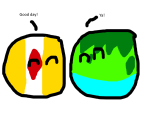 Made by Lim1345 (Fandom), c. 2021


Notes
https://i.epochtimes.com/assets/uploads/2017/12/JPN-T-171207.pdf#page5
https://www.reddit.com/r/vexillology/comments/uyqj0y/may_contest_winners_thread/

