Soviet Union in World War II: Difference between revisions
No edit summary |
|||
| Line 43: | Line 43: | ||
The Winter War took place from November 30, 1939, to March 13, 1940, between the Soviet Union and [[File:Finland-icon.png]] [[Finland]]. The war began when the Soviet Union invaded [[File:Finland-icon.png]] [[Finland]] after he refused to give up territory. Despite being very outnumbered, the [[File:Finland-icon.png]] [[Finland|Finnish]] forces used clever tactics and the harsh winter to slow down the Soviet advance. The snipers of [[File:Finland-icon.png]] [[Finland]] are known for taking out huge amounts of Soviet troops. | The Winter War took place from November 30, 1939, to March 13, 1940, between the Soviet Union and [[File:Finland-icon.png]] [[Finland]]. The war began when the Soviet Union invaded [[File:Finland-icon.png]] [[Finland]] after he refused to give up territory. Despite being very outnumbered, the [[File:Finland-icon.png]] [[Finland|Finnish]] forces used clever tactics and the harsh winter to slow down the Soviet advance. The snipers of [[File:Finland-icon.png]] [[Finland]] are known for taking out huge amounts of Soviet troops. | ||
The war ended with the Moscow Peace Treaty, where [[File:Finland-icon.png]] [[Finland]] had to give up 11% of his land but kept his independence. Still, Soviet Union was humiliated because no one ever thought that tiny [[File:Finland-icon.png]] [[Finland]] would cause so much Soviet casualties. | The war ended with the Moscow Peace Treaty, where [[File:Finland-icon.png]] [[Finland]] had to give up 11% of his land but kept his independence. Still, Soviet Union was humiliated because no one ever thought that tiny [[File:Finland-icon.png]] [[Finland]] would cause so much Soviet casualties.{{Quote|If we keep throwing men at bullets, they will run out of bullets.|[[File:USSR-icon2.png]] [[Union of Soviet Socialist Republics|Soviet Union]]’s strategy during the Winter War, probably}} | ||
=== Fight Against the Axis === | === Fight Against the Axis === | ||
Revision as of 18:16, 28 September 2024
Template:ViolentThis page about the history of the USSR during WWII. For the main article of this character, see Union of Soviet Socialist Republics.Template:CountryInfo
—  Complete History of the Soviet Union, Arranged to the Melody of Tetris Complete History of the Soviet Union, Arranged to the Melody of Tetris
|


The Soviet Union’s participation in World War II was important in defeating the  Axis Powers. His role in the conflict was multifaceted and impactful on several fronts. Initially allies with the
  German Third Reich to split up
  Poland, he switched teams when Nazi betrayed him and invaded him.
History
Invading Poland & Finland
In 1939, the Soviet Union signed the  Molotov-Ribbentrop Pact with Nazi Germany, a non-aggression treaty that included secret protocols dividing Eastern Europe. When Nazi Germany requested for him to invade Poland, he first hesitated. Soviet Union believed that Poland was more ready for war then he actually is, plus, Soviet’s army was still fighting
  Japan. But everything would resolve itself when the Japan heard about the Molotov-Ribbentrop Pact. Japan was hoping on allying with the German Third Reich against Soviet, but the non-aggression pact made it not possible. So Japan decided to not fight anymore. As a result, the Soviets invaded Poland from the east shortly after Germany's invasion from the west, effectively annexing territory according to the pact's provisions.
The Winter War took place from November 30, 1939, to March 13, 1940, between the Soviet Union and  Finland. The war began when the Soviet Union invaded Finland after he refused to give up territory. Despite being very outnumbered, the Finnish forces used clever tactics and the harsh winter to slow down the Soviet advance. The snipers of Finland are known for taking out huge amounts of Soviet troops.
The war ended with the Moscow Peace Treaty, where Finland had to give up 11% of his land but kept his independence. Still, Soviet Union was humiliated because no one ever thought that tiny Finland would cause so much Soviet casualties.
“”If we keep throwing men at bullets, they will run out of bullets.
|
—  Soviet Union’s strategy during the Winter War, probably Soviet Union’s strategy during the Winter War, probably
|
Fight Against the Axis
In 1941, Operation Barbarossa began as Nazi Germany launched a massive invasion of the Soviet Union, breaking the Molotov-Ribbentrop Pact. The surprise attack caught the Soviets off guard, and the Germans advanced rapidly into Soviet territory, leading to brutal sieges such as the one at  Leningrad. However, Soviet resistance stiffened, and the tide began to turn with decisive victories at
  Moscow and
  Stalingrad in 1942.
Battle of Stalingrad
The Battle of Stalingrad, fought from August 23, 1942, to February 2, 1943, was a pivotal confrontation between Nazi Germany and the Soviet Union during World War II. Stalingrad, a key industrial city on the  Volga River, held strategic importance for both sides. The battle began with a massive German assault aimed at capturing the city and securing vital oil fields in the Caucasus. However, the Soviets fiercely defended Stalingrad, engaging in intense urban warfare characterized by street-to-street fighting and close-quarters combat. The battle reached its climax in November 1942, when Soviet forces launched a counteroffensive, encircling the
  German Sixth Army inside the city. Cut off from supplies and reinforcements, the German forces faced dire conditions, including harsh winter weather and Soviet bombardment. Despite
  Hitler's refusal to allow a retreat, the
  German army surrendered in February 1943, marking a turning point in the war. The Battle of Stalingrad was a decisive Soviet victory, halting the German advance and boosting
  Allied morale while inflicting heavy casualties on the Axis Powers.
Defeating the Axis
The year 1943 saw the Soviets achieve a significant victory at the Battle of  Kursk, effectively ending German hopes of a successful offensive on the Eastern Front. In 1944, the Soviet Union launched offensives that pushed the Germans back and "liberated" territories in Ukraine and Eastern Europe. What these territories don’t know is that they’ll be under worse rule after the war. Meanwhile, the Allies launched the D-Day invasion of
  Normandy, opening a second front against Nazi Germany.
In 1945, the Soviet Union launched the Vistula-Oder Offensive, pushing deep into German territory and capturing  Warsaw. By April, Soviet troops encircled
  Berlin, leading to the Battle of Berlin and Adolf Hitler's suicide in his bunker. Germany surrendered unconditionally on May 8, marking the end of World War II in
  Europe. The Soviet Union emerged as one of the victorious Allied Powers, but the war left the country devastated, with over 20 million lives lost.
Relations
Enemies
 Finland - HOW? YUO LITTLE RAT! YUO THINK YUO SO SLICK WHILE SNIPING! I STILL DEFEATED YUO!!
-
 Look at the number of casualties.
 German Third Reich - YUO TRATIOR! I THOUGHT WE HAD NON-AGRESSION PACT!! YUO KILLED 20 MILLION OF MY PEOPLE
 not that I care about them or anything,1945 BEST YEAR OF MY LIFE!!! Polish Underground State - So what if I massacre your peoples, huh? Poland is must be into
  communist!


How to draw

- Draw a ball.
- Fill it with red.
- Draw the emblem of the sickle and hammer in the top left of the ball in yellow.
- Draw the eyes and you are done!
- Draw a ushanka or general's hat with the communist star or hammer and sickle on it (optional)
| Color Name | HEX | |
|---|---|---|
| Red | #CD0000 | |
| Yellow | #FFD700 | |
Gallery
-
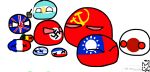 On Magma’s Art Jam
 -
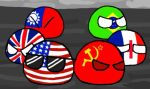 ALLIES


