Beiyang Government: Difference between revisions
| Line 112: | Line 112: | ||
IMG 3235.png | IMG 3235.png | ||
Beiyang comic.jpeg | Beiyang comic.jpeg | ||
WW1.png|WORLD WAR ONE | |||
</gallery> | </gallery> | ||
Latest revision as of 04:21, 11 July 2026
“”China is so tired of being
 bossed around that they deleted bossed around that they deleted  their old government and make a new, stronger government, which is accidentally weaker and controlled by a their old government and make a new, stronger government, which is accidentally weaker and controlled by a  guy from the previous government. guy from the previous government. |
—  Bill Wurtz, History of the entire world, I guess Bill Wurtz, History of the entire world, I guess
|
The Beiyang government was the internationally recognized government of the  Republic of China between 1912 and 1928, based in
  Beijing. He was dominated by the generals of the
  Beiyang Army, giving him his name.
Dispite the name suggesting that Beiyang was a  centralized government with control over all China, the government was heavily influenced by
  regional warlords, leading to a lack of effective central governance and contributing to widespread
  corruption. Different factions often competed and warred for legitmency. His reliance on
  military strength over popular support fostered an environment ripe for conflict, with various factions vying for power and control.
History
Beginnings (1912-1920)
On 10 March 1912, Yuan Shikai, leader of the Beiyang Army, became provisional president while located in Beijing, his power base. He refused to move to  Nanjing, fearing further assassination attempts. It was also more economical to keep the existing Qing bureaucracy in Beijing, so the provisional senate moved north as well; the government thereby began the administration from Beijing on 10 October 1912.
On the second year of the Republic of China (1913), October 6, Yuan Shikai was elected as the first president of the Republic of China, marking the official establishment of the Beijing government and the end of the provisional government. Also in 1913, the  southern provinces revolted against Beiyang and Yuan in what's known as the "Second Revolution", however it failed.
In 1915, Yuan Shikai tried to restore the  monarchy by founding the
  Empire of China, but this failed quickly because the people just got rid of a monarchy and weren't ready to have another one. So in 1916 the Empire of China collapsed and China broke into several warlords and armies, most of them loyal to the Beiyang Government. Over time, these warlords grouped together in shifting alliances known as "cliques". From this until "reunification" was known as the Warlord Era. Beiyang also tried to create a national army, but the southerners were distrustful to Beiyang, and no progress was made on this issue.
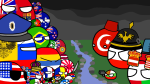
Some factions were opposed to joining WWI, but still in the end Beiyang government declared war on the  Central Powers in August 1917 and began sending labor battalions to
  France and a token force to
  Siberia.
  Duan Qirui, the premier of the Beiyang government (had only de-facto control over Northern China) got huge loans from
  Japan, claiming to build an army of a million men to send to Europe to fight. His rivals, however, knew that this army would not be leaving the country and would be used to crush dissent.
Mid-Late Warlord Era (1920-1928)
By the 1920s, what was left of the Beiyang government has completely collapsed, and Beiyang now exists in name only. Warlords now owned the land that was once controlled by Beiyang, and different factions fought against each other. Regional military governors backed by private armies competed for power, influence and weapons. The central government at Beijing served at the whim of whichever general that happened to hold the city. China was in complete chaos.
By 1920, there were four major cliques:  Fengtian in the north,
  Zhili in the central region,
  Anhui at the coast, and the KMT in the south. The cliques of Zhili and Anhui warred for control over the Beiyang government. Zhili, allied with the Fengtian Clique, won after a little more than a week and destroyed the Anhui Clique. The Beiyang Army was now permanently broken up.
The powerful Fengtian Clique was running  Manchuria as his personal fiefdom. The victory of Zhili in the Anhui-Zhili war of 1920 benefited Fengtian greatly, even though his forces didn't do much of the fighting. He gained extensive new territory in
  Inner Mongolia and northern
  Zhili, as well as stores of weaponry. He also developed Manchuria's economy by building up industry and arsenals. By 1920 71% of Fengtian's income was going towards his army. The loyalty of Fengtian's men varied, but compared to the armies of other cliques, the Fengtians were more trained, equipped, well-fed and modern. By 1922, Fengtian had 100,000 troops. This was largely due to
  Japanese support. Japan had big plans for Manchuria, and hoped Fengtian could collaborate.
In 1921, the Nationalist government was established, serving as an opposition to the Beiyang government for the control of China.
Despite the plans that the Japanese had, Fengtian's ambitions were bigger, and the weak central government has heavily influenced by him. Rumors spread through China that the central government was nothing more than a bunch of Fengtian  puppets. This started to worry Zhili, who ruled most of China together with Fengtian as the de-facto Beiyang government together. Zhili was the mastermind behind victory over Anhui, so he felt like Fengtian's power hasn't been earned. The two cliques had grown suspicious of each other, and they were denouncing each other in public. Zhili accused Fengtian of being a Japanese puppet. Of course, the Japanese weren't the only foreign powers involved, as countries like
  UK, France and
  Italy with their companies gave occasional support to local warlords. But Japan and the
  USSR became the most influential foreign players.
Foreign support wasn't about ideology, it was about power. Japan had offered Zhili and Anhui support before, but Anhui refused because he was working with the Italians. Fengtian wanted to expand, but Japan wanted him to stay in Manchuria to help solidify Japanese influence. Fengtian relied on Japan military-wise, and Japan wasn't too happy about the  nationalistic goals Fengtian was trying to achieve. Many European arm dealers made a fortune selling surplus equipment to warlords after the end of WWI.
First Zhili-Fengtian War broke in 1922, as all alliances at the time were basically only formed due to a common enemy. Zhili being the smart clique he is, came out victorious, with low casualties.
Northern China, where all the Beiyang cliques are, was overtaxed and had too many fighting warlords. So Beiyang's economy died between 1927 and 1928. Plus, general  Chiang Kai-she's, leader of the KMT, started the Northern Expedition in 1926 and was successful in overthrowing the Beiyang government in 1928.
Relationships
Friends
 Empire of Japan - Supported me against
  these revolutionaries
  .
.

Enemies
 Nationalist Government - You think you’ve won, don’t you? You call yourself the true heir of the Republic, but I was here first. It was MY armies that held China together after the fall of the
  Qing! Without me, you would have been nothing more than a band of idealists preaching revolution in the south.

Trivia
- Many people confuse the Beiyang flag as a
 LGBTQ+ flag, even though the Beiyang flag was made way before the LGBT movement solidified.
 - Some presidents of the Beiyang Government lasted only a few weeks before being kicked out by the next warlord.

Flag
The flag that the Beiyang government used is called "Five Races Under One Union", with the red representing the  Han Chinese, yellow the Manchus, blue the
  Mongols, white the
  Hui Muslims (later is also represented
  Uyghurs and all other
  Muslim minorities), and black the
  Tibetans. This set of symbolism would later be adopted by
  Manchukuo, who changed it up a bit.
Despite the Xinhai uprising targeting a Manchu-dominated regime, the flag and its supporters unanimously advocated racial integration. They promoted a view of the non- Han ethnicities as also being Chinese, despite them being a relatively small percentage of the population.
How to draw

Beiyang Government has a drawing rating of easy.
- Draw a ball.
- Divide the ball into five stripes horizontally.
- Fill in these colours for the stripes from top to bottom: red, yellow, blue, white, black.
- Add Chinese eyes and done!
| Color Name | HEX | |
|---|---|---|
| Red | #DE2119 | |
| Yellow | #FFC500 | |
| Blue | #08639C | |
| White | #FFFFFF | |
| Black | #000000 | |
Gallery
-

-

-

-
-

-
-

-

-

-
 WORLD WAR ONE


