Interwar and World War II United States
This page about the history of the US during WWI and WWII. For the main article of this character, see
United States of America.
—  Woodrow Wilson Woodrow Wilson
|
Interwar and World War II United States refers to the period from 1917 to 1945, when the United States experienced World War I, the Interwar Period, the Great Depression, and World War II. This would be the time period in which the United States would come out of  isolationism, rise above all the previous powers, eventually becoming one of the two
  world superpowers at the end of 1945.
In both of the World Wars, United States' participation radically advanced the progress of his allies. The US fought side by side by the  Entente Powers and
  Allied Powers, he absolutely destroyed the
  German Empire, and played an very important role in defeating the
  Nazis and the
  Japanese.
This era is where America began to be referred to as a " democracy". Before, America was referred to as a
  republic, like the Founding Fathers intended, who also insisted that America was not a democracy. However, by this time, the word's meaning began to change, from originally meaning "everyone participates" to now used so broadly as referring to anything where everybody is represented, which is partially due to the
  socialist movements who used "democracy" instead of "socialism" due to the latter getting a horrid reputation after the
  Bolsheviks seized power in
  Russia and slaughtered people everywhere. And with the President using this term to enter WWI, the word would be equated with America's system.
History
World War I
Is Neutrality Really Worth It?
At the outbreak of the Great War in 1914, the United States initially pursued a policy of  neutrality, aiming to avoid entanglement in the conflict engulfing
  Europe. However, as the war progressed and tensions escalated, maintaining neutrality became increasingly challenging. Plus, unrestricted submarine warfare conducted by Germany, which led to the sinking of civilian ships including the RMS
  Lusitania in 1915, resulted in American casualties and escalating
  anti-German sentiment.
Towards the end of WWI, the German Empire deployed  Lenin to
  Russia and kicked him out of the battlefield. This made Germany very confident, but he realizes that there was another rising power in the west that needs to be taken care of. Germany sent the
  Zimmermann Telegram to
  Mexico, asking him to for a military alliance against the United States on 17 January 1917 in exchange for some American states. The
  Brits intercepted it and showed it to the US.
This was America's last straw.
Into the Battlefields
The formal entry of the United States into the war came on 6 April 1917, after President Woodrow Wilson's request to Congress for a declaration of war against Germany. Wilson framed the conflict as a crusade to make the world "safe for democracy," appealing to both idealistic and  pragmatic sentiments. The publicly stated goals were to uphold
  American honor, crush German
  militarism, and reshape the postwar world. The
  U.S. military, initially small and underprepared having not fought any major wars since 1865, underwent rapid expansion and mobilization. The Selective Service Act of Spring 1917 was authorized, drafting of four million American
  men and significantly bolstering the ranks of the
  American Expeditionary Forces (AEF) under Genera; John J. Pershing.
The war saw many  women taking what were traditionally men's jobs for the first time. Many worked on the assembly lines of factories, producing tanks, trucks and munitions. For the first time, department stores employed
  African American women as elevator operators and cafeteria waitresses. The
  Food Administration helped housewives prepare nutritious meals with less waste and with optimum use of the foods available. Most important, the morale of the women remained high, as millions joined the
  Red Cross as volunteers to help soldiers and their families. With rare exceptions, the women did not protest the draft.
The AEF played a crucial role in the latter stages of the war, particularly in 1918, providing fresh troops and much-needed support to the exhausted Allied forces on the Western Front, supplying badly needed financing, food, and millions of fresh and eager soldiers, arriving at the rate of 10,000 per day. American forces participated in several key offensives, including the Battle of  Cantigny (28 May 1918, the first major American battle and offensive), Battle of
  Belleau Wood (1-26 June 1918), and the
  Meuse-Argonne
  Offensive (26 September-11 November 1918), which was one of the final and most significant operations leading to the armistice on 11 November 1918. The presence of American troops helped to shift the balance of power, boosting Allied morale and contributing greatly to the ultimate defeat of the
  Central Powers.
On the home front, the war effort prompted significant economic and social changes. The US government mobilized industry through the War Industries Board, ensuring efficient production and supply of war materials. The war also spurred advancements in technology and manufacturing, while  propaganda campaigns encouraged public support and participation in the
  war effort. Furthermore, the conflict had lasting impacts on American society, including the acceleration of the Great Migration, as African Americans moved northward for war-related jobs.
End of the Great War
After WWII ended in 1918, President Wilson played a key role in the  Paris Peace Conference and the drafting of the Treaty of Versailles, advocating for his Fourteen Points and the establishment of the
  League of Nations. Wilson had a vision for a lasting peace and a
  new international order.
A popular Tin Pan Alley song of 1919 asked, concerning the United States troops returning from World War I, "How Ya Gonna Keep 'em Down on the Farm (After They've Seen Paree)?". In fact, many did not remain "down on the farm"; there was a great migration of youth from farms to nearby towns and smaller cities. The average distance moved was only 10 miles (16 km). Few went to the cities with over 100,000 people. However, agriculture became increasingly mechanized with widespread use of the tractor, other heavy equipment, and superior techniques disseminated through County Agents, who were employed by state agricultural colleges and funded by the Federal government.
That same year, Wilson tried to convince  Congress to approve the Treaty of Versailles and allow the United States to join the League of Nations, the international organization he helped create to prevent future wars. He refused to accept compromises proposed by
  Republicans, and the treaty failed because it did not receive enough votes. While traveling across the country to promote the League, Wilson suffered several strokes. He never fully recovered and lost much of his ability to lead or negotiate. As a result, the
  Senate rejected the treaty, and the United States never joined the League of Nations.
After the war,  Germany was left politically unstable and deeply in debt due to the heavy reparations he was required to pay to the victorious countries. Britain and
  France, in turn, owed large sums of money to the United States for war loans. To stabilize Germany's
  economy, American and British banks provided loans under the Dawes Plan. This helped Germany rebuild his industry and pay reparations. During the 1920s, both European and American economies grew rapidly, reaching new levels of production and prosperity.
Interwar Period
The interwar period can be divided into subperiods, and is usually not considered a period on itself at all in US  history, unlike in other countries such as France.
1919: Strikes, Riots, Scares
Urban America was in turmoil throughout 1919. The huge number of returning veterans could not find work, something the Wilson administration had given little thought to. After the war, fear of subversion resumed in the context of the  Red Scare, massive strikes in major industries (steel, meatpacking) and violent
  race riots. Radicals bombed Wall Street, and workers went on strike in
  Seattle in February. During 1919, a series of more than 20 riotous and violent black-white race-related incidents occurred. These included the
  Chicago,
  Omaha, and
  Elaine Race Riots.
A phenomenon known as the Red Scare took place in the US from 1918 to 1919. With the rise of violent  Communist revolutions in Europe, leftist radicals were emboldened by the Bolshevik Revolution in Russia and were eager to respond to Lenin's call for
  world revolution. On 1 May 1919, a parade in
  Cleveland protesting the imprisonment of the
  Socialist Party leader,
  Eugene Debs, erupted into the violent May Day Riots. A series of bombings by the far left in 1919 and assassination attempts further inflamed the situation. Attorney General
  A. Mitchell Palmer conducted the Palmer Raids, a series of raids and arrests of non-citizen socialists,
  anarchists,
  radical unionists, and immigrants, charging them with planning to overthrow the government. By 1920, over 10,000 arrests were made, and the immigrants caught up in these raids were deported back to Europe, most notably the anarchist
  Emma Goldman, who years before had attempted to assassinate industrialist
  Henry Clay Frick.
Women's Suffrage
Main article:
Women's Suffrage

During WWI,  Women's rights advanced, highlighted by their critical contributions to the workforce. After a long period of agitation, US women were able in 1920 to obtain the necessary votes from a majority of men to obtain the right to vote in all state and federal elections. Women participated in the 1920 presidential and congressional elections. The 19th Amendment was passed, officially granting women's right to vote.
 Politicians responded to the new electorate by emphasizing issues of special interest to women, especially
  prohibition, child health, public schools, and world peace. Women did respond to these issues, but in terms of general voting they shared the same outlook and the same voting behavior as men.
Second KKK
In the 1910s-1920s, the  Second Klan, a powerful revival of the infamous
  white nationalist hate group, peaked in the U.S. and claimed some 3-6 million members and significant political influence, promoting
  Protestantism and opposing
  Catholics,
  Jews and blacks before rapidly declining by the late 1920s due to
  sexual and
  financial scandals and public backlash.
Roaring Twenties
Between the First and Second World Wars, the United States experienced significant  social, economic, and political changes. In the U.S.
  presidential election of 1920, the Republican Party returned to the White House with the landslide victory of
  Warren G. Harding, who promised a "return to normalcy" after the years of war,
  ethnic hatreds, race riots and
  exhausting reforms. Harding used new advertising techniques to lead the GOP to a massive landslide, carrying the major cities as many
  Irish Catholics and
  Germans, feeling betrayed, temporarily deserted the
  Democrats.
The 1920s, often referred to as the "Roaring Twenties", was a decade of economic prosperity, technological advancements, and cultural flourishing, marked by the widespread adoption of automobiles, radios, and  jazz music. Except for a recession in 1920-21, the economy enjoyed a long period of prosperity. New industries flourished especially electric power, movies, automobiles, gasoline, tourist travel, highway construction, and housing. The stock market was up, everyone was happy, they partied every night and employment was at an all-time high. On 17 January 1920, under the 18th Amendment passed back in 1919, the US banned the production, importation, transportation, and sale of
  alcoholic beverages, starting the Prohibition era.
Agriculture went through a bubble in soaring land prices that collapsed in 1921, and that sector remained depressed. Coal mining was shrinking as oil became the main energy source. Otherwise all sectors prospered and had a good time. Construction flourished as office buildings, factories, paved roads, and new housing was evident everywhere. Automobile production soared, suburban housing expanded and the nation's homes, towns and cities were electrified, along with some farms. Prices were stable, and the Gross Domestic Product (GDP) grew steadily until 1929, when the financial speculation bubble burst as Wall Street crashed.
Great Depression
The period of growth known as the Roaring Twenties ended abruptly with the Stock Market Crash of 1929, a sudden collapse of U.S. stock prices that wiped out billions of dollars in wealth and helped usher in the Depressing Thirties Great Depression, a time of severe economic hardship, high unemployment, and widespread poverty throughout the 1930s. The US tried to recover and help the victims, and President  Franklin D. Roosevelt implemented the New Deal, a series of programs and reforms that
  expanded government control and involvement in American life. These initiatives aimed at economic recovery, financial reform, direct relief for the unemployed and poor through public works programs,
  banking regulations,
  social welfare policies, and labor protections. While the New Deal restored confidence in the financial system and provided immediate assistance to millions, it failed to end the Depression and may have prolonged economic stagnation by discouraging private investment and market adjustment.
Politically, the era saw the rise of isolationist sentiments, again. Traumatized by the costs of World War I and focused on domestic recovery, many Americans opposed foreign entanglements and resisted involvement in international conflicts, a stance reinforced by neutrality legislation and widespread public opinion during the decade.
In 1932, the " Bonus Army" (a group of World War I veterans) marched on  Washington, D.C. demanding early payment of promised service bonuses. They were forcibly removed by the U.S. Army under President
  Hoover.
The nadir of the Great Depression occurred in 1933, when unemployment peaked and economic output reached its lowest point. The same year, under the 21st Amendment alcohol was unbanned. In 1934, the Banana Wars ended. A partial recovery of the economy followed over the next several years, aided by New Deal spending and monetary reforms, but this progress was interrupted by the recession of 1937-38, which exposed the fragility of the recovery. Unlike the 1920s, the 1930s saw no major new industries large enough to drive sustained economic expansion; automobiles, electrification, and construction had already matured, leaving the economy without a comparable engine of growth until the mobilization for World War II at the end of the decade.
World War II
“”No man can tame a tiger into a kitten by stroking it. There can be no appeasement with ruthlessness. There can be no reasoning with an incendiary bomb. We know now that a nation can have peace with the
Nazis only at the price of total surrender. |
| — Franklin D. Roosevelt
|
The United States' involvement in World War II was pivotal in determining the outcome of the conflict and reshaping  global politics. Initially adhering to a policy of neutrality, the US sought to avoid entanglement in the growing hostilities in Europe and
  Asia throughout the 1930s, just like how he did in WWI. This stance was solidified through a series of Neutrality Acts aimed at preventing the kind of entanglements that had drawn the nation into World War I. However, as the
  Axis Powers expanded aggressively, President Franklin D. Roosevelt began to prepare the country for the possibility of war. He tried to avoid repeating what he saw as Woodrow Wilson's mistakes in World War I, often making exactly the opposite decision. Wilson called for neutrality in thought and deed, while Roosevelt made it clear his administration strongly favored Britain and
  China, also emphasizing the need to support the Allies through measures like the Lend-Lease Act of 1941, which provided critical aid to nations like Britain and the
  Soviet Union. This kept Britain and USSR fed and fueled throughout the war.
On 16 June 1941, after negotiation with  Churchill, Roosevelt ordered the United States occupation of
  Iceland to replace the British invasion forces.
The turning point for American involvement and Allied victory came on 7 December 1941, when  Japan launched a surprise attack on the US naval base at Pearl Harbor,
  Hawaii. This devastating assault resulted in significant loss of life and damage to the
  Pacific Fleet, which enraged the US, galvanized American public opinion, and prompted a swift response. On 8 December 1941, the United States declared war on Japan, and shortly thereafter, Germany and
  Italy declared war on the United States, bringing America fully into World War II on both the Pacific and European fronts. The US also started rapidly producing military equipment, war ships, planes, tanks and much more, also ending the Great Depression in the process. USA shipped 2,000 locomotives, 11,000 railcars, 400,000 trucks, 14,000 aircraft, and $210 billion in total supply to the USSR (factoring inflation), and effectively rebuilt the Soviet supply network for the war effort.
In the European Theater, American forces initially focused on the North African Campaign, successfully pushing Axis forces out of the region by 1943. The subsequent invasion of Italy was a crucial step in weakening Axis positions in Europe. One of the most significant contributions came on 6 June 1944, known as D-Day, when Allied forces, including a substantial number of American troops, launched the largest amphibious invasion in history on the beaches of  Normandy,
  France. This operation was a turning point that led to the liberation of
  Western Europe from Nazi control. American cloth, steel and meat kept the
  Red Army clothed, equipped and fed while they marched into
  Berlin
 and . American forces continued to advance through France and into Germany, eventually defeat of Nazi Germany in May 1945.
 raped all their women
The U.S. was also secretly working on atomic weapons in the  Manhattan Project program, hoping to make them before the Germans figures out how.
In the Pacific Theater, USA funded the Chinese defense effort while soloing the  Imperial Japanese Navy. America adopted an island-hopping strategy to gradually reclaim territory from Japanese control. Key battles included the Battle of
  Midway in 1942, which turned the tide in favor of the Allies, and the grueling campaigns at Guadalcanal, Iwo Jima, and
  Okinawa. Each victory brought American forces closer to Japan.
On 12 April 1945, FDR, who had clung on to power since 1933 due to war reasons, died.  Harry S. Truman takes over. The Nazis were crumbling and
  Hitler tried negotiating with the new administration, to no avail.
Japan sees surrendering as dishonorable and was determined to fight until his last breath, so not wanting the war to drag on and potentially threaten the American mainland, the decision to use atomic weapons was made. The bombs named "Little Boy" and "Fat Man" were dropped on the cities of  Hiroshima and
  Nagasaki in August 1945. These bombings, coupled with the Soviet Union's declaration of war on Japan, led to Japan's unconditional surrender on 15 August, effectively ending World War II and ushering in a new era where America becomes a world power and dominated half of the globe.
List of Leaders
| Name | Number | Party | Years |
|---|---|---|---|
| Woodrow Wilson |
1 (28th) | Demoratic Party |
1917-1921 |
| Warren G. Harding |
2 (29th) | Republican Party |
1921-1923 |
 Calvin Coolidge Calvin Coolidge |
3 (30th) | Republican Party |
1923-1929 |
| Herbert Hoover |
4 (31st) | Republican Party |
1929-1933 |
| Franklin D. Roosevelt |
5 (32nd) | Demoratic Party |
1933-1945 |
| Harry S. Truman |
6 (33rd) | Demoratic Party |
1945-1945 |
Relationships
Friends
 United Kingdom - Great ally, the strongest
  Western European. Respects to you for you survived
  Nazi's rampage.
 Soviet Union - Though we have different ideologies, I gave you lots of equipment and we stand united against
  Fascism. But I see those eyes on
  Eastern Europe, and we're going to have issues later, comrade.
 Republic of China - Fought bravely against the
  Japanese monsters for eight years straight. I will fund your effort.


Enemies
 German Empire -You sank my civilian ships! I WILL CRUSH YOU INTO AN ACCORDION AND BEAT YOU UP!
- German Third Reich - Looks like you've gone insane again! STOP INVADING MY FRIENDS! STOP KILLING
 JEWS! REMOVE
  HITLER! Do have to teach you this lesson again??
  Empire of Japan - You really thought attacking Pearl Harbor was a good idea? REMOVE KAMIKAZE!!! GET NUKED!!!!
 Vichy France - France but with
  fascist seasoning. You shot at me in North Africa. Not cool.
 Socialist Party of America - Violent
  commies GTFO!!!!


How to Draw

Interwar and World War II United States has a drawing rating of intermediate.
There is no specific shade of colors needed to draw the flag of USA. So, you can draw in any shade of red, white and blue you want! But the preferable shades are listed below.
- Draw a ball.
- Draw 7 red stripes separated by 6 white stripes.
- Draw a small blue rectangle covering the left of 4 red stripes.
- Draw 48 stars (or dots if you are lazy) inside the blue rectangle.
- Draw a pair of sunglasses on the ball and you are done!
| Color Name | HEX | |
|---|---|---|
| Independence (American Blue) | #002664 | |
| Upsdell Red (American Red) | #BB133E | |
| #FFFFFF | ||
Gallery
-
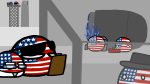 Manhattan Project
 -
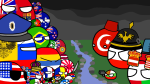 World War I
 -
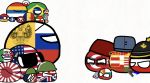 World War I
 -
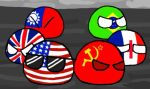 Allies gang
 -
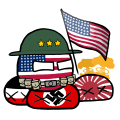 To be modified and used for something else…
 -

-
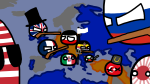
-

-
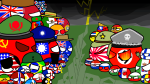


See Also
Navigation
States |  Alabama • Alabama •  Alaska • Alaska •  Arizona • Arkansas • Arizona • Arkansas •  California • California •  Colorado • Colorado •  Connecticut • Connecticut •  Delaware • Delaware •  Florida • Florida •  Georgia • Hawaii • Georgia • Hawaii •  Idaho • Idaho •  Illinois • Illinois •  Indiana • Indiana •  Iowa • Iowa •  Kansas • Kansas •  Kentucky • Kentucky •  Louisiana • Louisiana •  Maine • Maine •  Maryland • Maryland •  Massachusetts • Massachusetts •  Michigan ( Michigan ( Yooper) • Yooper) •  Minnesota • Minnesota •  Mississippi • Mississippi •  Missouri • Missouri •  Montana • Montana •  Nebraska • Nebraska •  Nevada • Nevada •  New Hampshire • New Hampshire •  New Jersey • New Jersey •  New Mexico • New Mexico •  New York • New York •  North Carolina • North Carolina •  North Dakota • North Dakota •  Ohio • Ohio •  Oklahoma • Oklahoma •  Oregon • Oregon •  Pennsylvania • Pennsylvania •  Rhode Island • Rhode Island •  South Carolina • South Carolina •  South Dakota • South Dakota •  Tennessee • Tennessee •  Texas • Texas •  Utah • Utah •  Vermont • Vermont •  Virginia • Virginia •  Washington • Washington •  West Virginia • West Virginia •  Wisconsin • Wisconsin •  Wyoming Wyoming | ||||
|---|---|---|---|---|---|
| Cities |
| ||||
| Historical Entities | |||||
| Historical Eras | |||||
| Military | |||||
| Theories | |||||
In | |||||


-icon.png)


