


Solidify our golden empire,
Follow the will of  Heaven,
All of creation will celebrate,
All of mankind will be filled with happiness.
As long as the Qing rules,
May the enlightened empire,
And its vast boundary be protected.
The sky is high,
The sea is turbulent.
Qing Dynasty: Difference between revisions
From Heterodontosaurus Balls
| (119 intermediate revisions by 4 users not shown) | |||
| Line 1: | Line 1: | ||
{{ | {{Infobox | ||
|Name = | |Name= {{i|Qing}} Great Qing {{i|QingNew}}{{I|Qing alt}} | ||
|NativeName = {{ILSize|ManchuL-icon.png|Manchu Language}}: ᡩᠠᡳ᠌ᠴᡳᠩ ᡤᡠᡵᡠᠨ<br>{{ILSize|ChineseL-icon.png|Chinese Language}}: 大清帝國 | |NativeName= {{ILSize|ManchuL-icon.png|Manchu Language}}: ᡩᠠᡳ᠌ᠴᡳᠩ ᡤᡠᡵᡠᠨ<br>{{ILSize|ChineseL-icon.png|Chinese Language}}: 大清帝國 | ||
|founded = 1644 | |founded= 1644 | ||
|predicon = Ming | |predicon= Ming | ||
|onlypredecessor = Ming Dynasty | |onlypredecessor= Ming Dynasty | ||
|ended = 1912 | |ended= 1912 | ||
|nexticon = Beiyang | |nexticon= Beiyang | ||
|onlysuccessor = Republic of China | |onlysuccessor= Republic of China | ||
|image = Qing Dynasty.png | |image= Qing Dynasty.png | ||
|Caption = Great Qing will unify the rivers and mountains once more! | |Caption= Great Qing will unify the rivers and mountains once more! | ||
|Alias = {{ | |Alias= {{Scroll|{{i|Qing}} Qing<br>{{i|Qing}} Qing China<br>Ching dynasty<br>Ch'ing dynasty<br>Great Purity<br>The {{I|Manchu}} [[Manchus|Manchus]]<br>{{i|Manchu}} [[Manchus|Manchu]] Dynasty<br>{{i|China}} [[China]]}} | ||
|Time | |Time= 1644 – 12 February 1912 | ||
|Government = [[ | |Government= {{I|AbMon}} [[Absolute Monarchism|Absolute Monarchy]] (1644-1911)<br>{{i|ConMon}} [[Constitutional Monarchism|Constitutional Monarchy]] (1911-1912) | ||
|Languages = | |Languages= {{I|ManchuL}} [[Manchu Language|Manchu]]<br>{{I|ChineseL}} [[Chinese Language|Chinese]]<br>{{i|ClassMongolL}} [[Classical Mongolian Language|Classical Mongolian]]<br>{{i|TibeticL}} [[Tibetic Languages|Tibetic]] | ||
|Religions = {{ | |Religions= {{Scroll| | ||
*{{I|Confucianism}} [[Confucianism]] | |||
* | *{{I|Buddhism}} [[Buddhism]] | ||
** | **{{I|ChineBudd}} [[Chinese Buddhism]] | ||
**[[ | **{{I|Vajrayana}} [[Vajrayāna|Mongolian Buddhism]] | ||
** | **{{I|TibetBudd}} [[Tibetan Buddhism]] | ||
* | *{{I|Taoism}} [[Taoism]] | ||
*[[ | *{{I|Chinese}} [[Chinese Folk Religion]] | ||
*[[ | *{{I|Shamanism}} [[Shamanism]] | ||
*[[ | *{{I|Islam}} [[Islam]] | ||
*{{I|Christi}} [[Christianity]] | |||
| | }} | ||
| | |Gender= Male | ||
|Capital= {{i|Beijing}} [[Beijing|Peking]] | |||
| | |Friends= {{Scroll|{{I|Joseon}} [[Joseon]]<br>{{I|Lanfang Republic}} [[Lanfang Republic]]<br>{{I|Brazil Emp}} [[Empire of Brazil]]<br>{{I|Ottoman}} [[Ottoman Empire]]<br>{{I|Boxer}} [[Boxer Movement]] (usually)<br>{{I|USA}} [[United States of America|United States]] (sometimes)<br>{{I|Manchu}} [[Manchus]]}} | ||
| | |Enemies= {{Scroll|{{I|Ming}} [[Ming Dynasty]]<br>{{I|Yuan}} [[Northern Yuan]]<br>{{I|Dzungar}} [[Dzungar Khanate]]<br>{{I|Portuguese Empire}} [[Portuguese Empire]]<br>{{I|Bogd Khan}} [[Bogd Khanate of Mongolia]]<br>{{I|Kuomintang}} [[Republic of China|XINHAI REBELS!!]]<br>{{i|Taiping}} [[Taiping Heavenly Kingdom|Lunatic Christian Heresy]]<br>{{i|British Raj}} [[British Raj]]<br>{{I|Lesser Japanese Empire}} [[Empire of Japan]]<br>{{I|Tsarism}} [[Russian Empire|Tsarist Russia]]<br>{{I|British Empire}} [[British Empire|Opium dealer]]<br>{{I|AH}} [[Austria-Hungary]]<br>{{I|German Empire}} [[German Empire]]<br>{{I|KoItaly}} [[Kingdom of Italy]]<br>{{I|French3}} [[French Third Republic|France]]<br>{{I|Eight Nation Alliance}} [[Eight-Nation Alliance]]<br>{{I|USA}} [[United States of America|United States]] (sometimes)}} | ||
| | |Likes= {{I|Isolationism}} [[Isolationism|isolation]], <big>🐲</big> Dragons, <big>🫖</big> tea, <big>🪙</big> silver, <big>🍚</big> rice, <big>🍜</big> noodles, yellow, creating many imperial seals | ||
|Dislikes= {{Scroll|{{I|Weed}} [[Drug Legalization|Opium]], {{I|EU}} [[Europe|European devils]], {{I|Reformism}} [[Reformism|reforms]] (most), {{I|Christi}} [[Christianity]] (many), {{I|Cultism}} [[Cultism|secret societies]]}} | |||
|Preceded= {{AL|{{I|QingNew}} [[Later Jurchen Jin]]<br>{{I|Ming}} [[Ming Dynasty]]<br>{{I|Dzungar}} [[Dzungar Khanate]]}} | |||
|Succeeded= {{AL|{{I|Beiyang}} [[Republic of China]]<br>{{I|Bogd Khan}} [[Bogd Khanate of Mongolia]]<br>{{I|Tibet}} [[Tibet]]<br>{{i|Uryankhay Republic}} [[Uryankhay Republic]]<br>{{i|GHSMG}} [[Great Han Sichuan Military Government]]}} | |||
|Song= {{i|QingNew}} [[#Cup of Solid Gold|Gong Jin'ou (Cup of Solid Gold)]] | |||
|themecolor= #ffd200 | |||
|textcolor= #14005f | |||
}}'''Qing Dynasty''', officially the '''Great Qing''', sometimes also known as the '''Qing Empire''' or '''Qing China''', was a big {{I|Manchu}} [[Manchus|Manchu]]-led {{I|China}} [[China|Chinese]] dynasty, and also the last imperial Chinese dynasty, ruled by the {{i|AisinGioro}} [[House of Aisin-Gioro]]. Despite being led by Manchus, the Qing adopted a Chinese name, switched to Chinese style of ruling, and proclaimed themselves as a rightful Chinese dynasty. | |||
The Qing | The Qing Dynasty was very powerful during the first half of his life. At his greatest extent, the Qing was ranked the 4th biggest {{I|Imp}} [[Imperialism|empire]] ever in {{I|History}} [[history]]. But in the second half, a strong foreign {{I|Culture}} [[culture]] (which the Chinese rarely encountered) came and beat Qing up. China had never encountered something as strong as the {{I|Europe}} [[Europe|European]] foreign culture, as almost all the other cultures China interacted with got blended and merged with the Chinese. | ||
== History == | ==History== | ||
=== Beginnings === | ===Beginnings=== | ||
The | The {{I|Manchu}} [[Manchus]], who lived up north of {{I|Ming}} [[Ming Dynasty|China]], saw the weakening and the instability of the once so powerful Ming Empire. So, they established themselves their own dynasty, the {{I|Qing}} [[Later Jin|Jin]] in 1616, crushing revolts and rival tribes. In 1636 the title of Great Qing ("Qing" meaning "pure") was established. As the invading Manchus, lead by their leader {{I|Imp}} [[Imperialism|Nurhaci]], stormed into the {{I|Beijing}} [[Beijing|capital]], the {{I|Chongzhen}} [[Chongzhen Thought|last Ming emperor]] hanged himself in the imperial palace in 1644. So, the Manchus established a new order in China, claiming the {{I|Mandate of Heaven}} [[Mandate of Heaven]]. Thousands of native Chinese officials committed suicide, but most of the population accepted the Manchus as their rulers. All men were forced to get a special Manchu-styled haircut called "queue" (anyone who resisted were faced with harsh punishment). | ||
Ming loyalists fled to the island of {{I|7ball}} [[Formosa Island|Taiwan]], forming the {{i|Kingdom of Tungning}} [[Kingdom of Tungning]] in 1661. The Qing were nomads and had no naval experience, so they couldn't chase immediately after in pursuit. Qing ordered the entire southern coast of China to be evacuated at least 15 km inland in what's known as the Great Clearance. 800,000+ people were forcibly evacuated to prevent any trade with Tungning. | |||
The | The Manchus educated themselves and the upper class. They took in Chinese {{I|Culture}} [[culture]] and customs while mixing some of their own into it, and very quickly, they learned how speak the {{I|ChineseL}} [[Chinese Language|Han language]] and write the Han characters. They no longer only understand simple plays, but deep {{I|Philosophy}} [[Philosophy|philosophical]] works from greats such as {{I|Confucianism}} [[Confucianism|Confucius]] as well. These were the new masters of China. | ||
===Golden Age & Expansion=== | |||
The second Qing emperor at {{I|Beijing}} [[Beijing|Peking]], {{I|Qing}} [[Monarchism|Kangxi]] ({{Abbr|reigning|r.}} 1661-1722) was a {{I|Noocracy}} [[Noocracy|wise]] emperor who respected {{I|Han}} [[Han Chinese|Chinese]] culture. Unlike the {{I|Khan}} [[Yuan Dynasty|Mongols]], he employed Chinese scholars in the civil service. He was the reason that many Chinese became loyal to the Qing. Kangxi ushered in the "High Qing" era, a golden age that lasted over 100 years. He was known for both {{i|Stratocracy}} [[Stratocracy|military prowess]] and fondness for literature, {{I|Philosophy}} [[philosophy]], and {{i|Science}} [[science]]. He trained in martial arts from a young age and was highly adept at horsemanship and archery. His mastery and precision were frequently displayed in outings at the imperial hunting park. | |||
The Qing employed the {{I|EightBanners}} [[Eight Banners]] system, a {{I|Militarism}} [[Militarism|military]] and {{I|Social}} [[Society|social]] structure that organized the {{I|Manchu}} [[Manchus|Manchu]], {{I|Mongolia}} [[Mongols|Mongol]], and {{I|Han}} [[Han Chinese|Han]] bannermen into distinct divisions. This system not only ensured military discipline but also created a sense of unity among the diverse ethnic groups under Qing control. As Qing expanded his rule, he faced numerous challenges, including regional rebellions and resistance from loyalists of the {{I|Ming}} [[Ming Dynasty]]. | |||
Emperor Kangxi's talent as a brilliant strategist quickly became evident. At age 16, he deposed and imprisoned his power-hungry regent. At 20, he began putting down rebellions that had risen against the Qing. Over the following decades, Kangxi captured {{i|Kingdom of Tungning}} [[Kingdom of Tungning|Taiwan]], personally led three expeditions to suppress {{i|Mongolia}} [[Qing Mongolia|Mongol]] rebellions, and defended the Qing's northern regions from invasions by {{i|Russian Empire}} [[Russian Empire|Tsarist Russia]]. He also installed a resident grand minister in the {{I|Tibet}} [[Qing Tibet|Tibetan]] capital of {{i|Tibet}} [[Lhasa]]. By the eighteenth century, Qing's imperial power spanned across 13 million square kilometers. The {{I|Economy}} [[economy]] also grew rapidly. China exported products such as tea, silk, and his famous blue and white porcelain, which was in high demand in the West. These goods were paid for in silver, giving China control over a large share of the world's {{i|Silver}} [[silver]] supply and a positive trade balance with the West. China's cities grew, and new crops such as potatoes, corn, and peanuts were introduced from the New World. This period between 1683 and 1839 is known as the "High Qing". | |||
{{ | For the next 150 or so years, Qing expanded and expanded. The Qing conquered Taiwan in 1683 because of the {{i|Kingdom of Tungning}} [[Kingdom of Tungning|Ming remnants]] that lived there and also expelled the {{i|Dutch Empire}} [[Dutch Colonial Empire|Dutch]], but never really integrated whole Taiwan into their government. Many court nobles wanted to abandon the island, but the military officers wanted to keep Taiwan because of the amount of effort put into the invasion. In the end, Taiwan was made into a prefecture in 1684. The people who were displaced during the Great Clearance were allowed to move back to the cleared areas. | ||
In | In 1689, Qing entered a treaty with {{i|Tsardom of Russia}} [[Tsardom of Russia|Russia]] that ended the Russian encroachment in the {{i|River}} [[Amur River]] region. This was the first treaty that the {{i|China}} [[China|Chinese]] had with a {{i|Europe}} [[Europe|European]] power. In 1696, Qing drove off the {{i|Dzungar}} [[Dzungar Khanate|Dzungars]] who had been advancing into {{i|EastTurk}} [[East Turkestan]] and {{I|Mongolia}} [[Outer Mongolia]] since 1878. Qing took the {{i|Dzungar}} [[Dzungar Khanate]] in 1758 and committed a {{i|Genocide}} [[genocide]] there because of rebellion. Around 420,000 to 480,000, or 70%-80% of the Dzungar population were killed, from both {{I|War}} [[War|warfare]] and disease. Along with the Dzungars, Qing also took over their protectorate of {{i|Tibet}} [[Ganden Phodrang]]. | ||
The great Emperor {{i|Autocracy}} [[Autocracy|Qianlong]] ruled from 1735 to 1796. Like Kangxi, as a teenager, Qianlong was already an accomplished martial artist. He later directed a series of successful military operations known as the Ten Great Campaigns (1755-1789), conquering areas controlled by the {{i|EastTurk}} [[Uyghurs]], {{i|Khan}} [[Mongols]], and {{i|South Vietnam}} [[Vietnamese]], further expanding the empire. | |||
===Decline=== | |||
<blockquote>''See also: {{i|QingNew}} [[Century of Humiliation]]''</blockquote> | |||
Many rebellions and revolts plagued the Qing dynasty during the late 1700s and 1800s. In 1795, the {{I|Sanmiao}} [[Miao]] peoples rebelled against the Qing, however their efforts were bloodily suppressed in 1806. In 1794, a {{i|Buddhism}} [[Buddhism|Buddhist]] sect called the {{i|White Lotus}} [[White Lotus]] rose up to rebel against Qing. The government went broke suppressing the movement, which was successfully removed in 1804. Under the incompetence of the {{i|AbMon}} [[Absolute Monarchism|Daoguang Emperor]], the {{I|Economy}} [[economy]] began to fall from the days of Qing's peak. | |||
Although relative economic prosperity continued, the population explosion created a food crisis. the population of China rose from 60 million in 1578 to more than 100 million in 1662, 143 million in 1741, 275 million in 1796, and 374 million by 1814 (according to a popular census). Agricultural land-use, however, was not able to keep up with the land expansion of the empire nor the population growth. {{I|3ball}} [[Americas|New World]] crops initially helped support population growth, however, their cultivation and the massive irrigation required eroded and degraded the arable land. Farming methods remained underdeveloped. Not only did large sections of the population begin to go hungry, but with such population growth came a labor surplus. More and more people found themselves unemployed yet were still subject to the Qing state's {{I|Regulationism}} [[Regulationism|high taxes]]. These troubles were only worsened by {{i|Drug}} [[Drug Legalization|opium addictions]] that were introduced by the {{i|UKGBI}} [[United Kingdom of Great Britain and Ireland|Brits]] later. | |||
From the 19th century, Qing began to decline. Westerners began appearing all over Asia. {{I|British Empire}} [[British Empire|British]] tried to sell Qing modern things in trade for tea, but Qing refused, saying that he has everything he needs and doesn't need other "weird useless gadgets", refused to accept more advanced technologies, and {{i|Isolationism}} [[Isolationism|closed himself down]] to the {{I|Globalism}} [[Globalism|world]]. Qing also demanded lots of {{I|Silver}} [[silver]] for tea, causing trade imbalance. Britain wasn't happy about that, so he decided to {{I|NarcoCap}} [[Narco-Capitalism|sell opium]] to Qing and get the Chinese people addicted. So the Qing dynasty banned opium. Britain got mad and started a {{I|War}} [[war]] in 1839 (First Opium War), and Qing was no match for Britol's {{I|Royal Navy}} [[Royal Navy|superior navy]]. Qing was forced to pay up and had to give {{I|BritHongKong}} [[British Hong Kong|Hong Kong]] to Britain in 1841, and ultimate defeat in the war came in 1842. | |||
A Korean once said: | {{Quote|By what right do {{I|UK}} [[British Empire|they]] use the {{I|Drug}} [[Drug Legalization|poisonous drug]] to injure the Chinese people? I have heard that smoking opium is strictly forbidden in your country; that is because the harm caused by opium is clearly understood. Since it is not permitted to do harm to your own country, then even less should you let it be passed on to the harm of other countries.|{{i|AntiDrug}} [[Anti-Drug|Lin Zexu]]}} | ||
A {{I|1ball}} [[Hakkas|Hakka]], named {{I|God Worshipping Society}} [[God Worshipping Society|Hong Xiuquan]] got mad after failing a bunch of imperial exams and claimed to be the brother of {{I|Jesus}} [[Jesusism|Jesus Christ]]. He declared the ruling {{I|Manchu}} [[Manchus]] as "devils" and must be killed. He founded the {{I|Taiping}} [[Taiping Heavenly Kingdom]] and started the Taiping Rebellion (1850-1864), resulting in the deaths of around 20-30 million people. Eventually Qing succeeded in putting down the rebellion, but it drained Qing's power and control even further, making collapse inevitable. | |||
Qing lost the Second Opium War (1856-1860) to the {{I|UK}} [[British Empire|Brits]] and the {{I|French3}} [[French Third Republic|French]], along with a bunch of land to foreigners by unequal treaties. In 1859, France and Britain advanced to {{i|Beijing}} [[Beijing]] and burnt down Qing's Summer Palace and stealing precious {{I|Plutocracy}} [[Plutocracy|riches]] in 1860. | |||
With all the {{i|CentHum}} [[Century of Humiliation|humiliation]] going on, the {{I|Boxer}} [[Boxer Movement]] rose up in 1899, which aimed at getting rid of the foreigners. This movement was unsuccessful, got {{I|Manchu}} [[Manchuria]] annexed by the {{I|Tsarism}} [[Russian Empire|Russians]] and led to even more unequal treaties. Eight western nations, known as the {{I|Eight Nation Alliance}} [[Eight-Nation Alliance]], teamed up to destroy Qing. Almost every member wanted Qing to be carved up except for {{I|Murica}} [[United States of America|America]]. | |||
Qing had embarrassed the Chinese people on the international stage too much. He tried to {{I|Reformism}} [[Reformism|reform]] into a {{i|ConMon}} [[Constitutional Monarchism|constitutional monarchy]] but it was too late. The Xinhai Rebellion broke out in 1911 to kick the Manchus out and out of power, and China was established into a {{i|Beiyang}} [[Republic of China|republic]] under {{I|SunYatSen}} [[Classical Tridemism|Sun Yat-Sen]] in 1912. | |||
==Arts & Culture== | |||
Under the Qing, inherited forms of Chinese {{I|Artist}} [[art]] flourished and innovations occurred at many levels and in many types. The {{i|Manchu}} [[Manchus]]' high interest in Chinese {{I|Culture}} [[culture]] played a huge part in this. High levels of literacy, a successful publishing industry, prosperous cities, and the {{i|Confucianism}} [[Confucianism|Confucian]] emphasis on cultivation all fed a lively and creative set of cultural fields. | |||
==Manchu or Chinese?== | |||
{{Quote|The seditious rebels claim that we are the rulers of {{I|Manchu}} [[Manchus]] and only later penetrated {{I|Han}} [[Han Chinese|central China]] to become its rulers. Their prejudices concerning the division of their and our country have caused many vitriolic falsehoods. What these rebels have not understood is the fact that it is for the Manchus the same as the birthplace is for the people of the central plain. {{I|Shun}} [[Emperor Shun Thought|Shun]] belonged to the {{I|Yi}} [[Dongyi|Eastern Yi]], and {{I|Rites of Zhou}} [[Rites of Zhou|King Wen]] to the {{I|Yi}} [[Yi|Western Yi]]. Does this fact diminish their {{I|Virtue Ethics}} [[Virtue Ethics|virtues]]?|{{I|Reformism}} [[Reformism|Yongzheng Emperor]]}}Many anti-Chinese people, such as {{I|SKorea}} [[South Korea|Korean]] and {{I|Japan}} [[Japan|Japanese]] {{I|Nationalism}} [[Nationalism|nationalists]], or some extreme {{I|Han}} [[Han Chinese|Han]] nationalists, think that because the {{i|Manchu}} [[Manchus|Manchu]] were not the Han Chinese ethnicity, Qing dynasty was not Chinese and China became a {{I|Colonialism}} [[Colonialism|colony]] of Manchuria during that period. The truth is, the Manchus got sinicizated<ref>Sinicization, a process by which non-Chinese societies or groups are acculturated or assimilated into Chinese culture, particularly the language, societal norms, culture, and ethnic identity of the [[File:Han-icon.png]] [[Han Chinese]]—the largest ethnic group of China.</ref> very quickly, while adding their own culture into the mix. The Qing adapted a Chinese name, ruled in a Chinese style, and proclaimed themselves as rightfully Chinese. As the old saying goes, "A non-sinicizated dynasty could not last longer than 50 years". | |||
A Korean once said: "When the Qing, who had Korean blood, conquered China, they made all Chinese people go bald. Us Koreans watching that laughed until our jaws dropped." But they are missing the fact that Korea was a vassal state of China during both the {{I|Ming}} [[Ming Dynasty|Ming]] and {{I|Qing}} [[Qing Imperial System|Qing]] dynasties. | |||
So, is the Qing dynasty Manchu or Chinese? The answer is: both. The two does not contradict each other. | So, is the Qing dynasty Manchu or Chinese? The answer is: both. The two does not contradict each other. | ||
== | ==Trivia== | ||
=== | *The {{i|AisinGioro}} [[House of Aisin-Gioro|Qing imperial family]] followed a {{i|Manchu}} [[Manchus|Manchu]] system where they only ate two meals a day, a tradition from their cold northeastern homeland. Two large meals a day was seen as practical. Dinner was usually served between 1:00 PM-3:00 PM. | ||
*The daily diet of Qing emperors were surprisingly simple. Each meal typically consisted of eight main dishes, four side dishes, plus sometimes hot pot, porridge, and soup, tailored to the emperor's preferences and the season. This was pretty much the same for both breakfast and dinner. | |||
* | **Festive banquettes were far more extravagant, take the New Year's Festive for example. Each table required 33kg of pork, 12kg of wild boar, 10kg of lamb, 20kg of fish, 7kg of venison, plus generous amounts of chicken, duck and geese. | ||
* | **Different emperors have different tastes. {{i|Autocracy}} [[Autocracy|Qianlong]] had a lifelong obsession with hot pot. In the 54th year of his reign, records show he ate hot pot on at least 200 days of that year. {{i|AbMon}} [[Absolute Monarchism|Daoguang]] wasn't interested in exotic delicacies. He had a particular fondness for 🥚 eggs. {{i|Puyi}} [[Puyi Thought|Puyi]] strongly preferred Western cuisine, even though it wasn't often served in the palace. | ||
* | **Dinner protocol was strict. Once the food was served, the emperor had to wait. Each dish had to be tested for poison. Eunuchs tasted the food before the emperor's chopsticks could touch it. | ||
*{{I|Manchu}} [[Manchus]] - The ethnicity that rules me, also really likes {{I|Han}} [[Han Chinese]] culture. | **The Qing emperors were not allowed to become attached to any particular dish. If he reached for the same dish a few times, the eunuch on duty had to immediately replace it, so no one could identify the emperor's favourite dish and poison him. Even as an emperor, indulging your appetite was considered inappropriate and even dangerous. | ||
==List of Emperors== | |||
Only includes the Qing emperors who ruled China proper, in other words, the emperors at {{i|Beijing}} [[Beijing]]. | |||
{| class="wikitable" style="margin:auto" | |||
|+ {{i|Qing}} Emperors of the Qing Dynasty {{i|QingNew}}{{i|AisinGioro}} | |||
|- | |||
! Name !! Chinese Name !! Number !! Years of Reign !! Years (AD) || Family | |||
|- | |||
| {{i|TibetBudd}} [[Tibetan Buddhism|Shunzhi Emperor]] || 順治帝 || 1 || 18 || 1643-1661 || Son of Hong Taiji | |||
|- | |||
| {{i|Stratocracy}} [[Stratocracy|Kangxi Emperor]] || 康熙帝 || 2 || 61 || 1661-1722 || Son of Shunzhi | |||
|- | |||
| {{i|Reformism}} [[Reformism|Yongzheng Emperor]] || 雍正帝 || 3 || 13 || 1772-1735 || Son of Kangxi | |||
|- | |||
| {{i|Qianlong}} [[Qianlongism|Qianlong Emperor]] || 乾隆帝 || 4 || 61 || 1735-1796 || Son of Yongzheng | |||
|- | |||
| {{i|Christophobia}} [[Christophobia|Jiaqing Emperor]] || 嘉慶帝 || 5 || 24 || 1796-1820 || Son of Qianlong | |||
|- | |||
| {{i|AbMon}} [[Absolute Monarchism|Daoguang Emperor]] || 道光帝 || 6 || 30 || 1820-1850 || Son of Jiaqing | |||
|- | |||
| {{i|Isolationism}} [[Isolationism|Xianfeng Emperor]] || 咸豐帝 || 7 || 11 || 1850-1861 || Son of Daoguang | |||
|- | |||
| {{i|Kak}} [[Kakistrocracy|Tongzhi Emperor]] || 同治帝 || 8 || 14 || 1861-1875 || Son of Xianfeng | |||
|- | |||
| {{i|MonCap}} [[Monarcho-Capitalism|Guangxu Emperor]] || 光緒帝 || 9 || 33 || 1875-1908 || Son of Yixuan | |||
|- | |||
| {{i|Puyi}} [[Puyi Thought|Xuantong Emperor]] || 宣統帝 || 10 || 5 || 1908-1912 || Son of Zaifeng | |||
|} | |||
==Relationships== | |||
===Friends=== | |||
*{{I|Joseon}} [[Joseon]] - We of cool. But he wants full {{i|Separatism}} [[Separatism|independence]], sometimes wants to kill me. Stay put, my tributary state. | |||
*{{I|Lanfang Republic}} [[Lanfang Republic]] - My good child in Southeast Asia. | |||
*{{I|Wales}} [[Wales]] - I is notice yuo have dragon on yours flag. | |||
*{{I|Bhutan}} [[Bhutan]] - Some as above, but even more similar eastern dragon. What's more, We both like {{i|TibetBudd}} [[Tibetan Buddhism]] and {{i|Isolationism}} [[Isolationism|closed-door]], and dislike {{i|British Empire}} [[British Empire|British]] {{i|Colonialism}} [[Colonialism|colonization]]. | |||
*{{I|Manchu}} [[Manchus]] - The {{i|Ethnocracy}} [[Ethnocracy|ethnicity that rules me]], also really likes {{I|Han}} [[Han Chinese]] culture. | |||
*{{I|Ottoman}} [[Ottoman Empire]] - He tried to support me when {{I|Boxer}} [[Boxer Movement|Boxer Rebellion]] happened. He warned the {{I|Hui}} [[Hui|Hui Muslims]] when the {{I|German Empire}} [[German Empire|Germans]] attacked. We also hate any {{I|Christi}} [[Christianity|Christian European]] who messes with us! | |||
=== Neutral === | ===Neutral=== | ||
* | *{{I|USA}} [[United States of America|United States]] - Even though you're a western scum, I appreciate that you opposed to cut me up into slices. Also thanks for building railways in my clay. | ||
=== Enemies === | ===Enemies=== | ||
* | *{{I|Ming}} [[Ming Dynasty]] - HAHAHAHA I DEFEATED YUO AND TOOK ALL OF YOUR LAND AND FIREARMS! 1644 BEST YEAR OF MY LIFE!! {{I|Chongzhen}} [[Chongzhen Thought|Yuo]] commit suicide when {{i|ShunDynasty}} [[Shun Dynasty|Shun]] enter yuor capital, even before I killed him, HAHAHA. | ||
* | *{{I|British Empire}} [[British Empire]] - You keep giving me opiums and I keep saying no, NOW YOU GOT ME ON OPIUMS AND WENT BAD. | ||
**{{IL|British Empire-icon.png|British Empire}} [[File:LBubble.png]] BUY💰💰 BRITISH🇬🇧🇬🇧 OPIUM🌿 100%📈 made🌞 in India🛖🛖 BEST😎😎 QUALITY😵💫😵💫 100% PICKED👨🏾🌾 UP WITH👀 FORCED♨️ LABOUR🤪🤪 100% QUALITY⭐⭐⭐⭐⭐ [[File:RBubble.png]] | |||
*{{i|Tsarism}} [[Russian Empire]] - DRUNK DOG! GET OUT OF {{i|Manchu}} [[Manchuria|MANCHURIA]] AND RETURN ME RAILWAYS! | *{{i|Tsarism}} [[Russian Empire]] - DRUNK DOG! GET OUT OF {{i|Manchu}} [[Manchuria|MANCHURIA]] AND RETURN ME RAILWAYS! | ||
* | *{{I|Eight Nation Alliance}} [[Eight-Nation Alliance]] - Stupid west people is so evil. They rob my clay and silver! | ||
*[[ | *{{i|British Raj}} [[British Raj]] - {{i|British Empire}} [[British Empire|Bastard]]’s child who helpings of partake in {{i|NarcoCap}} [[Narco-Capitalism|selling drugs]]! REMOVE! | ||
* | *{{I|Beiyang}} [[Republic of China]] - YOU STUPID IDIOT! OVER 5000+ YEARS OF DYNASTY WIPED OUT! WHAT IS CHINA NOW, A PATHETIC MESS OF WARLORDS?! THIS IS ALL THANKS TO YOU STUPID WESTERNIZATION ATTEMPTS! | ||
* | *{{I|Bogd Khan}} [[Bogd Khanate of Mongolia]] - Took advantage of my downfallings and seceded from me. At least my {{I|Empire of China}} [[Empids of China|successor]] tried to claim yuo back. | ||
*{{I|Dzungar}} [[Dzungar Khanate]] - Yuo dare rebel against me? A {{i|Genocide}} [[genocide]] will teach yuo a lesson, subhuman! I will show no mercy and will only save the {{i|Gerontocracy}} [[Gerontocracy|old]] and the {{i|Kak}} [[Kakistocracy|weak]]. | |||
*{{i|Taiping}} [[Taiping Heavenly Kingdom]] - CRAZED {{i|Christi}} [[Christianity|CHRISTIAN]] HERESY!! MANCHUS ARE NOT DEMONS! REMOVE!! BLOODY CIVIL WAR CAUSED BY YUO! | *{{i|Taiping}} [[Taiping Heavenly Kingdom]] - CRAZED {{i|Christi}} [[Christianity|CHRISTIAN]] HERESY!! MANCHUS ARE NOT DEMONS! REMOVE!! BLOODY CIVIL WAR CAUSED BY YUO! | ||
== | ==Songs== | ||
{{ | ===Cup of Solid Gold=== | ||
{{ | '''Cup of Solid Gold''' (鞏金甌, ''Gǒng jīn'ōu'') was the first official national anthem of {{i|China}} [[China]], adopted by the Qing Dynasty on 4 October 1911 shortly before his collapse. The song was composed by {{i|QingNew}} [[Qing Imperial Guards|Bo Tong]] (溥侗), a high-ranking officer of the {{i|QingNew}} [[Qing Imperial Guards|Imperial Guard]]. The lyrics, in {{i|ChineseL}} [[Classical Chinese Language|Classical Chinese]], were penned by {{i|Intellectualism}} [[Intellectualism|Yan Fu]], advisor to the {{i|QingNew}} [[Imperial Chinese Navy|Qing Navy]]. {{i|QingNew}} [[Qing Imperial System|Guo Cengxin]] (郭曾炘), Master of Ceremonies, made some minor adjustments and arranged the music. The song's title references the "golden cup", a ritual instrument that symbolized the empire. The instrumentals of the song is composed of nearly all traditional Chinese instruments without western ones, making it sound really Chinese unlike the more westernized anthems composed after the Xinhai Revolution. | ||
Six days after the anthem's adoption, the {{i|KMT}} [[Wuchang|Wuchang Uprising]] broke out, which quickly led to the fall of the Qing. As a result, the anthem never gained any notability. | |||
<tabber>|-|English= | |||
{{BigScroll| | |||
Solidify our golden empire,<br> | |||
Follow the will of {{i|天}} [[Chinese Folk Religion|Heaven]],<br> | |||
All of creation will celebrate,<br> | |||
All of mankind will be filled with happiness.<br> | |||
As long as the Qing rules,<br> | |||
May the enlightened empire,<br> | |||
And its vast boundary be protected.<br> | |||
The sky is high,<br> | |||
The sea is turbulent. | |||
}} | |||
|-|Chinese= | |||
{{BigScroll| | |||
鞏金甌,<br> | |||
承天幬,<br> | |||
民物欣鳧藻,<br> | |||
喜同袍。<br> | |||
清時幸遭,<br> | |||
真熙皞,<br> | |||
帝國蒼穹保。<br> | |||
天高高,<br> | |||
海滔滔。 | |||
}}</tabber> | |||
==Flag== | |||
The flag of the Qing dynasty was the first {{i|China}} [[China|Chinese]] {{i|Nationalism}} [[Nationalism|national]] flag, adopted in 1889. It is yellow which is a very important colour associated with the emperor, on it is a five-clawed dragon, the most important dragon of all, and a red pearl floating before the dragon. The yellow dragon flag has existed before, but it was not adopted into a national flag. | |||
The Qing decided to use a national flag because in the {{i|Drug}} [[Drug Legalization|Opium Wars]], {{i|UK}} [[United Kingdom of Great Britain and Ireland|UK]] and {{i|French3}} [[French Third Republic|France]] all had clear and distinctive flags while China had a bunch of different banners. The Westerners urged Qing to adopt a national flag of his own, and so he did. | |||
==How to draw== | |||
{{Flag|Qing Dynasty-design.png|Flag of the Qing dynasty}} | |||
{{DrawDif|hard}} | |||
#Draw a ball. | |||
#Fill it with yellow. | |||
#Draw a blue Chinese dragon with red and green hair and white scales in the middle. It’s head should be facing left. | |||
#Add a red ball on the top left of the dragon. | |||
#Add Chinese eyes and you are done! | |||
{{FlagColour | {{FlagColour | ||
|c1 = Yellow | |c1= Yellow | ||
|h1 = # | |h1= #FECD21 | ||
|c2 = Blue | |c2= Blue | ||
|h2 = # | |h2= #00386A | ||
|c3 = | |c3= Green | ||
|h3 = # | |h3= #09866C | ||
|c4 = Red | |c4= Red | ||
|h4 = # | |h4= #E6170F | ||
|c5 = | |c5= White | ||
|h5 = # | |h5= #FFFFFF | ||
|c6 = | |c6= Black | ||
|h6 | |h6= #000000 | ||
}} | }} | ||
== Gallery == | ==Gallery== | ||
<tabber> | |||
|-|Regular= | |||
<gallery widths=150px> | <gallery widths=150px> | ||
QingHum.jpeg | QingHum.jpeg | ||
| Line 132: | Line 217: | ||
TaipingWar.png | TaipingWar.png | ||
CarveUpQing.jpeg | CarveUpQing.jpeg | ||
Rebel Against Qing.png | |||
Lesser Qing.png | Lesser Qing.png | ||
IMG 3011.jpeg | |||
Sigma Beiyang.jpeg | |||
Qingball map.jpeg | |||
Beiyang comic.jpeg | |||
Russia vs Japan in China.jpeg|Russia vs Japan in China | |||
Large Qing comic.png | |||
</gallery> | |||
|-|Informational= | |||
<gallery widths=150px> | |||
PlainYellowBanner.png|Banner of the "Plain Yellow Banner" military unit, predecessor to the Qing flag | |||
</gallery> | </gallery> | ||
</tabber> | |||
== See Also == | ==See Also== | ||
*[[ | *{{I|CentHum}} [[Century of Humiliation]] | ||
*{{i|Qing alt}} [[Qing Imperial System]] | |||
== Notes == | ==Notes== | ||
<references /> | <references /> | ||
== Navigation == | ==Navigation== | ||
{{Navbox/China}} | {{Navbox/China}} | ||
[[Category:Characters]] | [[Category:Characters]] | ||
[[Category:Asia]] | [[Category:Asia]] | ||
[[Category:China]] | [[Category:China]] | ||
[[Category:Historical]] | [[Category:Historical]] | ||
[[Category:Empires]] | |||
Latest revision as of 17:02, 10 March 2026
Qing Dynasty, officially the Great Qing, sometimes also known as the Qing Empire or Qing China, was a big  Manchu-led
  Chinese dynasty, and also the last imperial Chinese dynasty, ruled by the
  House of Aisin-Gioro. Despite being led by Manchus, the Qing adopted a Chinese name, switched to Chinese style of ruling, and proclaimed themselves as a rightful Chinese dynasty.
The Qing Dynasty was very powerful during the first half of his life. At his greatest extent, the Qing was ranked the 4th biggest  empire ever in
  history. But in the second half, a strong foreign
  culture (which the Chinese rarely encountered) came and beat Qing up. China had never encountered something as strong as the
  European foreign culture, as almost all the other cultures China interacted with got blended and merged with the Chinese.
History
Beginnings
The Manchus, who lived up north of  China, saw the weakening and the instability of the once so powerful Ming Empire. So, they established themselves their own dynasty, the
  Jin in 1616, crushing revolts and rival tribes. In 1636 the title of Great Qing ("Qing" meaning "pure") was established. As the invading Manchus, lead by their leader Nurhaci, stormed into the
  capital, the
  last Ming emperor hanged himself in the imperial palace in 1644. So, the Manchus established a new order in China, claiming the
  Mandate of Heaven. Thousands of native Chinese officials committed suicide, but most of the population accepted the Manchus as their rulers. All men were forced to get a special Manchu-styled haircut called "queue" (anyone who resisted were faced with harsh punishment).
Ming loyalists fled to the island of  Taiwan, forming the
  Kingdom of Tungning in 1661. The Qing were nomads and had no naval experience, so they couldn't chase immediately after in pursuit. Qing ordered the entire southern coast of China to be evacuated at least 15 km inland in what's known as the Great Clearance. 800,000+ people were forcibly evacuated to prevent any trade with Tungning.
The Manchus educated themselves and the upper class. They took in Chinese culture and customs while mixing some of their own into it, and very quickly, they learned how speak the  Han language and write the Han characters. They no longer only understand simple plays, but deep
  philosophical works from greats such as
  Confucius as well. These were the new masters of China.
Golden Age & Expansion
The second Qing emperor at Peking, Kangxi (r. 1661-1722) was a  wise emperor who respected
  Chinese culture. Unlike the
  Mongols, he employed Chinese scholars in the civil service. He was the reason that many Chinese became loyal to the Qing. Kangxi ushered in the "High Qing" era, a golden age that lasted over 100 years. He was known for both
  military prowess and fondness for literature, philosophy, and
  science. He trained in martial arts from a young age and was highly adept at horsemanship and archery. His mastery and precision were frequently displayed in outings at the imperial hunting park.
The Qing employed the  Eight Banners system, a
  military and
  social structure that organized the Manchu,
  Mongol, and Han bannermen into distinct divisions. This system not only ensured military discipline but also created a sense of unity among the diverse ethnic groups under Qing control. As Qing expanded his rule, he faced numerous challenges, including regional rebellions and resistance from loyalists of the Ming Dynasty.
Emperor Kangxi's talent as a brilliant strategist quickly became evident. At age 16, he deposed and imprisoned his power-hungry regent. At 20, he began putting down rebellions that had risen against the Qing. Over the following decades, Kangxi captured Taiwan, personally led three expeditions to suppress Mongol rebellions, and defended the Qing's northern regions from invasions by  Tsarist Russia. He also installed a resident grand minister in the
  Tibetan capital of Lhasa. By the eighteenth century, Qing's imperial power spanned across 13 million square kilometers. The
  economy also grew rapidly. China exported products such as tea, silk, and his famous blue and white porcelain, which was in high demand in the West. These goods were paid for in silver, giving China control over a large share of the world's
  silver supply and a positive trade balance with the West. China's cities grew, and new crops such as potatoes, corn, and peanuts were introduced from the New World. This period between 1683 and 1839 is known as the "High Qing".
For the next 150 or so years, Qing expanded and expanded. The Qing conquered Taiwan in 1683 because of the Ming remnants that lived there and also expelled the  Dutch, but never really integrated whole Taiwan into their government. Many court nobles wanted to abandon the island, but the military officers wanted to keep Taiwan because of the amount of effort put into the invasion. In the end, Taiwan was made into a prefecture in 1684. The people who were displaced during the Great Clearance were allowed to move back to the cleared areas.
In 1689, Qing entered a treaty with  Russia that ended the Russian encroachment in the
  Amur River region. This was the first treaty that the Chinese had with a European power. In 1696, Qing drove off the
  Dzungars who had been advancing into
  East Turkestan and Outer Mongolia since 1878. Qing took the Dzungar Khanate in 1758 and committed a
  genocide there because of rebellion. Around 420,000 to 480,000, or 70%-80% of the Dzungar population were killed, from both
  warfare and disease. Along with the Dzungars, Qing also took over their protectorate of Ganden Phodrang.
The great Emperor  Qianlong ruled from 1735 to 1796. Like Kangxi, as a teenager, Qianlong was already an accomplished martial artist. He later directed a series of successful military operations known as the Ten Great Campaigns (1755-1789), conquering areas controlled by the Uyghurs, Mongols, and
  Vietnamese, further expanding the empire.
Decline
See also:
Century of Humiliation
Many rebellions and revolts plagued the Qing dynasty during the late 1700s and 1800s. In 1795, the  Miao peoples rebelled against the Qing, however their efforts were bloodily suppressed in 1806. In 1794, a
  Buddhist sect called the
  White Lotus rose up to rebel against Qing. The government went broke suppressing the movement, which was successfully removed in 1804. Under the incompetence of the
  Daoguang Emperor, the economy began to fall from the days of Qing's peak.
Although relative economic prosperity continued, the population explosion created a food crisis. the population of China rose from 60 million in 1578 to more than 100 million in 1662, 143 million in 1741, 275 million in 1796, and 374 million by 1814 (according to a popular census). Agricultural land-use, however, was not able to keep up with the land expansion of the empire nor the population growth.  New World crops initially helped support population growth, however, their cultivation and the massive irrigation required eroded and degraded the arable land. Farming methods remained underdeveloped. Not only did large sections of the population begin to go hungry, but with such population growth came a labor surplus. More and more people found themselves unemployed yet were still subject to the Qing state's
  high taxes. These troubles were only worsened by
  opium addictions that were introduced by the
  Brits later.
From the 19th century, Qing began to decline. Westerners began appearing all over Asia.  British tried to sell Qing modern things in trade for tea, but Qing refused, saying that he has everything he needs and doesn't need other "weird useless gadgets", refused to accept more advanced technologies, and
  closed himself down to the
  world. Qing also demanded lots of silver for tea, causing trade imbalance. Britain wasn't happy about that, so he decided to
  sell opium to Qing and get the Chinese people addicted. So the Qing dynasty banned opium. Britain got mad and started a war in 1839 (First Opium War), and Qing was no match for Britol's
  superior navy. Qing was forced to pay up and had to give
  Hong Kong to Britain in 1841, and ultimate defeat in the war came in 1842.
“”By what right do
 they use the poisonous drug to injure the Chinese people? I have heard that smoking opium is strictly forbidden in your country; that is because the harm caused by opium is clearly understood. Since it is not permitted to do harm to your own country, then even less should you let it be passed on to the harm of other countries. they use the poisonous drug to injure the Chinese people? I have heard that smoking opium is strictly forbidden in your country; that is because the harm caused by opium is clearly understood. Since it is not permitted to do harm to your own country, then even less should you let it be passed on to the harm of other countries. |
—  Lin Zexu Lin Zexu
|
A  Hakka, named
  Hong Xiuquan got mad after failing a bunch of imperial exams and claimed to be the brother of
  Jesus Christ. He declared the ruling Manchus as "devils" and must be killed. He founded the
  Taiping Heavenly Kingdom and started the Taiping Rebellion (1850-1864), resulting in the deaths of around 20-30 million people. Eventually Qing succeeded in putting down the rebellion, but it drained Qing's power and control even further, making collapse inevitable.
Qing lost the Second Opium War (1856-1860) to the Brits and the  French, along with a bunch of land to foreigners by unequal treaties. In 1859, France and Britain advanced to Beijing and burnt down Qing's Summer Palace and stealing precious
  riches in 1860.
With all the  humiliation going on, the
  Boxer Movement rose up in 1899, which aimed at getting rid of the foreigners. This movement was unsuccessful, got Manchuria annexed by the
  Russians and led to even more unequal treaties. Eight western nations, known as the
  Eight-Nation Alliance, teamed up to destroy Qing. Almost every member wanted Qing to be carved up except for
  America.
Qing had embarrassed the Chinese people on the international stage too much. He tried to  reform into a
  constitutional monarchy but it was too late. The Xinhai Rebellion broke out in 1911 to kick the Manchus out and out of power, and China was established into a
  republic under
  Sun Yat-Sen in 1912.
Arts & Culture
Under the Qing, inherited forms of Chinese  art flourished and innovations occurred at many levels and in many types. The Manchus' high interest in Chinese culture played a huge part in this. High levels of literacy, a successful publishing industry, prosperous cities, and the Confucian emphasis on cultivation all fed a lively and creative set of cultural fields.
Manchu or Chinese?
“”The seditious rebels claim that we are the rulers of
Manchus and only later penetrated central China to become its rulers. Their prejudices concerning the division of their and our country have caused many vitriolic falsehoods. What these rebels have not understood is the fact that it is for the Manchus the same as the birthplace is for the people of the central plain.  Shun belonged to the Shun belonged to the  Eastern Yi, and Eastern Yi, and  King Wen to the Western Yi. Does this fact diminish their King Wen to the Western Yi. Does this fact diminish their  virtues? virtues? |
| — Yongzheng Emperor
|
Many anti-Chinese people, such as  Korean and
  Japanese
  nationalists, or some extreme Han nationalists, think that because the Manchu were not the Han Chinese ethnicity, Qing dynasty was not Chinese and China became a
  colony of Manchuria during that period. The truth is, the Manchus got sinicizated[1] very quickly, while adding their own culture into the mix. The Qing adapted a Chinese name, ruled in a Chinese style, and proclaimed themselves as rightfully Chinese. As the old saying goes, "A non-sinicizated dynasty could not last longer than 50 years".
A Korean once said: "When the Qing, who had Korean blood, conquered China, they made all Chinese people go bald. Us Koreans watching that laughed until our jaws dropped." But they are missing the fact that Korea was a vassal state of China during both the Ming and Qing dynasties.
So, is the Qing dynasty Manchu or Chinese? The answer is: both. The two does not contradict each other.
Trivia
- The
 Qing imperial family followed a
  Manchu system where they only ate two meals a day, a tradition from their cold northeastern homeland. Two large meals a day was seen as practical. Dinner was usually served between 1:00 PM-3:00 PM.
 - The daily diet of Qing emperors were surprisingly simple. Each meal typically consisted of eight main dishes, four side dishes, plus sometimes hot pot, porridge, and soup, tailored to the emperor's preferences and the season. This was pretty much the same for both breakfast and dinner.
- Festive banquettes were far more extravagant, take the New Year's Festive for example. Each table required 33kg of pork, 12kg of wild boar, 10kg of lamb, 20kg of fish, 7kg of venison, plus generous amounts of chicken, duck and geese.
- Different emperors have different tastes.
 Qianlong had a lifelong obsession with hot pot. In the 54th year of his reign, records show he ate hot pot on at least 200 days of that year.
  Daoguang wasn't interested in exotic delicacies. He had a particular fondness for 🥚 eggs.
  Puyi strongly preferred Western cuisine, even though it wasn't often served in the palace.
 - Dinner protocol was strict. Once the food was served, the emperor had to wait. Each dish had to be tested for poison. Eunuchs tasted the food before the emperor's chopsticks could touch it.
- The Qing emperors were not allowed to become attached to any particular dish. If he reached for the same dish a few times, the eunuch on duty had to immediately replace it, so no one could identify the emperor's favourite dish and poison him. Even as an emperor, indulging your appetite was considered inappropriate and even dangerous.
List of Emperors
Only includes the Qing emperors who ruled China proper, in other words, the emperors at Beijing.
| Name | Chinese Name | Number | Years of Reign | Years (AD) | Family |
|---|---|---|---|---|---|
 Shunzhi Emperor Shunzhi Emperor |
順治帝 | 1 | 18 | 1643-1661 | Son of Hong Taiji |
| Kangxi Emperor |
康熙帝 | 2 | 61 | 1661-1722 | Son of Shunzhi |
| Yongzheng Emperor |
雍正帝 | 3 | 13 | 1772-1735 | Son of Kangxi |
 Qianlong Emperor Qianlong Emperor |
乾隆帝 | 4 | 61 | 1735-1796 | Son of Yongzheng |
 Jiaqing Emperor Jiaqing Emperor |
嘉慶帝 | 5 | 24 | 1796-1820 | Son of Qianlong |
| Daoguang Emperor |
道光帝 | 6 | 30 | 1820-1850 | Son of Jiaqing |
| Xianfeng Emperor |
咸豐帝 | 7 | 11 | 1850-1861 | Son of Daoguang |
 Tongzhi Emperor Tongzhi Emperor |
同治帝 | 8 | 14 | 1861-1875 | Son of Xianfeng |
 Guangxu Emperor Guangxu Emperor |
光緒帝 | 9 | 33 | 1875-1908 | Son of Yixuan |
 Xuantong Emperor Xuantong Emperor |
宣統帝 | 10 | 5 | 1908-1912 | Son of Zaifeng |
Relationships
Friends
 Joseon - We of cool. But he wants full
  independence, sometimes wants to kill me. Stay put, my tributary state.
 Lanfang Republic - My good child in Southeast Asia.
 Wales - I is notice yuo have dragon on yours flag.
 Bhutan - Some as above, but even more similar eastern dragon. What's more, We both like
  Tibetan Buddhism and
  closed-door, and dislike
  British
  colonization.
- Manchus - The
 ethnicity that rules me, also really likes
  Han Chinese culture.
  Ottoman Empire - He tried to support me when
  Boxer Rebellion happened. He warned the
  Hui Muslims when the
  Germans attacked. We also hate any
  Christian European who messes with us!
Neutral
 United States - Even though you're a western scum, I appreciate that you opposed to cut me up into slices. Also thanks for building railways in my clay.
Enemies
 Ming Dynasty - HAHAHAHA I DEFEATED YUO AND TOOK ALL OF YOUR LAND AND FIREARMS! 1644 BEST YEAR OF MY LIFE!!
  Yuo commit suicide when
  Shun enter yuor capital, even before I killed him, HAHAHA.
- British Empire - You keep giving me opiums and I keep saying no, NOW YOU GOT ME ON OPIUMS AND WENT BAD.
-
 BUY💰💰 BRITISH🇬🇧🇬🇧 OPIUM🌿 100%📈 made🌞 in India🛖🛖 BEST😎😎 QUALITY😵💫😵💫 100% PICKED👨🏾🌾 UP WITH👀 FORCED♨️ LABOUR🤪🤪 100% QUALITY⭐⭐⭐⭐⭐
 Russian Empire - DRUNK DOG! GET OUT OF MANCHURIA AND RETURN ME RAILWAYS!
 Eight-Nation Alliance - Stupid west people is so evil. They rob my clay and silver!
 British Raj - Bastard’s child who helpings of partake in
  selling drugs! REMOVE!
 Republic of China - YOU STUPID IDIOT! OVER 5000+ YEARS OF DYNASTY WIPED OUT! WHAT IS CHINA NOW, A PATHETIC MESS OF WARLORDS?! THIS IS ALL THANKS TO YOU STUPID WESTERNIZATION ATTEMPTS!
 Bogd Khanate of Mongolia - Took advantage of my downfallings and seceded from me. At least my
  successor tried to claim yuo back.
 Dzungar Khanate - Yuo dare rebel against me? A
  genocide will teach yuo a lesson, subhuman! I will show no mercy and will only save the
  old and the
  weak.
weak. Taiping Heavenly Kingdom - CRAZED CHRISTIAN HERESY!! MANCHUS ARE NOT DEMONS! REMOVE!! BLOODY CIVIL WAR CAUSED BY YUO!
Songs
Cup of Solid Gold
Cup of Solid Gold (鞏金甌, Gǒng jīn'ōu) was the first official national anthem of China, adopted by the Qing Dynasty on 4 October 1911 shortly before his collapse. The song was composed by  Bo Tong (溥侗), a high-ranking officer of the Imperial Guard. The lyrics, in Classical Chinese, were penned by
  Yan Fu, advisor to the Qing Navy. Guo Cengxin (郭曾炘), Master of Ceremonies, made some minor adjustments and arranged the music. The song's title references the "golden cup", a ritual instrument that symbolized the empire. The instrumentals of the song is composed of nearly all traditional Chinese instruments without western ones, making it sound really Chinese unlike the more westernized anthems composed after the Xinhai Revolution.
Six days after the anthem's adoption, the  Wuchang Uprising broke out, which quickly led to the fall of the Qing. As a result, the anthem never gained any notability.
鞏金甌,
承天幬,
民物欣鳧藻,
喜同袍。
清時幸遭,
真熙皞,
帝國蒼穹保。
天高高,
海滔滔。
Flag
The flag of the Qing dynasty was the first Chinese national flag, adopted in 1889. It is yellow which is a very important colour associated with the emperor, on it is a five-clawed dragon, the most important dragon of all, and a red pearl floating before the dragon. The yellow dragon flag has existed before, but it was not adopted into a national flag.
The Qing decided to use a national flag because in the Opium Wars, UK and France all had clear and distinctive flags while China had a bunch of different banners. The Westerners urged Qing to adopt a national flag of his own, and so he did.
How to draw

Qing Dynasty has a drawing rating of hard.
- Draw a ball.
- Fill it with yellow.
- Draw a blue Chinese dragon with red and green hair and white scales in the middle. It’s head should be facing left.
- Add a red ball on the top left of the dragon.
- Add Chinese eyes and you are done!
| Color Name | HEX | |
|---|---|---|
| Yellow | #FECD21 | |
| Blue | #00386A | |
| Green | #09866C | |
| Red | #E6170F | |
| White | #FFFFFF | |
| Black | #000000 | |
Gallery
-

-
-
-

-
-
-

-

-

-

-
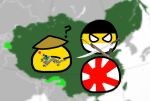 Russia vs Japan in China
 -


-
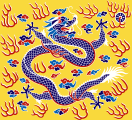 Banner of the "Plain Yellow Banner" military unit, predecessor to the Qing flag

See Also

Notes
- ↑ Sinicization, a process by which non-Chinese societies or groups are acculturated or assimilated into Chinese culture, particularly the language, societal norms, culture, and ethnic identity of the Han Chinese—the largest ethnic group of China.


