


Storm clouds, like a flock of crows, fill the sky
The  Lord has brought
  Russia down upon her knees
Down to her knees, in the mud of the roads, so the people may answer
Why have we failed to save the  Tsar.
Tsar.
Why did the Russian people,  right-believing and holy,
Drown their conscience in a glass of  Vodka?
Gave their homeland to the  foe, and
  flooded the land in blood,
And now they lap up that blood— Judas-wolves.
Gave their homeland to the foe, and flooded the land in blood,
And now they lap up that blood—Judas-wolves.
Chorus:
Tsar (Tsar, Tsar, Tsar)
There stands our Nicholas, among the birches.
He (He, he, he)
Waited so long to meet again with his Russian people.
To  heaven (to heaven, to heaven, to heaven)
The road is strewn with crimson rose petals.
And the Light— (light, light, light)
With waxen tears, the candles weep repentance.
Our holy and great Tsar, right-believing sovereign,
Day and night he prayed to God for Russia,
For his beloved people—that he believed they followed him,
And never expected a blow from them in the back.
He lived only by God's will,  served his homeland with all his heart,
He gave his life for the  faith, for
  his country.
𝄆 Passion-bearer Nicholas, show us the path to Heaven,
Pray for us, that the Almighty may forgive us. 𝄇
𝄆 Chorus 𝄇
Far away (far away, far away, far away)
The wind carries the sail of clouds.
The Tsar (Tsar, Tsar, Tsar)
Rides in a  flaming chariot of the heavens.
He (He, he, he)
Is our  hope, faith, and
  love…
love…
He (He, he, he)
Is Russia's light, held in the Divine right hand.
Tsar… (Tsar, Tsar, Tsar)
Is Russia's light, held in the Divine right hand.
Our Saintly Tsar,
You are the light of Rus'
[Held] In the Divine
Right hand.
Nicholas II Thought: Difference between revisions
No edit summary |
|||
| (104 intermediate revisions by 2 users not shown) | |||
| Line 1: | Line 1: | ||
{{Mbox/ | {{Mbox/Big}}{{Infobox | ||
|Name= {{i|Nicholas2}} Nikolai II Alexandrovich Romanov Thought {{i|Nicholas2}} | |Name= {{i|Nicholas2}} Nikolai II Alexandrovich Romanov Thought {{i|Nicholas2}} | ||
|NativeName= {{ILSize|RussianL-icon.png|Russian Language}}: Николай II Думал | |NativeName= {{ILSize|RussianL-icon.png|Russian Language}}: Николай II Думал | ||
| Line 9: | Line 9: | ||
|onlysuccessor= Leninism | |onlysuccessor= Leninism | ||
|image= Nicholas II Thought.png | |image= Nicholas II Thought.png | ||
|Caption= | |Caption= God depends on a Tsar’s responsibility! | ||
|Alias= {{I|Tsar}} [[Tsarism|Tsar]] Nicholas II Thought<br>Nicholas the Second Thought<br>Little Nicky Thought<br>Nicholas the Short<br>Nicholas II of {{i|Russian Empire}} [[Russian Empire|Russia]]<br>{{Alias|AntiAuth-icon.png|Anti-Authoritarianism|Bloody Nicholas}}<br>{{Alias|Socialism-icon.png|Socialism|Evil {{i|Slavery}} [[Slavery|slave owner]]}} | |Alias= {{I|Tsar}} [[Tsarism|Tsar]] Nicholas II Thought<br>Nicholas the Second Thought<br>Little Nicky Thought<br>Nicholas the Short<br>Nicholas II of {{i|Russian Empire}} [[Russian Empire|Russia]]<br>{{Alias|AntiAuth-icon.png|Anti-Authoritarianism|Bloody Nicholas}}<br>{{Alias|Socialism-icon.png|Socialism|Evil {{i|Slavery}} [[Slavery|slave owner]]}}<br>{{Alias|Putin-icon.png|Putinism|Erroneous/Absurd/Nicholas the Bloody}}<br>{{Alias|TikTok-icon.png|TikTok|{{i|Islamophobia}} [[Islamophobia|The -5.5 Million Man]]<ref>Referring to the estimated death toll of the {{i|Islamophobia}} [[Islamophobia|persecution]] of {{i|Islam}} [[Islam|Muslims]] during the {{i|Ottoman}} [[Ottoman Empire|Ottoman]] decline. The number "5.5" and Nicholas II became an icon on {{i|TikTok}} [[TikTok]] edits used against {{i|Turkey}} [[Türkiye|Turks]]. It isn't really accurate since Nicholas II was not the perpetrator nor the causer of the deaths.</ref>}} | ||
|Alignments= {{Info | |Alignments= {{Info|Authoritarian Right}}<br>{{Info|Culturally Right}}<br>{{Info|Monarchists}}<br>{{Info|Reactionary}}<br>{{Info|Religious}} | ||
|Origin= {{I|Russian Empire}} [[Russian Empire]] | |Origin= {{I|Russian Empire}} [[Russian Empire]] | ||
|Influenced By= {{Scroll|{{i|AbMon}} [[Absolute Monarchism]] (before 1906)<br>{{i|AgCap}} [[Agrarian Capitalism]]<br>{{i|AntiCommie}} [[Anti-Communism]]<br>{{i|AntiDem}} [[Anti-Democracy]]<br>{{i|AntiProg}} [[Anti-Progressivism]]<br>{{i|AntiJew}} [[ | |Influenced By= {{Scroll|{{i|AbMon}} [[Absolute Monarchism]] (before 1906)<br>{{i|AgCap}} [[Agrarian Capitalism]]<br>{{i|AntiCommie}} [[Anti-Communism]]<br>{{i|AntiDem}} [[Anti-Democracy]]<br>{{i|AntiProg}} [[Anti-Progressivism]]<br>{{i|AntiJew}} [[Antisemitism]] (debatably)<br>{{i|AuthCap}} [[Authoritarian Capitalism]]<br>{{i|AuthCon}} [[Authoritarian Conservatism]]<br>{{i|Necrocracy}} <s>[[Necrocracy|Canonization of the Romanovs]]</s><br>{{i|Dogmatism}} [[Dogmatism]]<br>{{i|Fatalism}} [[Fatalism]]<br>{{i|Imp}} [[Imperialism]]<br>{{i|Industrialism}} [[Industrialism]]<br>{{i|Kak}} [[Kakistocracy]] (accused)<br>{{I|Klep}} [[Kleptocracy]] (indirectly involved)<br>{{i|Militarism}} [[Militarism]]<br>{{i|MonCap}} [[Monarcho-Capitalism]]<br>{{i|Mysticism}} [[Mysticism]]<br>{{I|NucFam}} [[Nuclear Family Model]]<br>{{i|OrthoTheo}} [[Orthodox Theocracy]]<br>{{i|Slav}} [[Pan-Slavism]]<br>{{i|PatCon}} [[Paternalistic Conservatism]]<br>{{i|Okhrana}} [[Okhrana|Police Statism]]<br>{{i|Reactionary}} [[Reactionaryism]]<br>{{i|ConMon}} [[Constitutional Monarchism|Semi-Constitutional Monarchism]] (since 1906)<br>{{i|Stolypin}} [[Stolypinism]]<br>{{i|Stratocracy}} [[Stratocracy]]<br>{{i|Byzantine Model}} [[Byzantine Model|Third Rome]]<br>{{i|Tsar}} [[Tsarism]]|200px}} | ||
|Influenced= {{i|NeoTsar}} [[Neo-Tsarism]] | |Influenced= {{I|Alexandra Feodorovna}} [[Alexandra Feodorovna Thought]]<br>{{i|NeoTsar}} [[Neo-Tsarism]]<br>{{i|Stolypin}} [[Stolypinism]] | ||
|Gender= Male | |Gender= Male | ||
|People= | |People= | ||
*{{i|Nicholas2}} [[Tsarism|Nicholas II of Russia]] (1868-1918) | *{{i|Nicholas2}} [[Tsarism|Nicholas II of Russia]] (1868-1918) | ||
|Examples= {{i|Russian Empire}} [[Russian Empire|Russia under Nicholas II]] (1896-1917) | |Examples= {{i|Russian Empire}} [[Russian Empire|Russia under Nicholas II]] (1896-1917) | ||
|Likes= {{Scroll|{{i|YHWH}} [[YHWHism|God]] {{i|Orthodoxy}}<br>{{i|Romanov}} [[House of Romanovs|His family]] {{i|NucFam}}<br>{{I|Alexandra Feodorovna}} [[Alexandra Feodorovna Thought|His wife]]<br>{{i|Russian Empire}} [[Russian Empire|Russia]]<br>{{i|KOSerbia}} [[Kingdom of Serbia|Serbia]]<br>{{i|Denmark}} [[Denmark]]<br>{{i|UKGBI}} [[United Kingdom of Great Britain and Ireland|England]]<br>{{i|Siberia}} [[Siberia|Trans-Siberian Railway]]<br>{{i|Mysticism}} [[Mysticism]]<br>{{i|Rasputin}} [[Rasputinism|Rasputin]] (sorta)<br>tsarnicholas.org|200px}} | |Likes= {{Scroll|{{i|YHWH}} [[YHWHism|God]] {{i|Orthodoxy}}<br>{{i|Romanov}} [[House of Romanovs|His family]] {{i|NucFam}}<br>{{I|Alexandra Feodorovna}} [[Alexandra Feodorovna Thought|His wife]]<br>{{i|Russian Empire}} [[Russian Empire|Russia]]<br>{{i|KOSerbia}} [[Kingdom of Serbia|Serbia]]<br>{{i|Denmark}} [[Denmark]]<br>{{i|UKGBI}} [[United Kingdom of Great Britain and Ireland|England]]<br>{{i|Siberia}} [[Siberia|Trans-Siberian Railway]]<br>{{i|Mysticism}} [[Mysticism]]<br>{{i|Rasputin}} [[Rasputinism|Rasputin]] (sorta)<br>{{i|Primalism}} [[Primalism|Collie dogs]]<br>Taking pictures<br>Automobiles and cars<br>tsarnicholas.org|200px}} | ||
|Dislikes= {{Scroll|{{i|AntiMon}} [[Anti-Monarchism|Revolts]]<br>{{i|Socialism}} [[Socialism|Leftists]] {{i|Commie}}<br>{{i|Lib}} [[Liberalism|Liberals]]<br>{{i|EmpireJapan}} [[Empire of Japan]]<br>{{i|German Empire}} [[German Empire]]<br>{{i|AH}} [[Austria-Hungary]]<br>{{i|Politics}} [[Politics]]<br>{{i|Tsar}} [[Tsarism|Being Tsar]] (debatably)}} | |Dislikes= {{Scroll|{{i|AntiMon}} [[Anti-Monarchism|Revolts]]<br>{{i|Socialism}} [[Socialism|Leftists]] {{i|Commie}}<br>{{i|Lib}} [[Liberalism|Liberals]]<br>{{i|Parliament}} [[Imperial Duma|The First & Second Dumas]]<br>{{i|Bolsheviks}} [[Bolsheviks]]<br>{{i|EmpireJapan}} [[Empire of Japan]]<br>{{i|German Empire}} [[German Empire]]<br>{{i|AH}} [[Austria-Hungary]]<br>{{i|Ottoman}} [[Ottoman Empire]]<br>{{i|Politics}} [[Politics]]<br>{{i|Tsar}} [[Tsarism|Being Tsar]] (debatably)}} | ||
|Preceded= {{i|Alexander3}} [[Alexander III Thought]] | |Preceded= {{i|Alexander3}} [[Alexander III Thought]] | ||
|Succeeded= {{i|NeoTsar}} [[Neo-Tsarism]] | |Succeeded= {{i|NeoTsar}} [[Neo-Tsarism]] | ||
| Line 30: | Line 26: | ||
*🥔 Baked potatoes | *🥔 Baked potatoes | ||
*🐓 Plain roast chicken | *🐓 Plain roast chicken | ||
|Song= {{I|Nicholas2}} [[#Our Tsar|Our Tsar – Russian Song About Nicholas II]] {{I|Tsar}} | |Song= {{I|Nicholas2}} [[#Our Tsar|Our Tsar – Russian Song About Nicholas II]] {{I|Tsar}}<br>{{i|SpanishL}} <s>[[Latin Pop#Macarena|Macarena Phonk]]</s> {{i|Nicholas2}}{{i|Young Turks}} | ||
|Person= {{i|Nicholas2}} Nikolai II Alexandrovich Romanov (Николай Александрович Романов) | |Person= {{i|Nicholas2}} Nikolai II Alexandrovich Romanov (Николай Александрович Романов) | ||
|Born= 18 May 1868, {{i|Russian Empire}} [[Russian Empire|Imperial Russia]] | |Born= 18 May 1868, {{i|Russian Empire}} [[Russian Empire|Imperial Russia]] | ||
| Line 52: | Line 48: | ||
Tsar Nicholas II is considered the {{I|Kak}} [[Kakistocracy|weakest]] Tsar by many. He was not a {{I|Immoralism}} [[Immoralism|bad person]], he genuinely cared for his people, had good intentions, and worked very hard. However, to put it simply, he was a poor {{I|Politics}} [[Politics|politician]]. He did not like being the Tsar, although he accepted it as his duty by {{I|YHWH}} [[YHWHism|God]], whom he believed in the most. What the Tsar cared about most was his {{I|NucFam}} [[Nuclear Family Model|family]], and he had a hard time finding disinterested, trustworthy and competent administrators. It was precisely the treachery of untrustworthy and incompetent careerists that brought about his abdication. | Tsar Nicholas II is considered the {{I|Kak}} [[Kakistocracy|weakest]] Tsar by many. He was not a {{I|Immoralism}} [[Immoralism|bad person]], he genuinely cared for his people, had good intentions, and worked very hard. However, to put it simply, he was a poor {{I|Politics}} [[Politics|politician]]. He did not like being the Tsar, although he accepted it as his duty by {{I|YHWH}} [[YHWHism|God]], whom he believed in the most. What the Tsar cared about most was his {{I|NucFam}} [[Nuclear Family Model|family]], and he had a hard time finding disinterested, trustworthy and competent administrators. It was precisely the treachery of untrustworthy and incompetent careerists that brought about his abdication. | ||
Vilified by {{i|USSR}} [[Union of Soviet Socialist Republics|Soviet]] {{i|Pseudohistory}} [[ | Vilified by {{i|USSR}} [[Union of Soviet Socialist Republics|Soviet]] {{i|Pseudohistory}} [[Pseudohistory|historians]] as a symbol of {{i|Auth}} [[Authoritarianism|repression]] and {{i|Kak}} [[Kakistocracy|incompetence]], Nicholas has been reassessed more sympathetically in {{i|Russia1991}} [[Post-Soviet Russian Federation|post-Soviet]] [[Russia]] {{i|Russia}}. He and his family were canonized as passion bearers by the {{i|Orthodoxy}} [[Russian Orthodox Church]] in 2000, following the discovery and reburial of their remains in 1998. | ||
==History & Life== | ==History & Life== | ||
| Line 64: | Line 60: | ||
====Childhood==== | ====Childhood==== | ||
Nicholas II had five younger siblings: {{i|Male}} [[Male|Alexander]] (1869-1870), {{i|Noocracy}} [[Noocracy|George]] (1871-1899), {{i|Female}} [[Female|Xenia]] (1875-1960), {{i|Militarism}} [[Militarism|Michael]] (1878-1918) and {{i| | Nicholas II had five younger siblings: {{i|Male}} [[Male|Alexander]] (1869-1870), {{i|Noocracy}} [[Noocracy|George]] (1871-1899), {{i|Female}} [[Female|Xenia]] (1875-1960), {{i|Militarism}} [[Militarism|Michael]] (1878-1918) and {{i|Artist}} [[Art|Olga]] (1882-1960). In his youth, Nicholas was not favored by his father {{i|Alexander3}} [[Alexander III Thought|Alexander III]] due to his weak health. However, as a member of the royal family, he still received a strict education and was fluent in {{i|GermanL}} [[German Language|German]], {{i|FrenchL}} [[French Language|French]], and {{i|EnglishL}} [[English Language|English]]. Nicholas, with his shy personality, was very intimidated of his imposing and strict father, who viewed his son as {{i|Kak}} [[Kakistocracy|weak and childish]], sometimes calling him a "{{i|Female}} [[Female|girl]]". However, he very close to his mother {{i|MatMon}} [[Matriarchal Monarchism|Maria Feodorovna]], as revealed in their published letters to each other. In his childhood, Nicholas, his parents and siblings made annual visits to the {{i|Denmark}} [[Denmark|Danish]] royal palaces of Fredensborg and Bernstorff to visit his grandparents, the king and queen. The visits also served as family reunions, as his mother's siblings would also come from the {{i|UKGBI}} [[United Kingdom of Great Britain and Ireland|United Kingdom]], {{i|German Empire}} [[German Empire|Germany]] and {{i|Kingdom of Greece}} [[Kingdom of Greece|Greece]] with their respective families. | ||
In 1873, Nicholas accompanied his parents and younger brother, two-year-old George, on a two-month, semi-official visit to the United Kingdom. In {{i|London}} [[London]], Nicholas and his family stayed at Marlborough House, as guests of his "{{i|Imp}} [[Imperialism|Uncle Bertie]]" (Edward VII) and "{{i|MatMon}} [[Matriarchal Monarchism|Aunt Alix]]" (Alexandra of Denmark), the Prince and Princess of {{i|Wales}} [[Wales]], where he was spoiled by his uncle. | In 1873, Nicholas accompanied his parents and younger brother, two-year-old George, on a two-month, semi-official visit to the United Kingdom. In {{i|London}} [[London]], Nicholas and his family stayed at Marlborough House, as guests of his "{{i|Imp}} [[Imperialism|Uncle Bertie]]" (Edward VII) and "{{i|MatMon}} [[Matriarchal Monarchism|Aunt Alix]]" (Alexandra of Denmark), the Prince and Princess of {{i|Wales}} [[Wales]], where he was spoiled by his uncle. | ||
| Line 108: | Line 104: | ||
===Reign as Tsar=== | ===Reign as Tsar=== | ||
Although Nicholas visited the {{i|UK}} [[United Kingdom of Great Britain and Ireland|United Kingdom]] in 1893 and watched debates in the {{i|HouseCommonUK}} [[House of Commons of the United Kingdom|House of Commons]] seeming impressed by how a {{i|ConMon}} [[Constitutional Monarchism|constitutional monarchy]] worked, he refused to give any power to elected representatives in {{i|Russian Empire}} [[Russian Empire|Russia]]. | Although Nicholas visited the {{i|UK}} [[United Kingdom of Great Britain and Ireland|United Kingdom]] in 1893 and watched debates in the {{i|HouseCommonUK}} [[House of Commons of the United Kingdom|House of Commons]] seeming impressed by how a {{i|ConMon}} [[Constitutional Monarchism|constitutional monarchy]] worked, he refused to give any power to elected representatives in {{i|Russian Empire}} [[Russian Empire|Russia]]. | ||
Nicholas showed an interest for {{i|Humanism}} [[Humanism|humanistic]] ideals. He attended the first {{i|HCCH}} [[Hague Conference on Private International Law|Hague Conference]] in 1893. | |||
With the death of {{i|Alexander3}} [[Alexander III Thought|Alexander III]] on 1 November 1894, Nicholas II became the {{i|Tsar}} [[Tsarism|Tsar]], beginning his reign. Soon after he came to the throne, a group of peasants and workers from local assemblies (''zemstvos'') came to the Winter Palace. In what became known as the Tver Address, they asked for court reforms, including the creation of a constitutional monarchy and changes to improve the {{i|Politics}} [[Politics|political]] and {{i|Economy}} [[Economy|economic]] conditions of the peasantry. Although the addresses they had sent in beforehand were couched in mild and loyal terms, Nicholas was {{i|Aggression}} [[Aggressionism|angry]] and ignored advice from an Imperial Family Council by saying to them: | With the death of {{i|Alexander3}} [[Alexander III Thought|Alexander III]] on 1 November 1894, Nicholas II became the {{i|Tsar}} [[Tsarism|Tsar]], beginning his reign. Soon after he came to the throne, a group of peasants and workers from local assemblies (''zemstvos'') came to the Winter Palace. In what became known as the Tver Address, they asked for court reforms, including the creation of a constitutional monarchy and changes to improve the {{i|Politics}} [[Politics|political]] and {{i|Economy}} [[Economy|economic]] conditions of the peasantry. Although the addresses they had sent in beforehand were couched in mild and loyal terms, Nicholas was {{i|Aggression}} [[Aggressionism|angry]] and ignored advice from an Imperial Family Council by saying to them: | ||
| Line 118: | Line 116: | ||
In a celebration on 30 May 1896, a large festival with food, {{i|Alcohol}} [[Alcoholism|free beer]] and souvenir cups was held in Khodynka Field outside {{i|Moscow}} [[Moscow]]. Khodynka Field, primarily used as a {{i|Militarism}} [[Militarism|military]] training ground with its uneven trenches, was chosen as the location as it was the only place near Moscow large enough to hold all of the Moscow citizens. Before the food and drink was handed out, rumours spread that there would not be enough for everyone. As a result, the crowd rushed to get their share and individuals were tripped and trampled upon, suffocating in the dirt of the field. Of the approximate 100,000 in attendance, it is estimated that 1,389 individuals died and roughly 1,300 were injured. The Khodynka Tragedy was seen as an ill omen and Nicholas found gaining popular trust difficult from the beginning of his reign. The {{i|French3}} [[French Third Republic|French]] ambassador's gala was planned for that night. However, the Tsar wanted to stay in his chambers and pray for the lives lost. But his uncles believed that his absence at the ball would strain relations with France, particularly the 1894 Franco-Russian Alliance. Thus Nicholas attended the party; as a result the mourning populace saw Nicholas as frivolous and uncaring. | In a celebration on 30 May 1896, a large festival with food, {{i|Alcohol}} [[Alcoholism|free beer]] and souvenir cups was held in Khodynka Field outside {{i|Moscow}} [[Moscow]]. Khodynka Field, primarily used as a {{i|Militarism}} [[Militarism|military]] training ground with its uneven trenches, was chosen as the location as it was the only place near Moscow large enough to hold all of the Moscow citizens. Before the food and drink was handed out, rumours spread that there would not be enough for everyone. As a result, the crowd rushed to get their share and individuals were tripped and trampled upon, suffocating in the dirt of the field. Of the approximate 100,000 in attendance, it is estimated that 1,389 individuals died and roughly 1,300 were injured. The Khodynka Tragedy was seen as an ill omen and Nicholas found gaining popular trust difficult from the beginning of his reign. The {{i|French3}} [[French Third Republic|French]] ambassador's gala was planned for that night. However, the Tsar wanted to stay in his chambers and pray for the lives lost. But his uncles believed that his absence at the ball would strain relations with France, particularly the 1894 Franco-Russian Alliance. Thus Nicholas attended the party; as a result the mourning populace saw Nicholas as frivolous and uncaring. | ||
The next morning, Emperor Nicholas and Empress {{I|Alexandra Feodorovna}} [[Alexandra Feodorovna Thought|Alexandra]] attended a funeral service for the dead and then spent the day visiting the injured in several {{i|Medicine}} [[Medicine|hospitals]]. The Tsar donated one thousand rubles to each family of the dead and injured, and he established special orphanages for the children of the victims. The state bore the cost of the funerals, and no effort was made to conceal the tragedy, at the orders of the Tsar. | |||
In the autumn after the coronation, Nicholas and Alexandra toured {{i|Europe}} [[Europe]]. The couple visited the emperor and empress of {{i|AH}} [[Austria-Hungary]], {{i|German Empire}} [[German Empire|Germany]]'s Kaiser, and Nicholas's {{i|Denmark}} [[Denmark|Danish]] grandparents and other relatives. They then took ownership of their new yacht, ''Standart'', which had been built in Denmark. From there, they traveled to {{i|Scotland}} [[Scotland]] to stay with {{i|QueenVictoria}} [[Victorianism|Queen Victoria]] at Balmoral Castle. Alexandra enjoyed seeing her grandmother again, but Nicholas wrote to his mother complaining that he had to go shooting with his uncle, the {{i|Imp}} [[Imperialism|Prince of Wales]] (Edward VII), in bad weather, while also dealing with a bad toothache. | |||
====Start of Reign==== | ====Start of Reign==== | ||
When Nicholas II ascended to the throne he had very little experience of governing and he trusted the experience and diplomatic abilities of his mother, the widowed empress {{i|MatMon}} [[Matriarchal Monarchism|Maria Feodorovna]], for the first 10 years. Nicholas's {{I|Alexandra Feodorovna}} [[Alexandra Feodorovna Thought|wife]] was also strong-willed, which is thought to have resulted from the fact that Nicholas sought to compensate his own lack of a {{i|Auth}} [[Authoritarianism|strong will]] by governing {{i|Autocracy}} [[Autocracy|autocratically]]. Nicholas was also wary of his own ministers, but was himself unable to govern properly. Nicholas spent the first 10 years of his reign listening to his uncles. Nicholas and the imperial family often spent their summers on the archipelago and coast of {{I|Grand Duchy of Finland}} [[Grand Duchy of Finland|Finland]], sailing in their imperial yacht ''Standart''. | When Nicholas II ascended to the throne he had very little experience of governing and he trusted the experience and diplomatic abilities of his mother, the widowed empress {{i|MatMon}} [[Matriarchal Monarchism|Maria Feodorovna]], for the first 10 years. Nicholas's {{I|Alexandra Feodorovna}} [[Alexandra Feodorovna Thought|wife]] was also strong-willed, which is thought to have resulted from the fact that Nicholas sought to compensate his own lack of a {{i|Auth}} [[Authoritarianism|strong will]] by governing {{i|Autocracy}} [[Autocracy|autocratically]]. Nicholas was also wary of his own ministers, but was himself unable to govern properly. Nicholas spent the first 10 years of his reign listening to his uncles. Nicholas and the imperial family often spent their summers on the archipelago and coast of {{I|Grand Duchy of Finland}} [[Grand Duchy of Finland|Finland]], sailing in their imperial yacht ''Standart''. | ||
In 1899, Nicholas II initiated the First {{i|The Hague}} [[The Hague|Hague]] {{i|Pacifism}} [[Pacifism|Peace]] Conference, addressing growing concerns over the arms race and to foster {{i|Internationalism}} [[Internationalism|international]] peace. While most of {{i|Europe}} [[Europe]]'s leaders at the time were thinking "more weapons the better", Nicholas called out the arms race itself as dangerous. It was the first major diplomatic conference aimed at preventing {{i|War}} [[war]] rather than resolving one. | The first years of Nicholas's reign saw little more than continuation and development of the policy pursued by his father {{i|Alexander3}} [[Alexander III Thought|Alexander III]]. Nicholas allotted {{i|Plutocracy}} [[Plutocracy|money]] for the All-Russia Exhibition of 1896, which demonstrated the best achievements of the {{i|Industrialism}} [[Industrialism|industrial]] development and {{i|Artist}} [[Art|arts]] in {{i|Russian Empire}} [[Russian Empire|Russia]] that began in the latter part of the 19th century. In 1897, the {{i|Gold}} [[gold]] standard restoration by {{i|Moderatism}} [[Moderatism|Sergei Witte]], Minister of Finance, completed the series of financial reforms initiated fifteen years earlier. | ||
Because of Nicholas's poor knowledge of people, his preference of an {{i|Isolationism}} [[Isolationism|isolated]] {{i|NucFam}} [[Nuclear Family Model|family life]] plus his weak authority, he soon fell into the hands of his {{i|Reactionary}} [[Reactionaryism|reactionary]] surroundings. The only idea he steadfastly held on was the principle of an autocratic ruler. Nicholas did better as a father and husband than a ruler of a gigantic, restless realm. He was of average ability and indecisive character, but also {{i|Moderatism}} [[Moderatism|modest]] and frugal. Like his father, he was very old-fashioned and sought to Russificate everyhing that had been previously westernised, including preferring to use the title of tsar instead of emperor as he thought it sounded more Russian. Nicholas allowed his wife to control him in matters of government, such as choices of people. | |||
In 1899, Nicholas II initiated the First {{i|The Hague}} [[The Hague|Hague]] {{i|Pacifism}} [[Pacifism|Peace]] Conference, addressing growing concerns over the arms race and to foster {{i|Internationalism}} [[Internationalism|international]] peace. While most of {{i|Europe}} [[Europe]]'s leaders at the time were thinking "more weapons the better", Nicholas called out the arms race itself as dangerous. It was the first major diplomatic conference aimed at preventing {{i|War}} [[war]] rather than resolving one. However, Nicholas still had his own {{i|Imp}} [[Imperialism|ambitions]] in the {{i|1ball}} [[Asians|Far East]] as the Russian influence in the {{i|Ottoman}} [[Ottoman Empire|Balkans]] faltered; in 1901 he told his brother-in-law {{i|Thalassocracy}} [[Thalassocracy|Prince Henry of Prussia]] (born 1862) "I do not want to seize {{i|Korean Empire}} [[Korean Empire|Korea]] but under no circumstances can I allow {{i|EmpireJapan}} [[Empire of Japan|Japan]] to become firmly established there. That will be a {{i|War}} [[War|casus belli]]." By 1902, the {{i|Siberia}} [[Siberia|Trans-Siberian Railway]] was nearing completion; this helped the Russians trade in the Far East but the railway still required huge amounts of work. | |||
During the first ten years of Nicholas II's reign, Russia saw a {{i|Social}} [[Society|societal]] and {{i|Economy}} [[Economy|economic]] transform, a change from an {{i|Agrarianism}} [[Agrarianism|agrarian]] society to an {{i|Industrialism}} [[Industrialism|industrial]] one, whose seeds had already been sown during the reign of Nicholas's father Alexander III. During the inspection period from 1880 to 1910 economic growth in Russia was over nine percent per year on average. The {{i|Tradition}} [[Traditionalism|old-fashioned]] legislature, the unsolved question of land ownership after {{i|Caste System}} [[Caste System|serfdom]] had been {{i|Abolitionism}} [[Abolitionism|abolished]] in 1861 and concentration of economic growth in wealthy metropolitan areas caused conflicts among the growing working class, which the {{i|Socialist Revolutionary Party}} [[Socialist Revolutionary Party]] and the {{i|Commie}} [[Communism|communists]] exploited as a vessel of growth. | |||
====Ecclesiastical Affairs==== | |||
Nicholas believed that {{i|YHWH}} [[YHWHism|God]] had chosen him to be {{i|Tsar}} [[Tsarism|Tsar]], so he thought his decisions reflected God's will and could not be questioned. He believed ordinary {{i|Russian Empire}} [[Russian Empire|Russians]] understood this and loved him, based on the affection he thought he saw during public appearances. His {{i|Fideism}} [[Fideism|strong religious faith]] made him a stubborn ruler who refused to accept {{i|ConMon}} [[Constitutional Monarchism|constitutional]] limits on his power, which put him at odds with the growing {{i|Politics}} [[Politics|political]] views of the Russian {{i|Elitism}} [[Elitism|elite]]. It was also contradicted by the {{i|Orthodoxy}} [[Russian Orthodox Church|Church]]'s low, subordinate position within the state bureaucracy. As a result, new distrust developed between the tsar and the church leadership, and also between the church leaders and the people. This left the tsar's base of support divided. | |||
In 1903, Nicholas threw himself into an ecclesiastical crisis over whether {{i|Palamism}} [[Palamism|Seraphim of Sarov]] should be made a saint. The year before, people had suggested that if Seraphim were canonized, the imperial couple would have a son to inherit the throne. In July 1902, {{i|Alexandra Feodorovna}} [[Alexandra Feodorovna Thought|Alexandra]] insisted that Seraphim be canonized within a week, while Nicholas pushed for it to happen within a year. Despite public protest, the Church gave in to strong pressure from the imperial family and declared Seraphim worthy of canonization in January 1903. That summer, the imperial family traveled to {{i|Sarov}} [[Sarov]] for the ceremony. On 12 August 1904, {{i|Male}} [[Male|Alexei Nikolaevich]] would be born. | |||
====Ball in the Winter Palace==== | |||
In 1903, Nicholas and the {{i|Romanov}} [[House of Romanov]] held a {{i|Plutocracy}} [[Plutocracy|lavish]] costume ball at the Winter Palace in {{i|Saint Petersburg}} [[Saint Petersburg]]. It was to be their final blowout, and perhaps also the last great royal ball in {{i|Europe}} [[Europe]]. On the 290th anniversary of Romanov rule, Tsar Nicholas invited 390 guests and the ball ranged over two days with festivities and elaborate {{i|Tsardom of Russia}} [[Tsardom of Russia|17th-century]] {{i|Oligarchy}} [[Oligarchy|boyar]]-styled costumes, including 38 original royal items from the armory in {{i|Moscow}} [[Moscow]]. | |||
The {{i|Russian History Museum}} [[Russian History Museum]] is home to a massive souvenir album of the ball, containing photographs of guests in their magnificent attire, including 21 heliogravures and 174 phototypes, ranging from individual portraits to large group photos. {{i|Historicism}} [[Historicism|Sergei Polonsky]] donated the album to the museum in 1981, and it was primarily sold among those related to the ball participants. | |||
The celebration took place in two phases, first on 11 February and second on 13 February. On day one, guests gathered in the Winter Palace, proceeding in pairs to greet the imperial couple with the {{i|Tradition}} [[Traditionalism|traditional]] Russian bow. The greeting was followed by a concert in the Hermitage Theatre, and evening concluded with dinner and dances. For the second day, all participants dressed in costumes imitating the fashion of the 17th century. Nicholas was dressed in a suit that replicated the dress of his beloved ancestor, {{i|EnlightAb}} [[Enlightened Absolutism|Alexei of Russia]], while his wife {{I|Alexandra Feodorovna}} [[Alexandra Feodorovna Thought|Alexandra]] dressed up as Alexei's wife {{i|MatMon}} [[Matriarchal Monarchism|Maria Miloslavskaya]], and her crown was so heavy that it caused her trouble leaning over her plate at dinner. | |||
The entire Romanov family gathered at the staircase of the Hermitage Theatre for a group photo, the last time they would all be photographed together. It was like two worlds superimposed on each other—the Romanovs cosplaying as their beginning years while being in their last years. | |||
====Russo-Japanese War==== | |||
A clash between {{i|Russian Empire}} [[Russian Empire|Russia]] and the {{i|EmpireJapan}} [[Empire of Japan]] was almost inevitable by the turn of the 20th century. Russia's growing settlements and territorial ambitions in the {{i|1ball}} [[Asians|Far East]] clashed with Japan's own {{i|Imp}} [[Imperialism|goals]] on the Asian mainland. Nicholas followed an {{i|Aggression}} [[Aggressionism|aggressive]] foreign policy in {{i|Beiyang}} [[Beiyang Government|Manchuria]] and {{i|Korean Empire}} [[Korean Empire|Korea]] and strongly supported plans to gain timber concessions in those regions. | |||
In February 1904, the impatient Japanese attacked Russia's {{i|RussiaNavy}} [[Pacific Fleet]] in {{i|QingNew}} [[Lüshunkou|Port Arthur]] without warning. So {{i|War}} [[war]] began, and Nicholas's Russia was ill-equipped to fight a war thousands of miles from his {{i|Saint Petersburg}} [[Saint Petersburg|capital]]. No matter how justified Nicholas was at losing the war, it was still very humiliating: it was the first time in centuries that an {{i|Asia}} [[Asia|Asian]] country beat an {{i|Europe}} [[Europe|European]] one! The Russian people were outraged. | |||
====1905 Revolution==== | |||
On 19 January 1905, an assassination attempt was carried out on Nicholas. During an event, a soldier had fired at Nicholas with his rifle, causing absolute chaos. On the advice of his ministers, he left the {{i|Saint Petersburg}} [[Saint Petersburg|capital]] and went to {{i|Russia}} [[Tsarskoye Selo]], temporarily installing troops to install a curfew until the {{i|Okhrana}} [[Okhrana]] could investigate and root out terror cells in St. Petersburg until the city was declared safe again. | |||
On 22 January 1905 [O.S. 9 January], coinciding with the troops patrolling the capital, unhappy workers lead by priest {{i|Tolstoy}} [[Tolstoyism|Georgy Gapon]] went to the streets to march, hoping to get into the Winter Palace and hand a petition to the Tsar, despite him being absent. Gapon was a double agent for the {{i|Okhrana}} [[Okhrana]] and the {{i|Socialist Revolutionary Party}} [[Socialist Revolutionary Party]], the former having told him to not hold events on that day and save it for another time due to everyone on edge and public gatherings being suspended. There were two sides to the protest: one side was normal everyday people who loved the Tsar but wanted better conditions, the other was workers associated with the Socialist Revolutionaries. While the SRs planned to occupy the Winter Palace in the name of the Party, the normal workers locked arms and marched {{i|Pacifism}} [[Pacifism|peacefully]] through the streets. Some carried {{i|Orthodoxy}} [[Eastern Orthodoxy|religious]] icons and banners, as well as {{i|Nationalism}} [[Nationalism|national flags]] and portraits of the tsar. As they walked, they sang hymns and ''God Save The Tsar''. However, in Nicholas's absence, {{i|Stratocracy}} [[Stratocracy|troops arrived]] and shot at the protestors, and as bullets riddled their icons, their banners and their portraits of Nicholas, the people shrieked, "The Tsar will not help us!" Hundreds to thousands of protesters were killed this way. Nicholas wrote in his diary: | |||
{{Quote|A terrible day! There were serious disturbance in {{i|Saint Petersburg}} [[Saint Petersburg|Petersburg]] as a result of the workers wishing to reach the Winter Palace. The troops were forced to open fire in several parts of the town, there were many killed and wounded. {{i|Trinity}} [[Trinitarianism|Lord]], how painful and how sad!|{{i|Nicholas2}} [[Authoritarian Conservatism|Nicholas II]], in his diary}} | |||
"Bloody Sunday" as the incident came to be known, plus the humiliating defeat to {{i|EmpireJapan}} [[Empire of Japan|Japan]] in the Russo-Japanese War and not ideal conditions for the working class made Nicholas's reputation tumble and accumulated in the Russian Revolution of 1905. Organized {{i|Socialism}} [[Socialism|Socialists]] and {{i|Commie}} [[Communism|communists]], known as the "revolutionaries", {{i|Left-Ochlocracy}} [[Left-Ochlocracy|mobbed up]] and started to revolt against {{i|Tsarism}} [[Tsarism|Nicholas's government]]. The revolutionaries killed 17,000 civilians, but were eventually put down, though compromises had been made and the government went though some {{i|Dem}} [[Democracy|democratization]]. | |||
As a result of the mass {{i|Social}} [[Society|social]] unrest of the 1905 revolution, Nicholas had to submit to renovations and Russia became a {{i|ConMon}} [[Constitutional Monarchism|constitutional monarchy]]. In the October Manifesto written by Nicholas's competent prime minister {{i|Moderatism}} [[Moderatism|Sergei Witte]], a parliament, also known as the {{i|Parliament}} [[Imperial Duma|Duma]], was founded in Russia, and citizens' rights were widened. Nicholas still retained the right to veto the laws made by the Duma and the right to dissolve the parliament. | |||
====Duma Problems==== | |||
In the October Manifesto, Nicholas pledged to introduce basic {{i|CivLib}} [[Civil Libertarianism|civil liberties]], provide for broad participation in the {{i|Parliament}} [[Imperial Duma|State Duma]], and endow the Duma with legislative and oversight powers. He was determined, however, to preserve his {{i|Autocracy}} [[autocracy]] even in the context of {{i|Reformism}} [[Reformism|reform]]. This was signalled in the text of the 1906 {{i|Constitutionalism}} [[Constitutionalism|constitution]]. He was described as the supreme autocrat, and retained sweeping executive powers, also in {{i|Orthodoxy}} [[Russian Orthodox Church|church]] affairs. His cabinet ministers were not allowed to interfere with nor assist one another; they were responsible only to him. | |||
Nicholas's relations with the Duma were poor. The First Duma of March 1906, with a majority of {{i|Kadets}} [[Constitutional Democratic Party|Kadets]], almost immediately came into conflict with him. As soon as the Duma's 524 members met at the Tauride Palace, they sent him an "Address to the {{i|Tsar}} [[Tsarism|Throne]]". It called for universal voting rights, major {{i|Land Reform}} [[Land Reformism|land reforms]], release of all political prisoners, and the replacement of the Tsar's ministers with ones approved by the Duma. One of Nicholas's sisters later wrote: | |||
{{Quote|There was such gloom at {{i|Russia}} [[Tsarskoye Selo]]. I did not understand anything about {{i|Politics}} [[politics]]. I just felt everything was going wrong with {{i|Russian Empire}} [[Russian Empire|the country]] and all of us. The October Constitution did not seem to satisfy anyone. I went with my mother to the first {{i|Parliament}} [[Imperial Duma|Duma]]. I remember the large group of deputies from among peasants and factory people. The peasants looked sullen. But the workmen were worse: they looked as though they hated us. I remember the distress in {{i|Alexandra Feodorovna}} [[Alexandra Feodorovna Thought|Alicky]]'s eyes.|{{i|Artist}} [[Art|Grand Duchess Olga Alexandrovna]]}} | |||
Minister of the Court Count {{i|Militarism}} [[Militarism|Vladimir Frederiks]] commented, "The Deputies, they give one the impression of a gang of {{i|Illegalism}} [[Illegalism|criminals]] who are only waiting for the signal to throw themselves upon the ministers and {{i|Aggression}} [[Aggressionism|cut their throats]]. I will never again set foot among those people." The Dowager Empress {{i|MatMon}} [[Matriarchal Monarchism|Maria Feodorovna]] noticed "incomprehensible hatred." | |||
Although Nicholas initially had a good relationship with his prime minister, {{i|Moderatism}} [[Moderatism|Sergei Witte]], {{i|Alexandra Feodorovna}} [[Alexandra Feodorovna Thought|Alexandra]] distrusted him as he had instigated an investigation of {{i|Rasputin}} [[Rasputinism|Grigori Rasputin]] and, as the political situation deteriorated, Nicholas dissolved the Duma. The Duma was populated with radicals, many of whom wished to push through extremist legislation that would abolish {{i|Propertarianism}} [[Propertarianism|private property ownership]], among other things. Witte, unable to grasp the seemingly insurmountable problems of reforming {{i|Russian Empire}} [[Russian Empire|Russia]] and the {{i|Mon}} [[Monarchism|monarchy]], wrote to Nicholas on 14 April 1906 resigning his office. Nicholas was not ungracious to Witte and an imperial rescript was published on 22 April creating Witte a Knight of the Order of {{i|Patriotism}} [[Patriotism|Saint Alexander Nevsky]] with diamonds (the last two words were written in the emperor's own hand, followed by "I remain unalterably well-disposed to you and sincerely grateful, for ever more Nicholas."). | |||
A second Duma met for the first time in February 1907. The {{i|LeftUnity}} [[Left Unity|leftist]] parties—including the {{i|Socialism}} [[Russian Social Democratic Labour Party|Social Democrats]] and the {{i| Socialist Revolutionary Party}} [[Socialist Revolutionary Party|Socialist Revolutionaries]], who had boycotted the First Duma—had won 200 seats in the Second, more than a third of the membership. Again Nicholas waited impatiently to {{i|AntiCommie}} [[Anti-Communism|rid]] himself of the Duma. In two letters to his mother he let his bitterness flow. | |||
{{Quote|A grotesque deputation is coming from {{i|UKGBI}} [[United Kingdom of Great Britain and Ireland|England]] to see {{i|Liberalism}} [[Liberalism|liberal]] members of the {{i|Parliament}} [[Imperial Duma|Duma]]. {{i|Imp}} [[Imperialism|Uncle Bertie]]<ref>Referring to {{i|Imp}} [[Imperialism|Edward VII]].</ref> informed us that they were very sorry but were unable to take action to stop their coming. Their famous "liberty", of course. How angry they would be if a deputation went from us to the {{i|Irish Free State}} [[Irish Republic|Irish]] to wish them success in their struggle against their government.|{{i|Nicholas2}} [[Authoritarian Conservatism|Nicholas II]], writing to his mother {{i|MatMon}} [[Matriarchal Monarchism|Maria Feodorovna]]}} | |||
A little while later he further wrote: | |||
{{Quote|All would be well if everything said in the {{i|Parliament}} [[Imperial Duma|Duma]] remained within its walls. Every word spoken, however, comes out in the next day's {{i|Mediacracy}} [[Mediacracy|papers]] which are avidly read by everyone. In many places the populace is getting {{i|Ochlocracy}} [[Ochlocracy|restive]] again. They begin to talk about {{i|Land Reform}} [[Land Reformism|land]] once more and are waiting to see what the Duma is going to say on the question. I am getting telegrams from everywhere, petitioning me to order a dissolution, but it is too early for that. One has to let them do something manifestly {{i|Kak}} [[Kakistocracy|stupid]] or {{i|Immoralism}} [[Immoralism|mean]] and then—slap! And they are gone!|{{i|Nicholas2}} [[Authoritarian Conservatism|Nicholas II]], writing to his mother {{i|MatMon}} [[Matriarchal Monarchism|Maria Feodorovna]]}} | |||
After the Second Duma resulted in similar problems, new prime minister {{i|Stolypin}} [[Stolypinism|Pyotr Stolypin]] (whom Witte called {{i|Reactionary}} [[Reactionarysim|reactionary]]) dissolved it on his own and changed the voting laws so future Dumas would be more {{i|Conservatism}} [[Conservatism|conservative]] and mainly controlled by the {{i|LibCon}} [[Union of October 17|Octobrist Party]] led by {{i|LibCon}} [[Liberal Conservatism|Alexander Guchkov]]. Stolypin, a skilful politician, had ambitious plans for reform. These included making loans available to the lower classes to enable them to buy land, with the intent of forming a farming class loyal to the crown. Nevertheless, when the Duma remained hostile, Stolypin had no qualms about invoking Article 87 of the Fundamental Laws and passed the law anyway, as the article empowered the tsar to issue "urgent and extraordinary" emergency decrees "during the recess of the State Duma". Stolypin's most famous legislative act, the change in peasant land tenure, was promulgated under Article 87. | |||
The Third Duma in October 1907 stayed independent, but members acted more carefully. Instead of hurling themselves at the government, different groups worked to strengthen the Duma. Like the {{i|Parliament}} [[Parliament of the United Kingdom|British Parliament]], the Duma tried to gain influence by controlling state spending. Duma could question ministers in private about how they planned to spend {{i|Plutocracy}} [[Plutocracy|money]]. These meetings, supported by Stolypin, helped both sides understand each other better, and over time mutual hostility turned into mutual respect. Even {{i|Militarism}} [[Militarism|military]] spending, officially kept under the tsar's authority by the October Manifesto, came under review by a Duma committee. This group, made up of strong {{i|Patriotism}} [[Patriotism|patriots]] who also wanted to restore Russia's military reputation, often suggested spending even more than the government had proposed. | |||
====Entente Alliance==== | |||
In 1907, to end longstanding controversies over Central Asia, {{I|Russian Empire}} [[Russian Empire|Russia]] and the {{I|UK}} [[United Kingdom of Great Britain and Ireland|United Kingdom]] signed the Anglo-Russian Convention that resolved most of the problems generated for decades by the Great Game. The UK had already entered into the {{I|Entente}} [[Entente Cordiale]] with {{I|French3}} [[French Third Republic|France]] back in 1904, and the Anglo-Russian Convention led to the formation of the {{I|Entente}} [[Triple Entente]]. | |||
The following year, in May 1908, Nicholas and {{I|Alexandra Feodorovna}} [[Alexandra Feodorovna Thought|Alexandra]]'s shared "Uncle Bertie" and "Aunt Alix", Britain's {{I|Imp}} [[Imperialism|King Edward VII]] and {{I|MatMon}} [[Matriarchal Monarchism|Queen Alexandra]], made a state visit to Russia, being the first reigning British monarchs to do so. However, they did not set foot on Russian soil. Instead, they stayed aboard their yachts, meeting off the coast of modern-day {{I|Tallinn}} [[Tallinn]]. The purpose of this three-day meeting was to sign contracts of {{I|Politics}} [[Politics|political]] and {{I|Militarism}} [[Militarism|military]] assistance between the United Kingdom and Russia. With the foreign ministers of both countries present, a contract about changes in {{I|Macedonia}} [[Macedonia]] and the weakening of the {{I|Ottoman}} [[Ottoman Empire]] was signed. This meeting ignited the {{i|Young Turks}} [[Young Turks|Young Turk Revolution]] in the Ottoman Empire. | |||
Later that year, Nicholas was surprised to learn that his foreign minister, {{I|Aristocracy}} [[Aristocracy|Alexander Izvolsky]], had secretly made a deal with {{I|AH}} [[Austria-Hungary]]. The agreement was that {{I|RussiaNavy}} [[Imperial Russian Navy|Russian Navy]] to the {{I|River}} [[Dardanelles]] and {{I|River}} [[Bosporus]] Straits, and in return, Russia would not oppose Austria-Hungary annexing {{i|Ottoman Bosnia}} [[Ottoman Bosnia and Herzegovina|Bosnia and Herzegovina]], changing the 1878 Treaty of {{I|Berlin}} [[Berlin]]. When Austria-Hungary went ahead with the annexation in October, it caused the Bosnian Crisis. When {{i|Russian Empire}} [[Russian Empire|Russia]] complained, Austria-Hungary threatened to reveal the secret letters that Izvolsky had with the Austro-Hungarian foreign minister. Nicholas then wrote to Emperor {{I|ConMon}} [[Constitutional Monarchism|Franz Joseph I]], saying his trust had been broken. Due to the {{I|Slav}} [[Pan-Slavism|Pan-Slavic]] beliefs of Nicholas and Russia, he was greatly saddened and humiliated. | |||
In 1909, after the Anglo-Russian Convention, the Russian imperial family visited {{i|England}} [[England]] and stayed on the {{I|UK}} [[Isle of Wight]] during Cowes Week. | |||
====Stolypin's Dumas==== | |||
With the passage of time, Nicholas, who initially hated the idea, also began to have confidence in the {{I|Parliament}} [[Imperial Duma|Duma]], thanks to brilliant {{I|Stolypin}} [[Stolypinism|Stolypin]]'s efforts. "This Duma cannot be reproached with an attempt to seize power and there is no need at all to quarrel with it," he said to Stolypin in 1909. However, good things wouldn't last too long. People like Prince {{i|Reactionary}} [[Reactionaryism|Vladimir Nikolayevich Orlov]] never tired of telling Nicholas that the very existence of the Duma was a blot on the {{i|Autocracy}} [[autocracy]]. Stolypin, they whispered, was a traitor and secret revolutionary who was conniving with the Duma to steal the prerogatives assigned the tsar by {{i|YHWH}} [[YHWHism|God]]. {{I|Moderatism}} [[Moderatism|Witte]] also engaged in constant intrigue against Stolypin, blaming him for his fall even though he had had nothing to do with it. Stolypin had also unwittingly angered the {{i|Alexandra Feodorovna}} [[Alexandra Feodorovna Thought|tsaritsa]] by ordering an investigation into {{i|Rasputin}} [[Rasputinism|Rasputin]] and presenting it to Nicholas, who read it but did nothing. Stolypin, on his own authority, ordered Rasputin to leave {{i|Saint Petersburg}} [[Saint Petersburg|St. Petersburg]] in 1911. Alexandra, completely under Rasputin's spell, protested vehemently but Nicholas refused to overrule his prime minister, who had more influence with the emperor. Alexandra now really hated Stolypin, believing that he had severed her son {{i|Male}} [[Male|Alexei]]'s lifeline. | |||
Stolypin found it hard working with Nicholas. For a man who preferred clear decisive action, working with a sovereign who believed in {{i|Fatalism}} [[fatalism]] was frustrating. For example, Nicholas once returned a document unsigned with the note: | |||
{{Quote|Despite most convincing arguments in favour of adopting a positive decision in this matter, an inner voice keeps on insisting more and more that I do not accept responsibility for it. So far my conscience has not deceived me. Therefore I intend in this case to follow its dictates. I know that you, too, believe that "a {{i|Tsar}} [[Tsarism|Tsar]]'s heart is in {{i|YHWH}} [[YHWHism|God]]'s hands." Let it be so. For all laws established by me I bear a great responsibility before God, and I am ready to answer for my decision at any time.|{{i|Nicholas2}} [[Tsarism|Nicholas II]], on a unsigned document}} | |||
Stolypin was assassinated in September 1911. In 1912, a fourth Duma was elected with almost the same membership as the third. "The Duma started too fast. Now it is slower, but better, and more lasting", stated Nicholas to {{i|MarxLenin}} [[Marxism-Leninism|Sir Bernard Pares]]. | |||
====Internal Politics==== | |||
In his politics, Nicholas sought to continue the line of his father {{i|Alexander3}} [[Alexander III Thought|Alexander III]], but with significantly less success. Nicholas mostly fell on the {{i|Conservatism}} [[conservatism]] of his father and had been raised to believe in his own position as a ruler chosen by {{i|YHWH}} [[YHWHism|God]], so he felt a {{i|Parliament}} [[Parliamentarianism|parliament]] demanded by the people was a betrayal of God's trust. In {{i|Grand Duchy of Finland}} [[Grand Duchy of Finland|Finland]] he was known for his acts of Russification, such as in the February Manifesto where he made it so that Russia could pass whatever law that concerned Russia's interests and Finland's laws would only serve an advisory role. This led to the first period of oppression in Finland. | |||
One of Nicholas's greatest problems was finding disinterested, trustworthy and competent ministers. {{i|Rasputin}} [[Rasputinism|Grigori Rasputin]], a {{i|Siberia}} [[Siberia|Siberian]] peasant {{i|Mysticism}} [[Mysticism|mystic]] who claimed to can heal {{i|Male}} [[Male|Alexei]]'s aemophilia B, entered his inner circle. {{i|Alexandra Feodorovna}} [[Alexandra Feodorovna Thought|Alexandra]] believed deeply in his healing abilities, and his influence, despite public perception of him as {{i|Sexocracy}} [[Sexocracy|lecherous]] and {{i|Primalism}} [[Primalism|uncivilized]], intensified distrust of the {{i|Mon}} [[Monarchism|monarchy]]. Rasputin's calming effect on Alexei achieved partly through hypnosis and partly by avoiding aspirin, reinforced Alexandra's faith in him. Under her influence, Nicholas increasingly turned to spiritual advisers, especially Rasputin, who eventually gained sway over the imperial couple. Because of the fragility of the autocracy at this time, Alexei's condition was concealed by the couple until 1912, who before then tried to find any possible cure. Even within the household, many were unaware of the exact nature of the tsesarevich's illness. At first Alexandra turned to Russian {{i|Science}} [[Science|doctors]] and {{i|Medicine}} [[Medicine|medics]] to treat Alexei; however, their treatments generally failed, and Alexandra increasingly turned to {{i|Mysticism}} [[Mysticism|mystics]] and holy men (or ''starets'' as they were called in {{i|RussianL}} [[Russian Language|Russian]]), which Rasputin was and found amazing success and influence on Nicholas and Alexandra. | |||
In addition to Rasputin, Nicholas also had other irresponsible men in his inner circle, often of questionable authenticity who gave him a twisted image of {{i|Russian Empire}} [[Russian Empire|Russian]] life. Nicholas only trusted his {{i|NucFam}} [[Nuclear Family Model|family]] and did not trust his ministers, primarily because he felt they were intelligently superior to him and feared they might try to usurp his sovereign rights. His view of his role as an {{i|Auth}} [[Authoritarianism|authority]] was naively simple: he had received his authority from God, to whom alone he was responsible, and his holy duty was to keep his absolute power intact. He lacked the necessary strength of will for one with such a high view of his duty. In doing his duty Nicholas had to undergo a constant battle against himself, suffocating his natural indecisiveness and assuming the mask of confident decisiveness. His devotion to the {{i|Autocracy}} [[Autocracy|autocratic]] {{i|Dogmatism}} [[Dogmatism|dogma]] was an insufficient replacement for constructive {{i|Politics}} [[politics]] which alone would have lengthened his imperial reign. | |||
====Road to War==== | |||
On 5 July 1912 a meeting was held in {{I|Estonia}} [[Paldiski]] between Nicholas II and the German emperor {{I|Wilhelminism}} [[Wilhelminism|Wilhelm II]]. Wilhelm II was aboard the ship ''Hohenzollern II'', escorted by the battlecruiser ''Moltke''. A lunch for fifty people was held at the Paldiski roadstead on Nicholas II's yacht ''Standart'', where negotiations about the {{I|Politics}} [[Politics|political]] situation in {{I|Europe}} [[Europe]] were held. These negotiations failed to stop the approaching World War I. | |||
In 1913, during the Balkan Wars, Nicholas personally offered to arbitrate between {{I|KOSerbia}} [[Kingdom of Serbia|Serbia]] and {{I|Tsar Bulgaria}} [[Tsar Bulgaria|Bulgaria]]. However, the Bulgarians rejected his offer. Also in 1913, Nicholas, albeit without {{I|Alexandra Feodorovna}} [[Alexandra Feodorovna Thought|Alexandra]], made a visit to {{I|Berlin}} [[Berlin]] for the wedding of Kaiser Wilhelm II's daughter. Nicholas was also joined by his cousin, King {{I|Radicalism}} [[Radicalism|George V]] and his wife, {{I|MatMon}} [[Matriarchal Monarchism|Queen Mary]]. | |||
====World War I==== | |||
On 28 June 1914, {{i|AH}} [[Austria-Hungary|Austro-Hungarian]] Archduke {{i|MonFas}} [[Monarcho-Fascism|Franz Ferdinand]] was assassinated in {{i|KOSerbia}} [[Kingdom of Serbia|Serbia]] by an {{i|Terrorism}} [[Terrorism|extremist]]. Offended, Austria-Hungary attacks Serbia. As a staunch supporter of {{i|Slav}} [[Pan-Slavism|Pan-Slavic]] unity, Nicholas felt compelled to defend Serbia, a fellow {{i|Slav}} [[Slavs|Slavic]] nation. | |||
On 28 July, Austria-Hungary declared {{i|War}} [[war]] on Serbia, prompting Nicholas to order a partial mobilization of {{i|Russian Empire}} [[Russian Empire|Russian]] troops along the Austrian border. Nicholas wanted neither to abandon Serbia to the ultimatum of Austria-Hungary, nor provoke a general war. In letters exchanged with {{i|Wilhelminism}} [[Wilhelminism|Wilhelm]] of {{i|German Empire}} [[German Empire|Germany]], known as the "Willy–Nicky correspondence", the two proclaimed their desire for {{i|Pacifism}} [[Pacifism|peace]], and attempted to get the other to back down. Nicholas desired that Russia's mobilization be only against Austria-Hungary, in the hopes of preventing war with Germany. However, under pressure from his generals, troops were escalated to {{i|Militarism}} [[Militarism|full mobilization]] on 30 July, which Germany interpreted as a {{i|Aggression}} [[Aggressionism|threat]]. Germany declared war on Russia on 1 August 1914, followed by declarations against {{i|French3}} [[French Third Republic|France]] and an invasion of neutral {{i|Belgium}} [[Belgium]], drawing the {{i|UK}} [[United Kingdom of Great Britain and Ireland|United Kingdom]] into the conflict, beginning the Great War. | |||
Initial public enthusiasm in Russia was high, with crowds cheering Nicholas as he appeared on the balcony of the Winter Palace in {{i|Saint Petersburg}} [[Saint Petersburg|St. Petersburg]], singing the {{i|Nationalism}} [[Nationalism|national]] anthem. The war was framed as a {{i|Patriotism}} [[Patriotism|patriotic]] defense of Slavic brothers and the {{i|Orthodoxy}} [[Eastern Orthodoxy|Orthodox]] faith against {{i|German Empire}} [[German Empire|Teutonic]] aggression. To emphasize national unity, St. Petersburg was renamed Petrograd to sound less {{i|GermanL}} [[German Language|German]]. Nicholas appointed his cousin, Grand Duke {{i|Militarism}} [[Militarism|Nicholas Nikolaevich]] ("Nikolasha"), as supreme commander of the {{i|Imperial Russian Army}} [[Imperial Russian Army|Russian armies]]. | |||
Early Russian offensives in 1914, such as into {{i|East Prussia}} [[East Prussia]], ended in disaster at the Battle of {{i|Poland}} [[Stębark|Tannenberg]], with heavy losses. By summer 1915, the Great Retreat saw German and Austro-Hungarian forces advance deep into Russian territory, capturing vast areas including {{i|Congress Poland}} [[Congress Poland|Poland]] and causing nearly a million casualties. Blaming the supreme commander Nikolasha and seeking to boost morale, the {{i|Tsar}} [[Tsarism|Tsar]] Nicholas himself assumed personal command of the Russian armies on 5 September 1915, dismissing his cousin and moving to the military headquarters at {{i|Mogilev}} [[Mogilev]]. This decision, opposed by most ministers, tied Nicholas directly to subsequent military failures and worsened his image, even though in reality it was only symbolic, since important military decisions were made by his chief of staff, General {{I|Militarism}} [[Militarism|Mikhail Alekseyev]], and Nicholas did little more than review {{i|Imperial Russian Army}} [[Imperial Russian Army|troops]], inspect {{I|Medicine}} [[Medicine|field hospitals]], and preside over military luncheons. Moreover, it removed him from Petrograd, leaving governance to {{i|Alexandra Feodorovna}} [[Alexandra Feodorovna Thought|Alexandra]] and {{i|Rasputin}} [[Rasputinism|Rasputin]], who messed up the {{i|Economy}} [[economy]]. | |||
The {{I|Parliament}} [[Imperial Duma|Duma]] was still calling for political {{I|Reformism}} [[Reformism|reforms]], and unrest continued throughout the war. Cut off from public opinion, Nicholas could not see the {{I|Romanov}} [[House of Romanov|dynasty]] was tottering. Nicholas's absence from the {{i|Saint Petersburg}} [[Saint Petersburg|capital]], combined with rumors that Alexandra's a German spy/traitor and Rasputin's degenerate influence, eroded loyalty. Nicholas had been repeatedly warned about the destructive influence of Rasputin but failed to remove him. Anger at Nicholas's failure to act on the damage that Rasputin's influence was doing to Russia's war effort and the monarchy led to Rasputin's killing by {{I|Aristocracy}} [[Aristocracy|nobles]] in 1916. | |||
====Collapse==== | |||
As {{I|Russian Empire}} [[Russian Empire|the government]] failed to produce supplies, mounting hardship resulted in massive {{I|Ochlocracy}} [[Ochlocracy|riots and rebellions]]. With Nicholas away at the front from 1915 through 1916, authority appeared to collapse and the | |||
{{I|Saint Petersburg}} [[Saint Petersburg|capital]] was left in the hands of strikers and mutineering soldiers. Despite efforts by the {{I|UKGBI}} [[United Kingdom of Great Britain and Ireland|British]] Ambassador {{I|Internationalism}} [[Internationalism|Sir George Buchanan]] to warn Nicholas that he should grant {{I|Constitutionalism}} [[Constitutionalism|constitutional]] {{I|Reformism}} [[Reformism|reforms]] to fend off revolution, Nicholas continued to bury himself away at the Staff HQ (Stavka) 600 kilometres (400 mi) away at {{I|Mogilev}} [[Mogilev]], leaving his capital and court open to intrigues and insurrection. | |||
Ideologically the tsar's greatest support came from the right-wing {{I|Mon}} [[Monarchism|monarchists]], who had recently gained strength. However they were increasingly alienated by the tsar's support of {{I|Stolypin}} [[Stolypinism|Stolypin]]'s Westernizing reforms taken early in the Revolution of 1905 and especially by the {{I|Politics}} [[Politics|political]] power the tsar had bestowed on {{I|Rasputin}} [[Rasputinism|Rasputin]]. | |||
The {{I|War}} [[war]] brought immense suffering: Russia had millions of casualties (over 1.7 million dead by 1917), massive {{I|Economy}} [[Economy|economic]] strain, food shortages, railway breakdowns, and inflation. {{i|Ochlocracy}} [[Ochlocracy|Strikes and unrest]] grew, fueled by battlefield defeats and home-front hardships. The Brusilov Offensive in summer 1916 achieved temporary success but at enormous cost and failed to alter the overall disastrous course. By late 1916 and early 1917, Russia was on the verge of total collapse of morale. The {{i|Imperial Russian Army}} [[Imperial Russian Army|army]] had taken 15 million men from the farms and food prices had soared. An egg cost four times what it had in 1914, butter five times as much. The severe winter dealt the railways, overburdened by emergency shipments of coal and supplies, a crippling blow. Desertions rose and {{i|RevSoc}} [[Revolutionary Socialism|revolutionary]] agitation spread even among troops. | |||
Russia entered the war with 20,000 locomotives; by 1917, 9,000 were in service, while the number of serviceable railway wagons had dwindled from half a million to 170,000. In February 1917, 1,200 locomotives burst their boilers and nearly 60,000 wagons were immobilized. In Petrograd, supplies of flour and fuel had all but disappeared. War-time {{I|Prohibition}} [[Prohibitionism|prohibition]] of {{I|Alcohol}} [[Alcoholism|alcohol]] was enacted by Nicholas to boost {{I|Patriotism}} [[patriotism]] and productivity, but instead damaged the funding of the war, due to the treasury now being deprived of alcohol {{I|Regulationism}} [[Regulationism|taxes]]. | |||
===Russian Revolution=== | |||
On 23 February 1917 in {{i|Saint Petersburg}} [[Saint Petersburg|Petrograd]], a combination of very severe cold weather and acute food shortages caused people to {{I|Illegalism}} [[Illegalism|break]] into shops and bakeries to get bread and other necessities. In the streets, {{I|Socialism}} [[Socialism|red banners]] appeared and the {{I|Left-Ochlocracy}} [[Left-Ochlocracy|crowds]] chanted "Down with the {{I|Alexandra Feodorovna}} [[Alexandra Feodorovna|German woman]]! Down with {{I|Liberalism}} [[Liberalism|Protopopov]]! Down with the {{i|War}} [[war]]! Down with the {{I|Tsar}} [[Tsarism|Tsar]]!" | |||
{{I|Okhrana}} [[Okhrana|Police]] shot at the populace which incited riots. The troops in the capital were poorly motivated and their officers had no reason to be loyal to the regime, with the bulk of the tsar's loyalists away fighting World War I. In contrast, the soldiers in Petrograd were angry, full of revolutionary fervor and sided with the populace. | |||
Nicholas | The tsar's cabinet begged Nicholas to come back to the capital and even offered to resign completely. Nicholas, who was about 800 km (500 miles) away, was wrongly told by Interior Minister {{I|Liberalism}} [[Liberalism|Alexander Protopopov]] that everything was under control. Believing this, he ordered {{I|Auth}} [[Authoritarianism|strong action]] against the {{I|AntiMon}} [[Anti-Monarchism|protesters]]. But the troops in Petrograd were not fit for the job. Most of Russia's experienced soldiers had already been killed or lost in fighting in {{I|German Empire}} [[Government General of Warsaw|Poland]] and {{I|Galizia}} [[Galizia|Galicia]]. In the capital, there were about 170,000 new recruits, mostly peasants and older working-class men, led by officers who were away at the front or by cadets who had not yet finished training. Although many units had the famous names of {{I|Imperial Russian Army}} [[Russian Imperial Guard|Imperial Guard]] regiments, they were actually reserve or rear units. Many of these soldiers had little training, few officers, and in some cases not even enough rifles. | ||
On the morning of Sunday, 11 March 1917, General {{I|Imperial Russian Army}} [[Imperial Russian Army|Khabalov]] tried to carry out the Tsar's orders. Large posters warned people to stay off the streets, but huge crowds still gathered. Troops eventually fired on the demonstrators, and around 200 people were killed. However, not all soldiers obeyed. One company of the {{I|Imperial Russian Army}} [[Volhynian Life Guards Regiment|Volhynian Regiment]] shot into the air instead of at the crowd, and a unit of the {{I|Imperial Russian Army}} [[Pavlovsky Life Guards Regiment|Pavlovsky Life Guards]] even shot the officer who had ordered them to fire. When Nicholas heard what was happening from {{I|Conservatism}} [[Conservatism|Mikhail Rodzianko]], he ordered more troops to be sent to the capital and suspended the {{I|Parliament}} [[Imperial Duma|Duma]]. But by then, the situation had already slipped out of control. The same day, Nicholas had suffered a coronary occlusion. | |||
On 12 March, many regiments mutinied, and government and police buildings were {{I|Arson}} [[Arsonism|set on fire]]. By noon, the {{i|StPeter}} [[Petrine Primacy|Peter]] and {{I|StPaul}} [[Pauline Theology|Paul]] Fortress, with its heavy artillery, was in the hands of the insurgents. By nightfall, 60,000 soldiers had joined the revolution. | |||
Order {{I|Anarchism}} [[Anarchism|broke down]] and Prime Minister {{I|Aristocracy}} [[Aristocracy|Nikolai Golitsyn]] resigned; members of the Duma and the {{I|Socialism}} [[Socialism|Soviet]] formed a {{I|Russia}} [[Russian Provisional Government|Provisional Government]] to try to restore order. They issued a demand that Nicholas must abdicate. Faced with this demand, which was echoed by his generals, deprived of loyal troops, with his family firmly in the hands of the Provisional Government, and fearful of unleashing civil war and opening the way for {{I|German Empire}} [[German Empire|German]] conquest, Nicholas submitted. | |||
====Abdication==== | |||
With the abdication of Nicholas II on 15 March 1917 [O.S. 2 March], the February Revolution was finally complete. Nicholas first abdicated in favor of {{i|Male}} [[Male|Alexei]], but a few hours later changed his mind after advice from doctors that Alexei would not live long enough while separated from his parents, who would be forced into exile. Nicholas thus abdicated on behalf of his son, and drew up a new manifesto naming his brother, Grand Duke {{i|Militarism}} [[Militarism|Michael Alexandrovich]], as the next {{i|Tsar}} [[Tsarism|Emperor]] of all the Russias. He issued a statement but it was suppressed by the {{i|Russia}} [[Russian Provisional Government|Provisional Government]]. | |||
Michael declined to accept the throne until the people were allowed to vote through a {{i|Constitutionalism}} [[Constitutionalism|Constituent Assembly]] for the continuance of the {{i|Mon}} [[Monarchism|monarchy]] or a {{i|Republic}} [[Republicanism|republic]]. Michael's deferment of accepting the throne brought {{i|Tsardom of Russia}} [[Tsardom of Russia|Rus]][[Russian Empire|sia]] {{i|Russian Empire}}'s three centuries of monarchism and the {{i|Romanov}} [[House of Romanov|Romanov dynasty]]'s rule in to an end. The fall of {{i|Tsarism}} [[Tsarism|Tsarist autocracy]] brought joy to {{i|Lib}} [[Liberalism|liberals]] and {{i|Socialism}} [[Socialism|socialists]] in {{i|UK}} [[United Kingdom of Great Britain and Ireland|Britain]] and {{i|French3}} [[French Third Republic|France]]. {{i|USA}} [[United States of America|USA]] was the first foreign government to recognize the Provisional Government. In Russia, the announcement of the tsar's abdication was greeted with many emotions, including delight, relief, fear, anger and confusion. | |||
== | ====Possibility of Exile==== | ||
Nicholas | The {{i|Russia}} [[Russian Provisional Government|Provisional Government]] wanted the {{i|Romanov}} [[House of Romanov|royal family]] to go into exile following Nicholas's abdication. Nicholas himself agreed, wanting to preserve his family. The {{i|UK}} [[United Kingdom of Great Britain and Ireland|United Kingdom]] was the preferred option, and the British government reluctantly offered the family asylum on 19 March 1917, although it was suggested that it would be better for the Romanovs to go to a neutral country. News of the offer provoked uproar from the {{i|Labour Party}} [[Labour Party]] and many {{i|Liberal Party}} [[Liberal Party|Liberals]], and the British ambassador, {{i|Internationalism}} [[Internationalism|George Buchanan]], advised the government that the extreme left would use the ex-tsar's presence "as an excuse for rousing public opinion against us". Britain's Liberal prime minister, {{I|SocLib}} [[Social Liberalsm|David Lloyd George]], thought the Russian imperial family should go to a neutral country and wanted any asylum offer to appear as if it came at Russia's request. However, the offer of asylum was withdrawn in April. King {{I|Radicalism}} [[Radicalism|George V]], following advice from his secretary {{I|Militarism}} [[Militarism|Lord Stamfordham]], feared that Nicholas's presence in Britain might trigger unrest, similar to the Easter Rising in {{I|Ireland}} [[Irish Republic|Ireland]] the year before. Even so, the king later went against his secretary's advice and attended a memorial service for the Romanovs at the Russian Church in {{I|London}} [[London]], he was his cousin after all. In early summer 1917, the Russian government again asked Britain about asylum, but was told the offer had been withdrawn because of concerns about Britain's internal {{I|Politics}} [[Politics|political]] situation. | ||
The {{I|French3}} [[French Third Republic|French]] government declined to accept the Romanovs in view of increasing unrest on the Western Front and on the home front as a result of the ongoing war with {{I|German Empire}} [[German Empire|Germany]]. The British ambassador in {{I|Paris}} [[Paris]], {{I|Internationalism}} [[Internationalism|Francis Bertie]], advised the Foreign Secretary that the Romanovs would be unwelcome in France as the {{I|Alexandra Feodorovna}} [[Alexandra Feodorovna Thought|ex-empress]] was regarded as pro-German. | |||
Even if an offer of asylum had been forthcoming, there would have been other obstacles to be overcome. The Provisional Government only remained in power through an uneasy alliance with the {{I|Socialism}} [[Petrograd Soviet]], an arrangement known as "The {{I|Diarchy}} [[Diarchy|Dual]] Power". An initial plan to send the imperial family to the northern port of {{I|Murmansk}} [[Murmansk]] had to be abandoned when it was realized that the railway workers and the soldiers guarding them were loyal to the Petrograd Soviet, which opposed the escape of the tsar; a later proposal to send the Romanovs to a neutral port in the {{I|Water}} [[Baltic Sea]] via the {{I|Grand Duchy of Finland}} [[Grand Duchy of Finland]] faced similar difficulties. | |||
Nicholas | ====Captivity & Imprisonment==== | ||
=====Tsarskoye Selo===== | |||
After the abdication of Nicholas II, the {{I|Russia}} [[Russian Provisional Government]] protected the {{I|Romanov}} [[House of Romanov|imperial family]]. On 20 March 1917, the Provisional Government decreed that the imperial family should be held under house arrest in the {{I|EnlightAb}} [[Enlightened Absolutism|Alexander]] Palace at {{I|Russia}} [[Tsarskoye Selo]]. Nicholas joined the rest of the family there two days later, having traveled from the {{I|War}} [[War|wartime]] headquarters at {{I|Mogilev}} [[Mogilev]]. The family had total privacy inside the palace and they could do gardening while the guards were present, but walks in the grounds were strictly regulated and they could not leave the area. | |||
Members of their domestic staff were allowed to stay if they wished and culinary standards were maintained. Colonel {{I|Militarism}} [[Militarism|Eugene Kobylinsky]] was appointed to command the military garrison at Tsarskoye Selo, which increasingly had to be done through negotiation with the committees or soviets elected by the soldiers. | |||
== | =====Tobolsk===== | ||
That summer, the failure of the {{I|Kerensky}} [[Kerenskyism|Kerensky]] Offensive against {{I|AH}} [[Austria-Hungary|Austro-Hungarian]] and {{i|German Empire}} [[German Empire|German]] forces in {{I|Galizia}} [[Galizia|Galicia]] led to anti-government rioting in {{I|Saint Petersburg}} [[Saint Petersburg|Petrograd]], known as the July Days. {{I|Russia}} [[Russian Provisional Government|The government]] feared that further disturbances in the city could easily reach {{I|Russia}} [[Tsarskoye Selo]] and it was decided to move the Nicholas and his {{I|Romanov}} [[House of Romanov|family]] to a safer location. | |||
{{I|Kerensky}} [[Kerenskyism|Alexander Kerensky]], who had taken over as prime minister, selected {{I|Tobolsk}} [[Tobolsk]] in {{I|Siberia}} [[Siberia|Western Siberia]], sincethe town was remote from any large city and 150 miles (240 km) from the nearest rail station. Some sources state that there was an intention to send Nicholas and his family abroad in the spring of 1918 via {{I|EmpireJapan}} [[Empire of Japan|Japan]], but more recent work suggests that this was just a {{I|Bolsheviks}} [[Bolsheviks|Bolshevik]] rumour. Nicholas left the {{I|EnlightAb}} [[Enlightened Absolutism|Alexander]] Palace with his family late on 13 August, reached {{I|Tyumen}} [[Tyumen]] by rail four days later and then by two river ferries finally reached Tobolsk on 19 August. There they lived in the former Governor's Mansion in considerable comfort. The family were even allowed to walk to {{I|Orthodoxy}} [[Eastern Orthodoxy|church]] on Sundays. | |||
{{ | |||
== Relationships == | In October 1917, however, {{i|Lenin}} [[Vladimir Lenin Thought|Lenin]], brought back to Russia by the {{i|German Empire}} [[German Empire|German]], led the Bolsheviks to seize power from Kerensky's Provisional Government. Nicholas followed the events in the October Revolution with interest but not yet with alarm. {{i|Tsarism}} [[Tsarism|Boris Soloviev]], the former husband of {{i|Pseudohistory}} [[Pseudohistory|Maria Rasputin]] ({{i|Rasputin}} [[Rasputinism|Grigori]]'s daughter), attempted to organize a rescue with {{i|Mon}} [[Monarchism|monarchical]] factions, but it came to nothing. Rumors persist that Soloviev was working for the Bolsheviks or the Germans, or both. Separate preparations for a rescue by {{i|Tsarism}} [[Tsarism|Nikolai Yevgenyevich Markov]] were frustrated by Soloviev's {{i|Kak}} [[Kakistocracy|ineffectual]] activities. Nicholas continued to underestimate Lenin's importance. In the meantime he and his family occupied themselves with reading books, exercising and playing games. Nicholas particularly enjoyed chopping firewood, sometimes he chopped with {{i|Male}} [[Male|Alexei]]. However, in January 1918, the guard detachment's committee grew more assertive, restricting the hours that the family could spend in the grounds and banning them from walking to church on a Sunday as they had done since October. In a later incident, the soldiers tore the epaulettes from {{i|Militarism}} [[Militarism|Eugene Kobylinsky]]'s uniform, and he asked Nicholas not to wear his uniform outside for fear of provoking a similar event. | ||
=== Friends === | |||
In February 1918, the {{i|Bolsheviks}} [[Council of People's Commissars]] (Sovnarkom) in {{i|Moscow}} [[Moscow]], the new capital, announced that the state subsidy for the family would be drastically reduced, starting on 1 March. This meant parting with twelve devoted servants and giving up butter and coffee as luxuries, even though Nicholas added to the funds from his own resources. Walks outside the house were also limited. | |||
Nicholas and {{I|Alexandra Feodorovna}} [[Alexandra Feodorovna Thought|Alexandra]] were appalled by news of the signing of the Treaty of {{i|BrestLitovsk}} [[Brest-Litovsk]] on 3 March, whereby {{i|Bolsheviks}} [[Russian Soviet Federative Socialist Republic|Russia]] agreed to give up the non-proper Russian territories in {{i|Europe}} [[Europe]] to the {{i|Central Powers}} [[Central Powers]]. What kept the Nicholas's family's spirits up was the belief that help was at hand. The Romanovs believed that various plots were underway to break them out of captivity and smuggle them to safety. The {{i|Entente}} [[Entente Powers|Western Allies]] lost interest in the fate of the Romanovs after Russia left the war. Despite being the one sending Lenin, the German government still wanted the monarchy restored in Russia to crush the Bolsheviks and maintain good relations with the Central Powers. | |||
The situation in Tobolsk got worse on 26 March, when 250 poorly disciplined {{i|Socialism}} [[Russian Red Guards|Red Guards]] arrived from {{i|Omsk}} [[Omsk]]. Soon after, the soviet in {{i|Yekaterinburg}} [[Yekaterinburg]], the main city of the neighboring {{i|Ural}} [[Ural]] region, sent another 400 Red Guards to assert control. Clashes broke out between these rival groups, and there wasn’t enough {{i|Plutocracy}} [[Plutocracy|money]] to pay the guards. So they sent a delegation to Moscow to ask for help. In response, the Sovnarkom appointed a special official, {{i|Leninism}} [[Leninism|Vasily Yakovlev]], to take control of Tobolsk. His job was to move the Romanov family to Yekaterinburg, with plans to eventually put Nicholas on a show trial in Moscow. Yakovlev, an experienced Bolshevik, gathered loyal men on the way and arrived in Tobolsk on 22 April. He took command, settled the disputes between the Red Guard groups, paid and dismissed the local guards, and placed tighter restrictions on the Romanovs. The next day, Yakovlev told Colonel Kobylinsky that Nicholas would be moved to Yekaterinburg. Nicholas's son Alexei was too sick to travel, so Alexandra chose to go with Nicholas, along with their daughter {{i|Altruism}} [[Altruism|Maria]]. The other daughters stayed behind in Tobolsk until they were well enough to travel later. | |||
In Tobolsk the family sewed {{i|Plutocracy}} [[Plutocracy|jewels]] onto their corsets, undershirts, belts and hats. The buttons on their summer outfits were replaced with diamonds and jewels were sewn into Alexei's undergarments and the hat of his uniform. The diamond-studded undergarments of three of the girls weighed two kilograms in total. | |||
=====Yekaterinburg===== | |||
At 3 am on 25 April, the three {{i|Romanov}} [[House of Romanov|Romanovs]], their retinue, and the escort of {{i|Leninism}} [[Leninism|Yakovlev]]'s detachment, left {{i|Tobolsk}} [[Tobolsk]] in a convoy of nineteen tarantasses (four-wheeled carriages), as the river was still partly frozen which prevented the use of the ferry. After an arduous journey which included two overnight stops, fording rivers, frequent changes of horses and a foiled plot by the {{i|Yekaterinburg}} [[Yekaterinburg]] {{i|Bolsheviks}} [[Russian Red Guards|Red Guards]] to abduct and kill the prisoners, the party arrived at {{i|Tyumen}} [[Tyumen]] and boarded a requisitioned train. Yakovlev was able to communicate securely with {{i|Moscow}} [[Moscow]] by means of a {{i|Technocracy}} [[Technocracy|Hughes]]' teleprinter and obtained agreement to change their destination to {{i|Omsk}} [[Omsk]], where it was thought that the leadership were less likely to harm the Romanovs. Leaving Tyumen early on 28 April, the train left towards Yekaterinburg, but quickly changed direction towards Omsk. This led the Yekaterinburg leaders to believe that Yakovlev was a traitor who was trying to take Nicholas to exile by way of {{i|Vladivostok}} [[Vladivostok]]; telegraph messages were sent, two thousand armed men were {{i|Militarism}} [[Militarism|mobilized]] and a train was dispatched to arrest Yakovlev and the Romanovs. The Romanovs' train was halted at Omsk station and after a frantic exchange of cables with Moscow, it was agreed that they should go to Yekaterinburg in return for a guarantee of safety for the imperial family; they finally arrived there on the morning of 30 April. | |||
They were imprisoned in the two-story Ipatiev House, the home of the military engineer {{i|Technocracy}} [[Technocracy|Nikolay Nikolayevich Ipatiev]], which ominously became referred to as the "house of special purpose". By chance, the house's name was identical with that of the Ipatiev Monastery in {{i|Kostroma}} [[Kostroma]], where the Romanov dynasty had come to the {{i|Tsar}} [[Tsarism|throne]]. Here the Romanovs were kept under even stricter conditions; they were only allowed to speak {{i|RussianL}} [[Russian Language|Russian]], their cameras were confiscated, their belongings were inspected and taken to locked storage and their retinue was further reduced. The windows were painted shut, visits outside were limited and the house was surrounded with a tall fence. The family was not allowed to go to {{i|Orthodoxy}} [[Eastern Orthodoxy|church]] or receive guests, and also forbidden from reading {{i|Mediacracy}} [[Mediacracy|newspapers]] or writing letters. Food portions were limited. | |||
As time passed, the guards became more sympathetic towards the prisoners, after which the Bolshevik government replaced the guards with new ones. The new guards were members of the notorious {{i|Cheka}} [[Cheka]] {{i|PolState}} [[Police Statism|secret police]]. Six of them were {{i|Tsar Bulgaria}} [[Tsardom of Bulgaria|Bulgarian]] and {{i|RegencyHungary}} [[Lands of the Crown of Saint Stephen|Hungarian]] prisoners-of-war, who were used for the dirty work. Nicholas and his family knew their {{i|Fatalism}} [[Fatalism|fate]] when these men arrived. The cold, professional behaviour of the guards plainly showed them to be {{i|DeathPen}} [[Death Penalty|executioners]]. | |||
Following allegations of pilfering from the royal household, {{I|RedTerror}} [[Red Terror|Yakov Yurovsky]], a former member of the Cheka secret police, was appointed to command the guard detachment, a number of whom were replaced with trusted {{I|Latvia}} [[Latvian Socialist Soviet Republic|Latvian]] members of the Yekaterinburg "special-service detachment". | |||
After {{I|Male}} [[Male|Alexei]] had recovered he and the rest of the family were also taken to Yekaterinburg on steam ship and train in late May 1918. During the journey {{i|Alcohol}} [[Alcoholism|drunken]] guards {{i|Sexocracy}} [[Sexocracy|harassed]] the girls. The ladies-in-waiting, Alexei's teachers as well as the rest of the entourage were left at the station platform and told they were free to go. | |||
By the first weeks of June, the Bolsheviks were becoming alarmed by the Revolt of the {{I|Czechia}} [[Czechoslovak Legion]], whose forces were approaching the city from the east. This prompted a wave of executions and murders of those in the region who were believed to be "{{I|Reactionary}} [[Reactionaryism|counter-revolutionaries]]", including Nicholas's brother whom he appointed the new {{I|Tsar}} [[Tsarism|Tsar]] Grand Duke {{I|Militarism}} [[Militarism|Michael]], who was murdered on 13 June. | |||
Although the Bolshevik leadership in Moscow still intended to bring Nicholas to a show trial, as the military situation deteriorated, {{I|Trotsky}} [[Trotskyism|Leon Trotsky]] and {{I|Sverdlov}} [[Sverdlovism|Yakov Sverdlov]] began to publicly equivocate about the possible fate of the former tsar. On 16 July, the Yekaterinburg leadership informed Yurovsky that it had been decided to murder the Romanovs as soon as approval arrived from Moscow, because the Czechs were expected to reach the city imminently. A coded telegram arrived in Moscow from Yekaterinburg that evening; after {{I|Lenin}} [[Vladimir Lenin Thought|Lenin]] and Sverdlov had conferred a reply was sent, although no trace of that document has ever been found. In the meantime, Yurovsky had organized his firing squad and they waited through the night at the Ipatiev House for the signal to act. | |||
====Execution==== | |||
{{Quote|You know not what you do.|{{I|Jesus}} [[Jesusism|Jesus Christ]]}}In the early hours of 17 July 1918, Nicholas and his {{I|Romanov}} [[House of Romanov|family]] was awakened around 2:00 AM, got dressed, and were led down into a half-basement room at the back of the {{I|Technocracy}} [[Technocracy|Ipatiev]] House. The pretext for this move was the family's safety, i.e. that {{I|AntiBol}} [[Anti-Bolshevism|anti-Bolshevik]] forces were approaching {{I|Yekaterinburg}} [[Yekaterinburg]], and the house might be {{I|War}} [[War|fired upon]]. The prisoners were told that {{I|Moscow}} [[Moscow]] wanted a photograph of them as proof of their wellbeing. They were assembled, but instead of a photographer, a group of {{I|RevSoc}} [[Revolutionary Socialism|armed guards]] arrived. | |||
Present with Nicholas, {{I|Alexandra Feodorovna}} [[Alexandra Feodorovna Thought|Alexandra]] and their children were their doctor and three of their servants, who had voluntarily chosen to remain with the family: Nicholas's personal physician {{I|Medicine}} [[Medicine|Eugene Botkin]], Alexandra's maid {{I|Aristocracy}} [[Aristocracy|Anna Demidova]], and the family's chef, {{I|Noocracy}} [[Noocracy|Ivan Kharitonov]], and footman, {{I|Catholicism}} [[Catholicism|Alexei Trupp]]. A {{I|DeathPen}} [[Death Penalty|firing squad]] had been assembled and was waiting in an adjoining room, composed of seven {{I|Commie}} [[Communism|Communist]] soldiers from {{I|CentEurope}} [[Central Europe]] and three local {{I|Bolsheviks}} [[Bolsheviks]] all under the command of {{I|RedTerror}} [[Red Terror|Yurovsky]]. The executioners had agreed beforehand who would shoot whom, Nicholas II belonged to {{I|RedTerror}} [[Red Terror|Pyotr Yermakov]] and Alexandra belonged to Yurovsky. | |||
Nicholas was carrying his son {{I|Male}} [[Male|Alexei]]. When the family arrived in the basement, the former tsar asked if chairs could be brought in for his wife and son to sit on. Yurovsky ordered two chairs brought in, and when the former empress and heir were seated, the executioners filed into the room. Yurovsky announced to them that the {{I|Bolsheviks}} [[Russian Soviet Federative Socialist Republic|government]] had decided to murder them. A stunned Nicholas asked, "What? What did you say?" and turned toward his family. Yurovsky quickly repeated the order and Nicholas said his final words: "You know not what you do." | |||
Nicholas was shot several times in the chest (sometimes erroneously said to have been shot in his head, but his skull bore no bullet wounds). The OTMA sisters survived the first hail of bullet, they had been wearing over 1.3 kilograms of diamonds and precious gems sewn into their clothing, which provided some initial protection from the bullets and bayonets. They were then stabbed with bayonets and finally shot at close range in their cranium. | |||
{{I|Bolsheviks}} [[Russian Soviet Federative Socialist Republic|Soviet]] announced only that Nicholas had been executed and the family had been evacuated to a safe place. After that, Soviet denied knowing anything about the whereabouts of the family for eight years.The bodies were driven on a truck to nearby woodland, searched and {{I|Arson}} [[Arsonism|burned]]. The remains were soaked in acid and finally thrown down a disused mine shaft. Attempts at collapsing the mine shaft with explosives failed, and so the remains were dug back up on the following night and buried along the forest road on the place where the car sank at the "meadow of pigs". | |||
===Post-Death: Identification, Funeral & Sainthood=== | |||
{{i|Yeltsin}} [[Yeltsinism|Boris Yeltsin]], the first secretary of {{i|Yekaterinburg}} [[Yekaterinburg|Sverlovsk]]'s {{i|CPSU}} [[Communist Party of the Soviet Union|communist party]] had the {{i|Technocracy}} [[Technocracy|Ipatiev]] House demolished with bulldozers on orders from the politburo in 1977 as {{i|USSR}} [[Union of Soviet Socialist Republics|Soviet]] leaders feared the place would turn into a memorial site for people supporting {{i|Tsar}} [[Tsarism|imperial rule]]. | |||
In 1979, the bodies of Nicholas II, {{i|Alexandra Feodorovna}} [[Alexandra Feodorovna Thought|Alexandra]], three of their daughters, and those of four non-family members killed with them, were discovered near Sverdlovsk (Yekaterinburg) by amateur archaeologist {{i|History}} [[History|Alexander Avdonin]]. | |||
In 1981, Nicholas and his immediate family were recognised as martyred saints by the {{i|Orthodoxy}} [[Russian Orthodox Church Outside of Russia]], however, Nicholas' canonization was controversial, some members suggesting that the emperor was a {{i|Kak}} [[Kakistocracy|weak ruler]] and had failed to thwart the rise of the {{i|Bolsheviks}} [[Bolsheviks]]. It was pointed out by one priest that martyrdom has nothing to do with the martyr's personal actions but is instead related to why he or she was killed. | |||
The nine bodies in the grave were dug up in July 1991 with permission from Boris Yeltsin, now {{i|Presidentialism}} [[Presidentialism|president]] of {{i|Russia1991}} [[Post-Soviet Russian Federation|Russia]], and identified with DNA tests two years later. During the third day of the opening of the grave a dramatic fact became apparent, the grave was missing the skeletons of {{i|Male}} [[Male|Alexei]] and one {{i|Female}} [[Female|woman]]. However, the {{i|Orthodoxy}} [[Russian Orthodox Church]] did not recognize the remains, because they thought that their remains were {{i|Arson}} [[Arsonism|burned]] and the traces of the crime went away in smoke. | |||
In January 1998, the remains excavated from underneath the dirt road near Yekaterinburg were officially identified as those of Nicholas II and {{i|Romanov}} [[House of Romanov|his family]], excluding one daughter (either {{i|Altruism}} [[Altruism|Maria]] or {{i|Necrocracy}} [[Necrocracy|Anastasia]]) and Alexei. The identifications, including comparisons to a living relative, performed by separate {{i|Russia}} [[Russia|Russian]], {{i|UK}} [[United Kingdom|British]], and {{i|USA}} [[United States of America|American]] {{i|Science}} [[Science|scientists]] using DNA analysis concur and were found to be conclusive. | |||
After the DNA testing, the remains of the tsar and his immediate family were interred at St. {{i|StPeter}} [[Petrine Primacy|Peter]] and {{I|StPaul}} [[Pauline Theology|Paul]] Cathedral, {{i|Saint Petersburg}} [[Saint Petersburg]], on 17 July 1998, on the eightieth anniversary of their murder. The ceremony was attended by president Boris Yeltsin, who gave a speech at the funeral: | |||
{{Quote|Today is a {{i|Historicism}} [[Historicism|historic]] day for {{i|Russia}} [[Russia]]. For {{i|USSR2}} [[United States of America|many years]], we kept quiet about this {{i|RedTerror}} [[Red Terror|monstrous crime]], but the truth has to be spoken.|{{i|Yeltsin}} [[Yeltsinism|Boris Yeltsin]]}} | |||
The British {{i|Mon}} [[Monarchism|royal family]] was represented at the funeral by {{i|Capitalism}} [[Capitalism|Prince Michael of Kent]], and more than twenty ambassadors to Russia, including {{i|Internationalism}} [[Internationalism|Sir Andrew Marley Wood]], {{i|Catholicism}} [[Catholicism|Archbishop John Bukovsky]], and {{i|Internationalism}} [[Internationalism|Ernst-Jörg von Studnitz]] were also in attendance. | |||
The Russian Orthodox Church (inside Russia) ultimately recognized Nicholas and his family as "passion bearers" in 2000, people who met their deaths with {{i|Christi}} [[Christianity|Christian]] humility. Since the late 20th century, believers have attributed healing from illnesses or conversion to the {{i|Orthodoxy}} [[Eastern Orthodoxy|Orthodox faith]] to their prayers to the children of Nicholas, Maria and Alexei, as well as to the rest of the family. | |||
In July 2007, the amateur historian {{i|History}} [[History|Sergei Plotnikov]] discovered bones near Yekaterinburg belonging to a boy and young woman, located about 70 metres from where the rest of the family had been buried. The remains were confirmed to have belonged to the imperial family with three DNA tests, with the boy's almost completely burned corpse and the high-quality {{i|Silver}} [[silver]]-amalgam fillings in the remaining teeth, which were similar to the fillings of the rest of the family, being used as circumstantial evidence. Prosecutors reopened the investigation into the deaths of the imperial family and, in April 2008, DNA tests performed by an American laboratory proved that bone fragments exhumed in the {{i|Mountain}} [[Ural Mountains]] belonged to two children of Nicholas II, Alexei and a daughter. That same day it was announced by Russian authorities that remains from the entire family had been recovered. | |||
On 1 October 2008, the Supreme Court of Russia ruled that Nicholas II and his family were victims of {{i|Politics}} [[Politics|political]] persecution and should be rehabilitated. In March 2009, results of the DNA testing were published, confirming that the two bodies discovered in 2007 were those of Alexei and one of his sisters. In late 2015, at the insistence of the {{i|Orthodoxy}} [[Russian Orthodox Church]], Russian investigators exhumed the bodies of Nicholas II and his wife, Alexandra, for additional DNA testing, which confirmed that the bones were of the couple. | |||
==Beliefs== | |||
===Autocratic Monarchism & Orthodox Christian Conservatism=== | |||
Nicholas II was {{I|Dogmatism}} [[Dogmatism|deeply devout]] to the {{I|Orthodoxy}} [[Eastern Orthodoxy|Orthodox]] faith, also an adherent of {{I|Mysticism}} [[mysticism]] and {{I|Fatalism}} [[fatalism]]. He was a {{i|AuthCon}} [[Authoritarian Conservatism|authoritarianism conservative]] ruler who valued {{I|Tradition}} [[Traditionalism|traditional]] Russian {{I|CultNat}} [[Cultrual Nationalism|culture]] and {{i|Tsar}} [[Tsarism|institutions]]. Nicholas's belief in Eastern Orthodoxy influenced his policies, he also viewed Russian culture as the {{I|Nationalism}} [[Nationalism|best]]. | |||
To Nicholas, being the {{I|Tsar}} [[Tsarism|Tsar]] was a right and responsibility granted by {{I|YHWH}} [[YHWH|God]], and giving up any of his {{I|Autocracy}} [[Autocracy|autocratic]] power would been betraying God's trust, hence why he was very hesitant to {{I|Reformism}} [[Reformism|reform]] into {{I|ConMon}} [[Constitutional Monarchism|constitutional monarchy]]. This {{I|DivineCommand}} [[Divine Command Theory|divine right doctrine]] made Nicholas see any challenge to his {{I|Auth}} [[Authoritarianism|authority]] as not just a {{I|Politics}} [[Politics|political]] threat but a sacrilegious act against the will of God. His faith in this belief is evident, as with his personality and education, he did not want to be the Tsar, but still saw it as his sacred duty, believing deeply in his responsibility to uphold his {{I|Romanov}} [[House of Romanov|family]]'s legacy and to protect {{I|Russian Empire}} [[Russian Empire|his nation]]. | |||
Nicholas was greatly influenced by his wife, {{i|Alexandra Feodorovna}} [[Alexandra Feodorovna Thought|Alexandra Feodorovna]], who was under the spell of the sketchy {{I|Rasputin}} [[Rasputinism|Rasputin]] for a while. Giving up power because his family was at the hands of the {{I|Russia}} [[Russian Provisional Government]], Nicholas valued his {{I|NucFam}} [[Nuclear Family Model|family]] more than being Tsar, and he wants to live a good family life. Unlike the many forced marriages that happen in {{i|Mon}} [[Monarchism|monarchies]], Nicholas and his wife had a very happy relationship. | |||
===Reforms of Industrialism & Agrarian Capitalism=== | |||
{{I|Industrialism}} [[Industrialism|Industrialization]], which had {{i|Accelerationism}} [[Accelerationism|accelerated]] under {{I|Alexander3}} [[Alexander III Thought|Alexander III]], continued into Nicholas II's era, particularly in heavy industry, transportation, and {{I|Militarism}} [[Militarism|military]] production. Nicholas believed Russia should modernize while preserving {{I|Autocracy}} [[autocracy]], {{I|Orthodoxy}} [[Eastern Orthodoxy|Orthodoxy]], and traditional hierarchy, his support of industrialism stemming from his finance minister {{I|Moderatism}} [[Moderatism|Sergei Witte]]. | |||
During the reign of Nicholas II, the {{I|Russian Empire}} [[Russian Empire|Empire]] began to produce aeroplanes and cars. In the years leading up to and during the First World War, domestic aircraft production expanded rapidly. Between 1914 and 1917, approximately 6,300 aircraft were produced in "backward" Russia, placing Nicholas's Russia among the leading aviation producers of the war. Russian {{I|Technocracy}} [[Technocracy|engineers]] such as {{I|Orthodoxy}} [[Eastern Orthodoxy|Igor Sikorsky]] pioneered multi-engine aircraft, including the ''Russky Vityaz'' and the ''Ilya Muromets'', the latter being one of the world's first strategic bombers. At the same time, the production of submarines and other high-tech products was developing. | |||
The production of cement increased 15 fold, which was necessary for the rapidly gaining momentum in the construction industry. Such an increase was a result of the changes to urban construction and development, and it transformed major cities such as {{I|Moscow}} [[Moscow]] and {{I|Saint Petersburg}} [[Saint Petersburg]]. For the first time in Russian {{I|History}} [[history]], large-scale construction of seven- and eight-story apartment buildings became common. These multi-story residential buildings, often built in {{I|Art Nouveau}} [[Art Nouveau]] or early modern styles, still stand today. In Moscow, many are sometimes mistakenly attributed to the {{i|Stalinist Era}} [[Stalinist Era|Stalinist period]] due to their scale and imposing facades, though they predate the {{I|USSR}} [[Union of Soviet Socialist Republics|Soviet]] era and were constructed during Nicholas II's reign. | |||
In terms of the harvest of wheat and sugar beet, Russia ranked first in the {{I|Earth}} [[Earth|world]], in terms of the total volume of grain harvest, the {{i|USA}} [[United States of America|United States]] ranking second. Following the {{I|Stolypin}} [[Stolypinism|Stolypin]] agrarian {{I|Reformism}} [[Reformism|reforms]] (1906-1911), efforts were made to modernize farming, consolidate peasant landholdings, and increase productivity. {{I|Plutocracy}} [[Plutocracy|Huge sums of money]] were allocated for the creation of experimental {{I|AgCap}} [[Agrarian Capitalism|agricultural enterprises]]. Farms, and experimental stations were emerging, and agronomy was developing. It was at this time that the first tractors appeared in villages. The population was growing at a record pace, while mortality was decreasing. One of the many myths regarding the {{i|Russian Empire}} [[Russian Empire]] was that the population was allegedly starving, that every few years there was a terrible famine that claimed the lives of millions of people. Hunger in any case is reflected in the statistics, if there was one. But we know two peaks: the famine of the 1920s and 1930s. There were no such peaks in the Russian Empire; the mortality rate was consistently decreasing due to an increase in living standards. The claim that {{i|Leninism}} [[Leninism|the revolution]] saved people from hunger does not stand up to scrutiny. At the beginning of the 20th century, the Russian Empire was an advanced high-tech country with rapidly developing {{i|Industrialism}} [[Industrialism|industrialization]] and {{i|Technocracy}} [[Technocracy|education]]. | |||
===Russian Imperialism & Russian Nationalism=== | |||
Nicholas II supported a form of {{I|RusImp}} [[Russian Imperialism|imperial Russian]] {{I|Nationalism}} [[nationalism]]. He believed in the unity of the {{I|Russian Empire}} [[Russian Empire]] under the {{I|Tsar}} [[Tsarism|Tsar]] and promoted loyalty to the state and {{I|Romanov}} [[House of Romanov|dynasty]]. His rule emphasized the dominance of Russian {{I|Culture}} [[culture]], {{I|RussianL}} [[Russian Language|language]], and {{I|Orthodoxy}} [[Orthodoxy|Orthodox]] identity within the empire. Minority national movements, such as {{I|Congress Poland}} [[Congress Poland|Polish]], {{I|Grand Duchy of Finland}} [[Grand Duchy of Finland|Finnish]], and other {{I|Separatism}} [[Separatism|regional autonomies]], were often viewed with suspicion, and policies of Russification were supported to strengthen {{I|Centralism}} [[Centralism|central]] control. | |||
While Nicholas II was not the most extreme ruler in terms of {{i|AntiJew}} [[Antisemitism|antisemitism]], he failed to protect {{i|Jew}} [[Jews|Jewish]] communities against pogroms, making his reign hostile to Jewish people. The Jews were kept away from large areas of Russia for their own protection from peasants, who felt exploited and {{I|Aggression}} [[Aggressionism|aggrieved]] by the successful commercial genius of the Jews. | |||
===Anti-Liberalism, Anti-Socialism & Anti-Revolutionism=== | |||
Nicholas distrusted {{i|Lib}} [[Liberalism|liberal]] and {{i|Socialism}} [[Socialism|socialist]] movements/reforms, viewing them as threats to the {{i|Autocracy}} [[Autocracy|autocratic]] system and the traditional Russian way of life which {{I|YHWH}} [[YHWHism|God]] had bestowed upon the {{I|Russian Empire}} [[Russian Empire|Russian nation]]. This suspicion often led to crackdowns on {{i|Contrarianism}} [[Contrarianism|political dissent]] and {{I|RevSoc}} [[Revolutionary Socialism|revolutionary activities]]. | |||
Still, under Nicholas II there was also significant {{i|Reformism}} [[Reformism|reforms]]. The essence of the reforms resulted in the peasants having the right to {{I|Propertarianism}} [[Propertarianism|personal ownership]], giving a person the opportunity to buy and sell land without being constrained by any conditions. The {{i|Bolsheviks}} [[Bolsheviks]], on the other hand, drove everyone into {{I|Collectivism}} [[Collectivism|collective]] farms, again turning people into disenfranchised {{i|LeftSlave}} [[Left-Slavery|slaves]]. | |||
Nicholas saw himself as a {{I|Patriarchy}} [[Patriarchy|father]] to his people. In this view, the {{I|Tsar}} [[Tsarism|Tsar]]'s role was to protect and guide the population, not to {{I|Dem}} [[Democracy|share]] [[Parliamentarianism|power]] {{I|Parliament}} with them. He believed ordinary people were loyal and well-meaning but could be misled by {{I|Aggression}} [[Agressionism|agitators]] and {{I|RevSoc}} [[Revolutionary Socialism|revolutionaries]]. This {{I|Paternalism}} [[Paternalism|paternal]] outlook led him to underestimate political discontent, since unrest was caused mainly by troublemakers rather than structural problems. | |||
==Trivia== | |||
*Nicholas II spoke five languages fluently, had travelled the {{I|Earth}} [[Earth|world]] and was very well-acquainted with {{i|Europe}} [[Europe|European]] {{i|History}} [[history]]. He often communicated in {{i|EnglishL}} [[English Language|English]] with his wife {{I|Alexandra Feodorovna}} [[Alexandra Feodorovna Thought|Alexandra]]. | |||
*Nicholas is the only {{i|Russian Empire}} [[Russian Empire|Russian]] {{i|Tsar}} [[Tsarism|Tsar]] to be filmed and have his voice recorded. | |||
*Nicholas loved taking pictures and, along with his children, owned many cameras. | |||
*Nicholas had a passion for automobiles and built an impressive collection of cars. | |||
*Nicholas II was very athletic, enjoying tennis, swimming, rowing, cycling, and kayaking. | |||
*Nicholas loved {{i|Primalism}} [[Primalism|dogs]]. He was rarely without his faithful {{i|England}} [[England|English]] collies, which lived in the palace kennels. | |||
==Quotes== | |||
{{QuoteSlider | |||
|s1= {{QSfit|{{Quote|In the morning I warmed myself while sitting on the greenhouse roof.|{{i|Nicholas2}} [[Tsarism|Nicholas II of Russia]]}}}} | |||
|s2= {{QSfit|{{Quote|I shall never, under any circumstances, agree to a {{i|RepDem}} [[Representative Democracy|representative]] form of government because I consider it harmful to the people whom {{i|YHWH}} [[YHWHism|God]] has entrusted to my care.|{{i|Nicholas2}} [[Tsarism|Nicholas II of Russia]]}}}} | |||
}} | |||
==Relationships== | |||
===Friends=== | |||
*{{i|OrthoTheo}} [[Orthodox Theocracy]] - The true {{i|Religion}} [[Religion|faith]]! {{i|Russian Empire}} [[Russian Empire|Russia]] and {{i|KOSerbia}} [[Kingdom of Serbia|Serbia]] are true brothers! | |||
*{{i|Tsar}} [[Tsarism]] - I never wanted to be the Tsar, but it is my duty appointed by {{i|YHWH}} [[YHWH|God]]! | |||
*{{i|Autocracy}} [[Autocracy]] - {{i|YHWH}} [[YHWH|God]] gave me this responsibility! | |||
*{{i|Industrialism}} [[Industrialism]] - More planes, more cars, more buildings! | |||
*{{i|ChrTheo}} [[Christian Theocracy]] - I wanted to unite everyone under the banner of {{i|Jesus}} [[Jesusism|Christ]]. | *{{i|ChrTheo}} [[Christian Theocracy]] - I wanted to unite everyone under the banner of {{i|Jesus}} [[Jesusism|Christ]]. | ||
=== Neutral === | ===Neutral=== | ||
*{{i| | *{{i|Stolypin}} [[Stolypin]] - I like your {{i|Reformism}} [[Reformism|reforms]], they seem to work quite will and keeps everyone happy. However, some of my ministers have been telling me that you are seeking to undermine my {{i|Autocracy}} [[Autocracy|powers]]… | ||
=== Enemies === | ===Enemies=== | ||
*{{i|Revolutionary Socialism}} [[Revolutionary Socialism]] - Should never have let you seize power. Russia weeps as she sees the atrocities you commit. | *{{i|Revolutionary Socialism}} [[Revolutionary Socialism]] - Should never have let you seize power. Mother Russia weeps as she sees the {{i|RedTerror}} [[Red Terror|atrocities]] you commit. | ||
*{{i|Lenin}} [[Leninism]] - | *{{i|Lenin}} [[Leninism]] - I might have undermined you. They accuse {{I|Alexandra Feodorovna}} [[Alexandra Feodorovna Thought|my wife]] of being a {{i|German Empire}} [[German Empire|German]] spy while you are actually sent by Germany! You have been bringing nothing but destruction and death to Russia, so stop parading around with your "for the people" mask. | ||
== Songs == | ==Songs== | ||
=== Our Tsar === | ===Our Tsar=== | ||
'''Our Tsar''' (Наш Царь) is a {{i|RussianL}} [[Russian Language|Russian]] song about Nicholas II. | '''Our Tsar''' (Наш Царь) is a sad memorial {{i|RussianL}} [[Russian Language|Russian]] song about Nicholas II. | ||
<tabber> | <tabber> | ||
|-|English={{BigScroll | |-|English= {{BigScroll| | ||
Storm clouds, like a flock of crows, fill the sky <br> | Storm clouds, like a flock of crows, fill the sky<br> | ||
The {{i|Trinity}} [[Trinitarianism|Lord]] has brought {{i|Russian Empire}} [[Russian Empire|Russia]] down upon her knees<br> | |||
|-|Russian={{BigScroll | Down to her knees, in the mud of the roads, so the people may answer<br> | ||
Грозовые облака, стаей вь небь воронье <br> | Why have we failed to save the {{i|Tsar}} [[Tsarism|Tsar]].<br> | ||
<br> | |||
Why did the Russian people, {{i|Orthodoxy}} [[Eastern Orthodoxy|right-believing and holy]],<br> | |||
Drown their conscience in a glass of {{i|Alcohol}} [[Alcoholism|Vodka]]?<br> | |||
Gave their homeland to the {{i|Bolsheviks}} [[Bolsheviks|foe]], and {{i|RedTerror}} [[Red Terror|flooded the land in blood]],<br> | |||
And now they lap up that blood—{{i|Judas Iscariot}} [[Judas Iscariot Thought|Judas]]-wolves.<br> | |||
<br> | |||
Gave their homeland to the foe, and flooded the land in blood,<br> | |||
And now they lap up that blood—Judas-wolves.<br> | |||
<br> | |||
'''Chorus:'''<br> | |||
Tsar (Tsar, Tsar, Tsar)<br> | |||
There stands our Nicholas, among the birches.<br> | |||
He (He, he, he)<br> | |||
Waited so long to meet again with his Russian people.<br> | |||
To {{i|0ball}} [[Holy Beings|heaven]] (to heaven, to heaven, to heaven)<br> | |||
The road is strewn with crimson rose petals.<br> | |||
And the Light— (light, light, light)<br> | |||
With waxen tears, the candles weep repentance.<br> | |||
<br> | |||
Our holy and great Tsar, right-believing sovereign,<br> | |||
Day and night he prayed to God for Russia,<br> | |||
For his beloved people—that he believed they followed him,<br> | |||
And never expected a blow from them in the back.<br> | |||
{{i|Orthodoxy}} [[Eastern Orthodoxy|He lived only by God's will]], {{i|Nationalism}} [[Nationalism|served his homeland with all his heart]],<br> | |||
He gave his life for the {{i|Fideism}} [[Fideism|faith]], for {{i|Patriotism}} [[Patriotism|his country]].<br> | |||
<br> | |||
𝄆 Passion-bearer Nicholas, show us the path to Heaven,<br> | |||
Pray for us, that the Almighty may forgive us. 𝄇<br> | |||
<br> | |||
'''''𝄆 Chorus 𝄇'''''<br> | |||
<br> | |||
Far away (far away, far away, far away)<br> | |||
The wind carries the sail of clouds.<br> | |||
The Tsar (Tsar, Tsar, Tsar)<br> | |||
Rides in a {{i|Arson}} [[Arsonism|flaming]] chariot of the heavens.<br> | |||
He (He, he, he)<br> | |||
Is our {{i|Optimism}} [[Optimism|hope]], {{i|Fideism}} [[Fideism|faith]], and {{i|Altruism}} [[Altruism|love]]…<br> | |||
He (He, he, he)<br> | |||
Is Russia's light, held in the Divine right hand.<br> | |||
Tsar… (Tsar, Tsar, Tsar)<br> | |||
Is Russia's light, held in the Divine right hand.<br> | |||
<br> | |||
Our Saintly Tsar,<br> | |||
You are the light of Rus'<br> | |||
[Held] In the Divine<br> | |||
Right hand. | |||
}} | |||
|-|Russian= {{BigScroll| | |||
Грозовые облака, стаей вь небь воронье<br> | |||
Опустиль Господь Россію на кольни,<br> | |||
На кольни вь грязь дорогь, чтобы даль отвьть народь,<br> | |||
Почему спасти царя мы не сумбли.<br> | |||
<br> | |||
Почему російскій людь, православный и святой,<br> | |||
Свою совьсть утопиль вь стакань водки.<br> | |||
Отдаль Родину врагу, кровью залиль всю страну,<br> | |||
И хлебають эту кровь Іуды-волки.<br> | |||
<br> | |||
Отдаль Родину врагу, кровью залиль всю страну,<br> | |||
И хлебають эту кровь Іуды-волки.<br> | |||
<br> | |||
'''Припев:'''<br> | |||
Царь (Царь, Царь, Царь)<br> | |||
Стоить нашь Николай среди березь.<br> | |||
Онть (Онть, Онть, Онть)<br> | |||
Такь долго ждаль сь народомь русскимь встрьчи.<br> | |||
Вь рай (Вь рай, Вь рай, Вь рай)<br> | |||
Дорога лепестками алыхь розь.<br> | |||
Світь— (Світь, Світь, Світь)<br> | |||
Tо воскомь покаяніе плачуть свічи.<br> | |||
<br> | |||
Нашть святой великій царь, православный государь,<br> | |||
День и ночь молился Богу за Россію,<br> | |||
За любимый свой народь, вьриль онь за нимь идеть,<br> | |||
И не ждаль удара оть народа вь спину.<br> | |||
Лишь по воль Божьей жиль, сердцемь Родинь служиль,<br> | |||
Отдаль жизнь свою за Вру, за отчизну.<br> | |||
<br> | |||
𝄆 Страстотерпець Николай, укажи дорогу вь рай,<br> | |||
Помолись о нась, простиль чтобь нась Всевышній. 𝄇<br> | |||
<br> | |||
'''''𝄆 Припев 𝄇'''''<br> | |||
<br> | |||
Вдаль (Вдаль, Вдаль, Вдаль)<br> | |||
Уносить витерь парусь облаковь.<br> | |||
Царь (Царь, Царь, Царь)<br> | |||
Вь пылающей небесной колесниць.<br> | |||
Онть (Онть, Онть, Онть)<br> | |||
Надежда наша, вбра и любовь.<br> | |||
Онть (Онть, Онть, Онть)<br> | |||
Вь Россій світь вь Божественной десниць.<br> | |||
Царь (Царь, Царь, Царь)<br> | |||
Вь Россій світь вь Божественной десниць.<br> | |||
<br> | |||
Святой нашь Царь,<br> | |||
Ты своть Руси<br> | |||
Вь Божественной<br> | |||
Десниць. | |||
}} | |||
</tabber> | </tabber> | ||
== How to draw == | ==How to draw== | ||
{{Flag|Nicholas II | {{Flag|Nicholas II Thought-design.png|The famous flag proposal of late Russian Empire, but with Nicholas II's monogram instead of the eagle}} | ||
{{DrawDif|hard}} | {{DrawDif|hard}} | ||
# Draw a ball. | #Draw a ball. | ||
# Fill it with three horizontal stripes of these three colours in order from top to bottom: white, blue, red. | #Fill it with three horizontal stripes of these three colours in order from top to bottom: white, blue, red. | ||
# Draw a yellow square at the top left corner of the ball. | #Draw a yellow square at the top left corner of the ball. | ||
# Draw the monogram of Nicholas II in gray, and put the monogram in the yellow square.. | #Draw the monogram of Nicholas II in gray, and put the monogram in the yellow square.. | ||
# Add the eyes. | #Add the eyes. | ||
# Add Nicholas II’s cap, and you’re done! | #Add Nicholas II’s cap, and you’re done! | ||
# Add Nicholas II’s beard and clothing (optional) | #Add Nicholas II’s beard and clothing (optional) | ||
{{FlagColour | {{FlagColour | ||
|c1 = White | |c1= White | ||
|h1 = #FFFFFF | |h1= #FFFFFF | ||
|c2 = Blue | |c2= Blue | ||
|h2 = #0039A6 | |h2= #0039A6 | ||
|c3 = Red | |c3= Red | ||
|h3 = #D52B1E | |h3= #D52B1E | ||
|c4 = Yellow | |c4= Yellow | ||
|h4 = #FFCC33 | |h4= #FFCC33 | ||
|c5 = Dark Grey | |c5= Dark Grey | ||
|h5 = #4D4D4D | |h5= #4D4D4D | ||
|c6 = Grey | |c6= Grey | ||
|h6 = #808080 | |h6= #808080 | ||
}} | }} | ||
== Gallery == | ==Gallery== | ||
<tabber> | <tabber> | ||
|-|Normal= | |-|Normal= | ||
| Line 218: | Line 534: | ||
NicholasII monogram.png|Monogram of Nicholas II | NicholasII monogram.png|Monogram of Nicholas II | ||
</gallery></tabber> | </gallery></tabber> | ||
==Notes== | |||
<references/> | |||
[[Category:Characters]] | [[Category:Characters]] | ||
| Line 223: | Line 542: | ||
[[Category:Personal Tendencies]] | [[Category:Personal Tendencies]] | ||
[[Category:Russia]] | [[Category:Russia]] | ||
[[Category:Authoritarian Right]] | |||
[[Category:Culturally Right]] | |||
[[Category:Monarchists]] | |||
[[Category:Reactionary]] | |||
[[Category:Religious]] | |||
Latest revision as of 23:53, 28 May 2026

 Internet
—  Nicholas II of Russia Nicholas II of Russia
|
Nicholas II Thought represents the beliefs and tendencies of Tsar Nicholas II, the last reigning Emperor of Russia, King of  Congress Poland, and Grand Duke of
  Finland from 1 November 1894 until his abdication on 15 March 1917. His reign of over 22 years marked the final chapter of the
  House of Romanov, who had ruled Russia for more than three centuries. A personal tendency of
  Authoritarian Conservatism, Nicholas II Thought is
  Authoritarian Right and
  Culturally Right.
Tsar Nicholas II is considered the  weakest Tsar by many. He was not a
  bad person, he genuinely cared for his people, had good intentions, and worked very hard. However, to put it simply, he was a poor
  politician. He did not like being the Tsar, although he accepted it as his duty by
  God, whom he believed in the most. What the Tsar cared about most was his
  family, and he had a hard time finding disinterested, trustworthy and competent administrators. It was precisely the treachery of untrustworthy and incompetent careerists that brought about his abdication.
Vilified by  Soviet
  historians as a symbol of
  repression and incompetence, Nicholas has been reassessed more sympathetically in
  post-Soviet Russia
  . He and his family were canonized as passion bearers by the Russian Orthodox Church in 2000, following the discovery and reburial of their remains in 1998.
History & Life
Early Life
Birth & Family Background
Nikolai Alexandrovich Romanov (Николай Александрович Романов) was born on 18 May [O.S. 6 May] 1868 in Tsarskoye Selo, near  Saint Petersburg, Russia. Nikolai was the eldest son of
  Alexander Alexandrovich (later Emperor Alexander III) and his wife
  Maria Feodorovna (née Princess Dagmar of
  Denmark). Nikolai's father was next in line to the throne because he was the eldest surviving son of Emperor
  Alexander II and Empress
  Maria Alexandrovna. Nikolai's mother was the daughter of King
  Christian IX and Queen
  Louise of Hesse-Kassel.
Nikolai was  christened in the Chapel of the Resurrection of the Catherine Palace at Tsarskoye Selo on 1 June [O.S. 20 May] by the confessor of the imperial family, protopresbyter Vasily Borisovich Bazhanov. His godparents were Emperor Alexander II (his paternal grandfather), Louise of Hesse-Kassel (his maternal grandmother), Crown Prince
  Frederik of Denmark (his maternal uncle), and Grand Duchess
  Elena Pavlovna (his great-great-aunt). The boy received the traditional Romanov name Nicholas and was named in memory of his father's older brother and mother's first fiancé, Tsesarevich
  Nicholas Alexandrovich, who had died young in 1865.
Nicholas was of primarily  German and Danish descent and was related to several
  monarchs in
  Europe, famously being part of the "Three Cousins" of WWI alongside
  George V of
  Britain and Kaiser
  Wilhelm II of
  Germany. Tsar Nicholas II was the first cousin once-removed of Grand Duke
  Nicholas Nikolaevich. To distinguish between them, the Grand Duke was often known within the imperial family as "Nikolasha" and "Nicholas the Tall", while the Tsar was "Nicholas the Short". Informally, Nicholas II was known as "Nicky" throughout his life.
Childhood
Nicholas II had five younger siblings:  Alexander (1869-1870), George (1871-1899),
  Xenia (1875-1960), Michael (1878-1918) and
  Olga (1882-1960). In his youth, Nicholas was not favored by his father Alexander III due to his weak health. However, as a member of the royal family, he still received a strict education and was fluent in
  German,
  French, and
  English. Nicholas, with his shy personality, was very intimidated of his imposing and strict father, who viewed his son as weak and childish, sometimes calling him a " girl". However, he very close to his mother Maria Feodorovna, as revealed in their published letters to each other. In his childhood, Nicholas, his parents and siblings made annual visits to the Danish royal palaces of Fredensborg and Bernstorff to visit his grandparents, the king and queen. The visits also served as family reunions, as his mother's siblings would also come from the United Kingdom, Germany and
  Greece with their respective families.
In 1873, Nicholas accompanied his parents and younger brother, two-year-old George, on a two-month, semi-official visit to the United Kingdom. In  London, Nicholas and his family stayed at Marlborough House, as guests of his "
 Uncle Bertie" (Edward VII) and " Aunt Alix" (Alexandra of Denmark), the Prince and Princess of
  Wales, where he was spoiled by his uncle.
In February 1880 a group of  nihilist activists exploded a bomb in the dining room of the Winter Palace. The bomb destroyed almost the entire room. No one was hurt. Nicholas, along with his family, moved to the Yelagin Palace on Yelagin Island.
Tsesarevich
After the assassination of his grandfather Alexander II at Saint Petersburg in 1881, Nikolai became the heir apparent (tsesarevich) as his father ascended the throne. Nicholas and other family members were at the Winter Palace at the time of Alexander II's assassination; a bomb had injured him gravely and he was rushed in the palace. The Romanovs went to his study, where the dying emperor had been laid on a sofa. Alexander III and young Nicholas stood beside him as he slowly died. Nicholas later wrote about seeing his grandfather covered in blood, an image that stayed with him for life. At age 12, he learned that the ruler is always in danger, and made him fear revolution and distrust  reform. Both Alexander III and Nicholas II vowed to crush any
  liberal tendencies to prevent this from happening again. Nicholas also started to keep a diary, something he continued until his death.
Nicholas, colloquially called Nicky by his family, spent much of his vacations with them in his mother's home country Denmark and on cruises along the coasts of the Grand Duchy of Finland, especially on Alexander III's fishing lodge in the Langinkoski rapid, on the river  Kymi in
  Kotka. In summertime the family lived at the Alexander Palace, at the
  Livadia Palace in Crimea or sometimes hunted
  deer in
  Łowicz County, Poland.
During the annual visits to Denmark in 1883, Nicholas had a flirtation with one of his  British first cousins, Princess Victoria of the United Kingdom. Nicholas admired her seriousness and toughness.
Nicholas and his siblings were raised in a  Spartan way, in an
  English fashion. They slept in tent bends, rose at 6 and took cold baths, sometimes they were given a warm bath in their mother's bathroom. Breakfast consisted of porridge and black bread, lunch of lamb chops or roast beef with peas and roasted potatoes, and tea of bread, butter and jam. Nicholas and younger brother George had their own salon, dining room, play room and bedroom, which were simply decorated. The only prominent item was an icon surrounded by pearls and jewels. Because of the happy marriage of Nicholas's parents, he was raised surrounded by love and safety, which was missing in many other
  royal families.
Nicholas and George shared the same teachers, but studied in adjacent rooms. They followed the course of the academy of the general staff, and their teachers were valued professors. Their English teacher Charles Heath was Nicholas's favourite teacher. Both brothers spoke and wrote perfect English. Heath inspired them in sport, especially shooting and fly fishing. They spoke fluent French as well as passable German and  Danish. Konstantin Pobedonostsev was Nicholas' teacher of
  law and
  history. His home teacher general Grigory Danilovich did not ask for much from the tsesarevich, as "the sacrament of coronation will give the ruler all the information he needs."
Nicholas's large father, who could not tolerate weakness, was discouraging to Nicholas. Once when Nicholas made a mistake and let a playmate take the blame, Alexander shouted at him: "You are a girl!" Alexander was aware his son was too childish to take on responsibility, which he said clearly to minister of finance  Sergei Witte. Nicholas learnt to obey his father, who told him to participate in committees. Nicholas found political tasks uninteresting and instead
  partied with other young officers from the Preobrazhensky and hussar guards from the Romanov family, in restaurants and in the company of young women on the islands in front of St Petersburg. He was especially influenced by his uncle, Grand Duke
  Sergei Alexandrovich Romanov.
In 1884, Nikolai was commissioned as a cornet in the  Chevalier Guard Regiment, formerly beginning his military education. Neither Nikolai's education nor personality did equip him for the difficult job of governing a huge empire
  alone. His preferences and hobbies closely matched those of a typical young Russian officer of his era. He showed little interest in intellectual pursuits, instead enjoying physical activity and the outward symbols of military life: uniforms, insignia, parades. In formal settings, he often felt uncomfortable. Although personally charming, he was naturally shy and avoided close interaction with the public, choosing the quiet of family life over public engagement. According to his diary he played childish games well past the age of 20.
Nicholas underwent military training under general Grigory Danilovich and was inspired by him and senior procurator Konstantin Pobedonostsev in a  Pan-Slavist and even
  mystical religious way. Pobedonostsev's teachings caused Nicholas to think that as emperor by the grace of God he had a sacred duty to upkeep the autocracy and the Eastern Orthodox religion.
In 1884, Nicholas' coming-of-age ceremony was held at the Winter Palace, where he pledged loyalty to his father. Later that year, Nicholas' uncle Grand Duke Sergei Alexandrovich was getting married. At the wedding in St. Petersburg, the sixteen-year-old Tsarevich met with and admired the bride's youngest surviving sister, twelve-year-old Princess  Alix. Those feelings of admiration blossomed into love following her visit to St. Petersburg in 1889. Alix had feelings for him in turn. As a devout Lutheran, she was reluctant to convert to Eastern Orthodoxy to marry Nicholas but relented. In 1890, Nicholas started an affair with St. Petersburg ballerina
  Mathilde Kschessinska when she was 17. It would last about four years, just before his marriage with Alix.
Nicholas was the first Russian sovereign to show personal interest in  Asia. From 1890 to 1891, he undertook a grand tour of Asia on the cruiser Pamiat Azova, visiting countries like
  Egypt,
  India,
  Siam,
Siam,  Singapore, receiving honors as a distinguished guest in each country. During his trip through
  Japan, Nicholas had a large dragon tattooed on his right forearm by tattoo artist
  Hori Chiyo. It was during his visit to
  Ōtsu on 11 May 1891 that
  Tsuda Sanzō (one of his escorting policemen) swung at the Tsarevich's face with a sabre attempting to kill him, thinking he was a Russian spy. Nicholas was left with a 9 centimeter long scar on the right of his forehead, but it was not life-threatening. The attacker was captured and sentenced to life in prison. Nicholas was rushed back to
  Kyoto, where Prince Kitashirakawa Yoshihisa ordered that he be taken into the Kyoto Imperial Palace to rest, and messages were sent to
  Tokyo. Fearful that the incident would be used by Russia as a pretext for
  war, and knowing that Japan's military was no match for Russia at the time, Prime Minister
  Matsukata Masayoshi advised
  Emperor Meiji to go immediately to visit Nicholas. Meiji traveled through the night to reach Kyoto the following morning. The following day, when Nicholas wanted to return to the Russian boats at
  Kobe, Meiji ordered Prince Kitashirakawa and Prince
  Arisugawa Takehito to accompany him.
Returning overland to St. Petersburg, Nicholas was present at the ceremonies in  Vladivostok commemorating the beginning of work on the
  Trans-Siberian Railway. In 1893, Nicholas traveled to London on behalf of his parents for the wedding of his cousin the Duke of York (George V) to Princess Mary of Teck.
  Queen Victoria was struck by the physical resemblance between the two cousins, and their appearances confused some at the wedding.
After returning to St. Petersburg, Nicholas continued his relationship with Kschessinska in spite of his father's disapproval. However, the love of Nicholas' life proved not to be Mathilde but instead the young  German Princess Alix of Hessen-Darmstadt. The marriage was supported by Nicholas' uncle Sergei and his wife Elisabeth Feodorovna, who was also Alix's older sister. In 1894 Nicholas told Kschessinska of his love for Alix and that he wished Alix would marry him. So, the relationship between tsesarevich and ballerina ended.
Though Nicholas was heir-apparent to the throne, his father failed to prepare him for his role as Tsar. He attended meetings of the State Council; however, as his father was only in his forties, it was expected it would be years before Nicholas succeeded. Sergei Witte, the finance minister, saw things differently and suggested to the Tsar that Nicholas be appointed to the Siberian Railway Committee. Alexander argued that Nicholas was not mature enough to take on serious responsibilities, having once stated "Nikki is a good boy, but he has a poet's soul…God help him!" Witte stated that if Nicholas was not introduced to state affairs, he would never be ready to understand them. Alexander's assumption he would  live long and have years to prepare Nicholas proved wrong: by 1894, Alexander's health was failing.
Engagement, Marriage & Family
In April 1894, Nicholas travelled to  Coburg, Germany, for the wedding of Grand Duke Ernest Louis of Hesse (brother to both Alix and Elizabeth) to
  Princess Victoria Melita of Saxe-Coburg and Gotha. Guests included Queen Victoria and Kaiser Wilhelm II. While in Coburg, Nicholas proposed to Alix, who initially refused due to her reluctance to convert to Orthodoxy. Persuaded by the Kaiser, she reconsidered, and the couple became officially engaged on 20 April. Nicholas's parents hesitated to approve the match, citing Alix's poor impressions in Russia, but consented as Tsar Alexander III's health declined.
That summer, Nicholas visited Alix and Queen Victoria in England, coinciding with the birth of Nicholas's cousin Duke of York (George V) and Duchess of York (Mary of Teck)'s first child (later known as  Edward VIII). Nicholas and Alix attended the christening and were named among the child's godparents. Nicholas later returned to Russia for his sister Xenia's wedding.
By autumn, Alexander III was dying. Upon learning he had only weeks to live, he summoned Alix to Livadia Palace. She arrived on 22 October, and the Tsar, in full uniform, urged Nicholas to heed the advice of Sergei Witte. Alexander died ten days later, aged 49, and Nicholas was consecrated that evening as Tsar Nicholas II. The following day, Alix was received into the Russian Orthodox Church, taking the name Alexandra Feodorovna and the title of Grand Duchess and style of Imperial Highness. Their wedding took place at the Winter Palace on 26 November 1894, less than a month after Alexander's funeral. Due to the mourning period, the ceremony was modest. Observers reportedly remarked of the new empress: "She came to us from behind the coffin…"
Nicholas and Alexandra had five children, four of them daughters:  Olga (b. 15 November 1895),
  Tatiana (b. 10 June 1897), Maria (b. 26 June 1899), and
  Anastasia (b. 18 June 1901), together known as the OTMA sisters. Nicholas's only son and designated heir was Alexei Nikolaevich (b. 12 August 1904), heir to the throne. Alexei suffered from haemophilia B, an illness that impairs the ability in one's body to stop bleeding, passed down from Queen Victoria.
Reign as Tsar
Although Nicholas visited the United Kingdom in 1893 and watched debates in the  House of Commons seeming impressed by how a
  constitutional monarchy worked, he refused to give any power to elected representatives in Russia.
Nicholas showed an interest for  humanistic ideals. He attended the first
  Hague Conference in 1893.
With the death of Alexander III on 1 November 1894, Nicholas II became the Tsar, beginning his reign. Soon after he came to the throne, a group of peasants and workers from local assemblies (zemstvos) came to the Winter Palace. In what became known as the Tver Address, they asked for court reforms, including the creation of a constitutional monarchy and changes to improve the political and  economic conditions of the peasantry. Although the addresses they had sent in beforehand were couched in mild and loyal terms, Nicholas was
  angry and ignored advice from an Imperial Family Council by saying to them:
“”… it has come to my knowledge that during the last months there have been heard in some assemblies of the zemstvos the voices of those who have indulged in a senseless dream that the zemstvos be called upon to
 participate in the government of the country. I want everyone to know that I will devote all my strength to maintain, for the good of the whole nation, the principle of absolute autocracy, as firmly and as strongly as did my late lamented father. participate in the government of the country. I want everyone to know that I will devote all my strength to maintain, for the good of the whole nation, the principle of absolute autocracy, as firmly and as strongly as did my late lamented father. |
| — Nicholas II
|
Coronation
On 26 May 1896, Nicholas's formal coronation as Tsar was held in Uspensky Cathedral located within the Kremlin. The event was of gigantic proportions, and people from all over Russia arrived to witness the coronation of the new emperor. At the coronation, lieutenant  Carl Gustaf Emil Mannerheim, a future president of
  Finland, was one of the four officers escorting the new emperor. Brown trout from Finland was served for the guests at the coronation. Nicholas II announced already at the start of his reign that he would use the Russian title of Tsar instead of the western title of Emperor.
In a celebration on 30 May 1896, a large festival with food, free beer and souvenir cups was held in Khodynka Field outside  Moscow. Khodynka Field, primarily used as a military training ground with its uneven trenches, was chosen as the location as it was the only place near Moscow large enough to hold all of the Moscow citizens. Before the food and drink was handed out, rumours spread that there would not be enough for everyone. As a result, the crowd rushed to get their share and individuals were tripped and trampled upon, suffocating in the dirt of the field. Of the approximate 100,000 in attendance, it is estimated that 1,389 individuals died and roughly 1,300 were injured. The Khodynka Tragedy was seen as an ill omen and Nicholas found gaining popular trust difficult from the beginning of his reign. The
  French ambassador's gala was planned for that night. However, the Tsar wanted to stay in his chambers and pray for the lives lost. But his uncles believed that his absence at the ball would strain relations with France, particularly the 1894 Franco-Russian Alliance. Thus Nicholas attended the party; as a result the mourning populace saw Nicholas as frivolous and uncaring.
The next morning, Emperor Nicholas and Empress Alexandra attended a funeral service for the dead and then spent the day visiting the injured in several hospitals. The Tsar donated one thousand rubles to each family of the dead and injured, and he established special orphanages for the children of the victims. The state bore the cost of the funerals, and no effort was made to conceal the tragedy, at the orders of the Tsar.
In the autumn after the coronation, Nicholas and Alexandra toured Europe. The couple visited the emperor and empress of  Austria-Hungary, Germany's Kaiser, and Nicholas's Danish grandparents and other relatives. They then took ownership of their new yacht, Standart, which had been built in Denmark. From there, they traveled to
  Scotland to stay with Queen Victoria at Balmoral Castle. Alexandra enjoyed seeing her grandmother again, but Nicholas wrote to his mother complaining that he had to go shooting with his uncle, the Prince of Wales (Edward VII), in bad weather, while also dealing with a bad toothache.
Start of Reign
When Nicholas II ascended to the throne he had very little experience of governing and he trusted the experience and diplomatic abilities of his mother, the widowed empress Maria Feodorovna, for the first 10 years. Nicholas's wife was also strong-willed, which is thought to have resulted from the fact that Nicholas sought to compensate his own lack of a strong will by governing autocratically. Nicholas was also wary of his own ministers, but was himself unable to govern properly. Nicholas spent the first 10 years of his reign listening to his uncles. Nicholas and the imperial family often spent their summers on the archipelago and coast of Finland, sailing in their imperial yacht Standart.
The first years of Nicholas's reign saw little more than continuation and development of the policy pursued by his father Alexander III. Nicholas allotted  money for the All-Russia Exhibition of 1896, which demonstrated the best achievements of the
  industrial development and arts in Russia that began in the latter part of the 19th century. In 1897, the
  gold standard restoration by Sergei Witte, Minister of Finance, completed the series of financial reforms initiated fifteen years earlier.
Because of Nicholas's poor knowledge of people, his preference of an  isolated family life plus his weak authority, he soon fell into the hands of his
  reactionary surroundings. The only idea he steadfastly held on was the principle of an autocratic ruler. Nicholas did better as a father and husband than a ruler of a gigantic, restless realm. He was of average ability and indecisive character, but also modest and frugal. Like his father, he was very old-fashioned and sought to Russificate everyhing that had been previously westernised, including preferring to use the title of tsar instead of emperor as he thought it sounded more Russian. Nicholas allowed his wife to control him in matters of government, such as choices of people.
In 1899, Nicholas II initiated the First  Hague
Hague  Peace Conference, addressing growing concerns over the arms race and to foster
  international peace. While most of Europe's leaders at the time were thinking "more weapons the better", Nicholas called out the arms race itself as dangerous. It was the first major diplomatic conference aimed at preventing war rather than resolving one. However, Nicholas still had his own ambitions in the
  Far East as the Russian influence in the
  Balkans faltered; in 1901 he told his brother-in-law Prince Henry of Prussia (born 1862) "I do not want to seize
  Korea but under no circumstances can I allow Japan to become firmly established there. That will be a casus belli." By 1902, the Trans-Siberian Railway was nearing completion; this helped the Russians trade in the Far East but the railway still required huge amounts of work.
During the first ten years of Nicholas II's reign, Russia saw a  societal and economic transform, a change from an
  agrarian society to an industrial one, whose seeds had already been sown during the reign of Nicholas's father Alexander III. During the inspection period from 1880 to 1910 economic growth in Russia was over nine percent per year on average. The old-fashioned legislature, the unsolved question of land ownership after
  serfdom had been
  abolished in 1861 and concentration of economic growth in wealthy metropolitan areas caused conflicts among the growing working class, which the
  Socialist Revolutionary Party and the
  communists exploited as a vessel of growth.
Ecclesiastical Affairs
Nicholas believed that God had chosen him to be Tsar, so he thought his decisions reflected God's will and could not be questioned. He believed ordinary Russians understood this and loved him, based on the affection he thought he saw during public appearances. His strong religious faith made him a stubborn ruler who refused to accept constitutional limits on his power, which put him at odds with the growing political views of the Russian  elite. It was also contradicted by the Church's low, subordinate position within the state bureaucracy. As a result, new distrust developed between the tsar and the church leadership, and also between the church leaders and the people. This left the tsar's base of support divided.
In 1903, Nicholas threw himself into an ecclesiastical crisis over whether  Seraphim of Sarov should be made a saint. The year before, people had suggested that if Seraphim were canonized, the imperial couple would have a son to inherit the throne. In July 1902, Alexandra insisted that Seraphim be canonized within a week, while Nicholas pushed for it to happen within a year. Despite public protest, the Church gave in to strong pressure from the imperial family and declared Seraphim worthy of canonization in January 1903. That summer, the imperial family traveled to
  Sarov for the ceremony. On 12 August 1904, Alexei Nikolaevich would be born.
Ball in the Winter Palace
In 1903, Nicholas and the House of Romanov held a lavish costume ball at the Winter Palace in Saint Petersburg. It was to be their final blowout, and perhaps also the last great royal ball in Europe. On the 290th anniversary of Romanov rule, Tsar Nicholas invited 390 guests and the ball ranged over two days with festivities and elaborate  17th-century
  boyar-styled costumes, including 38 original royal items from the armory in Moscow.
The  Russian History Museum is home to a massive souvenir album of the ball, containing photographs of guests in their magnificent attire, including 21 heliogravures and 174 phototypes, ranging from individual portraits to large group photos.
  Sergei Polonsky donated the album to the museum in 1981, and it was primarily sold among those related to the ball participants.
The celebration took place in two phases, first on 11 February and second on 13 February. On day one, guests gathered in the Winter Palace, proceeding in pairs to greet the imperial couple with the traditional Russian bow. The greeting was followed by a concert in the Hermitage Theatre, and evening concluded with dinner and dances. For the second day, all participants dressed in costumes imitating the fashion of the 17th century. Nicholas was dressed in a suit that replicated the dress of his beloved ancestor,  Alexei of Russia, while his wife Alexandra dressed up as Alexei's wife Maria Miloslavskaya, and her crown was so heavy that it caused her trouble leaning over her plate at dinner.
The entire Romanov family gathered at the staircase of the Hermitage Theatre for a group photo, the last time they would all be photographed together. It was like two worlds superimposed on each other—the Romanovs cosplaying as their beginning years while being in their last years.
Russo-Japanese War
A clash between Russia and the Empire of Japan was almost inevitable by the turn of the 20th century. Russia's growing settlements and territorial ambitions in the Far East clashed with Japan's own goals on the Asian mainland. Nicholas followed an aggressive foreign policy in  Manchuria and Korea and strongly supported plans to gain timber concessions in those regions.
In February 1904, the impatient Japanese attacked Russia's  Pacific Fleet in
  Port Arthur without warning. So war began, and Nicholas's Russia was ill-equipped to fight a war thousands of miles from his capital. No matter how justified Nicholas was at losing the war, it was still very humiliating: it was the first time in centuries that an Asian country beat an European one! The Russian people were outraged.
1905 Revolution
On 19 January 1905, an assassination attempt was carried out on Nicholas. During an event, a soldier had fired at Nicholas with his rifle, causing absolute chaos. On the advice of his ministers, he left the capital and went to Tsarskoye Selo, temporarily installing troops to install a curfew until the  Okhrana could investigate and root out terror cells in St. Petersburg until the city was declared safe again.
On 22 January 1905 [O.S. 9 January], coinciding with the troops patrolling the capital, unhappy workers lead by priest  Georgy Gapon went to the streets to march, hoping to get into the Winter Palace and hand a petition to the Tsar, despite him being absent. Gapon was a double agent for the Okhrana and the Socialist Revolutionary Party, the former having told him to not hold events on that day and save it for another time due to everyone on edge and public gatherings being suspended. There were two sides to the protest: one side was normal everyday people who loved the Tsar but wanted better conditions, the other was workers associated with the Socialist Revolutionaries. While the SRs planned to occupy the Winter Palace in the name of the Party, the normal workers locked arms and marched peacefully through the streets. Some carried religious icons and banners, as well as national flags and portraits of the tsar. As they walked, they sang hymns and God Save The Tsar. However, in Nicholas's absence,
  troops arrived and shot at the protestors, and as bullets riddled their icons, their banners and their portraits of Nicholas, the people shrieked, "The Tsar will not help us!" Hundreds to thousands of protesters were killed this way. Nicholas wrote in his diary:
“”A terrible day! There were serious disturbance in
Petersburg as a result of the workers wishing to reach the Winter Palace. The troops were forced to open fire in several parts of the town, there were many killed and wounded. Lord, how painful and how sad! |
| — Nicholas II, in his diary
|
"Bloody Sunday" as the incident came to be known, plus the humiliating defeat to Japan in the Russo-Japanese War and not ideal conditions for the working class made Nicholas's reputation tumble and accumulated in the Russian Revolution of 1905. Organized  Socialists and communists, known as the "revolutionaries",
  mobbed up and started to revolt against Nicholas's government. The revolutionaries killed 17,000 civilians, but were eventually put down, though compromises had been made and the government went though some democratization.
As a result of the mass social unrest of the 1905 revolution, Nicholas had to submit to renovations and Russia became a constitutional monarchy. In the October Manifesto written by Nicholas's competent prime minister Sergei Witte, a parliament, also known as the Duma, was founded in Russia, and citizens' rights were widened. Nicholas still retained the right to veto the laws made by the Duma and the right to dissolve the parliament.
Duma Problems
In the October Manifesto, Nicholas pledged to introduce basic  civil liberties, provide for broad participation in the State Duma, and endow the Duma with legislative and oversight powers. He was determined, however, to preserve his autocracy even in the context of reform. This was signalled in the text of the 1906
  constitution. He was described as the supreme autocrat, and retained sweeping executive powers, also in church affairs. His cabinet ministers were not allowed to interfere with nor assist one another; they were responsible only to him.
Nicholas's relations with the Duma were poor. The First Duma of March 1906, with a majority of  Kadets, almost immediately came into conflict with him. As soon as the Duma's 524 members met at the Tauride Palace, they sent him an "Address to the Throne". It called for universal voting rights, major
  land reforms, release of all political prisoners, and the replacement of the Tsar's ministers with ones approved by the Duma. One of Nicholas's sisters later wrote:
“”There was such gloom at
Tsarskoye Selo. I did not understand anything about politics. I just felt everything was going wrong with the country and all of us. The October Constitution did not seem to satisfy anyone. I went with my mother to the first Duma. I remember the large group of deputies from among peasants and factory people. The peasants looked sullen. But the workmen were worse: they looked as though they hated us. I remember the distress in Alicky's eyes. |
| — Grand Duchess Olga Alexandrovna
|
Minister of the Court Count Vladimir Frederiks commented, "The Deputies, they give one the impression of a gang of  criminals who are only waiting for the signal to throw themselves upon the ministers and cut their throats. I will never again set foot among those people." The Dowager Empress Maria Feodorovna noticed "incomprehensible hatred."
Although Nicholas initially had a good relationship with his prime minister, Sergei Witte, Alexandra distrusted him as he had instigated an investigation of  Grigori Rasputin and, as the political situation deteriorated, Nicholas dissolved the Duma. The Duma was populated with radicals, many of whom wished to push through extremist legislation that would abolish
  private property ownership, among other things. Witte, unable to grasp the seemingly insurmountable problems of reforming Russia and the monarchy, wrote to Nicholas on 14 April 1906 resigning his office. Nicholas was not ungracious to Witte and an imperial rescript was published on 22 April creating Witte a Knight of the Order of Saint Alexander Nevsky with diamonds (the last two words were written in the emperor's own hand, followed by "I remain unalterably well-disposed to you and sincerely grateful, for ever more Nicholas.").
A second Duma met for the first time in February 1907. The  leftist parties—including the Social Democrats and the Socialist Revolutionaries, who had boycotted the First Duma—had won 200 seats in the Second, more than a third of the membership. Again Nicholas waited impatiently to
  rid himself of the Duma. In two letters to his mother he let his bitterness flow.
“”A grotesque deputation is coming from
England to see liberal members of the Duma. Uncle Bertie[2] informed us that they were very sorry but were unable to take action to stop their coming. Their famous "liberty", of course. How angry they would be if a deputation went from us to the  Irish to wish them success in their struggle against their government. Irish to wish them success in their struggle against their government. |
| — Nicholas II, writing to his mother Maria Feodorovna
|
A little while later he further wrote:
“”All would be well if everything said in the
Duma remained within its walls. Every word spoken, however, comes out in the next day's  papers which are avidly read by everyone. In many places the populace is getting papers which are avidly read by everyone. In many places the populace is getting  restive again. They begin to talk about land once more and are waiting to see what the Duma is going to say on the question. I am getting telegrams from everywhere, petitioning me to order a dissolution, but it is too early for that. One has to let them do something manifestly stupid or mean and then—slap! And they are gone! restive again. They begin to talk about land once more and are waiting to see what the Duma is going to say on the question. I am getting telegrams from everywhere, petitioning me to order a dissolution, but it is too early for that. One has to let them do something manifestly stupid or mean and then—slap! And they are gone! |
| — Nicholas II, writing to his mother Maria Feodorovna
|
After the Second Duma resulted in similar problems, new prime minister  Pyotr Stolypin (whom Witte called reactionary) dissolved it on his own and changed the voting laws so future Dumas would be more
  conservative and mainly controlled by the
  Octobrist Party led by Alexander Guchkov. Stolypin, a skilful politician, had ambitious plans for reform. These included making loans available to the lower classes to enable them to buy land, with the intent of forming a farming class loyal to the crown. Nevertheless, when the Duma remained hostile, Stolypin had no qualms about invoking Article 87 of the Fundamental Laws and passed the law anyway, as the article empowered the tsar to issue "urgent and extraordinary" emergency decrees "during the recess of the State Duma". Stolypin's most famous legislative act, the change in peasant land tenure, was promulgated under Article 87.
The Third Duma in October 1907 stayed independent, but members acted more carefully. Instead of hurling themselves at the government, different groups worked to strengthen the Duma. Like the British Parliament, the Duma tried to gain influence by controlling state spending. Duma could question ministers in private about how they planned to spend money. These meetings, supported by Stolypin, helped both sides understand each other better, and over time mutual hostility turned into mutual respect. Even military spending, officially kept under the tsar's authority by the October Manifesto, came under review by a Duma committee. This group, made up of strong patriots who also wanted to restore Russia's military reputation, often suggested spending even more than the government had proposed.
Entente Alliance
In 1907, to end longstanding controversies over Central Asia, Russia and the United Kingdom signed the Anglo-Russian Convention that resolved most of the problems generated for decades by the Great Game. The UK had already entered into the  Entente Cordiale with France back in 1904, and the Anglo-Russian Convention led to the formation of the Triple Entente.
The following year, in May 1908, Nicholas and Alexandra's shared "Uncle Bertie" and "Aunt Alix", Britain's King Edward VII and Queen Alexandra, made a state visit to Russia, being the first reigning British monarchs to do so. However, they did not set foot on Russian soil. Instead, they stayed aboard their yachts, meeting off the coast of modern-day  Tallinn. The purpose of this three-day meeting was to sign contracts of political and military assistance between the United Kingdom and Russia. With the foreign ministers of both countries present, a contract about changes in
  Macedonia and the weakening of the Ottoman Empire was signed. This meeting ignited the
  Young Turk Revolution in the Ottoman Empire.
Later that year, Nicholas was surprised to learn that his foreign minister, Alexander Izvolsky, had secretly made a deal with Austria-Hungary. The agreement was that Russian Navy to the Dardanelles and Bosporus Straits, and in return, Russia would not oppose Austria-Hungary annexing  Bosnia and Herzegovina, changing the 1878 Treaty of
  Berlin. When Austria-Hungary went ahead with the annexation in October, it caused the Bosnian Crisis. When Russia complained, Austria-Hungary threatened to reveal the secret letters that Izvolsky had with the Austro-Hungarian foreign minister. Nicholas then wrote to Emperor Franz Joseph I, saying his trust had been broken. Due to the Pan-Slavic beliefs of Nicholas and Russia, he was greatly saddened and humiliated.
In 1909, after the Anglo-Russian Convention, the Russian imperial family visited England and stayed on the Isle of Wight during Cowes Week.
Stolypin's Dumas
With the passage of time, Nicholas, who initially hated the idea, also began to have confidence in the Duma, thanks to brilliant Stolypin's efforts. "This Duma cannot be reproached with an attempt to seize power and there is no need at all to quarrel with it," he said to Stolypin in 1909. However, good things wouldn't last too long. People like Prince Vladimir Nikolayevich Orlov never tired of telling Nicholas that the very existence of the Duma was a blot on the autocracy. Stolypin, they whispered, was a traitor and secret revolutionary who was conniving with the Duma to steal the prerogatives assigned the tsar by God. Witte also engaged in constant intrigue against Stolypin, blaming him for his fall even though he had had nothing to do with it. Stolypin had also unwittingly angered the tsaritsa by ordering an investigation into Rasputin and presenting it to Nicholas, who read it but did nothing. Stolypin, on his own authority, ordered Rasputin to leave St. Petersburg in 1911. Alexandra, completely under Rasputin's spell, protested vehemently but Nicholas refused to overrule his prime minister, who had more influence with the emperor. Alexandra now really hated Stolypin, believing that he had severed her son Alexei's lifeline.
Stolypin found it hard working with Nicholas. For a man who preferred clear decisive action, working with a sovereign who believed in  fatalism was frustrating. For example, Nicholas once returned a document unsigned with the note:
“”Despite most convincing arguments in favour of adopting a positive decision in this matter, an inner voice keeps on insisting more and more that I do not accept responsibility for it. So far my conscience has not deceived me. Therefore I intend in this case to follow its dictates. I know that you, too, believe that "a
Tsar's heart is in God's hands." Let it be so. For all laws established by me I bear a great responsibility before God, and I am ready to answer for my decision at any time. |
| — Nicholas II, on a unsigned document
|
Stolypin was assassinated in September 1911. In 1912, a fourth Duma was elected with almost the same membership as the third. "The Duma started too fast. Now it is slower, but better, and more lasting", stated Nicholas to  Sir Bernard Pares.
Internal Politics
In his politics, Nicholas sought to continue the line of his father Alexander III, but with significantly less success. Nicholas mostly fell on the conservatism of his father and had been raised to believe in his own position as a ruler chosen by God, so he felt a parliament demanded by the people was a betrayal of God's trust. In Finland he was known for his acts of Russification, such as in the February Manifesto where he made it so that Russia could pass whatever law that concerned Russia's interests and Finland's laws would only serve an advisory role. This led to the first period of oppression in Finland.
One of Nicholas's greatest problems was finding disinterested, trustworthy and competent ministers. Grigori Rasputin, a Siberian peasant mystic who claimed to can heal Alexei's aemophilia B, entered his inner circle. Alexandra believed deeply in his healing abilities, and his influence, despite public perception of him as lecherous and uncivilized, intensified distrust of the monarchy. Rasputin's calming effect on Alexei achieved partly through hypnosis and partly by avoiding aspirin, reinforced Alexandra's faith in him. Under her influence, Nicholas increasingly turned to spiritual advisers, especially Rasputin, who eventually gained sway over the imperial couple. Because of the fragility of the autocracy at this time, Alexei's condition was concealed by the couple until 1912, who before then tried to find any possible cure. Even within the household, many were unaware of the exact nature of the tsesarevich's illness. At first Alexandra turned to Russian  doctors and medics to treat Alexei; however, their treatments generally failed, and Alexandra increasingly turned to mystics and holy men (or starets as they were called in
  Russian), which Rasputin was and found amazing success and influence on Nicholas and Alexandra.
In addition to Rasputin, Nicholas also had other irresponsible men in his inner circle, often of questionable authenticity who gave him a twisted image of Russian life. Nicholas only trusted his family and did not trust his ministers, primarily because he felt they were intelligently superior to him and feared they might try to usurp his sovereign rights. His view of his role as an authority was naively simple: he had received his authority from God, to whom alone he was responsible, and his holy duty was to keep his absolute power intact. He lacked the necessary strength of will for one with such a high view of his duty. In doing his duty Nicholas had to undergo a constant battle against himself, suffocating his natural indecisiveness and assuming the mask of confident decisiveness. His devotion to the autocratic  dogma was an insufficient replacement for constructive politics which alone would have lengthened his imperial reign.
Road to War
On 5 July 1912 a meeting was held in  Paldiski between Nicholas II and the German emperor Wilhelm II. Wilhelm II was aboard the ship Hohenzollern II, escorted by the battlecruiser Moltke. A lunch for fifty people was held at the Paldiski roadstead on Nicholas II's yacht Standart, where negotiations about the political situation in Europe were held. These negotiations failed to stop the approaching World War I.
In 1913, during the Balkan Wars, Nicholas personally offered to arbitrate between  Serbia and
  Bulgaria. However, the Bulgarians rejected his offer. Also in 1913, Nicholas, albeit without Alexandra, made a visit to Berlin for the wedding of Kaiser Wilhelm II's daughter. Nicholas was also joined by his cousin, King George V and his wife, Queen Mary.
World War I
On 28 June 1914, Austro-Hungarian Archduke Franz Ferdinand was assassinated in Serbia by an  extremist. Offended, Austria-Hungary attacks Serbia. As a staunch supporter of Pan-Slavic unity, Nicholas felt compelled to defend Serbia, a fellow Slavic nation.
On 28 July, Austria-Hungary declared war on Serbia, prompting Nicholas to order a partial mobilization of Russian troops along the Austrian border. Nicholas wanted neither to abandon Serbia to the ultimatum of Austria-Hungary, nor provoke a general war. In letters exchanged with Wilhelm of Germany, known as the "Willy–Nicky correspondence", the two proclaimed their desire for peace, and attempted to get the other to back down. Nicholas desired that Russia's mobilization be only against Austria-Hungary, in the hopes of preventing war with Germany. However, under pressure from his generals, troops were escalated to full mobilization on 30 July, which Germany interpreted as a threat. Germany declared war on Russia on 1 August 1914, followed by declarations against France and an invasion of neutral  Belgium, drawing the United Kingdom into the conflict, beginning the Great War.
Initial public enthusiasm in Russia was high, with crowds cheering Nicholas as he appeared on the balcony of the Winter Palace in St. Petersburg, singing the national anthem. The war was framed as a patriotic defense of Slavic brothers and the Orthodox faith against Teutonic aggression. To emphasize national unity, St. Petersburg was renamed Petrograd to sound less German. Nicholas appointed his cousin, Grand Duke Nicholas Nikolaevich ("Nikolasha"), as supreme commander of the  Russian armies.
Early Russian offensives in 1914, such as into  East Prussia, ended in disaster at the Battle of
  Tannenberg, with heavy losses. By summer 1915, the Great Retreat saw German and Austro-Hungarian forces advance deep into Russian territory, capturing vast areas including Poland and causing nearly a million casualties. Blaming the supreme commander Nikolasha and seeking to boost morale, the Tsar Nicholas himself assumed personal command of the Russian armies on 5 September 1915, dismissing his cousin and moving to the military headquarters at
  Mogilev. This decision, opposed by most ministers, tied Nicholas directly to subsequent military failures and worsened his image, even though in reality it was only symbolic, since important military decisions were made by his chief of staff, General Mikhail Alekseyev, and Nicholas did little more than review troops, inspect field hospitals, and preside over military luncheons. Moreover, it removed him from Petrograd, leaving governance to Alexandra and Rasputin, who messed up the economy.
The Duma was still calling for political reforms, and unrest continued throughout the war. Cut off from public opinion, Nicholas could not see the dynasty was tottering. Nicholas's absence from the capital, combined with rumors that Alexandra's a German spy/traitor and Rasputin's degenerate influence, eroded loyalty. Nicholas had been repeatedly warned about the destructive influence of Rasputin but failed to remove him. Anger at Nicholas's failure to act on the damage that Rasputin's influence was doing to Russia's war effort and the monarchy led to Rasputin's killing by nobles in 1916.
Collapse
As the government failed to produce supplies, mounting hardship resulted in massive riots and rebellions. With Nicholas away at the front from 1915 through 1916, authority appeared to collapse and the
capital was left in the hands of strikers and mutineering soldiers. Despite efforts by the British Ambassador Sir George Buchanan to warn Nicholas that he should grant constitutional reforms to fend off revolution, Nicholas continued to bury himself away at the Staff HQ (Stavka) 600 kilometres (400 mi) away at Mogilev, leaving his capital and court open to intrigues and insurrection.
Ideologically the tsar's greatest support came from the right-wing monarchists, who had recently gained strength. However they were increasingly alienated by the tsar's support of Stolypin's Westernizing reforms taken early in the Revolution of 1905 and especially by the political power the tsar had bestowed on Rasputin.
The war brought immense suffering: Russia had millions of casualties (over 1.7 million dead by 1917), massive economic strain, food shortages, railway breakdowns, and inflation. Strikes and unrest grew, fueled by battlefield defeats and home-front hardships. The Brusilov Offensive in summer 1916 achieved temporary success but at enormous cost and failed to alter the overall disastrous course. By late 1916 and early 1917, Russia was on the verge of total collapse of morale. The army had taken 15 million men from the farms and food prices had soared. An egg cost four times what it had in 1914, butter five times as much. The severe winter dealt the railways, overburdened by emergency shipments of coal and supplies, a crippling blow. Desertions rose and  revolutionary agitation spread even among troops.
Russia entered the war with 20,000 locomotives; by 1917, 9,000 were in service, while the number of serviceable railway wagons had dwindled from half a million to 170,000. In February 1917, 1,200 locomotives burst their boilers and nearly 60,000 wagons were immobilized. In Petrograd, supplies of flour and fuel had all but disappeared. War-time  prohibition of alcohol was enacted by Nicholas to boost patriotism and productivity, but instead damaged the funding of the war, due to the treasury now being deprived of alcohol
  taxes.
Russian Revolution
On 23 February 1917 in Petrograd, a combination of very severe cold weather and acute food shortages caused people to break into shops and bakeries to get bread and other necessities. In the streets, red banners appeared and the crowds chanted "Down with the German woman! Down with Protopopov! Down with the war! Down with the Tsar!"
Police shot at the populace which incited riots. The troops in the capital were poorly motivated and their officers had no reason to be loyal to the regime, with the bulk of the tsar's loyalists away fighting World War I. In contrast, the soldiers in Petrograd were angry, full of revolutionary fervor and sided with the populace.
The tsar's cabinet begged Nicholas to come back to the capital and even offered to resign completely. Nicholas, who was about 800 km (500 miles) away, was wrongly told by Interior Minister Alexander Protopopov that everything was under control. Believing this, he ordered strong action against the  protesters. But the troops in Petrograd were not fit for the job. Most of Russia's experienced soldiers had already been killed or lost in fighting in Poland and
  Galicia. In the capital, there were about 170,000 new recruits, mostly peasants and older working-class men, led by officers who were away at the front or by cadets who had not yet finished training. Although many units had the famous names of Imperial Guard regiments, they were actually reserve or rear units. Many of these soldiers had little training, few officers, and in some cases not even enough rifles.
On the morning of Sunday, 11 March 1917, General Khabalov tried to carry out the Tsar's orders. Large posters warned people to stay off the streets, but huge crowds still gathered. Troops eventually fired on the demonstrators, and around 200 people were killed. However, not all soldiers obeyed. One company of the Volhynian Regiment shot into the air instead of at the crowd, and a unit of the Pavlovsky Life Guards even shot the officer who had ordered them to fire. When Nicholas heard what was happening from Mikhail Rodzianko, he ordered more troops to be sent to the capital and suspended the Duma. But by then, the situation had already slipped out of control. The same day, Nicholas had suffered a coronary occlusion.
On 12 March, many regiments mutinied, and government and police buildings were set on fire. By noon, the  Peter and
  Paul Fortress, with its heavy artillery, was in the hands of the insurgents. By nightfall, 60,000 soldiers had joined the revolution.
Order  broke down and Prime Minister Nikolai Golitsyn resigned; members of the Duma and the Soviet formed a Provisional Government to try to restore order. They issued a demand that Nicholas must abdicate. Faced with this demand, which was echoed by his generals, deprived of loyal troops, with his family firmly in the hands of the Provisional Government, and fearful of unleashing civil war and opening the way for German conquest, Nicholas submitted.
Abdication
With the abdication of Nicholas II on 15 March 1917 [O.S. 2 March], the February Revolution was finally complete. Nicholas first abdicated in favor of Alexei, but a few hours later changed his mind after advice from doctors that Alexei would not live long enough while separated from his parents, who would be forced into exile. Nicholas thus abdicated on behalf of his son, and drew up a new manifesto naming his brother, Grand Duke Michael Alexandrovich, as the next Emperor of all the Russias. He issued a statement but it was suppressed by the Provisional Government.
Michael declined to accept the throne until the people were allowed to vote through a Constituent Assembly for the continuance of the monarchy or a  republic. Michael's deferment of accepting the throne brought Russia 's three centuries of monarchism and the Romanov dynasty's rule in to an end. The fall of Tsarist autocracy brought joy to liberals and socialists in Britain and France.
  USA was the first foreign government to recognize the Provisional Government. In Russia, the announcement of the tsar's abdication was greeted with many emotions, including delight, relief, fear, anger and confusion.
Possibility of Exile
The Provisional Government wanted the royal family to go into exile following Nicholas's abdication. Nicholas himself agreed, wanting to preserve his family. The United Kingdom was the preferred option, and the British government reluctantly offered the family asylum on 19 March 1917, although it was suggested that it would be better for the Romanovs to go to a neutral country. News of the offer provoked uproar from the  Labour Party and many
  Liberals, and the British ambassador, George Buchanan, advised the government that the extreme left would use the ex-tsar's presence "as an excuse for rousing public opinion against us". Britain's Liberal prime minister,
  David Lloyd George, thought the Russian imperial family should go to a neutral country and wanted any asylum offer to appear as if it came at Russia's request. However, the offer of asylum was withdrawn in April. King George V, following advice from his secretary Lord Stamfordham, feared that Nicholas's presence in Britain might trigger unrest, similar to the Easter Rising in
  Ireland the year before. Even so, the king later went against his secretary's advice and attended a memorial service for the Romanovs at the Russian Church in London, he was his cousin after all. In early summer 1917, the Russian government again asked Britain about asylum, but was told the offer had been withdrawn because of concerns about Britain's internal political situation.
The French government declined to accept the Romanovs in view of increasing unrest on the Western Front and on the home front as a result of the ongoing war with Germany. The British ambassador in  Paris, Francis Bertie, advised the Foreign Secretary that the Romanovs would be unwelcome in France as the ex-empress was regarded as pro-German.
Even if an offer of asylum had been forthcoming, there would have been other obstacles to be overcome. The Provisional Government only remained in power through an uneasy alliance with the Petrograd Soviet, an arrangement known as "The  Dual Power". An initial plan to send the imperial family to the northern port of
  Murmansk had to be abandoned when it was realized that the railway workers and the soldiers guarding them were loyal to the Petrograd Soviet, which opposed the escape of the tsar; a later proposal to send the Romanovs to a neutral port in the
  Baltic Sea via the Grand Duchy of Finland faced similar difficulties.
Captivity & Imprisonment
Tsarskoye Selo
After the abdication of Nicholas II, the Russian Provisional Government protected the imperial family. On 20 March 1917, the Provisional Government decreed that the imperial family should be held under house arrest in the Alexander Palace at Tsarskoye Selo. Nicholas joined the rest of the family there two days later, having traveled from the wartime headquarters at Mogilev. The family had total privacy inside the palace and they could do gardening while the guards were present, but walks in the grounds were strictly regulated and they could not leave the area.
Members of their domestic staff were allowed to stay if they wished and culinary standards were maintained. Colonel Eugene Kobylinsky was appointed to command the military garrison at Tsarskoye Selo, which increasingly had to be done through negotiation with the committees or soviets elected by the soldiers.
Tobolsk
That summer, the failure of the  Kerensky Offensive against Austro-Hungarian and German forces in Galicia led to anti-government rioting in Petrograd, known as the July Days. The government feared that further disturbances in the city could easily reach Tsarskoye Selo and it was decided to move the Nicholas and his family to a safer location.
Alexander Kerensky, who had taken over as prime minister, selected  Tobolsk in Western Siberia, sincethe town was remote from any large city and 150 miles (240 km) from the nearest rail station. Some sources state that there was an intention to send Nicholas and his family abroad in the spring of 1918 via Japan, but more recent work suggests that this was just a Bolshevik rumour. Nicholas left the Alexander Palace with his family late on 13 August, reached
  Tyumen by rail four days later and then by two river ferries finally reached Tobolsk on 19 August. There they lived in the former Governor's Mansion in considerable comfort. The family were even allowed to walk to church on Sundays.
In October 1917, however,  Lenin, brought back to Russia by the German, led the Bolsheviks to seize power from Kerensky's Provisional Government. Nicholas followed the events in the October Revolution with interest but not yet with alarm. Boris Soloviev, the former husband of Maria Rasputin ( Grigori's daughter), attempted to organize a rescue with monarchical factions, but it came to nothing. Rumors persist that Soloviev was working for the Bolsheviks or the Germans, or both. Separate preparations for a rescue by Nikolai Yevgenyevich Markov were frustrated by Soloviev's ineffectual activities. Nicholas continued to underestimate Lenin's importance. In the meantime he and his family occupied themselves with reading books, exercising and playing games. Nicholas particularly enjoyed chopping firewood, sometimes he chopped with Alexei. However, in January 1918, the guard detachment's committee grew more assertive, restricting the hours that the family could spend in the grounds and banning them from walking to church on a Sunday as they had done since October. In a later incident, the soldiers tore the epaulettes from Eugene Kobylinsky's uniform, and he asked Nicholas not to wear his uniform outside for fear of provoking a similar event.
In February 1918, the Council of People's Commissars (Sovnarkom) in Moscow, the new capital, announced that the state subsidy for the family would be drastically reduced, starting on 1 March. This meant parting with twelve devoted servants and giving up butter and coffee as luxuries, even though Nicholas added to the funds from his own resources. Walks outside the house were also limited.
Nicholas and Alexandra were appalled by news of the signing of the Treaty of  Brest-Litovsk on 3 March, whereby Russia agreed to give up the non-proper Russian territories in Europe to the
  Central Powers. What kept the Nicholas's family's spirits up was the belief that help was at hand. The Romanovs believed that various plots were underway to break them out of captivity and smuggle them to safety. The Western Allies lost interest in the fate of the Romanovs after Russia left the war. Despite being the one sending Lenin, the German government still wanted the monarchy restored in Russia to crush the Bolsheviks and maintain good relations with the Central Powers.
The situation in Tobolsk got worse on 26 March, when 250 poorly disciplined Red Guards arrived from  Omsk. Soon after, the soviet in
  Yekaterinburg, the main city of the neighboring
  Ural region, sent another 400 Red Guards to assert control. Clashes broke out between these rival groups, and there wasn’t enough money to pay the guards. So they sent a delegation to Moscow to ask for help. In response, the Sovnarkom appointed a special official,
  Vasily Yakovlev, to take control of Tobolsk. His job was to move the Romanov family to Yekaterinburg, with plans to eventually put Nicholas on a show trial in Moscow. Yakovlev, an experienced Bolshevik, gathered loyal men on the way and arrived in Tobolsk on 22 April. He took command, settled the disputes between the Red Guard groups, paid and dismissed the local guards, and placed tighter restrictions on the Romanovs. The next day, Yakovlev told Colonel Kobylinsky that Nicholas would be moved to Yekaterinburg. Nicholas's son Alexei was too sick to travel, so Alexandra chose to go with Nicholas, along with their daughter Maria. The other daughters stayed behind in Tobolsk until they were well enough to travel later.
In Tobolsk the family sewed jewels onto their corsets, undershirts, belts and hats. The buttons on their summer outfits were replaced with diamonds and jewels were sewn into Alexei's undergarments and the hat of his uniform. The diamond-studded undergarments of three of the girls weighed two kilograms in total.
Yekaterinburg
At 3 am on 25 April, the three Romanovs, their retinue, and the escort of Yakovlev's detachment, left Tobolsk in a convoy of nineteen tarantasses (four-wheeled carriages), as the river was still partly frozen which prevented the use of the ferry. After an arduous journey which included two overnight stops, fording rivers, frequent changes of horses and a foiled plot by the Yekaterinburg Red Guards to abduct and kill the prisoners, the party arrived at Tyumen and boarded a requisitioned train. Yakovlev was able to communicate securely with Moscow by means of a  Hughes' teleprinter and obtained agreement to change their destination to Omsk, where it was thought that the leadership were less likely to harm the Romanovs. Leaving Tyumen early on 28 April, the train left towards Yekaterinburg, but quickly changed direction towards Omsk. This led the Yekaterinburg leaders to believe that Yakovlev was a traitor who was trying to take Nicholas to exile by way of Vladivostok; telegraph messages were sent, two thousand armed men were mobilized and a train was dispatched to arrest Yakovlev and the Romanovs. The Romanovs' train was halted at Omsk station and after a frantic exchange of cables with Moscow, it was agreed that they should go to Yekaterinburg in return for a guarantee of safety for the imperial family; they finally arrived there on the morning of 30 April.
They were imprisoned in the two-story Ipatiev House, the home of the military engineer Nikolay Nikolayevich Ipatiev, which ominously became referred to as the "house of special purpose". By chance, the house's name was identical with that of the Ipatiev Monastery in  Kostroma, where the Romanov dynasty had come to the throne. Here the Romanovs were kept under even stricter conditions; they were only allowed to speak Russian, their cameras were confiscated, their belongings were inspected and taken to locked storage and their retinue was further reduced. The windows were painted shut, visits outside were limited and the house was surrounded with a tall fence. The family was not allowed to go to church or receive guests, and also forbidden from reading newspapers or writing letters. Food portions were limited.
As time passed, the guards became more sympathetic towards the prisoners, after which the Bolshevik government replaced the guards with new ones. The new guards were members of the notorious  Cheka
Cheka  secret police. Six of them were Bulgarian and
  Hungarian prisoners-of-war, who were used for the dirty work. Nicholas and his family knew their fate when these men arrived. The cold, professional behaviour of the guards plainly showed them to be
  executioners.
Following allegations of pilfering from the royal household, Yakov Yurovsky, a former member of the Cheka secret police, was appointed to command the guard detachment, a number of whom were replaced with trusted  Latvian members of the Yekaterinburg "special-service detachment".
After Alexei had recovered he and the rest of the family were also taken to Yekaterinburg on steam ship and train in late May 1918. During the journey drunken guards harassed the girls. The ladies-in-waiting, Alexei's teachers as well as the rest of the entourage were left at the station platform and told they were free to go.
By the first weeks of June, the Bolsheviks were becoming alarmed by the Revolt of the  Czechoslovak Legion, whose forces were approaching the city from the east. This prompted a wave of executions and murders of those in the region who were believed to be " counter-revolutionaries", including Nicholas's brother whom he appointed the new Tsar Grand Duke Michael, who was murdered on 13 June.
Although the Bolshevik leadership in Moscow still intended to bring Nicholas to a show trial, as the military situation deteriorated,  Leon Trotsky and
  Yakov Sverdlov began to publicly equivocate about the possible fate of the former tsar. On 16 July, the Yekaterinburg leadership informed Yurovsky that it had been decided to murder the Romanovs as soon as approval arrived from Moscow, because the Czechs were expected to reach the city imminently. A coded telegram arrived in Moscow from Yekaterinburg that evening; after Lenin and Sverdlov had conferred a reply was sent, although no trace of that document has ever been found. In the meantime, Yurovsky had organized his firing squad and they waited through the night at the Ipatiev House for the signal to act.
Execution
“”You know not what you do.
|
—  Jesus Christ Jesus Christ
|
In the early hours of 17 July 1918, Nicholas and his family was awakened around 2:00 AM, got dressed, and were led down into a half-basement room at the back of the Ipatiev House. The pretext for this move was the family's safety, i.e. that  anti-Bolshevik forces were approaching Yekaterinburg, and the house might be fired upon. The prisoners were told that Moscow wanted a photograph of them as proof of their wellbeing. They were assembled, but instead of a photographer, a group of armed guards arrived.
Present with Nicholas, Alexandra and their children were their doctor and three of their servants, who had voluntarily chosen to remain with the family: Nicholas's personal physician Eugene Botkin, Alexandra's maid Anna Demidova, and the family's chef, Ivan Kharitonov, and footman,  Alexei Trupp. A firing squad had been assembled and was waiting in an adjoining room, composed of seven Communist soldiers from
  Central Europe and three local Bolsheviks all under the command of Yurovsky. The executioners had agreed beforehand who would shoot whom, Nicholas II belonged to Pyotr Yermakov and Alexandra belonged to Yurovsky.
Nicholas was carrying his son Alexei. When the family arrived in the basement, the former tsar asked if chairs could be brought in for his wife and son to sit on. Yurovsky ordered two chairs brought in, and when the former empress and heir were seated, the executioners filed into the room. Yurovsky announced to them that the government had decided to murder them. A stunned Nicholas asked, "What? What did you say?" and turned toward his family. Yurovsky quickly repeated the order and Nicholas said his final words: "You know not what you do."
Nicholas was shot several times in the chest (sometimes erroneously said to have been shot in his head, but his skull bore no bullet wounds). The OTMA sisters survived the first hail of bullet, they had been wearing over 1.3 kilograms of diamonds and precious gems sewn into their clothing, which provided some initial protection from the bullets and bayonets. They were then stabbed with bayonets and finally shot at close range in their cranium.
Soviet announced only that Nicholas had been executed and the family had been evacuated to a safe place. After that, Soviet denied knowing anything about the whereabouts of the family for eight years.The bodies were driven on a truck to nearby woodland, searched and burned. The remains were soaked in acid and finally thrown down a disused mine shaft. Attempts at collapsing the mine shaft with explosives failed, and so the remains were dug back up on the following night and buried along the forest road on the place where the car sank at the "meadow of pigs".
Post-Death: Identification, Funeral & Sainthood
 Boris Yeltsin, the first secretary of Sverlovsk's
  communist party had the Ipatiev House demolished with bulldozers on orders from the politburo in 1977 as Soviet leaders feared the place would turn into a memorial site for people supporting imperial rule.
In 1979, the bodies of Nicholas II, Alexandra, three of their daughters, and those of four non-family members killed with them, were discovered near Sverdlovsk (Yekaterinburg) by amateur archaeologist Alexander Avdonin.
In 1981, Nicholas and his immediate family were recognised as martyred saints by the Russian Orthodox Church Outside of Russia, however, Nicholas' canonization was controversial, some members suggesting that the emperor was a weak ruler and had failed to thwart the rise of the Bolsheviks. It was pointed out by one priest that martyrdom has nothing to do with the martyr's personal actions but is instead related to why he or she was killed.
The nine bodies in the grave were dug up in July 1991 with permission from Boris Yeltsin, now  president of Russia, and identified with DNA tests two years later. During the third day of the opening of the grave a dramatic fact became apparent, the grave was missing the skeletons of Alexei and one woman. However, the Russian Orthodox Church did not recognize the remains, because they thought that their remains were burned and the traces of the crime went away in smoke.
In January 1998, the remains excavated from underneath the dirt road near Yekaterinburg were officially identified as those of Nicholas II and his family, excluding one daughter (either Maria or Anastasia) and Alexei. The identifications, including comparisons to a living relative, performed by separate Russian, British, and American scientists using DNA analysis concur and were found to be conclusive.
After the DNA testing, the remains of the tsar and his immediate family were interred at St. Peter and Paul Cathedral, Saint Petersburg, on 17 July 1998, on the eightieth anniversary of their murder. The ceremony was attended by president Boris Yeltsin, who gave a speech at the funeral:
“”Today is a
historic day for Russia. For  many years, we kept quiet about this monstrous crime, but the truth has to be spoken. many years, we kept quiet about this monstrous crime, but the truth has to be spoken. |
| — Boris Yeltsin
|
The British royal family was represented at the funeral by  Prince Michael of Kent, and more than twenty ambassadors to Russia, including Sir Andrew Marley Wood, Archbishop John Bukovsky, and Ernst-Jörg von Studnitz were also in attendance.
The Russian Orthodox Church (inside Russia) ultimately recognized Nicholas and his family as "passion bearers" in 2000, people who met their deaths with Christian humility. Since the late 20th century, believers have attributed healing from illnesses or conversion to the Orthodox faith to their prayers to the children of Nicholas, Maria and Alexei, as well as to the rest of the family.
In July 2007, the amateur historian Sergei Plotnikov discovered bones near Yekaterinburg belonging to a boy and young woman, located about 70 metres from where the rest of the family had been buried. The remains were confirmed to have belonged to the imperial family with three DNA tests, with the boy's almost completely burned corpse and the high-quality  silver-amalgam fillings in the remaining teeth, which were similar to the fillings of the rest of the family, being used as circumstantial evidence. Prosecutors reopened the investigation into the deaths of the imperial family and, in April 2008, DNA tests performed by an American laboratory proved that bone fragments exhumed in the
  Ural Mountains belonged to two children of Nicholas II, Alexei and a daughter. That same day it was announced by Russian authorities that remains from the entire family had been recovered.
On 1 October 2008, the Supreme Court of Russia ruled that Nicholas II and his family were victims of political persecution and should be rehabilitated. In March 2009, results of the DNA testing were published, confirming that the two bodies discovered in 2007 were those of Alexei and one of his sisters. In late 2015, at the insistence of the Russian Orthodox Church, Russian investigators exhumed the bodies of Nicholas II and his wife, Alexandra, for additional DNA testing, which confirmed that the bones were of the couple.
Beliefs
Autocratic Monarchism & Orthodox Christian Conservatism
Nicholas II was deeply devout to the Orthodox faith, also an adherent of mysticism and fatalism. He was a authoritarianism conservative ruler who valued traditional Russian  culture and institutions. Nicholas's belief in Eastern Orthodoxy influenced his policies, he also viewed Russian culture as the best.
To Nicholas, being the Tsar was a right and responsibility granted by God, and giving up any of his autocratic power would been betraying God's trust, hence why he was very hesitant to reform into constitutional monarchy. This  divine right doctrine made Nicholas see any challenge to his authority as not just a political threat but a sacrilegious act against the will of God. His faith in this belief is evident, as with his personality and education, he did not want to be the Tsar, but still saw it as his sacred duty, believing deeply in his responsibility to uphold his family's legacy and to protect his nation.
Nicholas was greatly influenced by his wife, Alexandra Feodorovna, who was under the spell of the sketchy Rasputin for a while. Giving up power because his family was at the hands of the Russian Provisional Government, Nicholas valued his family more than being Tsar, and he wants to live a good family life. Unlike the many forced marriages that happen in monarchies, Nicholas and his wife had a very happy relationship.
Reforms of Industrialism & Agrarian Capitalism
Industrialization, which had  accelerated under Alexander III, continued into Nicholas II's era, particularly in heavy industry, transportation, and military production. Nicholas believed Russia should modernize while preserving autocracy, Orthodoxy, and traditional hierarchy, his support of industrialism stemming from his finance minister Sergei Witte.
During the reign of Nicholas II, the Empire began to produce aeroplanes and cars. In the years leading up to and during the First World War, domestic aircraft production expanded rapidly. Between 1914 and 1917, approximately 6,300 aircraft were produced in "backward" Russia, placing Nicholas's Russia among the leading aviation producers of the war. Russian engineers such as Igor Sikorsky pioneered multi-engine aircraft, including the Russky Vityaz and the Ilya Muromets, the latter being one of the world's first strategic bombers. At the same time, the production of submarines and other high-tech products was developing.
The production of cement increased 15 fold, which was necessary for the rapidly gaining momentum in the construction industry. Such an increase was a result of the changes to urban construction and development, and it transformed major cities such as Moscow and Saint Petersburg. For the first time in Russian history, large-scale construction of seven- and eight-story apartment buildings became common. These multi-story residential buildings, often built in  Art Nouveau or early modern styles, still stand today. In Moscow, many are sometimes mistakenly attributed to the
  Stalinist period due to their scale and imposing facades, though they predate the Soviet era and were constructed during Nicholas II's reign.
In terms of the harvest of wheat and sugar beet, Russia ranked first in the  world, in terms of the total volume of grain harvest, the United States ranking second. Following the Stolypin agrarian reforms (1906-1911), efforts were made to modernize farming, consolidate peasant landholdings, and increase productivity. Huge sums of money were allocated for the creation of experimental
  agricultural enterprises. Farms, and experimental stations were emerging, and agronomy was developing. It was at this time that the first tractors appeared in villages. The population was growing at a record pace, while mortality was decreasing. One of the many myths regarding the Russian Empire was that the population was allegedly starving, that every few years there was a terrible famine that claimed the lives of millions of people. Hunger in any case is reflected in the statistics, if there was one. But we know two peaks: the famine of the 1920s and 1930s. There were no such peaks in the Russian Empire; the mortality rate was consistently decreasing due to an increase in living standards. The claim that the revolution saved people from hunger does not stand up to scrutiny. At the beginning of the 20th century, the Russian Empire was an advanced high-tech country with rapidly developing industrialization and education.
Russian Imperialism & Russian Nationalism
Nicholas II supported a form of  imperial Russian nationalism. He believed in the unity of the Russian Empire under the Tsar and promoted loyalty to the state and dynasty. His rule emphasized the dominance of Russian
  culture, language, and Orthodox identity within the empire. Minority national movements, such as Polish, Finnish, and other
  regional autonomies, were often viewed with suspicion, and policies of Russification were supported to strengthen
  central control.
While Nicholas II was not the most extreme ruler in terms of  antisemitism, he failed to protect
  Jewish communities against pogroms, making his reign hostile to Jewish people. The Jews were kept away from large areas of Russia for their own protection from peasants, who felt exploited and aggrieved by the successful commercial genius of the Jews.
Anti-Liberalism, Anti-Socialism & Anti-Revolutionism
Nicholas distrusted liberal and socialist movements/reforms, viewing them as threats to the autocratic system and the traditional Russian way of life which God had bestowed upon the Russian nation. This suspicion often led to crackdowns on  political dissent and revolutionary activities.
Still, under Nicholas II there was also significant reforms. The essence of the reforms resulted in the peasants having the right to personal ownership, giving a person the opportunity to buy and sell land without being constrained by any conditions. The Bolsheviks, on the other hand, drove everyone into  collective farms, again turning people into disenfranchised
  slaves.
Nicholas saw himself as a  father to his people. In this view, the Tsar's role was to protect and guide the population, not to share power with them. He believed ordinary people were loyal and well-meaning but could be misled by agitators and revolutionaries. This
  paternal outlook led him to underestimate political discontent, since unrest was caused mainly by troublemakers rather than structural problems.
Trivia
- Nicholas II spoke five languages fluently, had travelled the
 world and was very well-acquainted with
  European
  history. He often communicated in
  English with his wife
  Alexandra.
 - Nicholas is the only
 Russian
  Tsar to be filmed and have his voice recorded.
 - Nicholas loved taking pictures and, along with his children, owned many cameras.
- Nicholas had a passion for automobiles and built an impressive collection of cars.
- Nicholas II was very athletic, enjoying tennis, swimming, rowing, cycling, and kayaking.
- Nicholas loved
 dogs. He was rarely without his faithful
  English collies, which lived in the palace kennels.
Quotes
“”In the morning I warmed myself while sitting on the greenhouse roof.
|
| — Nicholas II of Russia
|
“”I shall never, under any circumstances, agree to a
 representative form of government because I consider it harmful to the people whom God has entrusted to my care. representative form of government because I consider it harmful to the people whom God has entrusted to my care. |
| — Nicholas II of Russia
|
Relationships
Friends
 Orthodox Theocracy - The true
  faith! Russia and
  Serbia are true brothers!
- Tsarism - I never wanted to be the Tsar, but it is my duty appointed by
 God!
God!  Autocracy - God gave me this responsibility!
 Industrialism - More planes, more cars, more buildings!
 Christian Theocracy - I wanted to unite everyone under the banner of
  Christ.
Neutral
 Stolypin - I like your
  reforms, they seem to work quite will and keeps everyone happy. However, some of my ministers have been telling me that you are seeking to undermine my powers…
Enemies
 Revolutionary Socialism - Should never have let you seize power. Mother Russia weeps as she sees the
  atrocities you commit.
 Leninism - I might have undermined you. They accuse my wife of being a
  German spy while you are actually sent by Germany! You have been bringing nothing but destruction and death to Russia, so stop parading around with your "for the people" mask.
Songs
Our Tsar
Our Tsar (Наш Царь) is a sad memorial Russian song about Nicholas II.
Грозовые облака, стаей вь небь воронье
Опустиль Господь Россію на кольни,
На кольни вь грязь дорогь, чтобы даль отвьть народь,
Почему спасти царя мы не сумбли.
Почему російскій людь, православный и святой,
Свою совьсть утопиль вь стакань водки.
Отдаль Родину врагу, кровью залиль всю страну,
И хлебають эту кровь Іуды-волки.
Отдаль Родину врагу, кровью залиль всю страну,
И хлебають эту кровь Іуды-волки.
Припев:
Царь (Царь, Царь, Царь)
Стоить нашь Николай среди березь.
Онть (Онть, Онть, Онть)
Такь долго ждаль сь народомь русскимь встрьчи.
Вь рай (Вь рай, Вь рай, Вь рай)
Дорога лепестками алыхь розь.
Світь— (Світь, Світь, Світь)
Tо воскомь покаяніе плачуть свічи.
Нашть святой великій царь, православный государь,
День и ночь молился Богу за Россію,
За любимый свой народь, вьриль онь за нимь идеть,
И не ждаль удара оть народа вь спину.
Лишь по воль Божьей жиль, сердцемь Родинь служиль,
Отдаль жизнь свою за Вру, за отчизну.
𝄆 Страстотерпець Николай, укажи дорогу вь рай,
Помолись о нась, простиль чтобь нась Всевышній. 𝄇
𝄆 Припев 𝄇
Вдаль (Вдаль, Вдаль, Вдаль)
Уносить витерь парусь облаковь.
Царь (Царь, Царь, Царь)
Вь пылающей небесной колесниць.
Онть (Онть, Онть, Онть)
Надежда наша, вбра и любовь.
Онть (Онть, Онть, Онть)
Вь Россій світь вь Божественной десниць.
Царь (Царь, Царь, Царь)
Вь Россій світь вь Божественной десниць.
Святой нашь Царь,
Ты своть Руси
Вь Божественной
Десниць.
How to draw

Nicholas II Thought has a drawing rating of hard.
- Draw a ball.
- Fill it with three horizontal stripes of these three colours in order from top to bottom: white, blue, red.
- Draw a yellow square at the top left corner of the ball.
- Draw the monogram of Nicholas II in gray, and put the monogram in the yellow square..
- Add the eyes.
- Add Nicholas II’s cap, and you’re done!
- Add Nicholas II’s beard and clothing (optional)
| Color Name | HEX | |
|---|---|---|
| White | #FFFFFF | |
| Blue | #0039A6 | |
| Red | #D52B1E | |
| Yellow | #FFCC33 | |
| Dark Grey | #4D4D4D | |
| Grey | #808080 | |
Gallery
-
 Nicholas II in the middle, represented with the Russian flag

-
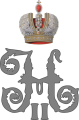 Monogram of Nicholas II

Notes
- ↑ Referring to the estimated death toll of the
 persecution of
  Muslims during the
  Ottoman decline. The number "5.5" and Nicholas II became an icon on
  TikTok edits used against
  Turks. It isn't really accurate since Nicholas II was not the perpetrator nor the causer of the deaths.
- ↑ Referring to
 Edward VII.


