


-
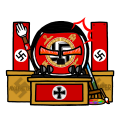 Portrait, no hat
 -
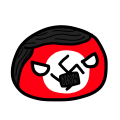 Nazi flag
Hitlerism: Difference between revisions
From Heterodontosaurus Balls
| Line 134: | Line 134: | ||
{{Quote|We erupted into a frenzy of {{i|GermanNat}} [[German Nationalism|nationalistic pride]] that bordered on hysteria. For minutes on end, we shouted at the top of our lungs, with tears streaming down our faces: Sieg Heil, Sieg Heil, Sieg Heil! From that moment on, I belonged to Adolf Hitler body and soul.|{{i|PostNazi}} [[Post-Nazism|Alfons Heck]] (former member of the {{i|Hitler Youth}} [[Hitler Youth]])}} | {{Quote|We erupted into a frenzy of {{i|GermanNat}} [[German Nationalism|nationalistic pride]] that bordered on hysteria. For minutes on end, we shouted at the top of our lungs, with tears streaming down our faces: Sieg Heil, Sieg Heil, Sieg Heil! From that moment on, I belonged to Adolf Hitler body and soul.|{{i|PostNazi}} [[Post-Nazism|Alfons Heck]] (former member of the {{i|Hitler Youth}} [[Hitler Youth]])}} | ||
The programme of the Nazi Party was laid out in their 25-point programme ({{i|Nazi}} [[Nazism|National Socialist]] Program) on 24 February 1920. This did not represent a coherent ideology, but was a conglomeration of received ideas which had currency in the {{i|Volkism}} [[Volkism|völkisch]] {{i|PanGerman}} [[Pan-Germanicism|pan-Germanic]] movement, such as {{i|Ultranationalism}} [[ultranationalism]], {{i|Militarism}} [[Militarism|opposition to the Treaty of Versailles]], {{i|AntiCap}} [[Anti-Capitalism|distrust of capitalism]], as well as some {{i|Socialism}} [[Socialism|socialist]] ideas. For Hitler, the most important aspect of it was its strong {{i|AntiJew}} [[Anti-Semitism|antisemitic]] stance. He also perceived the programme as primarily a basis for propaganda and for attracting people to the party. | |||
Beginning in February 1924, Hitler was tried for high treason before the special {{i|Krit}} [[People's Court (Bavaria)|People's Court]] in {{i|Munich}} [[Munich|Munich]]. He used his trial as an opportunity to spread his message throughout Germany. At one point during the trial, Hitler discussed political leadership, during which he stated that leading people was not a matter of political science (Staatswissenschaft) but an innate ability, one of statecraft (Staatskunst). He further elaborated by claiming that out of 10,000 politicians, only one, {{i|Bismarck}} [[Bismarckism|Otto von Bismarck]], emerged, subtly implying that he too had been born with this gift. Continuing, he declared that it was not {{i|MarxC}} [[Karl Marx Thought|Karl Marx]] who stirred the masses and ignited the Russian Revolution, but {{i|Lenin}} [[Lenin|Vladimir Lenin]], by making his appeal to the senses rather than the mind. | Beginning in February 1924, Hitler was tried for high treason before the special {{i|Krit}} [[People's Court (Bavaria)|People's Court]] in {{i|Munich}} [[Munich|Munich]]. He used his trial as an opportunity to spread his message throughout Germany. At one point during the trial, Hitler discussed political leadership, during which he stated that leading people was not a matter of political science (Staatswissenschaft) but an innate ability, one of statecraft (Staatskunst). He further elaborated by claiming that out of 10,000 politicians, only one, {{i|Bismarck}} [[Bismarckism|Otto von Bismarck]], emerged, subtly implying that he too had been born with this gift. Continuing, he declared that it was not {{i|MarxC}} [[Karl Marx Thought|Karl Marx]] who stirred the masses and ignited the Russian Revolution, but {{i|Lenin}} [[Lenin|Vladimir Lenin]], by making his appeal to the senses rather than the mind. | ||
Revision as of 16:16, 19 December 2025

This Article is Under Construction.
“Wörk, wörk, wörk.” —  Germany
 Germany
There may be lots of WIPs, missing icons, bad formatting, and/or unedited material from other sources on this page. Consider helping out!
—  Adolf Hitler (not) Adolf Hitler (not)
|
Hitlerism refers to the personal ideology, philosophy, and policies of Adolf Hitler, the notorious founder of the  Nazi movement, Führer of the Third Reich, and leader of the
  Nazi Party. He is known for policies such the
  Holocaust (mass extermination of
  Jews), Aktion T4 (involuntary mass euthanasia of disabled peoples), the invasion of
  Poland in 1939 and Generalplan Ost (
 Germanizing
  Eastern Europe by
  genocide and
  ethnic cleansings). Hitlerism's hatred for many ideologies, including
  communism,
  liberalism,
  capitalism,
  globalism and
  democracy is based in the belief that all of these are Jewish.
Hitler is an extremely, and probably the most controversial character, he is the cultural icon and the face of  pure evil, considered the evilest man to ever exist by many. Due to this, he often appears (and is overused) in "dark humour" (often in an attempt to trigger people),
  political satires, and many other
  internet pop culture. And, showing his face or mentioning his name on many social media platforms risks you getting banned, so people came up with nicknames for him such as the "
 Austrian Painter" or "Moustache Man".
Hitlerism can be interpreted to be the predecessor and leader of  Nazism, or seen as a sub-ideology of Nazism.
Life & History
Early Life
Childhood
Adolf Hitler was born on 20 April 1889, in the small town of  Braunau am Inn, which was in
  Austria-Hungary and close to the border of
  Germany. Adolf was the fourth of six children born to
  Alois Hitler and his third wife,
  Klara Pölzl. Adolf's three older siblings—
 Gustav,
  Ida, and Otto—all died before he was born. Also living in the household were Alois's children from his second marriage: Alois Jr. and Angela. In 1892, the three-year-old Adolf and his family moved to
  Passau following Alois's promotion to the customs administration there. Alois was promoted and transferred to
  Linz on 1 April 1893, but the rest of the family remained in Passau. There Hitler acquired the distinctive
  lower Bavarian dialect, rather than
  Austrian German, which marked his speech throughout his life. The family returned to Austria and settled in
  Leonding on 9 May 1894, and in June 1895, Alois retired near to
  Lambach, where he farmed and kept bees. Hitler attended Volksschule (state-funded primary school) in nearby
  Fischlham.
Adolf's father was an  alcoholic, and this behavior had a significant impact on the household, contributing to a difficult and often abusive family environment. The move to near Lambach coincided with the onset of intense father–son conflicts caused by Adolf's refusal to conform to the strict discipline of his school. Alois tried to browbeat his son into obedience, while Adolf did his best to be the opposite of whatever his father wanted. Alois would also beat his son, his mother tried to protect him from regular beatings but she was too scared of his father.
In January 1894, when Hitler was four, he got saved from drowning in the  Inn River by a priest.
Alois Hitler's farming efforts near Lambach were unsuccessful, so in 1897, the family decided to live in Lambach directly. The eight-year-old Adolf took singing lessons, sang in the  church choir, and even considered becoming a priest. In 1898, the Hitler family returned permanently to Leonding. Adolf was deeply affected by the death of his younger brother Edmund in 1900 from measles. Thus, he transformed from a confident, outgoing, and conscientious student to a morose, detached boy who frequently clashed with his father and teachers. Adolf's younger sister Paula recalled that Adolf was a teenage bully who would often slap her.
Alois had made a successful career in the customs bureau and wanted his son to follow in his footsteps. Adolf Hitler later dramatized an episode from this period when his father took him to visit a customs office, depicting it as an event that gave rise to an unforgiving antagonism between father and son, who were both strong-willed. Ignoring his son's desire to attend a classical high school and become an artist, Alois sent Adolf to the Realschule in Linz in September 1900. Adolf rebelled against this decision, intentionally performing poorly hoping that once his father saw what little progress he was making at the technical school, he would let him devote himself to his artistic dream.
Young Adolf was a troublemaker, he smoked in bathrooms and beat his teachers up. As such, he got expelled from many schools. Like many Austrian Germans, Adolf began to develop  German nationalist ideas from a young age. He expressed loyalty only to Germany, despising the declining
  Habsburg Monarchy and their rule over an
  ethnically diverse empire. Adolf and his friends used the greeting "Heil", and sang the "Deutschlandlied" instead of the Austrian Imperial anthem. Hitler believed that Austria should be a part of a "Greater Germany", provoking some of his fellow Austrians.
When Adolf's father suddenly died in 1903, his performance at school deteriorated, and his mother allowed him to leave. He enrolled at the Realschule in  Steyr in September 1904, where his behaviour and performance improved. In 1905, after passing a repeat of the final exam, Adolf left the school without any ambitions for further education or clear plans for a career. He had lived a good life with his mother, sadly she died from breast cancer in 1907 when Adolf was 18. Adolf Hitler became very sad and kept a picture of her next to his bed for the rest of his life.
Early Adulthood
Despite his father wanting him to be a civil servant, Hitler still dreamed of becoming an artist. He tried to joined in the  Academy of Fine Arts in the autumns of 1907 and 1908. But his master said that his painting isn't good enough. He said that it lacked
  empathy and emotion (foreshadowing…). He got rejected from art school both times by
  Christian Griepenkerl, who in 1907 told Hitler's painting "Sample drawing unsatisfactory. Too few heads." and in 1908 simply "Not admitted". This made Hitler deeply upset. Disillusioned and bitter, he turned to
  politics as a means to channel his frustrations and ambitions. (Well, his remaining art pieces were sold for relatively large amounts of money after WWII, so I guess this is something he would be happy about.) The director suggested Hitler should apply to a school for architecture, but he lacked the necessary academic credentials because he had not finished secondary school.
In 1909, Hitler ran out of money and was forced to live a bohemian life in homeless shelters and the Meldemannstraße dormitory. He earned money as a casual labourer and by painting and selling watercolours of  Vienna's sights. During his time in Vienna, he pursued a growing passion for architecture and music, attending ten performances of Lohengrin, his favourite of
  Richard Wagner's operas.
At Vienna, Hitler was exposed to  racist rhetoric.
  Populists such as Mayor
  Karl Lueger exploited the city's prevalent antisemitic sentiment, blamed Jews "for simply anything and everything", and also espoused German nationalist notions for political benefit. German nationalism was even more widespread in the
  Mariahilf district, where Hitler then lived. Georg Ritter von Schönerer became a major influence on Hitler, and he developed an admiration for
  Martin Luther. Hitler read local newspapers that promoted prejudice and used
  Christian fears of being swamped by an influx of Eastern European Jews as well as pamphlets that published the thoughts of philosophers and theoreticians such as
  Houston Stewart Chamberlain,
  Charles Darwin,
  Friedrich Nietzsche,
  Gustave Le Bon, and
  Arthur Schopenhauer. During his life in Vienna, Hitler also developed fervent
  anti-Slavic sentiments.
In May 1913, Hitler received the final part of his father's estate and moved to  Munich, where he continued to struggle financially, working odd jobs and living in a men's hostel. When he was conscripted into the Austro-Hungarian Army, he journeyed to
  Salzburg on 5 February 1914 for medical assessment. After he was deemed unfit for service, he returned to Munich. Hitler later claimed that he did not wish to serve the Habsburg Empire because of the mixture of races in the army and his belief that the collapse of Austria-Hungary was imminent.
World War I
In 1914, when World War I broke out, Hitler eagerly enlisted in the  Bavarian Army, seeing the war as an opportunity to prove his worth and serve the country he idolized. According to a 1924 report by the
  Bavarian authorities, allowing Hitler to serve was most likely an administrative error, because as an Austrian citizen, he should have been returned to Austria.
Hitler was posted to the 6th Bavarian Reserve Division, serving as a dispatch runner at  Belgium and
  France on the Western Front. While other soldiers were smoking and drinking and talking about women, Hitler liked to read and sketch. Hitler spent nearly half his time at the regimental headquarters in
  Fournes-en-Weppes, well behind the front lines. In 1914, he was present at the First Battle of
  Ypres and in that year was decorated for bravery, receiving the Iron Cross, Second Class. During the war, he was saved by his commanding officer,
  Fritz Wiedemann, who pulled Hitler out of the rubble of a collapsed building while under heavy fire.
While he was in France, one of Hitler's fellow soldiers,  Hans Mend, observed Hitler allegedly committing
  homosexuality. In fact, years later (but before Hitler became infamous), he wrote in his memoirs: "At night, Hitler lay with
  Schmidl, his male whore." Schmidl, otherwise known as Ernst Schmidt, and Hitler were inseparable lovers for five years.
During his service at headquarters, Hitler pursued his artistic interests, drawing cartoons and providing instructions for an army newspaper. During the Battle of the Somme in October 1916, he was wounded in the left thigh when a shell exploded in the dispatch runners' dugout. Hitler spent almost two months recovering in hospital at  Beelitz, returning to his regiment on 5 March 1917. He was present at the Battle of
  Arras of 1917 and the Battle of Passchendaele. He received the Black Wound Badge on 18 May 1918. Three months later, in August 1918, on a recommendation by Lieutenant Hugo Gutmann, his Jewish superior, Hitler received the Iron Cross, First Class, a decoration rarely awarded at Hitler's Gefreiter rank. On 15 October 1918, Hitler was temporarily blinded in a mustard gas attack and was hospitalised in
  Pasewalk. While there, Hitler learned of Germany's defeat, and, by his own account, suffered a second bout of blindness after receiving this news. Like many others, he felt betrayed by the German government, which he believed had stabbed the country in the back by signing the Treaty of Versailles.
Hitler described his role in World War I as "the greatest of all experiences" and was praised by his commanding officers for his bravery. His  wartime experience reinforced his German patriotism, and he was shocked by Germany's capitulation in November 1918. His displeasure with the collapse of the war effort began to shape his ideology. Like other German nationalists, he believed the Dolchstoßlegende (stab-in-the-back myth), which claimed that the German army, "undefeated in the field", had been "stabbed in the back" on the home front by civilian leaders, Jews,
  Marxists, and those who signed the armistice that ended the fighting—later dubbed the "November criminals".
The Versailles Treaty caused  Germany very poor
  economic,
  social, and political conditions, which were later exploited by Hitler for political gain.
Entry into Politics
After the war, Hitler returned to Munich. Without formal education or career prospects, he remained in the army. In July 1919, he was appointed Verbindungsmann (intelligence agent) of an Aufklärungskommando (reconnaissance unit) of the  Reichswehr, assigned to influence other soldiers and to infiltrate the
  German Workers' Party (DAP). At a DAP meeting on 12 September 1919, Party chairman
  Anton Drexler was impressed by Hitler's oratorical skills. He gave him a copy of his pamphlet My Political Awakening, which contained antisemitic, nationalist,
  anti-capitalist, and
  anti-Marxist ideas. On the orders of his army superiors, Hitler applied to join the party, and within a week was accepted as party member no. 555 (the party began counting membership at 500 to give the impression they were a much larger party). Hitler would meet and discuss things with other members at a beer bar. He quickly rose within the ranks due to his oratory skills and
  propaganda talents.
Hitler made his earliest known written statement about the Jewish question in a 16 September 1919 letter to  Adolf Gemlich (now known as the Gemlich letter). In the letter, Hitler argues that the aim of the government "must unshakably be the removal of the Jews altogether". At the DAP, Hitler met Dietrich Eckart, one of the party's founders and a member of the occult
  Thule Society. Eckart became Hitler's mentor, exchanging ideas with him and introducing him to a wide range of Munich society. To increase the party's appeal, the DAP changed his name in 1920 to the Nationalsozialistische Deutsche Arbeiterpartei ( National Socialist German Workers' Party (NSDAP), now known as the "Nazi Party"). Hitler designed the party's banner of a swastika in a white circle on a red background.
Hitler was discharged from the Army on 31 March 1920 and began working full-time for the party. The party headquarters was in Munich, a centre for anti-government German nationalists determined to eliminate Marxism and undermine the Weimar Republic.
“”He had come to a house where he had never been before, wearing gaiters, a floppy, wide-brimmed hat, and carrying a riding whip… Eventually, he managed to launch into a
speech. He talked on and on, endlessly. He preached. He went on at us like a division chaplain in the Army. We did not in the least contradict him, or venture to differ in any way, but he began to bellow at us. The servants thought we were being attacked, and rushed in to defend us. When he had gone, we sat silently confused and not at all amused. There was a feeling of dismay, as when on a train you suddenly find you are sharing a compartment with a psychotic. |
—  Friedrich Reck-Malleczewen, Diary of a Man in Despair Friedrich Reck-Malleczewen, Diary of a Man in Despair
|
In February 1921, already highly effective at crowd manipulation, Hitler spoke to a crowd of over 6,000. To publicise the meeting, two truckloads of party supporters drove around Munich waving swastika flags and distributing leaflets. Hitler soon gained notoriety for his rowdy polemic speeches against the Treaty of Versailles, rival politicians, and especially against Jews and Marxists.
In June 1921, while Hitler and Eckart were on a fundraising trip to  Berlin, a mutiny broke out within the Nazi Party in Munich. Members of the executive committee wanted to merge with the
  Nuremberg-based
  German Socialist Party (DSP). Hitler returned to Munich on 11 July and
  angrily tendered his resignation. The committee members realized that the resignation of their leading public figure and speaker would mean the end of the party. Hitler announced he would rejoin on the condition that he would replace Drexler as party chairman, and that the party headquarters would remain in Munich. The committee agreed, and he rejoined the party on 26 July as member no. 3,680. Hitler continued to face some opposition within the Nazi Party. Opponents of Hitler in the leadership had Hermann Esser expelled from the party, and they printed 3,000 copies of a pamphlet attacking Hitler as a traitor to the party. In the following days, Hitler spoke to several large audiences and defended himself and Esser, to thunderous applause. His strategy proved successful, and at a special party congress on 29 July, he was granted absolute power as party chairman, succeeding Drexler, by a vote of 533 to 1.
Hitler's vitriolic beer hall speeches began attracting regular audiences. A demagogue, he became adept at using  populist themes, including the use of scapegoats, who were blamed for his listeners' economic hardships. Hitler used personal magnetism and an understanding of crowd psychology to his advantage while engaged in public speaking.
  Historians have noted the hypnotic effect of his rhetoric on large audiences, and of his eyes in small groups. Early followers of Hitler included
  Rudolf Hess,
  Hermann Göring, and
  Ernst Röhm.
“”We erupted into a frenzy of
nationalistic pride that bordered on hysteria. For minutes on end, we shouted at the top of our lungs, with tears streaming down our faces: Sieg Heil, Sieg Heil, Sieg Heil! From that moment on, I belonged to Adolf Hitler body and soul. |
—  Alfons Heck (former member of the Alfons Heck (former member of the  Hitler Youth) Hitler Youth)
|
The programme of the Nazi Party was laid out in their 25-point programme ( National Socialist Program) on 24 February 1920. This did not represent a coherent ideology, but was a conglomeration of received ideas which had currency in the völkisch pan-Germanic movement, such as  ultranationalism, opposition to the Treaty of Versailles, distrust of capitalism, as well as some
  socialist ideas. For Hitler, the most important aspect of it was its strong antisemitic stance. He also perceived the programme as primarily a basis for propaganda and for attracting people to the party.
Beginning in February 1924, Hitler was tried for high treason before the special  People's Court in Munich. He used his trial as an opportunity to spread his message throughout Germany. At one point during the trial, Hitler discussed political leadership, during which he stated that leading people was not a matter of political science (Staatswissenschaft) but an innate ability, one of statecraft (Staatskunst). He further elaborated by claiming that out of 10,000 politicians, only one,
  Otto von Bismarck, emerged, subtly implying that he too had been born with this gift. Continuing, he declared that it was not
  Karl Marx who stirred the masses and ignited the Russian Revolution, but
  Vladimir Lenin, by making his appeal to the senses rather than the mind.
During his brief time in prison, he wrote his manifesto "Mein Kampf", outlining his ideology and future plans for Germany.
Hitler cared extremely much about his image. He would practice speeches in the mirror while listening to his recordings of his own voice. His official photographer, Heinrich Hoffmann, took hundreds of shots of the man testing different poses and gestures, and only the images whose poses looked strong would survive. So upon his release in 1925, Hitler needed to rebuild his reputation. Hoffmann suggested wearing Bavarian traditional pants (lederhosen). The idea was that Hitler would be seen as a "man of the people". But when the images came back Hitler was furious because he thought they looked silly. The short pants emphasized his bony legs and awkward frame. Hitler ordered every copy to be destroyed, but Hoffmann didn't listen and hid them in his archive. These images were found when Hoffmann was arrested in 1945.
Rise to Power
Hitler focused on rebuilding the Nazi Party and gaining power through legal political means. The Great Depression of 1929 significantly increased the party's support, as Hitler promised economic and political stability. By 1932, the Nazis were the largest party in the  Reichstag (parliament), and in 1933, Hitler was appointed Chancellor of Germany. He quickly consolidated power, passing the Reichstag Fire Decree and the Enabling Act, which gave him
  dictatorial powers. By 1934, after the death of president
  Hindenburg, Hitler had merged the positions of chancellor and president, becoming the supreme leader of Germany.
Hitler's rule led to the aggressive expansion of the German Third Reich and the onset of World War II in 1939, starting with the invasion of Poland. His regime implemented the Holocaust, resulting in the mass extermination of six million Jews and millions of other persecuted groups.
In a Munich hall in November 8, 1939, a bomb was secretly planted behind Hitler's podium as he gave his speech. The bomb was planted by Georg Elser. But Hitler left 13 minutes earlier than expected, and the bomb went off afterwords killing 8 and injuring 62. Hitler was unscathed, and Elser was captured by the  Gestapo near the
  Swiss border trying to escape.
In 1944, Hitler was at Bavaria. The  Brits found out that he took the same morning walk every day with minimal security. So, the Brits set up a plan to assassinate him, with a sniper that spoke
  German and everything. But in the end the plan was canceled because it was feared that Hitler may become a martyr and the Germans would fight even harder, under the command of someone even smarter like
  Himmler or
  Goebbels.
As the war turned against Germany after the invasion of the  USSR, Hitler retreated to his Führerbunker in Berlin. Facing imminent defeat and with Soviets at his doorsteps, he committed suicide on April 30, 1945. His death marked the end of the Nazi regime, and
  Germany surrendered shortly afterward, leaving a legacy of unprecedented destruction and horror.
Adolf Hitler's last meal consisted of a simple plate of pasta with tomato sauce. This meal was prepared by his personal chef, Constanze Manziarly, Manziarly's notes indicate that Hitler killed himself between courses, with a main course of fried eggs and mashed potatoes also prepared but not consumed.
Hitlerism would then be revived in 2024 when a
 YouTube content slop creator, Masteroogwgay, amidst controversy, released the song "Adolf Hitler is My N*gga".
Beliefs & Practices
- Economic Control and Autarky - While not strictly an economic theory, Hitlerism included elements of state control over the economy to ensure it served the interests of the nation and the war effort. This involved policies aimed at achieving self-sufficiency (
 Autarky) and the mobilization of resources for rearmament and military expansion.
 - Darwinism - Hitler took many inspirations from
 Darwin's theory of
  evolution and appropriated it in shaping his racial Darwinist view of human history. He was captivated by evolutionary ideas probably since he was a boy, though he wasn't familiar with Darwin until after 1923. Hitler believed that the File:Pseudoscientocracy-icon.png pseudoscientific theory of evolution justified his destructive and oppressive vision, as for him, cleansing out the
  Jews were partly to make the German race evolve stronger. He had outlined his conclusion that
  Social Darwinism was the basis for a "successful Germany" as early as 1925, in chapter 4 of Mein Kampf. Darwinism, quite undisguised, lie at the bases of all that is worst in Mein Kampf and Hitler's speeches. He reasoned that a higher race would always conquer the lower.
 - Ethnic Self-Hatred - In 1945, the situation for the Nazis were desperate. Hitler came to view the German people as having failed him, unworthy of their great mission in history and thus
 deserving to die alongside his regime. He also ordered the
  Nero Decree, which is to destroy all infrastructure in
  Reich territory, such including the Eiffel Tower. However, the decree was disobeyed.
 - Drug Usage - Hitler consumed
 drugs, such as a mix of cocaine and opioids during the later phase of the war, which he had become increasingly dependent upon. Hitler needed those highs to substitute for his natural charisma, which he had lost in the course of the war. Even before the war, Hitler was injected with vitamins. After 1943 Hitler took a lot more heavy doses. His veins collapsed after thousands of injections. His heavy reliance on drugs was behind his increasingly erratic decision making, especially in the latter stages of the War.
 - Zionism - Hitler was an
 anti-Semitic Zionist. He allowed the Haavara Agreement, which was was an agreement between Nazi Germany and
  Zionist organizations signed on 25 August 1933. It was a major factor in making possible the migration of approximately 60,000 German Jews to
  Palestine between 1933 and 1939. Hitler also planned to forcibly relocate the Jewish population of Europe to the island of
  Madagascar, known simply as the Madagascar Plan.
Anti-Semitism
Central to Hitlerism is the belief in the superiority of the  Aryan race, particularly the Germanic peoples, and the inferiority of other races. This ideology justified the systemic persecution and extermination of Jews, whom Hitler and the Nazis scapegoated for Germany's problems and considered an existential threat.
The origin and development of Hitler's antisemitism remain a matter of debate.[58] His friend August Kubizek claimed that Hitler was a "confirmed antisemite" before he left Linz.[59] However, the historian Brigitte Hamann describes Kubizek's claim as "problematical".[60] While Hitler states in Mein Kampf that he first became an antisemite in Vienna,[61] Reinhold Hanisch, who helped him to sell his paintings, disagrees. Hitler had dealings with Jews while living in Vienna.[62][63][64] The historian Richard J. Evans states that "historians now generally agree that his notorious, murderous antisemitism emerged well after Germany's defeat [in World War I], as a product of the paranoid "stab-in-the-back" explanation for the catastrophe".[65]
Antis
Hitler was opposed to Marxism, Capitalism, and Democracy, viewing them as threats to the Nazi vision of a racially pure and  hierarchically organized society. He believed that Marxism, particularly the focus on class struggle and
  internationalism, was a tool of Jewish influence aimed at undermining the German nation and Aryan race. Hitler's anti-Semitic worldview led him to equate Marxism with a Jewish conspiracy, which he sought to eradicate through aggressive policies and ultimately, the Holocaust.
Capitalism, in Hitler's eyes, was another manifestation of Jewish control, seen as promoting individualism, greed, and economic exploitation that destabilized the social order. While the Nazi regime tolerated and utilized capitalist structures to some extent, especially to fund its war machine and industrial growth, it did so under strict state control, ensuring that economic power aligned with the goals of the regime rather than the interests of private capital.
Democracy was rejected by Hitler as weak and decadent, incapable of providing the strong, unified leadership he deemed necessary for Germany's revival. He saw democratic governance as inherently  corrupt and inefficient, diluting national strength by allowing diverse, and in his view, inferior elements to have a say in the nation's future. In place of democracy, Hitler promoted a
  totalitarian state where power was centralized in the Führer, with absolute authority to guide the nation toward its destiny of
  territorial expansion, racial purity, and
  military dominance.
Hitler was also an  Anti-Americanist. He declared
  America as a "mongrel nation", grown too rich too soon and governed by a capitalist elite with strong ties to the Jews and the Americans were a "mongrel people" incapable of higher culture or great creative achievements.
In Meme Culture
- Kitlers - “Kitlers” are identified as white cats who have a black rectangle spot under their noses, which makes it look like Hitler’s mustache. Additionally, the cat may also have a black spot resembling Hitler’s hairstyle. Sometimes when Kitlers stretch their limbs, it looks like a
 Nazi salute.
 - The Man Who Killed Hitler - Various versions of this meme has taken form. Such as,
 God saying that “whoever kills
  Hitler goes to heaven”, which implies that Hitler went to heaven since he
  killed himself. Another version is on a basketball clip, where the rest of the world tries to shoot the ball in the hoop to kill Hitler but Hitler steals the ball and does it himself.
 - Adolf Hitler vs Darth Vader - The "Epic Rap Battles of History" released three rap battles between Adolf Hitler and Darth Vader, with Hitler’s first verse of the first episode "I AM ADOLF HITLER" being inserted into many clips that starts with "I am".
- Adolf Hitler vs Eminem - A FNF mod featuring Hitler rap battling against
 Eminem has gained popularity. Also, in meme history channels, this is quite popular too.
Trivia
- Hitler asked for a longer visor on his cap in order to protect his eyes from hyper photo sensibility.
- While Hitler is planning his next offensive, a fly annoys him. Furious at this pest, he demands one of his confidants to dispatch the fly. But the aide decided to crack a joke and says, "This is an airborne object. This is better handled by the
 Luftwaffe." The aide is then sent to the Eastern Front.
 Hitler probably was just jealous of how good the joke was - In Hitler’s regime, it was made illegal to kill animals without euthanasia, and was illegal to boil live lobsters and crabs.
- Hitler was a vegetarian. He also cared for
 animal rights, something almost no one else cared for at the time. People who violate his laws on animal rights could be sent to concentration camps, so in a twisted way, Hitler treated animals like humans, and humans as animals.
 - Hitler was a bingewatcher. He liked King Kong, Snow White, Mickey Mouse, and he was a fan of
 Laurel and Hardy. Hitler also organized his own cinema nights with his guests, binge watching into the late night hours in his private screening room. He loved Snow White and other
  Disney films, despite the regime claiming that
  American cartoons were a form Jewish corruption. He was also infuriated because German cartoonists couldn't do better.
 - In his early days, Hitler smoked 40-45 cigarettes a day. He later realized that his
 Aryan super race cannot be associated with smoking. So, he launched a nationwide non-smoking campaign. There even were non-smoking rooms built in bomb shelters.
 - Hitler had many "doubles" who were trained to act exactly like him, for safety reasons.
Hitler's Sexuality
“”Even today Hitler derives pleasure from looking at
men's bodies and associating with homosexuals.  Strasser tells us that his personal body guard is almost always 100% homosexuals. Strasser tells us that his personal body guard is almost always 100% homosexuals. |
— 1943  OSS report by OSS report by  Walter Charles Langer Walter Charles Langer
|
Hitler's sexuality and sex life is an enigma. There are many rumors about depraved interest and abusive tastes, but these are just rumors, no one knows for sure. Hitler had many relations with women. However, some allege does have Homosexual tendencies. Hitler might have even ordered the deaths of several high-ranking Nazis to prevent the secret of his homosexuality from surfacing. One example is Ernst Röhm, the openly gay leader of the  Nazi Storm Troopers, who was reportedly blackmailing Hitler with knowledge of his homosexuality. Röhm was murdered during the Night of the Long Knives, and this might be part of Hitler's effort to protect his secret.
Hitler's service notes read that as a result of an alleged love affair with Ernst Schmidt in the trenches of WWI there was reluctance among senior officers to promote him. According to Erich Ebermeier, a lawyer and writer who viewed Hitler's military files years later: "Despite his bravery towards the  enemy, because of his homosexual activity he lost out on a promotion to non-commissioned officer."
Police reports from Munich after the First World War also suggest that Hitler was pursued by police because of his sexual orientation. As a  fascist advocate, Hitler managed to lure many young men to his side, but not only for political reasons… The police reports also described several young men who claimed to have spent the night with Hitler or been invited to his home. These files were secretly kept by General Otto von Lossow, who planned to use them as blackmail if needed. Though the documents were published in
  Italy, they were mostly ignored by German historians.
Hitler also was allegedly hooked on female hormone  drugs.
Quotes
“”Hitler is probably the
 world's most notorious world's most notorious  tyrant. His name is virtually synonymous with evil. Rising from obscurity and failure, he found inspiration in the German Army and entered politics after World War I. His Nazi Party became the largest in Germany, leading to his appointment as Chancellor in 1933. Within a year, he had turned Germany into a dictatorship. He built up the economy while establishing a police state based on tyrant. His name is virtually synonymous with evil. Rising from obscurity and failure, he found inspiration in the German Army and entered politics after World War I. His Nazi Party became the largest in Germany, leading to his appointment as Chancellor in 1933. Within a year, he had turned Germany into a dictatorship. He built up the economy while establishing a police state based on  terror. He pushed his country into World War II where his aggressive leadership produced spectacular vicotories until he was opposed by the terror. He pushed his country into World War II where his aggressive leadership produced spectacular vicotories until he was opposed by the  Soviet Union and the United States. During the war, he ordered the murder of six million Jews and other minorities. With his country collapsing around him, he committed Soviet Union and the United States. During the war, he ordered the murder of six million Jews and other minorities. With his country collapsing around him, he committed  suicide. suicide. |
| — Clive Foss
|
“”If he (Hitler) does not eat meat, drink alcoholic beverages, or smoke, it is not due to the fact that he has some kind of inhibition or does it because he believes it will improve his health. He abstains from these because he is following the example of the great German,
Richard Wagner, or because he has discovered that it increases his energy and endurance to such a degree that he can give much more of himself to the creation of the new German Reich. |
—  Walter Charles Langer Walter Charles Langer
|
Songs
10 Things I Hate About Jews
10 Things I Hate About Jews is a song created by Rucka Rucka Ali. It is parody of the song 10 Things I Hate About You created by  Leah Kate, and is sung by an impression of Hitler's voice.
{{{1}}}
I caught you sneaking out the ghetto,
Where you were going, I’ll never know.
Thought we were friends,
I gave you jobs and housed you
And then I said that I was pissed,
No you can’t get in, you’re not on the list,
So here’s 10 things I really HATE ABOUT JEWS!
10: You’re so  rich,
rich,
9: You look  Asian,
8 long days for  holidays and,
7th day of rest it’s kind of lazy,
Only 6 million and the rest escaped me.
5: your lox sucks,
4: and your soup,
3: I need your gold teeth and shoes,
2 sips of your grape juice and you’re drunk dude
1: I spent my gas money getting rid of you…
Your movies suck, the reboots too,
You can’t come up with anything new.
Stop making sequels, and give us BACK OUR MONEY!
I won’t even watch Terminator 6,
Just let it die, Arnold you b*tch!
Now here’s 10 more reasons why you can’t STAY IN MY COUNTRY!
10: You don’t lift,
9: You’re basic,
8: I’m just well, kind of racist,
7: You dress great, for a neckbeard  pagan,
6: You don’t eat pig, it’s a waste of bacon.
5: You suck d*ck,
4: And f*ck you,
3: I wish I never met you,
2 kill all you would sit weird in my gut dude,
1: I hate the fact that you made me love Jews
Rah-ah, you made me love Jews
You made me love Jews
Oo-oh-oo-oh-oo
How’d you make me love Jews?
We had a bone that I had to pick,
We can move on now, what do you think?
But first here’s some things that I still HATE ABOUT JEWS,
10: You don’t shellfish,
9: You eat bagels,
8: Let’s put this on the table,
7: Talk a big game till you’re naked,
In the shower- 6: you’re gay,
5: You’re f*ckwits,
4: You are Jews,
3: I still have gas leak issues,
2 many twists of the knob make it stuck dude,
Juan the  Mexican didn’t fix it, I’m screwed.
Everyone I don't like is LITERALLY HITLER
Everyone I don't like is LITERALLY HITLER - The Song is a satire song made by  Rusty Cage, released to YouTube on 2 July 2017. As of April 2025, the video has garnered more than 1,115,692 views.
{{{1}}}
Everyone I don't like is  literally Hitler, literally Hitler, literally Hitler,
Everyone I don't like is literally Hitler, let's have a look and see!
You got  Donald Trump,
  PewDiePie, Pepe the Frog,
Hand signs[5],  free speech, follow
  Godwin's law,
 Pro-life conservatives, grammar police,
 White men, YouTubers, people who eat meat,
Yeah, everyone I don't like is literally Hitler, everyone except for me!
Everyone I hate is a literal Nazi, literal Nazi, literal Nazi,
Everyone I hate is a literal Nazi, let's have a look and see!
 Jordan Peterson! NAZI!
  GamerGate! NAZI! Feminist! NAZI!
  Shakespeare plays! NAZI!
  Barack Obama! NAZI!
  George W. Bush! NAZI!
  Bill Clinton! NAZI!
  Ronald Reagan! NAZI!
Yeah, everyone I hate is a literal Nazi, everyone expect for me!
Everything I don't like is literally Hitler, literally Hitler, literally Hitler,
Everything I don't like is literally Hitler, let's have a look and see!
Comic books! HITLER! Comedians! HITLER! Capitalism! HITLER! Socialism! HITLER! Criticism! HITLER!  Men's rights activism! HITLER! Sexual dimorphism! HITLER! Facts! HITLER! Donald Duck! HITLER! Manspreading! HITLER! Babies! HITLER!
  4chan! HITLER!
  Science! HITLER! Gun control! HITLER! Statistics! HITLER! Milk! HITLER!
Yeah, everyone I don't like is literally Hitler, everyone except for me! Everyone except for me!
Adolf's Box
ADOLF'S BOX is a "song" that is a parody of a part of the FNAF song "JACKIE'S BOX" made by  XTRATUNA on YouTube. The YouTube video containing Adolf's Box was uploaded by
  Ataliste on 6 January 2025.
{{{1}}}
My name is Hitler.
I made the Reich.
It was difficult to put the nations together.
But unfortunately, something went so wrong,
And now I can't do anything, but sing this stupid song!
My name is Hitler. (Hitler. Hitler. Hitler. Hitler. Hitler.)
Relationships
Übermenschen (Supermans)
- Nazism - MIEN IDEOLOGIE! MIEN LIFE'S WORK! Ja! Tohgether, vee shall KONQUER ze VERLD! Zis is NOT just an idea, nein, it is a REVOLUTION! Us German peoples shall RISE AGAIN!!!
 Fascism - You're ze building blocks of my system! Admit it, you zink I’m one of ze most based ideologies out zere.
 Mussolinism - Ally, but you are too soft on ze racial issues.
 Imperialism - Deutschland needs more
  Lebensraum… WAR VITH ZE
  SOWJETS!
 Scientific Racism - "The Jews are undoubtedly a race, but they are not human."
- Drug Legalization - Helps me be energetic. Mein rallies had passion, danke to ze amphetamines.
 Militarism - Yes. YES. BLITZKRIEG. STUKA DIVE. PANZER MARCH. ORDER AND IRON WILL!
 Mediacracy - "Make the lie big, make it simple, keep saying it, and eventually they will believe it."
Jewish-Nazism - I said I wanted a glass of juice, NOT TO GAS THE JEWS!
Anti-Work - Aw, take the day off, pal, what have you got to lose?[6]
Mischlinge
 European Federalism - I wanted to paint, they rejected me. So I painted the entirety of Europe red.
 Röhmism - We were very close. He helped me seize power with street violence. He was the only man I ever loved. He had a brutal, unscrupulous manner, which served me well politically, but after 1933 his
  Sturmabteilung was getting too powerful and threatening my position, so I ordered his arrest and execution.
Untermenschen (Subhumans)
- Der Juden - FILTHY JUDEN! NOT EVEN HUMAN! Mein eternal nemesis, mein obsession. Without you… what would I blame?
 Interculturalism &
  Multiculturalism - "I was repelled by the conglomeration of races which the capital showed me, repelled by this whole mixture of
  Czechs,
  Poles,
  Hungarians,
  Ruthenians,
  Serbs,
  Croats, and everywhere, the eternal mushroom of humanity — Jews and more Jews."
- Zionism - JEW! I smile as I look into the oven and see you dead.
Though maybe it would be nice to ship you all leeches to a place for a country of your own, far far away…  Stalinism - A cunning caucasian. But why do you shoot your own generals like chill man… also stop copying my uniform aesthetic.
 Trumpism - WHO ARE YOU?! Was ist das?! Why do people keep comparing me to a sniveling, blundering, JEW-LOVING fool?
- Liberalism - Weak, degenerate,
 democratic swine! Freedom? Equality? Nein! You let ze JEWS in!
Primalism - IF YOU BREAK YOUR LEGS, IT'S HARD TO COOK ORANGUTAN
How do draw
Hitlerism has a drawing rating of hard.
- Draw a ball.
- Fill the ball with red.
- Draw a white border inside and around the ball.
- Draw a thinner black border inside and around the white border.
- Draw a white circle in the middle of the ball.
- Draw a Nazi Swastika in the white circle.
- Draw a fancy circle in yellow around the white circle. Border the yellow with gold.
- Draw four eagles holding Nazi Swastikas around the circle.
- Add the eyes, Hitler’s cap and a toothbrush mustache. You’re! done.
| Color Name | HEX | |
|---|---|---|
| Red | #DD0000 | |
| Black | #000000 | |
| White | #FFFFFF | |
| Yellow | #FDE77B | |
| Gold | #803300 | |
| Beige | #C29241 | |
Rejected Paintings by Adolf Hitler Gallery


-
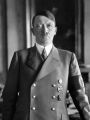 Adolf Hitler
 -
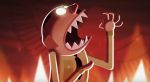 A comedic depiction of Hitler, from the Netflix adult show “Love, Death & Robots”


Notes
- ↑ Throughout World War II, Hitler often compared himself to
 Frederick II the Great, and he kept a copy of
  Anton Graff's portrait of Frederick with him to the end in the Führerbunker in
  Berlin.
- ↑
 British spies plotted to lace Hitler's food with
  female sex hormones during World War II in a bid to curb his aggressive impulses and make him more feminine.
- ↑ A painting by
 Franz von Stuck in 1889 influenced Hitler's looks significantly. Hitler cosplayed as
  Wotan (Odin), who appeared in the painting leading an army of dead, for the rest of his life.
- ↑ Less common later due to stomach issues.
- ↑
 Jacklyn Reeves (@JacklynReeves12) on an unknown social media platform (presumably
  Twitter): "#powerhandprivilege EVERYONE, LISTEN UP! This ok sign (👌) is a commonly used symbol of
  white supremacy, hijacked by nazis #powerhandprivilege" along with photos of
  Mel Gibson and Donald Trump doing the OK hand sign and a Nazi war flag with the Hakenkreuz replaced by the hand sign.
- ↑ Reference to a WWII
 Allied propaganda poster urging everyone to work. The poster shows Hitler telling the phrase to a man in bed. This poster has been getting people banned in r/AntiWork.


