Soviet Union in World War II: Difference between revisions
No edit summary |
|||
| (97 intermediate revisions by 4 users not shown) | |||
| Line 1: | Line 1: | ||
{{ | {{Mbox/Evil}}<blockquote>''This page about the history of the USSR during WWII. For the main article of this character, see {{i|USSR}} [[Union of Soviet Socialist Republics]].''</blockquote>{{Infobox | ||
|Name | |Name= {{I|USSRWW2}} Union of Soviet Socialist Republics {{I|USSRWW2}} | ||
| | |NativeName= {{ILSize|RussianL-icon.png|Russian Language}}: Союз Советских Социалистических Республик | ||
| | |founded= 1939 | ||
| | |predicon= Stalinist Era | ||
|Caption | |onlypredecessor= Stalinist Era | ||
|Alias | |ended= 1945 | ||
|nexticon= Stalinist Era | |||
|onlysuccessor= Stalinist Era | |||
| | |image= Soviet Union in World War II.png | ||
|Caption= Can’t be the hero if you are worse than the villain. | |||
|Alias= "Liberator" of Europe<br>WWII Era of USSR<br>World War II in the Soviet Union<br>World War II in the Union of Soviet Socialist Republics<br>{{Alias|Churchill-icon.png|Churchillism|(Allied) Hell attacked by {{i|Hitler}} [[Hitlerism|Hitler]]}} | |||
|Founder= {{i|Stalin}} [[Stalinism|Joseph Stalin]] (1878-1953) | |||
|Time= 17 September 1939 – 2 September 1945 | |||
|Government= {{i|Federalism}}{{I|MarxLenin}}{{i|OneParty}}{{i|Socialism}}{{i|Republic}}{{I|Stalin}}{{i|Totalitarianism}}{{i|Dictatorship}} [[Federalism|Federal]] [[Marxism-Leninism|Marxist–Leninist]] [[One-Party State|One-Party]] [[Socialism|Socialist]] [[Republicanism|Republic]] [[Stalinism|under a Stalinist]] [[Totalitarianism|Totalitarian]] [[Dictatorship]] | |||
|Languages= {{Scroll|'''Official:'''<br>{{I|RussianL}} [[Russian Language|Russian]]<br>'''Regional:'''<br>{{I|BelarusianL}} [[Belarusian Language|Belarusian]]<br>{{I|UkrainianL}} [[Ukrainian Language|Ukrainian]]<br>{{I|LithuanianL}} [[Lithuanian Language|Lithuanian]]<br>{{I|LatvianL}} [[Latvian Language|Latvian]]<br>{{I|EstonianL}} [[Estonian Language|Estonian]]<br>{{I|RomanianL}} [[Romanian Language|Romanian/Moldovan]]<br>{{I|ArmenianL}} [[Armenian Language|Armenian]]<br>{{I|AzerbaijaniL}} [[Azerbaijani Language|Azeri]]<br>{{I|GeorgianL}} [[Georgian Language|Georgian]] | |||
}} | |||
|Affiliation= {{i|Stalinist Era}} [[Stalinist Era|Stalinist Era of the Soviet Union]]<br>{{i|Hitler-Stalin}} [[Molotov-Ribbentrop Pact]]<br>{{I|Allies}} [[Allied Powers]] | |||
|Religions= {{i|Atheism}} [[Atheism]] | |||
|Capital= {{i|Moscow}} [[Moscow]] | |||
| | |Gender= Male | ||
| | |Friends= {{Scroll|{{I|USA interwar}} [[Interwar and World War II United States|United States of America]]<br>{{I|UK}} [[United Kingdom]]<br>{{I|ROC}} [[Republic of China]]<br>{{I|CCP}} [[Chinese Communist Party|Chinese Communists]]<br>{{i|Provisional Government of National Unity}} [[Provisional Government of National Unity]]}} | ||
| | |Enemies= {{Scroll|{{I|NaziWar}} [[German Third Reich|Nazi Germany]]<br>{{I|JapEmp}} [[Empire of Japan]]<br>{{I|Poland2}} [[Second Polish Republic]]<br>{{I|PolishUS}} [[Polish Underground State]]<br>{{I|Finland}} [[Finland]]<br>{{i|Pahlavi}} [[Pahlavi Iran]]<br>{{i|Lithuania}} [[First Republic of Lithuania]]<br>{{i|Latvia}} [[First Republic of Latvia]]<br>{{i|Estonia}} [[First Republic of Estonia]]<br>{{i|KingdomRomania}} [[Kingdom of Romania]]<br>{{i|RegencyHungary}} [[Regency Hungary]]}} | ||
| | |Likes= {{i|Stalin}} [[Stalinism|Glorious Stalin]], carving up {{I|Poland2}} [[Second Polish Republic|Poland]], killing {{I|Nazi}} [[Nazism|Nazis]], the Great {{i|Patriotism}} [[Patriotism|Patriotic]] War, tanks, massacres, {{i|Rape}} [[Rapeism|rape]], simps claiming he took down the Nazis all by himself, the winter | ||
| | |Dislikes= {{i|Hitler}} [[Hitlerism|Traitor Hitler]] | ||
| | |Preceded= {{i|Stalinist Era}} [[Stalinist Era]] | ||
|Succeeded= {{i|Stalinist Era}} [[Stalinist Era]] | |||
| | |themecolor= #563534 | ||
| | |textcolor= #ff0000 | ||
}}{{Quote|If {{I|Hitler}} [[Hitlerism|Hitler]] invaded hell, I would make at least a favourable reference to the {{I|Satan}} [[Satanism|devil]] in the {{i|HouseCommonUK}} [[House of Commons of the United Kingdom|House of Commons]].|{{I|Churchill}} [[Churchillism|Winston Churchill]]}}The '''Soviet Union's participation in World War II''' was an era that is part of the {{i|Stalinist Era}} [[Stalinist Era]], playing an important role in defeating the {{I|Axis}} [[Axis Powers]]. His activities in the conflict was multifaceted and impactful on several fronts. Initially allies with the {{I|Nazi}} [[German Third Reich]] to split up {{I|Poland2}} [[Second Polish Republic|Poland]], he became in inspired by the Nazi to go on his own Blitzkrieg streak on his neighbors. USSR switched teams when Germany betrayed him by {{I|Lebensraum}} [[Lebensraum|invading]] him. Then, he used "fighting Nazis" as an excuse to spread {{I|SovietImp}} [[Soviet Social Imperialism|Soviet imperialism]], which was way more successful. | |||
| | |||
| | Many people claim the Soviets liberated {{I|Europe}} [[Europe]] from the Nazis. But the reality is, the Soviet Union's {{I|Commie}} [[Communism|communism]] is as brutal as {{I|Nazi}} [[Nazism]] if not more. While the Nazis aim to eliminate a certain group of people (such as the {{I|Jew}} [[Jews]]), communism aims at the total destruction of all people, including their own, physically and spiritually. | ||
| | |||
| | ==History== | ||
| | In the late 1930s, before the "Great Patriotic War", {{i|Stalin}} [[Stalinism|Stalin]] purged his {{i|Red Army}} [[Red Army|army]] brutally. Later, a bunch of failed and useless military campaigns added more to the unnecessary loss of life. | ||
}} | Stalin wanted to catch up to the {{i|Capitalism}} [[Capitalism|capitalist]] world, since his {{i|Commie}} [[Communism|communist]] state was far behind. USSR came up with a plan, as in 1933 the {{i|Nazi}} [[German Third Reich|Nazis]] came to power: he would cause the Nazis and the Capitalists to go to {{i|War}} [[war]] with each other, and while they did, Soviet can develop himself. And when the war ended, the capitalists would be weak, leaving Soviet as the sole world superpower. USSR tried allying himself with the capitalists in order to stir up war, but they refused due to a lack of trust. So, the USSR decided to ally with the Nazis instead, as to throw them into war was the primary goal, while who he allied with was secondary. | ||
===Invasion of Poland=== | |||
On 23 August 1939, the Soviet Union signed the {{i|Hitler-Stalin}} [[Molotov-Ribbentrop Pact]] with {{i|Nazi}} [[German Third Reich|Nazi Germany]], a non-aggression treaty that included secret protocols dividing {{i|EastEurope}} [[Eastern Europe]], negotiated by Soviet foreign minister {{i|Molotov}} [[Molotovism|Vyacheslav Molotov]] and German foreign minister {{i|Ribbentrop}} [[Ribbentropism|Joachim von Ribbentrop]]. This established a "{{i|Hitler-Stalin}} [[Berlin-Moscow Axis]]". | |||
When Germany requested Soviet Union to invade {{i|Poland2}} [[Second Polish Republic|Poland]], he first hesitated. Soviet Union believed that Poland was more ready for {{i|War}} [[war]] then he actually is, plus, {{i|Red Army}} [[Red Army|Soviet's army]] were still fighting {{i|JapEmpSane}} [[Empire of Japan|Japan]]. But everything would resolve itself when the Japan heard about the Molotov-Ribbentrop Pact. Japan was hoping on allying with the German Third Reich against the Soviet Union, but the non-aggression pact made it not possible, thus Japan decided to not fight anymore. As a result, on 17 September 1939, Soviet invaded Poland from the east shortly after Germany's invasion from the west, effectively annexing territory according to the pact's provisions. Soviet Union annexed Western Ukraine and Western Belorussia into their {{i|UkrSSR}} [[Ukrainian Soviet Socialist Republic|respective Sov]][[Byelorussian Soviet Socialist Republic|iet republics]] {{i|BeloSSR}}. Hundreds of thousands of Polish soldiers and civilians were captured or deported to the Soviet interior. | |||
===Winter War=== | |||
On 30 November 1939, Soviet Union invaded {{i|Finland}} [[Finland]] since he didn't want to give up clay to him. USSR was confident that he could win against puny little Finland. But, the bright uniforms of the {{i|Red Army}} [[Red Army]] made Soviet easy targets in the white snowy Finnish environment for the native Finns, who wore white camouflage. Despite being very much outnumbered, the Finnish forces used clever tactics and the harsh winter to slow down the Soviet advance. The snipers of Finland are known for taking out huge amounts of Soviet troops. Soviet soldiers asked their superiors for more camouflaged clothing, but they denied. | |||
The war ended with the {{i|Moscow}} [[Moscow]] {{I|Pacifism}} [[Pacifism|Peace]] Treaty on 13 March 1940, where Finland had to give up 11% of his land but kept his independence. Still, Soviet Union was humiliated because no one ever thought that tiny Finland would cause so much Soviet casualties.{{Quote|If we keep throwing men at bullets, they will run out of bullets.|{{i|USSR2}} [[Union of Soviet Socialist Republics|Soviet Union]]’s strategy during the Winter War, probably}} | |||
===Soviet Blitzkrieg: Baltic Occupations & Expansion of 1940=== | |||
Between April and May 1940, Soviet Union used his {{i|NKVD}} [[People's Commissariat of Internal Affairs|NKVD]] to {{i|Genocide}} [[genocide]] 21,000+ {{i|PolandAlt}} [[Poles|Polish]] {{i|Militarism}} [[Militarism|generals]] and {{i|Intellectualism}} [[Intellectualism|intellectuals]] for {{i|SovietImp}} [[Soviet Social Imperialism|Sovietization]] reasons. This series of killings was known as the {{i|Forest}} [[Katyn]] Massacre, and the order to {{i|DeathPen}} [[Death Penalty|execute]] captive members of the Polish officer corps was secretly issued by the {{i|CPSU}} [[Communist Party of the Soviet Union|Soviet Politburo]] led by {{i|Stalin}} [[Stalinism|Stalin]]. When a Polish general came requesting information about missing Polish officers, Stalin falsely told him that all of the Poles were freed and escaped {{i|1ball}} [[Asians|East]], and that not all could be accounted because the Soviets "lost track" of them in {{i|Manchu}} [[Manchuria]]. | |||
The Soviet Union realized that his plan of throwing the {{i|Capitalism}} [[Capitalism|capitalist]] world into {{i|War}} [[war]] has failed when {{i|Nazi}} [[German Third Reich|Germany]] invaded and conquered {{i|French3}} [[French Third Republic|France]] in June. As it turns out, the Nazis would become powerful as the sole superpower, not USSR. Feeling inspired by Germany's lightning war, USSR decided to go on his own Blitzkrieg. In June 1940, while the {{I|Allies}} [[Allied Powers|Allies]] were busy dealing with Germany, USSR forced {{I|Lithuania}} [[First Republic of Lithuania|Lithuania]], {{I|Latvia}} [[First Republic of Latvia|Latvia]], and {{I|Estonia}} [[First Republic of Estonia|Estonia]] to allow his {{I|Red Army}} [[Red Army|troops]] into their clay. Shortly afterward, the USSR organized {{I|IllibDem}} [[Illiberial Democracy|rigged elections]] and installed {{I|Commie}} [[Communism|communist]] governments. By August 1940, all three countries were formally annexed into the Soviet Union as the {{i|LithSSR}} [[Lithuanian Soviet Socialist Republic]], {{i|LatSSR}} [[Latvian Soviet Socialist Republic]], and {{i|EstSSR}} [[Estonian Soviet Socialist Republic]]. | |||
At the same time, the Soviet Union pressured {{I|KingdomRomania}} [[Kingdom of Romania|Romania]] to hand over {{I|Romania}} [[Bessarabia]] and northern {{I|Romania}} [[Bukovina]]. Romania, fearing both the USSR and {{i|Nazi}} [[German Third Reich|Germany]], agreed to the Soviet demands in June 1940. These lands were then incorporated mainly into the {{i|MoldSSR}} [[Moldavian Soviet Socialist Republic]] and the {{i|UkrSSR}} [[Ukrainian Soviet Socialist Republic]]. Through these expansions, the Soviet Union significantly increased his territory and pushed his western borders further away from {{i|Moscow}} [[Moscow]]. However, the aggressive {{I|Imp}} [[Imperialism|expansion]] also alarmed many neighbouring countries and increased tensions with Germany. | |||
===Great Patriotic War: Fight Against the Axis=== | |||
====Operation Barbarossa==== | |||
{{i|Nazi}} [[German Third Reich|Germany]] decided that he needed more {{i|Lebensraum}} [[Lebensraum|living space]], so on 22 June 1941, he launched the largest invasion ever, Operation Barbarossa, against the Soviet Union, opening a huge front and breaking their {{i|Hitler-Stalin}} [[Molotov-Ribbentrop Pact|pact]]. Millions of armed men ushered in at the Soviet border, surprising USSR. | |||
The attack caught the Soviet leadership largely unprepared. The earlier purges of the {{i|Red Army}} [[Red Army]] officer corps had weakened Soviet command, and German forces advanced rapidly through Soviet territory. Within months Germany captured huge swaths of clay, including parts of {{i|UkrSSR}} [[Ukrainian Soviet Socialist Republic|Ukraine]], {{i|BeloSSR}} [[Byelorussian Soviet Socialist Republic|Belarus]], and western {{i|RSFSR}} [[Russian Soviet Federative Socialist Republic|Russia]]. Millions of Soviet soldiers were killed or captured in the opening months of the invasion. | |||
German forces advanced toward major Soviet cities such as {{i|Lenin}} [[Leningrad]], {{i|Moscow}} [[Moscow]], and {{i|Stalinist Era}} [[Stalingrad]]. The invasion marked the beginning of what the Soviet Union called the "Great {{i|Patriotism}} [[Patriotism|Patriotic]] War". USSR knew he had to join the {{i|Allies}} [[Allied Powers]] now, and an official {{i|UK}} [[United Kingdom|Anglo]]-Soviet agreement was signed on 12 July 1941 which pledged mutual support. As such, he also invaded {{i|Pahlavi}} [[Pahlavi Iran|Iran]] in August 1941 with the British. In addition to mutual support, USSR also wanted a promise to gain the clay he was supposed to have under the Molotov-Ribbentrop Pact. Britain refused to accept the territorial gain agreements, which {{I|Stalin}} [[Stalinism|Stalin]] accepted months later as the military situation had deteriorated somewhat by mid-1942. | |||
====War at the Russian Cities==== | |||
By the {{i|Autumn}} [[Autumncore|autumn]] of 1941, {{i|Nazi}} [[German Third Reich|German]] forces had advanced deep into Soviet territory and began Operation Typhoon, the offensive aimed at capturing the capital {{i|Moscow}} [[Moscow]], the {{i|Politics}} [[Politics|political]] and logistical center of the Soviet Union, and the fall of such city would be catastrophic. Panic spread in the streets of Moscow, and government offices began evacuating eastward. Despite the danger, {{i|Stalin}} [[Stalinism|Stalin]] chose to remain. Soviet Union mobilized enormous resources for the defense of the capital. Civilians helped dig trenches and anti-tank ditches, while factories were dismantled and moved east to the {{i|Ural}} [[Ural Mountains]] and {{i|Siberia}} [[Siberia]], where they could continue producing weapons beyond German reach. The losses of the Germans and Russians were quite equal throughout, but the Soviets had the largest assembled {{i|Red Army}} [[Red Army|army]] in {{i|History}} [[history]]. | |||
Meanwhile, on 8 September 1941, German and {{i|Finland}} [[Finland|Finnish]] forces surrounded {{i|Lenin}} [[Leningrad]]. Rather than storm the city directly, Germany chose to blockade, cutting off food and supplies. The Siege of Leningrad would become one of the longest, deadliest and most brutal sieges in {{i|History}} [[history]]. It was not classified as a war crime at the time, but since then, some historians have classified it as a {{i|Genocide}} [[genocide]] due to the intentional destruction of the city and the systematic starvation of the civilian population. | |||
Under the Lend-Lease Act, from October 1941 to September 1945, with initial deliveries starting shortly after the German invasion in June 1941, the {{I|USA interwar}} [[Interwar and World War II United States|United States]] sent the USSR $11 billion in goods (approx. $180 billion in 2016 dollars), including 400,000 jeeps/trucks, 14,000 aircraft, and massive quantities of food and raw materials. This is contrary to what USSR simps' claim that the {{I|Commie}} [[Communism|Communists]] defeated the Nazis all by themselves. | |||
The {{i|Red Army}} [[Red Army]] also received crucial reinforcements from Siberian divisions that had been stationed near the border with {{i|JapEmpSane}} [[Empire of Japan|Japan]]. Soviet intelligence had learned that Japan did not intend to attack the USSR at that moment, allowing Stalin to move these well-trained troops westward. When {{i|Winter}} [[Wintercore|winter]] arrived, the German forces were unprepared for the extreme cold and began to stall outside Moscow. In December 1941, the Soviet Union launched a massive counteroffensive, pushing German forces back from the city. This marked the first major strategic defeat of Nazi Germany in the war, proving that the German army was not invincible. | |||
In early 1942, Soviet began a series of offensives labelled "Stalin's First Strategic Offensives". The counteroffensive bogged down, in part due to mud from rain in the {{I|Spring}} [[Springcore|spring]] of 1942. Stalin's attempt to retake {{I|Kharkiv}} [[Kharkiv|Kharkov]] in {{I|Ukraine}} [[Reichskommissariat Ukraine|Ukraine]] ended in the disastrous encirclement of Soviet forces, with over 200,000 Soviet casualties suffered, leading Stalin to attack the competence of the generals involved. General {{I|Red Army}} [[Stratocracy|Georgy Zhukov]] and others subsequently revealed that some of those generals had wished to remain in a defensive posture in the region, but Stalin and others had pushed for the offensive. | |||
At the same time, {{I|Hitler}} [[Hitlerism|Hitler]] was worried about {{I|USA}} [[United States of America|American]] popular support after the U.S. entry into the {{I|War}} [[war]] following the Attack on Pearl Harbor, and a potential {{I|UK}} [[United Kingdom|Anglo]]-[[Interwar and World War II United States|American]] {{I|Murica}} invasion on the Western Front in 1942 (which did not occur until 1944). He changed his primary goal from an immediate victory in the East to the more long-term goal of securing the southern Soviet Union in order to protect oil fields vital to the long-term German war effort. While Red Army generals correctly judged the evidence that Hitler would shift his efforts south, Stalin thought it a flanking move in the German attempt to take Moscow. | |||
The German southern campaign began with a push to capture the {{I|Crimea}} [[Crimean Autonomous Socialist Soviet Republic|Crimea]], which ended in disaster for the Red Army. Stalin publicly criticised his generals' leadership. In his southern campaigns, Germany took 625,000 Red Army prisoners in July and August 1942 alone. At the same time, in a meeting in Moscow, {{I|Churchill}} [[Churchillism|Churchill]] privately told Stalin that the British and Americans were not yet prepared to make an amphibious landing against a fortified {{I|NaziWar}} [[Occupation of France|Nazi-held French]] coast in 1942, and would direct their efforts to invading German-held North Africa. He pledged a campaign of massive strategic bombing, to include German civilian targets. | |||
====Battle of Stalingrad==== | |||
Estimating that the Russians were "finished," {{I|Nazi}} [[German Third Reich|Germany]] began another southern operation in the {{I|Autumn}} [[Autumncore|autumn]] of 1942, toward the Caucasus oil fields and the city of {{i|Stalin}} [[Stalingrad]] on the {{i|River}} [[Volga River]]. The battle that followed became one of the most brutal urban battles in {{i|History}} [[history]]. Stalingrad was a key {{i|Industrialism}} [[Industrialism|industrial]] city that held strategic importance for both sides. German forces entered the city in late {{i|Summer}} [[Summercore|summer]] 1942, and fighting quickly devolved into street-to-street and close-quarters combat. Entire buildings changed hands multiple times in a single day. Soviet troops were ordered to hold their ground at all costs. | |||
In November 1942, the {{i|Red Army}} [[Red Army]] launched Operation {{i|Uranus}} [[Uranus]], a massive encirclement attack targeting the weaker {{i|KingdomRomania}} [[Kingdom of Romania|Romanian]] and {{i|RegencyHungary}} [[Regency Hungary|Hungarian]] units protecting the German flanks. The maneuver made the battle reach the climax, trapping the {{i|Nazi6Army}} [[Wehrmacht 6th Army|German 6th Army]] inside Stalingrad, cut off from supplies and reinforcements and facing dire conditions, including harsh {{i|Winter}} [[Wintercore|winter]] weather and Soviet bombardment. After months of starvation and fighting, the surrounded German forces surrendered in February 1943 despite {{i|Hitler}} [[Hitlerism|Hitler]]'s refusal to allow a retreat. The Soviet victory at Stalingrad marked a major turning point of the war, shifting the strategic initiative to the Soviet Union, halting the German advance and boosting {{i|Allies}} [[Allied Powers|Allied]] morale while inflicting heavy casualties on the {{i|Axis}} [[Axis Powers]]. | |||
====Battle of Kursk==== | |||
In 1943, after the defeat at {{i|Stalinist Era}} [[Stalingrad]], {{i|Stalin}} [[Stalinism|Stalin]] ceded to his generals' call for the Soviet Union to take a defensive stance because Soviet forces had suffered disappointing losses at Stalingrad, they lacked reserves for new offensives, and commanders believed that the {{i|Nazi}} [[German Third Reich|Germans]] would likely attack the bulge in the Soviet front at {{i|Kursk}} [[Kursk]]. Preparing defensive positions there would allow USSR to use his resources more effectively. And sure enough, {{i|Nazi}} [[German Third Reich|Germany]] attempted one final major offensive on the {{i|EastEurope}} [[Eastern Europe|Eastern Front]] against USSR at the Battle of {{i|Kursk}} [[Kursk]] in July 1943. The battle centered around a large Soviet salient in the front lines. Both sides prepared massive forces, including thousands of tanks. The clash became the largest tank battle in {{i|History}} [[history]], particularly during the fighting near {{i|Prokhorovka}} [[Prokhorovka]]. | |||
However, the Soviet Union had extensive defensive preparations, including minefields, anti-tank positions, and deep defensive layers. When the German offensive stalled, the {{i|Red Army}} [[Red Army]] launched powerful counterattacks. {{i|Hitler}} [[Hitlerism|Hitler]] cancelled the attack due to the {{i|Allies}} [[Allied Powers|Allied]] invasion of {{i|Sicily}} [[Sicily]]. After Kursk, Germany permanently lost the ability to launch large-scale offensives in the east. From this point forward, the Soviet Union remained largely on the offensive. | |||
====Soviet Advance into Eastern Europe==== | |||
Following {{i|Kursk}} [[Kursk]], the {{i|Red Army}} [[Red Army]] began pushing {{i|Nazi}} [[German Third Reich|Nazi]] forces westward across {{i|EastEurope}} [[Eastern Europe]]. Major operations "liberated" large parts of Soviet territory and later advanced into {{i|Axis}} [[Axis Powers|Axis]]-occupied countries. What these territories didn't know was that they'll be under worse rule after the war. | |||
After Polish railroad workers found the mass grave from the {{i|Forest}} [[Katyn]] killings from 1940, the Nazis used the massacre to attempt to drive a wedge between {{i|Stalin}} [[Stalinism|Stalin]] and the other {{i|Allies}} [[Allied Powers|Allies]], including bringing in a {{i|Europe}} [[Europe|European]] commission of investigators from twelve countries to examine the graves. In 1943, as the Soviets prepared to retake {{i|GeneralGov}} [[General Government|Poland]], Nazi Propaganda Minister {{i|Goebbels}} [[Goebbelsism|Joseph Goebbels]] correctly guessed that Stalin would attempt to falsely claim that the Germans massacred the victims. As Goebbels predicted, the Soviets had a "commission" investigate the matter, falsely concluding that the Germans had killed the PoWs. The Soviets did not admit responsibility until {{i|Gorbachev}} [[Gorbachevism|1990]]. | |||
In 1944, Soviet Union launched Operation Bagration, named after Russian general {{i|Imp}} [[Imperialism|Pyotr Bagration]] of the {{i|Bonapartism}} [[Bonapartism|Napoleonic]] Wars, and it was one of the most successful offensives of the war. The operation destroyed much of Germany's {{i|NaziWar}} [[Army Group Centre]] and retook {{i|BeloSSR}} [[Byelorussian Soviet Socialist Republic|Belarus]], while Soviet forces also advanced into {{i|GeneralGov}} [[General Government|Poland]] and the {{i|Baltic}} [[Baltic States|Baltic]] region. As the Red Army advanced, Soviet influence expanded across Eastern Europe. {{i|Commie}} [[Communism|Communist]] governments were set up in several of the territories "liberated" by Soviet forces. Meanwhile, in June 1944, the Western {{I|Allies}} [[Allied Powers|Allies]] launched the D-Day invasion of {{I|Normandy}} [[Normandy]], opening a second front against {{I|Nazi}} [[German Third Reich|Nazi Germany]]. | |||
On 12 January 1945, the Soviet Union launched the {{I|River}} [[Vistula River|Vistula]]-[[Oder River|Oder]] {{I|River}} Offensive, pushing deep into German territory and capturing {{I|Warsaw}} [[Warsaw]], reviving {{i|Provisional Government of National Unity}} [[Provisional Government of National Unity|Poland]] as his {{I|Puppet}} [[Puppet Dictatorship|puppet]]. | |||
On 30 January 1945, over 10,000 German civilian refugees, wounded soldiers, and crew tried to escape the hands of the advancing and brutal Soviets through the {{i|Water}} [[Baltic Sea]] on the MV ''{{i|Nazi}} [[Nazism|Wilhelm Gustloff]]''. USSR didn't let that slide and torpedoed the ship three times, leading to an estimated 9,000+ deaths, primarily {{i|Female}} [[Female|women]] and children, in freezing waters. It was the deadliest maritime disaster in {{i|History}} [[history]], killing far more than even the RMS ''Titanic''. | |||
====Fall of Berlin==== | |||
By April 1945, German Third Reich was close to defeat. On the {{I|EastEurope}} [[Eastern Europe|Eastern Front]], about 1.9 million German soldiers were fighting 6.4 million soldiers of the Soviet {{I|Red Army}} [[Red Army]]. On the {{I|WestEurope}} [[Western Europe|Western Front]], about 1 million German soldiers were facing 4 million Western Allied troops. Although there had been early discussions about a race between the Allies to capture {{I|Berlin}} [[Berlin]], the situation changed after {{I|Stalin}} [[Stalinism|Joseph Stalin]] persuaded the Allies at the {{I|Crimea}} [[Yalta]] Conference in February 1945 that eastern Germany would fall under {{I|East Germany}} [[East Germany|Soviet influence]]. Because of this agreement, the Western Allies did not plan a ground assault to capture the city. | |||
Stalin directed the Red Army to move rapidly in a broad front into Germany because he did not believe the Western Allies would hand over territory they occupied, while he made capturing Berlin the overriding objective. As the Soviets {{I|Genocide}} [[Genocide|massacred]] and {{I|Rape}} [[Rapeism|raped]] without discrimination in {{i|RegencyHungary}} [[Kingdom of Hungary|Hungary]] and {{i|Prussia}} [[Prussia]], the people in Berlin knew what was coming for them, and many tried to flee to the more merciful hands of {{i|USA}} [[United States of America|USA]] or {{i|UK}} [[United Kingdom|UK]]. | |||
The Red Army's match into Germany was filled with massacres, looting, and unspeakable amounts of rape.{{Quote|The {{i|Red Army}} [[Red Army|Russian soldiers]] were raping every {{I|Female}} [[Female|girl]]- from 8 to 80. It was an army of {{i|Rape}} [[Rapeism|rapists]].|{{i|UK}} [[United Kingdom|Antony Beevor]]}} | |||
The | |||
By April, Soviet troops encircled {{I|Berlin}}, leading to the Battle of {{I|Berlin}} [[Berlin]] and subsequent Fall of Berlin, becoming an iconic Soviet victory. {{I|Hitler}} [[Hitlerism|Adolf Hitler]] committed suicide in his bunker on 30 April as Soviet troops banged on his bunker, and they disposed of his body. Germany surrendered unconditionally on 8 May, ending World War II in {{I|Europe}} [[Europe]]. Soviet Union emerged as one of the victorious {{I|Allies}} [[Allied Powers]], but {{I|War}} [[war]] left the country devastated, with over 20 million lives lost. Still, the USSR established {{I|Puppet}} [[Puppet Dictatorship|puppet states]] and a {{I|Commie}} [[Eastern Bloc|sphere of influence]] in {{I|EastEurope}} [[Eastern Europe]] from the remains of Nazi Germany, and took in many Nazi {{I|Science}} [[Science|scientists]] as part of his Operation Osoaviakhim. | |||
The victory of the Soviets in WWII, propaganda tells you, was a {{I|Moralism}} [[Moralism|noble]] victory, as the mighty Soviets have saved Europe from the {{I|Immoralism}} [[Immoralism|evil]] Nazis. The truth was that it was far from noble. | |||
== | ====War on Japan==== | ||
=== | Although {{i|Nazi}} [[German Third Reich|Germany]] had surrendered, {{i|EmpireJapan}} [[Empire of Japan|Japan]] was still going and Soviet Union still had a neutrality pact with him. At the {{i|Crimea}} [[Yalta]] Conference, however, {{i|Stalin}} [[Stalinism|Stalin]] agreed to join the war against Japan once the {{i|Europe}} [[Europe|European]] war ended. On 8 August 1945, the Soviet Union declared {{i|War}} [[war]] on Japan and launched a massive invasion of {{i|Manchukuo}} [[Manchukuo|Manchuria]], defeating the Japanese {{i|Banzai}} [[Kwantung Army]] in a rapid campaign known as the Manchurian Strategic Offensive Operation. Soviet forces also occupied {{i|Karafuto}} [[Karafuto|South Sakhalin]], the {{i|KurilIslands}} [[Kuril Islands]], and parts of northern {{i|JapKorea}} [[Japanese Korea|Korea]]. | ||
== How to draw == | Shortly afterward, Japan surrendered in September 1945 after being nuked by {{i|Murica}} [[United States of America|'Murica]], ending the Second World War. The USSR left the {{i|CCP}} [[Communist-Controlled China|Chinese commies]] to inherit the Manchuria he occupied. | ||
{{Flag| | |||
# Draw a ball. | The Great Patriotic War had finally ended, but the USSR experienced a staggering amount of devastation and suffering. Soviet men born in 1923 are called the lost generation: they were 18 when Germany invaded, and by 1945, 4 out of 5 were dead. | ||
# Fill it with red. | |||
# Draw the emblem of the sickle and hammer in the top left of the ball in yellow. | ==Trivia== | ||
# Draw the eyes and you are done! | *The famous photo of the unnamed Russian soldier raising the Soviet flag over the ruins of {{i|Hitler}} [[Hitlerism|Hitler]]'s chancellory had to be retaken a few days later because someone at the Soviet propaganda department realized while examining the original photos that the soldier in question was wearing six stolen watches. | ||
# Draw a ushanka or general's hat with the communist star or hammer and sickle on it (optional) | |||
==Quotes== | |||
{{Quote|I am the man who arranges the {{I|Militarism}} [[Militarism|tanks]], that will make all the {{I|Nazi}} [[German Third Reich|Nazis]] keep away! THE {{I|Hitler}} [[Hitlerism|FÜHRER]] IS DEAD! AND EUROPE IS {{I|MarxLenin}} '''{{CL|#FF0000|Marxism-Leninism|RED}}!''' And let's all point our guns to the {{I|USA}} [[United States of America|U.S.A]]!|Complete History of the {{i|USSR}} [[Union of Soviet Socialist Republics#History|Soviet Union]], Arranged to the Melody of {{i|Tetris}} [[Tetris]]}} | |||
==Relationships== | |||
===Friends=== | |||
*{{i|USA}} [[Interwar and World War II United States|United States]] - Thanks for sending me loads of supplies. Even if our opposing ideologies cause tension, we still have to act like we're united and like each other in public. | |||
*{{i|UK}} [[United Kingdom]] - Also, thank your ships. | |||
*{{i|ROC}} [[Republic of China]] - Saved {{i|Chiang}} [[Chiangism|your]] butt by making {{i|CCP}} [[Chinese Communist Party|him]] work with you instead of killings you. | |||
*{{i|PRPoland}} [[Provisional Government of National Unity]] - I liberated Poland! | |||
**{{Alias|Allies-icon.png|Allied Powers|*Looks for where the Polish prisoners went* Uhm, do you have any, well, live people?}} | |||
**{{Alias|USSR-icon.png|Union of Soviet Socialist Republics|Uh, no, only dead ones.}} | |||
===Enemies=== | |||
*{{I|Finland}} [[Finland]] - I will crush you in two weeks- '''HOW?''' YUO LITTLE RAT! YUO THINK YUO SO SLICK WHILE SNIPING! MORE TROOPS MORE TROOPS MORE TROOPS!! I STILL DEFEATED YUO!! | |||
**{{Alias|Finland-icon.png|Finland|Look at the number of casualties. How humiliating!}} | |||
*{{I|Nazi}} [[German Third Reich]] - YUO TRAITOR! I THOUGHT WE HAD {{I|Hitler-Stalin}} [[Molotov-Ribbentrop Pact|NON-AGGRESSION]] PACT!! '''YUO KILLED 20 MILLION OF MY PEOPLE''' <s>not that I care about them or anything,</s> '''<big>1945 BEST YEAR OF MY LIFE!!!</big>''' | |||
*{{I|PolishUS}} [[Polish Underground State]] - So what if I massacre your peoples, huh? Poland is must be into {{I|Commie}} [[Communism|communist]]! | |||
*{{i|Berlin}} [[Berlin]] - Yuo need to be liberated, I will {{I|Rape}} [[Rapeism|rape]] all your women. | |||
==How to draw== | |||
{{Flag|Soviet Union in World War II-design.png|Flag of USSR, 5 December 1936 – 19 August 1955.}} | |||
{{DrawDif|medium}} | |||
#Draw a ball. | |||
#Fill it with red. | |||
#Draw the emblem of the sickle and hammer in the top left of the ball in yellow. | |||
#Draw the eyes and you are done! | |||
#Draw a ushanka or general's hat with the communist star or hammer and sickle on it (optional) | |||
{{FlagColour | {{FlagColour | ||
|c1 = Red | |c1= Red | ||
|h1 = # | |h1= #BC0000 | ||
|c2 = Yellow | |c2= Yellow | ||
|h2 = # | |h2= #FCD116 | ||
}} | }} | ||
== Gallery == | ==Gallery== | ||
<gallery widths=150> | <gallery widths=150> | ||
WWII old.jpeg | |||
WWII old new.png | |||
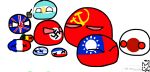
WW2balls art jam.jpeg|On Magma’s Art Jam | WW2balls art jam.jpeg|On Magma’s Art Jam | ||
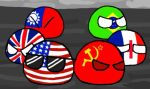
Alliesballs.jpeg|ALLIES | Alliesballs.jpeg|ALLIES | ||
IMG_3296.jpeg | |||
</gallery> | </gallery> | ||
==See Also== | |||
*{{i|Stalinist Era}} [[Stalinist Era]] | |||
*{{i|USSR}} [[Union of Soviet Socialist Republics]] | |||
==Navigation== | |||
{{Navbox/Communism}} | |||
[[Category:Characters]] | [[Category:Characters]] | ||
[[Category:Eras of Countries]] | [[Category:Eras of Countries]] | ||
[[Category:Historical]] | [[Category:Historical]] | ||
[[Category:Russia]] | |||
[[Category:Europe]] | |||
[[Category:Asia]] | |||
Latest revision as of 01:46, 24 June 2026


This page about the history of the USSR during WWII. For the main article of this character, see
Union of Soviet Socialist Republics.
“”If
 Hitler invaded hell, I would make at least a favourable reference to the Hitler invaded hell, I would make at least a favourable reference to the  devil in the devil in the  House of Commons. House of Commons. |
—  Winston Churchill Winston Churchill
|
The Soviet Union's participation in World War II was an era that is part of the  Stalinist Era, playing an important role in defeating the
  Axis Powers. His activities in the conflict was multifaceted and impactful on several fronts. Initially allies with the
  German Third Reich to split up
  Poland, he became in inspired by the Nazi to go on his own Blitzkrieg streak on his neighbors. USSR switched teams when Germany betrayed him by
  invading him. Then, he used "fighting Nazis" as an excuse to spread
  Soviet imperialism, which was way more successful.
Many people claim the Soviets liberated  Europe from the Nazis. But the reality is, the Soviet Union's
  communism is as brutal as Nazism if not more. While the Nazis aim to eliminate a certain group of people (such as the
  Jews), communism aims at the total destruction of all people, including their own, physically and spiritually.
History
In the late 1930s, before the "Great Patriotic War",  Stalin purged his
  army brutally. Later, a bunch of failed and useless military campaigns added more to the unnecessary loss of life.
Stalin wanted to catch up to the  capitalist world, since his communist state was far behind. USSR came up with a plan, as in 1933 the Nazis came to power: he would cause the Nazis and the Capitalists to go to
  war with each other, and while they did, Soviet can develop himself. And when the war ended, the capitalists would be weak, leaving Soviet as the sole world superpower. USSR tried allying himself with the capitalists in order to stir up war, but they refused due to a lack of trust. So, the USSR decided to ally with the Nazis instead, as to throw them into war was the primary goal, while who he allied with was secondary.
Invasion of Poland
On 23 August 1939, the Soviet Union signed the  Molotov-Ribbentrop Pact with Nazi Germany, a non-aggression treaty that included secret protocols dividing
  Eastern Europe, negotiated by Soviet foreign minister
  Vyacheslav Molotov and German foreign minister
  Joachim von Ribbentrop. This established a " Berlin-Moscow Axis".
When Germany requested Soviet Union to invade Poland, he first hesitated. Soviet Union believed that Poland was more ready for war then he actually is, plus, Soviet's army were still fighting  Japan. But everything would resolve itself when the Japan heard about the Molotov-Ribbentrop Pact. Japan was hoping on allying with the German Third Reich against the Soviet Union, but the non-aggression pact made it not possible, thus Japan decided to not fight anymore. As a result, on 17 September 1939, Soviet invaded Poland from the east shortly after Germany's invasion from the west, effectively annexing territory according to the pact's provisions. Soviet Union annexed Western Ukraine and Western Belorussia into their
  respective Soviet republics
  . Hundreds of thousands of Polish soldiers and civilians were captured or deported to the Soviet interior.
Winter War
On 30 November 1939, Soviet Union invaded  Finland since he didn't want to give up clay to him. USSR was confident that he could win against puny little Finland. But, the bright uniforms of the Red Army made Soviet easy targets in the white snowy Finnish environment for the native Finns, who wore white camouflage. Despite being very much outnumbered, the Finnish forces used clever tactics and the harsh winter to slow down the Soviet advance. The snipers of Finland are known for taking out huge amounts of Soviet troops. Soviet soldiers asked their superiors for more camouflaged clothing, but they denied.
The war ended with the  Moscow
  Peace Treaty on 13 March 1940, where Finland had to give up 11% of his land but kept his independence. Still, Soviet Union was humiliated because no one ever thought that tiny Finland would cause so much Soviet casualties.
“”If we keep throwing men at bullets, they will run out of bullets.
|
—  Soviet Union’s strategy during the Winter War, probably Soviet Union’s strategy during the Winter War, probably
|
Soviet Blitzkrieg: Baltic Occupations & Expansion of 1940
Between April and May 1940, Soviet Union used his  NKVD to
  genocide 21,000+
  Polish
  generals and
  intellectuals for Sovietization reasons. This series of killings was known as the
  Katyn Massacre, and the order to
  execute captive members of the Polish officer corps was secretly issued by the
  Soviet Politburo led by Stalin. When a Polish general came requesting information about missing Polish officers, Stalin falsely told him that all of the Poles were freed and escaped
  East, and that not all could be accounted because the Soviets "lost track" of them in
  Manchuria.
The Soviet Union realized that his plan of throwing the capitalist world into war has failed when Germany invaded and conquered  France in June. As it turns out, the Nazis would become powerful as the sole superpower, not USSR. Feeling inspired by Germany's lightning war, USSR decided to go on his own Blitzkrieg. In June 1940, while the
  Allies were busy dealing with Germany, USSR forced
  Lithuania,
  Latvia, and
  Estonia to allow his troops into their clay. Shortly afterward, the USSR organized
  rigged elections and installed communist governments. By August 1940, all three countries were formally annexed into the Soviet Union as the
  Lithuanian Soviet Socialist Republic,
  Latvian Soviet Socialist Republic, and
  Estonian Soviet Socialist Republic.
At the same time, the Soviet Union pressured  Romania to hand over
  Bessarabia and northern Bukovina. Romania, fearing both the USSR and Germany, agreed to the Soviet demands in June 1940. These lands were then incorporated mainly into the
  Moldavian Soviet Socialist Republic and the Ukrainian Soviet Socialist Republic. Through these expansions, the Soviet Union significantly increased his territory and pushed his western borders further away from Moscow. However, the aggressive
  expansion also alarmed many neighbouring countries and increased tensions with Germany.
Great Patriotic War: Fight Against the Axis
Operation Barbarossa
Germany decided that he needed more living space, so on 22 June 1941, he launched the largest invasion ever, Operation Barbarossa, against the Soviet Union, opening a huge front and breaking their pact. Millions of armed men ushered in at the Soviet border, surprising USSR.
The attack caught the Soviet leadership largely unprepared. The earlier purges of the Red Army officer corps had weakened Soviet command, and German forces advanced rapidly through Soviet territory. Within months Germany captured huge swaths of clay, including parts of Ukraine, Belarus, and western  Russia. Millions of Soviet soldiers were killed or captured in the opening months of the invasion.
German forces advanced toward major Soviet cities such as  Leningrad, Moscow, and Stalingrad. The invasion marked the beginning of what the Soviet Union called the "Great
  Patriotic War". USSR knew he had to join the Allied Powers now, and an official
  Anglo-Soviet agreement was signed on 12 July 1941 which pledged mutual support. As such, he also invaded
  Iran in August 1941 with the British. In addition to mutual support, USSR also wanted a promise to gain the clay he was supposed to have under the Molotov-Ribbentrop Pact. Britain refused to accept the territorial gain agreements, which Stalin accepted months later as the military situation had deteriorated somewhat by mid-1942.
War at the Russian Cities
By the  autumn of 1941, German forces had advanced deep into Soviet territory and began Operation Typhoon, the offensive aimed at capturing the capital Moscow, the
  political and logistical center of the Soviet Union, and the fall of such city would be catastrophic. Panic spread in the streets of Moscow, and government offices began evacuating eastward. Despite the danger, Stalin chose to remain. Soviet Union mobilized enormous resources for the defense of the capital. Civilians helped dig trenches and anti-tank ditches, while factories were dismantled and moved east to the
  Ural Mountains and
  Siberia, where they could continue producing weapons beyond German reach. The losses of the Germans and Russians were quite equal throughout, but the Soviets had the largest assembled army in
  history.
Meanwhile, on 8 September 1941, German and Finnish forces surrounded Leningrad. Rather than storm the city directly, Germany chose to blockade, cutting off food and supplies. The Siege of Leningrad would become one of the longest, deadliest and most brutal sieges in history. It was not classified as a war crime at the time, but since then, some historians have classified it as a genocide due to the intentional destruction of the city and the systematic starvation of the civilian population.
Under the Lend-Lease Act, from October 1941 to September 1945, with initial deliveries starting shortly after the German invasion in June 1941, the  United States sent the USSR $11 billion in goods (approx. $180 billion in 2016 dollars), including 400,000 jeeps/trucks, 14,000 aircraft, and massive quantities of food and raw materials. This is contrary to what USSR simps' claim that the Communists defeated the Nazis all by themselves.
The Red Army also received crucial reinforcements from Siberian divisions that had been stationed near the border with Japan. Soviet intelligence had learned that Japan did not intend to attack the USSR at that moment, allowing Stalin to move these well-trained troops westward. When  winter arrived, the German forces were unprepared for the extreme cold and began to stall outside Moscow. In December 1941, the Soviet Union launched a massive counteroffensive, pushing German forces back from the city. This marked the first major strategic defeat of Nazi Germany in the war, proving that the German army was not invincible.
In early 1942, Soviet began a series of offensives labelled "Stalin's First Strategic Offensives". The counteroffensive bogged down, in part due to mud from rain in the  spring of 1942. Stalin's attempt to retake
  Kharkov in
  Ukraine ended in the disastrous encirclement of Soviet forces, with over 200,000 Soviet casualties suffered, leading Stalin to attack the competence of the generals involved. General Georgy Zhukov and others subsequently revealed that some of those generals had wished to remain in a defensive posture in the region, but Stalin and others had pushed for the offensive.
At the same time, Hitler was worried about  American popular support after the U.S. entry into the war following the Attack on Pearl Harbor, and a potential Anglo-American
  invasion on the Western Front in 1942 (which did not occur until 1944). He changed his primary goal from an immediate victory in the East to the more long-term goal of securing the southern Soviet Union in order to protect oil fields vital to the long-term German war effort. While Red Army generals correctly judged the evidence that Hitler would shift his efforts south, Stalin thought it a flanking move in the German attempt to take Moscow.
The German southern campaign began with a push to capture the  Crimea, which ended in disaster for the Red Army. Stalin publicly criticised his generals' leadership. In his southern campaigns, Germany took 625,000 Red Army prisoners in July and August 1942 alone. At the same time, in a meeting in Moscow, Churchill privately told Stalin that the British and Americans were not yet prepared to make an amphibious landing against a fortified
  Nazi-held French coast in 1942, and would direct their efforts to invading German-held North Africa. He pledged a campaign of massive strategic bombing, to include German civilian targets.
Battle of Stalingrad
Estimating that the Russians were "finished," Germany began another southern operation in the autumn of 1942, toward the Caucasus oil fields and the city of Stalingrad on the  Volga River. The battle that followed became one of the most brutal urban battles in history. Stalingrad was a key
  industrial city that held strategic importance for both sides. German forces entered the city in late
  summer 1942, and fighting quickly devolved into street-to-street and close-quarters combat. Entire buildings changed hands multiple times in a single day. Soviet troops were ordered to hold their ground at all costs.
In November 1942, the Red Army launched Operation  Uranus, a massive encirclement attack targeting the weaker Romanian and
  Hungarian units protecting the German flanks. The maneuver made the battle reach the climax, trapping the
  German 6th Army inside Stalingrad, cut off from supplies and reinforcements and facing dire conditions, including harsh winter weather and Soviet bombardment. After months of starvation and fighting, the surrounded German forces surrendered in February 1943 despite Hitler's refusal to allow a retreat. The Soviet victory at Stalingrad marked a major turning point of the war, shifting the strategic initiative to the Soviet Union, halting the German advance and boosting Allied morale while inflicting heavy casualties on the Axis Powers.
Battle of Kursk
In 1943, after the defeat at Stalingrad, Stalin ceded to his generals' call for the Soviet Union to take a defensive stance because Soviet forces had suffered disappointing losses at Stalingrad, they lacked reserves for new offensives, and commanders believed that the Germans would likely attack the bulge in the Soviet front at  Kursk. Preparing defensive positions there would allow USSR to use his resources more effectively. And sure enough, Germany attempted one final major offensive on the Eastern Front against USSR at the Battle of Kursk in July 1943. The battle centered around a large Soviet salient in the front lines. Both sides prepared massive forces, including thousands of tanks. The clash became the largest tank battle in history, particularly during the fighting near
  Prokhorovka.
However, the Soviet Union had extensive defensive preparations, including minefields, anti-tank positions, and deep defensive layers. When the German offensive stalled, the Red Army launched powerful counterattacks. Hitler cancelled the attack due to the Allied invasion of  Sicily. After Kursk, Germany permanently lost the ability to launch large-scale offensives in the east. From this point forward, the Soviet Union remained largely on the offensive.
Soviet Advance into Eastern Europe
Following Kursk, the Red Army began pushing Nazi forces westward across Eastern Europe. Major operations "liberated" large parts of Soviet territory and later advanced into Axis-occupied countries. What these territories didn't know was that they'll be under worse rule after the war.
After Polish railroad workers found the mass grave from the Katyn killings from 1940, the Nazis used the massacre to attempt to drive a wedge between Stalin and the other Allies, including bringing in a European commission of investigators from twelve countries to examine the graves. In 1943, as the Soviets prepared to retake  Poland, Nazi Propaganda Minister
  Joseph Goebbels correctly guessed that Stalin would attempt to falsely claim that the Germans massacred the victims. As Goebbels predicted, the Soviets had a "commission" investigate the matter, falsely concluding that the Germans had killed the PoWs. The Soviets did not admit responsibility until
  1990.
1990.
In 1944, Soviet Union launched Operation Bagration, named after Russian general Pyotr Bagration of the  Napoleonic Wars, and it was one of the most successful offensives of the war. The operation destroyed much of Germany's Army Group Centre and retook Belarus, while Soviet forces also advanced into Poland and the
  Baltic region. As the Red Army advanced, Soviet influence expanded across Eastern Europe. Communist governments were set up in several of the territories "liberated" by Soviet forces. Meanwhile, in June 1944, the Western Allies launched the D-Day invasion of
  Normandy, opening a second front against Nazi Germany.
On 12 January 1945, the Soviet Union launched the Vistula-Oder Offensive, pushing deep into German territory and capturing  Warsaw, reviving
  Poland as his
  puppet.
On 30 January 1945, over 10,000 German civilian refugees, wounded soldiers, and crew tried to escape the hands of the advancing and brutal Soviets through the  Baltic Sea on the MV Wilhelm Gustloff. USSR didn't let that slide and torpedoed the ship three times, leading to an estimated 9,000+ deaths, primarily
  women and children, in freezing waters. It was the deadliest maritime disaster in history, killing far more than even the RMS Titanic.
Fall of Berlin
By April 1945, German Third Reich was close to defeat. On the Eastern Front, about 1.9 million German soldiers were fighting 6.4 million soldiers of the Soviet Red Army. On the  Western Front, about 1 million German soldiers were facing 4 million Western Allied troops. Although there had been early discussions about a race between the Allies to capture
  Berlin, the situation changed after Joseph Stalin persuaded the Allies at the Yalta Conference in February 1945 that eastern Germany would fall under
  Soviet influence. Because of this agreement, the Western Allies did not plan a ground assault to capture the city.
Stalin directed the Red Army to move rapidly in a broad front into Germany because he did not believe the Western Allies would hand over territory they occupied, while he made capturing Berlin the overriding objective. As the Soviets massacred and  raped without discrimination in Hungary and
  Prussia, the people in Berlin knew what was coming for them, and many tried to flee to the more merciful hands of USA or UK.
The Red Army's match into Germany was filled with massacres, looting, and unspeakable amounts of rape.
| — Antony Beevor
|
By April, Soviet troops encircled , leading to the Battle of Berlin and subsequent Fall of Berlin, becoming an iconic Soviet victory. Adolf Hitler committed suicide in his bunker on 30 April as Soviet troops banged on his bunker, and they disposed of his body. Germany surrendered unconditionally on 8 May, ending World War II in Europe. Soviet Union emerged as one of the victorious Allied Powers, but war left the country devastated, with over 20 million lives lost. Still, the USSR established puppet states and a sphere of influence in Eastern Europe from the remains of Nazi Germany, and took in many Nazi  scientists as part of his Operation Osoaviakhim.
The victory of the Soviets in WWII, propaganda tells you, was a  noble victory, as the mighty Soviets have saved Europe from the
  evil Nazis. The truth was that it was far from noble.
War on Japan
Although Germany had surrendered,  Japan was still going and Soviet Union still had a neutrality pact with him. At the Yalta Conference, however, Stalin agreed to join the war against Japan once the European war ended. On 8 August 1945, the Soviet Union declared war on Japan and launched a massive invasion of
  Manchuria, defeating the Japanese
  Kwantung Army in a rapid campaign known as the Manchurian Strategic Offensive Operation. Soviet forces also occupied
  South Sakhalin, the
  Kuril Islands, and parts of northern
  Korea.
Shortly afterward, Japan surrendered in September 1945 after being nuked by 'Murica, ending the Second World War. The USSR left the  Chinese commies to inherit the Manchuria he occupied.
The Great Patriotic War had finally ended, but the USSR experienced a staggering amount of devastation and suffering. Soviet men born in 1923 are called the lost generation: they were 18 when Germany invaded, and by 1945, 4 out of 5 were dead.
Trivia
- The famous photo of the unnamed Russian soldier raising the Soviet flag over the ruins of
 Hitler's chancellory had to be retaken a few days later because someone at the Soviet propaganda department realized while examining the original photos that the soldier in question was wearing six stolen watches.
Quotes
— Complete History of the  Soviet Union, Arranged to the Melody of Soviet Union, Arranged to the Melody of  Tetris Tetris
|

Relationships
Friends
 United States - Thanks for sending me loads of supplies. Even if our opposing ideologies cause tension, we still have to act like we're united and like each other in public.
 United Kingdom - Also, thank your ships.
 Republic of China - Saved
  your butt by making
  him work with you instead of killings you.
 Provisional Government of National Unity - I liberated Poland!

 *Looks for where the Polish prisoners went* Uhm, do you have any, well, live people?
- Uh, no, only dead ones.


Enemies
 Finland - I will crush you in two weeks- HOW? YUO LITTLE RAT! YUO THINK YUO SO SLICK WHILE SNIPING! MORE TROOPS MORE TROOPS MORE TROOPS!! I STILL DEFEATED YUO!!
- Look at the number of casualties. How humiliating!
 German Third Reich - YUO TRAITOR! I THOUGHT WE HAD
  NON-AGGRESSION PACT!! YUO KILLED 20 MILLION OF MY PEOPLE
 not that I care about them or anything,1945 BEST YEAR OF MY LIFE!!! Polish Underground State - So what if I massacre your peoples, huh? Poland is must be into
  communist!
 Berlin - Yuo need to be liberated, I will
  rape all your women.

How to draw

Soviet Union in World War II has a drawing rating of intermediate.
- Draw a ball.
- Fill it with red.
- Draw the emblem of the sickle and hammer in the top left of the ball in yellow.
- Draw the eyes and you are done!
- Draw a ushanka or general's hat with the communist star or hammer and sickle on it (optional)
| Color Name | HEX | |
|---|---|---|
| Red | #BC0000 | |
| Yellow | #FCD116 | |
Gallery
-
-
-
 On Magma’s Art Jam
 -
 ALLIES
 -


