Authoritarianism
“”We do not argue with those who disagree with us, we destroy them.
|
—  Benito Mussolini Benito Mussolini
|
Authoritarianism is a form of government characterized by strong (usually  central) power that demands obedience to authority and limited
  political and
  civil freedoms. Political scientists have created various classifications to categorize authoritarian states, and qualities commonly associated with authoritarian regimes include the absence of
  free and competitive elections, a
  one-party state, as well as censorship and minimal power restrictions. Though sometimes authoritarianism can reside in
  democratic countries with free and fair elections where there's a clampdown on liberties instead, as well as more emphasis on authority.
Authoritarianism is characterized by a highly concentrated and centralized government power maintained by political repression and the exclusion of potential or supposed  challengers
  by
by  armed force
  . He uses political parties and mass organizations to mobilize people around the goals of the regime.
Auth is very demanding and angry, don't mention this to him or he'll become very  angry. He also hates it when people call him
  totalitarian. He arrests and sometimes
  executes people if he finds out that some of his citizens are not affected by his propaganda, usually.
History
The shift from  tribal societies to complex cities often led to the rise of authoritarian rule. Powerful figures, like
  monarchs, emerged from dynasties, consolidating control. In
  Greece,
  democracy, initially seen as a challenger to authoritarian rule, eventually succumbed to authoritarian tendencies. This cycle continued for centuries. But the
  Enlightenment brought a revolutionary shift.
  Philosophers questioned
  traditional authority, sparking
  rebellions
  . Though, however, even these newly formed governments often slipped back into
  authoritarianism
  , continuing the cycle and highlighting the difficulty of maintaining a free and just society.
During both World War II and Cold War, the  Western Alliance, even with their fair share of
  dictatorships, began to embrace democracy more than
  authoritarian , so the use of him began to drop. Today, the amount of authoritarian governments are at an all time low compared to the rest of
  history.
Beliefs
Authoritarian State
While authoritarian rule has existed for millennia (e.g.,  Roman Empire), the idea of an "authoritarian state" became more concrete with figures like
  Louis XIV and
  Thomas Hobbes. Louis XIV embodied
  absolute monarchy and rejected
  Feudalism, ruling with complete authority and justifying it through
  religion. These regimes tend to persecute opponents and
  manipulate elections to stay in power.
Censorship
One of, if not the main characteristic of authoritarianism is censorship against the opinion and manifestation of opponents or divergent cultural values. Even though censorship has existed since  biblical times, it only gained some notoriety when
  Socrates was censored in 399 BC.
There are several types of censorships, such as opposition censorship, cultural value censorship,  internet censorship,
  ethnocentric censorship, economic induced censorship,
  isolationist censorship and censorship against
  science.
- Opposition censorship is when a government restricts freedom of opinion and expression by persecuting opponents, either through financial pressure, imprisonment or even the death penalty, against individuals, movements and demonstrations. Sometimes the government secretly presecutes opponents (without the people knowing), other times the government censures in a generalized and public way, such as in
 totalitarian dictatorships, especially with public executions.
 - Cultural values censorship is when a government censors restricting freedom of expression just because cultural values are divergent, usually against individual choices and artistic expression. Older authoritarian regimes are stereotyped to censor
 progress (like the
  Middle Ages). Later, authoritarian regimes started to censor against
  tradition and
  religion, examples of this include the
  French Revolution,
  Mao Zedong, and
  Jiang Zemin.
 - Internet censorship (or information censorship) is the censorship of knowledge on the internet by the state. Currently, foreign social medias have been banned for having information about their country's problems in many authoritarian states, notably
 Russia, and on the more extreme side,
  North Korea and
  China. Certain information that include things that "oppose" or "threaten" the state are censored (famous example being Tank Man in Tiananmen Square Massacre image being censored in Chinese medias), and the people in the country cannot access the uncensored internet that is used by the rest of the world without using a VPN. The most famous example of this is China's own social media, which is based on the foreign social media (for example,
  BiliBili is based on
  YouTube) except there is a "
 Great Firewall" keeping everything the state does not want out.
 - Economic induced censorship would be a type of censorship made by the markets to not favor certain types of information, often leaving information expensive on purpose. Some examples would be the
 favoring of companies in
  capitalist dictatorships, as well as a few occasions in the
  Epstein case.
 - Ethnocentric censorship would be a type of censorship to
 favor only one type of ethnicity, restricting the freedom to pursue the culture and ways of acting of a certain ethnic group, usually combined with
  ethnocide and
  ethnocracy. Most of the time there is also propaganda against these ethnicities and also an attempt to replace cultures.
 - Isolationist censorship would be censorship to favor a government and not show anything from abroad to the population within the country, which would
 isolate them. Those who use this method often also implements totalitarianism to make sure of the population’s isolation, banning other cultures from abroad. The most famous example of this is North Korea.
 - Censorship against science is a type of censorship against any
 technological or
  scientific innovations, usually to further an ideology or narrative, sometimes being selective in the science to censor. Some examples are the
  German Third Reich and the
  modern West.


Detention and Violence
One of the hallmarks of authoritarianism is the arrest (or imprisonment) and torture of political opponents, especially if they are extremely popular. But smaller opponents such as demonstrators are not excluded from this treatment. Auth usually use this as an example so that it cannot be repeated, even if it is sometimes expensive.
Some states, especially the older ones, used public execution to set an example of what would happen if they opposed the government, abusing the fear of people. Examples of this include the French Revolution and  Maoist China. Others perform without the public's view, hoping to avoid revolts, the most famous example being the cases of dictatorships.
Others create forced labor camps in subhuman conditions with cruel torture for scientific experiments on opponents of the government, the most famous examples being  Nazi Germany and the
  Soviet Union (intensified under the
  Stalin regime). Currently, this is seen extremely negatively, so authoritarian governments end up substituting the name as "re-education camps" or something similar. Notable examples of this includes the
  People's Republic of China and
  North Korea.
Propaganda
Authoritarian governments abuse advertisements to manipulate the public opinion, whether for an ideal, an ideology, a religion, a culture, etc. Usually they can use traditional means, i.e. with posters, indoctrination in schools and means of apprenticeship, cultural indoctrination (songs, essays, etc.), demonization of opponents, changes in meaning (such as classifying everyone who opposes as  communist or Nazi) and other forms of advertising.
While  satire is used to mock and discredit opposition, authoritarian regimes often silence satirists of the other side.
This propaganda machine frequently manufactures a  Cult of Personality around the leader and/or the state itself, portraying them as infallible or godlike figures. This creates obedience to the regime, facilitating control, but also future instability.
Propaganda also serves as a smokescreen, concealing the nation's problems and failures. It paints a rosy picture, assuring citizens that the government is competent and the country thriving. This manipulation extends to  wartime, where propaganda can obscure defeats.
Stay in Power
As previously discussed, the strategies mentioned above are often employed to keep a dictatorship in power, though these methods can fail in numerous ways. Many dictatorships have historically relied on ideals and religions to justify their rule. Initially,  pagan and
  Asian religions were used, but later,
  Christianity became the most commonly exploited religion in the West, while
  Islam, Paganism, and various Asian religions were utilized in other regions.
Following the
Islam, Paganism, and various Asian religions were utilized in other regions.
Following the  Industrial Revolution and World War I, religion was less frequently used to justify dictatorships, with some exceptions. Instead, ideologies like
  revolutionary,
  republican,
  anti-communist, and others became the primary tools for legitimizing authoritarian regimes.
In modern times, dictatorships often use a mix of ideologies, religion, and rhetoric to justify their existence and maintain control. Phrases like "in defense of freedom" or "in defense of
anti-communist, and others became the primary tools for legitimizing authoritarian regimes.
In modern times, dictatorships often use a mix of ideologies, religion, and rhetoric to justify their existence and maintain control. Phrases like "in defense of freedom" or "in defense of  anti-American liberation" are sometimes employed, despite their contradictions. After the
  Iraq War, Islam was invoked to justify the rule of certain dictatorships (such as
  Iran) and by
  terrorist organizations (such as the
  Islamic State). Additionally, extreme
  nationalism have also been exploited, as seen in countries like China and
  Russia.
Quotes
“”A nation based on freedom is just another place to go shopping.
|
—  Richard B. Spencer, 2016 Richard B. Spencer, 2016
|
Relationships
Law and Order
 Absolute Monarchism - Unjust and just authority are both great.
 Illiberal Democracy - The best type of
  democracy.
 Oligarchy - From the shadows, my friend.
 Autocracy - You're too narcissistic but I like the way you work.
 Marxism-Leninism - The way you work has no room for freedom.
 Pinochetism - Throwing dissidents out of helicopters? Creative! WRITE THAT DOWN!
 Stratocracy - What better way to achieve and maintain authority?
 Theocracy - Rule by a strong religious class is great! The
  Bible and
  Quran are good because they have so many amazing rules.
 State Atheism - Urrr, forget what I said, mandatory
  Atheism is super great!
 Ba'athism - Getting the authoritarian part right, but in overt denial about it.
 Social Authoritarianism - The correct way to do
  welfare.
- Authoritarian Capitalism -
 Capitalism but better.
  Authoritarian Socialism -
  Socialism but better.
 Authoritarian Conservatism -
  Conservatism but better.
 Authoritarian Progressivism - Progressivism but better.
 Dengism - Mass surveillance? Hell yeah! The social credit system would’ve been very good. It is a shame you didn’t implement it.
 Police Statism - Respecting the authority.
 Kritarchy - Maintaining law and order.
- Totalitarianism - Son, that is a bit too far.


Suspicious
 Ingsoc - Grandson, that is way too far.
 Enlightenment Thought - Could have ended me, but ended up falling victim to the cycle.
 Tribalism - The future is now, old man.
- Democracy - Moron. We don't need ya dirty "liberty" and all that jazz… but you do elect authoritarian leaders sometimes which is nice.
 Satirism - I like it better when you are used by me rather than when you are used by my opponents.
 Neoconservatism - Claims to hate me but ironically installs
  dictatorships.
 Juche - I like how you make new policies and laws to control your citizens, and your harsh punishments for dissidence is great. But maybe you've gone too far, some of your laws and their punishments are quite ridiculous, even by my standards.
 Apoliticism - Even the law says the laws are cool, so obey it!


Freedumbs
 Free Speech Advocacy - The government knows better than anyone, especially people who want to oppose it.
 Kakistrocracy - This is where liberty leads, people.
  Oh wait-
 Anti-Authoritarianism - My opposite. You guys are all rioters who terrorize and vandalize property, I hope you like me sending my guards after you, hehe.
 Anarchism - No authority? None, like at all? Do you have enough IQ digits to see why this is bad?
 Insurrectionary Anarchism - [Comment cleaned up, sentenced to death immediately.]
 To be honest, I'm kind of scared of him.


How to Draw

Authoritarianism has a drawing rating of intermediate.
- Draw a ball.
- Fill it with a slightly faded navy blue.
- Draw a large black gavel in the middle of the ball in a slanted position.
- Draw eyes and you are done!
- Draw the hammer as his tool (optional)
| Color Name | HEX | |
|---|---|---|
| Faded Navy Blue | #3F51B5 | |
| Black | #222222 | |
Gallery
-
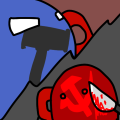 Authoritarianism calling Communism
 -
 "Don't act like you didn't do something against our law"
 -
 By Andrew


