Greater East Asia Co-Prosperity Sphere: Difference between revisions
m Text replacement - "Mbox/Violent" to "Mbox/Evil" |
m Text replacement - "Mediacracy}} [[Mediacracy|propaganda" to "Propaganda}} [[propaganda" |
||
| Line 50: | Line 50: | ||
}}The '''Greater East Asia Co-Prosperity Sphere''' ('''GEACPS'''), formerly termed '''New Order in East Asia''', also referring to '''Japanese Imperialism''', was a {{i|Fascism}} [[Fascism|fascist]], {{I|ShoStat}} [[Shōwa Statism|Showa Statist]] and {{I|Imp}} [[Imperialism|Imperialist]] idea of an {{I|Asia}} [[Asia]] dominated by {{i|Banzai}} [[Empire of Japan|Japan]] and free from any western influence, a concept used to justify Japan's {{i|Militarism}} [[Militarism|ultra-militarist]] ideals of {{i|RaceNat}} [[Racial Nationalism|racial superiority]], {{i|War}} [[war]] and {{i|Genocide}} [[genocide]]. GEACPS was the {{i|Asia}} [[Pan-Asianism|pan-Asian]] alliance that the Empire of Japan sought to establish during WWII, often equated with the Japanese Empire's territories at its height, however the ideology can refer to the dream of Japanese hugemony as a whole. Initially, the Sphere only encompassed Japan (including annexed {{i|JapKorea}} [[Japanese Korea|Korea]] (''Chōsen''), {{i|Manchukuo}} [[Manchukuo]], and parts of {{i|ROC}} [[Republic of China|China]]. As the {{i|Water}} [[Pacific Ocean|Pacific]] War progressed, he expanded to include territories in {{i|ASEAN}} [[Southeast Asia]]. | }}The '''Greater East Asia Co-Prosperity Sphere''' ('''GEACPS'''), formerly termed '''New Order in East Asia''', also referring to '''Japanese Imperialism''', was a {{i|Fascism}} [[Fascism|fascist]], {{I|ShoStat}} [[Shōwa Statism|Showa Statist]] and {{I|Imp}} [[Imperialism|Imperialist]] idea of an {{I|Asia}} [[Asia]] dominated by {{i|Banzai}} [[Empire of Japan|Japan]] and free from any western influence, a concept used to justify Japan's {{i|Militarism}} [[Militarism|ultra-militarist]] ideals of {{i|RaceNat}} [[Racial Nationalism|racial superiority]], {{i|War}} [[war]] and {{i|Genocide}} [[genocide]]. GEACPS was the {{i|Asia}} [[Pan-Asianism|pan-Asian]] alliance that the Empire of Japan sought to establish during WWII, often equated with the Japanese Empire's territories at its height, however the ideology can refer to the dream of Japanese hugemony as a whole. Initially, the Sphere only encompassed Japan (including annexed {{i|JapKorea}} [[Japanese Korea|Korea]] (''Chōsen''), {{i|Manchukuo}} [[Manchukuo]], and parts of {{i|ROC}} [[Republic of China|China]]. As the {{i|Water}} [[Pacific Ocean|Pacific]] War progressed, he expanded to include territories in {{i|ASEAN}} [[Southeast Asia]]. | ||
The proposed objectives of this union were to ensure economic self-sufficiency and cooperation among the member states, along with resisting the influence of {{i|NeoCon}} [[Neoconservatism|Western imperialism]] and {{i|MarxLenin}} [[Marxism-Leninism|Soviet communism]]. In reality, {{i|Stratocracy}} [[Stratocracy|militarists]] and {{i|Nationalism}} [[Nationalism|nationalists]] saw the Sphere as an effective {{I| | The proposed objectives of this union were to ensure economic self-sufficiency and cooperation among the member states, along with resisting the influence of {{i|NeoCon}} [[Neoconservatism|Western imperialism]] and {{i|MarxLenin}} [[Marxism-Leninism|Soviet communism]]. In reality, {{i|Stratocracy}} [[Stratocracy|militarists]] and {{i|Nationalism}} [[Nationalism|nationalists]] saw the Sphere as an effective {{I|Propaganda}} [[propaganda]] tool to enforce Japanese hegemony. The latter approach was reflected in a document released by Japan's {{i|JapanHealth}} [[Ministry of Health, Labour and Welfare|Ministry of Health and Welfare]], ''An Investigation of {{I|Globalism}} [[Globalism|Global Policy]] with the {{i|Yamato}} [[Yamato Nationalism|Yamato]] Race as Nucleus'', which promoted {{i|Racism}} [[Racism|racial supremacist]] theories. Japanese spokesmen openly described the Greater East Asia Co-Prosperity Sphere as a device for the "development of the {{i|Japan}} [[Japan|Japanese]] race." When World War II ended, the GEACPS became a source of criticism and scorn. | ||
Though the term "GEACPS" was first introduced by Minister for Foreign Affairs {{i|PanNat}} [[Pan-Nationalism|Hachirō Arita]] on 29 June 1940, the concepts of Japanese Imperialism stretches back to Autumn 1872, where they are represented and referred to {{I|Heterodontosaurus}} [[Heterodontosaurus Balls|here]] as the same ideology. | Though the term "GEACPS" was first introduced by Minister for Foreign Affairs {{i|PanNat}} [[Pan-Nationalism|Hachirō Arita]] on 29 June 1940, the concepts of Japanese Imperialism stretches back to Autumn 1872, where they are represented and referred to {{I|Heterodontosaurus}} [[Heterodontosaurus Balls|here]] as the same ideology. | ||
| Line 85: | Line 85: | ||
After Japanese advancements into {{I|FrenchIndo}} [[French Indochina]] in 1940, knowing that Japan was completely dependent on other countries for natural resources, {{I|USA}} [[Interwar and World War II United States|U.S.]] President {{I|Roosevelt}} [[New Deal Liberalism|Franklin D. Roosevelt]] ordered a trade embargo on steel and oil, raw materials that were vital to Japan's {{I|War}} [[war]] effort. Without steel and oil imports, Japan's military could not fight for long. As a result of the embargo, Japan decided to attack the {{I|UK}} [[United Kingdom|British]] and {{I|Netherlands}} [[Netherlands|Dutch]] colonies in Southeast Asia from 7 to 19 December 1941, seizing the raw materials needed for the war effort. These efforts were successful, with Japanese politician {{I|Kishi}} [[Kishism|Nobusuke Kishi]] announcing via radio broadcast that vast resources were available for Japanese use in the newly conquered territories. | After Japanese advancements into {{I|FrenchIndo}} [[French Indochina]] in 1940, knowing that Japan was completely dependent on other countries for natural resources, {{I|USA}} [[Interwar and World War II United States|U.S.]] President {{I|Roosevelt}} [[New Deal Liberalism|Franklin D. Roosevelt]] ordered a trade embargo on steel and oil, raw materials that were vital to Japan's {{I|War}} [[war]] effort. Without steel and oil imports, Japan's military could not fight for long. As a result of the embargo, Japan decided to attack the {{I|UK}} [[United Kingdom|British]] and {{I|Netherlands}} [[Netherlands|Dutch]] colonies in Southeast Asia from 7 to 19 December 1941, seizing the raw materials needed for the war effort. These efforts were successful, with Japanese politician {{I|Kishi}} [[Kishism|Nobusuke Kishi]] announcing via radio broadcast that vast resources were available for Japanese use in the newly conquered territories. | ||
As part of the war drive in the {{I|Water}} [[Pacific Ocean|Pacific]], Japanese {{I| | As part of the war drive in the {{I|Water}} [[Pacific Ocean|Pacific]], Japanese {{I|Propaganda}} [[propaganda]] included phrases like "{{I|Asia}} [[Asia]] for the {{I|1ball}} [[Asians|Asiatics]]" and talked about the need to "liberate" Asian {{I|Colonialism}} [[Colonialism|colonies]] from the control of Western powers. They also planned to change the {{I|China}} [[China|Chinese]] hegemony in the agricultural market in {{I|ASEAN}} [[Southeast Asia]] with Japanese immigrants to boost its economic value, with the former being despised by Southeast Asian natives. The Japanese failure to bring the ongoing Second {{I|ROC}} [[Republic of China|Sino]]-[[Empire of Japan|Japanese]] {{I|Banzai}} War to a swift conclusion was blamed in part on the lack of resources; Japanese propaganda claimed this was due to the refusal by Western powers to supply Japan's military, a really {{I|Kak}} [[Kakistocracy|dumb]] claim, since when did your enemies supply you with weapons? Although invading Japanese forces sometimes received rapturous welcomes throughout recently captured Asian territories due to {{I|AntiWest}} [[Anti-Westernism|anti-Western]] and occasionally, {{I|Taiwanphobia}} [[Sinophobia|anti-Chinese]] sentiment, the subsequent {{I|Genocide}} [[Genocide|brutality]] of the Japanese military led many of the inhabitants of those regions to regard Japan as being worse than their former colonial rulers. The Japanese government directed that economies of occupied territories be managed strictly for the production of raw materials for the Japanese war effort; a cabinet member declared, "There are no restrictions. They are enemy possessions. We can take them, do anything we want." For example, according to estimates, under Japanese occupation, about 100,000 {{I|Myanmar}} [[Burmese]], {{I|Malaysia}} [[Malays|Malay]], and {{I|India}} [[Indians|Indian]] labourers died while constructing the {{i|State of Burma}} [[State of Burma|Burma]]-[[Thailand|Siam]] {{I|Thailand}} Railway. The Japanese only sometimes spared ethnic groups, such as Chinese immigrants, if they supported the war effort, whether sincerely or not. | ||
====Greater East Asia Conference==== | ====Greater East Asia Conference==== | ||
Latest revision as of 19:08, 7 July 2026


The Greater East Asia Co-Prosperity Sphere (GEACPS), formerly termed New Order in East Asia, also referring to Japanese Imperialism, was a  fascist,
  Showa Statist and
  Imperialist idea of an
  Asia dominated by
  Japan and free from any western influence, a concept used to justify Japan's
  ultra-militarist ideals of
  racial superiority,
  war and
  genocide. GEACPS was the pan-Asian alliance that the Empire of Japan sought to establish during WWII, often equated with the Japanese Empire's territories at its height, however the ideology can refer to the dream of Japanese hugemony as a whole. Initially, the Sphere only encompassed Japan (including annexed
  Korea (Chōsen),
  Manchukuo, and parts of
  China. As the
  Pacific War progressed, he expanded to include territories in
  Southeast Asia.
The proposed objectives of this union were to ensure economic self-sufficiency and cooperation among the member states, along with resisting the influence of  Western imperialism and
  Soviet communism. In reality,
  militarists and
  nationalists saw the Sphere as an effective
  propaganda tool to enforce Japanese hegemony. The latter approach was reflected in a document released by Japan's
  Ministry of Health and Welfare, An Investigation of
  Global Policy with the
  Yamato Race as Nucleus, which promoted
  racial supremacist theories. Japanese spokesmen openly described the Greater East Asia Co-Prosperity Sphere as a device for the "development of the
  Japanese race." When World War II ended, the GEACPS became a source of criticism and scorn.
Though the term "GEACPS" was first introduced by Minister for Foreign Affairs  Hachirō Arita on 29 June 1940, the concepts of Japanese Imperialism stretches back to Autumn 1872, where they are represented and referred to
  here as the same ideology.
History
Background: Development of Japanese Imperialism
The concept of a unified Asia under Japanese leadership had roots dating back to the 16th century. For example,  Toyotomi Hideyoshi proposed to make
  China,
  Korea, and
  Japan into "one". Moreover, Hideyoshi had further plans to expand into
  India, the
  Philippines, and other islands in the Pacific.
Monroe Doctrine for Japan
In Autumn 1872, the  U.S. minister to
  Japan,
  Charles E. DeLong explained to U.S. General
  Charles Le Gendre that he had been urging Japan to occupy
  Taiwan and "civilize" the
  Taiwanese indigenous people just as the U.S. had taken over the land of the
  Native Americans and "civilized" them. General Le Gendre, the first non-Japanese person hired as a foreign policy expert by the Japanese government, encouraged the Japanese to declare a Japanese "sphere of influence" modelled on the
  Monroe Doctrine that the U.S. had declared for the exclusion of other powers from the Western Hemisphere. Such a Japanese sphere of influence would be the first time a non-White state would adopt such a policy. The stated aim of the sphere of influence would be to civilize the barbarians of Asia:
“”
 Pacify and civilize them if possible, and if not… exterminate them or otherwise deal with them as the Pacify and civilize them if possible, and if not… exterminate them or otherwise deal with them as the  United States and United States and  England have dealt with the barbarians. England have dealt with the barbarians. |
| — Charles Le Gendre
|
Japan began invading Taiwan in 1874 and fought the  Russian Empire for control of
  Manchuria starting in 1904.
Continuing this American policy, U.S. President  Theodore Roosevelt (r. 1901-1909) also secretly reiterated to Japan that, just as the U.S. under the Monroe Doctrine (and the addition of Roosevelt Corollary) declared the
  Western Hemisphere as part his sphere of influence, Japan should create his own sphere of influence in the Pacific Rim. Teddy was encouraged by Japan embarking on Western ways and developing a modern military in the wake of the forced "Opening of Japan" by the United States that had begun with the
  Perry Expedition. Roosevelt envisioned demarcating respective United States and Japanese zones of military and economic dominance in the Pacific Rim. Roosevelt told the Japanese that they are more racially similar to Americans than
  Russians are, even though Russians are a
  White race, and that Japan should take his place among the great Western powers to dominate, among other areas,
  Korea and Manchuria, but that Japan must not encroach on U.S. possession of the Philippines. In much the same way that
  Europeans used the "backwardness" of
  African and Asian nations as a reason for why they had to
  conquer them, for the Japanese
  elite the "backwardness" of China and Korea was proof of the inferiority of those nations, thus giving the Japanese the "right" to conquer them. This mutual recognition of the U.S. and the Japanese zones of control in the Pacific would be secretly articulated in the
  Taft–Katsura
  Agreement of July 1905, essentially partitioning the Western Pacific Rim between the two powers.
In an interview with the  New York Times days later, Katsura explained that Japan's "policy in the Far East will be in exact accord with that of England and the United States."
“”[
Japan will soon force] upon Korea and China the same benefits of  modern development that have been in the past forced on us… We intend to begin a campaign of education in [Korea and China] such as we ourselves have experienced [and to develop] Asiatic commercial interests that will benefit us all. China and Korea are both atrociously mis-governed… These conditions we will endeavor to correct at the earliest possible date--by modern development that have been in the past forced on us… We intend to begin a campaign of education in [Korea and China] such as we ourselves have experienced [and to develop] Asiatic commercial interests that will benefit us all. China and Korea are both atrociously mis-governed… These conditions we will endeavor to correct at the earliest possible date--by  persuasion and education, if possible; by force, if necessary. And in this, as in all things, we expect to act in exact concurrence with the ideas and desires of persuasion and education, if possible; by force, if necessary. And in this, as in all things, we expect to act in exact concurrence with the ideas and desires of  England and the England and the  United States. United States. |
| — Katsura Tarō
|
During the proceedings of the Lansing–Ishii  Agreement of 1917, Japan explained to Western observers that his expansionism in Asia was analogous to the United States' Monroe Doctrine. This conception was influential in the development of the Greater East Asia Co-Prosperity concept, with the
  Japanese Army also comparing it to the Roosevelt Corollary. One of the reasons why Japan adopted imperialism was to resolve domestic issues such as overpopulation and resource scarcity. Another reason was to
  counter the white man's imperialism; Japan, who used to be pro-West and tried to improve military to earn their respect and was inspired by them, became anti-West as the Japanese wanted more and more influence.
Invasion of China and World War II
On 3 November 1938, Prime Minister Fumimaro Konoe and Minister for Foreign Affairs Hachirō Arita proposed the development of the New Order in East Asia (東亜新秩序, Tōa Shin Chitsujo), which was limited to Japan,  China, and the
  puppet state of Manchukuo. They believed that the union had 6 purposes:
- Permanent stability of
 Eastern Asia
 - Neighbourly amity and international justice
 Joint defense against communism
- Creation of a new
 culture
 - Economic cohesion and co-operation
 World peace


On 29 June 1940, Arita renamed the union the Greater East Asia Co-Prosperity Sphere, which he announced by radio address. At Yōsuke Matsuoka's advice, Arita emphasized on the economic aspects more. On 1 August, Konoe, who still used the original name, expanded the scope of the union to include the territories of Southeast Asia. On November 5, Konoe reaffirmed that a Japan–Manchukuo–China yen bloc would continue and be "perfected".
The outbreak of World War II in Europe gave the Japanese an opportunity to fulfill the objectives of the Greater East Asia Co-Prosperity Sphere, without significant pushback from the Western powers or China. This entailed the conquest of Southeast Asian territories to extract their natural resources. If territories were unprofitable, the Japanese would encourage their subjects, including those in mainland Japan, to endure "economic suffering" and prevent outflow of material to the enemy. Nonetheless, Japan preached the  moral superiority of cultivating a "spiritual essence" instead of prioritizing
  material gain like Western powers.
After Japanese advancements into  French Indochina in 1940, knowing that Japan was completely dependent on other countries for natural resources, U.S. President
  Franklin D. Roosevelt ordered a trade embargo on steel and oil, raw materials that were vital to Japan's war effort. Without steel and oil imports, Japan's military could not fight for long. As a result of the embargo, Japan decided to attack the
  British and
  Dutch colonies in Southeast Asia from 7 to 19 December 1941, seizing the raw materials needed for the war effort. These efforts were successful, with Japanese politician
  Nobusuke Kishi announcing via radio broadcast that vast resources were available for Japanese use in the newly conquered territories.
As part of the war drive in the Pacific, Japanese propaganda included phrases like " Asia for the  Asiatics" and talked about the need to "liberate" Asian colonies from the control of Western powers. They also planned to change the
  Chinese hegemony in the agricultural market in Southeast Asia with Japanese immigrants to boost its economic value, with the former being despised by Southeast Asian natives. The Japanese failure to bring the ongoing Second Sino-Japanese War to a swift conclusion was blamed in part on the lack of resources; Japanese propaganda claimed this was due to the refusal by Western powers to supply Japan's military, a really
  dumb claim, since when did your enemies supply you with weapons? Although invading Japanese forces sometimes received rapturous welcomes throughout recently captured Asian territories due to anti-Western and occasionally,
  anti-Chinese sentiment, the subsequent brutality of the Japanese military led many of the inhabitants of those regions to regard Japan as being worse than their former colonial rulers. The Japanese government directed that economies of occupied territories be managed strictly for the production of raw materials for the Japanese war effort; a cabinet member declared, "There are no restrictions. They are enemy possessions. We can take them, do anything we want." For example, according to estimates, under Japanese occupation, about 100,000
  Burmese,
  Malay, and
  Indian labourers died while constructing the
  Burma-Siam
  Railway. The Japanese only sometimes spared ethnic groups, such as Chinese immigrants, if they supported the war effort, whether sincerely or not.
Greater East Asia Conference
The Greater East Asia Conference (大東亞會議, Dai Tōa Kaigi), also referred to as the  Tokyo Conference, took place on 5–6 November 1943: Japan hosted an international summit with the heads of state of various component members of the Greater East Asia Co-Prosperity Sphere. The common language used by the delegates was
  English, and the conference was mainly used as propaganda, addressing few issues of substance.
At the conference, war criminal  Hideki Tojo greeted them with a speech praising the "spiritual essence" of Asia instead of the " materialistic civilization" of the West, despite the fact Japan was indeed very much materialistic, perhaps the most materialistic in Asia. Their meeting was characterized by the praise of solidarity and condemnation of colonialism (further self-contradicting) but without practical plans for either economic development nor integration. Because of a lack of military representatives at the conference, the conference served little military value.
With the simultaneous use of  Wilsonian and Pan-Asian rhetoric, the goals of the conference were to solidify the commitment of certain Asian countries to Japan's war effort and to improve Japan's world image; however, the representatives of the other attending countries were in practice neither independent nor treated as equals by Japan.
The following dignitaries attended:
 Hideki Tojo, Prime Minister of the
  Empire of Japan
 Zhang Jinghui, Prime Minister of the
  Empire of Manchuria
 Wang Jingwei, President of the
  Republic of China
- Ba Maw, Head of State of the
 State of Burma
  Subhas Chandra Bose, Head of State of the
  Provisional Government of Free India
 José P. Laurel, President of the
  Republic of the Philippines
 Wan Waithayakon, Prince and envoy from the
  Kingdom of Thailand


Rule in the East
Japan set up many puppet regimes in China, such as Manchukuo (1932-1945),  East Hebei Autonomous Government (1935-1938),
  Great Way Government (1937-1938), Provisional Government of the Republic of China (1937-1940), Reformed Government of the Republic of China (1938-1940),
  Mengjiang (1939-1945), and the Wang Jingwei Regime (1940-1945), who all vanished at the war's end. The Imperial Army operated ruthless administrations in most conquered areas but paid more favourable attention to the
  Dutch East Indies. The main goal was to obtain oil, but the
  Dutch colonial government destroyed the oil wells. However, the Japanese could repair and reopen them within a few months of their conquest. However, most tankers transporting oil to Japan were sunk by U.S. Navy submarines, so Japan's oil shortage became increasingly acute. Japan also sponsored an
  Indonesian nationalist movement under
  Sukarno, who finally came to power in the late 1940s after several years of fighting the Dutch.
To build up the economic base of the Co-Prosperity Sphere, the Imperial Japanese Army envisioned using the Philippine Islands as a source of agricultural products needed for his industry. For example, Japan had a surplus of sugar from  Taiwan, and a severe shortage of cotton, so they tried to grow cotton on sugar lands with disastrous results; they lacked the seeds, pesticides, and technical skills to grow cotton. Jobless farm workers flocked to the cities, where there were minimal relief and few jobs. The Japanese Army also tried using cane sugar for fuel, castor beans and copra for oil, Derris plant for quinine, cotton for uniforms, and abacá for rope. The plans were difficult to implement due to limited skills, collapsed international markets, bad weather, and transportation shortages. The program failed, giving very little help to Japanese industry and diverting resources needed for food production. Filipinos rapidly learned as well that "co-prosperity" meant servitude to Japan's economic requirements.
Living conditions were poor throughout the Philippines during the war. Transportation between the islands was difficult because of a lack of fuel. Food was in short supply, with sporadic famines and epidemic diseases that killed hundreds of thousands of people. In October 1943, Japan declared the Philippines an independent  republic. The Japanese-sponsored
  Second Philippine Republic, headed by President
  José P. Laurel, proved to be ineffective and unpopular as Japan maintained
  very tight control.
Failure
The GEACPS sought to incorporate all of East Asia, though this was cut short as the  United States decided to drop two atomic bombs on Japan. The Co-Prosperity Sphere collapsed with Japan's surrender to the Allies in September 1945. Ba Maw, wartime leader of pro-Japanese Burma, blamed the Japanese military for the failure of the Co-Prosperity Sphere:
“”The
militarists saw everything only from a Japanese perspective and, even worse, they insisted that all others dealing with them should do the same. For them, there was only one way to do a thing, the Japanese way; only one goal and interest, the Japanese interest; only one destiny for the East Asian countries, to become so many Manchukuos or Koreas tied forever to Japan. This racial impositions … made any real understanding between the Japanese militarists and the people of our region virtually impossible. |
| — Ba Maw
|
In other words, the Greater East Asia Co-Prosperity Sphere operated not for the betterment of all the Asian countries but for Japan's interests, and thus the Japanese failed to gather support in other Asian countries. Nationalist movements did appear in these Asian countries during this period, and these nationalists cooperated with the Japanese to some extent. However, the Japanese government and these nationalist leaders never developed a real unity of interests between the two parties, and there was no overwhelming despair on the part of the Asians at Japan's defeat.
The failure of Japan to understand the goals and interests of the other countries involved in the Greater East Asia Co-Prosperity Sphere led to a weak association of countries bound to Japan only in theory and not in spirit. Ba Maw argued that Japan should've acted according to the declared aims of " Asia for the Asiatics". He claimed that if Japan had proclaimed this maxim at the beginning of the war and acted on that idea, they could have engineered a very different outcome.
Beliefs
Imperialism
The idea of the GEACPS developed from a series of issues, the main one was that Japanese leaders had an imperialistic interest in securing natural resources and expanding Japan's territory, military, and economy.
Pan-Asianism
Greater East Asia Co-Prosperity Sphere claim to believe that Westerners treated the Japanese unfairly, out of racial and  ethnic prejudice against Asians (despite themselves massacring non-Japanese Asians). They resented the Western colonization of Asian countries as well as the supposed discriminatory laws and sentiments against Asians in the United States of America and other Western countries.
During WWII, the GEACPS used talks that were highly contradictory to the Sphere's actually practices. For example, the they sloganed " Asia for the Asiatics" and talked about the need to "liberate" Asian colonies from the control of Western powers, while favouring the Japanese over the actual native Asians in their own established colonies across Asia.
An Investigation of Global Policy with the Yamato Race as Nucleus – a secret document completed in 1943 for high-ranking government use – laid out that Japan, as the originator and strongest military power within the region, would naturally take the superior position within the Greater East Asia Co-Prosperity Sphere, with the other nations under Japan's umbrella of "protection". Japanese propaganda was useful in mobilizing Japanese citizens for the war effort, convincing them Japan's expansion was an act of  anti-colonial liberation from Western domination. The booklet Read This and the War is Won (which was for the Imperial Japanese Army) presented colonialism as an oppressive group of colonists living in luxury by burdening Asians. According to Japan, since racial ties of blood connected other Asians to the Japanese, and Asians had been weakened by colonialism, it was Japan's self-appointed role to "make
  men of them again" and "liberate" them from their Western oppressors.
Members
 Empire of Japan
 Northeast Supreme Administrative Council[1]
- Manchukuo
 East Hebei Autonomous Government
 Mengjiang
 Great Way Government
- Japanese Provisional Government of the Republic of China
- Reformed Government of the Republic of China
- Wang Jingwei Regime
- State of Burma
- Second Philippine Republic
- Azad Hind
 Empire of Vietnam
 Kingdom of Kampuchea
 Japanese Kingdom of Luang Prabang
- Thai State


Relationships
Allies
 Shōwa Statism - Founder, leader, controller. ALL HAIL THE EMPEROR!
- Pan-Asianism - Asia for the
 Asiatics!!
 And by Asiatics I mean the Japanese.  Ultranationalism - The
  Yamato race is the nucleus of all Asia!
 Militarism -
  That'll show 'em!
 Monroe Doctrine - He suggested that I get a sphere of influence, willing to divide the
  Pacific with me!
 Teddy Roosevelt Thought - Thank you for encouraging me!
- Wang Jingwei Thought - The true China!
- Tojoism - Leader of the Greater East Asia Conference and my strongest warrior!
 Manchukuo Model - My economical support.
 Marhaenism - I support you against
  Dutch pigs!
 Nazism - An ally, with similar goals to mine.


Enemies
 Neoconservatism - Greedy
  imperialists and
  capitalists that want nothing more to exploit Asia.
 Ignore that I literally do the same American Model (after 1940) - FAAKING PIGDOG RUINED ALL MY PLANS!!!
 Chiangism - Get out of here Shina pig!!!


How to draw

- Draw a ball.
- Draw a circle in the middle, the borders in red
- Draw the map of Asia-Pacific on a globe into the red circle, in red
- Fill the rest of the circle with white
- Draw rays of red spreading from the circle
- Fill the rest of the ball with white
- Add eyes and finish!
- Add some puppet states (optional)
| Color Name | HEX | |
|---|---|---|
| Red | #BC0024 | |
| White | #FFFFFF | |
Gallery
-
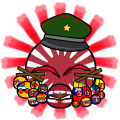 Original infobox image, showing the union as separate balls instead of one
 -
 A bit lazy, sorry


See Also
Notes
- ↑
 Japanese puppet organization in
  Manchuria before the establishment of Manchukuo, not Fengtian Clique
Navigation
| Regions | |||||
|---|---|---|---|---|---|
| Prefectures | |||||
| Cities |
| ||||
| Historical Entities | |||||
| Government | |||||
| Political Parties | |||||
| Clans | |||||
| Organizations Companies | |||||
| Theories | |||||
| Culture | |||||
| People | |||||


