


-
 Portrait, no hat
 -
 Nazi flag
Hitlerism: Difference between revisions
From Heterodontosaurus Balls
m Text replacement - "|Place=" to "|Origin=" |
No edit summary |
||
| (161 intermediate revisions by 3 users not shown) | |||
| Line 1: | Line 1: | ||
{{Mbox/ | {{Mbox/Evil}}{{Mbox/Big}}''<blockquote>This page is about Adolf Hitler himself. For his general following often associated with him, see {{i|Nazi}} [[Nazism]].</blockquote>''{{Infobox | ||
|Name= {{i|Hitler}} Adolf Hitler Thought {{i|Hitler suicide}}{{i|HitlerArt}}{{i|Everyone I don’t like}} | |Name= {{i|Hitler}} Adolf Hitler Thought {{i|Hitler suicide}}{{i|HitlerArt}}{{i|Everyone I don’t like}} | ||
|NativeName= {{ILSize|German-icon.png|German Language}}: Adolf-Hitler-Gedanke | |NativeName= {{ILSize|German-icon.png|German Language}}: Adolf-Hitler-Gedanke | ||
| Line 5: | Line 5: | ||
|ended= 1945 | |ended= 1945 | ||
|predicon= AntiJew | |predicon= AntiJew | ||
|onlypredecessor= | |onlypredecessor= Antisemitism | ||
|nexticon= Nazi | |nexticon= Nazi | ||
|onlysuccessor= Nazism | |onlysuccessor= Neo-Nazism | ||
|image= | |image= Hitlerism.png | ||
|Caption= | |Caption= Ja, ze person you don’t like is mein greatest disciple! | ||
|Alias= {{Scroll|{{I|Hitler}} Hitlerismus<br>{{I|Hitler}} Hitler Thought<br>{{i|Hitler}} Literally Hitler<br>Guy with the silly moustache<br>Ruiner of the swastika<br>{{i|NaziWar}} [[Nazism|Original Nazism]]<br>{{i|Autocracy}} [[Autocracy|Führerprinzip]]<br>{{I|Messianism}} [[Messianism|Messiah]] (by himself and his {{i|Cult of Personality}} [[Cult of Personality]])<br>{{i|HitlerArt}} [[Austria|Austrian Painter/Failed Austrian Painter]] (euphemism)<br>{{i|Animal Rights}} [[Animal Rights|Savior of Animals]] (by Nazi propaganda)<br>{{i|Everyone I don’t like}} Literally [person I don't like]<br>{{i|Everyone I don’t like}} Most common political strawman<br>{{Alias|Nazi-icon.png|Nazism|Mein Führer}}<br>{{Alias|Mussolini-icon.png|Mussolinism|Unpleasantly looking}}<br>{{Alias|Churchill-icon.png|Churchillism|{{i|Patriotism}} [[Patriotism|Patriot]]}} (1935)<br>{{Alias|Churchill-icon.png|Churchillism|Monster of Wickedness}} (1940)<br>{{Alias|Stalin-icon.png|Stalinism|"{{i|Hitler suicide}} Too bad we didn't capture him alive!"}} (1945)<br>{{Alias|UK-icon.png|United Kingdom|Only got one ball}}<br>{{Alias|Time-icon.png|Time|Person of the Year 1938}}<br>{{Alias|USdem stupid-icon.png|Democratic Party|LITERALLY {{i|Trump}} [[Trumpism|TRUMP]]!!!}}<br>{{Alias|YouTube-icon.png|YouTube| | |Alias= {{Scroll|{{I|Hitler}} Hitlerismus<br>{{I|Hitler}} Hitler Thought<br>{{i|Hitler}} Literally Hitler<br>Guy with the silly moustache<br>Ruiner of the swastika<br>{{i|NaziWar}} [[Nazism|Original Nazism]]<br>{{i|Autocracy}} [[Autocracy|Führerprinzip]]<br>{{I|Messianism}} [[Messianism|Messiah]] (by himself and his {{i|Cult of Personality}} [[Cult of Personality]])<br>{{i|HitlerArt}} [[Austria|Austrian Painter/Failed Austrian Painter]] (euphemism)<br>{{i|Animal Rights}} [[Animal Rights|Savior of Animals]] (by Nazi propaganda)<br>{{i|Immoralism}} [[Immoralism|Most evil man]] (by many)<br>{{i|Everyone I don’t like}} Literally [person I don't like]<br>{{i|Everyone I don’t like}} Most common political strawman<br>{{Alias|Nazi-icon.png|Nazism|{{i|Autocracy}} [[Autocracy|Mein Führer]]}}<br>{{Alias|DAP-icon.png|German Workers' Party|Member 555}}<br>{{Alias|NaziParty-icon.png|National Socialist German Workers' Party|Member 3,680}}<br>{{Alias|Mussolini-icon.png|Mussolinism|Unpleasantly looking}}<br>{{Alias|Churchill-icon.png|Churchillism|{{i|Patriotism}} [[Patriotism|Patriot]]}} (1935)<br>{{Alias|Churchill-icon.png|Churchillism|{{i|Immoralism}} [[Immoralism|Monster of Wickedness]]}} (1940)<br>{{Alias|Stalin-icon.png|Stalinism|"{{i|Hitler suicide}} Too bad we didn't capture him alive!"}} (1945)<br>{{Alias|UK-icon.png|United Kingdom|Only got one ball}}<br>{{Alias|Time-icon.png|Time|Person of the Year 1938}}<br>{{Alias|USdem stupid-icon.png|Democratic Party|LITERALLY {{i|Trump}} [[Trumpism|TRUMP]]!!!}}<br>{{Alias|YouTube-icon.png|YouTube|Mustache Man}}<br>{{Alias|YouTube-icon.png|YouTube|No no man}}<br>{{i|Immoralism}} [[Immoralism|Model Satan]] {{i|Everyone I don’t like}} of the post-WWII era}} | ||
| | |Alignments= {{Info|Authoritarian Unity}}<br>{{Info|Culturally Far-Right}}<br>{{Info|Fascists}}<br>{{Info|Populists}} | ||
|Origin= {{I|Weimar Republic}} [[Weimar Republic]] | |Origin= {{I|Weimar Republic}} [[Weimar Republic]] | ||
|Achievements= | |Achievements= | ||
*{{I|Nazi}} [[German Third Reich|Founding of the Third Reich]] | *{{I|Nazi}} [[German Third Reich|Founding of the Third Reich]] | ||
|Influenced By= {{Scroll|{{I|Aggression}} [[Aggressionism]]<br>{{i|Animal Ethics}} [[Animal Ethics]]<br>{{i|AntiAmer}} [[Anti-Americanism]]<br>{{i|AntiBol}} [[Anti-Bolshevism]]<br>{{i|AntiCap}} [[Anti-Capitalism]]<br>{{i|AntiCommie}} [[Anti-Communism]]<br>{{I|AntiCon}} [[Anti- | *{{i|Nazi}} [[Nazism|Creator of Nazism]] | ||
|Influenced By= {{Scroll|{{I|Aggression}} [[Aggressionism]]<br>{{i|Animal Ethics}} [[Animal Ethics]]<br>{{i|AntiAmer}} [[Anti-Americanism]]<br>{{i|AntiBol}} [[Anti-Bolshevism]]<br>{{i|AntiCap}} [[Anti-Capitalism]]<br>{{i|AntiCommie}} [[Anti-Communism]]<br>{{I|AntiCon}} [[Anti-Conservatism]]<br>{{i|AntiDem}} [[Anti-Democracy]]<br>{{i|AntiJudaism}} [[Anti-Judaism]]<br>{{I|AntiLiberal}} [[Anti-Liberalism]]<br>{{i|AntiMarx}} [[Anti-Marxism]]<br>{{I|AntiPar}} [[Anti-Parliamentarianism]]<br>{{i|AntiJew}} [[Antisemitism]]<br>{{i|AntiWest}} [[Anti-Westernism]]<br>{{i|AntiZion}} [[Anti-Zionism]]<br>{{i|Aryan}} [[Aryanism]]<br>{{I|Asceticism}} [[Asceticism]]<br>{{i|Autarky}} [[Autarky]]<br>{{i|Bonapartism}} [[Bonapartism]]<br>{{i|Collectivism}} [[Collectivism]]<br>{{I|Communitarianism}} [[Communitarianism]]<br>{{i|Corporatist Statism}} [[Corporatist Statism]]<br>{{i|Counterintelligence Statism}} [[Counterintelligence Statism]]<br>{{i|Cult of Personality}} [[Cult of Personality]]<br>{{I|Cyclism}} [[Cyclism]]<br>{{i|Darwinism}} [[Darwinism]]<br>{{i|Drug}} [[Drug Legalization|Drug Addiction]]<br>{{i|Eco-Fascism}} [[Eco-Fascism]]<br>{{I|Enlightenment}} [[Enlightenment]]<br>{{i|Ethnocracy}} [[Ethnocracy]]<br>{{I|Ethnoultranationalism}} [[Ethnoultranationalism]]<br>{{i|Eugenicism}} [[Eugenicism]]<br>{{I|Fichteanism}} [[Fichteanism]]<br>{{i|Finland}} [[Finland|Finophilia]]<br>{{i|Frederick the Great}} [[Frederick the Great Thought]]<ref>Throughout World War II, Hitler often compared himself to {{i|Frederick the Great}} [[Frederick the Great Thought|Frederick II the Great]], and he kept a copy of {{i|Switzerland}} [[Switzerland|Anton Graff]]'s portrait of Frederick with him to the end in the Führerbunker in {{i|Berlin}} [[Berlin]].</ref><br>{{i|Autocracy}} [[Autocracy|Führerprinzip]]<br>{{i|Centralism}} [[Centralism|Gleichschaltung]]<br>{{I|Gobinism}} [[Gobinism]]<br>{{I|GreatMan}} [[Great Man Theory]]<br>{{I|Heracliteanism}} [[Heracliteanism]]<br>{{i|Iceland}} [[Iceland|Icelandophilia]]<br>{{i|Japan}} [[Japanophilia]]<br>{{i|Lebensraum}} [[Lebensraum]]<br>{{I|LeBon}} [[Le Bonianism]]<br>{{i|Mach}} [[Machiavellianism]]<br>{{I|Materialism}} [[Materialism]]<br>{{i|Mediacracy}} [[Mediacracy]]<br>{{i|Militarism}} [[Militarism]]<br>{{I|Natrual Law}} [[Natural Law Theory]]<br>{{i|Nazi}} [[Nazism]]<br>{{I|Nietzsche}} [[Nietzscheanism]]<br>{{I|PanGerman}} [[Pan-Germanicism]]<br>{{I|Pantheism}} [[Pantheism]]<br>{{i|NaziPop}} [[Nazi Populism|Populism]]<br>{{I|Prohibition}} [[Prohibitionism]]<br>{{i|ReactMod}} [[Reactionary Modernism]]<br>{{i|Revanchism}} [[Revanchism]]<br>{{i|Richard Wagnerism}} [[Richard Wagnerism]]<br>{{I|Schopenhauer}} [[Schopenhauerism]]<br>{{i|Scientific Racism}} [[Scientific Racism]]<br>{{I|Scientism}} [[Scientism]]<br>{{i|Slavery}} [[Slavery|Slave Labor]]<br>{{I|Slavophobia}} [[Slavophobia]]<br>{{i|Terrorism}} [[Terrorism|State Terrorism]]<br>{{i|Totalitarianism}} [[Totalitarianism]]<br>{{i|Volkism}} [[Völkism]]<br>{{I|Odin}} [[Odinism|Wotanism]] (aesthetically)<ref>A painting by {{i|Enlightenment}} [[Enlightenment|Franz von Stuck]] in 1889 influenced Hitler's looks significantly. Hitler cosplayed as {{I|Odin}} [[Odinism|Wotan]] (Odin), who appeared in the painting leading an army of dead, for the rest of his life.</ref> | |||
*'''Allegedly:''' | *'''Allegedly:''' | ||
**{{i|Bisex}} [[Bisexuality]] | **{{i|Bisex}} [[Bisexuality]] | ||
**{{I|ConRev}} [[Conservative Revolution]] | **{{I|ConRev}} [[Conservative Revolution]] | ||
**{{i|Germanic Paganism}} [[Germanic Religion]] | |||
**{{I|Gnosticism}} [[Gnosticism]] | **{{I|Gnosticism}} [[Gnosticism]] | ||
**{{I|Paranoia}} [[Paranoia]] | **{{I|Paranoia}} [[Paranoia]] | ||
**{{i|Positive Christianity}} [[Positive Christianity]] | **{{i|Positive Christianity}} [[Positive Christianity]] | ||
**{{I|Psychopathy}} [[Psychopathy]] | **{{I|Psychopathy}} [[Psychopathy]] | ||
**{{i|Romanticism}} [[Romanticism]] | |||
**{{I|Schizophrenia}} [[Schizophrenia]] | **{{I|Schizophrenia}} [[Schizophrenia]] | ||
**{{I|Sorelianism}} [[Sorelianism]] | **{{I|Sorelianism}} [[Sorelianism]] | ||
**{{i|Trans}} <s>[[Transgender|Transgenderism]]</s><ref>{{i|UK}} [[United Kingdom|British]] spies plotted to lace Hitler's food with {{i|Female}} [[female]] sex hormones during World War II in a bid to curb his aggressive impulses and make him more feminine.</ref> | |||
*'''Inspiration:''' | |||
**{{i|HenryFord}} [[Henry Fordism|Fordism]] | |||
**{{i|LeftSlave}} [[Left-Slavery|Gulag System]] {{i|Stalin}} | |||
**{{i|Hindenburg}} [[Hindenburgism]] | |||
**{{i|PaxAmer}} [[Pax Americana|Manifest Destiny]] | |||
**{{i|Mussolini}} [[Mussolinism]] | |||
**{{i|Talaat Pasha}} [[Talaat Pashaism]] | |||
*'''Sympathetic:''' | |||
**{{I|Al-Husseini}} [[Al-Husseinism]] | |||
**{{I|Lutheran}} [[Lutheranism|Martin Luther Thought]] | |||
**{{I|Shinto}} [[Shintō]] | |||
*'''Self-Proclaimed:''' | |||
**{{i|UtSoc}} [[Utopian Socialism|Anti-Marxist Socialism]] | |||
**{{i|Pacifism}} [[Pacifism]] | |||
*'''Formerly:''' | *'''Formerly:''' | ||
**{{i|Catholicism}} [[Catholicism]] | **{{i|UK}} [[Anglophilia]] | ||
**{{I| | **{{i|Anti-Semzio}} [[Anti-Semitic Zionism]] (somewhat) | ||
**{{i|Catholicism}} [[Catholicism]]<ref>Hitler was born and raised {{i|Catholicism}} [[Catholicism|Catholic]]. However, at some point, he non-publicly renounced Catholicism. While he never formally renounced it, he expressed contempt for {{i|Christi}} [[Christianity]] in private conversations (such as those recorded in ''Hitler's Table Talk''), calling the faith weak and incompatible with {{i|Nazi}} [[Nazism|Nazi ideology]]. He viewed the {{i|CathChurch}} [[Catholic Church]] as a rival power structure that needed to be controlled or eventually eliminated.</ref> | |||
**{{I|Socialism}} [[Socialism]]<ref>Hitler served in the {{I|Ko Bavaria}} [[People's State of Bavaria]] during the German Revolution from 1918-1919. In fact, {{i|Mein Kampf}} [[Mein Kampf]] was written in part to discredit and downplay his role in it.</ref> | |||
*'''In 1945:''' | |||
**{{i|Germanophobia}} [[Germanophobia|Ethnic Self-Hatred]] | |||
**{{i|Misanthropy}} [[Misanthropy]] | |||
**{{i|Nero}} [[Neroism]] | |||
|200px}} | |200px}} | ||
|Influenced= {{i|Nazi}} [[Nazism]]<br>{{I|Idi Amin}} [[Idi Amin Thought]]<br>{{i|Nguema}} [[Nguemaism]] | |Influenced= {{Scroll|{{i|Hess}} [[Hessism]]<br>{{i|Goebbels}} [[Goebbelsism]]<br>{{i|Himmler}} [[Himmlerism]]<br>{{i|Goring}} [[Göringism]]<br>{{i|Nazi}} [[Nazism]]<br>{{I|Idi Amin}} [[Idi Amin Thought]]<br>{{i|Nguema}} [[Nguemaism]]}} | ||
|People= | |People= | ||
*{{i|Hitler}} [[Nazism|Adolf Hitler]] (1889-1945) | |||
*{{i|Ismism}} '''Fictional:''' {{Collapse| | *{{i|Ismism}} '''Fictional:''' {{Collapse| | ||
**{{I|Hitler}} [[Nazi Populism|Adolf Hitler]] (1889-, ''Look Who's Back'') | **{{I|Hitler}} [[Nazi Populism|Adolf Hitler]] (1889-, ''Look Who's Back'') | ||
**{{i|HitlerArt}} [[SCP Foundation|SCP-2430]] (1951-, ''SCP Foundation'') | **{{i|HitlerArt}} [[SCP Foundation|SCP-2430]] (1951-, ''SCP Foundation'') | ||
}} | }} | ||
*{{i|Everyone I don’t like}} <s>Everyone I don't like</br> | *{{i|Everyone I don’t like}} <s>Everyone I don't like</br> | ||
|Examples= {{i|Nazi}} [[German Third Reich|Germany under Hitler]] (1933-1945) | |Examples= {{i|Nazi}} [[German Third Reich|Germany under Hitler]] (1933-1945) | ||
|Likes= {{Scroll|{{I|Aggression}} [[Aggressionism|Shouting & being angry]]<br>{{i|Aryan}} [[Aryanism|Aryan master race]]<br>{{I|Holocaust}} [[Holocaust]]<br>Making {{i|Jew}} [[Jews]] miserable every way possible<br>{{I|Vegetarianism}} [[Vegetarianism|Vegetarian diet]]<br>{{i|Animal Rights}} [[Animal Rights|Animals]] (especially dogs)<br>Expanding his {{i|Nazi}} [[German Third Reich|Reich]]<br>Sweet deserts<br>{{I|Drug}} [[Drug Legalization|Drugs]] (meth, cocaine, etc.)<br>{{i|HitlerArt}} [[Art|19th century painting, art, architecture, opera]]<br>🐕 His dog Blondi<br>His doctor<br>Snow White<br>{{I|Mediacracy}} [[Mediacracy|Binging films]]<br>{{i|Lebensraum}} [[Lebensraum|Living space]]<br><s>Rap battling {{i|Lib}} [[Liberalism|Eminem]]</s>}} | |Likes= {{Scroll|{{I|Aggression}} [[Aggressionism|Shouting & being angry]]<br>{{i|Aryan}} [[Aryanism|Aryan master race]]<br>{{I|Holocaust}} [[Holocaust]]<br>Making {{i|Jew}} [[Jews]] miserable every way possible<br>{{I|Mein Kampf}} [[Mein Kampf]]<br>{{I|Vegetarianism}} [[Vegetarianism|Vegetarian diet]]<br>{{i|Animal Rights}} [[Animal Rights|Animals]] (especially dogs)<br>Expanding his {{i|Nazi}} [[German Third Reich|Reich]]<br>Sweet deserts<br>{{I|Drug}} [[Drug Legalization|Drugs]] (meth, cocaine, etc.)<br>{{i|HitlerArt}} [[Art|19th century painting, art, architecture, opera]]<br>🐕 His dog Blondi<br>His doctor<br>{{I|Moral Idealism}} [[Moral Idealism|Snow White]]<br>{{I|Mediacracy}} [[Mediacracy|Binging films]]<br>{{i|Lebensraum}} [[Lebensraum|Living space]]<br><s>Rap battling {{i|Lib}} [[Liberalism|Eminem]]</s>}} | ||
|Dislikes= {{Scroll|{{I|Jew}} [[Jews|JUDEN]]<br>Getting rejected from {{I| | |Dislikes= {{Scroll|{{I|Jew}} [[Jews|JUDEN]]<br>Getting rejected from {{I|Arts Vienna}} [[Academy of Fine Arts Vienna|art school]]<br>{{i|Patriarchy}} [[Patriarchy|His father]], who punished him severely<br>Smoking and {{I|Alcohol}} [[Alcoholism|drinking]]<br>Having long horse farts<br>Hunting bloodsports<br>{{i|Commie}} [[Communism|Communists]]<br>{{i|Hitler suicide}} [[German Third Reich#The Thousand Year Reich Lasted Thirteen Years|1945]]<br>Being woken up before midday<br>{{i|Bavaria}} [[Bavaria|Lederhosen]]<br>{{i|Jazz}} [[Jazz]]<br>{{I|Vader}} <s>[[Vaderism|Darth Vader]]</s>}} | ||
|Preceded= {{i|AntiJew}} [[ | |Preceded= {{AL|{{i|AntiJew}} [[Antisemitism]]<br>{{i|Bonapartism}} [[Bonapartism]]}} | ||
|Succeeded= {{i|Nazi}} [[Nazism]] | |Succeeded= {{i|Nazi}} [[Nazism]] | ||
|Food= {{Scroll| | |Food= {{Scroll| | ||
| Line 63: | Line 80: | ||
*🍳 Fried eggs<ref>Less common later due to stomach issues.</ref> | *🍳 Fried eggs<ref>Less common later due to stomach issues.</ref> | ||
}} | }} | ||
|Family= | |||
'''Parents:''' | |||
*{{I|Manosphere}} [[Manosphere|Alois Hitler]] (mother) | |||
*{{I|Catholicism}} [[Catholicism|Klara Pölzl]] (father) | |||
'''Spouse:''' | |||
*{{I|Eva Braun}} [[Eva Braunism|Eva Braun]] ({{Abbr|Married|m.}} 1945) | |||
|themecolor= #dd0000 | |themecolor= #dd0000 | ||
|textcolor= | |textcolor= | ||
|Song= | |Song= | ||
{{I|AntiJew}} [[#10 Things I Hate About Jews|10 Things I Hate About Jews | {{I|AntiJew}} [[#10 Things I Hate About Jews|10 Things I Hate About Jews]] {{I|RuckaRuckaAli}} <br> | ||
{{I|Literally Hitler}} [[#Everyone I don't like is LITERALLY HITLER|Everyone I don't like is LITERALLY HITLER | {{I|TechPostHum}} [[#Adolf's Box|"ADOLF'S BOX" — FNAF MIMIC SONG]]<br> | ||
{{I|Literally Hitler}} [[#Everyone I don't like is LITERALLY HITLER|Everyone I don't like is LITERALLY HITLER]] | |||
|PersonName= {{I|Hitler}} Adolf Hitler | |PersonName= {{I|Hitler}} Adolf Hitler | ||
|Born= 20 April 1889, {{i|AH}} [[Austria-Hungary|Austria]] | |Born= 20 April 1889, {{i|AH}} [[Austria-Hungary|Austria]] | ||
|Death= 30 April 1945, {{i|Nazi}} [[German Third Reich|Germany]] | |Death= 30 April 1945, {{i|Nazi}} [[German Third Reich|Germany]] | ||
|Job= {{i|GermanArmy}} [[German Army|German Soldier]] (1914-1920)<br>{{i|Dictatorship}} [[Dictatorship|Dictator]] (1933-1945) | |Job= {{i|GermanArmy}} [[German Army|German Soldier]] (1914-1920)<br>{{i|Dictatorship}} [[Dictatorship|Dictator]] (1933-1945) | ||
}}{{Quote|I am Adolf Hitler, commander of thee {{I|Nazi}} [[German Third Reich|Third Reich]]!<br>Little known fact, also dope on the mic!|{{I|Hitler}} [[Nazism|Adolf Hitler]] (not)}}'''Hitlerism''' refers to the personal ideology, philosophy, and policies of '''Adolf Hitler''', the notorious founder of the {{I|Nazi}} [[Nazism|Nazi movement]], Führer of the {{I|Nazi}} [[German Third Reich|Third Reich]], and leader of the {{I|NaziParty}} [[National Socialist German Workers' Party|Nazi Party]]. He is known for policies such the {{I|Holocaust}} [[Holocaust]] (mass extermination of {{I|Jew}} [[Jews]]), Aktion T4 (involuntary mass euthanasia of disabled peoples), the invasion of {{i|Poland2}} [[Second Polish Republic|Poland]] in 1939 and Generalplan Ost ({{I|PanGerman}} [[Pan-Germanicism|Germanizing]] {{I|EastEurope}} [[Eastern Europe]] by {{i|Genocide}} [[genocide]] and {{I|EthNat}} [[Ethnic Nationalism|ethnic cleansings]]). Hitlerism's hatred for many ideologies, including {{i|Commie}} [[communism]], {{i|Liberalism}} [[liberalism]], {{i|Capitalism}} [[capitalism]], {{i|Globalism}} [[globalism]] and {{i|Dem}} [[democracy]] is based in the belief that all of these are {{i|Jew}} [[Jews|Jewish]]. | }}{{Quote|I am Adolf Hitler, commander of thee {{I|Nazi}} [[German Third Reich|Third Reich]]!<br>Little known fact, also dope on the mic!|{{I|Hitler}} [[Nazism|Adolf Hitler]] (not)}}'''Hitlerism''' refers to the personal {{i|Politics}} [[Politics|ideology]], {{i|Philosophy}} [[philosophy]], and policies of '''Adolf Hitler''', the notorious founder of the {{I|Nazi}} [[Nazism|Nazi movement]], {{I|Autocracy}} [[Autocracy|Führer]] of the {{I|Nazi}} [[German Third Reich|Third Reich]], and leader of the {{I|NaziParty}} [[National Socialist German Workers' Party|Nazi Party]]. He is known for his iconic toothbrush mustache, his {{I|Aggression}} [[Aggressionism|angry and energetic speeches]], and policies such the {{I|Holocaust}} [[Holocaust]] (mass extermination of {{I|Jew}} [[Jews]]), Aktion T4 (involuntary mass euthanasia of disabled peoples), the invasion of {{i|Poland2}} [[Second Polish Republic|Poland]] in 1939 and Generalplan Ost ({{I|PanGerman}} [[Pan-Germanicism|Germanizing]] {{I|EastEurope}} [[Eastern Europe]] by {{i|Genocide}} [[genocide]] and {{I|EthNat}} [[Ethnic Nationalism|ethnic cleansings]]). Hitlerism's hatred for many ideologies, including {{i|Commie}} [[communism]], {{i|Liberalism}} [[liberalism]], {{i|Capitalism}} [[capitalism]], {{i|Globalism}} [[globalism]] and {{i|Dem}} [[democracy]] is based in the belief that all of these are {{i|Jew}} [[Jews|Jewish]]. | ||
Hitler is an extremely, and probably the most controversial character, he is the {{i|Culture}} [[Culture|cultural]] icon and the face of {{I|Immoralism}} [[Immoralism|pure evil]], considered the evilest man to ever exist by many. Due to this, he often appears (and is overused) in "dark humour" (often in an attempt to trigger people), {{I|Satirism}} [[Satirism|political satires]], and many other {{I|Internet}} [[internet]] pop culture. And, showing his face or mentioning his name on many social media platforms risks you getting banned, so people came up with nicknames for him such as the "{{I|HitlerArt}} [[Art|Austrian Painter]]" or "Mustache Man". | |||
Hitler cared tremendously much about his {{I|Mediacracy}} [[Mediarcacy|own image]]. He would practice speeches in the mirror while listening to his recordings of his own voice, he would do it over and over. His official photographer, {{i|Bavaria}} [[Bavaria|Heinrich Hoffmann]], took hundreds of shots of him testing different poses and gestures, and only the images whose poses looked strong would survive. These poses would then be rehearsed and used in speeches. | |||
Hitler | After {{i|Nazi}} [[German Third Reich|Germany]]'s defeat in WWII and Hitler's {{i|Hitler suicide}} [[#Death|suicide]] in 1945, people thought all that suffering couldn't have been for nothing. So, Hitler became the "model {{i|Satan}} [[Satanism|Satan]]": {{i|Social}} [[Social|society]]'s replacement for the embodiment of evil as the world {{i|Secularism}} [[Secularism|secularized]]. Thus, everything Hitler did had to be evil: Hitler was a {{i|Nationalism}} [[Nationalism|nationalist]], so nationalism must be evil. Hitler stood on a balcony, so anyone who stood on a balcony must be evil. Since the 2016 eruption of the culture war, Hitlerism finds himself as the most common {{i|Politics}} [[Politics|political]] strawman—{{i|Everyone I don’t like}} [[Social Justice Warriors|Everyone I don't like is literally Hitler]]! | ||
Hitlerism can be interpreted to be the predecessor and leader of {{I|NaziWar}} [[Nazism]], or seen as a sub-ideology of Nazism. | Hitlerism can be interpreted to be the predecessor and leader of {{I|NaziWar}} [[Nazism]], or seen as a sub-ideology of Nazism. In {{i|Philosophyball}} [[Philosophyball Wiki|Philosophyball]], he is a personal tendency of {{i|Aryan}} [[Aryanism]]. | ||
==Life & History== | ==Life & History== | ||
| Line 84: | Line 111: | ||
Adolf Hitler was born on 20 April 1889, in the small town of {{i|Braunau am Inn}} [[Braunau am Inn]], which was in {{I|AH}} [[Austria-Hungary]] and close to the border of {{I|German Empire}} [[German Empire|Germany]]. Adolf was the fourth of six children born to {{I|Manosphere}} [[Manosphere|Alois Hitler]] and his third wife, {{I|Catholicism}} [[Catholicism|Klara Pölzl]]. Adolf's three older siblings—{{I|Male}} [[Male|Gustav]], {{I|Female}} [[Female|Ida]], and {{I|Male}} [[Male|Otto]]—all died before he was born. Also living in the household were Alois's children from his second marriage: {{I|Male}} [[Male|Alois Jr]]. and {{I|Female}} [[Female|Angela]]. In 1892, the three-year-old Adolf and his family moved to {{I|Passau}} [[Passau]] following Alois's promotion to the customs administration there. Alois was promoted and transferred to {{I|Linz}} [[Linz]] on 1 April 1893, but the rest of the family remained in Passau. There Hitler acquired the distinctive {{I|BavarianL}} [[Bavarian German|lower Bavarian dialect]], rather than {{I|AustrianGerman}} [[Austrian German]], which marked his speech throughout his life. The family returned to Austria and settled in {{I|Leonding}} [[Leonding]] on 9 May 1894, and in June 1895, Alois retired near to {{I|Lambach}} [[Lambach]], where he farmed and kept bees. Hitler attended ''Volksschule'' (state-funded primary school) in nearby {{I|Fischlham}} [[Fischlham]]. | Adolf Hitler was born on 20 April 1889, in the small town of {{i|Braunau am Inn}} [[Braunau am Inn]], which was in {{I|AH}} [[Austria-Hungary]] and close to the border of {{I|German Empire}} [[German Empire|Germany]]. Adolf was the fourth of six children born to {{I|Manosphere}} [[Manosphere|Alois Hitler]] and his third wife, {{I|Catholicism}} [[Catholicism|Klara Pölzl]]. Adolf's three older siblings—{{I|Male}} [[Male|Gustav]], {{I|Female}} [[Female|Ida]], and {{I|Male}} [[Male|Otto]]—all died before he was born. Also living in the household were Alois's children from his second marriage: {{I|Male}} [[Male|Alois Jr]]. and {{I|Female}} [[Female|Angela]]. In 1892, the three-year-old Adolf and his family moved to {{I|Passau}} [[Passau]] following Alois's promotion to the customs administration there. Alois was promoted and transferred to {{I|Linz}} [[Linz]] on 1 April 1893, but the rest of the family remained in Passau. There Hitler acquired the distinctive {{I|BavarianL}} [[Bavarian German|lower Bavarian dialect]], rather than {{I|AustrianGerman}} [[Austrian German]], which marked his speech throughout his life. The family returned to Austria and settled in {{I|Leonding}} [[Leonding]] on 9 May 1894, and in June 1895, Alois retired near to {{I|Lambach}} [[Lambach]], where he farmed and kept bees. Hitler attended ''Volksschule'' (state-funded primary school) in nearby {{I|Fischlham}} [[Fischlham]]. | ||
Adolf's father was an {{I|Alcohol}} [[Alcoholism|alcoholic]], and this behavior had a significant impact on the household, contributing to a difficult and often abusive family environment. The move to near Lambach coincided with the onset of intense father–son conflicts caused by Adolf's refusal to conform to the strict discipline of his school. Alois tried to browbeat his son into obedience, while Adolf did his best to be the opposite of whatever his father wanted. Alois would also beat his son, his mother tried to protect him from regular beatings but she was too scared of his father. | |||
In January 1894, when Hitler was four, he got saved from drowning in the {{I|River}} [[Inn River]] by a priest. Hitler | In January 1894, when Hitler was four, he got saved from drowning in the {{I|River}} [[Inn River]] by a priest. | ||
Alois Hitler's farming efforts near Lambach were unsuccessful, so in 1897, the family decided to live in Lambach directly. The eight-year-old Adolf took singing lessons, sang in the {{I|CathChurch}} [[Catholic Church|church choir]], and even considered becoming a {{I|Catholicism}} [[Catholicism|priest]]. In 1898, the Hitler family returned permanently to Leonding. Adolf was deeply affected by the death of his younger brother {{I|Male}} [[Male|Edmund]] in 1900 from measles. Thus, he transformed from a confident, outgoing, and conscientious student to a morose, detached boy who frequently clashed with his father and teachers. Adolf's younger sister {{I|Female}} [[Female|Paula]] recalled that Adolf was a teenage bully who would often slap her. | |||
Alois had made a successful career in the customs bureau and wanted his son to follow in his footsteps. Adolf Hitler later dramatized an episode from this period when his father took him to visit a customs office, depicting it as an event that gave rise to an unforgiving antagonism between father and son, who were both strong-willed. Ignoring his son's desire to attend a classical high school and become an {{I|HitlerArt}} [[Art|artist]], Alois sent Adolf to the ''Realschule'' in {{I|Linz}} [[Linz]] in September 1900. Adolf rebelled against this decision, intentionally performing poorly hoping that once his father saw what little progress he was making at the technical school, he would let him devote himself to his artistic dream. | |||
Young Adolf was a troublemaker, he smoked in bathrooms and beat his teachers up. As such, he got expelled from many schools. Like many Austrian Germans, Adolf began to develop {{I|GermanNat}} [[German Nationalism|German nationalist]] ideas from a young age. He expressed loyalty only to {{I|German Empire}} [[German Empire|Germany]], despising the declining {{I|Austrian Empire}} [[Habsburg Monarchy]] and their rule over an {{I|Multiculturalism}} [[Multiculturalism|ethnically diverse]] empire. Adolf and his friends used the greeting "Heil", and sang the "Deutschlandlied" instead of the Austrian Imperial anthem. Hitler believed that Austria should be a part of a "Greater Germany", provoking some of his fellow Austrians. | |||
When Adolf's father suddenly died in 1903, his performance at school deteriorated, and his mother allowed him to leave. He enrolled at the ''Realschule'' in {{I|Steyr}} [[Steyr]] in September 1904, where his behaviour and performance improved. In 1905, after passing a repeat of the final exam, Adolf left the school without any ambitions for further education or clear plans for a career. He had lived a good life with his mother, sadly she died from breast cancer in 1907 when Adolf was 18. Adolf Hitler became very sad and kept a picture of her next to his bed for the rest of his life. | |||
====Early Adulthood==== | ====Early Adulthood==== | ||
At 18, Hitler had exactly one friend: a young man named {{i|Music}} [[Music|August Kubizek]]. Hitler was incredibly {{i|Aggression}} [[Aggressionism|moody, volatile, and prone to sudden explosions of rage]]. Hitler did not treat Kubizek as an equal; he treated him as a captive audience. Hitler would pace around their shared room delivering furious, hours-long monologues about architecture, {{i|Social}} [[society]], and his {{i|Nazi}} [[Nazism|grand plans]], completely ignoring whether Kubizek was actually interested. | |||
Despite his father wanting him to be a civil servant, Hitler still dreamed of becoming an {{I|HitlerArt}} [[Art|artist]]. He tried to joined in the {{I|Arts Vienna}} [[Academy of Fine Arts Vienna|Academy of Fine Arts]] in the autumns of 1907 and 1908. But his master said that his painting isn't good enough. He said that it lacked {{I|Altruism}} [[Altruism|empathy]] and emotion (foreshadowing…). He got rejected from art school both times by {{I|Artist}} [[Art|Christian Griepenkerl]], who in 1907 told Hitler's painting "Sample drawing unsatisfactory. Too few heads." and in 1908 simply "Not admitted". This made Hitler deeply upset. Disillusioned and bitter, he turned to {{I|Politics}} [[politics]] as a means to channel his frustrations and ambitions. (Well, his remaining art pieces were sold for relatively large amounts of money after WWII, so I guess this is something he would be happy about.) The director suggested Hitler should apply to a school for architecture, but he lacked the necessary academic credentials because he had not finished secondary school. | |||
In | In 1909, Hitler ran out of money and was forced to live a bohemian life in homeless shelters and the Meldemannstraße dormitory. He earned money as a casual labourer and by painting and selling watercolours of {{I|Vienna}} [[Vienna]]'s sights. During his time in Vienna, he pursued a growing passion for architecture and music, attending ten performances of ''Lohengrin'', his favourite of {{I|Richard Wagnerism}} [[Richard Wagnerism|Richard Wagner]]'s operas. | ||
At Vienna, Hitler was exposed to {{i|Racism}} [[Racism|racist]] rhetoric. {{i|Populism}} [[Populism|Populists]] such as Mayor {{i|AntiJew}} [[Antisemitism|Karl Lueger]] exploited the city's prevalent {{i|AntiJew}} [[Antisemitism|antisemitic]] sentiment, blamed {{i|Jew}} [[Jews]] "for simply anything and everything", and also espoused {{I|GermanNat}} [[German Nationalism|German nationalist]] notions for political benefit. German nationalism was even more widespread in the {{I|Mariahilf}} [[Mariahilf]] district, where Hitler then lived. {{I|PanGerman}} [[Pan-Germanicism|Georg Ritter von Schönerer]] became a major influence on Hitler, and he developed an admiration for {{I|Lutheran}} [[Lutheranism|Martin Luther]]. Hitler read local newspapers that promoted prejudice and used {{I|Christi}} [[Christianity|Christian]] fears of being swamped by an influx of {{I|EastEurope}} [[Eastern Europe|Eastern European]] Jews as well as pamphlets that published the thoughts of philosophers and theoreticians such as {{I|Scientific Racism}} [[Scientific Racism|Houston Stewart Chamberlain]], {{I|Darwin}} [[Charles Darwin Thought|Charles Darwin]], {{I|Nietzsche}} [[Nietzscheanism|Friedrich Nietzsche]], {{I|LeBon}} [[Le Bonianism|Gustave Le Bon]], and {{I|Schopenhauer}} [[Schopenhauerism|Arthur Schopenhauer]]. During his life in Vienna, Hitler also developed fervent {{I|Slavophobia}} [[Slavophobia|anti-Slavic sentiments]]. | |||
In May 1913, Hitler received the final part of his father's estate and moved to {{I|Munich}} [[Munich]], where he continued to struggle financially, working odd jobs and living in a men's hostel. When he was conscripted into the {{I|AH}} [[Austro-Hungarian Army]], he journeyed to {{I|Salzburg}} [[Salzburg]] on 5 February 1914 for medical assessment. After he was deemed unfit for service, he returned to Munich. Hitler later claimed that he did not wish to serve the {{I|Austrian Empire}} [[Habsburg Monarchy|Habsburg Empire]] because of the mixture of races in the army and his belief that the collapse of {{I|AH}} [[Austria-Hungary]] was imminent. | |||
====World War I==== | ====World War I==== | ||
In 1914, when World War I broke out, | In 1914, when World War I broke out, Hitler was happy. He was cheering at a mass rally in {{i|Munich}} [[Munich]]'s Odeonsplatz on 2 August, following {{I|German Empire}} [[German Empire|Germany]]'s declaration of {{i|War}} [[war]] on {{i|Russian Empire}} [[Russian Empire|Russia]]. Hitler eagerly enlisted in the {{I|Bavarian Army}} [[Bavarian Army]], seeing the war as an opportunity to prove his worth and serve the {{I|German Empire}} [[German Empire|country]] he idolized. According to a 1924 report by the {{I|Bavaria}} [[Free State of Bavaria|Bavarian]] authorities, allowing Hitler to serve was most likely an administrative error, because as an {{I|AH}} [[Austria-Hungary|Austrian]] citizen, he should have been returned to Austria. | ||
Hitler was posted to the {{I|Bavarian Army}} [[6th Bavarian Reserve Division]], serving as a dispatch runner at {{I|Belgium}} [[Belgium]] and {{I|French3}} [[French Third Republic|France]] on the Western Front. While other soldiers were smoking and drinking and talking about {{i|Female}} [[Female|women]], Hitler liked to read and sketch. Hitler spent nearly half his time at the regimental headquarters in {{I|Fournes-en-Weppes}} [[Fournes-en-Weppes]], well behind the front lines. In 1914, he was present at the First Battle of {{I|Ypres}} [[Ypres]] and in that year was decorated for bravery, receiving the Iron Cross, Second Class. During the war, he was saved by his commanding officer, {{I|Militarism}} [[Militarism|Fritz Wiedemann]], who pulled Hitler out of the rubble of a collapsed building while under heavy fire. | |||
While he was in France, one of Hitler's fellow soldiers, {{i|GermanArmy}} [[German Army|Hans Mend]], observed Hitler allegedly committing {{I|Homosex}} [[homosexuality]]. In fact, years later (but before Hitler became infamous), he wrote in his memoirs: "At night, Hitler lay with {{i|Gay}} [[Gay (LGBTQ+)|Schmidl]], his male whore." Schmidl, otherwise known as Ernst Schmidt, and Hitler were inseparable lovers for five years. | |||
During his service at headquarters, Hitler pursued his {{I|HitlerArt}} [[Art|artistic interests]], drawing cartoons and providing instructions for an army newspaper. During the Battle of the {{i|River}} [[Somme River|Somme]] in October 1916, he was wounded in the left thigh when a shell exploded in the dispatch runners' dugout. Hitler spent almost two months recovering in hospital at {{i|Beelitz}} [[Beelitz]], returning to his regiment on 5 March 1917. He was present at the Battle of {{I|Arras}} [[Arras]] of 1917 and the Battle of {{I|Belgium}} [[Passchendaele]]. He received the Black Wound Badge on 18 May 1918. Three months later, in August 1918, on a recommendation by Lieutenant {{I|Jew}} [[Jews|Hugo Gutmann]], his {{I|Jew}} [[Jews|Jewish]] superior, Hitler received the Iron Cross, First Class, a decoration rarely awarded at Hitler's ''Gefreiter'' rank. On 15 October 1918, Hitler was temporarily blinded in a mustard gas attack and was hospitalised in {{I|Pasewalk}} [[Pasewalk]]. While there, Hitler learned of Germany's defeat, and, by his own account, suffered a second bout of blindness after receiving this news. Like many others, he felt betrayed by the German government, which he believed had stabbed the country in the back by signing the Treaty of Versailles. | |||
Hitler described his role in World War I as "the greatest of all experiences" and was praised by his commanding officers for his bravery. His {{I|War}} [[War|wartime]] experience reinforced his {{I|GermanNat}} [[German Nationalism|German patriotism]], and he was shocked by Germany's capitulation in November 1918. His displeasure with the collapse of the war effort began to shape {{I|Nazi}} [[Nazism|his ideology]]. Like other German nationalists, he believed the ''Dolchstoßlegende'' (stab-in-the-back myth), which claimed that the German army, "undefeated in the field", had been "stabbed in the back" on the home front by civilian leaders, {{I|Jew}} [[Jews]], {{I|Marxism}} [[Marxism|Marxists]], and those who signed the armistice that ended the fighting—later dubbed the "November criminals". | |||
The Versailles Treaty caused {{I|Weimar Republic}} [[Weimar Republic|Germany]] very poor {{i|Economy}} [[Economy|economic]], {{i|Social}} [[Society|social]], and {{I|Politics}} [[Politics|political]] conditions, which were later exploited by Hitler for political gain. | |||
===Entry into Politics=== | |||
After the war, Hitler returned to {{I|Munich}} [[Munich]]. Without formal education or career prospects, he remained in the army. He also served a minor role in the {{i|Marxism}} [[Bavarian Soviet Republic]] during the German Revolution from 1918-1919. In July 1919, Hitler was appointed ''Verbindungsmann'' (intelligence agent) of an ''Aufklärungskommando'' (reconnaissance unit) of the {{I|Reichswehr}} [[Reichswehr]], assigned to influence other soldiers and to infiltrate the {{I|DAP}} [[German Workers' Party]] (DAP). At a DAP meeting on 12 September 1919, Party chairman {{I|Drexler}} [[Drexlerism|Anton Drexler]] was impressed by Hitler's oratorical skills. He gave him a copy of his pamphlet ''My Political Awakening'', which contained {{I|AntiJew}} [[Antisemitism|antisemitic]], {{I|GermanNat}} [[German Nationalism|nationalist]], {{I|AntiCap}} [[Anti-Capitalism|anti-capitalist]], and {{I|AntiMarx}} [[Anti-Marxism|anti-Marxist]] ideas. On the orders of his army superiors, Hitler applied to join the party, and within a week was accepted as party member no. 555 (the party began counting membership at 500 to give the impression they were a much larger party). Hitler would meet and discuss things with other members at a {{i|Alcohol}} [[Alcoholism|beer bar]]. He quickly rose within the ranks due to his oratory skills and {{I|Mediacracy}} [[Mediacracy|propaganda]] talents. | |||
Hitler made his earliest known written statement about the {{I|Jew}} [[Jews|Jewish]] question in a 16 September 1919 letter to {{I|Imperial German Army}} [[Imperial German Army|Adolf Gemlich]] (now known as the Gemlich letter). In the letter, Hitler argues that the aim of the government "must unshakably be the removal of the Jews altogether". At the DAP, Hitler met {{I|DAP}} [[German Workers' Party|Dietrich Eckart]], one of the party's founders and a member of the occult {{I|Thule Society}} [[Thule Society]]. Eckart became Hitler's mentor, exchanging ideas with him and introducing him to a wide range of Munich society. To increase the party's appeal, the DAP changed his name in 1920 to the ''Nationalsozialistische Deutsche Arbeiterpartei'' ({{I|NaziParty}} [[National Socialist German Workers' Party]] (NSDAP), now known as the "Nazi Party"). Hitler designed the party's banner of a swastika in a white circle on a red background. | |||
Hitler was discharged from the {{I|Reichswehr}} [[Reichswehr|Army]] on 31 March 1920 and began working full-time for the party. The party headquarters was in {{i|Munich}} [[Munich]], a centre for anti-government {{i|GermanNat}} [[German Nationalism|German nationalists]] determined to eliminate {{i|Marxism}} [[Marxism]] and undermine the {{i|Weimar Republic}} [[Weimar Republic]]. | |||
{{Quote|He had come to a house where he had never been before, wearing gaiters, a floppy, wide-brimmed hat, and carrying a riding whip… Eventually, he managed to launch into a {{i|Mediacracy}} [[Mediacracy|speech]]. He talked on and on, endlessly. He preached. He went on at us like a division chaplain in the {{I|Reichswehr}} [[Reichswehr|Army]]. We did not in the least contradict him, or venture to differ in any way, but he began to bellow at us. The servants thought we were being attacked, and rushed in to defend us. When he had gone, we sat silently confused and not at all amused. There was a feeling of dismay, as when on a train you suddenly find you are sharing a compartment with a psychotic.|{{i|AntiNazi}} [[Anti-Nazism|Friedrich Reck-Malleczewen]], ''Diary of a Man in Despair''}} | |||
In February 1921, already highly effective at {{i|Mediacracy}} [[Mediacracy|crowd manipulation]], Hitler spoke to a crowd of over 6,000. To publicise the meeting, two truckloads of party supporters drove around Munich waving {{i|Nazi}} [[Nazism|swastika flags]] and distributing leaflets. Hitler soon gained notoriety for his rowdy polemic speeches against the Treaty of Versailles, {{i|AntiNazi}} [[Anti-Nazism|rival politicians]], and especially against {{i|Jew}} [[Jews]] and {{i|Marxism}} [[Marxism|Marxists]]. | |||
In June 1921, while Hitler and Eckart were on a fundraising trip to {{i|Berlin}} [[Berlin]], a mutiny broke out within the {{i|NaziParty}} [[National Socialist German Workers' Party|Nazi Party]] in Munich. Members of the executive committee wanted to merge with the {{i|Nuremberg}} [[Nuremberg]]-based {{i|Volkism}} [[German Socialist Party]] (DSP). Hitler returned to Munich on 11 July and {{i|Aggression}} [[Aggressionism|angrily]] tendered his resignation. The committee members realized that the resignation of their leading public figure and speaker would mean the end of the party. Hitler announced he would rejoin on the condition that he would replace Drexler as party chairman, and that the party headquarters would remain in Munich. The committee agreed, and he rejoined the party on 26 July as member no. 3,680. Hitler continued to face some opposition within the Nazi Party. Opponents of Hitler in the leadership had {{i|Mediacracy}} [[Mediacracy|Hermann Esser]] expelled from the party, and they printed 3,000 copies of a pamphlet attacking Hitler as a traitor to the party. In the following days, Hitler spoke to several large audiences and defended himself and Esser, to thunderous applause. His strategy proved successful, and at a special party congress on 29 July, he was granted absolute power as party chairman, succeeding Drexler, by a vote of 533 to 1. | |||
Hitler's vitriolic beer hall speeches began attracting regular audiences. A demagogue, he became adept at using {{i|NaziPop}} [[Nazi Populism|populist]] themes, including the use of scapegoats, who were blamed for his listeners' economic hardships. Hitler used personal magnetism and an understanding of crowd psychology to his advantage while engaged in public speaking. {{i|History}} [[History|Historians]] have noted the hypnotic effect of his rhetoric on large audiences, and of his eyes in small groups. Early followers of Hitler included {{i|Hess}} [[Hessism|Rudolf Hess]], {{i|Goring}} [[Göringism|Hermann Göring]], and {{i|Röhm}} [[Röhmism|Ernst Röhm]]. | |||
{{Quote|We erupted into a frenzy of {{i|GermanNat}} [[German Nationalism|nationalistic pride]] that bordered on hysteria. For minutes on end, we shouted at the top of our lungs, with tears streaming down our faces: Sieg Heil, Sieg Heil, Sieg Heil! From that moment on, I belonged to Adolf Hitler body and soul.|{{i|PostNazi}} [[Post-Nazism|Alfons Heck]] (former member of the {{i|Hitler Youth}} [[Hitler Youth]])}} | |||
The programme of the Nazi Party was laid out in their 25-point programme ({{i|Nazi}} [[Nazism|National Socialist]] Program) on 24 February 1920. This did not represent a coherent ideology, but was a conglomeration of received ideas which had currency in the {{i|Volkism}} [[Völkism|völkisch]] {{i|PanGerman}} [[Pan-Germanicism|pan-Germanic]] movement, such as {{i|Ultranationalism}} [[ultranationalism]], {{i|Militarism}} [[Militarism|opposition to the Treaty of Versailles]], {{i|AntiCap}} [[Anti-Capitalism|distrust of capitalism]], as well as some {{i|Socialism}} [[Socialism|socialist]] ideas. For Hitler, the most important aspect of it was its strong {{i|AntiJew}} [[Antisemitism|antisemitic]] stance. He also perceived the programme as primarily a basis for propaganda and for attracting people to the party. | |||
====Beer Hall Putsch and Landsberg Prison==== | |||
In 1923, Hitler enlisted the help of World War I General {{I|Imperial German Army}} [[Imperial German Army|Erich Ludendorff]] for an attempted coup known as the Beer Hall Putsch. Hitler's {{I|NaziParty}} [[National Socialist German Workers' Party|Nazi Party]] used {{I|Fascism}} [[Fascism|Italian Fascism]] as a model for their appearance and policies. Hitler wanted to emulate {{I|Mussolini}} [[Mussolinism|Benito Mussolini]]'s March on {{I|Rome}} [[Rome]] in 1922 by staging his own coup in {{I|FS Bavaria}} [[Free State of Bavaria|Bavaria]], to be followed by a challenge to the {{I|Weimar Republic}} [[Weimar Republic|government]] in {{I|Berlin}} [[Berlin]]. Hitler and Ludendorff sought the support of ''Staatskommissar'' (State Commissioner) {{I|AuthCon}} [[Authoritarian Conservatism|Gustav Ritter von Kahr]], Bavaria's de facto ruler. However, Kahr, along with police chief {{I|PolState}} [[Police Statism|Hans Ritter von Seisser]] and {{I|Reichswehr}} [[Reichswehr]] General {{I|Militarism}} [[Militarism|Otto von Lossow]], wanted to install a {{I|Nationalism}} [[Nationalism|nationalist]] {{I|Dictatorship}} [[dictatorship]] without Hitler. | |||
On 8 November 1923, Hitler and the {{I|SA}} [[Sturmabteilung|SA]] stormed a public meeting of 3,000 people organized by Kahr in the {{i|Alcohol}} [[Bürgerbräukeller]], a beer hall in {{I|Munich}} [[Munich]]. Interrupting Kahr's speech, he announced that the national revolution had begun and declared the formation of a new government with Ludendorff. Retiring to a back room, Hitler, with his pistol drawn, demanded and subsequently received the support of Kahr, Seisser, and Lossow. Hitler's forces initially succeeded in occupying the local Reichswehr and police headquarters, but Kahr and his cohorts quickly withdrew their support. Neither the army nor the police joined forces with Hitler. The next day, Hitler and his followers marched from the beer hall to the {{I|War}} [[Bavarian Ministry of War]] to overthrow the Bavarian government, but police dispersed them. In the failed coup, 16 Nazi Party members and four police officers were killed. | |||
Hitler fled to the home of {{I|PostNazi}} [[Post-Nazisn|Ernst Hanfstaengl]] and by some accounts contemplated suicide. He was depressed but calm when arrested on 11 November 1923 for high treason. His trial before the special {{i|Krit}} [[People's Court (Bavaria)|People's Court]] in Munich began in February 1924, and {{I|Rosenberg}} [[Rosenbergism|Alfred Rosenberg]] became temporary leader of the Nazi Party. | |||
Hitler used his trial as an opportunity to spread his message throughout Germany. At one point during the trial, Hitler discussed {{I|Politics}} [[Politics|political]] leadership, during which he stated that leading people was not a matter of political science (''Staatswissenschaft'') but an innate ability, one of statecraft (''Staatskunst''). He further elaborated by claiming that out of 10,000 politicians, only one, {{i|Bismarck}} [[Bismarckism|Otto von Bismarck]], emerged, subtly implying that he too had been born with this gift. Continuing, he declared that it was not {{i|MarxC}} [[Karl Marx Thought|Karl Marx]] who stirred the masses and ignited the Russian Revolution, but {{i|Lenin}} [[Lenin|Vladimir Lenin]], by making his appeal to the senses rather than the mind. | |||
On 1 April, Hitler was sentenced to five years' ''Festungshaft'' (fortress confinement) at {{I|Landsberg am Lech}} [[Landsberg am Lech|Landsberg]] Prison. There, he received friendly treatment from the guards and was allowed mail from supporters and regular visits by party comrades. During his brief time in prison, he wrote his manifesto/autobiography {{I|Mein Kampf}} ''[[Mein Kampf]]'', outlining {{I|Nazi}} [[Nazism|his ideology]] and {{I|Totalitarianism}} [[Totalitarianism|future plans]] for Germany. The book laid out Hitler's plans for {{I|Lebensraum}} [[Lebensraum|territorial]] expansion as well as transforming German society into a {{I|RaceNat}} [[Racial Nationalism|dictatorship based on race]]. Throughout the book, {{I|Jew}} [[Jews]] are equated with "germs" and presented as the "{{I|Internationalism}} [[Internationalism|international]] poisoners" of society. According to Hitler, the only solution was their {{I|Genocide}} [[Genocide|extermination]]. Hitler did not describe exactly how this was to be accomplished, ''yet''. | |||
Pardoned by the Bavarian Supreme Court, Hitler was released from jail on 20 December 1924, against the state prosecutor's objections. Including time on remand, Hitler served just over one year in prison. Published in two volumes in 1925 and 1926, Mein Kampf sold 228,000 copies between 1925 and 1932. Shortly before Hitler was eligible for parole, the Bavarian government attempted to have him deported to {{I|AH}} [[Austria-Hungary|Austria]]. The Austrian federal chancellor rejected the request on the specious grounds that his service in the {{I|Reichswehr}} [[Reichswehr|German Army]] made his Austrian citizenship void. In response, Hitler formally renounced his Austrian citizenship on 7 April 1925. | |||
Hitler | ====Rebuilding the Nazi Party==== | ||
Upon Hitler's release from prison in 1925, he needed to rebuild his reputation. His personal photogragper, {{I|Mediacracy}} [[Mediacracy|Heinrich Hoffmann]], suggested wearing {{i|Bavaria}} [[Bavaria|Bavarian]] traditional pants (lederhosen). The idea was that Hitler would be seen as a "man of the people". But when the images came back, Hitler was furious because he thought they looked silly. The short pants emphasized his bony legs and awkward frame. Hitler ordered every copy to be destroyed, but Hoffmann didn't listen and hid them in his archive (these images were found when Hoffmann was arrested in 1945). | |||
When Hitler returned, {{I|Politics}} [[politics]] in {{I|Weimar Republic}} [[Weimar Republic|Germany]] had become {{I|Pacifism}} [[Pacifism|less combative]], and the {{I|Economy}} [[economy]] had improved, limiting his opportunities for political agitation. As a result of the failed Beer Hall Putsch, the {{I|NaziParty}} [[National Socialist German Workers' Party|Nazi Party]] and his affiliated organizations were banned in {{I|FS Bavaria}} [[Free State of Bavaria|Bavaria]]. In a meeting with Prime Minister {{I|Catholicism}} [[Catholicism|Heinrich Held]] on 4 January 1925, Hitler agreed to respect the state's authority and promised that he would seek political power only through the {{I|Dem}} [[Democracy|democratic]] process. The meeting paved the way for the ban on the Nazi Party to be lifted on 16 February. | |||
However, after an {{I|Aggression}} [[Aggressionism|inflammatory]] speech he gave on 27 February 1925, Hitler was barred from public speaking by the Bavarian authorities, a ban that remained in place until 1927. To advance his political ambitions in spite of the ban, Hitler appointed {{I|Strasserism}} [[Strasserism|Gregor Strasser]], {{I|Strasserism}} [[Strasserism|Otto Strasser]], and {{i|Goebbels}} [[Goebbelsism|Joseph Goebbels]] to organize and enlarge the Nazi Party in northern Germany. Gregor Strasser steered a more independent political course, emphasizing the {{I|Socialism}} [[Socialism|socialist]] elements of the party's programme. | |||
Hitler's personal life had grown more {{I|Hedonism}} [[Hedonism|relaxed]] and stable with the added comfort that accompanied political success. After his release from prison, he often went to live in the mountainside retreat {{I|Bavaria}} [[Obersalzberg]]. His income at this time was derived from party funds and from writing for {{I|GermanNat}} [[German Nationalism|nationalist]] newspapers. He was largely indifferent to clothes and food but {{I|Vegetarianism}} [[Vegetarianism|did not eat meat]] and gave up {{I|Alcohol}} [[Alcoholism|drinking beer]] (and all other alcohols). His rather irregular working schedule prevailed. He usually rose late, sometimes dawdled at his desk, and retired late at night. | |||
The stock market in the {{I|USAsquare}} [[United States of America|United States]] crashed on 24 October 1929. The impact in Germany was dire: millions became unemployed, and several major banks collapsed. Hitler and the Nazi Party prepared to take advantage of the emergency to gain support for their party. They promised to repudiate the Versailles Treaty, strengthen the economy, and provide jobs. | |||
===Rise to Power=== | ===Rise to Power=== | ||
Adolf | <blockquote>''See also: {{I|Nazi}} [[Nazism]] and {{I|NaziParty}} [[National Socialist German Workers' Party]]''</blockquote> | ||
{{Quote|At the risk of appearing to talk nonsense I tell you that the {{I|Nazi}} [[Nazism|National Socialist]] movement will go on for 1,000 years! … Don't forget how people laughed at me 15 years ago when I declared that one day I would govern {{I|Weimar Republic}} [[Weimar Republic|Germany]]. They laugh now, just as {{I|Kak}} [[Kakistocracy|foolishly]], when I declare that I shall {{I|Dictatorship}} [[Dictatorship|remain in power]]!|{{I|Hitler}} [[Nazism|Adolf Hitler]]<ref>To a {{I|UK}} [[United Kingdom|British]] correspondent in {{I|Berlin}} [[Berlin]], June 1934</ref>}}To avoid arrest again, Hitler focused on gaining power through legal political means. The Great Depression provided a political opportunity for Hitler. {{I|Weimar Republic}} [[Weimar Republic|Germans]] were ambivalent about the {{I|Parliament}} [[Parliamentarianism|parliamentary]] {{I|Republic}} [[Republicanism|republic]], which faced challenges from right-wing and left-wing extremists. The {{I|Moderatism}} [[Moderatism|moderate]] political parties were increasingly unable to stem the tide of extremism, and the German referendum of 1929 helped to elevate Hitler's {{I|Nazi}} [[Nazism|Nazi]] ideology. | |||
At {{I|Bavaria}} [[Obersalzberg]], Hitler's half sister {{I|Female}} [[Female|Angela Raubal]] and her two daughters accompanied him. Hitler became devoted to one of them, {{I|Female}} [[Female|Geli]]. He prohibited her from having friends or romantic relationships, he had someone watch over her everywhere she went, and forbid her going to {{I|Vienna}} [[Vienna]] to pursue her singing dreams. Hitler's possessiveness and jealousy over Geli drove her to commit suicide on 18 September 1931. For weeks Hitler was inconsolable. | |||
Although Hitler had terminated his {{I|AH}} [[Austria-Hungary|Austrian]] citizenship in 1925, he did not acquire German citizenship for almost seven years. This meant that he was stateless, legally unable to run for public office, and still faced the risk of deportation. On 25 February 1932, the interior minister of {{I|FS Brunswick}} [[Free State of Brunswick|Brunswick]], {{I|Volkism}} [[Völkism|Dietrich Klagges]], who was a member of the Nazi Party, appointed Hitler as administrator for the state's delegation to the {{I|Reichsrat}} [[Reichsrat]] in {{I|Berlin}} [[Berlin]], making Hitler a citizen of Brunswick, and thus of Germany. | |||
Hitler ran against {{I|Hindenburg}} [[Hindenburgism|Hindenburg]] in the 1932 presidential election, which by then, the {{I|NaziParty}} [[National Socialist German Workers' Party|Nazi Party]] were the largest party in the {{I|Parliament}} [[Weimar Reichstag|Reichstag]] (parliament). A speech to the Industry Club in {{I|Dusseldorf}} [[Düsseldorf]] on 27 January 1932 won Hitler support from many of Germany's most powerful {{I|Industrialism}} [[Industrialism|industrialists]]. Hindenburg had support from various {{I|Nationalism}} [[Nationalism|nationalist]], {{I|Mon}} [[Monarchism|monarchist]], {{I|CathTheo}} [[Catholic Theocracy|Catholic]], and {{I|Republic}} [[Republicanism|republican]] parties, and some {{I|SocDem}} [[Social Democracy|Social Democrats]]. Hitler used the campaign slogan "Hitler über Deutschland" ("Hitler over Germany"), a reference to his political ambitions and his campaigning by aircraft. He was one of the first {{I|Politics}} [[Politics|politicians]] to use aircraft travel for campaigning and used it effectively. Hitler came in second in both rounds of the election, garnering more than 35% of the vote in the final election. Although he lost to Hindenburg, this election established Hitler as a strong force in German politics. | |||
====Chancellor & Dictatorship==== | |||
The absence of an effective government prompted two influential politicians, {{I|AuthCon}} [[Authoritarian Conservatism|Franz von Papen]] and {{I|NatCon}} [[National Conservatism|Alfred Hugenberg]], along with several other {{I|Industrialism}} [[Industrialism|industrialists]] and {{I|Capitalism}} [[Capitalism|businessmen]], to write a letter to Hindenburg. The signers urged Hindenburg to appoint Hitler as leader of a government "independent from parliamentary parties", which could turn into a movement that would "enrapture millions of people". Hindenburg reluctantly agreed to appoint Hitler as chancellor after two further parliamentary elections—in July and November 1932—had not resulted in the formation of a majority government. Hitler headed a short-lived coalition government formed by the Nazi Party (which had the most seats in the Reichstag) and Hugenberg's party, the {{I|German Empire}} [[German National People's Party]] (DNVP). | |||
On 30 January 1933, the new cabinet was sworn in during a brief ceremony in Hindenburg's office, and Hitler was appointed Chancellor of {{I|Weimar Republic}} [[Weimar Republic|Germany]]. He quickly consolidated power, urging Hindenburg to pass the Reichstag Fire Decree on 28 February after the Reichstag was {{I|Arson}} [[Arsonism|set on fire]] by a {{I|Netherlands}} [[Netherlands|Dutch]] {{I|Commie}} [[Communism|communist]] a day earlier. The decree suspended key {{I|CivLib}} [[Civil Libertarianism|civil liberties]] crippling any {{I|AntiNazi}} [[Anti-Nazism|opposition]], especially {{I|SocDem}} [[Social Democracy|social democrats]] and {{I|Commie}} [[Communism|communists]]. | |||
On 23 March 1933, the Reichstag meeting in the Kroll Opera House (under heavy {{I|SA}} [[Sturmabteilung|SA]] and {{I|SS}} [[Schutzstaffel|SS]] presence) passed the Enabling Act, which gave Hitler {{i|Dictatorship}} [[Dictatorship|dictatorial]] powers, turning Germany into a de-facto legal dictatorship. | |||
Hitler did not want to completely overturn society or start a major social revolution. To gain and keep power, he still needed the support of {{I|Conservatism}} [[Conservatism|traditional conservatives]] and the {{I|Militarism}} [[Militarism|army]]. He also planned to keep {{I|Capitalism}} [[Capitalism|business leaders]] and {{I|Industrialism}} [[Industrialism|wealthy industrialists]] in place, as long as they {{I|Corporatist Statism}} [[Corporatist Statism|cooperated and helped]] the {{I|Nazi}} [[German Third Reich|Nazi government]]. However, {{I|Röhm}} [[Röhmism|Ernst Röhm]] wanted the Nazi revolution to {{I|Trotskyism}} [[Trotskyism|keep going and become more radical]]. As leader of the {{I|SA}} [[Sturmabteilung|SA]], he was also feared and disliked by the {{I|NaziWar}} [[Wehrmacht|regular army]]. At first, Hitler tried to convince Röhm to support his plans {{I|Pacifism}} [[Pacifism|peacefully]]. Meanwhile, {{I|Goring}} [[Göringism|Hermann Göring]] and {{I|Himmler}} [[Himmlerism|Heinrich Himmler]] wanted Röhm removed, but Hitler hesitated until the last moment. Finally, on 29 June 1934, he reached his decision. The "Night of the Long Knives" purge was launched, and Röhm, along with his allies, were executed without trial. The army leaders, satisfied at seeing the SA broken up, approved Hitler's actions. | |||
When president {{I|Hindenburg}} [[Hindenburgism|Hindenburg]] died on 2 August 1934, Hitler had merged the positions of chancellor and {{I|Presidentialism}} [[Presidentialism|president]], becoming the {{I|Totalitarianism}} [[Totalitarianism|supreme leader]] of a {{I|Nazi}} [[German Third Reich|new Germany]]. Now officers and men took an oath of allegiance to Hitler personally. | |||
===Nazi Germany=== | |||
<blockquote>''Main article: {{I|Nazi}} [[German Third Reich]]''</blockquote> | |||
{{I|Economy}} [[Economy|Economic]] recovery and a fast reduction in unemployment (coincident with {{I|Earth}} [[Earth|world]] recovery, but for which Hitler took credit) made the {{I|Nazi}} [[German Third Reich|Nazi regime]] increasingly popular, and a combination of success and {{I|PolState}} [[Police Statism|police terror]] lead to about 90 percent of voters backing the regime in a public vote. | |||
Hitler devoted little attention to the organization and running of the domestic affairs of the {{i|Nazi}} [[Nazism|Nazi]] state. Responsible for the broad lines of policy, as well as for the system of {{I|Terrorism}} [[Terrorism|terror]] that upheld the state, he left detailed administration to his subordinates. Each of these exercised arbitrary power in his own sphere; but by deliberately creating offices and organizations with overlapping authority, Hitler effectively prevented any one of these particular realms from ever becoming sufficiently strong to challenge his own {{I|Totalitarianism}} [[Totalitarianism|absolute authority]]. | |||
In a meeting with {{i|NaziWar}} [[Wehrmacht|German military]] leaders on 3 February 1933, Hitler spoke of "{{i|Imp}} [[Imperialism|conquest]] for {{i|Lebensraum}} [[Lebensraum]] in the {{i|Slav}} [[Slavs|East]] and its ruthless {{i|PanGerman}} [[Pan-Germanicism|Germanisation]]" as his ultimate foreign policy objectives. At the first meeting of his cabinet in 1933, Hitler prioritized {{i|Militarism}} [[Militarism|military]] spending over unemployment relief. But before such conquest was possible, it was necessary to remove the restrictions placed on Germany at the end of World War I by the Treaty of Versailles. Hitler used all the arts of {{i|Mediacracy}} [[Mediacracy|propaganda]] to allay the suspicions of the other powers. He posed as the champion of {{i|Europe}} [[Europe]] against the scourge of {{i|MarxLenin}} [[Marxism-Leninism|Bolshevism]] and insisted that he was a man of {{i|Pacifism}} [[Pacifism|peace]] who wished only to remove the inequalities of the Versailles Treaty. He withdrew from the Disarmament Conference and from the {{i|League of Nations}} [[League of Nations]] in October 1933, and he signed a nonaggression treaty with {{i|Poland2}} [[Second Polish Republic|Poland]] in January 1934. Every repudiation of the treaty was followed by an offer to negotiate a fresh agreement and insistence on the limited nature of Germany's ambitions. Only once did the Nazis overreach themselves: when {{i|Hitler Youth}} [[Austrian Nazism|Austrian Nazis]], with the connivance of German organizations, murdered Chancellor {{i|AuthCon}} [[Authoritarian Conservatism|Engelbert Dollfuss]] of Austria and attempted a revolt in July 1934. The attempt failed, and Hitler disclaimed all responsibility. | |||
In August 1934, Hitler put {{I|Schacht}} [[Schachtism|Hjalmar Schacht]] in charge of Germany's economy and later made him responsible for preparing the economy for {{I|War}} [[war]]. The government paid for rebuilding and rearming the country by borrowing money, printing more money, and taking {{I|Propertarianism}} [[Propertarianism|property]] from people labeled enemies of the state, including {{I|Jew}} [[Jews]]. Unemployment dropped sharply, from about six million people in 1932 to under one million by 1936. Hitler also led huge building projects, such as highways (autobahns), dams, and railways. However, everyday life was not entirely better for workers. Wages were slightly lower than they had been before, while living costs rose by about 25%. People also worked longer hours, and by 1939 most Germans worked close to 50 hours a week. | |||
In January 1935, a vote in the {{i|SaarBasin}} [[Territory of the Saar Basin|Saarland]] showed that over 90% of people wanted to return to Germany, and the territory was restored to German control. In March 1935, Hitler brought back military conscription. This caused protests from {{i|UK}} [[United Kingdom|Britain]], {{i|French3}} [[French Third Republic|France]], and {{i|KoItaly2}} [[Fascist Italy|Italy]], but they did not take strong action. Hitler's claims of wanting {{i|Pacifism}} [[Pacifism|peace]] helped convince Britain to sign a naval agreement with Germany in June 1935, which accepted Germany's right to build a large navy. | |||
Hitler also invested heavily in grand architecture to reflect his ideas of {{I|CultNat}} [[Cultural Nationalism|German culture]]. {{I|Speer}} [[Speerism|Albert Speer]] was put in charge of redesigning {{I|Berlin}} [[Berlin]]. Even though some countries considered boycotting Germany, the Nazis hosted the 1936 {{I|Olympics}} [[Olympic Games]], which Hitler used as a way to showcase Germany to the world. | |||
In 1936, Hitler was photographed wearing a formal {{i|EmpireJapan}} [[Empire of Japan|Japanese]] kimono that had reportedly been presented to him during a period of rapidly strengthening ties between Germany and Japan. The image appeared in Japanese newspapers at the time and was used as propaganda to symbolize the growing political relationship between the two countries. The kimono itself was custom made in traditional Japanese style and featured family crest-like symbols woven into the fabric. During the 1930s, both Germany and Japan frequently exchanged ceremonial gifts, photographs, and diplomatic gestures as their governments moved closer {{i|Politics}} [[Politics|politically]] and {{i|Militarism}} [[Militarism|militarily]]. That same year, Germany and Japan signed the {{i|Axis}} [[Anti-Comintern Pact]]. | |||
Hitler's biggest success yet came in March 1936, when he sent German troops into the demilitarized {{i|Rhineland}} [[Rhineland]], which he justified by pointing out a treaty between France and the {{i|USSR}} [[Union of Soviet Socialist Republics|Soviet Union]]. Many of his generals warned him against it, but Hitler went ahead anyway. In October 1936, Count {{i|Fascism}} [[Fascism|Galeazzo Ciano]], {{i|Mussolini}} [[Mussolinism|Mussolini]]'s foreign minister, visited Germany. While there, he signed a Nine-Point Protocol to improve relations between {{i|KoItaly2}} [[Fascist Italy|Italy]] and Germany and met personally with Adolf Hitler. On 1 November, Mussolini announced that Germany and Italy were now linked in an "{{i|Axis}} [[Axis Powers|axis]]". | |||
On 1 August 1936, Adolf Hitler delivered an opening speech to the {{i|Olympics}} [[Olympic Games]]. This speech, broadcasted to 41 different countries, was using radio equipment powerful enough that it would have been sent out from the {{i|Earth}} [[Earth]] and into {{i|Universe}} [[Universe|space]], and by 2026 it wound have traveled a distance of approximately 90 light years. It would be the first message that {{i|6ball}} [[Aliens|extraterrestrial aliens]] could theoretically hear from {{i|Humankind}} [[humankind]]. | |||
In November 1936, Hitler met with his foreign ministers and military leaders in the Reich Chancellery. At this meeting, he restated his goal of gaining Lebensraum (living space) for the German people. He ordered that preparations for a {{i|War}} [[war]] in {{i|EastEurope}} [[Eastern Europe]] begin as early as 1938 and no later than 1943. The record of this meeting, known as the Hossbach Memorandum, was meant to serve as his {{i|Politics}} [[Politics|political legacy]] if he died. By 1937, Hitler had given up on forming an alliance with {{i|UK}} [[United Kingdom|Britain]], blaming poor British leadership. In 1938, Hitler ended the Sino-German cooperation alliance in order ally with the more powerful {{i|EmpireJapan}} [[Empire of Japan|Japan]], and cut off all aid and personal to {{i|ROC}} [[Republic of China|China]]. In response, {{i|Chiang}} [[Chiangism|Chiang Kai-shek]] cancelled all Sino-German economic agreements, depriving the Germans of many Chinese raw materials. | |||
Hitler believed that Germany's {{i|Economy}} [[Economy|economic]] problems and declining living standards could only be solved through military expansion, especially by taking over {{i|Federal State of Austria}} [[Federal State of Austria|Austria]] and {{i|Czechoslovakia3}} [[Czechoslovakia]], which he did in 1938. He was cheered on in Austria, and tricked Czechoslovakia (and Europe) into first giving him {{i|Sudetenland}} [[Sudetenland]], promising this was his last territorial demand, before occupying the entire country. He pushed for quick action before {{i|UK}} [[United Kingdom|Britain]] and {{i|French3}} [[French Third Republic|France]] became too strong militarily. After the annexation (''Anschluss'') of Austria, he returned in triumph to {{i|Vienna}} [[Vienna]], the scene of his youthful humiliations and hardships. No resistance was encountered from Britain and France. Hitler had taken special care to secure the support of Italy; as this was forthcoming he proclaimed his undying gratitude to Mussolini. | |||
In 1938, a trial case was instructed by Hitler for parents that called for the "mercy death" of their child who has severe disabilities. The child was euthanized in July 1939, and Hitler ordered the same fate for all of the incurably ill. Programs that killed children and adults with disabilities ran under policies known as Aktion T4. Hitler had been thinking about doing this since 1933, but known that back then, public opinion wouldn't accept it. | |||
In early 1938, after the {{i|Sexocracy}} [[Sexocracy|Blomberg–Fritsch affair]], Hitler took direct control of both the military and foreign policy. From that point on, Hitler openly pursued a foreign policy aimed at war. | |||
===World War II=== | |||
{{Quote|{{i|Roosevelt}} [[New Deal Liberalism|Mr. Roosevelt]] demands that {{i|NaziWar}} [[Wehrmacht|German troops]] shall not attack the following independent nations: {{i|Finland}} [[Finland|Finnland]], {{I|Latvia}} [[First Republic of Latvia|Lettland]], {{I|Lithuania}} [[First Republic of Lithuania|Litauen]], {{I|Estonia}} [[First Republic of Estonia|Estland]], {{i|Norway}} [[Norway|Norwegen]], {{i|Sweden}} [[Sweden|Schweden]], {{i|Denmark}} [[Denmark|Dänemark]], {{i|Netherlands}} [[Netherlands|Niederlande]], {{i|Belgium}} [[Belgium|Belgien]], {{i|UK}} [[United Kingdom|Großbritannien]], {{i|Ireland}} [[Ireland|Irland]], {{i|French3}} [[French Third Republic|Frankreich]], {{I|Portugal}} [[Estado Novo (Portugal)|Portugal]], {{i|Francoist}} [[Francoist Spain|Spanien]], {{i|Switzerland}} [[Switzerland|Schweiz]], {{i|Liechtenstein}} [[Liechtenstein|Liechtenstein]], {{i|Luxembourg}} [[Luxembourg|Luxemburg]], {{i|Poland2}} [[Second Polish Republic|Polen]], {{i|RegencyHungary}} [[Regency Hungary|Ungarn]], {{i|KingdomRomania}} [[Kingdom of Romania|Rumänien]], {{i|Yugoslavia}} [[Yugoslavia|Jugoslawien]], {{i|USSR}} [[Union of Soviet Socialist Republics|Russland]], {{I|Tsar Bulgaria}} [[Tsardom of Bulgaria|Bulgarien]], {{i|Turkey}} [[Türkiye|Türkei]], {{i|KingdomIraq}} [[Kingdom of Iraq|Irak]], {{i|Saudi Arabia}} [[Saudi Arabia|Arabien]], {{i|FSA}} [[First Syrian Republic|Syrien]], {{i|PalestineCube}} [[Mandatory Palestine|Palästina]], {{i|KOEgypt}} [[Kingdom of Egypt|Ägypten]]! (Crowd bursts into laughter)|{{i|Hitler}} [[Nazism|Adolf Hitler]]}} | |||
====1939 Invasion of Poland==== | |||
In private discussions in 1939, Hitler declared {{i|UK}} [[United Kingdom|Britain]] the main enemy to be defeated and that {{i|Poland2}} [[Second Polish Republic|Poland]]'s obliteration was a necessary prelude for that goal. The eastern flank would be secured and land would be added to the {{i|Lebensraum}} [[Lebensraum]]. Offended by the British "guarantee" on 31 March 1939 of Polish independence, Hitler stated that he shall "brew them a devil's drink". Polish leaders were determined to resist him, especially after Britain and {{i|French3}} [[French Third Republic|France]] promised to support Poland. In response, Hitler strengthened {{i|Nazi}} [[German Third Reich|Germany]]'s alliance with {{i|KoItaly2}} [[Fascist Italy|Italy]] by signing the {{i|Axis}} [[Pact of Steel]] in May 1939. | |||
Hitler initially favoured the idea of a {{i|Puppet}} [[Puppet Dictatorship|satellite state]], but upon the rejection by the Polish government, he decided that he would invade and made this the main foreign policy goal of 1939. On 3 April, Hitler ordered the {{i|NaziWar}} [[Wehrmacht|military]] to prepare for Fall Weiss ("Case White"), the plan for invading Poland on 25 August. In a Reichstag speech on 28 April, he renounced both the Anglo-German Naval Agreement and the German-Polish Non-Aggression Pact. One reason for Hitler's rush to war was his fear of an early death, as he had repeatedly claimed that he must lead Germany into war before he got too old, as his successors might lack his {{i|Aggression}} [[Aggressionism|strength of will]]. On 23 August, Hitler signed a {{i|Hitler-Stalin}} [[Molotov-Ribbentrop Pact|nonaggression pact]] with the {{i|USSR}} [[Union of Soviet Socialist Republics|Soviet Union]] under {{i|Stalin}} [[Stalinism|Joseph Stalin]]. This agreement shocked the {{i|Earth}} [[Earth|world]]. | |||
Hitler's plan depended on quiet support from the Soviet Union, which will come through the non-aggression pact that secretly agreed that Germany and the Soviet Union would divide Poland between them. Despite German foreign minister {{i|Ribbentrop}} [[Ribbentropism|Ribbentrop]]'s belief that Britain would abandon Poland, Britain and Poland signed a formal {{i|Militarism}} [[Militarism|military alliance]] on 25 August 1939. At the same time, {{i|Mussolini}} [[Mussolinism|Mussolini]] informed Hitler that Italy would not support Germany under the Pact of Steel. Because of this, Hitler delayed the attack on Poland from 25 August to 1 September. Hitler then tried, unsuccessfully, to keep Britain out of the conflict by offering a {{i|Pacifism}} [[Pacifism|non-aggression]] agreement on 25 August. He also ordered Ribbentrop to present a last-minute "peace proposal" with an unrealistically short deadline, hoping to make Britain and Poland appear responsible for the coming war. Although Hitler claimed he did not want a war with Britain, it really made no difference. When Germany {{i|Imp}} [[Imperialism|invaded]] Poland on 1 September 1939, Britain and France declared {{i|War}} [[war]] back two days later, surprising Hitler and prompting him to angrily ask Ribbentrop, "Now what?" | |||
The invasion of Poland was swift and brutal, employing Hitler's strategy of ''Blitzkrieg'' (lightning war), which combined fast-moving tanks, aircraft, and infantry to overwhelm enemies. The Soviet Union invaded Poland from the east on 17 September, and by early October, Poland had fallen. Hitler visited the conquered territories, proclaiming victory and beginning the process of {{i|PanGerman}} [[Pan-Germanicism|Germanization]]. The division of Poland fulfilled the secret protocol of the Molotov-Ribbentrop Pact, but it also sowed seeds of future conflict with the Soviets. | |||
Hitler put two Nazi officials in charge of north-western Poland: {{I|Nazi}} [[Nazism|Albert Forster]] in {{I|NaziWar}} [[Reichsgau Danzig-West Prussia|Danzig-West Prussia]] and {{I|Nazi}} [[Nazism|Arthur Greiser]] in {{I|NaziWar}} [[Reichsgau Wartheland|Wartheland]]. He ordered both of them to "{{I|PanGerman}} [[Pan-Germanicism|Germanise]]" their regions (meaning they were to make the areas more "German") and had told them not to worry about how they did it. They handled this very differently. Forster's Poles were often allowed to become "German" simply by signing papers saying they had German ancestry. This was a relatively loose and paperwork-based process. Greiser, working closely with {{I|Himmler}} [[Himmlerism|Himmler]], used much harsher policies. He carried out {{I|Genocide}} [[Genocide|ethnic cleansing]] by forcing Poles out, persecuting them, and treating them as enemies rather than trying to absorb them. Greiser later complained that Forster was letting too many Poles become "{{I|RaceNat}} [[Racial Nationalism|racial]] Germans", which he believed threatened racial purity. Hitler did not step in to settle this disagreement for this was an example of "working toward the Führer"—a system where Hitler gave vague orders and expected his subordinates to figure out, expand, and carry out extreme policies on their own. | |||
In a {{i|Munich}} [[Munich]] hall on 8 November 1939, a bomb was secretly planted behind Hitler's podium as he gave his speech. The bomb was planted by {{i|AntiNazi}} [[Anti-Nazism|Georg Elser]]. But Hitler left 13 minutes earlier than expected, and the bomb went off afterwords killing 8 and injuring 62. Hitler was unscathed, and Elser was captured by the {{i|Gestapo}} [[Gestapo]] near the {{i|Switzerland}} [[Switzerland|Swiss]] border trying to escape. | |||
====Phoney War & Western Front==== | |||
After {{I|Poland2}} [[Second Polish Republic|Poland]] was defeated, a quiet period followed that journalists at the time called the "Phoney War" (''Sitzkrieg'', "sitting war") between {{I|Nazi}} [[German Third Reich|Germany]] and {{I|UK}} [[United Kingdom|UK]]/{{I|French3}} [[French Third Republic|FR]], because very little actual fighting was happening. | |||
Another major disagreement over the polices of {{I|GeneralGov}} [[General Government|occupied Poland]] was when {{I|Himmler}} [[Himmlerism|Heinrich Himmler]] and {{I|Nazi}} [[Nazism|Arthur Greiser]] advocated for {{I|EthNat}} [[Ethnonationalism|ethnic cleansing]], aiming to remove large portions of the Polish population, while {{I|Goring}} [[Göringism|Hermann Göring]] and {{I|EsoFas}} [[Esoteric Fascism|Hans Frank]], the governor of occupied Poland, favoured using the region primarily as a food-producing "granary" for Germany. Initially, Göring and Frank's approach prevailed, and on 12 February 1940, mass expulsions were slowed because they were economically disruptive. However, on 15 May 1940, Himmler issued the memo ''Some Thoughts on the Treatment of {{I|Slav}} [[Slavs|Alien Population]] in the {{I|EastEurope}} [[Eastern Europe|East]]'', which called for forcing all {{I|Jew}} [[Jews]] out of {{I|Europe}} [[Europe]] and reducing the Polish population to a {{I|Slavery}} [[Slavery|powerless labor class]] with no leadership. Hitler endorsed the memo as "good and correct", shifting Nazi policy to follow Himmler and Greiser and disregarding the earlier objections of Göring and Frank. | |||
On 9 April 1940, Germany invaded {{I|Denmark}} [[Denmark]] and {{I|Norway}} [[Norway]]. That same day, Hitler announced his idea of a {{I|PanGerman}} [[Pan-Germanicism|Greater Germanic Reich]], a future empire made up of "Germanic" nations such as the {{I|Netherlands}} [[Netherlands|Dutch]], {{I|Flanders}} [[Flanders|Flemish]], and {{I|Viking}} [[Scandinavia|Scandinavians]], ruled by Germany and based on Nazi {{I|RaceNat}} [[Racial Nationalism|racial ideas]]. In May 1940, Hitler's Germany attacked and defeated {{I|French3}} [[French Third Republic|France]], {{I|Luxembourg}} [[Luxembourg]], the {{I|Netherlands}} [[Netherlands]], and {{I|Belgium}} [[Belgium]]. After these quick victories, {{I|Mussolini}} [[Mussolinism|Mussolini]]'s {{I|KoItaly2}} [[Fascist Italy|Italy]] joined Germany on 10 June. France officially surrendered on 22 June. | |||
Hitler became extremely popular in Germany after returning from a victory tour in France, and he celebrated by promoting 12 generals to field marshal. Hitler visited {{I|Paris}} [[Paris]] briefly in the morning of 23 June, taking the infamous photo of him at the Eiffel Tower. He also visited the tomb of {{i|Bonapartism}} [[Bonapartism|Napoleon Bonaparte]], spending significant time standing quietly and staring down at Napoleon's red quartzite sarcophagus, later stating that visit was the "greatest and finest moment of my life". In a rare gesture of deference, Hitler removed his cap while inside the monument and instructed his generals to do the same. To stand out visually for his photographers and the German public, Hitler wore a distinctive white trench coat while his generals stood around him in dark military uniforms. Hitler left Paris quickly, only touring for three hours, so no one could assassinate him there. | |||
Britain continued fighting. Hitler tried to make {{I|Pacifism}} [[Pacifism|peace]] with Britain's new prime minister, {{I|Churchill}} [[Churchillism|Winston Churchill]], but was rejected. So, Hitler ordered air attacks on Britain. Starting in September 1940, German planes began nightly bombing raids on {{I|London}} [[London]] and other cities. Germany failed to defeat the {{I|Royal Air}} [[Royal Air Force|British air force]], so Hitler postponed his planned invasion of Britain. | |||
On 27 September, {{I|Nazi}} [[German Third Reich|Germany]], {{I|KoItaly2}} [[Fascist Italy|Italy]], and {{I|EmpireJapan}} [[Empire of Japan|Japan]] signed the Tripartite Pact, creating the {{I|Axis}} [[Axis Powers|Axis alliance]]. {{i|RegencyHungary}} [[Regency Hungary|Hungary]], {{i|KingdomRomania}} [[Kingdom of Romania|Romania]], and {{i|Tsar Bulgaria}} [[Tsardom of Bulgaria|Bulgaria]] later joined. Hitler also tried to bring the {{I|USSR2}} [[Union of Soviet Socialist Republics]] into this alliance, but after talks failed, he began preparing to invade the Soviet Union. | |||
In 1941, German forces expanded into North Africa, the Balkans, and the Middle East to help Italy. During the November of that year, Hitler met with {{I|Al-Husseini}} [[Al-Husseinism|Amin al-Husseini]], the Grand Mufti of {{I|Jerusalem}} [[Jerusalem]]. Hitler linked his {{I|AntiZion}} [[Anti-Zionism|opposition]] to a {{I|Zion}} [[Zionism|Jewish homeland]] as a part of Germany {{I|AntiJew}} [[Antisemitism|struggle against the Jews]] and began working with him. Hitler received a puppy German Shepherd as a gift from {{I|Bormann}} [[Bormannism|Martin Bormann]] named {{I|Primalism}} [[Primalism|Blondi]] the same year. Hitler was very fond of the dog. | |||
====Holocaust & Generalplan Ost==== | |||
Hitler believed that {{I|Jew}} [[Jews]] were the main enemies of the {{I|PanGerman}} [[Germans|German people]]. Hitler also wanted to expand into {{I|EastEurope}} [[Eastern Europe]] and remove or kill the {{I|Slav}} [[Slavs]] so Germans could settle in their land. As such, in 1941 Hitler decided to invade the {{I|USSR2}} [[Union of Soviet Socialist Republics|USSR]] for {{I|Lebensraum}} [[Lebensraum|living space]] and resources. Betraying the {{I|Hitler-Stalin}} [[Molotov-Ribbentrop Pact]], Hitler wanted to destroy the Soviet Union and force {{I|UK}} [[United Kingdom|Britain]] to surrender, proving Germany could not be stopped. | |||
A secret plan called Generalplan Ost explained how to invade and repaint Eastern Europe. It proposed that millions of people would be forced out of their homes, sent to {{I|Siberia}} [[Siberia]] as {{I|Slavery}} [[Slavery|slave labor]], or {{I|Genocide}} [[Genocide|murdered]]. The land would then be taken over by Germans. When Germany failed to defeat the Soviet Union quickly, Hitler decided to carry out these plans immediately instead of waiting. By early 1942, Hitler had decided that Jews, Slavs, and other people the {{I|Nazi}} [[Nazism|Nazis]] considered "undesirable" should be killed. The genocide was organized mainly by {{I|Himmler}} [[Himmlerism|Heinrich Himmler]] and {{I|RSHA}} [[Reich Security Main Office|Reinhard Heydrich]]. Hitler often spoke about eliminating Jews and supported the killings, even though no written order signed by him has been found. | |||
The {{I|Imp}} [[Imperialism|invasion]] was very successful at first. Hitler's forces captured huge areas, including the {{I|Baltic}} [[Baltic states]], {{I|BeloSSR}} [[Byelorussian Soviet Socialist Republic|Belarus]], and western {{I|UkrSSR}} [[Ukrainian Soviet Socialist Republic|Ukraine]]. By August, Nazi territory had advanced about 500 km (310 miles). | |||
Special Nazi killing units called the {{I|SS}} [[Einsatzgruppen]] followed the {{I|NaziWar}} [[Wehrmacht|German army]] into Eastern Europe and shot entire communities of Jews. Large extermination camps such as Auschwitz were expanded to {{I|Genocide}} [[Genocide|kill]] or {{I|Slavery}} [[Slavery|enslave]] huge numbers of people. Many other camps were also built across Europe for mass murder, accumulating to the deaths of 6 million Jews (two-thirds of total European Jews) in the "Final Solution" known as the {{I|Holocaust}} [[Holocaust]], and in total 11 million civilians. Hitler also planned to starve tens of millions of people to make room for German settlers in a policy called the Hunger Plan. Food was taken from occupied areas and sent to Germany, causing mass starvation. | |||
====Decline of the Reich==== | |||
The tide began to turn for Hitler's invasion when he made critical decision in mid-August 1941. Instead of continuing directly toward {{I|Moscow}} [[Moscow]], he ordered his main army group to pause and divert troops to attack {{I|Lenin}} [[Leningrad]] and {{I|Kyiv}} [[Kyiv]]. His generals strongly disagreed. This delay gave the {{I|USSR}} [[Union of Soviet Socialist Republics|USSR]] time to regroup and bring in new soldiers. When Hitler finally resumed his attack on Moscow in October 1941, it failed badly, and the offensive collapsed by December. During this crisis, Hitler made himself commander-in-chief of the {{I|NaziWar}} [[Wehrmacht|German army]]. | |||
On 7 December 1941, Hitler's ally {{I|Banzai}} [[Empire of Japan|Japan]] attacked the {{I|USA}} [[United States of America|United States]] {{I|Roosevelt}} at Pearl Harbor. Four days later, Hitler declared {{I|War}} [[war]] on the United States. Later that month, Hitler made statements that strongly suggest he approved the {{I|Holocaust}} [[Holocaust|killing]] of {{I|Jew}} [[Jews]] in Soviet territories. | |||
In late 1942, German forces were defeated in North Africa, stopping Hitler's plans to reach the Middle East. Soon after, Hitler refused to allow German troops to retreat at the Battle of {{I|Stalin}} [[Stalingrad]]. This decision led to the destruction of the entire {{I|Nazi6Army}} [[Wehrmacht 6th Army|6th Army]], with hundreds of thousands of soldiers killed or captured. Another major defeat followed at the Battle of {{I|Kursk}} [[Kursk]] in 1943. From then on, {{I|Nazi}} [[German Third Reich|Germany]] was steadily pushed back, and Hitler’s decisions became more erratic as Germany's situation worsened. | |||
In 1943, the Western {{I|Allies}} [[Allied Powers|Allies]] defeated {{I|Mussolini}} [[Mussolinism|Mussolini]] and began pushing eastward while the Soviets continued to push westward. Then came D-Day on 6 June 1944, and many German officers now believed the war was lost and that Hitler's leadership was destroying Germany. | |||
In January 1944, while Hitler is planning his next offensive, a fly annoys him. Furious at this pest, he demands one of his confidants, {{I|SS}} [[Waffen-SS|Fritz Darges]], to dispatch the fly. But Darges decided to crack a joke and says, "This is an airborne object. This is better handled by the {{I|Luftwaffe}} [[Luftwaffe]]." Furious, Hitler sent Darges to the Eastern Front. <s>Hitler probably was just jealous of how good the joke was</s> | |||
There were many attempts to kill Hitler, but the most famous was the 20 July 1944 plot. Colonel {{I|PostNazi}} [[Post-Nazism|Claus von Stauffenberg]] planted a bomb at Hitler's Eastern Front military headquarters, the Wolf's Lair. Hitler survived because the briefcase containing the bomb was moved behind a thick table leg, which reduced the blast. Hitler then ordered brutal reprisals, and more than 4,900 people were {{I|DeathPen}} [[Death Penalty|executed]]. That same year, Hitler was at {{i|Bavaria}} [[Bavaria]]. The {{i|UK}} [[United Kingdom|Brits]] found out that he took the same morning walk every day with minimal security. So, the Brits set up a plan to assassinate him, with a sniper that spoke {{i|GermanL}} [[German Language|German]] and everything was prepared. But in the end the plan was canceled because it was feared that Hitler may become a martyr and the Germans would fight even harder, under the command of someone even smarter like {{i|Himmler}} [[Himmlerism|Himmler]] or {{i|Goebbels}} [[Goebbelsism|Goebbels]]. | |||
By late 1944, both the {{I|Red Army}} [[Red Army]] and the {{I|USA}}{{I|UK}} [[United States of America|Western]] [[United Kingdom|Allies]] {{I|Free France}} were advancing into Germany. Hitler decided to use his remaining mobile troops against the Americans and British whom he saw as weaker than the Soviets. On 16 December 1944, Hitler launched the {{I|Forest}} [[Ardennes]] Offensive, hoping to split the Western Allies and maybe convince them to fight the Soviets. The attack initially succeeded in some areas but ultimately failed. | |||
Hitler was put on the {{I|UN}} [[United Nations War Crimes Commission]]'s first list of war criminals in December 1944, after determining that Hitler could be held criminally responsible for the {{I|Nazi}} [[Nazism|acts of the Nazis]] in occupied countries. By March 1945, at least seven indictments had been filed against him. | |||
By early 1945, much of Germany was in ruins. Hitler gave a {{I|Mediacracy}} [[Mediacracy|radio speech]] claiming Germany could still overcome the crisis through sheer will. On 19 March, he said the needs of the German population could be ignored because only the strongest nations would survive, and ordered the {{I|Nero}} [[Neroism|Nero Decree]]—wanting the destruction of factories and infrastructure in {{i|Nazi}} [[German Third Reich|Reich territory]], including {{I|Paris}} [[Paris]] and the Eiffel Tower, to prevent them from falling into {{I|Allies}} [[Allied Powers|Allied]] hands. Minister {{I|Speer}} [[Speerism|Albert Speer]] was supposed to carry this out but secretly disobeyed. Hitler also hoped to negotiate {{I|Pacifism}} [[Pacifism|peace]] with the {{I|USA}} [[United States of America|U.S.]] and {{I|UK}} [[United Kingdom|Britain]] after President {{I|Roosevelt}} [[New Deal Liberalism|Roosevelt]] died on 12 April, but this had no effect on Allied unity. | |||
On 20 April 1945, Hitler's 56th birthday, he left the Führerbunker for the last time to award Iron Crosses to {{I|Hitler Youth}} [[Hitler Youth]] boys fighting the {{I|Red Army}} [[Red Army]] near {{I|Berlin}} [[Berlin]]. The next day {{I|USSR}} [[Union of Soviet Socialist Republics|Soviet]] forces had broken through German defenses and reached Berlin's outskirts. Hitler still hoped that {{I|NaziWar}} [[Army Detachment Steiner]], a weak and poorly equipped force, could counterattack and stop the Soviets, but the attack never happened as the troops were too inadequate. On 22 April, during a military meeting, Hitler learned that the planned attack had failed and that the Soviets were already in Berlin. Furious, he declared for the first time that "everything is lost" and said he would stay in Berlin until the end, intending to kill himself. Hitler became {{I|Misanthropy}} [[Misanthropy|misanthropic]], coming to view the German people as having failed him, unworthy of their great mission in {{I|History}} [[history]] and thus {{I|Germanophobia}} [[Germanophobia|deserving to die]] alongside {{I|Nazi}} [[German Third Reich|his regime]]. | |||
By 23 April, the Red Army had surrounded Berlin. {{I|Goebbels}} [[Goebbelsism|Joseph Goebbels]] urged citizens to defend the city. {{I|Goring}} [[Göringism|Hermann Göring]] tried to claim leadership of Germany, arguing Hitler was {{I|Isolationism}} [[Isolationism|isolated]], but Hitler arrested him. On 28 April, Hitler learned that {{I|Himmler}} [[Himmlerism|Heinrich Himmler]] had tried to negotiate surrender with the Allies, which Hitler saw as treason. He ordered the {{i|DeathPen}} [[Death Penalty|execution]] of {{I|Fegelein}} [[Fegeleinism|Hermann Fegelein]], Himmler's representative, for desertion. | |||
Hitler | ===Death=== | ||
After midnight on 28-29 April, Hitler married {{I|Eva Braun}} [[Eva Braunism|Eva Braun]] in a brief civil ceremony in the ''Führerbunker''. She was 33 and he was 56. The two lived together as husband and wife in the bunker for less than 40 hours. By 01:00 on 30 April, Field Marshal {{I|Keitel}} [[Keitelism|Wilhelm Keitel]] had reported that all of the forces on which Hitler had been depending to rescue {{I|Berlin}} [[Berlin]] had either been encircled or forced onto the defensive. At around 02:30, Hitler appeared in the corridor where about twenty people, mostly women, were assembled to give their farewells. He went down the line, shaking hands and speaking with each of them, before retiring to his quarters. On 29 April, Hitler learnt the {{I|DeathPen}} [[Death Penalty|public execution]] and humiliation of {{I|Mussolini}} [[Mussolinism|Benito Mussolini]]. He became determined not to be captured. Hitler had a cyanide capsule tested on his beloved dog {{I|Primalism}} [[Primalism|Blondi]]. It was crushed in the mouth of the dog, who died as a result. Hitler was expressionless as he viewed Blondi's corpse, but he became completely inconsolable. | |||
Late in the morning, with {{I|Red Army}} [[Red Army|Soviet troops]] only 500 meters from the ''Führerbunker'', Hitler had a meeting with General {{I|Nazi}} [[Nazism|Helmuth Weidling]], the commander of the Berlin defence area. Weidling told Hitler that the garrison would likely run out of ammunition that night, and that the fighting in Berlin would inevitably come to an end within the next 24 hours. Weidling asked for permission for a breakout; this was a request he had unsuccessfully made before. Hitler did not answer, and Weidling went back to his headquarters in the Bendlerblock. At about 13:00, Weidling received Hitler's permission to attempt a breakout that night. | |||
Hitler's | Adolf Hitler's last meal consisted of a simple plate of pasta with tomato sauce. This meal was prepared by his personal chef, {{i|Female}} [[Female|Constanze Manziarly]]. Hitler, two secretaries, and the chef had this as lunch, after which Hitler and Braun said goodbye to members of the bunker staff and fellow occupants, including {{I|Bormann}} [[Bormannism|Bormann]], {{I|Goebbels}} [[Goebbelsism|Goebbels]], the secretaries, and several military officers. At around 14:30 Adolf and Eva Hitler went into his personal room. Hitler's adjutant {{I|SS}} [[Schutzstaffel|SS]]-Sturmbannführer {{I|PolState}} [[Police Statism|Otto Günsche]] stood guard outside the door. | ||
Around between 15:30 and 15:50, on 30 April 1945, Adolf Hitler shot himself through the head with a Walther PKK. His dead body sat sunken, with blood dripping from his right temple. The gun lay at his feet. Hitler's dripping blood had made a large stain on the right arm of the sofa and was pooling on the rug. His wife Eva Braun's body had no visible wounds, and her face showed how she had died—from cyanide poisoning. | |||
Chef Manziarly's notes indicate that Hitler killed himself between courses, with a main course of fried eggs and mashed potatoes also prepared but not consumed. In accordance with Hitler's wishes, their corpses were carried outside to the garden behind the Reich Chancellery, doused with petrol, and burned in a bomb crater. | |||
==Beliefs== | |||
<blockquote>''See also: {{I|Nazi}} [[Nazism]]''</blockquote> | |||
Adolf Hitler's beliefs presented by writings and methods were often adapted to need and circumstance. However, there are steady themes and consistent themes: {{I|AntiJew}} [[Antisemitism|antisemitism]], {{I|AntiMarx}} [[Anti-Marxism|anti-Marxism]], {{I|Slavophobia}} [[Slavophobia|anti-Slavism]], {{I|AntiPar}} [[Anti-Parliamentarianism|anti-parliamentarianism]], {{I|Lebensraum}} [[Lebensraum|German Lebensraum]] ('living space'), belief in the superiority of an {{I|Aryan}} [[Aryanism|Aryan race]] and an extreme form of {{I|GermanNat}} [[German Nationalism]]. | |||
Hitler's {{I|Politics}} [[Politics|political]] views were formed during three periods: | |||
# In his years as an impoverished young man in {{I|Vienna}} [[Vienna]] and {{I|Munich}} [[Munich]] prior to the First World War, during which time he turned to nationalist-oriented political pamphlets and antisemitic newspapers out of distrust for mainstream newspapers and political parties; | |||
# During the closing months of the war when the {{I|German Empire}} [[German Empire]] lost, where Hitler claimed to have developed his extreme nationalism and allegedly pledged to "save" Germany from both external and internal enemies; | |||
# The 1920s, during which his early political career began and he wrote his autobiographical political manifesto {{i|Mein Kampf}} [[Mein Kampf]]. | |||
Hitler was essential to {{i|Nazi}} [[Nazism|National Socialism]]'s political appeal and development in Germany. So important were Hitler's views that they immediately affected the political policies of the {{I|Nazi}} [[German Third Reich]]. He asserted the {{I|Autocracy}} ''[[Autocracy|Führerprinzip]]'' ('leader principle'), which advocated the absolute obedience of all subordinates to their superiors. Correspondingly, Hitler viewed himself at the top of both {{I|NaziParty}} [[National Socialist German Workers' Party|the party]] and government in this structure. | |||
Hitler firmly believed that the force of "will" was decisive in determining the political course for a nation and rationalized his actions accordingly. Given that Hitler was appointed "leader of the German Reich for life", he "embodied the supreme power of the state and, as the delegate of the German people", it was his role to determine the "outward form and structure of the Reich". To that end, Hitler's political motivation consisted of an ideology that combined traditional German and Austrian antisemitism with an {{I|Scientific Racism}} [[Scientific Racism|intellectualized racial doctrine]] resting on an admixture of elements of {{I|SocialDarwin}} [[social Darwinism]] and the ideas—mostly obtained second-hand and only partially understood—of {{I|Nietzsche}} [[Nietzscheanism|Friedrich Nietzsche]], {{I|Schopenhauer}} [[Schopenhauerism|Arthur Schopenhauer]], {{i|Richard Wagnerism}} [[Richard Wagnerism|Richard Wagner]], {{i|Volkism}} [[Völkism|Houston Stewart Chamberlain]], {{i|Gobinism}} [[Gobinism|Arthur de Gobineau]] and {{I|Rosenberg}} [[Rosenbergism|Alfred Rosenberg]] as well as {{I|Positive Christianity}} [[Positive Christianity|Paul de Lagarde]], {{I|Sorelianism}} [[Sorelianism|Georges Sorel]], {{I|Aryan}} [[Aryanism|Alfred Ploetz]] and others. | |||
=== | ===Aryanism=== | ||
Central to Hitlerism is the belief in the superiority of the {{I|Aryan}} [[Aryanism|Aryan race]], particularly the {{I|PanGerman}} [[Germanics|Germanic people]], and the {{I|Racism}} [[Racism|inferiority]] of other races. This ideology justified the {{I|AntiJew}} [[Antisemitism|systemic persecution and extermination]] of {{i|Jew}} [[Jews]], whom Hitler scapegoated for {{I|Weimar Republic}} [[Weimar Republic|Germany]]'s problems and considered an existential threat. | |||
The origin and development of Hitler's antisemitism remain a matter of debate. His friend {{I|Intellectualism}} [[Intellectualism|August Kubizek]] claimed that Hitler was a "confirmed antisemite" before he left {{I|Linz}} [[Linz]]. However, the historian {{I|History}} [[History|Brigitte Hamann]] describes Kubizek's claim as "problematical". While Hitler states in {{I|Mein Kampf}} [[Mein Kampf]] that he first became an antisemite in {{I|Vienna}} [[Vienna]], {{I|Artist}} [[Art|Reinhold Hanisch]], who helped him to sell his paintings, disagrees. Hitler had dealings with Jews while living in Vienna. The historian {{I|History}} [[History|Richard J. Evans]] states that "historians now generally agree that his {{I|Immoralism}} [[Immoralism|notorious]], {{i|Genocide}} [[Genocide|murderous]] antisemitism emerged well after Germany's defeat [in World War I], as a product of the {{I|Paranoia}} [[Paranoia|paranoid]] "stab-in-the-back" explanation for the catastrophe." | |||
{{ | Aside from the Jews, two other races stand out in particular when being viewed as "lesser" by Hitler and are also subjected to extermination: {{I|Roma}} [[Roma]] and {{I|Slav}} [[Slavs]]. | ||
{{ | ===Darwinism=== | ||
{{Quote|Nature herself limits population, but {{I|Noocracy}} [[Noocracy|wisely]] and {{I|Immoralism}} [[Immoralism|ruthlessly]]. She creates difficulties which kill off the weak and allow only the strong to survive; this strengthens the entire species. | |||
Meanwhile, the Lord's good little Ape does not see this. No, he artificially limits the number of births, thus stopping the struggle for life and its process of natural selection. He controls the quantity, all right, but he pays no attention to the quality. Every effort is made to preserve not only the weak, but the weakest. | |||
Nature's law cannot be broken in this way. A stronger race will come to drive out these weak people. | |||
== | He who argues that the German people should preserve their existence in this way, would rob the German people of their future.|{{I|Hitler}} [[Nazism|Adolf Hitler]], {{I|Mein Kampf}} ''[[Mein Kampf]]''}}Hitler took many inspirations from {{I|Darwin}} [[Charles Darwin Thought|Darwin]]'s theory of {{I|Darwinism}} [[Darwinism|evolution]] and appropriated it in shaping his {{I|Racism}} [[Racism|racial]] Darwinist view of {{I|History}} [[History|human history]]. He had outlined his conclusion that {{i|SocialDarwin}} [[Social Darwinism]] was the basis for a "successful Germany" as early as 1925, in chapter 4 of {{I|Mein Kampf}} [[Mein Kampf]]. Darwinism, quite undisguised, lie at the bases of all that is worst in Mein Kampf and Hitler's speeches. He reasoned that a higher race would always conquer the lower. | ||
Hitler has been captivated by evolutionary ideas probably since he was a boy, though he wasn't familiar with Darwin until after 1923. Hitler believed that the {{I|Pseudoscience}} [[Pseudoscience|pseudoscientific]] theory of Darwinism justified his destructive and oppressive vision, as for him, cleansing out the lesser races were partly to make the {{I|PanGerman}} [[Germanics|Germanic race]] evolve stronger. | |||
* | |||
*Hitler was a vegetarian. He also cared for {{i|Animal Rights}} [[Animal Rights|animal rights]], something almost no one else cared for at the time. People who violate his laws on animal rights could be sent to concentration camps, so in a twisted way, Hitler treated animals like humans, and humans as animals. | ===Anti-Marxism=== | ||
*Hitler was a bingewatcher. He liked King Kong, Snow White, Mickey Mouse, and | Hitler was a staunch {{I|AntiMarx}} [[Anti-Marxism|anti-Marxist]]. In Hitler's mind, {{I|Marxism}} [[Marxism]] was a major enemy of Germany, an enemy he often mentions in {{I|Mein Kampf}} [[Mein Kampf]]. During the trial for his involvement in the Beer Hall Putsch, Hitler claimed that his singular goal was to assist the {{I|Weimar Republic}} [[Weimar Republic|German government]] in "fighting Marxism". He believed that Marxism, particularly the focus on class struggle and {{i|Internationalism}} [[Internationalism|internationalism]], was a tool of {{i|CommieJew}} [[Jews|Jewish]] influence aimed at undermining the {{i|PanGerman}} [[Pan-Germanicism|German nation]] and {{i|Aryan}} [[Aryanism|Aryan race]]. | ||
*In his early days, Hitler smoked 40-45 cigarettes a day. He later realized that his | |||
Hitler's {{i|AntiJew}} [[Antisemitism|anti-Semitic]] worldview led him to equate Marxism with a Jewish conspiracy termed "Judeo-Bolshevism", which he sought to eradicate through {{I|Aggression}} [[Aggressionism|aggressive]] policies and ultimately, the {{I|Holocaust}} [[Holocaust]]. | |||
===Anti-Capitalism & Anti-Westernism=== | |||
Hitler was {{I|AntiCap}} [[Anti-Capitalism|opposed]] to {{i|Capitalism}} [[Capitalism]], which in Hitler's eyes, was another manifestation of {{I|CapJew}} [[Jews|Jewish]] control. Capitalism seen as promoting {{I|Individualism}} [[individualism]], {{I|Materialism}} [[Materialism|greed]], and {{I|Economy}} [[Economy|economic]] exploitation that destabilized the social order. While the {{i|Nazi}} [[German Third Reich|Nazi regime]] tolerated and utilized capitalist structures to some extent, especially to fund the Nazi {{I|War}} [[war]] machine and {{I|Industrialism}} [[Industrialism|industrial]] growth, it did so under strict state control, ensuring that economic power aligned with the goals of the regime rather than the interests of private capital. | |||
Hitler was also an {{i|AntiAmer}} [[Anti-Americanism|Anti-Americanist]]. He declared {{i|USA}} [[United States of America|America]] as a "mongrel nation", grown too {{I|Plutocracy}} [[Plutocracy|rich]] too soon and governed by a capitalist {{I|Elitism}} [[Elitism|elite]] with strong ties to the {{i|Jew}} [[Jews]] and the Americans were a "mongrel people" incapable of higher {{I|CultNat}} [[Cultural Nationalism|culture]] or great creative achievements. | |||
===Anti-Democracy & Autocracy=== | |||
{{Quote|Now Hitler took {{I|Strasserism}} [[Strasserism|Strasser]] to task for placing "{{I|Nazi}} [[Nazism|the idea]]" above the {{I|Autocracy}} [[Autocracy|Führer]] and wanting "to give every {{I|NaziParty}} [[National Socialist German Workers' Party|party comrade]] the right to decide the nature of the idea, even to decide whether or not the Führer is true to the so-called idea." That, he cried {{I|Aggression}} [[Aggressionism|angrily]], was the worst kind of {{I|Dem}} [[democracy]], for which there was no place in their movement. "With us the Führer and the idea are one and the same, and every party comrade has to do what the Führer commands, for he embodies the idea and he alone knows its ultimate goal."|{{I|History}} [[History|Joachim Fest]]}}{{i|Dem}} [[Democracy]] was {{I|AntiDem}} [[Anti-Democracy|rejected]] by Hitler as weak and decadent, incapable of providing the strong, unified leadership he deemed necessary for {{i|Weimar Republic}} [[Weimar Republic|Germany]]'s revival. Hitler blamed Germany's {{I|Parliament}} [[Parliamentarianism|parliamentary]] government for many of the nation's ills. The {{I|Nazi}} [[Nazism|Nazis]] and especially Hitler associated democracy with the failed Weimar government and the punitive Treaty of Versailles. Hitler often denounced democracy, equating the system with {{I|Internationalism}} [[internationalism]]. Democratic ideals espoused {{I|Egalitarianism}} [[Egalitarianism|equality for all men]], which represented to Hitler and his Nazi ideologues the notion of {{I|Ochlocracy}} [[Ochlocracy|mob rule]] and the hatred of excellence. Not only was democracy antithetical to Hitler's {{I|SocialDarwin}} [[Social Darwinism|social Darwinist]] abstractions, but the {{I|Capitalism}} [[Capitalism|international-capitalist]] framework was considered an exclusively {{I|Jew}} [[Jews|Jewish]]-derived conception. Hitler also thought democracy was nothing more than a preliminary stage of {{I|Marxism}} [[Marxism|Bolshevism]]. | |||
Hitler saw democratic governance as inherently {{i|Klep}} [[Kleptocracy|corrupt]] and {{I|Kak}} [[Kakistocracy|inefficient]], diluting national strength by allowing diverse, and in his view, inferior elements to have a say in the nation's future. In place of democracy, Hitler promoted a {{i|Totalitarianism}} [[Totalitarianism|totalitarian]] state where power was {{I|Centralism}} [[Centralism|centralized]] in the {{I|Autocracy}} [[Autocracy|Führer]], with absolute authority to guide {{I|PanGerman}} [[Pan-Germanicism|the nation]] towards the destiny of {{i|Imp}} [[Imperialism|territorial expansion]], {{i|RaceNat}} [[Racial Nationalism|racial purity]], and {{i|Stratocracy}} [[Stratocracy|military dominance]]. | |||
Although Hitler realized that his ascension to power required the use of the Weimar Republic's parliamentary system (founded on democratic principles), he never intended for the continuation of democratic governance once in control. Contrarily, Hitler proclaimed that he would "destroy democracy with the weapons of democracy". The rapid transition made by the Nazis once they assumed control clearly reveals that Hitler succeeded in this regard. For the most part, democratic governance was never embraced by the German {{I|Populism}} [[Populism|masses]] or by the {{I|Elitism}} [[Elitism|elite]]. The ill-fated Weimar Republic's inability to provide economic relief to the German people during the Great Depression further enhanced democracy's image as an ineffectual system of government amid the masses. Hitler offered people the prospect of a "new and better society". He exploited the conditions in Germany in the ultimate expression of {{I|Pragmatism}} [[Pragmatism|political opportunism]] when he brought his {{I|Dictatorship}} [[Dictatorship|dictatorial]] and {{I|Totalitarianism}} [[Totalitarianism|totalitarian]] government to power and thereafter attempting to impose himself and his system upon the {{I|Earth}} [[Earth|world]] in the process. | |||
===Antisemetic Zionism=== | |||
Hitler was an {{i|Anti-Semzio}} [[Anti-Semitic Zionism|anti-Semitic Zionist]]. He allowed the {{I|PalestineCube}} [[Haavara]] Agreement, which was an agreement between {{i|Nazi}} [[German Third Reich|Nazi Germany]] and {{i|Zion}} [[Zionism|Zionist]] organizations signed on 25 August 1933, a major factor in making possible the migration of approximately 60,000 German Jews to {{i|PalestineCube}} [[Mandatory Palestine|Palestine]] between 1933 and 1939. Hitler also planned to forcibly relocate the {{I|Jew}} [[Jews|Jewish]] population of {{I|Europe}} [[Europe]] to the island of {{i|Madagascar}} [[French Madagascar|Madagascar]], known simply as the Madagascar Plan. Before the war, Hitler made multiple offers to other nations to take the Jews away from Germany, but they all declined. | |||
===Drugs=== | |||
Despite being against smoking and {{I|Alcohol}} [[Alcoholism|drinking]], Hitler consumed and became dependent on a lot of {{I|Drug}} [[Drug Legalization|drugs]], such as a mix of cocaine and opioids during the later phase of WWII. Hitler needed those highs to substitute for his natural charisma, which he had lost in the course of the war. Even before the war, Hitler was injected with vitamins. After 1943 Hitler took a lot more heavy doses. His veins collapsed after thousands of injections. His heavy reliance on drugs was behind his increasingly erratic decision making, especially in the latter stages of WWII. | |||
==In Pop Culture== | |||
Various {{I|Internet}} [[internet]] {{I|Satirism}} [[Satirism|memes]] have been spawned out of the extremely controversial and sensitive figure of Adolf Hitler. Many are edgy, corny and "dark". | |||
*'''Kitlers''' - "Kitlers" are identified as white cats who have a black rectangle spot under their noses, which makes it look like Hitler's infamous toothbrush mustache. Additionally, the cat may also have a black spot resembling Hitler's hairstyle. Sometimes when Kitlers stretch their limbs, it looks like a {{I|Nazi}} [[Nazism|Nazi]] salute. | |||
*'''The Man Who Killed Hitler''' - Various versions of this meme has taken form. Such as, {{I|YHWH}} [[YHWHism|God]] saying that "whoever kills Hitler goes to heaven", which implies that Hitler went to heaven since he {{i|Hitler suicide}} [[Death Worship|killed himself]]. Another version is on a basketball clip, where the rest of the world tries to shoot the ball in the hoop to kill Hitler but Hitler steals the ball and does it himself. | |||
*'''Adolf Hitler vs Darth Vader''' - The "Epic Rap Battles of History" released three rap battles between Adolf Hitler and {{I|Vader}} [[Vaderism|Darth Vader]], with Hitler's first verse of the first episode "I AM ADOLF HITLER" being inserted into many clips that starts with "I am". Many verses of the rap itself have also become memes in their own right. | |||
*'''Adolf Hitler vs Eminem''' - A FNF mod featuring Hitler rap battling against {{i|Lib}} [[Liberalism|Eminem]] has gained popularity. Also, in {{I|Pseudohistory}} [[Pseudohistory|satire history]] channels, this is quite popular too. | |||
*'''Agartha Hitler''' - Photoshopped images of Hitler with blonde hair and blue eyes, with a giant beard or a mewing face structure appear in memes regarding the mythical Agartha and/or Hyperborea. | |||
*'''Hitler Did Nothing Wrong''' - A statement used for trolling purposes to deny that Hitler did anything {{I|Immoralism}} [[Immoralism|morally wrong]] during his reign. | |||
*'''Hitler Downfall Parodies''' - A series of parody-subtitled videos based on a pinnacle scene from Der Untergang (2004), a {{I|GermanL}} [[German Language|German]] WWII drama revisiting the last ten days of Hitler's life. In these parodies Hitler rant about a wide variety of topics. | |||
==Trivia== | |||
*Adolf Hitler asked for a longer visor on his cap in order to protect his eyes from hyper photo sensibility. | |||
*Hitler made it {{I|Illegalism}} [[Illegalism|illegal]] to kill animals without euthanasia, and was illegal to boil live lobsters and crabs. | |||
*Hitler was a {{I|Vegetarianism}} [[Vegetarianism|vegetarian]]. He also cared for {{i|Animal Rights}} [[Animal Rights|animal rights]], something almost no one else cared for at the time. People who violate his laws on animal rights could be sent to concentration camps, so in a twisted way, Hitler treated animals like humans, and humans as animals. | |||
*Hitler was a bingewatcher. He liked {{I|Primalism}} [[Primalism|King Kong]], {{I|Moral Idealism}} [[Moral Idealism|Snow White]], {{I|Disney}} [[Disney|Mickey Mouse]], and a fan of {{I|Satirism}} [[Satirism|Laurel and Hardy]]. Hitler also organized his own cinema nights with his guests, binge watching into the late night hours in his private screening room. He loved Snow White and other {{i|Disney}} [[Disney]] films, despite {{i|Nazi}} [[German Third Reich|the regime]] claiming that {{i|USA}} [[United States of America|American]] cartoons were a form of {{i|Jew}} [[Jews|Jewish]] corruption. He was also infuriated because German cartoonists couldn't do better. | |||
*In his early days, Hitler smoked 40-45 cigarettes a day. He later realized that his {{I|Aryan}} [[Aryanism|Aryan super race]] cannot be associated with smoking. So, he launched a nationwide non-smoking campaign. There even were non-smoking rooms builtin bomb shelters. | |||
*Hitler had many "doubles" who were trained to act exactly like him, for safety reasons. | *Hitler had many "doubles" who were trained to act exactly like him, for safety reasons. | ||
*Hitler's longtime parter, {{I|Eva Braun}} [[Eva Braunism|Eva Braun]] was hidden from public view since Hitler wanted to present himself being "married to the German people". Hitler didn't marry her until the very end. | |||
== | ==Sexuality== | ||
{{Quote|Even today Hitler derives pleasure from looking at {{i|Male}} [[Male|men]]'s bodies and associating with {{i|Homosex}} [[Homosexuality|homosexuals]]. {{i|Strasserism}} [[Strasserism|Strasser]] tells us that his personal body guard is almost always 100% homosexuals.|1943 {{i|OSS}} [[Office of Strategic Services|OSS]] report by {{i|Harvard University}} [[Harvard University|Walter Charles Langer]]}}Hitler's sexuality and sex life is an enigma. There are many rumors about depraved interest and abusive tastes, but these are just rumors, no one knows for sure. Hitler had many relations with {{i|Female}} [[Female|women]]. However, some allege does have {{I|Homosex}} [[Homosexuality| | {{Quote|Even today Hitler derives pleasure from looking at {{i|Male}} [[Male|men]]'s bodies and associating with {{i|Homosex}} [[Homosexuality|homosexuals]]. {{i|Strasserism}} [[Strasserism|Strasser]] tells us that his personal body guard is almost always 100% homosexuals.|1943 {{i|OSS}} [[Office of Strategic Services|OSS]] report by {{i|Harvard University}} [[Harvard University|Walter Charles Langer]]}}Hitler's sexuality and sex life is an enigma. There are many rumors about depraved interest and abusive tastes, but these are just rumors, no one knows for sure. Hitler had many relations with {{i|Female}} [[Female|women]], his ultimate pick for his wife being the young {{I|Eva Braun}} [[Eva Braunism|Eva Braun]]. The general consensus is that he was {{i|Heterosex}} [[Heterosexuality|heterosexual]]. However, some allege does have {{I|Homosex}} [[Homosexuality|homosexual]] tendencies. Hitler might have even ordered the deaths of several high-ranking {{i|Nazi}} [[Nazism|Nazis]] to prevent the secret of his homosexuality/{{i|Bisex}} [[bisexuality]] from surfacing. One example is {{i|Röhm}} [[Röhmism|Ernst Röhm]], the openly gay leader of the {{i|SA}} [[Sturmabteilung|Nazi Storm Troopers]], who was reportedly blackmailing Hitler with knowledge of his homosexuality. Röhm was murdered during the Night of the Long Knives, and this might be part of Hitler's effort to protect his secret. | ||
Hitler's service notes read that as a result of an alleged love affair with {{i|Gay}} [[Gay (LGBTQ+)|Ernst Schmidt]] in the trenches of WWI there was reluctance among senior officers to promote him. According to {{i|Krit}} [[Kritarchy|Erich Ebermeier]], a lawyer and writer who viewed Hitler's military files years later: "Despite his bravery towards the {{i|Entente}} [[Entente Powers|enemy]], because of his {{i|Homosex}} [[Homosexuality|homosexual]] activity he lost out on a promotion to non-commissioned officer." | Hitler's service notes read that as a result of an alleged love affair with {{i|Gay}} [[Gay (LGBTQ+)|Ernst Schmidt]] in the trenches of WWI there was reluctance among senior officers to promote him. According to {{i|Krit}} [[Kritarchy|Erich Ebermeier]], a lawyer and writer who viewed Hitler's military files years later: "Despite his bravery towards the {{i|Entente}} [[Entente Powers|enemy]], because of his {{i|Homosex}} [[Homosexuality|homosexual]] activity he lost out on a promotion to non-commissioned officer." | ||
| Line 168: | Line 394: | ||
Hitler also was allegedly hooked on {{i|Female}} [[female]] hormone {{i|Drug}} [[Drug Legalization|drugs]]. | Hitler also was allegedly hooked on {{i|Female}} [[female]] hormone {{i|Drug}} [[Drug Legalization|drugs]]. | ||
== Quotes == | ==Quotes== | ||
{{Quote|Hitler is probably the {{i|Earth}} [[Earth|world]]'s most notorious {{i|Tyranny}} [[Tyranny|tyrant]]. His name is virtually synonymous with {{i|Immoralism}} [[Immoralism|evil]]. Rising from obscurity and failure, he found inspiration in the {{I|GermanArmy}} [[German Army]] and entered politics after World War I. His {{I|NaziParty}} [[National Socialist German Workers' Party|Nazi Party]] became the largest in {{i|Weimar Republic}} [[Weimar Republic|Germany]], leading to his appointment as Chancellor in 1933. Within a year, he had turned Germany into a {{i|Dictatorship}} [[dictatorship]]. He built up the economy while establishing a {{I|PolState}} [[Police Statism|police state]] based on {{I|Terrorism}} [[Terrorism|terror]]. He pushed his country into World War II where his aggressive leadership produced spectacular vicotories until he was opposed by the {{I|USSR}} [[Union of Soviet Socialist Republics|Soviet Union]] and the {{I|USA}} [[United States of America|United States]]. During the war, he ordered the murder of six million {{I|Jew}} [[Jews]] and other minorities. With {{I|Nazi}} [[German Third Reich|his country]] collapsing around him, he committed {{I|Hitler suicide}} [[Death Worship|suicide]].|{{I|History}} [[History|Clive Foss]]}} | {{QuoteSlider | ||
|s1={{QSfit|{{Quote|Hitler is probably the {{i|Earth}} [[Earth|world]]'s most notorious {{i|Tyranny}} [[Tyranny|tyrant]]. His name is virtually synonymous with {{i|Immoralism}} [[Immoralism|evil]]. Rising from obscurity and failure, he found inspiration in the {{I|GermanArmy}} [[German Army]] and entered politics after World War I. His {{I|NaziParty}} [[National Socialist German Workers' Party|Nazi Party]] became the largest in {{i|Weimar Republic}} [[Weimar Republic|Germany]], leading to his appointment as Chancellor in 1933. Within a year, he had turned Germany into a {{i|Dictatorship}} [[dictatorship]]. He built up the economy while establishing a {{I|PolState}} [[Police Statism|police state]] based on {{I|Terrorism}} [[Terrorism|terror]]. He pushed his country into World War II where his aggressive leadership produced spectacular vicotories until he was opposed by the {{I|USSR}} [[Union of Soviet Socialist Republics|Soviet Union]] and the {{I|USA}} [[United States of America|United States]]. During the war, he ordered the murder of six million {{I|Jew}} [[Jews]] and other minorities. With {{I|Nazi}} [[German Third Reich|his country]] collapsing around him, he committed {{I|Hitler suicide}} [[Death Worship|suicide]].|{{I|History}} [[History|Clive Foss]]}}}} | |||
{{Quote|If he (Hitler) does not eat meat, drink alcoholic beverages, or smoke, it is not due to the fact that he has some kind of inhibition or does it because he believes it will improve his health. He abstains from these because he is following the example of the great German, {{I|Richard Wagnerism}} [[Richard Wagnerism|Richard Wagner]], or because he has discovered that it increases his energy and endurance to such a degree that he can give much more of himself to the creation of the {{I|Nazi}} [[German Third Reich|new German Reich]].|{{I|Noocracy}} [[Noocracy|Walter Charles Langer]]}} | |s2={{QSfit|{{Quote|If he (Hitler) does not eat meat, drink {{I|Alcohol}} [[Alcoholism|alcoholic]] beverages, or smoke, it is not due to the fact that he has some kind of inhibition or does it because he believes it will improve his health. He abstains from these because he is following the example of the great German, {{I|Richard Wagnerism}} [[Richard Wagnerism|Richard Wagner]], or because he has discovered that it increases his energy and endurance to such a degree that he can give much more of himself to the creation of the {{I|Nazi}} [[German Third Reich|new German Reich]].|{{I|Noocracy}} [[Noocracy|Walter Charles Langer]]}}}} | ||
}} | |||
== Songs == | ==Songs== | ||
=== 10 Things I Hate About Jews === | ===10 Things I Hate About Jews=== | ||
'''10 Things I Hate About Jews''' is a song created by {{I|RuckaRuckaAli}} [[Rucka Rucka Alism|Rucka Rucka Ali]]. It is a parody of the song ''10 Things I Hate About You'' created by {{i|Fem}} [[Feminism|Leah Kate]], and is sung by an impression of Hitler's voice. | |||
{{BigScroll | {{BigScroll| | ||
I caught {{i|Jew}} [[Jews|you]] sneaking out the ghetto,<br> | I caught {{i|Jew}} [[Jews|you]] sneaking out the ghetto,<br> | ||
Where you were going, I’ll never know.<br> | Where you were going, I’ll never know.<br> | ||
| Line 231: | Line 459: | ||
2 many twists of the knob make it stuck dude,<br> | 2 many twists of the knob make it stuck dude,<br> | ||
Juan the {{i|Mexico}} [[Mexico|Mexican]] didn’t fix it, I’m screwed. | Juan the {{i|Mexico}} [[Mexico|Mexican]] didn’t fix it, I’m screwed. | ||
}} | |||
===Everyone I don't like is LITERALLY HITLER=== | |||
'''Everyone I don't like is LITERALLY HITLER - The Song''' is a {{i|Satirism}} [[Satirism|satire]] song made by {{i|Florida}} [[Florida|Rusty Cage]], released to {{i|YouTube}} [[YouTube]] on 2 July 2017. As of April 2025, the video has garnered more than 1,115,692 views. | |||
{{BigScroll| | |||
Everyone I don't like is {{i|Literally Hitler}} [[Kakistocracy|literally Hitler]], literally Hitler, literally Hitler,<br> | Everyone I don't like is {{i|Literally Hitler}} [[Kakistocracy|literally Hitler]], literally Hitler, literally Hitler,<br> | ||
Everyone I don't like is literally Hitler, let's have a look and see!<br> | Everyone I don't like is literally Hitler, let's have a look and see!<br> | ||
| Line 244: | Line 472: | ||
Yeah, everyone I don't like is literally Hitler, everyone except for me!<br> | Yeah, everyone I don't like is literally Hitler, everyone except for me!<br> | ||
Everyone I hate is a literal {{i| | Everyone I hate is a literal {{i|Nazi}} [[Nazism|Nazi]], literal Nazi, literal Nazi,<br> | ||
Everyone I hate is a literal Nazi, let's have a look and see!<br> | Everyone I hate is a literal Nazi, let's have a look and see!<br> | ||
{{i|Peterson}} [[Petersonism|Jordan Peterson]]! NAZI! {{i|GamerGate}} [[GamerGate]]! NAZI! {{i|Fem}} [[Feminism|Feminist]]! NAZI! {{i|Shakespeare}} [[Shakespeareanism|Shakespeare]] plays! NAZI! {{i|Obama}} [[Obamaism|Barack Obama]]! NAZI! {{i|GWB}} [[George W. Bush Thought|George W. Bush]]! NAZI! {{i|Clinton}} [[Clintonism|Bill Clinton]]! NAZI! {{i|Reagan}} [[Reaganomics|Ronald Reagan]]! NAZI!<br> | {{i|Peterson}} [[Petersonism|Jordan Peterson]]! NAZI! {{i|GamerGate}} [[GamerGate]]! NAZI! {{i|Fem}} [[Feminism|Feminist]]! NAZI! {{i|Shakespeare}} [[Shakespeareanism|Shakespeare]] plays! NAZI! {{i|Obama}} [[Obamaism|Barack Obama]]! NAZI! {{i|GWB}} [[George W. Bush Thought|George W. Bush]]! NAZI! {{i|Clinton}} [[Clintonism|Bill Clinton]]! NAZI! {{i|Reagan}} [[Reaganomics|Ronald Reagan]]! NAZI!<br> | ||
| Line 251: | Line 479: | ||
Everything I don't like is {{i|Literally Hitler}} [[Kakistocracy|literally Hitler]], literally Hitler, literally Hitler,<br> | Everything I don't like is {{i|Literally Hitler}} [[Kakistocracy|literally Hitler]], literally Hitler, literally Hitler,<br> | ||
Everything I don't like is literally Hitler, let's have a look and see!<br> | Everything I don't like is literally Hitler, let's have a look and see!<br> | ||
Comic books! HITLER! {{i|Satirism}} [[Satirism|Comedians]]! HITLER! {{i|Capitalism}} [[Capitalism]]! HITLER! {{i|Socialism}} [[Socialism]]! HITLER! Criticism! HITLER! {{i|Men}} [[Masculism|Men's rights activism]]! HITLER! Sexual dimorphism! HITLER! Facts! HITLER! Donald Duck! HITLER! Manspreading! HITLER! Babies! HITLER! {{i|4chan}} [[4chan]]! HITLER! {{i|Scientocracy}} [[Scientocracy|Science]]! HITLER! Gun control! HITLER! Statistics! HITLER! Milk! HITLER!<br> | Comic books! HITLER! {{i|Satirism}} [[Satirism|Comedians]]! HITLER! {{i|Capitalism}} [[Capitalism]]! HITLER! {{i|Socialism}} [[Socialism]]! HITLER! Criticism! HITLER! {{i|Men}} [[Masculism|Men's rights activism]]! HITLER! Sexual dimorphism! HITLER! Facts! HITLER! {{I|Satirism}} [[Satirism|Donald Duck]]! HITLER! Manspreading! HITLER! Babies! HITLER! {{i|4chan}} [[4chan]]! HITLER! {{i|Scientocracy}} [[Scientocracy|Science]]! HITLER! Gun control! HITLER! Statistics! HITLER! Milk! HITLER!<br> | ||
Yeah, everyone I don't like is literally Hitler, everyone except for me! Everyone except for me! | Yeah, everyone I don't like is literally Hitler, everyone except for me! Everyone except for me! | ||
}} | |||
===Adolf's Box=== | |||
'''ADOLF'S BOX''' is a "song" that is a parody of a part of the {{I|FreddyFazbear}} [[Five Nights At Freddy's|FNAF]] song "{{I|TechPostHum}} [[Technological Post-Humanism|JACKIE]]'S BOX" made by {{i|Kak}} [[Kakistocracy|XTRATUNA]] on {{i|YouTube}} [[YouTube]]. The YouTube video containing Adolf's Box was uploaded by {{i|Sexocracy}} [[Sexocracy|Ataliste]] on 6 January 2025. | |||
{{BigScroll| | |||
My name is Hitler.<br> | My name is Hitler.<br> | ||
I made the {{i|Nazi}} [[German Third Reich|Reich]].<br> | I made the {{i|Nazi}} [[German Third Reich|Reich]].<br> | ||
| Line 264: | Line 492: | ||
And now I can't do anything, but sing this {{i|Kak}} [[Kakistocracy|stupid song]]!<br> | And now I can't do anything, but sing this {{i|Kak}} [[Kakistocracy|stupid song]]!<br> | ||
My name is Hitler. (Hitler. Hitler. Hitler. Hitler. Hitler.) | My name is Hitler. (Hitler. Hitler. Hitler. Hitler. Hitler.) | ||
}} | |||
==Relationships== | |||
== Relationships == | ===Übermenschen (Supermans)=== | ||
=== Übermenschen (Supermans) === | *{{i|Nazi}} [[Nazism]] - MIEN IDEOLOGIE! MIEN LIFE'S WORK! Ja! Zis is NOT just an idea, nein, it is a REVOLUTION! Us German peoples shall RISE AGAIN against ze evil {{I|Jew}} [[Jews|JUDEN]] und their {{I|Allies}} [[Allied Powers|PUPPETS]]!!! | ||
*{{i| | *{{I|Goebbels}} [[Goebbelsism]] - Mein most loyal and effective follower! A close personal frien of ich, we often dine together. ICH PICK DU TO INHERIT ZE {{I|Nazi}} [[German Third Reich|REICH]]! | ||
*{{i|Fascism}} [[Fascism]] - You're ze building blocks of my system! Admit it, you zink | *{{I|Himmler}} [[Himmlerism]] - Der Treue Heinrich! Old fighter! Another brutal and effective follower of mein! <small>But vait, you tried to defect to ze {{I|Allies}} [[Allied Powers|enemy]] when ze {{I|Nazi}} [[German Third Reich|Reich]] broke!? TRAITOR!!!!</small> | ||
*{{i|Mussolini}} [[Mussolinism]] - Ally, but you are too soft on ze racial issues. | *{{i|Fascism}} [[Fascism]] - You're ze building blocks of my system! Admit it, you zink I'm one of ze most based ideologies out zere. | ||
*{{i|Imp}} [[Imperialism]] - Deutschland needs more {{i|Lebensraum}} [[Lebensraum]]… WAR VITH ZE {{i|USSR}} [[Union of Soviet Socialist Republics|SOWJETS]]! | *{{i|Mussolini}} [[Mussolinism]] - Ally, also a huge inspiration, but you are too soft on ze racial issues. <small>You became a burden later in the war zough.</small> | ||
*{{I|Scientific Racism}} [[Scientific Racism]] - "The {{I|Jew}} [[Jews]] are undoubtedly a race, but they are not human." | *{{i|Imp}} [[Imperialism]] - Deutschland needs more {{i|Lebensraum}} [[Lebensraum]]… WAR VITH ZE {{i|USSR}} [[Union of Soviet Socialist Republics|SOWJETS]]! If {{i|Arts Vienna}} [[Academy of Fine Arts Vienna|art school]] says nein, {{i|Europe}} [[Europe]] vill be mein! | ||
*{{I|Scientific Racism}} [[Scientific Racism]] - "The {{I|Jew}} [[Jews]] are undoubtedly a race, but they are not {{I|HomoSapiens}} [[Humankind|human]]." | |||
*{{i|Drug}} [[Drug Legalization]] - Helps me be energetic. Mein rallies had passion, danke to ze amphetamines. | *{{i|Drug}} [[Drug Legalization]] - Helps me be energetic. Mein rallies had passion, danke to ze amphetamines. | ||
*{{i|Militarism}} [[Militarism]] - Yes. YES. BLITZKRIEG. STUKA DIVE. PANZER MARCH. ORDER AND IRON WILL! | *{{i|Militarism}} [[Militarism]] - Yes. YES. BLITZKRIEG. STUKA DIVE. PANZER MARCH. ORDER AND IRON WILL! | ||
*{{I|Mediacracy}} [[Mediacracy]] - "Make the lie big, make it simple, keep saying it, and eventually they will believe it." | *{{I|Mediacracy}} [[Mediacracy]] - "Make the lie big, make it simple, keep saying it, and eventually they will believe it." | ||
*{{i|Autocracy}} [[Autocracy]] - Führerprinzip! Ze führer und ze {{i|Nazi}} [[Nazism|ideologie]] are one! | |||
*{{i|Vegetarianism}} [[Vegetarianism]] - Mein diet. | |||
*{{i|Animal Ethics}} [[Animal Ethics]] - Bring ze animal abusers to ZE CAMPS!!! Ich love {{i|Primalism}} [[Primalism|Blondi]]. BLOODSPORTS, KILLING WITHOUT EUTHANASIA UND BOILING LOBSTERS ALIVE ARE BARBARIC!!!!!! | |||
*{{i|Darwin}} [[Charles Darwin Thought]] - He is ze {{i|Scientocracy}} [[Science|scientist]] that influenced me ze most! Danke. | |||
*{{i|JewNazi}} <s>[[Jewish-Nazism]] - I said I wanted a glass of juice, NOT TO GAS THE {{i|Jew}} [[Jews|JEWS]]!</s> | *{{i|JewNazi}} <s>[[Jewish-Nazism]] - I said I wanted a glass of juice, NOT TO GAS THE {{i|Jew}} [[Jews|JEWS]]!</s> | ||
*{{i|AntiWork}} <s>[[Anti-Work]] - Aw, take the day off, pal, what have you got to lose?<ref>Reference to a WWII {{i|Allies}} [[Allied Powers|Allied]] propaganda poster urging everyone to work. The poster shows Hitler telling the phrase to a man in bed. This poster has been getting people banned in r/AntiWork.</ref></s> | *{{i|AntiWork}} <s>[[Anti-Work]] - Aw, take the day off, pal, what have you got to lose?<ref>Reference to a WWII {{i|Allies}} [[Allied Powers|Allied]] propaganda poster urging everyone to work. The poster shows Hitler telling the phrase to a man in bed. This poster has been getting people banned in {{i|AntiWork}} [[Anti-Work|r/AntiWork]].</ref></s> | ||
===Mischlinge=== | ===Mischlinge=== | ||
*{{i|EuroFed}} [[European Federalism]] - I | *{{i|EuroFed}} [[European Federalism]] - I vanted to {{i|HitlerArt}} [[Art|paint]], {{i|Arts Vienna}} [[Academy of Fine Arts Vienna|zey]] rejected me. So I painted ze entirety of Europe red. | ||
*{{i|Röhm}} [[Röhmism]] - We were very close. He helped me seize power | *{{i|Röhm}} [[Röhmism]] - We were very close. He helped me seize power vith street violence. He was ze only man I ever loved. He had a {{i|Tyranny}} [[Tyranny|brutal]], unscrupulous manner, which served me well {{i|Politics}} [[Politics|politically]], but after 1933 his {{i|SA}} [[Sturmabteilung]] was getting too powerful! A lot of mein men wanted him gone, so ich ordered his arrest and {{I|DeathPen}} [[Death Penalty|execution]]. | ||
*{{I|Francoism}} [[Francoism]] - Ich helped {{I|Francoist}} [[Francoist Spain|him]] against der {{I|2SpainRep}} [[Second Spanish Republic|communists]]. But vhen ich wanted him to join ze {{I|Axis}} [[Axis Powers|Axis]], his circular logic und evasive talking, trying to get IMPOSSIBLE amounts of land drained me to mein CORE! {{I|Mussolini}} [[Mussolinism|Mussolini]], I'd rather have three or four of my teeth pulled out than to talk to him again! | |||
=== Untermenschen (Subhumans) === | ===Untermenschen (Subhumans)=== | ||
*{{i|Jew}} [[Jews|Der Juden]] - FILTHY JUDEN! NOT EVEN HUMAN! Mein eternal nemesis, mein obsession. Without you… what would I blame? | *{{i|Jew}} [[Jews|Der Juden]] - FILTHY JUDEN! NOT EVEN HUMAN! Mein eternal nemesis, mein obsession. Without you… what would I blame? | ||
*{{i|Interculturalism}} [[Interculturalism]] & {{i|Multiculturalism}} [[Multiculturalism]] - "I was repelled by the conglomeration of races which the capital showed me, repelled by this whole mixture of {{i|Czechia}} [[Czechs]], {{i|Poland}} [[Poles]], {{i|Hungary}} [[Hungarians]], {{i|Ukraine}} [[Ruthenians]], {{i|Serbia}} [[Serbs]], {{i|Croatia}} [[Croats]], and everywhere, the eternal mushroom of humanity — {{i|Jew}} [[Jews]] and more Jews." | *{{i|Interculturalism}} [[Interculturalism]] & {{i|Multiculturalism}} [[Multiculturalism]] - "I was repelled by the conglomeration of races which the capital showed me, repelled by this whole mixture of {{i|Czechia}} [[Czechs]], {{i|Poland}} [[Poles]], {{i|Hungary}} [[Hungarians]], {{i|Ukraine}} [[Ruthenians]], {{i|Serbia}} [[Serbs]], {{i|Croatia}} [[Croats]], and everywhere, the eternal mushroom of humanity — {{i|Jew}} [[Jews]] and more Jews." | ||
*{{i|Zion}} [[Zionism]] - | *{{i|Stalin}} [[Stalinism]] - A cunning caucasian. But not even ich shoot mein own generals! Und stop copying my uniform aesthetic du dirty {{I|Marx}} [[Marxism|Marxist]]. | ||
*{{I|Parliamentarianism}} [[Parliamentarianism]] - {{I|Weimar Republic}} [[Weimar Republic]]. Need ich say more? | |||
*{{i|Liberalism}} [[Liberalism]] - Weak, degenerate, {{i|Dem}} [[Democracy|democratic]] swine! Freedom? Equality? Nein! You let ze {{i|Jew}} [[Jews|JEWS]] in! | |||
*{{i|Zion}} [[Zionism]] - {{i|Jew}} [[Jews|JUDEN]]! I smile as ich look into ze oven and see you dead. <s>Though maybe it would be nice to ship you all leeches to a place for a country of your own, far far away… But ze {{I|Allies}} [[Allied Powers|Allies]] had their chance to take you in, it's too late now!</s> | |||
*{{i|Trump}} [[Trumpism]] - WHO ARE YOU?! Was ist das?! Why do people keep comparing me to a sniveling, blundering, {{i|Jew}} [[Jews|JEW]]-LOVING fool? | *{{i|Trump}} [[Trumpism]] - WHO ARE YOU?! Was ist das?! Why do people keep comparing me to a sniveling, blundering, {{i|Jew}} [[Jews|JEW]]-LOVING fool? | ||
*{{i|Primalism}} <s>[[Primalism]] - '''IF YOU BREAK YOUR LEGS, IT'S HARD TO COOK ORANGUTAN'''</s> | *{{i|Primalism}} <s>[[Primalism]] - '''IF YOU BREAK YOUR LEGS, IT'S HARD TO COOK ORANGUTAN'''</s> | ||
*{{i|Vader}} <s>[[Vaderism]] - '''YOU STINK VADER, YOUR STYLE SMELLS SOMETHING SOUR. YOU NEED TO WASH UP DAWG, HERE STEP IN MY SHOWER!'''</s> | |||
==Personal Standard== | |||
The Standard of the Führer (''Führerstandarte or Standarte des Führers'') was a square red banner of arms with a black {{i|Nazi}} [[Nazism|swastika]] on a white disc inside a central wreath of golden oak leaves and four Nazi eagles in the corners, associated with the office of the {{i|Autocracy}} [[Autocracy|''Führer'']] (leader) of {{i|Nazi}} [[German Third Reich|Nazi Germany]] (a title which in practice was only held by Adolf Hitler). It typically indicated the presence of Hitler at official events and was displayed in the form of a hoisted flag, small car flag, and so on. | |||
== How do draw == | ==How do draw== | ||
{{Flag| | {{Flag|Hitlerism-design.png|Personal standard of Adolf Hitler}} | ||
{{DrawDif|hard}} | {{DrawDif|hard}} | ||
# Draw a ball. | #Draw a ball. | ||
# Fill the ball with red. | #Fill the ball with red. | ||
# Draw a white border inside and around the ball. | #Draw a white border inside and around the ball. | ||
# Draw a thinner black border inside and around the white border. | #Draw a thinner black border inside and around the white border. | ||
# Draw a white circle in the middle of the ball. | #Draw a white circle in the middle of the ball. | ||
# Draw a Nazi Swastika in the white circle. | #Draw a Nazi Swastika in the white circle. | ||
# Draw a fancy circle in yellow around the white circle. Border the yellow with gold. | #Draw a fancy circle in yellow around the white circle. Border the yellow with gold. | ||
# Draw four eagles holding Nazi Swastikas around the circle. | #Draw four eagles holding Nazi Swastikas around the circle. | ||
# Add the eyes, Hitler’s cap and a toothbrush mustache. You’re! done. | #Add the eyes, Hitler’s cap and a toothbrush mustache. You’re! done. | ||
{{FlagColour | {{FlagColour | ||
|c1 = Red | |c1= Red | ||
|h1 = #DD0000 | |h1= #DD0000 | ||
|c2 = Black | |c2= Black | ||
|h2 = #000000 | |h2= #000000 | ||
|c3 = White | |c3= White | ||
|h3 = #FFFFFF | |h3= #FFFFFF | ||
|c4 = Yellow | |c4= Yellow | ||
|h4 = #FDE77B | |h4= #FDE77B | ||
|c5 = Gold | |c5= Gold | ||
|h5 = #803300 | |h5= #803300 | ||
|c6 = Beige | |c6= Beige | ||
|h6 = #C29241 | |h6= #C29241 | ||
}} | }} | ||
== <s>Rejected Paintings by Adolf Hitler</s> Gallery == | ==<s>Rejected Paintings by Adolf Hitler</s> Gallery== | ||
<tabber> | <tabber> | ||
|-|Regular= | |-|Regular= | ||
| Line 331: | Line 570: | ||
</gallery></tabber> | </gallery></tabber> | ||
== Notes == | ==Notes== | ||
<references /> | <references /> | ||
== See Also == | ==See Also== | ||
* | *{{I|Nazi}} [[German Third Reich]] | ||
* | *{{I|Nazi}} [[Nazism]] | ||
== Navigation == | ==Navigation== | ||
{{Germany}} | {{Navbox/Germany}} | ||
[[Category:Characters]] | [[Category:Characters]] | ||
[[Category:Ideologies]] | [[Category:Ideologies]] | ||
[[Category:Sub-Ideologies]] | |||
[[Category:Germany]] | |||
[[Category:Authoritarian Unity]] | |||
[[Category:Culturally Far-Right]] | |||
[[Category:Fascists]] | |||
[[Category:Populists]] | |||
Latest revision as of 22:29, 20 June 2026

This page is big and may take a while to load.
“That is a lot of bytes to handle for a small website!” —  Internet
 Internet
Consider splitting the page into new pages! Add this messagebox to pages with more than 100,000 bytes.
This page is about Adolf Hitler himself. For his general following often associated with him, see
Nazism.
—  Adolf Hitler (not) Adolf Hitler (not)
|
Hitlerism refers to the personal  ideology,
  philosophy, and policies of Adolf Hitler, the notorious founder of the
  Nazi movement,
  Führer of the Third Reich, and leader of the
  Nazi Party. He is known for his iconic toothbrush mustache, his
  angry and energetic speeches, and policies such the
  Holocaust (mass extermination of
  Jews), Aktion T4 (involuntary mass euthanasia of disabled peoples), the invasion of
  Poland in 1939 and Generalplan Ost (
 Germanizing
  Eastern Europe by
  genocide and
  ethnic cleansings). Hitlerism's hatred for many ideologies, including
  communism,
  liberalism,
  capitalism,
  globalism and
  democracy is based in the belief that all of these are Jewish.
Hitler is an extremely, and probably the most controversial character, he is the  cultural icon and the face of
  pure evil, considered the evilest man to ever exist by many. Due to this, he often appears (and is overused) in "dark humour" (often in an attempt to trigger people),
  political satires, and many other internet pop culture. And, showing his face or mentioning his name on many social media platforms risks you getting banned, so people came up with nicknames for him such as the "
 Austrian Painter" or "Mustache Man".
Hitler cared tremendously much about his  own image. He would practice speeches in the mirror while listening to his recordings of his own voice, he would do it over and over. His official photographer,
  Heinrich Hoffmann, took hundreds of shots of him testing different poses and gestures, and only the images whose poses looked strong would survive. These poses would then be rehearsed and used in speeches.
After Germany's defeat in WWII and Hitler's  suicide in 1945, people thought all that suffering couldn't have been for nothing. So, Hitler became the "model
  Satan":
  society's replacement for the embodiment of evil as the world
  secularized. Thus, everything Hitler did had to be evil: Hitler was a
  nationalist, so nationalism must be evil. Hitler stood on a balcony, so anyone who stood on a balcony must be evil. Since the 2016 eruption of the culture war, Hitlerism finds himself as the most common political strawman—
 Everyone I don't like is literally Hitler!
Hitlerism can be interpreted to be the predecessor and leader of  Nazism, or seen as a sub-ideology of Nazism. In
  Philosophyball, he is a personal tendency of
  Aryanism.
Life & History
Early Life
Childhood
Adolf Hitler was born on 20 April 1889, in the small town of  Braunau am Inn, which was in
  Austria-Hungary and close to the border of
  Germany. Adolf was the fourth of six children born to
  Alois Hitler and his third wife,
  Klara Pölzl. Adolf's three older siblings—
 Gustav,
  Ida, and Otto—all died before he was born. Also living in the household were Alois's children from his second marriage: Alois Jr. and Angela. In 1892, the three-year-old Adolf and his family moved to
  Passau following Alois's promotion to the customs administration there. Alois was promoted and transferred to
  Linz on 1 April 1893, but the rest of the family remained in Passau. There Hitler acquired the distinctive
  lower Bavarian dialect, rather than
  Austrian German, which marked his speech throughout his life. The family returned to Austria and settled in
  Leonding on 9 May 1894, and in June 1895, Alois retired near to
  Lambach, where he farmed and kept bees. Hitler attended Volksschule (state-funded primary school) in nearby
  Fischlham.
Adolf's father was an  alcoholic, and this behavior had a significant impact on the household, contributing to a difficult and often abusive family environment. The move to near Lambach coincided with the onset of intense father–son conflicts caused by Adolf's refusal to conform to the strict discipline of his school. Alois tried to browbeat his son into obedience, while Adolf did his best to be the opposite of whatever his father wanted. Alois would also beat his son, his mother tried to protect him from regular beatings but she was too scared of his father.
In January 1894, when Hitler was four, he got saved from drowning in the  Inn River by a priest.
Alois Hitler's farming efforts near Lambach were unsuccessful, so in 1897, the family decided to live in Lambach directly. The eight-year-old Adolf took singing lessons, sang in the  church choir, and even considered becoming a priest. In 1898, the Hitler family returned permanently to Leonding. Adolf was deeply affected by the death of his younger brother Edmund in 1900 from measles. Thus, he transformed from a confident, outgoing, and conscientious student to a morose, detached boy who frequently clashed with his father and teachers. Adolf's younger sister Paula recalled that Adolf was a teenage bully who would often slap her.
Alois had made a successful career in the customs bureau and wanted his son to follow in his footsteps. Adolf Hitler later dramatized an episode from this period when his father took him to visit a customs office, depicting it as an event that gave rise to an unforgiving antagonism between father and son, who were both strong-willed. Ignoring his son's desire to attend a classical high school and become an artist, Alois sent Adolf to the Realschule in Linz in September 1900. Adolf rebelled against this decision, intentionally performing poorly hoping that once his father saw what little progress he was making at the technical school, he would let him devote himself to his artistic dream.
Young Adolf was a troublemaker, he smoked in bathrooms and beat his teachers up. As such, he got expelled from many schools. Like many Austrian Germans, Adolf began to develop  German nationalist ideas from a young age. He expressed loyalty only to Germany, despising the declining
  Habsburg Monarchy and their rule over an
  ethnically diverse empire. Adolf and his friends used the greeting "Heil", and sang the "Deutschlandlied" instead of the Austrian Imperial anthem. Hitler believed that Austria should be a part of a "Greater Germany", provoking some of his fellow Austrians.
When Adolf's father suddenly died in 1903, his performance at school deteriorated, and his mother allowed him to leave. He enrolled at the Realschule in  Steyr in September 1904, where his behaviour and performance improved. In 1905, after passing a repeat of the final exam, Adolf left the school without any ambitions for further education or clear plans for a career. He had lived a good life with his mother, sadly she died from breast cancer in 1907 when Adolf was 18. Adolf Hitler became very sad and kept a picture of her next to his bed for the rest of his life.
Early Adulthood
At 18, Hitler had exactly one friend: a young man named  August Kubizek. Hitler was incredibly moody, volatile, and prone to sudden explosions of rage. Hitler did not treat Kubizek as an equal; he treated him as a captive audience. Hitler would pace around their shared room delivering furious, hours-long monologues about architecture, society, and his grand plans, completely ignoring whether Kubizek was actually interested.
Despite his father wanting him to be a civil servant, Hitler still dreamed of becoming an artist. He tried to joined in the  Academy of Fine Arts in the autumns of 1907 and 1908. But his master said that his painting isn't good enough. He said that it lacked
  empathy and emotion (foreshadowing…). He got rejected from art school both times by
  Christian Griepenkerl, who in 1907 told Hitler's painting "Sample drawing unsatisfactory. Too few heads." and in 1908 simply "Not admitted". This made Hitler deeply upset. Disillusioned and bitter, he turned to politics as a means to channel his frustrations and ambitions. (Well, his remaining art pieces were sold for relatively large amounts of money after WWII, so I guess this is something he would be happy about.) The director suggested Hitler should apply to a school for architecture, but he lacked the necessary academic credentials because he had not finished secondary school.
In 1909, Hitler ran out of money and was forced to live a bohemian life in homeless shelters and the Meldemannstraße dormitory. He earned money as a casual labourer and by painting and selling watercolours of  Vienna's sights. During his time in Vienna, he pursued a growing passion for architecture and music, attending ten performances of Lohengrin, his favourite of
  Richard Wagner's operas.
At Vienna, Hitler was exposed to  racist rhetoric.
  Populists such as Mayor
  Karl Lueger exploited the city's prevalent antisemitic sentiment, blamed Jews "for simply anything and everything", and also espoused German nationalist notions for political benefit. German nationalism was even more widespread in the
  Mariahilf district, where Hitler then lived. Georg Ritter von Schönerer became a major influence on Hitler, and he developed an admiration for
  Martin Luther. Hitler read local newspapers that promoted prejudice and used
  Christian fears of being swamped by an influx of Eastern European Jews as well as pamphlets that published the thoughts of philosophers and theoreticians such as
  Houston Stewart Chamberlain,
  Charles Darwin,
  Friedrich Nietzsche,
  Gustave Le Bon, and
  Arthur Schopenhauer. During his life in Vienna, Hitler also developed fervent
  anti-Slavic sentiments.
In May 1913, Hitler received the final part of his father's estate and moved to  Munich, where he continued to struggle financially, working odd jobs and living in a men's hostel. When he was conscripted into the Austro-Hungarian Army, he journeyed to
  Salzburg on 5 February 1914 for medical assessment. After he was deemed unfit for service, he returned to Munich. Hitler later claimed that he did not wish to serve the Habsburg Empire because of the mixture of races in the army and his belief that the collapse of Austria-Hungary was imminent.
World War I
In 1914, when World War I broke out, Hitler was happy. He was cheering at a mass rally in Munich's Odeonsplatz on 2 August, following Germany's declaration of  war on
  Russia. Hitler eagerly enlisted in the
  Bavarian Army, seeing the war as an opportunity to prove his worth and serve the country he idolized. According to a 1924 report by the Bavarian authorities, allowing Hitler to serve was most likely an administrative error, because as an Austrian citizen, he should have been returned to Austria.
Hitler was posted to the 6th Bavarian Reserve Division, serving as a dispatch runner at  Belgium and
  France on the Western Front. While other soldiers were smoking and drinking and talking about women, Hitler liked to read and sketch. Hitler spent nearly half his time at the regimental headquarters in
  Fournes-en-Weppes, well behind the front lines. In 1914, he was present at the First Battle of
  Ypres and in that year was decorated for bravery, receiving the Iron Cross, Second Class. During the war, he was saved by his commanding officer,
  Fritz Wiedemann, who pulled Hitler out of the rubble of a collapsed building while under heavy fire.
While he was in France, one of Hitler's fellow soldiers,  Hans Mend, observed Hitler allegedly committing
  homosexuality. In fact, years later (but before Hitler became infamous), he wrote in his memoirs: "At night, Hitler lay with
  Schmidl, his male whore." Schmidl, otherwise known as Ernst Schmidt, and Hitler were inseparable lovers for five years.
During his service at headquarters, Hitler pursued his artistic interests, drawing cartoons and providing instructions for an army newspaper. During the Battle of the Somme in October 1916, he was wounded in the left thigh when a shell exploded in the dispatch runners' dugout. Hitler spent almost two months recovering in hospital at  Beelitz, returning to his regiment on 5 March 1917. He was present at the Battle of
  Arras of 1917 and the Battle of Passchendaele. He received the Black Wound Badge on 18 May 1918. Three months later, in August 1918, on a recommendation by Lieutenant Hugo Gutmann, his Jewish superior, Hitler received the Iron Cross, First Class, a decoration rarely awarded at Hitler's Gefreiter rank. On 15 October 1918, Hitler was temporarily blinded in a mustard gas attack and was hospitalised in
  Pasewalk. While there, Hitler learned of Germany's defeat, and, by his own account, suffered a second bout of blindness after receiving this news. Like many others, he felt betrayed by the German government, which he believed had stabbed the country in the back by signing the Treaty of Versailles.
Hitler described his role in World War I as "the greatest of all experiences" and was praised by his commanding officers for his bravery. His wartime experience reinforced his German patriotism, and he was shocked by Germany's capitulation in November 1918. His displeasure with the collapse of the war effort began to shape his ideology. Like other German nationalists, he believed the Dolchstoßlegende (stab-in-the-back myth), which claimed that the German army, "undefeated in the field", had been "stabbed in the back" on the home front by civilian leaders, Jews,  Marxists, and those who signed the armistice that ended the fighting—later dubbed the "November criminals".
The Versailles Treaty caused  Germany very poor
  economic, social, and political conditions, which were later exploited by Hitler for political gain.
Entry into Politics
After the war, Hitler returned to Munich. Without formal education or career prospects, he remained in the army. He also served a minor role in the Bavarian Soviet Republic during the German Revolution from 1918-1919. In July 1919, Hitler was appointed Verbindungsmann (intelligence agent) of an Aufklärungskommando (reconnaissance unit) of the  Reichswehr, assigned to influence other soldiers and to infiltrate the
  German Workers' Party (DAP). At a DAP meeting on 12 September 1919, Party chairman
  Anton Drexler was impressed by Hitler's oratorical skills. He gave him a copy of his pamphlet My Political Awakening, which contained antisemitic, nationalist,
  anti-capitalist, and
  anti-Marxist ideas. On the orders of his army superiors, Hitler applied to join the party, and within a week was accepted as party member no. 555 (the party began counting membership at 500 to give the impression they were a much larger party). Hitler would meet and discuss things with other members at a beer bar. He quickly rose within the ranks due to his oratory skills and propaganda talents.
Hitler made his earliest known written statement about the Jewish question in a 16 September 1919 letter to  Adolf Gemlich (now known as the Gemlich letter). In the letter, Hitler argues that the aim of the government "must unshakably be the removal of the Jews altogether". At the DAP, Hitler met Dietrich Eckart, one of the party's founders and a member of the occult
  Thule Society. Eckart became Hitler's mentor, exchanging ideas with him and introducing him to a wide range of Munich society. To increase the party's appeal, the DAP changed his name in 1920 to the Nationalsozialistische Deutsche Arbeiterpartei ( National Socialist German Workers' Party (NSDAP), now known as the "Nazi Party"). Hitler designed the party's banner of a swastika in a white circle on a red background.
Hitler was discharged from the Army on 31 March 1920 and began working full-time for the party. The party headquarters was in Munich, a centre for anti-government German nationalists determined to eliminate Marxism and undermine the Weimar Republic.
“”He had come to a house where he had never been before, wearing gaiters, a floppy, wide-brimmed hat, and carrying a riding whip… Eventually, he managed to launch into a
speech. He talked on and on, endlessly. He preached. He went on at us like a division chaplain in the Army. We did not in the least contradict him, or venture to differ in any way, but he began to bellow at us. The servants thought we were being attacked, and rushed in to defend us. When he had gone, we sat silently confused and not at all amused. There was a feeling of dismay, as when on a train you suddenly find you are sharing a compartment with a psychotic. |
—  Friedrich Reck-Malleczewen, Diary of a Man in Despair Friedrich Reck-Malleczewen, Diary of a Man in Despair
|
In February 1921, already highly effective at crowd manipulation, Hitler spoke to a crowd of over 6,000. To publicise the meeting, two truckloads of party supporters drove around Munich waving swastika flags and distributing leaflets. Hitler soon gained notoriety for his rowdy polemic speeches against the Treaty of Versailles, rival politicians, and especially against Jews and Marxists.
In June 1921, while Hitler and Eckart were on a fundraising trip to  Berlin, a mutiny broke out within the Nazi Party in Munich. Members of the executive committee wanted to merge with the
  Nuremberg-based
  German Socialist Party (DSP). Hitler returned to Munich on 11 July and angrily tendered his resignation. The committee members realized that the resignation of their leading public figure and speaker would mean the end of the party. Hitler announced he would rejoin on the condition that he would replace Drexler as party chairman, and that the party headquarters would remain in Munich. The committee agreed, and he rejoined the party on 26 July as member no. 3,680. Hitler continued to face some opposition within the Nazi Party. Opponents of Hitler in the leadership had Hermann Esser expelled from the party, and they printed 3,000 copies of a pamphlet attacking Hitler as a traitor to the party. In the following days, Hitler spoke to several large audiences and defended himself and Esser, to thunderous applause. His strategy proved successful, and at a special party congress on 29 July, he was granted absolute power as party chairman, succeeding Drexler, by a vote of 533 to 1.
Hitler's vitriolic beer hall speeches began attracting regular audiences. A demagogue, he became adept at using  populist themes, including the use of scapegoats, who were blamed for his listeners' economic hardships. Hitler used personal magnetism and an understanding of crowd psychology to his advantage while engaged in public speaking.
  Historians have noted the hypnotic effect of his rhetoric on large audiences, and of his eyes in small groups. Early followers of Hitler included
  Rudolf Hess,
  Hermann Göring, and
  Ernst Röhm.
“”We erupted into a frenzy of
nationalistic pride that bordered on hysteria. For minutes on end, we shouted at the top of our lungs, with tears streaming down our faces: Sieg Heil, Sieg Heil, Sieg Heil! From that moment on, I belonged to Adolf Hitler body and soul. |
—  Alfons Heck (former member of the Alfons Heck (former member of the  Hitler Youth) Hitler Youth)
|
The programme of the Nazi Party was laid out in their 25-point programme ( National Socialist Program) on 24 February 1920. This did not represent a coherent ideology, but was a conglomeration of received ideas which had currency in the völkisch pan-Germanic movement, such as  ultranationalism, opposition to the Treaty of Versailles, distrust of capitalism, as well as some
  socialist ideas. For Hitler, the most important aspect of it was its strong antisemitic stance. He also perceived the programme as primarily a basis for propaganda and for attracting people to the party.
Beer Hall Putsch and Landsberg Prison
In 1923, Hitler enlisted the help of World War I General Erich Ludendorff for an attempted coup known as the Beer Hall Putsch. Hitler's Nazi Party used  Italian Fascism as a model for their appearance and policies. Hitler wanted to emulate
  Benito Mussolini's March on
  Rome in 1922 by staging his own coup in
  Bavaria, to be followed by a challenge to the government in Berlin. Hitler and Ludendorff sought the support of Staatskommissar (State Commissioner)
  Gustav Ritter von Kahr, Bavaria's de facto ruler. However, Kahr, along with police chief
  Hans Ritter von Seisser and Reichswehr General Otto von Lossow, wanted to install a nationalist
  dictatorship without Hitler.
On 8 November 1923, Hitler and the  SA stormed a public meeting of 3,000 people organized by Kahr in the Bürgerbräukeller, a beer hall in Munich. Interrupting Kahr's speech, he announced that the national revolution had begun and declared the formation of a new government with Ludendorff. Retiring to a back room, Hitler, with his pistol drawn, demanded and subsequently received the support of Kahr, Seisser, and Lossow. Hitler's forces initially succeeded in occupying the local Reichswehr and police headquarters, but Kahr and his cohorts quickly withdrew their support. Neither the army nor the police joined forces with Hitler. The next day, Hitler and his followers marched from the beer hall to the Bavarian Ministry of War to overthrow the Bavarian government, but police dispersed them. In the failed coup, 16 Nazi Party members and four police officers were killed.
Hitler fled to the home of Ernst Hanfstaengl and by some accounts contemplated suicide. He was depressed but calm when arrested on 11 November 1923 for high treason. His trial before the special  People's Court in Munich began in February 1924, and
  Alfred Rosenberg became temporary leader of the Nazi Party.
Hitler used his trial as an opportunity to spread his message throughout Germany. At one point during the trial, Hitler discussed political leadership, during which he stated that leading people was not a matter of political science (Staatswissenschaft) but an innate ability, one of statecraft (Staatskunst). He further elaborated by claiming that out of 10,000 politicians, only one,  Otto von Bismarck, emerged, subtly implying that he too had been born with this gift. Continuing, he declared that it was not
  Karl Marx who stirred the masses and ignited the Russian Revolution, but
  Vladimir Lenin, by making his appeal to the senses rather than the mind.
On 1 April, Hitler was sentenced to five years' Festungshaft (fortress confinement) at  Landsberg Prison. There, he received friendly treatment from the guards and was allowed mail from supporters and regular visits by party comrades. During his brief time in prison, he wrote his manifesto/autobiography
  Mein Kampf, outlining his ideology and
  future plans for Germany. The book laid out Hitler's plans for
  territorial expansion as well as transforming German society into a
  dictatorship based on race. Throughout the book, Jews are equated with "germs" and presented as the "
 international poisoners" of society. According to Hitler, the only solution was their extermination. Hitler did not describe exactly how this was to be accomplished, yet.
Pardoned by the Bavarian Supreme Court, Hitler was released from jail on 20 December 1924, against the state prosecutor's objections. Including time on remand, Hitler served just over one year in prison. Published in two volumes in 1925 and 1926, Mein Kampf sold 228,000 copies between 1925 and 1932. Shortly before Hitler was eligible for parole, the Bavarian government attempted to have him deported to Austria. The Austrian federal chancellor rejected the request on the specious grounds that his service in the German Army made his Austrian citizenship void. In response, Hitler formally renounced his Austrian citizenship on 7 April 1925.
Rebuilding the Nazi Party
Upon Hitler's release from prison in 1925, he needed to rebuild his reputation. His personal photogragper, Heinrich Hoffmann, suggested wearing Bavarian traditional pants (lederhosen). The idea was that Hitler would be seen as a "man of the people". But when the images came back, Hitler was furious because he thought they looked silly. The short pants emphasized his bony legs and awkward frame. Hitler ordered every copy to be destroyed, but Hoffmann didn't listen and hid them in his archive (these images were found when Hoffmann was arrested in 1945).
When Hitler returned, politics in Germany had become  less combative, and the economy had improved, limiting his opportunities for political agitation. As a result of the failed Beer Hall Putsch, the Nazi Party and his affiliated organizations were banned in Bavaria. In a meeting with Prime Minister Heinrich Held on 4 January 1925, Hitler agreed to respect the state's authority and promised that he would seek political power only through the democratic process. The meeting paved the way for the ban on the Nazi Party to be lifted on 16 February.
However, after an inflammatory speech he gave on 27 February 1925, Hitler was barred from public speaking by the Bavarian authorities, a ban that remained in place until 1927. To advance his political ambitions in spite of the ban, Hitler appointed  Gregor Strasser, Otto Strasser, and
  Joseph Goebbels to organize and enlarge the Nazi Party in northern Germany. Gregor Strasser steered a more independent political course, emphasizing the socialist elements of the party's programme.
Hitler's personal life had grown more  relaxed and stable with the added comfort that accompanied political success. After his release from prison, he often went to live in the mountainside retreat Obersalzberg. His income at this time was derived from party funds and from writing for nationalist newspapers. He was largely indifferent to clothes and food but
  did not eat meat and gave up drinking beer (and all other alcohols). His rather irregular working schedule prevailed. He usually rose late, sometimes dawdled at his desk, and retired late at night.
The stock market in the  United States crashed on 24 October 1929. The impact in Germany was dire: millions became unemployed, and several major banks collapsed. Hitler and the Nazi Party prepared to take advantage of the emergency to gain support for their party. They promised to repudiate the Versailles Treaty, strengthen the economy, and provide jobs.
Rise to Power
See also:
National Socialist German Workers' Party
“”At the risk of appearing to talk nonsense I tell you that the
National Socialist movement will go on for 1,000 years! … Don't forget how people laughed at me 15 years ago when I declared that one day I would govern Germany. They laugh now, just as  foolishly, when I declare that I shall remain in power! foolishly, when I declare that I shall remain in power! |
| — Adolf Hitler[7]
|
To avoid arrest again, Hitler focused on gaining power through legal political means. The Great Depression provided a political opportunity for Hitler. Germans were ambivalent about the  parliamentary
  republic, which faced challenges from right-wing and left-wing extremists. The
  moderate political parties were increasingly unable to stem the tide of extremism, and the German referendum of 1929 helped to elevate Hitler's Nazi ideology.
At Obersalzberg, Hitler's half sister Angela Raubal and her two daughters accompanied him. Hitler became devoted to one of them, Geli. He prohibited her from having friends or romantic relationships, he had someone watch over her everywhere she went, and forbid her going to Vienna to pursue her singing dreams. Hitler's possessiveness and jealousy over Geli drove her to commit suicide on 18 September 1931. For weeks Hitler was inconsolable.
Although Hitler had terminated his Austrian citizenship in 1925, he did not acquire German citizenship for almost seven years. This meant that he was stateless, legally unable to run for public office, and still faced the risk of deportation. On 25 February 1932, the interior minister of  Brunswick, Dietrich Klagges, who was a member of the Nazi Party, appointed Hitler as administrator for the state's delegation to the
  Reichsrat in Berlin, making Hitler a citizen of Brunswick, and thus of Germany.
Hitler ran against  Hindenburg in the 1932 presidential election, which by then, the Nazi Party were the largest party in the Reichstag (parliament). A speech to the Industry Club in
  Düsseldorf on 27 January 1932 won Hitler support from many of Germany's most powerful
  industrialists. Hindenburg had support from various nationalist,
  monarchist,
  Catholic, and republican parties, and some
  Social Democrats. Hitler used the campaign slogan "Hitler über Deutschland" ("Hitler over Germany"), a reference to his political ambitions and his campaigning by aircraft. He was one of the first politicians to use aircraft travel for campaigning and used it effectively. Hitler came in second in both rounds of the election, garnering more than 35% of the vote in the final election. Although he lost to Hindenburg, this election established Hitler as a strong force in German politics.
Chancellor & Dictatorship
The absence of an effective government prompted two influential politicians, Franz von Papen and  Alfred Hugenberg, along with several other industrialists and businessmen, to write a letter to Hindenburg. The signers urged Hindenburg to appoint Hitler as leader of a government "independent from parliamentary parties", which could turn into a movement that would "enrapture millions of people". Hindenburg reluctantly agreed to appoint Hitler as chancellor after two further parliamentary elections—in July and November 1932—had not resulted in the formation of a majority government. Hitler headed a short-lived coalition government formed by the Nazi Party (which had the most seats in the Reichstag) and Hugenberg's party, the German National People's Party (DNVP).
On 30 January 1933, the new cabinet was sworn in during a brief ceremony in Hindenburg's office, and Hitler was appointed Chancellor of Germany. He quickly consolidated power, urging Hindenburg to pass the Reichstag Fire Decree on 28 February after the Reichstag was  set on fire by a
  Dutch communist a day earlier. The decree suspended key
  civil liberties crippling any opposition, especially social democrats and communists.
On 23 March 1933, the Reichstag meeting in the Kroll Opera House (under heavy SA and  SS presence) passed the Enabling Act, which gave Hitler dictatorial powers, turning Germany into a de-facto legal dictatorship.
Hitler did not want to completely overturn society or start a major social revolution. To gain and keep power, he still needed the support of  traditional conservatives and the army. He also planned to keep business leaders and wealthy industrialists in place, as long as they
  cooperated and helped the Nazi government. However, Ernst Röhm wanted the Nazi revolution to
  keep going and become more radical. As leader of the SA, he was also feared and disliked by the regular army. At first, Hitler tried to convince Röhm to support his plans peacefully. Meanwhile, Hermann Göring and
  Heinrich Himmler wanted Röhm removed, but Hitler hesitated until the last moment. Finally, on 29 June 1934, he reached his decision. The "Night of the Long Knives" purge was launched, and Röhm, along with his allies, were executed without trial. The army leaders, satisfied at seeing the SA broken up, approved Hitler's actions.
When president Hindenburg died on 2 August 1934, Hitler had merged the positions of chancellor and  president, becoming the supreme leader of a new Germany. Now officers and men took an oath of allegiance to Hitler personally.
Nazi Germany
Main article:
Economic recovery and a fast reduction in unemployment (coincident with  world recovery, but for which Hitler took credit) made the Nazi regime increasingly popular, and a combination of success and police terror lead to about 90 percent of voters backing the regime in a public vote.
Hitler devoted little attention to the organization and running of the domestic affairs of the Nazi state. Responsible for the broad lines of policy, as well as for the system of  terror that upheld the state, he left detailed administration to his subordinates. Each of these exercised arbitrary power in his own sphere; but by deliberately creating offices and organizations with overlapping authority, Hitler effectively prevented any one of these particular realms from ever becoming sufficiently strong to challenge his own absolute authority.
In a meeting with German military leaders on 3 February 1933, Hitler spoke of " conquest for Lebensraum in the
  East and its ruthless Germanisation" as his ultimate foreign policy objectives. At the first meeting of his cabinet in 1933, Hitler prioritized military spending over unemployment relief. But before such conquest was possible, it was necessary to remove the restrictions placed on Germany at the end of World War I by the Treaty of Versailles. Hitler used all the arts of propaganda to allay the suspicions of the other powers. He posed as the champion of
  Europe against the scourge of
  Bolshevism and insisted that he was a man of peace who wished only to remove the inequalities of the Versailles Treaty. He withdrew from the Disarmament Conference and from the
  League of Nations in October 1933, and he signed a nonaggression treaty with Poland in January 1934. Every repudiation of the treaty was followed by an offer to negotiate a fresh agreement and insistence on the limited nature of Germany's ambitions. Only once did the Nazis overreach themselves: when Austrian Nazis, with the connivance of German organizations, murdered Chancellor Engelbert Dollfuss of Austria and attempted a revolt in July 1934. The attempt failed, and Hitler disclaimed all responsibility.
In August 1934, Hitler put  Hjalmar Schacht in charge of Germany's economy and later made him responsible for preparing the economy for war. The government paid for rebuilding and rearming the country by borrowing money, printing more money, and taking
  property from people labeled enemies of the state, including Jews. Unemployment dropped sharply, from about six million people in 1932 to under one million by 1936. Hitler also led huge building projects, such as highways (autobahns), dams, and railways. However, everyday life was not entirely better for workers. Wages were slightly lower than they had been before, while living costs rose by about 25%. People also worked longer hours, and by 1939 most Germans worked close to 50 hours a week.
In January 1935, a vote in the  Saarland showed that over 90% of people wanted to return to Germany, and the territory was restored to German control. In March 1935, Hitler brought back military conscription. This caused protests from
  Britain, France, and
  Italy, but they did not take strong action. Hitler's claims of wanting peace helped convince Britain to sign a naval agreement with Germany in June 1935, which accepted Germany's right to build a large navy.
Hitler also invested heavily in grand architecture to reflect his ideas of  German culture.
  Albert Speer was put in charge of redesigning Berlin. Even though some countries considered boycotting Germany, the Nazis hosted the 1936
  Olympic Games, which Hitler used as a way to showcase Germany to the world.
In 1936, Hitler was photographed wearing a formal  Japanese kimono that had reportedly been presented to him during a period of rapidly strengthening ties between Germany and Japan. The image appeared in Japanese newspapers at the time and was used as propaganda to symbolize the growing political relationship between the two countries. The kimono itself was custom made in traditional Japanese style and featured family crest-like symbols woven into the fabric. During the 1930s, both Germany and Japan frequently exchanged ceremonial gifts, photographs, and diplomatic gestures as their governments moved closer politically and militarily. That same year, Germany and Japan signed the
  Anti-Comintern Pact.
Hitler's biggest success yet came in March 1936, when he sent German troops into the demilitarized  Rhineland, which he justified by pointing out a treaty between France and the
  Soviet Union. Many of his generals warned him against it, but Hitler went ahead anyway. In October 1936, Count Galeazzo Ciano, Mussolini's foreign minister, visited Germany. While there, he signed a Nine-Point Protocol to improve relations between Italy and Germany and met personally with Adolf Hitler. On 1 November, Mussolini announced that Germany and Italy were now linked in an " axis".
On 1 August 1936, Adolf Hitler delivered an opening speech to the Olympic Games. This speech, broadcasted to 41 different countries, was using radio equipment powerful enough that it would have been sent out from the Earth and into  space, and by 2026 it wound have traveled a distance of approximately 90 light years. It would be the first message that
  extraterrestrial aliens could theoretically hear from
  humankind.
In November 1936, Hitler met with his foreign ministers and military leaders in the Reich Chancellery. At this meeting, he restated his goal of gaining Lebensraum (living space) for the German people. He ordered that preparations for a war in Eastern Europe begin as early as 1938 and no later than 1943. The record of this meeting, known as the Hossbach Memorandum, was meant to serve as his political legacy if he died. By 1937, Hitler had given up on forming an alliance with Britain, blaming poor British leadership. In 1938, Hitler ended the Sino-German cooperation alliance in order ally with the more powerful Japan, and cut off all aid and personal to  China. In response,
  Chiang Kai-shek cancelled all Sino-German economic agreements, depriving the Germans of many Chinese raw materials.
Hitler believed that Germany's economic problems and declining living standards could only be solved through military expansion, especially by taking over  Austria and
  Czechoslovakia, which he did in 1938. He was cheered on in Austria, and tricked Czechoslovakia (and Europe) into first giving him
  Sudetenland, promising this was his last territorial demand, before occupying the entire country. He pushed for quick action before Britain and France became too strong militarily. After the annexation (Anschluss) of Austria, he returned in triumph to Vienna, the scene of his youthful humiliations and hardships. No resistance was encountered from Britain and France. Hitler had taken special care to secure the support of Italy; as this was forthcoming he proclaimed his undying gratitude to Mussolini.
In 1938, a trial case was instructed by Hitler for parents that called for the "mercy death" of their child who has severe disabilities. The child was euthanized in July 1939, and Hitler ordered the same fate for all of the incurably ill. Programs that killed children and adults with disabilities ran under policies known as Aktion T4. Hitler had been thinking about doing this since 1933, but known that back then, public opinion wouldn't accept it.
In early 1938, after the  Blomberg–Fritsch affair, Hitler took direct control of both the military and foreign policy. From that point on, Hitler openly pursued a foreign policy aimed at war.
World War II
“”
 Mr. Roosevelt demands that German troops shall not attack the following independent nations: Mr. Roosevelt demands that German troops shall not attack the following independent nations:  Finnland, Finnland,  Lettland, Lettland,  Litauen, Litauen,  Estland, Estland,  Norwegen, Norwegen,  Schweden, Schweden,  Dänemark, Niederlande, Belgien, Großbritannien, Dänemark, Niederlande, Belgien, Großbritannien,  Irland, Frankreich, Irland, Frankreich,  Portugal, Portugal,  Spanien, Spanien,  Schweiz, Schweiz,  Liechtenstein, Liechtenstein,  Luxemburg, Polen, Luxemburg, Polen,  Ungarn, Ungarn,  Rumänien, Rumänien,  Jugoslawien, Russland, Jugoslawien, Russland,  Bulgarien, Bulgarien,  Türkei, Türkei,  Irak, Irak,  Arabien, Arabien,  Syrien, Syrien,  Palästina, Palästina,  Ägypten! (Crowd bursts into laughter) Ägypten! (Crowd bursts into laughter) |
| — Adolf Hitler
|
1939 Invasion of Poland
In private discussions in 1939, Hitler declared Britain the main enemy to be defeated and that Poland's obliteration was a necessary prelude for that goal. The eastern flank would be secured and land would be added to the Lebensraum. Offended by the British "guarantee" on 31 March 1939 of Polish independence, Hitler stated that he shall "brew them a devil's drink". Polish leaders were determined to resist him, especially after Britain and France promised to support Poland. In response, Hitler strengthened Germany's alliance with Italy by signing the Pact of Steel in May 1939.
Hitler initially favoured the idea of a  satellite state, but upon the rejection by the Polish government, he decided that he would invade and made this the main foreign policy goal of 1939. On 3 April, Hitler ordered the military to prepare for Fall Weiss ("Case White"), the plan for invading Poland on 25 August. In a Reichstag speech on 28 April, he renounced both the Anglo-German Naval Agreement and the German-Polish Non-Aggression Pact. One reason for Hitler's rush to war was his fear of an early death, as he had repeatedly claimed that he must lead Germany into war before he got too old, as his successors might lack his strength of will. On 23 August, Hitler signed a
  nonaggression pact with the Soviet Union under
  Joseph Stalin. This agreement shocked the world.
Hitler's plan depended on quiet support from the Soviet Union, which will come through the non-aggression pact that secretly agreed that Germany and the Soviet Union would divide Poland between them. Despite German foreign minister  Ribbentrop's belief that Britain would abandon Poland, Britain and Poland signed a formal military alliance on 25 August 1939. At the same time, Mussolini informed Hitler that Italy would not support Germany under the Pact of Steel. Because of this, Hitler delayed the attack on Poland from 25 August to 1 September. Hitler then tried, unsuccessfully, to keep Britain out of the conflict by offering a non-aggression agreement on 25 August. He also ordered Ribbentrop to present a last-minute "peace proposal" with an unrealistically short deadline, hoping to make Britain and Poland appear responsible for the coming war. Although Hitler claimed he did not want a war with Britain, it really made no difference. When Germany invaded Poland on 1 September 1939, Britain and France declared war back two days later, surprising Hitler and prompting him to angrily ask Ribbentrop, "Now what?"
The invasion of Poland was swift and brutal, employing Hitler's strategy of Blitzkrieg (lightning war), which combined fast-moving tanks, aircraft, and infantry to overwhelm enemies. The Soviet Union invaded Poland from the east on 17 September, and by early October, Poland had fallen. Hitler visited the conquered territories, proclaiming victory and beginning the process of Germanization. The division of Poland fulfilled the secret protocol of the Molotov-Ribbentrop Pact, but it also sowed seeds of future conflict with the Soviets.
Hitler put two Nazi officials in charge of north-western Poland: Albert Forster in Danzig-West Prussia and Arthur Greiser in Wartheland. He ordered both of them to " Germanise" their regions (meaning they were to make the areas more "German") and had told them not to worry about how they did it. They handled this very differently. Forster's Poles were often allowed to become "German" simply by signing papers saying they had German ancestry. This was a relatively loose and paperwork-based process. Greiser, working closely with Himmler, used much harsher policies. He carried out ethnic cleansing by forcing Poles out, persecuting them, and treating them as enemies rather than trying to absorb them. Greiser later complained that Forster was letting too many Poles become " racial Germans", which he believed threatened racial purity. Hitler did not step in to settle this disagreement for this was an example of "working toward the Führer"—a system where Hitler gave vague orders and expected his subordinates to figure out, expand, and carry out extreme policies on their own.
In a Munich hall on 8 November 1939, a bomb was secretly planted behind Hitler's podium as he gave his speech. The bomb was planted by Georg Elser. But Hitler left 13 minutes earlier than expected, and the bomb went off afterwords killing 8 and injuring 62. Hitler was unscathed, and Elser was captured by the  Gestapo near the Swiss border trying to escape.
Phoney War & Western Front
After Poland was defeated, a quiet period followed that journalists at the time called the "Phoney War" (Sitzkrieg, "sitting war") between Germany and UK/ FR, because very little actual fighting was happening.
Another major disagreement over the polices of  occupied Poland was when Heinrich Himmler and Arthur Greiser advocated for ethnic cleansing, aiming to remove large portions of the Polish population, while Hermann Göring and
  Hans Frank, the governor of occupied Poland, favoured using the region primarily as a food-producing "granary" for Germany. Initially, Göring and Frank's approach prevailed, and on 12 February 1940, mass expulsions were slowed because they were economically disruptive. However, on 15 May 1940, Himmler issued the memo Some Thoughts on the Treatment of Alien Population in the East, which called for forcing all Jews out of Europe and reducing the Polish population to a
  powerless labor class with no leadership. Hitler endorsed the memo as "good and correct", shifting Nazi policy to follow Himmler and Greiser and disregarding the earlier objections of Göring and Frank.
On 9 April 1940, Germany invaded Denmark and Norway. That same day, Hitler announced his idea of a Greater Germanic Reich, a future empire made up of "Germanic" nations such as the Dutch,  Flemish, and
  Scandinavians, ruled by Germany and based on Nazi racial ideas. In May 1940, Hitler's Germany attacked and defeated France, Luxembourg, the Netherlands, and Belgium. After these quick victories, Mussolini's Italy joined Germany on 10 June. France officially surrendered on 22 June.
Hitler became extremely popular in Germany after returning from a victory tour in France, and he celebrated by promoting 12 generals to field marshal. Hitler visited  Paris briefly in the morning of 23 June, taking the infamous photo of him at the Eiffel Tower. He also visited the tomb of
  Napoleon Bonaparte, spending significant time standing quietly and staring down at Napoleon's red quartzite sarcophagus, later stating that visit was the "greatest and finest moment of my life". In a rare gesture of deference, Hitler removed his cap while inside the monument and instructed his generals to do the same. To stand out visually for his photographers and the German public, Hitler wore a distinctive white trench coat while his generals stood around him in dark military uniforms. Hitler left Paris quickly, only touring for three hours, so no one could assassinate him there.
Britain continued fighting. Hitler tried to make peace with Britain's new prime minister,  Winston Churchill, but was rejected. So, Hitler ordered air attacks on Britain. Starting in September 1940, German planes began nightly bombing raids on
  London and other cities. Germany failed to defeat the
  British air force, so Hitler postponed his planned invasion of Britain.
On 27 September, Germany, Italy, and Japan signed the Tripartite Pact, creating the Axis alliance. Hungary, Romania, and Bulgaria later joined. Hitler also tried to bring the  Union of Soviet Socialist Republics into this alliance, but after talks failed, he began preparing to invade the Soviet Union.
In 1941, German forces expanded into North Africa, the Balkans, and the Middle East to help Italy. During the November of that year, Hitler met with  Amin al-Husseini, the Grand Mufti of
  Jerusalem. Hitler linked his
  opposition to a
  Jewish homeland as a part of Germany struggle against the Jews and began working with him. Hitler received a puppy German Shepherd as a gift from
  Martin Bormann named
  Blondi the same year. Hitler was very fond of the dog.
Holocaust & Generalplan Ost
Hitler believed that Jews were the main enemies of the German people. Hitler also wanted to expand into Eastern Europe and remove or kill the Slavs so Germans could settle in their land. As such, in 1941 Hitler decided to invade the USSR for living space and resources. Betraying the Molotov-Ribbentrop Pact, Hitler wanted to destroy the Soviet Union and force Britain to surrender, proving Germany could not be stopped.
A secret plan called Generalplan Ost explained how to invade and repaint Eastern Europe. It proposed that millions of people would be forced out of their homes, sent to  Siberia as slave labor, or murdered. The land would then be taken over by Germans. When Germany failed to defeat the Soviet Union quickly, Hitler decided to carry out these plans immediately instead of waiting. By early 1942, Hitler had decided that Jews, Slavs, and other people the Nazis considered "undesirable" should be killed. The genocide was organized mainly by Heinrich Himmler and
  Reinhard Heydrich. Hitler often spoke about eliminating Jews and supported the killings, even though no written order signed by him has been found.
The invasion was very successful at first. Hitler's forces captured huge areas, including the  Baltic states,
  Belarus, and western
  Ukraine. By August, Nazi territory had advanced about 500 km (310 miles).
Special Nazi killing units called the Einsatzgruppen followed the German army into Eastern Europe and shot entire communities of Jews. Large extermination camps such as Auschwitz were expanded to kill or enslave huge numbers of people. Many other camps were also built across Europe for mass murder, accumulating to the deaths of 6 million Jews (two-thirds of total European Jews) in the "Final Solution" known as the Holocaust, and in total 11 million civilians. Hitler also planned to starve tens of millions of people to make room for German settlers in a policy called the Hunger Plan. Food was taken from occupied areas and sent to Germany, causing mass starvation.
Decline of the Reich
The tide began to turn for Hitler's invasion when he made critical decision in mid-August 1941. Instead of continuing directly toward  Moscow, he ordered his main army group to pause and divert troops to attack Leningrad and
  Kyiv. His generals strongly disagreed. This delay gave the USSR time to regroup and bring in new soldiers. When Hitler finally resumed his attack on Moscow in October 1941, it failed badly, and the offensive collapsed by December. During this crisis, Hitler made himself commander-in-chief of the German army.
On 7 December 1941, Hitler's ally  Japan attacked the
  United States at Pearl Harbor. Four days later, Hitler declared war on the United States. Later that month, Hitler made statements that strongly suggest he approved the killing of Jews in Soviet territories.
In late 1942, German forces were defeated in North Africa, stopping Hitler's plans to reach the Middle East. Soon after, Hitler refused to allow German troops to retreat at the Battle of Stalingrad. This decision led to the destruction of the entire  6th Army, with hundreds of thousands of soldiers killed or captured. Another major defeat followed at the Battle of
  Kursk in 1943. From then on, Germany was steadily pushed back, and Hitler’s decisions became more erratic as Germany's situation worsened.
In 1943, the Western  Allies defeated Mussolini and began pushing eastward while the Soviets continued to push westward. Then came D-Day on 6 June 1944, and many German officers now believed the war was lost and that Hitler's leadership was destroying Germany.
In January 1944, while Hitler is planning his next offensive, a fly annoys him. Furious at this pest, he demands one of his confidants, Fritz Darges, to dispatch the fly. But Darges decided to crack a joke and says, "This is an airborne object. This is better handled by the  Luftwaffe." Furious, Hitler sent Darges to the Eastern Front.
 Hitler probably was just jealous of how good the joke was
There were many attempts to kill Hitler, but the most famous was the 20 July 1944 plot. Colonel Claus von Stauffenberg planted a bomb at Hitler's Eastern Front military headquarters, the Wolf's Lair. Hitler survived because the briefcase containing the bomb was moved behind a thick table leg, which reduced the blast. Hitler then ordered brutal reprisals, and more than 4,900 people were  executed. That same year, Hitler was at Bavaria. The Brits found out that he took the same morning walk every day with minimal security. So, the Brits set up a plan to assassinate him, with a sniper that spoke
  German and everything was prepared. But in the end the plan was canceled because it was feared that Hitler may become a martyr and the Germans would fight even harder, under the command of someone even smarter like Himmler or Goebbels.
By late 1944, both the  Red Army and the Western Allies
  were advancing into Germany. Hitler decided to use his remaining mobile troops against the Americans and British whom he saw as weaker than the Soviets. On 16 December 1944, Hitler launched the
  Ardennes Offensive, hoping to split the Western Allies and maybe convince them to fight the Soviets. The attack initially succeeded in some areas but ultimately failed.
Hitler was put on the  United Nations War Crimes Commission's first list of war criminals in December 1944, after determining that Hitler could be held criminally responsible for the acts of the Nazis in occupied countries. By March 1945, at least seven indictments had been filed against him.
By early 1945, much of Germany was in ruins. Hitler gave a radio speech claiming Germany could still overcome the crisis through sheer will. On 19 March, he said the needs of the German population could be ignored because only the strongest nations would survive, and ordered the  Nero Decree—wanting the destruction of factories and infrastructure in Reich territory, including Paris and the Eiffel Tower, to prevent them from falling into Allied hands. Minister Albert Speer was supposed to carry this out but secretly disobeyed. Hitler also hoped to negotiate peace with the U.S. and Britain after President Roosevelt died on 12 April, but this had no effect on Allied unity.
On 20 April 1945, Hitler's 56th birthday, he left the Führerbunker for the last time to award Iron Crosses to Hitler Youth boys fighting the Red Army near Berlin. The next day Soviet forces had broken through German defenses and reached Berlin's outskirts. Hitler still hoped that Army Detachment Steiner, a weak and poorly equipped force, could counterattack and stop the Soviets, but the attack never happened as the troops were too inadequate. On 22 April, during a military meeting, Hitler learned that the planned attack had failed and that the Soviets were already in Berlin. Furious, he declared for the first time that "everything is lost" and said he would stay in Berlin until the end, intending to kill himself. Hitler became  misanthropic, coming to view the German people as having failed him, unworthy of their great mission in history and thus
  deserving to die alongside his regime.
By 23 April, the Red Army had surrounded Berlin. Joseph Goebbels urged citizens to defend the city. Hermann Göring tried to claim leadership of Germany, arguing Hitler was  isolated, but Hitler arrested him. On 28 April, Hitler learned that Heinrich Himmler had tried to negotiate surrender with the Allies, which Hitler saw as treason. He ordered the execution of
  Hermann Fegelein, Himmler's representative, for desertion.
Death
After midnight on 28-29 April, Hitler married  Eva Braun in a brief civil ceremony in the Führerbunker. She was 33 and he was 56. The two lived together as husband and wife in the bunker for less than 40 hours. By 01:00 on 30 April, Field Marshal
  Wilhelm Keitel had reported that all of the forces on which Hitler had been depending to rescue Berlin had either been encircled or forced onto the defensive. At around 02:30, Hitler appeared in the corridor where about twenty people, mostly women, were assembled to give their farewells. He went down the line, shaking hands and speaking with each of them, before retiring to his quarters. On 29 April, Hitler learnt the public execution and humiliation of Benito Mussolini. He became determined not to be captured. Hitler had a cyanide capsule tested on his beloved dog Blondi. It was crushed in the mouth of the dog, who died as a result. Hitler was expressionless as he viewed Blondi's corpse, but he became completely inconsolable.
Late in the morning, with Soviet troops only 500 meters from the Führerbunker, Hitler had a meeting with General Helmuth Weidling, the commander of the Berlin defence area. Weidling told Hitler that the garrison would likely run out of ammunition that night, and that the fighting in Berlin would inevitably come to an end within the next 24 hours. Weidling asked for permission for a breakout; this was a request he had unsuccessfully made before. Hitler did not answer, and Weidling went back to his headquarters in the Bendlerblock. At about 13:00, Weidling received Hitler's permission to attempt a breakout that night.
Adolf Hitler's last meal consisted of a simple plate of pasta with tomato sauce. This meal was prepared by his personal chef, Constanze Manziarly. Hitler, two secretaries, and the chef had this as lunch, after which Hitler and Braun said goodbye to members of the bunker staff and fellow occupants, including Bormann, Goebbels, the secretaries, and several military officers. At around 14:30 Adolf and Eva Hitler went into his personal room. Hitler's adjutant SS-Sturmbannführer Otto Günsche stood guard outside the door.
Around between 15:30 and 15:50, on 30 April 1945, Adolf Hitler shot himself through the head with a Walther PKK. His dead body sat sunken, with blood dripping from his right temple. The gun lay at his feet. Hitler's dripping blood had made a large stain on the right arm of the sofa and was pooling on the rug. His wife Eva Braun's body had no visible wounds, and her face showed how she had died—from cyanide poisoning.
Chef Manziarly's notes indicate that Hitler killed himself between courses, with a main course of fried eggs and mashed potatoes also prepared but not consumed. In accordance with Hitler's wishes, their corpses were carried outside to the garden behind the Reich Chancellery, doused with petrol, and burned in a bomb crater.
Beliefs
See also:
Adolf Hitler's beliefs presented by writings and methods were often adapted to need and circumstance. However, there are steady themes and consistent themes: antisemitism, anti-Marxism, anti-Slavism,  anti-parliamentarianism, German Lebensraum ('living space'), belief in the superiority of an Aryan race and an extreme form of German Nationalism.
Hitler's political views were formed during three periods:
- In his years as an impoverished young man in
 Vienna and
  Munich prior to the First World War, during which time he turned to nationalist-oriented political pamphlets and antisemitic newspapers out of distrust for mainstream newspapers and political parties;
 - During the closing months of the war when the
 German Empire lost, where Hitler claimed to have developed his extreme nationalism and allegedly pledged to "save" Germany from both external and internal enemies;
 - The 1920s, during which his early political career began and he wrote his autobiographical political manifesto
 Mein Kampf.
Hitler was essential to National Socialism's political appeal and development in Germany. So important were Hitler's views that they immediately affected the political policies of the German Third Reich. He asserted the Führerprinzip ('leader principle'), which advocated the absolute obedience of all subordinates to their superiors. Correspondingly, Hitler viewed himself at the top of both the party and government in this structure.
Hitler firmly believed that the force of "will" was decisive in determining the political course for a nation and rationalized his actions accordingly. Given that Hitler was appointed "leader of the German Reich for life", he "embodied the supreme power of the state and, as the delegate of the German people", it was his role to determine the "outward form and structure of the Reich". To that end, Hitler's political motivation consisted of an ideology that combined traditional German and Austrian antisemitism with an intellectualized racial doctrine resting on an admixture of elements of  social Darwinism and the ideas—mostly obtained second-hand and only partially understood—of Friedrich Nietzsche, Arthur Schopenhauer, Richard Wagner, Houston Stewart Chamberlain,
  Arthur de Gobineau and Alfred Rosenberg as well as
  Paul de Lagarde,
  Georges Sorel, Alfred Ploetz and others.
Aryanism
Central to Hitlerism is the belief in the superiority of the Aryan race, particularly the Germanic people, and the inferiority of other races. This ideology justified the systemic persecution and extermination of Jews, whom Hitler scapegoated for Germany's problems and considered an existential threat.
The origin and development of Hitler's antisemitism remain a matter of debate. His friend  August Kubizek claimed that Hitler was a "confirmed antisemite" before he left Linz. However, the historian Brigitte Hamann describes Kubizek's claim as "problematical". While Hitler states in Mein Kampf that he first became an antisemite in Vienna, Reinhold Hanisch, who helped him to sell his paintings, disagrees. Hitler had dealings with Jews while living in Vienna. The historian Richard J. Evans states that "historians now generally agree that his notorious, murderous antisemitism emerged well after Germany's defeat [in World War I], as a product of the
  paranoid "stab-in-the-back" explanation for the catastrophe."
Aside from the Jews, two other races stand out in particular when being viewed as "lesser" by Hitler and are also subjected to extermination:  Roma and Slavs.
Darwinism
“”Nature herself limits population, but
 wisely and ruthlessly. She creates difficulties which kill off the weak and allow only the strong to survive; this strengthens the entire species. wisely and ruthlessly. She creates difficulties which kill off the weak and allow only the strong to survive; this strengthens the entire species.
Meanwhile, the Lord's good little Ape does not see this. No, he artificially limits the number of births, thus stopping the struggle for life and its process of natural selection. He controls the quantity, all right, but he pays no attention to the quality. Every effort is made to preserve not only the weak, but the weakest. Nature's law cannot be broken in this way. A stronger race will come to drive out these weak people. He who argues that the German people should preserve their existence in this way, would rob the German people of their future. |
| — Adolf Hitler, Mein Kampf
|
Hitler took many inspirations from Darwin's theory of  evolution and appropriated it in shaping his racial Darwinist view of human history. He had outlined his conclusion that Social Darwinism was the basis for a "successful Germany" as early as 1925, in chapter 4 of Mein Kampf. Darwinism, quite undisguised, lie at the bases of all that is worst in Mein Kampf and Hitler's speeches. He reasoned that a higher race would always conquer the lower.
Hitler has been captivated by evolutionary ideas probably since he was a boy, though he wasn't familiar with Darwin until after 1923. Hitler believed that the  pseudoscientific theory of Darwinism justified his destructive and oppressive vision, as for him, cleansing out the lesser races were partly to make the Germanic race evolve stronger.
Anti-Marxism
Hitler was a staunch anti-Marxist. In Hitler's mind, Marxism was a major enemy of Germany, an enemy he often mentions in Mein Kampf. During the trial for his involvement in the Beer Hall Putsch, Hitler claimed that his singular goal was to assist the German government in "fighting Marxism". He believed that Marxism, particularly the focus on class struggle and internationalism, was a tool of  Jewish influence aimed at undermining the German nation and Aryan race.
Hitler's anti-Semitic worldview led him to equate Marxism with a Jewish conspiracy termed "Judeo-Bolshevism", which he sought to eradicate through aggressive policies and ultimately, the Holocaust.
Anti-Capitalism & Anti-Westernism
Hitler was opposed to Capitalism, which in Hitler's eyes, was another manifestation of  Jewish control. Capitalism seen as promoting
  individualism,
  greed, and economic exploitation that destabilized the social order. While the Nazi regime tolerated and utilized capitalist structures to some extent, especially to fund the Nazi war machine and industrial growth, it did so under strict state control, ensuring that economic power aligned with the goals of the regime rather than the interests of private capital.
Hitler was also an  Anti-Americanist. He declared America as a "mongrel nation", grown too
  rich too soon and governed by a capitalist
  elite with strong ties to the Jews and the Americans were a "mongrel people" incapable of higher culture or great creative achievements.
Anti-Democracy & Autocracy
“”Now Hitler took
Strasser to task for placing " the idea" above the Führer and wanting "to give every party comrade the right to decide the nature of the idea, even to decide whether or not the Führer is true to the so-called idea." That, he cried angrily, was the worst kind of democracy, for which there was no place in their movement. "With us the Führer and the idea are one and the same, and every party comrade has to do what the Führer commands, for he embodies the idea and he alone knows its ultimate goal." |
| — Joachim Fest
|
Democracy was  rejected by Hitler as weak and decadent, incapable of providing the strong, unified leadership he deemed necessary for Germany's revival. Hitler blamed Germany's parliamentary government for many of the nation's ills. The Nazis and especially Hitler associated democracy with the failed Weimar government and the punitive Treaty of Versailles. Hitler often denounced democracy, equating the system with internationalism. Democratic ideals espoused
  equality for all men, which represented to Hitler and his Nazi ideologues the notion of
  mob rule and the hatred of excellence. Not only was democracy antithetical to Hitler's social Darwinist abstractions, but the international-capitalist framework was considered an exclusively Jewish-derived conception. Hitler also thought democracy was nothing more than a preliminary stage of Bolshevism.
Hitler saw democratic governance as inherently  corrupt and inefficient, diluting national strength by allowing diverse, and in his view, inferior elements to have a say in the nation's future. In place of democracy, Hitler promoted a totalitarian state where power was
  centralized in the Führer, with absolute authority to guide the nation towards the destiny of territorial expansion, racial purity, and
  military dominance.
Although Hitler realized that his ascension to power required the use of the Weimar Republic's parliamentary system (founded on democratic principles), he never intended for the continuation of democratic governance once in control. Contrarily, Hitler proclaimed that he would "destroy democracy with the weapons of democracy". The rapid transition made by the Nazis once they assumed control clearly reveals that Hitler succeeded in this regard. For the most part, democratic governance was never embraced by the German masses or by the elite. The ill-fated Weimar Republic's inability to provide economic relief to the German people during the Great Depression further enhanced democracy's image as an ineffectual system of government amid the masses. Hitler offered people the prospect of a "new and better society". He exploited the conditions in Germany in the ultimate expression of  political opportunism when he brought his dictatorial and totalitarian government to power and thereafter attempting to impose himself and his system upon the world in the process.
Antisemetic Zionism
Hitler was an  anti-Semitic Zionist. He allowed the Haavara Agreement, which was an agreement between Nazi Germany and Zionist organizations signed on 25 August 1933, a major factor in making possible the migration of approximately 60,000 German Jews to Palestine between 1933 and 1939. Hitler also planned to forcibly relocate the Jewish population of Europe to the island of
  Madagascar, known simply as the Madagascar Plan. Before the war, Hitler made multiple offers to other nations to take the Jews away from Germany, but they all declined.
Drugs
Despite being against smoking and drinking, Hitler consumed and became dependent on a lot of  drugs, such as a mix of cocaine and opioids during the later phase of WWII. Hitler needed those highs to substitute for his natural charisma, which he had lost in the course of the war. Even before the war, Hitler was injected with vitamins. After 1943 Hitler took a lot more heavy doses. His veins collapsed after thousands of injections. His heavy reliance on drugs was behind his increasingly erratic decision making, especially in the latter stages of WWII.
In Pop Culture
Various internet memes have been spawned out of the extremely controversial and sensitive figure of Adolf Hitler. Many are edgy, corny and "dark".
- Kitlers - "Kitlers" are identified as white cats who have a black rectangle spot under their noses, which makes it look like Hitler's infamous toothbrush mustache. Additionally, the cat may also have a black spot resembling Hitler's hairstyle. Sometimes when Kitlers stretch their limbs, it looks like a Nazi salute.
- The Man Who Killed Hitler - Various versions of this meme has taken form. Such as,
 God saying that "whoever kills Hitler goes to heaven", which implies that Hitler went to heaven since he
  killed himself. Another version is on a basketball clip, where the rest of the world tries to shoot the ball in the hoop to kill Hitler but Hitler steals the ball and does it himself.
 - Adolf Hitler vs Darth Vader - The "Epic Rap Battles of History" released three rap battles between Adolf Hitler and
 Darth Vader, with Hitler's first verse of the first episode "I AM ADOLF HITLER" being inserted into many clips that starts with "I am". Many verses of the rap itself have also become memes in their own right.
 - Adolf Hitler vs Eminem - A FNF mod featuring Hitler rap battling against
 Eminem has gained popularity. Also, in
  satire history channels, this is quite popular too.
 - Agartha Hitler - Photoshopped images of Hitler with blonde hair and blue eyes, with a giant beard or a mewing face structure appear in memes regarding the mythical Agartha and/or Hyperborea.
- Hitler Did Nothing Wrong - A statement used for trolling purposes to deny that Hitler did anything
 morally wrong during his reign.
 - Hitler Downfall Parodies - A series of parody-subtitled videos based on a pinnacle scene from Der Untergang (2004), a
 German WWII drama revisiting the last ten days of Hitler's life. In these parodies Hitler rant about a wide variety of topics.
Trivia
- Adolf Hitler asked for a longer visor on his cap in order to protect his eyes from hyper photo sensibility.
- Hitler made it
 illegal to kill animals without euthanasia, and was illegal to boil live lobsters and crabs.
 - Hitler was a
 vegetarian. He also cared for
  animal rights, something almost no one else cared for at the time. People who violate his laws on animal rights could be sent to concentration camps, so in a twisted way, Hitler treated animals like humans, and humans as animals.
 - Hitler was a bingewatcher. He liked
 King Kong,
  Snow White,
  Mickey Mouse, and a fan of
  Laurel and Hardy. Hitler also organized his own cinema nights with his guests, binge watching into the late night hours in his private screening room. He loved Snow White and other Disney films, despite the regime claiming that
  American cartoons were a form of
  Jewish corruption. He was also infuriated because German cartoonists couldn't do better.
 - In his early days, Hitler smoked 40-45 cigarettes a day. He later realized that his
 Aryan super race cannot be associated with smoking. So, he launched a nationwide non-smoking campaign. There even were non-smoking rooms builtin bomb shelters.
 - Hitler had many "doubles" who were trained to act exactly like him, for safety reasons.
- Hitler's longtime parter,
 Eva Braun was hidden from public view since Hitler wanted to present himself being "married to the German people". Hitler didn't marry her until the very end.
Sexuality
“”Even today Hitler derives pleasure from looking at
men's bodies and associating with homosexuals. Strasser tells us that his personal body guard is almost always 100% homosexuals. |
— 1943  OSS report by OSS report by  Walter Charles Langer Walter Charles Langer
|
Hitler's sexuality and sex life is an enigma. There are many rumors about depraved interest and abusive tastes, but these are just rumors, no one knows for sure. Hitler had many relations with women, his ultimate pick for his wife being the young Eva Braun. The general consensus is that he was  heterosexual. However, some allege does have homosexual tendencies. Hitler might have even ordered the deaths of several high-ranking Nazis to prevent the secret of his homosexuality/
 bisexuality from surfacing. One example is Ernst Röhm, the openly gay leader of the Nazi Storm Troopers, who was reportedly blackmailing Hitler with knowledge of his homosexuality. Röhm was murdered during the Night of the Long Knives, and this might be part of Hitler's effort to protect his secret.
Hitler's service notes read that as a result of an alleged love affair with Ernst Schmidt in the trenches of WWI there was reluctance among senior officers to promote him. According to Erich Ebermeier, a lawyer and writer who viewed Hitler's military files years later: "Despite his bravery towards the  enemy, because of his homosexual activity he lost out on a promotion to non-commissioned officer."
Police reports from Munich after the First World War also suggest that Hitler was pursued by police because of his sexual orientation. As a fascist advocate, Hitler managed to lure many young men to his side, but not only for political reasons… The police reports also described several young men who claimed to have spent the night with Hitler or been invited to his home. These files were secretly kept by General Otto von Lossow, who planned to use them as blackmail if needed. Though the documents were published in  Italy, they were mostly ignored by German historians.
Hitler also was allegedly hooked on female hormone drugs.
Quotes
“”Hitler is probably the
world's most notorious  tyrant. His name is virtually synonymous with evil. Rising from obscurity and failure, he found inspiration in the German Army and entered politics after World War I. His Nazi Party became the largest in Germany, leading to his appointment as Chancellor in 1933. Within a year, he had turned Germany into a dictatorship. He built up the economy while establishing a police state based on terror. He pushed his country into World War II where his aggressive leadership produced spectacular vicotories until he was opposed by the Soviet Union and the United States. During the war, he ordered the murder of six million Jews and other minorities. With his country collapsing around him, he committed suicide. tyrant. His name is virtually synonymous with evil. Rising from obscurity and failure, he found inspiration in the German Army and entered politics after World War I. His Nazi Party became the largest in Germany, leading to his appointment as Chancellor in 1933. Within a year, he had turned Germany into a dictatorship. He built up the economy while establishing a police state based on terror. He pushed his country into World War II where his aggressive leadership produced spectacular vicotories until he was opposed by the Soviet Union and the United States. During the war, he ordered the murder of six million Jews and other minorities. With his country collapsing around him, he committed suicide. |
| — Clive Foss
|
“”If he (Hitler) does not eat meat, drink
alcoholic beverages, or smoke, it is not due to the fact that he has some kind of inhibition or does it because he believes it will improve his health. He abstains from these because he is following the example of the great German, Richard Wagner, or because he has discovered that it increases his energy and endurance to such a degree that he can give much more of himself to the creation of the new German Reich. |
| — Walter Charles Langer
|
Songs
10 Things I Hate About Jews
10 Things I Hate About Jews is a song created by  Rucka Rucka Ali. It is a parody of the song 10 Things I Hate About You created by
  Leah Kate, and is sung by an impression of Hitler's voice.
I caught you sneaking out the ghetto,
Where you were going, I’ll never know.
Thought we were friends,
I gave you jobs and housed you
And then I said that I was pissed,
No you can’t get in, you’re not on the list,
So here’s 10 things I really HATE ABOUT JEWS!
10: You’re so rich,
9: You look  Asian,
8 long days for  holidays and,
7th day of rest it’s kind of lazy,
Only 6 million and the rest escaped me.
5: your lox sucks,
4: and your soup,
3: I need your gold teeth and shoes,
2 sips of your grape juice and you’re drunk dude
1: I spent my gas money getting rid of you…
Your movies suck, the reboots too,
You can’t come up with anything new.
Stop making sequels, and give us BACK OUR MONEY!
I won’t even watch Terminator 6,
Just let it die, Arnold you b*tch!
Now here’s 10 more reasons why you can’t STAY IN MY COUNTRY!
10: You don’t lift,
9: You’re basic,
8: I’m just well, kind of racist,
7: You dress great, for a neckbeard  pagan,
6: You don’t eat pig, it’s a waste of bacon.
5: You suck d*ck,
4: And f*ck you,
3: I wish I never met you,
2 kill all you would sit weird in my gut dude,
1: I hate the fact that you made me love Jews
Rah-ah, you made me love Jews
You made me love Jews
Oo-oh-oo-oh-oo
How’d you make me love Jews?
We had a bone that I had to pick,
We can move on now, what do you think?
But first here’s some things that I still HATE ABOUT JEWS,
10: You don’t shellfish,
9: You eat bagels,
8: Let’s put this on the table,
7: Talk a big game till you’re naked,
In the shower- 6: you’re gay,
5: You’re f*ckwits,
4: You are Jews,
3: I still have gas leak issues,
2 many twists of the knob make it stuck dude,
Juan the  Mexican didn’t fix it, I’m screwed.
Everyone I don't like is LITERALLY HITLER
Everyone I don't like is LITERALLY HITLER - The Song is a satire song made by  Rusty Cage, released to
  YouTube on 2 July 2017. As of April 2025, the video has garnered more than 1,115,692 views.
Everyone I don't like is literally Hitler, literally Hitler, literally Hitler,
Everyone I don't like is literally Hitler, let's have a look and see!
You got  Donald Trump,
  PewDiePie, Pepe the Frog,
Hand signs[8],  free speech, follow
  Godwin's law,
 Pro-life conservatives, grammar police,
 White men, YouTubers, people who eat meat,
Yeah, everyone I don't like is literally Hitler, everyone except for me!
Everyone I hate is a literal Nazi, literal Nazi, literal Nazi,
Everyone I hate is a literal Nazi, let's have a look and see!
 Jordan Peterson! NAZI!
  GamerGate! NAZI! Feminist! NAZI!
  Shakespeare plays! NAZI!
  Barack Obama! NAZI!
  George W. Bush! NAZI!
  Bill Clinton! NAZI!
  Ronald Reagan! NAZI!
Yeah, everyone I hate is a literal Nazi, everyone expect for me!
Everything I don't like is literally Hitler, literally Hitler, literally Hitler,
Everything I don't like is literally Hitler, let's have a look and see!
Comic books! HITLER! Comedians! HITLER! Capitalism! HITLER! Socialism! HITLER! Criticism! HITLER!  Men's rights activism! HITLER! Sexual dimorphism! HITLER! Facts! HITLER! Donald Duck! HITLER! Manspreading! HITLER! Babies! HITLER!
  4chan! HITLER!
  Science! HITLER! Gun control! HITLER! Statistics! HITLER! Milk! HITLER!
Yeah, everyone I don't like is literally Hitler, everyone except for me! Everyone except for me!
Adolf's Box
ADOLF'S BOX is a "song" that is a parody of a part of the  FNAF song "
 JACKIE'S BOX" made by XTRATUNA on YouTube. The YouTube video containing Adolf's Box was uploaded by Ataliste on 6 January 2025.
My name is Hitler.
I made the Reich.
It was difficult to put the nations together.
But unfortunately, something went so wrong,
And now I can't do anything, but sing this stupid song!
My name is Hitler. (Hitler. Hitler. Hitler. Hitler. Hitler.)
Relationships
Übermenschen (Supermans)
- Nazism - MIEN IDEOLOGIE! MIEN LIFE'S WORK! Ja! Zis is NOT just an idea, nein, it is a REVOLUTION! Us German peoples shall RISE AGAIN against ze evil JUDEN und their
 PUPPETS!!!
  Goebbelsism - Mein most loyal and effective follower! A close personal frien of ich, we often dine together. ICH PICK DU TO INHERIT ZE REICH!
 Himmlerism - Der Treue Heinrich! Old fighter! Another brutal and effective follower of mein! But vait, you tried to defect to ze enemy when ze Reich broke!? TRAITOR!!!!
 Fascism - You're ze building blocks of my system! Admit it, you zink I'm one of ze most based ideologies out zere.
 Mussolinism - Ally, also a huge inspiration, but you are too soft on ze racial issues. You became a burden later in the war zough.
 Imperialism - Deutschland needs more
  Lebensraum… WAR VITH ZE
  SOWJETS! If
  art school says nein,
  Europe vill be mein!
 Scientific Racism - "The Jews are undoubtedly a race, but they are not
  human."
 Drug Legalization - Helps me be energetic. Mein rallies had passion, danke to ze amphetamines.
 Militarism - Yes. YES. BLITZKRIEG. STUKA DIVE. PANZER MARCH. ORDER AND IRON WILL!
 Mediacracy - "Make the lie big, make it simple, keep saying it, and eventually they will believe it."
 Autocracy - Führerprinzip! Ze führer und ze ideologie are one!
- Vegetarianism - Mein diet.
 Animal Ethics - Bring ze animal abusers to ZE CAMPS!!! Ich love Blondi. BLOODSPORTS, KILLING WITHOUT EUTHANASIA UND BOILING LOBSTERS ALIVE ARE BARBARIC!!!!!!
 Charles Darwin Thought - He is ze
  scientist that influenced me ze most! Danke.
Jewish-Nazism - I said I wanted a glass of juice, NOT TO GAS THE JEWS!
Anti-Work - Aw, take the day off, pal, what have you got to lose?[9]
Mischlinge
 European Federalism - I vanted to
  paint, zey rejected me. So I painted ze entirety of Europe red.
 Röhmism - We were very close. He helped me seize power vith street violence. He was ze only man I ever loved. He had a
  brutal, unscrupulous manner, which served me well
  politically, but after 1933 his
  Sturmabteilung was getting too powerful! A lot of mein men wanted him gone, so ich ordered his arrest and
  execution.
 Francoism - Ich helped
  him against der
  communists. But vhen ich wanted him to join ze
  Axis, his circular logic und evasive talking, trying to get IMPOSSIBLE amounts of land drained me to mein CORE! Mussolini, I'd rather have three or four of my teeth pulled out than to talk to him again!
Untermenschen (Subhumans)
- Der Juden - FILTHY JUDEN! NOT EVEN HUMAN! Mein eternal nemesis, mein obsession. Without you… what would I blame?
 Interculturalism &
  Multiculturalism - "I was repelled by the conglomeration of races which the capital showed me, repelled by this whole mixture of
  Czechs,
  Poles,
  Hungarians,
  Ruthenians,
  Serbs,
  Croats, and everywhere, the eternal mushroom of humanity — Jews and more Jews."
 Stalinism - A cunning caucasian. But not even ich shoot mein own generals! Und stop copying my uniform aesthetic du dirty
  Marxist.
 Parliamentarianism -
  Weimar Republic. Need ich say more?
- Liberalism - Weak, degenerate,
 democratic swine! Freedom? Equality? Nein! You let ze JEWS in!
  Zionism - JUDEN! I smile as ich look into ze oven and see you dead.
 Though maybe it would be nice to ship you all leeches to a place for a country of your own, far far away… But ze Allies had their chance to take you in, it's too late now! Trumpism - WHO ARE YOU?! Was ist das?! Why do people keep comparing me to a sniveling, blundering, JEW-LOVING fool?
-
Primalism - IF YOU BREAK YOUR LEGS, IT'S HARD TO COOK ORANGUTAN -
Vaderism - YOU STINK VADER, YOUR STYLE SMELLS SOMETHING SOUR. YOU NEED TO WASH UP DAWG, HERE STEP IN MY SHOWER!
Personal Standard
The Standard of the Führer (Führerstandarte or Standarte des Führers) was a square red banner of arms with a black swastika on a white disc inside a central wreath of golden oak leaves and four Nazi eagles in the corners, associated with the office of the Führer (leader) of Nazi Germany (a title which in practice was only held by Adolf Hitler). It typically indicated the presence of Hitler at official events and was displayed in the form of a hoisted flag, small car flag, and so on.
How do draw

Hitlerism has a drawing rating of hard.
- Draw a ball.
- Fill the ball with red.
- Draw a white border inside and around the ball.
- Draw a thinner black border inside and around the white border.
- Draw a white circle in the middle of the ball.
- Draw a Nazi Swastika in the white circle.
- Draw a fancy circle in yellow around the white circle. Border the yellow with gold.
- Draw four eagles holding Nazi Swastikas around the circle.
- Add the eyes, Hitler’s cap and a toothbrush mustache. You’re! done.
| Color Name | HEX | |
|---|---|---|
| Red | #DD0000 | |
| Black | #000000 | |
| White | #FFFFFF | |
| Yellow | #FDE77B | |
| Gold | #803300 | |
| Beige | #C29241 | |
Rejected Paintings by Adolf Hitler Gallery


-
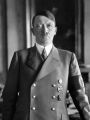 Adolf Hitler
 -
 A comedic depiction of Hitler, from the Netflix adult show “Love, Death & Robots”


Notes
- ↑ Throughout World War II, Hitler often compared himself to
 Frederick II the Great, and he kept a copy of
  Anton Graff's portrait of Frederick with him to the end in the Führerbunker in
  Berlin.
- ↑ A painting by
 Franz von Stuck in 1889 influenced Hitler's looks significantly. Hitler cosplayed as
  Wotan (Odin), who appeared in the painting leading an army of dead, for the rest of his life.
- ↑
 British spies plotted to lace Hitler's food with
  female sex hormones during World War II in a bid to curb his aggressive impulses and make him more feminine.
- ↑ Hitler was born and raised
 Catholic. However, at some point, he non-publicly renounced Catholicism. While he never formally renounced it, he expressed contempt for
  Christianity in private conversations (such as those recorded in Hitler's Table Talk), calling the faith weak and incompatible with Nazi ideology. He viewed the
  Catholic Church as a rival power structure that needed to be controlled or eventually eliminated.
- ↑ Hitler served in the
 People's State of Bavaria during the German Revolution from 1918-1919. In fact, Mein Kampf was written in part to discredit and downplay his role in it.
- ↑ Less common later due to stomach issues.
- ↑ To a British correspondent in Berlin, June 1934
- ↑
 Jacklyn Reeves (@JacklynReeves12) on an unknown social media platform (presumably
  Twitter): "#powerhandprivilege EVERYONE, LISTEN UP! This ok sign (👌) is a commonly used symbol of
  white supremacy, hijacked by
  nazis #powerhandprivilege" along with photos of
  Mel Gibson and Donald Trump doing the OK hand sign and a Nazi war flag with the Hakenkreuz replaced by the hand sign.
- ↑ Reference to a WWII Allied propaganda poster urging everyone to work. The poster shows Hitler telling the phrase to a man in bed. This poster has been getting people banned in r/AntiWork.


See Also
Navigation
| States | |
|---|---|
| Cities | |
| Towns | |
| Historical Entities | |
| Military | |
| Political Parties | |
| Theories | |
| Languages | |
| People | Adolf Hitler •  Albert Einstein • Arthur Schopenhauer • Albert Einstein • Arthur Schopenhauer •  Eduard Bernstein • Eduard Bernstein •  Franz von Papen • Franz von Papen •  Frederick the Great • Frederick the Great •  Friedrich Engels • Martin Luther • Friedrich Nietzsche • Karl Marx • Friedrich Engels • Martin Luther • Friedrich Nietzsche • Karl Marx •  Max Stirner • Max Stirner •  Oskar Dirlewanger • Otto von Bismarck • Paul von Hindenburg • Richard Wagner • Oskar Dirlewanger • Otto von Bismarck • Paul von Hindenburg • Richard Wagner •  Wilhelm II • Wilhelm Keitel Wilhelm II • Wilhelm Keitel |
 PAY DEBTS! PAY DEBTS! or else… | |


