


-
 Building
 -
 Civil War
 -
 Cold War staring
 -
 Syria
Syria -
 America's TikTok ban
 -
 WORLD WAR ONE
 -
 WORLD WAR TWO
 -
 WORLD WAR THREE
 -
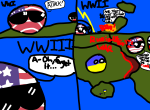 Made by Wikiball
 -
 Made by Andrew
 -
 waht
waht -
 Made by Andrew
 -
-
-
 Hey Vsauce, Michael here! Or am I? Let's talk about balls, see what you are looking at is not me, but a depiction of me portrayed by the Ball Meme.
 -

-

-

-

-
 By LB HD Mapper
 -
 Old attempt at German history
 -
 USA
USA -
-
-
United States of America: Difference between revisions
From Heterodontosaurus Balls
| (412 intermediate revisions by 4 users not shown) | |||
| Line 1: | Line 1: | ||
{{ | {{Mbox/Big}}{{Infobox | ||
|Name | |Name= {{I|USA}} United States of America {{I|USAfirst}}{{i|USAcircle}}{{i|USAsquare}}{{i|USA interwar}}{{i|USAWW1}}{{i|USAWW2}}{{I|USAJew}}{{I|USA burger}}{{I|FatUSA}}{{i|Murica}}{{I|USAtangle}} | ||
| | |NativeName= <div class="mw-customtoggle-myTable wikia-menu-button" style="display:inline-block;">[open/close]</div><div class="mw-collapsible mw-collapsed" id="mw-customcollapsible-myTable">{{ILSize|SpanishL-icon.png|Spanish Language}}: Estados Unidos de América<br>{{ILSize|HawaiianL-icon.png|Hawaiian Language}}: ʻAmelika Hui Pū ʻIa<br>{{ILSize|Central Alaskan Yupik-icon.png|Central Alaskan Yupik Language}}: Yugtun Nunakellriit Ataneng<br>{{ILSize|CherokeeL-icon.png|Cherokee Language}}: ᏌᏊᎢᏳᎾᎵᏍᏔᏅᏍᎦᏚᎩ ᎾᎿ ᎠᎺᏰᏟ<br>{{ILSize|ChineseL-icon.png|Chinese Language}}: 美利堅共和國<br>{{ILSize|VietnameseL-icon.png|Vietnamese Language}}: Hợp chúng quốc Hoa Kỳ | ||
|founded = 1776 | |founded= 1776 | ||
|predicon = Thirteen Colonies | |predicon= Thirteen Colonies | ||
|onlypredecessor = Thirteen Colonies | |onlypredecessor= Thirteen Colonies | ||
|ended = | |ended= | ||
|nexticon = NATO | |nexticon= NATO | ||
|onlysuccessor = | |onlysuccessor= NATO | ||
|image | |image= United States of America.png | ||
|Caption | |Caption= GOD BLESS AMERICA!!! 🇺🇸🇺🇸🇺🇸🦅🦅🦅 | ||
|Alias | |Alias= {{Scroll|{{i|Murica}} 'Murica<br>{{I|Murica}} Stars & Stripes<br>{{i|Uncle Sam}} [[Uncle Sam Thought|Uncle Sam]]<br>{{I|Liberty}} [[Liberty|Freedomland]]<br>{{I|Optimism}} [[Optimism|Land of Opportunities]]<br>🦅 Bald Eagle<br>{{I|USA}} US of A<br>{{I|USA}} The States<br>{{I|USA}} Yankee<br>{{I|NeoCon}} [[Neoconservatism|Policemen of the World]]<br>{{I|USA burger}} [[Satirism|Burger Empire]]<br>{{i|FatUSA}} [[Lipostocracy|Obesityland]]<br>{{I|Murica}} WHAT THE F**K IS A KILOMETER (eagle screech) (gunshots)<br>{{Alias|EU-icon.png|European Union|No free healthcare}}<br>{{IL|UK-icon.png|United Kingdom}}/{{Alias|EU-icon.png|European Union|School shooting fields}}<br>{{Alias|USSR2-icon.png|Union of Soviet Socialist Republics|{{I|Capitalism}} [[Capitalism|Capitalist]] pig}}<br>{{Alias|Nazi-icon.png|German Third Reich|{{I|USAJew}} [[Jews|Jewish]] controlled country}}<br>{{Alias|BlackNat-icon.png|Black Nationalism|{{i|KKK}} [[Ku Klux Klan|AmeriKKKa]]}}<br>{{Alias|Kak-icon.png|Kakistocracy|Goofy Ahh Fatty Gunz Oil Burger Kingdom}}|200px}} | ||
|Founder = | |Founder= {{I|George Washington}} [[Washingtonism|George Washington]] (1732-1799) | ||
| | |Time= 4 July 1776 – Present | ||
|Government | |Government= {{I|Federalism}}{{I|Presidentialism}}{{I|Republic}} [[Federalism|Federal]] [[Presidentialism|Presidential]] [[Republicanism|Republic]] | ||
|Languages | |Languages= {{Scroll|'''Official:''' | ||
* | *{{i|EnglishL}} [[English Language|English]] | ||
** | **{{i|American English}} [[American English]] ''(de facto)'' | ||
*'''Minority:''' | *'''Minority:''' | ||
** | **{{i|SpanishL}} [[Spanish Language|Spanish]] | ||
** | **{{i|ChineseL}} [[Chinese Language|Chinese]] | ||
**[[ | **{{i|VietnameseL}} [[Vietnamese Language|Vietnamese]] | ||
**[[ | **{{i|CherokeeL}} [[Cherokee Language|Cherokee]] | ||
|Affiliation | **{{i|Central Alaskan Yupik}} [[Central Alaskan Yupik Language|Yupik]] | ||
* | **{{i|HawaiianL}} [[Hawaiian Language|Hawaiian]] | ||
* | }} | ||
** | |Affiliation= {{Scroll| | ||
** | *{{i|NATO}} [[NATO]] | ||
** | *{{i|UN}} [[United Nations]] | ||
* | **{{i|UNESCO}} [[UNESCO]] | ||
* | **{{i|WHO}} [[World Health Organization|WHO]] | ||
* | **{{i|Permanent Members}} [[Permanent Members]] | ||
* | *{{i|G7}} [[Group of Seven]] | ||
* | *{{i|G20}} [[Group of Twenty]] | ||
* | *{{i|WTO}} [[World Trade Organization]] | ||
* | *{{i|USA}}{{i|Canada}}{{i|Mexico}} [[United States-Mexico-Canada Agreement|USMCA]] | ||
* | *{{i|OAS}} [[Organization of American States|OAS]] | ||
* | *{{i|QUAD}} [[Quadrilateral Security Dialogue]] | ||
* | *{{i|Israel}}{{i|India}}{{i|UAE}}{{i|USA}} [[I2U2 Group]] | ||
*[[ | *{{i|Australia}}{{i|UK}}{{i|USA}} [[AUKUS]] | ||
*{{i|Interpol}} [[Interpol]] | |||
*{{i|USA}}{{i|UK}}{{i|Australia}}{{i|Canada}}{{i|New Zealand}} [[Five Eyes]] | |||
*{{i|ANZUS}} [[ANZUS]] | |||
*{{i|Board of Peace}} [[Board of Peace]] | |||
*'''Formerly:''' | *'''Formerly:''' | ||
** | **{{i|NAFTA}} [[North American Free Trade Agreement|NAFTA]] | ||
**{{i|Western Bloc}} [[Western Bloc]] | **{{i|Western Bloc}} [[Western Bloc]] | ||
** | **{{i|Allies}} [[Allied Powers]] | ||
** | **{{i|Entente}} [[Entente Powers]] | ||
**{{i|Eight Nation Alliance}} [[Eight-Nation Alliance]] | **{{i|Eight Nation Alliance}} [[Eight-Nation Alliance]] | ||
|Religions | }} | ||
{{ | |Religions= '''Almost all religions, especially:''' | ||
* | {{Scroll| | ||
** | *{{i|Christianity}} [[Christianity]] (main) | ||
*** | **{{i|Protestantism}} [[Protestantism]] | ||
***[[ | ***{{i|Baptism}} [[Baptism]] | ||
*** | ***{{i|Lutheran}} [[Lutheranism]] | ||
**[[ | ***{{i|Pentecostalism}} [[Pentecostalism]] | ||
** | **{{i|Catholicism}} [[Catholicism]] | ||
**[[ | **{{i|Orthodoxy}} [[Eastern Orthodoxy]] | ||
* | **{{i|Oriental Orthodoxy}} [[Oriental Orthodoxy]] | ||
*[[ | **{{i|Mormonism}} [[Mormonism]] | ||
*[[ | **{{i|JW}} [[Jehovah's Witnesses]] | ||
* | *{{i|Judaism}} [[Judaism]] | ||
**[[ | *{{i|Islam}} [[Islam]] | ||
*[[ | **{{i|Sunni}} [[Sunni Islam|Sunni]] | ||
*[[ | **{{i|Shia}} [[Shia Islam|Shia]] | ||
* | *{{i|Hinduism}} [[Hinduism]] | ||
*{{i|Buddhism}} [[Buddhism]] | |||
**{{i|Mahayana}} [[Mahāyāna]] | |||
**{{i|Theravada}} [[Theravāda]] | |||
**{{i|Vajrayana}} [[Vajrayāna]] | |||
*{{i|NeoPaganism}} [[Neo-Paganism]] | |||
*{{i|3ball}} [[Native American Religion|Native Religions]] | |||
*{{i|Sikhism}} [[Sikhism]] | |||
*{{i|Agnosticism}} [[Agnosticism]] | |||
| | *{{i|Atheism}} [[Atheism]] | ||
| | }} | ||
| | |Capital= {{i|DC}} [[Washington, D.C.]] | ||
|Gender= Male | |||
|Friends= {{Scroll|{{i|UK}} [[United Kingdom|Parent]]<br>{{i|Canada}} [[Canada|Sibling]]<br>{{i|Israel}} [[Israel]]<br>{{i|EU}} [[European Union]]<br>{{i|Germany}} [[Germany|Pretzel]]<br>{{i|France}} [[France|Croissant]]<br>{{i|Italy}} [[Italy|Pizza]]<br>{{i|Ireland}} [[Ireland|St. Patrick's Day]]<br>{{i|Ukraine}} [[Ukraine]]<br>{{i|Spain}} [[Spain]]<br>{{i|Greece}} [[Greece|Democracy]]<br>{{i|Sweden}} [[Sweden|IKEA meatballs]]<br>{{i|Panama}} [[Panama]]<br>{{i|Mexico}} [[Mexico|Taco Bell]]<br>{{i|Australia}} [[Australia]]<br>{{i|Japan}} [[Japan|Godzilla]]<br>{{i|SKorea}} [[South Korea|K-Pop]]<br>{{i|Taiwan}} [[Taiwan]]<br>{{i|Vietnam}} [[Socialist Republic of Vietnam|Friendly Commie]]<br>{{i|India}} [[India]]<br>{{i|Bahamas}} [[Bahamas]]<br>{{i|Kosovo}} [[Kosovo]]<br>{{I|Morocco}} [[Morocco]]<br>{{i|Saudi Arabia}} [[Saudi Arabia]]<br>{{i|Qatar}} [[Qatar]]<br>{{i|FSA}} [[Syria]]}} | |||
| | |Enemies= {{Scroll|{{i|Russia}} [[Russia|Archenemy]]<br>{{i|PRC}} [[People's Republic of China|Spy balloon]]<br>{{i|North Korea}} [[North Korea|Nuke Overlord]]<br>{{i|CommieCuba}} [[Communist Cuba]]<br>{{i|Venezuela}} [[Venezuela]]<br>{{i|Iran}} [[Islamic Republic of Iran|Terrorist Iran]]<br>{{i|Syria}} [[Ba'athist Syria]]<br>{{i|BaathIraq}} [[Ba'athist Iraq]]<br>{{i|Palestine}} [[Palestine]] (usually)<br>{{i|Libyan Arab Jamahiriya}} [[Libyan Arab Jamahiriya]]<br>{{i|Vietnam}} [[Socialist Republic of Vietnam|NAM WAR (in memes)]]<br>{{i|AlQaeda}} [[Al-Qaeda|9/11 NEVER FORGET!]]<br>{{i|HamasWar}} [[Al-Qassam Brigades|Hummus]]<br>{{i|Taliban}} [[Taliban]]<br>{{i|Houthis}} [[Houthis]]<br>{{I|ISIS}} [[Islamic State]]<br>{{i|Cartel}} [[Jalisco New Generation Cartel]]<br>{{i|USSR2}} [[Union of Soviet Socialist Republics|COMMIE Union]]<br>{{i|Warsaw Pact}} [[Warsaw Pact|COMMIE Pact]]<br>{{i|Nazi}} [[German Third Reich|Literally a Nazi]]<br>{{i|JapEmp}} [[Empire of Japan|Pearl Harbor bomber]]<br>{{i|Manchukuo}} [[Manchukuo]]<br>{{i|KoItaly2}} [[Fascist Italy]]<br>{{i|CSA}} [[Confederate States of America|Racist Traitor]]<br>{{i|Second Federal Republic of Mexico}} [[Second Federal Republic of Mexico]]<br>{{i|North Vietnam}} [[North Vietnam|The]] [[Viet Cong|Trees]] {{i|Vietcong}}<br>{{i|Spanish Empire}} [[Spanish Empire]]<br>{{i|British Empire}} [[British Empire|No more tax!]]}} | ||
| | |Likes= {{Scroll|{{i|Liberty}} [[Liberty]], guns, {{i|Trinity}} [[Trinitarianism|God]], fast food, FREEDOM, bald eagles, 4th of July, oil 🛢️🛢️🛢️, apple pies, his {{i|Constitutionalism}} [[Constitutionalism|constitution]], amendments and rights, having lots of military bases around the {{i|Earth}} [[Earth|world]], {{i|SoldierTF2}} [[TF2 Soldier Model|Soldier from TF2]], thanksgiving, nukes, soda, {{i|Capitalism}} [[Capitalism]], superheroes, inventing things, making up sports that no one else plays (will always be world champion in that way), building highways, getting a lot of girls, <s>being {{i|Homosex}} [[Homosexuality|gay]] and {{i|Homophobia}} [[Homophobia|homophobic]] at the same time</s>}} | ||
}} | |Dislikes= {{Scroll|{{i|Communism}} [[Communism|Commies]], {{i|Fascism}} [[Fascism|fashies]], {{i|Jihadism}} [[Jihadism|jihadies]], 9/11, being called {{i|FatUSA}} [[Lipostocracy|fat]], kilometer, {{i|CCP}} [[Chinese Communist Party|COVID-19]], <s>fish water (tea in {{i|American English}} [[American English]])</s>, {{i|Terrorism}} [[Terrorism|terrorists]], {{i|NarcoCap}} [[Narco-Capitalism|drugs]], {{i|Regulationism}} [[Regulationism|taxes]], {{i|Stalin}} [[Stalinism|Joseph Stalin]], {{i|Osama}} [[Bin Ladenism|Osama Bin Laden]]}} | ||
|Preceded= {{i|Thirteen Colonies}} [[Thirteen Colonies]] | |||
|Succeeded= {{i|Murica}} <s>[[NATO|American Empire]]</s> | |||
|Food= | |||
*🍔 Hamburger | |||
*🥤 Cola | |||
*🍟 French fries | |||
*🥧 Apple pie | |||
*🛢️ <s>Oil</s> | |||
|themecolor= #3C3B6E | |||
|textcolor= #ffffff | |||
}}{{Quote|<big>'''''USA! USA! USA!'''''</big>|{{i|AmerNat}} [[American Nationalism|American nationalist]] chant}}'''United States of America''' ('''USA'''), also commonly known as just the '''United States''' ('''US''') or simply <s>''''Murica'''</s> '''America''', is a powerful {{i|Dem}} [[Democracy|democratic]] global superpower Western {{i|Republic}} [[Republicanism|republic]] located in {{i|3ball}} [[North America]], the first ever nation to be built upon the principles of {{i|Liberty}} [[liberty]] and {{i|Free Speech}} [[Free Speech Advocacy|free speech]]. He is best known for guns, fast food, 🦅 bald eagles, oil, and bringing Fʀᴇᴇᴅᴏᴍ to other countries. Since defeating {{i|Nazi}} [[German Third Reich|Nazi]] in '45 and {{i|USSR2}} [[Union of Soviet Socialist Republics|Commie]] in '91, USA has emerged as the strongest country in the {{i|Earth}} [[Earth|world]] by miles, and accordingly, has a significant {{i|Globalism}} [[Globalism|global]] influence in {{i|Economy}} [[Economy|economics]], {{i|Politics}} [[politics]], and {{i|Culture}} [[culture]]. | |||
USA has an unparalleled spirit of {{i|Patriotism}} [[Patriotism|patriotism]], is very {{i|AmerNat}} [[American Nationalism|passionate]], {{i|Murica}} [[Militarism|powerful]], and {{i|Christi}} [[Christianity|God-loving]]. He is also the {{i|Earth}} [[Earth|world]]'s biggest {{i|Dem}} [[Democracy|democracy]] and has the most influence on the planet, hence the nickname "Land of the Free, Home of the Brave". Many people from {{i|Auth}} [[Authoritarianism|authoritarian]] and/or poor countries dream of coming to live and build their life up in America, because under {{i|Capitalism}} [[capitalism]] and {{i|Liberty}} [[liberty]], America is the land of opportunities and the land of freedom. | |||
The three biggest enemies of America and {{i|AmerMod}} [[American Model|his ideals]] are: | |||
*{{i|Commie}} [[Communism|Commies]] {{i|USSR2}}{{i|PRC}}{{i|NKorea}}{{i|North Vietnam}}{{i|CommieCuba}} | |||
*{{i|Fascism}} [[Fascism|Fashies]] {{i|Nazi}}{{i|KoItaly2}}{{i|Banzai}}{{i|VichyFrance}}{{i|NDH}} | |||
*{{i|Jihadism}} [[Jihadism|Jihadies]] {{i|Iran}}{{i|Hezbollah}}{{i|Hamas}}{{i|Houthis}}{{i|ISIS}}{{i|AlQaeda}} | |||
As his role as the global police, America has tried his best to stop these {{i|Immoralism}} [[Immoralism|evils]]. | |||
In the general {{i|Poland}} [[Polandball|Polandball community]] (such as {{i|Polandball Subreddit}} [[r/Polandball]]), USA is the character that gets {{i|Satirism}} [[Satirism|most made fun of]], alongside {{i|PolandAlt}} [[Poland]]. He is often portrayed as {{i|Kak}} [[Kakistocracy|dumb]], ignorant, {{i|FatUSA}} [[Lipostocracy|fat]], highly competitive, and {{i|Aggression}} [[Aggressionism|violent]] because of his sheer amount of power and influence in the real world. The success of America and Americans drives {{i|AntiAmer}} [[Anti-Americanism|anti-Americanists]] insane. | |||
America, ''America,'' '''''AMERICA!!!''''' 🥹🥹🥹 | |||
==History== | ==History== | ||
===Independence=== | |||
{{Quote|Give me {{i|Liberty}} [[liberty]] or give me death!|{{i|Christi}} [[Christianity|Patrick Henry]]}} | |||
The {{i|Thirteen Colonies}} [[Thirteen Colonies]] were full of people who chose to leave for {{i|3ball}} [[North America|America]] to settle for a better life. However, his master {{i|Great Britain}} [[Great Britain]] did not care and constantly raises the {{i|Regulationism}} [[Regulationism|tax]], causing significant tensions until they exploded into {{i|War}} [[war]]. {{i|George Washington}} [[Washingtonism|George Washington]] led the Colonies to victory, and on 4 July 1776, the United States of America was declared. | |||
The values of the United States of America changed from demanding {{I|Reformism}} [[Reformism|reform]] within an empire to defense of {{I|Liberty}} [[liberty]] and the protection of {{I|Natural Law}} [[Natural Law Theory|inalienable natural rights]] gifted from {{I|Trinity}} [[Trinitarianism|God]]; sovereignty of the people; {{i|Republic}} [[Republicanism|republicanism]] over Britain's {{i|Mon}} [[Monarchism|monarchism]]; {{I|Communitarianism}} [[Communitarianism|civic virtue]]; and an {{I|AntiCorrupt}} [[Anti-Corruption|intolerance of political corruption]]. America thus became the {{i|Earth}} [[Earth|world]]'s first free nation. | |||
In 1777, {{I|Morocco}} [[Alawi Sultanate|Morocco]] became the first nation to recognize the young USA. Even to this day, Morocco remains one of America's closest allies. | |||
===Confederation Period=== | |||
After winning the American Revolution, Americans now faced the harder, quieter work of governing themselves. After defeating the final {{i|Great Britain}} [[Great Britain|British]] loyalists at {{I|Virginia}} [[Yorktown]] in 1781, United States ratified the {{i|USAsquare}} [[Confederation Period|Articles of Confederation]], giving the thirteen original states, {{i|Delaware}} [[Delaware]], {{i|Pennsylvania}} [[Pennsylvania]], {{i|NewJersey}} [[New Jersey]], {{i|USGeorgia}} [[Georgia (United States)|Georgia]], {{i|Connecticut}} [[Connecticut]], {{i|Massachusetts}} [[Massachusetts]], {{i|Maryland}} [[Maryland]], {{i|SouthCarolina}} [[South Carolina]], {{i|NewHampshire}} [[New Hampshire]], {{i|Virginia}} [[Virginia]], {{i|New York}} [[New York]], {{i|NorthCarolina}} [[North Carolina]], and {{i|RhodeIsland}} [[Rhode Island]], a loose framework for cooperation. | |||
At the Treaty of {{I|Paris}} [[Paris]] in 1783, Great Britain recognized United States as an independent nation. The treaty was one of the most favorable {{I|Pacifism}} [[Pacifism|peace]] settlements a young nation could have hoped for; Britain recognized American sovereignty over a vast territory stretching to the {{I|River}} [[Mississippi River|Mississippi]], vindicating the sacrifices of a generation. | |||
Still, young USA faced many problems of nation-building. A huge debt remained from the Revolution, paper money issued during and after the war was worthless, and Britain and {{i|Spanish Empire new}} [[Spanish Empire|Spain]] occupied territory claimed by the United States. The new country lacked the machinery of government, consisting of nothing more than 75 post offices, a small number of unpaid clerks, and an {{i|US Army}} [[United States Army|army]] consisting of just 672 soldiers. There was no {{i|Federalism}} [[Federalism|federal]] court system, no {{i|Thalassocracy}} [[Thalassocracy|navy]], and no system for {{i|Regulationism}} [[Regulationism|collecting taxes]]. | |||
The weaknesses of the Confederation became impossible to ignore. In 1786, {{i|Populism}} [[Populism|Daniel Shays]] led debt-ridden {{i|Massachusetts}} [[Massachusetts]] farmers to revolt against USA in the Shays's Rebellion, exposing the terrifying fragility of a government that could not {{i|Militarism}} [[Militarism|raise an army]], collect taxes, or compel its own citizens to obey the {{i|Law}} [[law]]. The thirteen states bickered like neighbours over a fence, slapping each other with trade restrictions and quarrelling over borders. Something had to change. | |||
In the sweltering {{i|Summer}} [[Summercore|summer]] of 1787, fifty-five delegates gathered in {{i|Philadelphia}} [[Philadelphia]] for what was supposed to be a modest revision of the Articles of Confederation. Instead, they threw the whole thing out. Working in secret with windows nailed shut against the heat, Founding Fathers like {{i|Madisonism}} [[Madisonism|James Madison]], {{i|Hamilton}} [[Hamiltonianism|Alexander Hamilton]], and {{i|Franklin}} [[Benjamin Franklin Thought|Benjamin Franklin]] hammered out an entirely new document: the {{i|Constitutionalism}} [[Constitutionalism|Constitution]] of the United States, which gave citizens 10 amendments: | |||
#Freedoms of {{i|Free Speech}} [[Free Speech Advocacy|speech]], {{i|Religion}} [[religion]], {{i|Mediacracy}} [[Mediacracy|press]], assembly, and petition. | |||
#{{i|Gun}} [[Gun Rights Advocacy|Right to bear arms]]. | |||
#Protection against quartering troops. | |||
#Protection against unreasonable search and seizure. | |||
#Due process, double jeopardy, self-incrimination, and eminent domain. | |||
#Rights to a fair and speedy trial, including counsel. | |||
#Trial by jury in civil cases. | |||
#Protection against excessive bail and {{i|Sadism}} [[Sadism|cruel]] and {{i|Psychopathy}} [[Psychopathy|unusual]] punishment. | |||
#Rights retained by the people, even if not listed in the Constitution. | |||
#Powers not delegated to the {{i|Federalism}} [[Federalism|federal]] government are reserved for the states or the people. | |||
They designed a {{i|Republic}} [[Republicanism|republic]] with three branches of government to prevent any one man from becoming a {{i|Autocracy}} [[Autocracy|king in all but name]], with a system of checks and balances so intricate it has survived for over two centuries. Nine states ratified it by 1788, and the great American experiment truly began. | |||
===Early Republic=== | |||
{{i|George Washington}} [[Washingtonism|George Washington]] was unanimously chosen as the first {{I|Presidentialism}} [[Presidentialism|President]], inaugurated in {{I|NYC}} [[New York City]] on 30 April 1789. Washington was reluctant, but took on this duty anyway. In the late 1700s, America took some {{i|3ball}} [[Native Americans|native lands]] in the west of the {{i|Mountain}} [[Appalachian Mountains]]. | |||
But the young nation was already dividing. {{i|Hamilton}} [[Hamiltonianism|Alexander Hamilton]] pushed for a {{I|Centralism}} [[Centralism|strong federal government]], a {{I|Financialism}} [[Financialism|national bank]], and an {{I|Economy}} [[economy]] built on {{i|Corporatocracy}} [[Corporatocracy|commerce and industry]]. {{I|JeffDem}} [[Jeffersonian Democracy|Thomas Jefferson]] and {{I|Madisonism}} [[Madisonism|James Madison]] recoiled at what they saw as creeping {{i|Aristocracy}} [[aristocracy]], championing the rights of states and the {{I|Virtue Ethics}} [[Virtue Ethics|virtues]] of the common farmer. These two visions, Hamilton's America and Jefferson's America, birthed the {{I|Earth}} [[Earth|world]]'s first {{I|Particracy}} [[Particracy|political party system]], and Americans have been arguing about it ever since. | |||
USA started minting coins in 1792. | |||
In 1794, the Whiskey Rebellion tested the new government when {{I|Pennsylvania}} [[Pennsylvania]] farmers took up arms against a {{i|Federalism}} [[Federalism|federal]] {{I|Regulationism}} [[Regulationism|tax]] on {{I|Alcohol}} [[Alcoholism|spirits]]. Washington himself rode out at the head of an {{I|US Army}} [[United States Army|army]], becoming the only sitting president to lead troops in the field, and the rebels melted away. The message was clear: the new Constitution had teeth. | |||
America began to take the clay he claimed but didn't control yet. By 1796, he had begun exploring and {{i|Imp}} [[Imperialism|conquering]] clay as far as the {{I|USAsquare}} [[Ohio Territory]]. | |||
Washington stepped down after two terms, proving to a {{I|Auth}} [[Authoritarianism|skeptical world]] that a {{I|Dem}} [[Democracy|free republic]] could {{I|Pacifism}} [[Pacifism|peacefully]] transfer power. This also set a tradition of presidents only serving two terms in office. George delivered his Farewell Address in 1796, warning his countrymen against permanent foreign alliances and the "baneful effects" of political parties. Nobody listened to either warning. | |||
{{I|Adams}} [[Adamsism|John Adams]], Washington's Vice President, took power in 1797. USA faced an immediate crisis: {{I|French4}} [[French Colonial Empire|France]], furious at his neutrality during Frenchie's {{I|War}} [[war]] against {{I|Great Britain}} [[British Empire|Britain]], began seizing American merchant ships. When USA sent diplomats to {{I|Paris}} [[Paris]] to negotiate, French agents, cheekily recorded in {{I|History}} [[history]] as "X, Y, and Z", demanded a bribe just to begin talks. Americans were outraged. "Millions for defense, but not one cent for tribute!" became the rallying cry, and an undeclared {{I|Thalassocracy}} [[Thalassocracy|naval]] war, the Quasi-War, broke out with France from 1798 to 1800. | |||
In 1798, Adams made a major mistake by signing the Alien and Sedition Acts, which made it {{I|Auth}} [[Authoritarianism|illegal to criticize the government]]. In response, Jefferson and Madison wrote the {{I|Virginia}} [[Virginia]] and {{I|Kentucky}} [[Kentucky]] Resolutions, arguing that states could ignore federal laws they believed were unconstitutional—an idea that would cause problems for many years. Adams lost the election of 1800 to Jefferson in what Jefferson called the "Revolution of 1800", the first peaceful transfer of power between rival political parties. Bitter and tired, Adams left {{i|DC}} [[Washington, D.C.|Washington]] early on inauguration day instead of watching Jefferson become president. | |||
In 1800, USA began to organize and design his new capital, {{I|DC}} [[Washington, D.C.|DC]]. DC was already the capital since 1790, but was not developed. | |||
{{i|Bonapartism}} [[Bonapartism|Bonaparte]] gave up on having an empire in the Americas after a catastrophic {{i|Abolitionism}} [[Abolitionism|slave revolt]] at {{i|Kingdom of France}} [[Saint-Domingue|Haiti]] in 1803, offering the entire {{i|French Louisiana}} [[French Louisiana|Louisiana territory]] to USA. For 15 million dollars, roughly three cents an acre, the United States acquired 828,000 square miles, which doubled his clay size, becoming one of the largest nations on Earth overnight. It was perhaps the greatest real estate deal in {{i|History}} [[history]]. | |||
{{i|British Empire}} [[British Empire|Britain]] continued to harass American sailors, interrupting American waters, limiting USA's trade with {{i|Europe}} [[Europe]], stealing US' {{i|US Navy}} [[United States Navy|naval men]], arm {{i|3ball}} [[Native Americans|Native American]] tribes on the frontier, and treat the United States with barely concealed contempt. In Congress, a fiery new generation of "War Hawks" demanded that the United States stand up for his own honor. President {{i|Madisonism}} [[Madisonism|Madison]] asked Congress for a declaration of {{i|War}} [[war]] against Britain on 1 June 1812. After years of humiliation on the high seas and the frontier, the United States was going back to war with his old master. | |||
USA thought the British's minion, {{I|CanadaOld}} [[Dominion of Canada|Canada]], would fall quickly, and thus was overconfident. But the opening invasion of Canada collapsed in embarrassing fashion. {{i|Detroit}} [[Detroit]] surrendered to a smaller British and Native American force without a fight. American generals bickered, militias refused to cross the border, and the grand northern campaign dissolved into chaos. At sea, however, the tiny American navy stunned the world as British cannonballs appeared to bounce harmlessly off the thick oak hull of America's ships. A nation humiliated on land celebrated furiously at sea. But Britain, having finally defeated Napoleon in 1814, was free to send hardened veteran troops to America. UK marched on Washington D.C. in August, and found the city almost undefended. President Madison fled as the British {{i|Arson}} [[Arsonism|burned]] the White House, the Capitol, and most of the federal buildings to the ground. | |||
Yet the war's most decisive moment came not in Washington, but in {{i|Baltimore}} [[Baltimore]]. When the {{i|Royal Navy}} [[Royal Navy|British fleet]] bombarded Fort McHenry through the night of 13-14 September 1814, a young lawyer named {{i|Law}} [[Law|Francis Scott Key]] watched anxiously from a ship in the harbour. At dawn, the enormous {{i|Murica}} [[American Nationalism|American flag]] still flew over the fort. In his relief, Key scribbled the verses that would become The Star-Spangled Banner. | |||
The war ended in stalemate. The Treaty of {{i|Ghent}} [[Ghent]], signed on Christmas Eve 1814, restored the pre-war borders and settled nothing that had caused the conflict. But one final battle hadn't been fought yet—news traveled slowly in 1814. On 8 January 1815, General {{I|JackDem}} [[Jacksonian Democracy|Andrew Jackson]], a fierce, battle-hardened frontiersman from {{i|Tennessee}} [[Tennessee]], led a ragtag force of regulars, {{i|Hydrarchy}} [[Hydrarchy|pirates]], and militia to a crushing victory over vastly superior British forces at the Battle of {{i|New Orleans}} [[New Orleans]]. Hundreds of British soldiers fell while fewer than a dozen Americans were killed. Jackson became a {{i|GreatMan}} [[Great Man Theory|national hero]] overnight, and America, despite the burning of his own capital, celebrated the war as a great victory. | |||
It had proved something important: the United States could not be bullied back into submission. The young {{i|Republic}} [[Republicanism|republic]] had survived his second war with Britain and come out standing. | |||
===Middle Period=== | |||
With the {{i|War}} [[war]] over and {{i|AmerNat}} [[American Nationalism|national pride]] soaring, America entered a rare moment of political calm. The {{i|Federalist Party}} [[Federalist Party]] had collapsed in disgrace after opposing the war, leaving {{I|JeffDem}} [[Jeffersonian Democracy|Jefferson]]'s {{I|Republic}} [[Democratic-Republican Party|Democratic-Republicans]] as the only party standing. President {{I|Monroe}} [[Monroe Doctrine|James Monroe]], elected in 1816, presided over what newspapers cheerfully dubbed the "Era of Good Feelings"—a period of {{i|PaxAmer}} [[Pax Americana|westward expansion]], {{i|Economy}} [[Economy|economic]] growth, and unusual national unity. America also bought {{i|Spanish Florida}} [[Spanish Florida|Florida]] from {{i|Spanish Empire}} [[Spanish Empire|Spain]] and defined his borders with the latter in 1819. | |||
The good feelings didn't last, of course. Underneath the calm surface, old tensions were quietly building, and the most explosive of these was {{i|Slavery}} [[slavery]]. In 1819, {{i|Missouri}} [[Missouri]] applied for statehood as a slave state, threatening to tip the balance between slave and {{i|Abolitionism}} [[Abolitionism|free states]] in the {{i|US Senate}} [[United States Senate|Senate]]. After bitter debate, Congress hammered out the Missouri Compromise of 1820, with Missouri entering as a slave state while {{i|Maine}} [[Maine]] as a free state, and a line was drawn across the map at latitude 36°30': slavery would be permitted south of it and banned north of it. The crisis was postponed, not resolved. Jefferson, now {{i|Gerontocracy}} [[Gerontocracy|elderly]] and retired at Monticello, called it "a fire bell in the night", a warning of catastrophe to come. | |||
America's {{i|Abolitionism}} [[Abolitionism|former/freed slaves]] decided to establish the {{i|Colonialism}} [[Colonialism|colony]] of {{i|American Liberia}} [[American Liberia|Liberia]] in 1821, the only American colony in {{i|Africa}} [[Africa]]. | |||
In 1823, Monroe issued what became known as the {{i|Monroe}} [[Monroe Doctrine]], warning {{i|Europe}} [[Europe|European]] powers to stay out of the affairs of the {{i|Separatism}} [[Separatism|newly independent]] nations of {{i|LatinAmer}} [[Latin America]]. Europe largely ignored USA's demands at the time, and America would spend the next century making them take it seriously. | |||
The {{i|Dem}} [[Democracy|election]] of 1824 was the collapse of the {{i|OneParty}} [[One-Party State|one-party]] Era of Good Feelings. With no candidate winning a majority, {{i|JQA}} [[John Quincy Adams Thought|John Quincy Adams]] was chosen over {{I|JackDem}} [[Jacksonian Democracy|Andrew Jackson]], despite Jackson leading in the popular vote, leading his supporters to scream of a "{{i|Klep}} [[Kleptocracy|corrupt]] bargain". This also began the rise of organized mass politics in the US. Jackson spent four years building a movement to take back his position, and succeeded spectacularly in 1828. Jackson's election represented how the frontier West and the rural South sweeping away the old Eastern establishment. Ordinary men who had never voted before turned out in droves for "Old Hickory". When Jackson arrived in {{i|DC}} [[Washington, D.C.|Washington]], a mob of jubilant supporters followed him into the White House, standing on furniture and smashing china in their excitement, until attendants lured them outside with tubs of {{i|Alcohol}} [[Alcoholism|whiskey-spiked punch]]. | |||
Jackson governed as {{i|Aggression}} [[Aggressionism|ferociously]] as he had fought. Under his rule, USA dismantled his Second Bank, which Jackson despised as a corrupt institution serving the {{i|Elitism}} [[Elitism|wealthy elite]], and vetoed more bills than all previous presidents combined. AJ's {{i|Immoralism}} [[Immoralism|darkest legacy]] was the Indian Removal Act of 1830, which forcibly relocated tens of thousands of {{i|3ball}} [[Native Americans]] from their ancestral homelands in the Southeast to territories west of the {{i|River}} [[Mississippi River|Mississippi]]. The {{i|Cherokee}} [[Cherokee]], who had adopted American {{i|Law}} [[Law|laws]], {{i|LatinScript}} [[Latin Script|alphabet]], and {{i|AmerMod}} [[American Model|customs]] in the hope of {{i|Pacifism}} [[Pacifism|peaceful coexistence]], were dragged from their homes anyway. Their forced march west in 1838 killed thousands and became known as the Trail of Tears, one of the most shameful episodes in American {{i|History}} [[history]]. | |||
By the 1840s, America had convinced himself that {{i|Trinity}} [[Trinitarianism|God]] had personally assigned him the entire continent. The phrase "{{i|PaxAmer}} [[Pax Americana|Manifest Destiny]]" captured the spirit perfectly—{{i|Imp}} [[Imperialism|expansion]] wasn't greed or conquest, it was destiny. Wagon trains rolled across the {{i|Oregon}} [[Oregon Territory|Oregon]] Trail by the thousands, settlers poured into {{i|Texas}} [[Republic of Texas|Texas]], and the map of North America began changing rapidly. | |||
Texas had declared {{i|Separatism}} [[Separatism|independence]] from {{i|Mexico}} [[Centralist Republic of Mexico|Mexico]] in 1836, and Texas spent nine years as his own {{i|Republic}} [[Republicanism|republic]] before being annexed by the United States in 1845. This infuriated Mexico, who had never recognized Texan independence. United States wanted to Manifest his Destiny more, so he offered his {{i|Second Federal Republic of Mexico}} [[Second Federal Republic of Mexico|Mexican rival]] 30 million dollars for {{i|Second Federal Republic of Mexico}} [[Alta California|California]] and {{i|Second Federal Republic of Mexico}} [[Santa Fe de Nuevo México|New Mexico]]. Mexico declined, so the United States sent troops to a disputed region along the Mexican-American border. The troops were captured. The ensuing Mexican-American War was swift and brutal, America sliced through Mexico's defenses with ease, and in September 1847, USA was fighting his way into {{i|MexicoCity}} [[Mexico City]]. Mexico was forced to sign the Treaty of {{i|MexicoCity}} [[Villa de Guadalupe|Guadalupe Hidalgo]] in 1848, surrendering an enormous swath of territory—present-day {{i|California}} [[California]], {{i|Nevada}} [[Nevada]], {{i|Utah}} [[Utah]], {{i|Arizona}} [[Arizona]], {{i|NewMexico}} [[New Mexico]], and {{i|Colorado}} [[Colorado]]—for $15 million. United States had grown by a third almost overnight, his largest expansion ever, heavens bless! | |||
Then, days before the treaty was even signed, a carpenter named {{i|Industrialism}} [[Industrialism|James W. Marshall]] spotted something glittering in a millrace at {{I|Switzerland}} [[Switzerland|Sutter]]'s Mill in {{I|California}} [[California]]. It was {{i|Gold}} [[gold]]. And the {{I|Earth}} [[Earth|world]] would never be the same. | |||
===Antebellum & Civil War=== | |||
The news of {{I|Gold}} [[gold]] in United States spread like wildfire. By 1849, hundreds of thousands of fortune-seekers, "Forty-Niners", were pouring into {{I|California}} [[California]] from every corner of the {{I|Earth}} [[Earth|globe]]. Americans came overland on grueling wagon trails. Adventurers sailed around the tip of {{I|USAN}} [[South America]]. {{I|QingNew}} [[Qing Dynasty|Chinese]] immigrants crossed the {{I|Water}} [[Pacific Ocean|Pacific]] chasing the "Gold Mountain". In a single year, California's population exploded from 14,000 to over 100,000. Most miners never struck it rich; the real fortunes went to the merchants, saloon keepers, and suppliers selling shovels and beans to desperate men at outrageous prices. California joined USA as a free state in 1850, and the Gold Rush left behind a transformed, {{i|Multiculturalism}} [[Multiculturalism|multicultural]], and thoroughly chaotic new corner of America. California's admission immediately reignited the slavery crisis, and the comfortable line drawn by the {{i|Missouri}} [[Missouri]] Compromise was no longer enough. | |||
USA tried to ease tensions between the {{i|Abolitionism}} [[Abolitionism|anti-slavery]] North and the {{i|Slavery}} [[Slavery|pro-slavery]] South. The Compromise of 1850 led California to be entered as a free state, other territories would vote on slavery, and a harsh Fugitive Slave Act forced Northerners to help capture escaped slaves. Many in the North, who had been indifferent before, were outraged at being made to take part. In 1852, {{i|Christi}} [[Christianity|Harriet Beecher Stowe]] published ''Uncle Tom's Cabin'', a powerful novel that showed the {{i|Immoralism}} [[Immoralism|cruelty]] of slavery. It became the best-selling book of its time. The South attacked it as propaganda, while many in the North were deeply moved and angered, furthering tensions between the two factions. | |||
In 1853, America {{i|US Navy}} [[United States Navy|sailed]] to {{i|Tokugawa}} [[Tokugawa Shogunate|Japan]] and <s>forcefully</s> opened the samurai who was 220 years in {{i|Isolationism}} [[Isolationism|isolation]] up for trade and foreign contact. | |||
The Kansas-Nebraska Act of 1854 made everything worse domestically. USA hoped to build a transcontinental railroad through the north, proposed letting {{i|Kansas}} [[Kansas]] and {{i|Nebraska}} [[Nebraska]] decide slavery by popular vote, effectively scrapping the Missouri Compromise line. Pro-slavery and anti-slavery settlers flooded into Kansas simultaneously, and the territory dissolved into guerrilla {{i|War}} [[War|warfare]]. "Bleeding Kansas" as newspapers said, was a preview of the catastrophe ahead. The debate was so poisonous it destroyed the old {{i|Whig Party}} [[Whig Party]] entirely and birthed a new one: the {{i|USrep}} [[US Republican Party|Republican Party]], founded in 1854 on the simple platform of stopping slavery's expansion. | |||
In ''{{i|8ball}} [[African Americans|Dred Scott]] v. {{i|Capitalism}} [[Capitalism|Sandford]]'' in 1857, the Supreme Court ruled that {{i|8ball}} [[African Americans|Black Americans]] were not citizens and that Congress had no power to ban slavery, striking down the Missouri Compromise. Abolitionists were shocked, Republicans were furious, and the South celebrated, pushing USA closer to conflict. {{i|John Brown}} [[John Brownism|John Brown]], a radical abolitionist, launched a raid on a federal arsenal in {{i|Virginia}} [[Virginia]] in October 1859, hoping to spark a massive slave uprising, but was quickly crushed by Colonel {{i|CSA war}} [[White Nationalism|Robert E. Lee]]. Brown was captured, tried for treason, and {{i|DeathPen}} [[Death Penalty|hanged]]. In the North, church bells rang in mourning and poets called him a martyr; while in the South, the raid confirmed that the North intended to drown them in a slave rebellion. The mutual {{i|Terrorism}} [[Terrorism|terror]] was now total. | |||
{{i|Lincoln}} [[Lincolnism|Abraham Lincoln]], with his spare, precise language and his {{i|Moralism}} [[Moralism|moral clarity]] on slavery, was {{i|Dem}} [[Democracy|elected]] 1860. He decided to ban slavery to free the Africans. The South was not happy, especially since Lincoln won the {{i|Presidentialism}} [[Presidentialism|presidency]] without carrying a single Southern state. He hadn't needed to. The numbers told Southern leaders everything: the North was simply bigger, faster-growing, and {{i|Industrialism}} [[Industrialism|industrializing]] rapidly. If the {{i|USdem}} [[US Democratic Party|Democrats]] stayed in the USA, slavery would eventually be voted out of existence. Within weeks of Lincoln's election, {{i|SouthCarolina}} [[South Carolina]] seceded. Six more Southern states followed before Lincoln was even inaugurated. In February 1861, these traitorous states formed the {{i|CSA}} [[Confederate States of America]], with {{i|WhiteNat}} [[White Nationalism|Jefferson Davis]] as president. America was now split in two: {{i|Lincoln}} [[Lincolnism|The Union]] in the North, and {{i|CSA war}} [[Confederatism|The Confederacy]] in the South. Both sides expected the American Civil War to be short. When the first major battle came at Bull Run in July 1861, Washington socialites packed picnic baskets and rode out to watch the USA crush the rebellion. Instead, Confederate forces routed the Union troops, who fled back to Washington in panic. The picnickers fled with them. This was not going to be a short war. | |||
The {{i|USAsquare}} [[Lincolnism|Union]] (USA) held enormous advantages, such as a larger population, virtually all of the industrial capacity, a navy, and control of the railroads. The {{i|CSA}} [[Confederalism|Confederacy]] (CSA) had brilliant generals, highly motivated soldiers fighting on home soil, and the hope that {{i|UKGBI}} [[United Kingdom of Great Britain and Ireland|Britain]] or {{i|French4}} [[Second French Empire|France]] might intervene on his behalf to secure Southern cotton. The war that followed would become the bloodiest in American history, consuming an entire generation. | |||
The Union finally won in 1865. A lot of people are salty about this loss and proclaimed that the Confederacy was fighting for "state rights" instead of slavery, which was partly true, but the state rights being fought for were for to allow slavery. Four years of {{i|War}} [[war]] had killed approximately 620,000 Americans, which was more than all other American wars combined up to that point. An entire way of life had been destroyed, but four million people had been freed from bondage. And the question settled, in blood, once and for all: the United States was one nation, indivisible, and no state could change that. | |||
===Reconstruction, Industrialization, & the Gilded Age=== | |||
After the Civil War, the reconstruction of the devastation began. However, {{i|Lincoln}} [[Lincolnism|Lincoln]]'s plan for reuniting the nation had been generous to a fault. His successor had none of his wisdom. {{i|Andrew Johnson}} [[Andrew Johnsonism|Andrew Johnson]], a {{i|Tennessee}} [[Tennessee]] {{i|USdem}} [[US Democratic Party|Democrat]] placed on the ticket in 1864 to appeal to border-state voters, was a stubborn, small-minded man who believed that {{i|8ball}} [[African Americans|Black Americans]] deserved essentially nothing from their freedom. | |||
Congress disagreed violently with Johnson. {{i|USrep}} [[US Republican Party|Republicans]] pushed through the Thirteenth, Fourteenth, and Fifteenth Amendments, {{i|Abolitionism}} [[Abolitionism|abolishing]] slavery, guaranteeing equal citizenship, and extending voting rights to black {{i|Male}} [[Male|men]]. For a brief, remarkable moment, Black Americans voted, held office, and built schools and churches across the South. Over 600 Black men served in Southern state legislatures. It was an extraordinary {{i|Dem}} [[Democracy|democratic]] experiment. However, the {{i|USdem}} [[US Democratic Party|Democrats]] retaliated by creating the {{i|KKK}} [[Ku Klux Klan]] and {{i|Ethnopluralism}} [[Ethnopluralism|Jim Crow segregation laws]]. | |||
In 1856, USA acquired the {{i|Murica}} [[Guano Islands]]. America recognized the {{i|Separatism}} [[Separatism|independence]] of {{i|Liberia}} [[Liberia]] in 1862. USA also expanded his clay by purchasing {{i|Russian America}} [[Russian America|Alaska]] from {{i|Tsarism}} [[Russian Empire|Russia]] for 7.2 million US dollars in 1867. | |||
While the South slipped back into white nationalism, in the North, immigration surged, the {{i|Economy}} [[economy]] boomed, and United States started to become a major power. The transcontinental railroad, completed in 1869 when a golden spike was driven at {{i|Utah}} [[Utah]], stitched the continent together and unleashed an economic explosion of staggering scale. Steel mills roared across {{i|Pennsylvania}} [[Pennsylvania]], oil derricks sprouted across {{i|Ohio}} [[Ohio]], {{i|Chicago}} [[Chicago]] rose from prairie mud to become one of the world's great cities seemingly overnight. America was also focused on civilizing the Wild West; the last chapter of the frontier came to a close as USA began conquering more and more {{i|3ball}} [[Native Americans|Native nations]]. America lost to the Natives at {{i|River}} [[Little Bighorn River]] in 1876, and USA forced the Native Americans to move to Indian reservations in order to make room for cities and farms. They initially resisted, attacking American farms and cities. <s>This is where those scenes of Native Americans attacking caravans in Western movies came about.</s> Still, most of the {{i|Aggression}} [[Aggressionism|violent]] Native resistance movements ended by 1890. | |||
By the 1880s, USA had vastly improved his economy and status. {{i|French3}} [[French Third Republic|France]] gifted him the famous Statue of Liberty in 1886. America held his first {{i|Earth}} [[Earth|world]]'s fair in Chicago in 1892. In 1896, the {{i|Yukon}} [[Klondike, Yukon|Klondike]] {{i|Gold}} [[Gold]] Rush sent many US citizens to {{i|Yukon}} [[Yukon]] for gold. America annexed {{i|Hawaii}} [[Republic of Hawaii|Hawaii]] in 1898. | |||
In the 1890s, America was looking beyond his own landmass. Naval theorist {{i|US Navy}} [[United States Navy|Alfred Thayer Mahan]] argued that great nations required {{i|Thalassocracy}} [[Thalassocracy|great navies and overseas bases]], and ambitious men like Assistant Navy Secretary {{I|Teddy}} [[Teddy Roosevelt Thought|Theodore Roosevelt]] listened eagerly. When the USS {{i|Maine}} [[Maine]] exploded mysteriously in {{i|Water}} [[Havana Harbor]] in February 1898, the newspapers screamed "Remember the Maine!" and America had his pretext for {{i|War}} [[war]] against {{i|Spanish Empire new}} [[Spanish Empire|Spain]]. | |||
The Spanish-American War lasted roughly four months and was, militarily, almost comically one-sided. The United States paid Spain $20 million and took {{i|Spanish Empire new}} [[Spanish East Indies|Guam]], {{i|Spanish Empire new}} [[Spanish West Indies|Puerto Rico]], {{i|Spanish Empire new}} [[Spanish West Indies|Cuba]], and {{i|Spanish Empire new}} [[Spanish East Indies|Philippines]]. However, by then Spain was no longer considered a global power but a {{i|Plutocracy}} [[Plutocracy|rich]] and weak country and was considered a secondary country among the European powers. Therefore, the Spanish defeat did not draw much European attention concerning the {{i|Militarism}} [[Militarism|military capacity]] of America, even though in practice the US has taken Spain's place as a major power. America was already the most significant {{i|Economy}} [[Economy|economic]] power in the world but with little military importance. | |||
America was now an {{i|Imp}} [[Imperialism|imperial power]], just like his {{i|British Empire}} [[British Empire|former master]], whether he wanted to admit it or not. Many Americans didn't. A furious {{i|AntiImp}} [[Anti-Imperialism|anti-imperialist]] movement rose, including {{i|Twain}} [[Twainism|Mark Twain]] and former President {{i|Grover Cleveland}} [[Clevelandism|Grover Cleveland]]. The {{i|First Philippine Republic}} [[First Philippine Republic|Philippines]] gave America some trouble by becoming {{i|Separatism}} [[Separatism|independent]] in 1899, and America undertook a brutal three-year guerrilla war to pacify him into a {{i|American Philippines}} [[American Philippines|loyal child]], at a cost far exceeding anything the war with Spain had involved. | |||
USA was also involved in {{i|QingNew}} [[Qing Dynasty|China]] as a part of the {{i|Eight Nation Alliance}} [[Eight-Nation Alliance]] in the 1890s and 1900s, and helped build a railroad through China's clay. {{i|Tsarism}} [[Russian Empire]] suggested carving China up but USA opposed, while all other members of the Eight-Nation Alliance agreed. America got his hands on {{i|American Samoa}} [[American Samoa]] in 1900, and helped put down the {{i|Boxer}} [[Boxer Movement|Boxer rebellion]] in 1901. | |||
The legend himself {{i|Teddy}} [[Teddy Roosevelt Thought|Teddy Roosevelt]] became {{i|Presidentialism}} [[Presidentialism|President]] in 1901 after {{i|McKinley}} [[McKinleyism|McKinley]] was assassinated. Teddy, despite being an {{i|New York}} [[New York]] {{i|Aristocracy}} [[Aristocracy|aristocrat]], was popular among the common American. He was a {{i|Envi}} [[Environmentalism|conservationist]] who loved hunting, an {{i|Imp}} [[Imperialism|imperialist]] who genuinely believed in {{i|Dem}} [[democracy]]. Under his rule, America acquired the {{i|Panama Canal Zone}} [[Panama Canal Zone]] in 1903 and helped mediate the {{i|War}} [[war]] between {{i|Russian Empire}} [[Russian Empire|Russia]] and {{i|EmpireJapan}} [[Empire of Japan|Japan]] by orchestrating the Treaty of {{i|Portsmouth}} [[Portsmouth]] in 1905. | |||
Domestically, a broader {{i|BMProg}} [[Bull Moose Progressivism|Progressive]] movement was remaking American {{i|Politics}} [[politics]] from the ground up. Investigative journalists, or "muckrakers" as Roosevelt called them affectionately, exposed the {{i|Klep}} [[Kleptocracy|corruption]] of city political machines, the misery of urban poverty, and the criminality of {{i|Corporatocracy}} [[Corporatocracy|big business]]. Cities built parks, playgrounds, and settlement houses. USA invented the ✈️ airplane in 1903, and subsequently started mass-producing cars in the 1900s and 1910s. The Rust Belt across his clay was a surge of income. | |||
Teddy's handpicked successor {{I|Taft}} [[Taftian Theory|William Howard Taft]] was a disappointment to him, too cautious and too friendly to the old {{i|USrep}} [[US Republican Party|Republican]] establishment. Teddy challenged him in 1912, failed to win the Republican nomination, and launched a third-party run on the {{i|BMProg}} [[Bull Moose Party|Progressive Party]] ticket. Teddy was shot in the chest at a speech, but that was only a minor inconvenience for him and he went on for 90 minutes without any issue. He lost anyway, splitting the Republican vote and handing the presidency to the {{i|USdem}} [[US Democratic Party|Democrat]] {{i|Wilsonianism}} [[Wilsonianism|Woodrow Wilson]], who was actually more {{i|Prog}} [[Progressivism|progressive]], but he was also a {{i|WhiteNat}} [[White Nationalism|white nationalist]] and screened a {{i|KKK}} [[Ku Klux Klan|KKK]] propaganda at the White House. | |||
America completed the {{i|Panama Canal Zone}} [[Panama Canal Zone|canal]] through {{i|Panama}} [[Panama]] in 1914. That same year, {{i|Europe}} [[Europe]] was thrown into chaos, and America had {{i|Isolationism}} [[Isolationism|no intention to intervene]]. Wilson declared American neutrality immediately and won re-election in 1916 on the slogan "He kept us out of war". America sold supplies to both sides, but since he was blocked by the {{i|UK}} [[United Kingdom|British]] naval blockade, overwhelmingly to the {{i|Entente}} [[Entente Powers|Allies]]. {{i|German Empire}} [[German Empire|Germany]], desperate to cut Britain's supply lines, unleashed unrestricted submarine warfare. When a German U-boat sank the civilian ship RMS ''{{i|RomeEmp2}} [[Lusitania]]'' in May 1915, killing 1,198 people including 128 Americans, public outrage nearly pushed the country into war. Germany backed down, but only temporarily. By early 1917, Germany had concluded he could win the war if it starved Britain before America could mobilize, and resumed unrestricted submarine warfare. | |||
Then Britain intercepted the {{i|Mach}} [[Machiavellianism|Zimmermann]] Telegram, where Germany invited {{i|Mexico}} [[Mexico]] to join the war against the United States in exchange for help recovering {{i|Texas}} [[Texas]], {{i|NewMexico}} [[New Mexico]], and {{i|Arizona}} [[Arizona]]. When British intelligence handed the telegram to America, he was unbelievably pissed off, and just like that, the last flicker of {{i|Pacifism}} [[Pacifism|neutrality]] died. | |||
On 2 April 1917, {{i|Wilsonianism}} [[Wilsonianism|Woodrow Wilson]] stood before Congress and asked for a declaration of {{i|War}} [[war]]. The {{i|Earth}} [[Earth|world]], he said, must be made safe for {{i|Dem}} [[democracy]]. America was going to war. | |||
===World War I, Interwar, World War II=== | |||
<blockquote>''Main article: {{i|USA interwar}} [[Interwar and World War II United States]]''</blockquote> | |||
At first, United States was spectacularly unprepared for {{i|War}} [[war]]. The {{i|US Army}} [[United States Army|Army]] numbered barely 100,000 men, which was smaller than the armies of several minor {{i|Europe}} [[Europe|European]] powers. But, America awoke and launched the most ambitious military mobilization in {{i|History}} [[history]], drafting nearly three million men, converting factories overnight from consumer goods to weapons, and financing the whole enterprise through massive Liberty Bond drives that turned war support into a {{i|Murica}} [[Patriotism|patriotic]] duty. {{i|German Empire}} [[German Empire|Germany]] was seen as America's public enemy number one. | |||
America purchased {{i|Danish West Indies}} [[Danish West Indies]] in March 1917 for $25 million in {{i|Gold}} [[gold]] to secure strategic naval positions near the {{i|Panama Canal Zone}} [[Panama Canal Zone]] and prevent German control during World War I, renaming the islands as the "{{i|Virgin Islands}} [[United States Virgin Islands|Virgin Islands]]". | |||
The fresh American "doughboys" went to Europe and destroyed Germany in 1918, consolidating United States's {{i|Militarism}} [[Militarism|military prestige]] for the first time. America arrived at the {{i|Pacifism}} [[Pacifism|Paris Peace Conference]] in January 1919 as a hero as crowds in {{i|Paris}} [[Paris]], {{i|Rome}} [[Rome]], and {{i|London}} [[London]] greeted him with great adoration. {{i|Wilsonianism}} [[Wilsonianism|Woodrow]] arrived with his Fourteen Points, a visionary framework for a just and lasting peace: {{i|Nationalism}} [[Nationalism|national self-determination]], freedom of the seas, open diplomacy, and above all, a {{i|League of Nations}} [[League of Nations]] to resolve future disputes without war. | |||
But the other {{i|Entente}} [[Entente Powers|Allies]], having lost millions of soldiers, and were determined to make {{i|Weimar Republic}} [[Weimar Republic|Germany]] pay. The resulting Treaty of Versailles punished Germany with savage reparations, stripped him of territory, and assigned him sole "war guilt" for the entire conflict. America salvaged the League of Nations but had to swallow almost everything else, and even then, the {{i|US Senate}} [[United States Senate|Senate]] wanted more {{i|Isolationism}} [[Isolationism|isolationism]], and since Wilson was suffering from a massive stroke, America never joined League of Nations. Without the most powerful and prominent member, the League was crippled from birth. The seeds planted at Versailles would bear poisoned fruit within a generation. | |||
America decided to be nice and give Germany many loans to by debts. The war had made Europe decline, which in turn made America emerge as a world power. But even with that much ability, America ultimately turned his back on the world and instead got {{i|Plutocracy}} [[Plutocracy|rich]] domestically. The 1920s brought a prosperity so dazzling it seemed to banish the memory of the trenches entirely. Cars rolled off {{i|HenryFord}} [[Henry Fordism|Henry Ford]]'s assembly lines in their millions, transforming American geography and {{i|Culture}} [[culture]]. Highways stretched across the continent, and suburbs bloomed around every major city. Electricity reached into ordinary homes for the first time, bringing with it radios, refrigerators, and washing machines. Consumer credit (buy now, pay later) allowed ordinary Americans to participate in a prosperity that felt limitless. {{i|Jazz}} [[Jazz]] exploded out of {{i|New Orleans}} [[New Orleans]] and {{i|Chicago}} [[Chicago]], and the decade roared accordingly. In 1920, the Eighteenth Amendment {{i|Prohibition}} [[Prohibitionism|banned alcohol]] but many still continued to {{i|Alcohol}} [[Alcoholism|drink it secretly]], and the Nineteenth Amendment allowed {{i|Female}} [[Female|women]] to {{i|Dem}} [[Democracy|vote]]. America even flew solo across the {{i|Water}} [[Atlantic Ocean|Atlantic]] in 1927. But at the same time, some {{i|Commie}} [[Communism|radical]] [[Anarchism|leftists]] {{i|Anarchism}} conducted {{i|Terrorism}} [[Terrorism|terrorist]] attacks, and the {{i|KKK}} [[Ku Klux Klan]] grew rapidly. | |||
On Wall Street, everyone was getting rich. Stock prices rose year after year. Ordinary Americans borrowed money to invest, convinced the market could only go up. By 1929, the market was a towering edifice built on debt, speculation, and magical thinking. But on 24 October 1929, "Black Thursday", it all collapsed, and America, and the rest of the {{i|Earth}} [[Earth|world]], entered the Great Depression. | |||
What followed was a cascade of failures, and USA called back all his debts immediately. As banks collapsed, life savings were wiped out overnight. Businesses shuttered, farms failed, unemployment spiraled from 3% to 25% in three years. By 1932, his {{i|Financialism}} [[Financialism|banks]] and {{i|Gold}} [[gold]] standard had all failed, and over thirteen million Americans were out of work. Families lost homes and farms, and "Hoovervilles", shantytowns of cardboard and scrap metal named in bitter tribute to President {{i|Hoover}} [[Hooverism|Herbert Hoover]], appeared on the edges of every major city. In the {{i|OAS}} [[Great Plains]], years of drought and catastrophically bad farming practices turned millions of acres of topsoil into dust, sending vast black blizzards rolling across the sky. Hundreds of thousands of "{{i|Oklahoma}} [[Oklahoma|Okies]]" loaded everything they owned onto broken-down trucks and drove west to {{i|California}} [[California]], finding not salvation but {{i|NeoSlavery}} [[Neo-Slavery|labor camps]]. | |||
{{i|Roosevelt}} [[New Deal Liberalism|FDR]] was elected in 1932. He implemented the New Deal, which expanded government control greatly. The New Deal brought temporary relief to struggling Americans, and in the first Hundred Days, his administration pushed through more legislation than most presidencies managed in four years. America also repealed {{i|Prohibition}} [[Prohibitionism|Prohibition]] in 1933 and moved {{i|Oklahoma}} [[Oklahoma]] and {{i|Nebraska}} [[Nebraska]] away from the Dust Bowl. FDR won again in 1936 by the largest electoral margin since {{i|Monroe}} [[Monroe Doctrine|James Monroe]], just try to "pack" the Supreme Court with additional friendly justices—a power grab so blatant that even his own allies recoiled. He survived {{i|Politics}} [[Politics|politically]] but was never quite as dominant again. | |||
Internationally, America was still in {{i|Isolationism}} [[isolationism]]. But, he did place a {{i|Moralism}} [[Moralism|moral]] embargo on aircraft/parts against {{i|Japanese Empire}} [[Empire of Japan|Japan]] in response to the invasion of {{i|ROC}} [[Republic of China|China]] in 1937. | |||
The New Deal did not end the Depression, unemployment was still at 17.2% in 1939. {{i|Hitler}} [[Hitlerism|Hitler]], who took power in {{i|Weimar Republic}} [[Weimar Republic|Germany]] the same year as FDR did in the US, started a Second World War in 1939 against the nations of {{i|Dem}} [[democracy]]. As {{i|Nazi}} [[German Third Reich|Germany]] moved with lightning speed killing anyone in his way, FDR watched with alarm. However, the American public opinion was stubbornly isolationist, as the memory of the trenches ran deep, and many Americans were determined never again to die in a {{i|Europe}} [[Europe|European]] war. Still, United States began providing significant, formal aid to the {{i|UK}} [[United Kingdom]] and {{i|Allies}} [[Allied Powers|allies]] in September 1940 through the destroyers-for-bases deal. | |||
On the quiet Sunday morning of 7 December 1941, {{i|Banzai}} [[Empire of Japan|Japan]] decided to attack America via his base in {{i|Hawaii}} [[Hawaii]]. In two hours of devastation at Pearl Harbor, Japan sank or damaged eighteen ships, destroyed 188 aircraft, and killed 2,403 Americans. Four days later, {{i|Nazi}} [[German Third Reich|Germany]] declared war on the United States, resolving Roosevelt's dilemma of how to join the European war without losing public support. So, America decided that enough was enough, and Japan didn't know that he had awoken a sleeping giant. | |||
The scale of American mobilization was unlike anything in {{i|History}} [[history]]. Sixteen million Americans eventually served in uniform. All of USA's industries converted to make wartime goods, factories that had been making cars were making tanks and bombers within months. {{i|Female}} [[Female|Women]], under the leadership of {{i|Rosie}} [[Rosie the Riveter Thought|Rosie the Riveter]], poured into the workforce in millions, transforming American society in ways that could never be fully undone. The Depression vanished overnight, dissolved by the {{i|Industrialism}} [[Industrialism|industrial]] demands of total war. America fought against Germany in Europe and against Japan in the {{i|Water}} [[Pacific Ocean|Pacific]], turning the tide of the war, destroying the Japanese island-by-island and landing on the beaches of {{i|Normandy}} [[Normandy]] in 1944 and destroying Germany, ensuring Allied victory in Europe. Japan was more stubborn, due to his {{i|ShoStat}} [[Shōwa Statism|traditions]] he wasn't about to give up and humiliate themselves in front of the whole world. So the USA developed nuclear weapons. In July 1945, the first device was detonated at {{i|NewMexico}} [[New Mexico]]; the flash was visible for hundreds of miles. The age of nuclear weapons had arrived. Just as the desperate Japan was planning to unleash biological warfare on American soil, America nuked the cities of {{i|Hiroshima}} [[Hiroshima]] and {{i|Nagasaki}} [[Nagasaki]] in 1945, finally making Japan surrender. | |||
The war allowed America to flex his industrial and military might. When the Second World War was finally over, fifty million people were dead. {{i|Europe}} [[Europe]] lay in ruins, and {{i|Asia}} [[Asia]] was transformed beyond recognition. Two nations—the {{i|Murica}} [[Interwar and World War II United States|United States]] and the {{i|USSR2}} [[Union of Soviet Socialist Republics|Soviet Union]]—stood over the wreckage as superpowers, glaring at each other across an ideological divide as wide as the world itself. | |||
===Post-World War II=== | |||
America emerged from the Second World War as the most powerful nation in known {{I|History}} [[history]], and almost uniquely undamaged. His cities stood intact, his {{I|Industrialism}} [[Industrialism|factories]] hummed, his {{I|Agrarianism}} [[Agrarianism|farms]] produced abundance. United States held two thirds of the world's {{I|Gold}} [[gold]] reserves, produced half of the {{I|Earth}} [[Earth|world]]'s industrial output, had the best {{I|Economy}} [[economy]], and alone possessed the atomic bomb. It was an inheritance of staggering responsibility, and by and large, America rose to meet it. | |||
The America who shaped the postwar order were sober, serious, and largely {{I|Pragmatism}} [[Pragmatism|uninterested in ideology for its own sake]]. He had lived through the Depression and the war, and he understood that the world required his leadership whether he wanted to provide it or not. He rebuilt {{I|Western Bloc}} [[Western Bloc|Western]]-aligned {{I|Europe}} [[Europe]] through the {{I|Marshall}} [[Marshallism|Marshall Plan]], injecting $13 billion into shattered economies. It was an act of extraordinary generosity and extraordinarily shrewd self-interest: prosperous {{I|Dem}} [[Democracy|democracies]] don't fall to {{I|Commie}} [[communism]]. It worked better than almost anyone had dared hope; USA could do this effectively because back in 1944, he established his dollar as the world's reserve currency, meaning while trading in US dollars, countries can keep their own currency artificially low, allowing them to export cheap goods to the US. Generous loans were given to {{i|West Germany}} [[West Germany|Germany]] and {{i|Japan}} [[Japan]], which allowed them to become the economic powerhouses we see today. In return, America was able to from deep ties with the nations he helped, getting {{I|neoCon}} [[Neoconservatism|military bases all around the world]], circling the USSR. In essence, the deal was: "we'll help you rebuild by selling stuff in our market, in exchange you become our ally." | |||
The {{I|UN}} [[United Nations]] was established in {{i|San Francisco}} [[San Francisco]] in 1945, backed with American support and {{I|AmerMod}} [[American Model|American idealism]]. {{I|NATO}} [[NATO]] followed in 1949, a permanent {{I|Pacifism}} [[Pacifism|peacetime]] {{I|Militarism}} [[Militarism|military]] alliance that would have horrified {{I|George Washington}} [[Washingtonism|Washington]] and {{I|JeffDem}} [[Jeffersonian Democracy|Jefferson]] equally, but which reflected the hard lessons of two world wars: that American {{I|Isolationism}} [[Isolationism|isolation]] invited catastrophe. These institutions were imperfect, occasionally maddening, and indispensable; building the architecture of a free world order was unglamorous work. America did it anyway. | |||
USA was an a standoff with the {{i|USSR2}} [[Union of Soviet Socialist Republics|USSR]], and the Cold War began between the {{I|Western Bloc}} [[Western Bloc]] led by the US and the {{I|Commie}} [[Eastern Bloc]] led by the USSR. The two were fighting proxy wars and constantly threatening each other. USSR directed his agents to subvert America, by {{I|Kak}} [[Kakistocracy|dumbing down]] education, turning {{i|Pacifism}} [[Pacifism|peaceful]] protests {{I|Aggression}} [[Aggressionism|violent]], and adding fuel to already divisive issues. The Soviet Union had been America's wartime ally of necessity, never of affection. USSR had murdered millions of his own citizens, facts well known in {{I|DC}} [[Washington, D.C.|Washington]] even when politely unmentioned. | |||
The {{I|Trumanism}} [[Trumanism|Truman Doctrine]] extended American protection to {{I|Kingdom of Greece}} [[Kingdom of Greece|Greece]] and {{i|Turkey}} [[Türkiye|Turkey]] in 1947, who were both under Soviet pressure. When USSR blockaded {{I|Berlin}} [[West Berlin]] in 1948, America declined to back down, supplying the city by air. USSR, unwilling to shoot down aircraft and trigger a war he wasn't ready for, lifted the blockade in May 1949. It was America's first great triumph in the Cold War, and it was firm, calm, and bloodless. However, things turned dramatically. In August 1949, Soviet Union detonated his own atomic bomb that was aided by espionage. In October, {{I|PRC}} [[People's Republic of China]] was established, completing the communist takeover of the world's most populous nation. The free world's margin for error had just shrunk considerably. | |||
In 1950, {{i|NKorea}} [[North Korea]], with help from {{i|USSR}} [[Union of Soviet Socialist Republics|Soviet]], decided to invade and crossed the 38th parallel, driving south in overwhelming strength, capturing {{i|Seoul}} [[Seoul]] almost immediately, nearly killing {{i|SKorea}} [[First Republic of Korea|South Korea]]. So, USA brought in {{i|NATO}} [[NATO]] members and {{i|UN}} [[United Nations]] to help counter the invasion, pushing the communists back. However, the PRC intervened and the tables turned again. General {{i|MacArthurism}} [[MacArthurism|MacArthur]] wanted to bomb PRC, but Truman fired him. MacArthur returned home to a {{I|GreatMan}} [[Great Man Theory|hero]]'s welcome, addressed a joint session of Congress to thunderous applause, and left Truman {{I|Politics}} [[Politics|politically]] damaged. The general was right about one thing: fighting a limited war in {{I|Asia}} [[Asia]] while leaving enemy sanctuaries untouched was a deeply unsatisfying and costly enterprise. It was a lesson America would fail to learn for the next decades. The Korean War ended in 1953 in an armistice that restored almost original border, giving South Korea just a tad more bit of land. Communist aggression was contained this time… | |||
The anxieties of the early Cold War were real. Soviet espionage had genuinely penetrated American government and {{I|Science}} [[Science|scientific]] establishments. USA was anxious following the Soviet bomb and the fall of {{I|ROC}} [[Republic of China|China]]. {{I|McCarthyism}} [[McCarthyism|McCarthy]] tried to warn everyone in the Red Scare, his accusations, later proven by declassified documents, purged lots of communist sympathizers, but was ultimately ineffective as he was censured by the {{I|US Senate}} [[United States Senate|Senate]] in 1954 and died three years later. In the 1990s, the US government declassified the Venona files, a collection of {{i|USSR}} [[Union of Soviet Socialist Republics|Soviet]] communications that were decoded by American intelligence during World War II and the Cold War. These documents showed that at least three hundred Soviet spies were working in the US government, including high-ranking officials in the {{i|Roosevelt}} [[New Deal Liberalism|Roosevelt]] administration who had access to top-secret information. Other agents used their positions to influence American policymaking and statecraft. Turns out McCarthy was right after all. | |||
USA also gave the {{i|8ball}} [[African Americans]] more rights in the 1950s and 1960s. The civil rights movement of the blacks inspired the {{i|3ball}} [[Native Americans|Natives]] to also get more rights, with USA giving them at the end of the 1960s. | |||
{{I|JFK}} [[New Frontier Liberalism|JFK]] arrived at the White House in January 1961, at forty-three, he was the youngest elected {{I|Presidentialism}} [[Presidentialism|president]] in American history, the first {{I|Catholicism}} [[Catholicism|Catholic]], and the first born in the twentieth century. USA partnered up with {{I|Cuba}} [[Cuban Democratic Revolutionary Front|Cuban exiles]] and landed at the Bay of Pigs in April 1961 to try to overthrow {{I|CommieCuba}} [[Communist Cuba]]. The operation collapsed in three days, so the USSR thought USA was weak and built Berlin Wall in {{I|Berlin}} [[East Berlin]]. USA had to accept it; there were limits to what even the most powerful nation on earth could undo without {{I|War}} [[war]]. In 1962, America found out that Soviet gave nukes to Cuba nukes, striking tensions to a nuclear-apocalyptic scale. The Cuban Missile Crisis was averted through diplomacy; USA agreed to remove his missiles from Turkey in exchange for the missiles to be removed from Cuba. | |||
The two superpowers decided they need to compete in something less lethal, and decided they would race to space. Soviet Union had the first victories, and USA managed to be the second country to have orbited around {{i|Earth}} [[Earth]] in 1962. | |||
JFK was assassinated by an {{i|Oswald}} [[Oswaldism|extremist leftist]] in 1963, and {{I|LBJ}} [[Great Society Liberalism|Lyndon Johnson]], possessing none of Kennedy's glamour and all of his own formidable political skill, intended to use it. In 1964, the Civil Rights Act was passed, banning discrimination in public accommodations and employment on the basis of {{I|RaceNat}} [[Racial Nationalism|race/color]], {{I|ReliNat}} [[Religious Nationalism|religion]], {{I|Sexism}} [[Sexism|sex]], or {{I|Xenophobia}} [[Xenophobia|national origin]]. | |||
===Late Postwar Era=== | |||
{{i|North Vietnam}} [[North Vietnam]] attacked {{i|South Vietnam}} [[South Vietnam]], with the help of {{i|USSR}} [[Union of Soviet Socialist Republics|USSR]] and {{i|PRC}} [[People's Republic of China|PRC]]. So in 1965, the USA went to Vietnam counter the invasion and help his ally, though never actually invading North Vietnam and focusing on defense only. The {{i|War}} [[war]] was very brutal, and American soldiers suffered the harsh climate of Vietnam plus the deadly traps laid out by the {{i|Commie}} [[Communism|communist]] Vietnamese guerrillas. | |||
In the 1960s and 1970s, America under {{i|Nixon}} [[Nixonism|Nixon]] and {{i|Kissingerism}} [[Kissingerism|Kissinger]] helped create a bunch of {{i|AntiCommie}} [[Anti-Communism|anti-communist]] {{i|Dictatorship}} [[Dictatorship|dictatorships]] in {{i|LatinAmer}} [[Latin America]]. Many {{I|AntiAmer}} [[Anti-Americanism|anti-Americans]] accuse the US of being a hypocrite for the USA also called out against how USSR made {{i|Puppet}} [[Puppet Dictatorship|puppet states]] in {{i|Warsaw Pact}} [[Warsaw Pact|Eastern Europe]]. However, the difference is, while America did help and support these anti-communist dictatorships, they were not directly controlled by America and they made decisions on their own for the most part, unlike the Soviet-backed puppets. Under Nixon, USA also found himself in the Watergate scandal, which led to Nixon's resignation. | |||
A degenerate counterculture movement rose in 1965, members of the movement were called "{{i|Hippie}} [[Hippieism|Hippies]]". Sparked by the spies that the Soviets implemented to cause disruption among American society, these so-called free spirits rejected {{i|Tradition}} [[Traditionalism|traditional values]], favoring {{i|Hedonism}} [[Hedonism|self-indulgence]] over responsibility. Eschewing hard work and discipline, they instead embraced a lifestyle of aimless wandering, {{i|Drug}} [[Drug Legalization|substance abuse]], and {{i|Anarchism}} [[Anarchism|anti-establishment]] rhetoric. This movement laid a solid foundation for the {{i|SJW}} [[Social Justice Warriors|further degeneration of the Western left]] in the future. | |||
America sent the first people on the {{i|Moon}} [[Moon|Moon]] in 1969, and it was a success. {{i|Ohio}} [[Ohio|Neil Armstrong]] was the first man to step on the Lunar surface, with {{i|NewJersey}} [[New Jersey|Buzz Aldrin]] being the second. | |||
By the 1970s, the US' trade surplus flipped to a trade deficit due to the US' rebuilding deal that helped post-WWII countries, and American businesses were being undercut by foreign competitors, such as the American automobile industry getting wrecked when {{i|Japan}} [[Japan|Japanese]] cars started to flood the market. | |||
The growing {{i|Pacifism}} [[Pacifism|anti-war movement]] among the young generation, partly due to USSR's influence of spies implemented in America, sparked the calling for the retreat of American forces from Vietnam. The reality is, the essence of the Korean War and the Vietnam War aren't much different. What was different was that Vietnam was being televised, making people see how horrible {{i|War}} [[war]] really is. And so, the anti-war movement grew so large that the US was forced to retreat and give up on saving South Vietnam in 1975. After 4 months of American absence, the entirety of Vietnam fell to communism. This war was considered an embarrassing defeat for the US, and he is still being mocked for it to this day, despite the fact it was not the military who lost, rather it was the will of the public. | |||
{{i|JimmyCarter}} [[Carterism|Carter]] came to power on 1977, a genuinely good man who was badly suited to the presidency. In foreign policy, he had one success and one failure. In 1978, America managed to make {{i|Pacifism}} [[Pacifism|peace]] between {{i|Egypt}} [[Egypt]] and {{i|Israel}} [[Israel]]. {{i|Sadat}} [[Sadatism|Anwar Sadat]] and {{I|Begin}} [[Begin Doctrine|Menachem Begin]] deserved their {{i|Nobel}} [[Nobel Foundation|Nobel Peace Prizes]]. So, arguably, did Carter. | |||
In November 1979, Iranian students stormed America's embassy in {{i|Tehran}} [[Tehran]] and took sixty-six Americans hostage for 444 days. The crisis made Carter's weakness apparent: Americans are being held captive, humiliated, while their government appeared impotent to free them! | |||
Inflation reached 13% by 1979, interest rates climbed toward 20%. Oil price shocks, the result of {{i|Iran}} [[Islamic Republic of Iran|revolution in Iran]] and the continued leverage of {{i|OPEC}} [[OPEC]] produced gasoline lines that brought the dysfunction of American energy dependence into every driver's daily life. A rescue mission sent to Iran in April 1980, Operation Eagle Claw, ended in catastrophic mechanical failure with eight American servicemen dead before even reaching Tehran. The images of burning American helicopters in the desert were the final installment in a prolonged national humiliation. | |||
The Soviet invasion of {{i|DRAfghan}} [[Democratic Republic of Afghanistan|Afghanistan]] in December 1979, or as Carter called it, the greatest threat to world peace since the Second World War, completed the collapse of {{i|Pacifism}} [[Pacifism|détente]]. USA withdrew his team from the {{i|Moscow}} [[Moscow]] [[Olympic Games|Olympics]], embargoed grain sales to the Soviet Union, and tried to give the Soviets their own Vietnam War by funding the {{i|AfghanMujahideen}} [[Afghan Mujahideen]]. It worked, Soviet Union were trapped in an unwinnable quagmire and the war turned out to be disastrous for USSR, which also contributed to his collapse. But, the Mujahideen that Carter funded split into multiple {{i|Jihadism}} [[Jihadism|Jihadist]] groups, one of them being the {{i|Taliban}} [[Taliban]]. | |||
By the {{i|Summer}} [[Summercore|summer]] of 1980, {{i|Reagan}} [[Reaganomics|Ronald Reagan]] was asking Americans a simple question: "Are you better off than you were four years ago?" The answer, for most Americans, was obviously no. Reagan won forty-four states. Minutes after he was inaugurated on 20 January 1981, Iran released the American hostages, a final, calculated insult to Carter, and an early signal that the new president would be dealt with differently. | |||
===Reagan & the Cold War Victory=== | |||
On the central question for the United States: how to deal with the {{i|USSR2}} [[Union of Soviet Socialist Republics|Soviet Union]], {{i|Reagan}} [[Reaganomics|Reagan]] broke decisively from the assumptions that had governed American policy since {{i|Nixon}} [[Nixonism|Nixon]]. {{i|Pacifism}} [[Pacifism|Détente]] had rested on the implicit acceptance of Soviet power as a permanent feature of the international landscape, to be managed and accommodated rather than challenged. Reagan rejected this entirely. He believed the Soviet Union was not merely an adversary to be balanced but an "{{i|Immoralism}} [[Immoralism|evil]] empire"—his phrase, which caused diplomatic apoplexy in polite foreign policy circles but considerable private satisfaction among the millions living under Soviet rule. Reagan also believed that the {{i|MarxLenin}} [[Marxism-Leninism|Soviet system]] had serious internal weaknesses and contradictions like {{i|Socialism}} [[Socialism|economic problems]] and {{i|StateSoc}} [[State Socialism|lack of freedom]]. So if USA stayed strong and confident, he could pressure Soviet Union and eventually cause him to weaken or collapse. | |||
America provided military and financial support to {{i|AntiCommie}} [[Anti-Communism|anti-communist]] resistance movements around the {{i|Earth}} [[Earth|world]], such as the {{i|Contras}} [[Contras]] in {{i|Nicaragua}} [[Nicaragua]], {{i|UNITA}} [[UNITA]] in {{i|Angola}} [[People's Republic of Angola|Angola]], and the {{i|AfghanMujahideen}} [[Afghan Mujahideen|Mujahideen]] in {{i|DRAfghan}} [[Democratic Republic of Afghanistan|Afghanistan]]. This was not without its {{i|Moralism}} [[Moralism|moral]] [[Immoralism|complications]] {{i|Immoralism}} as some of the movements supported were far from admirable, but the strategic logic was sound: make {{i|SovietImp}} [[Soviet Social Imperialism|Soviet imperialism]] expensive, demonstrate that the correlation of forces was moving against USSR rather than the other way, and accelerate the internal pressures building within a system that could not deliver prosperity, freedom, or truth to its own people. | |||
USA | In 1986, USA ordered airstrikes on {{i|Libyan Arab Jamahiriya}} [[Libyan Arab Jamahiriya|Libya]] after it was revealed that {{i|Gaddafism}} [[Gaddafism|Muammar Gaddafi]] was behind multiple {{i|Terrorism}} [[Terrorism|terrorist]] attacks against Americans, including the bombing of a {{i|Berlin}} [[West Berlin|Berlin]] nightclub that killed American soldiers. | ||
The cost to the Soviet system of attempting to project imperial power while the domestic {{i|Economy}} [[economy]] slowly collapsed was becoming impossible to conceal. Oil prices, USSR's primary source of hard currency, had fallen sharply. America and {{i|Saudi Arabia}} [[Saudi Arabia]] had cooperated to ensure they stayed low. Maintaining the {{i|Militarism}} [[Militarism|military]] competition with a resurgent America while subsidizing {{i|Warsaw Pact}} [[Warsaw Pact|Eastern European satellites]] while funding {{i|RevSoc}} [[Revolutionary Socialism|revolutionary movements]] while fighting in Afghanistan while keeping 280 million Soviet citizens from learning how the other half lived—the arithmetic was becoming impossible. | |||
Reagan went to {{i|Berlin}} [[Berlin]] in 1987. "Mr. {{i|Gorbachev}} [[Gorbachevism|Gorbachev]], tear down this wall!" Reagan's speechwriters had tried to remove the line. His {{i|NSC}} [[United States National Security Council|National Security Council]] had tried to remove the line. The {{i|DOS}} [[United States Department of State|State Department]], with habitual preference for not saying anything that might disturb anyone, had tried to remove the line. Reagan put it back in every time. He understood, as the foreign policy establishment did not, that there are moments when clarity is more valuable than tact. | |||
By the time Reagan left office in January 1989, the Soviet Union was visibly weakening. The Iron Curtain began to disintegrate, and the {{i|Warsaw Pact}} [[Warsaw Pact|Communist Eastern Europe]] began to dissolve. He handed a world transformed to his Vice President, {{i|GHWB}} [[George H. W. Bush Thought|GHWB]]. The endgame was managed with the steady, experienced hand it required, reassuring Gorbachev that a {{i|Germany}} [[Germany|reunified Germany]] inside {{i|NATO}} [[NATO]] was not a threat to Soviet security, coordinating with {{i|EU}} [[European Union|European allies]], and resisting the temptation to gloat. {{i|History}} [[History]] moved too fast for adequate celebration. | |||
The | The new world order was already clicking into place. When {{i|BaathIraq}} [[Ba'athist Iraq]] invaded {{i|Kuwait}} [[Kuwait]] in 1990, the US led thirty-four countries to beat the crap out of him. | ||
The | The {{i|USSR2}} [[Union of Soviet Socialist Republics|Soviet Union]] finally collapsed in 1991, officially ending the Cold War in an {{i|Murica}} [[Western Bloc|American]] victory. The West had won, not through conquest or catastrophe, but through the patient, confident demonstration that {{i|Lib}} [[Liberialism|free people]], {{i|Capitalism}} [[Capitalism|free markets]], and {{i|AntiAuth}} [[Anti-Authoritarianism|free institutions]] produce more prosperity, more {{i|Optimism}} [[Optimism|dignity]], and more truth than any system. The people who had lived under Soviet rule and chosen freedom at personal risk, in {{i|Warsaw}} [[Warsaw]] and {{i|Prague}} [[Prague]] and {{i|Budapest}} [[Budapest]] and {{i|Berlin}} [[Berlin]] and {{i|Moscow}} [[Moscow]], deserved the greatest credit. But the American {{i|Presidentialism}} [[Presidentialism|presidents]], statesmen, and soldiers who had held the line for forty years deserved rather more than the ambivalent verdict history has sometimes assigned them. Reagan had believed, when almost no one else in the foreign policy establishment did, that the Soviet Union was not a permanent feature of the landscape but a {{i|Immoralism}} [[Immoralism|historical wrong]] that the forward march of freedom would eventually correct. He had not merely predicted the Cold War's end, he had helped bring it about. And he was right. It is worth saying so plainly. | ||
{{ | ===Post-Cold War Era=== | ||
After the Cold War, America became the sole {{i|Earth}} [[Earth|global]] superpower. The 1990s were full of opportunities and {{i|Optimism}} [[optimism]] and America reached unparalleled levels of power. The new world order was unipolar. However, {{i|Social}} [[society]]'s {{i|Moralism}} [[Moralism|morals]] and {{i|Culture}} [[culture]] began to degrade further as {{i|Materialism}} [[materialism]] consumed America. | |||
There was no need for the US' huge deficit-causing trade system that he had since 1945, for the Cold War had ended and {{i|USSR}} [[Union of Soviet Socialist Republics|Soviet]] was dead. So, trade should have gotten back to being more balanced. But that is not what happened, and it only got worse. In 1992, {{i|Presidentialism}} [[Presidentialism|President]] {{i|GHWB}} [[George H. W. Bush Thought|Georgie Senior]] got the ball rolling on {{i|NAFTA}} [[North American Free Trade Agreement|NAFTA]] with {{i|Canada}} [[Canada]] and {{i|Mexico}} [[Mexico]]. When {{i|Clinton}} [[Clintonism|Bill]] entered the White House in 1993, he heavily championed it, leading to many job losses. | |||
America did some humanitarian intervention in {{i|Somalia}} [[Interim Government of Somalia|Somalia]] in 1992, deploying troops under Operation Restore Hope to secure aid distribution amid famine. At {{i|Mogadishu}} [[Mogadishu]] in 1993, America was attacked by insurgents and 18 American soldiers were killed in a firefight. Clinton administration chose to withdraw, and {{i|Osama}} [[Bin Ladenism|Osama bin Laden]] thought to himself that when you inflict casualties on Americans, they will run. | |||
USA began to try to reform {{i|Medicine}} [[Medicine|healthcare]] and grow the {{i|Economy}} [[economy]]. The economy experienced a period of growth, fueled by the dot-com boom, the technological {{i|Internet}} [[internet]] revolution. The dot-com bubble encompassed a period of excessive speculation in {{i|Internet}} [[internet]]-based companies from the mid-1990s to early 2000, fueled by widespread optimism about online commerce and technology despite many firms lacking viable business models or profits. Things were also better since the welfare reform legislation that Clinton signed only under intense congressional pressure after twice vetoing it. The {{i|USrep}} [[US Republican Party|Republican]] Revolution of 1994, led by {{i|Rpop}} [[Right-Wing Populism|Newt Gingrich]] and the Contract with America, was the true engine of {{i|FisCon}} [[Fiscal Conservatism|fiscal discipline]] in the 1990s. The balanced budgets of that era were a congressional achievement, not a presidential one. | |||
The 1990s was also the decade where USA was attacked directly and indirectly by {{i|AlQaeda}} [[Al-Qaeda]], who declared {{i|War}} [[war]] on the United States repeatedly and openly. In 1993, al-Qaeda bombed the World Trade Center, and it treated primarily as a law enforcement matter; the deeper strategic implications were not pursued. | |||
USA got {{i|NKorea}} [[North Korea]] to agree to freeze his nuclear weapons program in exchange for energy assistance and diplomatic normalization in 1994. However, North Korea continued his nuclear program covertly, pocketed the concessions, and emerged from the decade closer to a nuclear weapon than when the agreement was signed. America led {{i|NATO}} [[NATO]] to former {{i|Yugoslavia}} [[Yugoslavia]] in 1995 to help the {{i|BosniaOld}} [[Republic of Bosnia and Herzegovina|Bosnians]] against their {{i|Genocide}} [[Genocide|genocidal]] {{i|BosnianSerb}} [[Republika Srpska|Serbian]] counterparts. | |||
In | In 1996, al-Qaeda attacked the Khobar Towers in {{i|Saudi Arabia}} [[Saudi Arabia]] and killed 19 USA's servicemen. In 1998, when al-Qaeda bombed USA's embassies in {{i|Kenya}} [[Kenya]] and {{i|Tanzania}} [[Tanzania]]. USA then tried to kill al-Qaeda with cruise missiles, but failed. When the opportunity arose to capture or kill {{i|Osama}} [[Bin Ladenism|Osama bin Laden]], it was passed up, hamstrung by risk aversion, bureaucratic timidity, and a Clinton White House unwilling to make hard decisions. Intelligence and defense communities were hollowed out through budget cuts, a the {{i|CIA}} [[Central Intelligence Agency|CIA]]'s human intelligence capabilities atrophied. The wall between intelligence and law enforcement agencies, formalized in the mid-1990s, prevented the very information-sharing that might have disrupted future plots. {{i|Conservatism}} [[Conservatism|Conservatives]] who called for a more serious approach to {{i|Terrorism}} [[terrorism]] were often dismissed as alarmist. | ||
Culturally, the Clinton years were corrosive. The administration brought with it a permissiveness and a contempt for traditional institutions such as faith, family, and community. Bill's personal conduct, especially his {{i|Sexocracy}} [[Sexocracy|Monica Lewinsky]] scandal in 1998, outraged Americans. | |||
In 1999, USA successfully avoided the Y2K bug, helped {{i|Kosovo}} [[Kosovo]] against {{i|Serbia}} [[Serbia]], and returned the {{i|Panama Canal Zone}} [[Panama Canal Zone]] to {{i|Panama}} [[Panama]] <s>something he would later regret</s>. | |||
When Bill Clinton granted {{i|PRC}} [[People's Republic of China|China]] permanent status of favoured nation by signing the US-China Relations Act of 2000, America's trade deficit problem got way much worse. So basically, the US created a {{i|Globalism}} [[Globalism|global]] free trade system to fight an {{i|USSR2}} [[Union of Soviet Socialist Republics|aggressive communist dictatorship]], and when that was done, used the same system to build up another {{i|PRC}} [[People's Republic of China|aggressive communist dictatorship]]. Since then, America's trade deficits have exploded. | |||
In | In the year 2000, the USS ''{{i|Thalassocracy}} [[Thalassocracy|Cole]]'' was {{i|Terrorism}} [[Terrorism|bombed]]. {{i|AlQaeda}} [[Al-Qaeda]] suicide-attacked a {{i|US Navy}} [[United States Navy|US Navy]] ship in {{i|Yemen}} [[Yemen]], killing 17 (including the attackers). This was a warning sign of what was to come. | ||
{{i|GWB}} [[George W. Bush Thought|George W. Bush]] was {{i|Dem}} [[Democracy|elected]] and entered the White House in 2001. Under his rule, America emphasized {{i|Altruism}} [[Altruism|compassionate]] {{i|Conservatism}} [[Conservatism|conservatism]], focusing on tax relief, education {{i|Reformism}} [[Reformism|reform]], and {{i|Christi}} [[Christianity|faith-based initiatives]]. And with the rest of the {{i|Earth}} [[Earth|world]], America celebrated the arrival of the new millennium. | |||
The | The hope and optimism for the arrival of a new era would be cut short by something disastrous. On 11 September 2001, at date now known as "9/11" that will forever live on in infamy, two of the four planes hijacked by the {{i|Jihadism}} [[Jihadism|Islamic terrorist]] organization {{i|AlQaeda}} [[Al-Qaeda]] hit the Twin Towers of the World Trade Center, which collapsed the towers and killed 2,977 Americans, making the largest {{i|Terrorism}} [[Terrorism|terrorist]] attacks in {{i|History}} [[history]]. This national tragedy is forever glued to American hearts, fueled rage against {{i|Islam}} [[Islam|Muslims]], and shattered the optimism about the new millennium, making a {{i|Paranoia}} [[Paranoia|paranoid]] USA overhaul his security, air travel, surveillance, data collection, internal intelligence agencies, cooperation, and most visibly, his own geopolitical ambitions. {{i|GWB}} [[George W. Bush Thought|Bush Doctrine]], emerged in the months after 9/11, rested on several pillars: that United States would not distinguish between terrorists and the states that harbored them; that he would act preemptively against gathering threats rather than waiting for attacks to materialize; that he would use his primacy to spread {{i|Dem}} [[democracy]] as a long-term antidote to the conditions that bred radicalism; and that he would act unilaterally if necessary, rather than allow multilateral process to paralyze decisive action. As such, Bush declared a global War on Terror, and used it to justify military intervention in the {{i|4ballME}} [[Middle East]]. United States has been tangled there ever since. | ||
As part of the War on Terror, America invaded {{i|TalibanAfghan}} [[Islamic Emirate of Afghanistan|Afghanistan]] in October 2001. The operation, by any reasonable measure, was both justified and initially successful. Operation Enduring Freedom shattered the {{i|Taliban}} [[Taliban]] regime in weeks, denied al-Qaeda his primary sanctuary, and demonstrated the extraordinary lethality of American arms combined with indigenous resistance forces and special operations troops. {{i|Kabul}} [[Kabul]] fell in November, and the Taliban scattered. However, America then turned his attention to {{i|BaathIraq}} [[Ba'athist Iraq|Iraq]], leaving {{i|ISAfghan}} [[Islamic State of Afghanistan|Afghanistan]] chronically under-resourced. The Taliban regrouped in {{i|Pakistan}} [[Pakistan|Pakistan]]'s sanctuaries, supported by Pakistani intelligence services despite receiving US aid. This was one of the worst post-9/11 failures: USA treated Pakistan as an ally while Pakistan undermined American goals. Fear of destabilizing a nuclear state led to inaction, but ignoring the problem solved nothing. | |||
== | In 2003, USA decided to invade {{i|BaathIraq}} [[Ba'athist Iraq|Iraq]]. In about one month, {{i|Baghdad}} [[Baghdad]] was seized and {{i|Saddam}} [[Saddamism|Saddam Hussein]] was captured. The case for removing Saddam Hussein rested on his use of chemical weapons against his own people and {{i|Iran}} [[Islamic Republic of Iran|Iranians]], invasions of neighbors, attacks on US aircraft, expulsion of inspectors, and widespread belief he was pursuing WMDs. Sanctions were collapsing amid {{i|Klep}} [[Kleptocracy|corruption]] such as the Oil-for-Food scandal, making containment unstable. And after the 9/11 attacks, the risk of such a regime gaining or sharing WMDs was seen as unacceptable. | ||
*USA is an | |||
*Unlike in the | The intelligence on WMD proved catastrophically wrong. Whatever Saddam's intentions, his active programs were far less advanced than assessed. This failure of the intelligence community, of the analytical process, of the policymakers who consumed and in some cases oversold the intelligence, was very damaging to American credibility. More damaging still was the post-invasion planning, or rather, its absence. The decision to disband the {{i|IraqGroundForce}} [[Iraqi Ground Forces|Iraqi Army]], made by {{i|Coalition Provisional Authority}} [[Coalition Provisional Authority]] administrator {{i|NeoCon}} [[Neoconservatism|Paul Bremer]], put hundreds of thousands of armed, humiliated men on the streets with no income and no future. The assumption that liberation would be self-sustaining, that Iraqis would build functional {{i|Dem}} [[Democracy|democratic]] institutions in the aftermath of decades of {{i|Totalitarianism}} [[totalitarianism]], proved catastrophically naive. | ||
*The average person in the US eats 5 gallons of ice cream a year. | |||
*The US has produced 3204 serial killers, far more than the rest of the world. | In late August 2005, {{i|Hurricane}} [[Hurricane Katrina]] hit USA. The damages are estimated between $97.4 billion to $145.5 billion, with 1,836 fatalities. The flooding of {{i|New Orleans}} [[New Orleans]] exposed the dysfunction of {{i|Federalism}} [[Federalism|federal]] emergency management with painful clarity. | ||
By 2006, {{i|Iraq}} [[Iraq|America's Iraq]] was sliding toward full-scale civil war. The {{i|Conservatism}} [[Conservatism|conservative]] instinct that had always been skeptical of ambitious nation-building projects, the {{i|Burke}} [[Burkean Conservatism|Burkean]] recognition that institutions cannot be conjured by fiat, that social order is fragile and not easily reconstructed, had been overridden by a {{i|NeoCon}} [[Neoconservatism|neoconservative]] optimism about the {{i|Universalism}} [[Universalism|universality]] of the democratic impulse and the transformative power of American arms. | |||
2007 and 2008 saw the Great Recession, USA's worst financial crisis since the Great Depression. Wall Street's invention of increasingly exotic {{i|Financialism}} [[Financialism|financial]] instruments that packaged and obscured risk, and the rating agencies that blessed them with undeserved credibility all contributed to a housing bubble of historic proportions. When the housing bubble burst, the collapse of {{i|Financialism}} [[Financialism|Lehman Brothers]] in 2008 froze credit markets and pushed the global financial system to the brink. | |||
In 2009, the first {{i|8ball}} [[African Americans|black]] President {{i|Obama}} [[Obamaism|Barack Obamna]], the most {{i|LeftUnity}} [[Left Unity|left-wing]] president in American history, promises that the chaos of old are over. The worst of the recession was still yet to come, and Americans were looking for hope, which Obama sold. Obama's {{i|Welfarism}} [[Welfarism|healthcare]] was the centerpiece of his campaign, and the promises were simple: keep what works, fix what doesn't, and nobody loses what they already have. However, this was quickly broken by the Affordable Care Act in 2010. Obama began spying on his conservative opponents and his {{i|Envi}} [[Environmentalism|green agenda]] fails and gave more advantages to {{i|PRC}} [[People's Republic of China|Chinese manufacturers]]. | |||
On 2 May 2011, America killed {{i|Osama}} [[Bin-Ladenism|Osama]] hiding in {{i|Pakistan}} [[Pakistan]] a major success that every American celebrated. | |||
The Arab Spring reaches {{i|Libyan Arab Jamahiriya}} [[Libyan Arab Jamahiriya|Libya]] in 2011, and {{i|Gaddafi}} [[Gaddafism|Gaddafi]] threatens to kill civilians. So America and his allies intervened and killed Gaddafi, and Libyans celebrated. However, Obama was toppling a regime without any plan for what followed. {{i|Libya}} [[Libya]] descended into a failed state, a haven for competing militias, a transit point for weapons flowing to jihadist groups. In 2012, Ambassador {{i|California}} [[California|J. Christopher Stevens]] and three other Americans were murdered in Libya in a terrorist attack, and Obama tried to cover it up. Libya became the template for what critics called "leading from behind", a posture in which America initiates military action, declines to commit the resources necessary to shape the outcome, and then disengages, leaving chaos. It combines the worst features of intervention and restraint. | |||
Obama perused a "reset" or relations with {{i|Russia}} [[Russia]]. Despite setting a "red-line" in 2012 that Russian-ally {{i|BaathSyria}} [[Ba'athist Syria|Syria]] must chemical weapons on civilians, Syria crossed it in 2013, but Obama didn't want to do anything about it. America's threatened military response was scrapped in favor of Russia "removing" the stockpiles, basically nothing changed. Obama also gave {{i|Iran}} [[Islamic Republic of Iran|Iran]] a bunch of money. In 2014, USA and {{i|CommieCuba}} [[Communist Cuba|Cuba]] reconciled for the first time in almost 50 years. Obama confidently said that the growing {{i|ISIS}} [[Islamic State|ISIS]] was not a threat. He was very wrong, and America had to return to the Middle East to settle things. | |||
The {{i|GWB}} [[George W. Bush Thought|Bush]] administration overestimated what American power could construct. The {{i|Obama}} [[Obamaism|Obama]] administration underestimated what American power was sustaining. Both failures were costly, but there is an asymmetry: the Bush errors were errors of overreach in pursuit of a recognizable strategic vision; the Obama errors were errors of deliberate retrenchment that left vacuums filled by {{i|Iran}} [[Islamic Republic of Iran|Iran]], {{i|RussiaHat}} [[Russia]], {{i|PRC}} [[People's Republic of China|China]], and the {{i|ISIS}} [[Islamic State]]. | |||
Culturally, Obama's {{i|SocProg}} [[Social Progressivism|progressivism]] was especially damaging. In 2015, {{i|Homosex}} [[Homosexuality|sodomy]] was legalized. More and more degenerate movements and ideas spread across America, as {{i|SJW}} [[Social Justice Warriors|woke policies]] began to take norm. Obama divided everything to {{i|BlackNat}} [[Black Nationalism|race]], and radicalized racial tensions in America, which had been steadily bettering beforehand. The regular American protested, and a strong man was about to enter the stage to challenge the degenerate establishment. | |||
===Culture Wars=== | |||
An unlikely outsider, {{I|Trump}} [[Trumpism|Donald J. Trump]], would win the hearts of the Americans. Trump had everything he could have wanted, he was a {{I|Plutocracy}} [[Plutocracy|super-rich]] and successful businessman. He could have spent the rest of his days in comfort while the rest of America slipped and burned, but he didn't do that. He saw what was happening and decided to step up and bring America back to common sense. | |||
Trump's rising {{I|Trumpism}} [[Trumpism|MAGA]] movement was hated by {{I|USdem}} [[US Democratic Party|Democrats]], who became increasingly radicalized during the late {{I|Obama}} [[Obamaism|Obama]] years and have been taken over by an aggressive {{I|SJW}} [[Social Justice Warriors|woke cult]] with lunatic ideas that does not appeal the slightest to reason. This made many former {{I|Lib}} [[Liberalism|liberals]] and {{i|Moderatism}} [[Moderatism|centrists/moderates]] now appear to be {{I|Conservatism}} [[Conservatism|conservative]], whom the cult viciously attacked and cancelled, ruining the lives of many ordinary Americans. {{i|Hillary}} [[Hillaryism|Hillary Clinton]] utilized the entire {{I|Mediacracy}} [[Mediacracy|mainstream corporate media]] and steered it into the {{I|ModernLeft}} [[Western New Left|far-left]]. Almost all major media outlets began spewing blatant propaganda and disinformation in order to slander Trump, including the most outrageous and fake claims the mind can conceive of. The media and {{i|Elitism}} [[Elitism|political elites]] laughed at him. But with the {{I|Internet}} [[internet]] age coming in full swing, people were able to counter this through {{I|Satirism}} [[Satirism|memes]]. When Trump and his supporters fought back against {{I|StateLib}} [[State Liberalism|the powerful system]] and its mentally unwell supporters, a massive {{I|Culture}} [[culture]] war started, and it would upheaval and divide American society. | |||
Trump won the {{i|USrep}} [[US Republican Party|Republican]] nomination by speaking plainly and unapologetically (something that would become his signature) about things the party's donor class had long preferred spoken around: that mass {{i|Illegalism}} [[Illegalism|illegal]] immigration had real costs for real Americans; that trade deals designed by and for {{i|Internationalism}} [[Internationalism|multinational]] {{i|Corporatocracy}} [[Corporatocracy|corporations]] had gutted American manufacturing; that {{i|NATO}} [[NATO]] allies were taking American protection while refusing to meet their own commitments; that the {{i|BaathIraq}} [[Ba'athist Iraq|Iraq]] War had been a catastrophic mistake sold on false premises by people who suffered no consequences for their error. These were not fringe positions, polls consistently showed them to be majority opinions among Republican voters and competitive among the broader public. The party establishment simply hadn't been listening. | |||
Donald Trump was able to win the 2016 {{i|Dem}} [[Democracy|election]] despite all the odds stacked against him. Immediately, the woke cult thrashed and cried that he was working with {{i|Russia}} [[Russia]] to {{i|IllibDem}} [[Illiberal Democracy|steal the election]], without any evidence. At least 217 {{i|Aggression}} [[Aggressionism|violent]] leftist protestors were arrested in {{I|DC}} [[Washington D.C.]] on the day of his inauguration. The reaction was immediate, intense, and in many quarters unhinged. Fanatic protesters took to the streets the night of the election screaming and crying that Trump was "not my president", and the hashtag #Resistance appeared within hours. The normalization of a scorched-earth opposition to a duly elected president, justified to its participants by the conviction that Trump somehow represented an existential {{i|AntiDem}} [[Anti-Democracy|threat to democracy]] requiring extraordinary measures, became the operating assumption of Democratic politics, media coverage, and much of the permanent bureaucratic class for the next four years. | |||
In 2017, {{i|USA}} USA and {{i|NATO}} [[NATO]] engaged in fighting against {{i|ISIS}} [[Islamic State|ISIS]], {{i|Boko Haram}} [[Boko Haram]], remnants of the followers of {{i|AlQaeda}} [[Al-Qaeda]], and {{i|Taliban}} [[Taliban]]. He also indirectly teamed up with long-time rivals like {{i|Russia}} [[Russia]] while fighting these {{i|Jihadism}} [[Jihadism|jihadist]] groups. | |||
Meanwhile, Trump wasted no time pushing an "America First" agenda. In early 2018, USA slapped tariffs on {{i|PRC}} [[People's Republic of China|PRC]] to fight unfair trade practices that had hollowed out American manufacturing for decades. From 2018 to 2020, he renegotiated {{I|NAFTA}} [[North American Free Trade Agreement|NAFTA]] into the {{i|NAFTA}} [[United States-Mexico-Canada Agreement|USMCA]], trying to bring jobs back home. The {{i|Economy}} [[economy]] boomed with low unemployment, stock market highs, and energy independence thanks to deregulation in oil and gas. He moved his embassy in {{i|Israel}} [[Israel]] to {{i|Jerusalem}} [[Jerusalem]], brokered the {{I|Abraham}} [[Abrahamism|Abraham Accords]] for normalization between Israel and several {{i|Arab}} [[Arab League|Arab states]], and took a hard line on {{i|Iran}} [[Islamic Republic of Iran|Iran]] by pulling out of Obama's nuclear deal and killing top general {{i|IRGC}} [[Stratocracy|Qasem Soleimani]] in a drone strike. | |||
On the domestic front, Trump built sections of the border wall, cracked down on {{i|Illegalism}} [[Illegalism|illegal]] immigration, and appointed three {{i|Conservatism}} [[Conservatism|conservative]] Supreme Court justices, shifting the court rightward for a generation. But the endless {{i|AltLite}} [[Alt-Lite|culture]] [[Social Justice Warriors|war]] {{i|SJW}} raged on, especially on these pressing questions: | |||
*Should the killing of the unborn be {{i|ProChoice}} [[Pro-Choice|legal]] or {{i|ProLife}} [[Pro-Life|not]]? | |||
*Should people have the rights to {{i|Gun}} [[Gun Rights Advocacy|firearms]]? | |||
*Are everyone {{i|LGBTQ}} [[LGBTQ+|whatever gender they want to identify as]], or does {{i|Science}} [[Science|biology]] matter? | |||
*Should we brainwash and allow kids to {{i|Trans}} [[Transgender|mutilate their own genitalia]]? | |||
*Should we put {{i|Sexocracy}} [[Sexocracy|sexually explicit content]] and {{i|Porn}} [[Pornography Legalization|porn]] in children's books? | |||
*Should borders exist? | |||
*Are {{i|8ball}} [[African Americans|black people]] of the main black community systematically oppressed by law enforcement due to their higher {{i|Illegalism}} [[Illegalism|crime]] statistics? | |||
*Should {{i|Police}} [[Police|law enforcement]] exist? | |||
*Should we cancel and remove opinions we disagree with? | |||
*Should we allow endless mass migration, deport nobody, even if said person is entering {{i|Illegalism}} [[Illegalism|illegally]] and/or is a criminal because we are all {{i|HomoSapiens}} [[Humankind|human beings]]? | |||
*Should we give endless {{i|Welfarism}} [[Welfarism|welfare]] checks to illegal immigrants and reward them even more if they have more children and don't work? | |||
*Can we be {{i|AmerNat}} [[American Nationalism|proud to be American]]? | |||
*Are everyone from the {{i|History}} [[History|past]] all evil {{i|Racism}} [[Racism|racist]] bigots that also were all secretly {{i|Homosex}} [[Homosexuality|gay]]? | |||
*Are {{i|Cis}} [[Cisgender|cis]] {{i|2ball}} [[Caucasians|white]] {{i|Heterosex}} [[Heterosexuality|straight]] {{i|Male}} [[Male|males]] inherently {{i|Immoralism}} [[Immoralism|evil]] and invalid? | |||
*Are we {{i|Kak}} [[Kakistocracy|retarded]]? | |||
The {{i|StateLib}} [[State Liberalism|mainstream media and Big Tech]] ramped up {{i|Auth}} [[Authoritarianism|censorship]] and biased "fact-checking", often to propagandic proportions. The Russia collusion hoax consumed years of headlines and investigations, only to collapse with no evidence of Trump campaign coordination. | |||
And then came 2020, the most radical and chaotic year of all. A deadly virus, {{i|CCP}} [[Chinese Communist Party|COVID-19]], leaked from a lab funded by Big Pharma in {{i|Wuhan}} [[Wuhan]] and quickly caused a {{i|Earth}} [[Earth|global]] pandemic. In America, {{i|Klep}} [[Kleptocracy|Dr. Fauci]]'s vaccines were handed out with record speed and absolute assurance, despite said vaccines being unfinished and in-development. Mass lockdowns, school closures, and mask-wearing and {{i|Isolationism}} [[Isolationism|distance-keeping]] mandates took place, and with no access to the {{i|Social}} [[Society|outside world]], an entire generation was {{i|Kak}} [[Kakistocracy|brainrotted]]. Lockdowns, job losses, and isolation increased stress and anger, and a new phase of radicalism had only just begun… | |||
In May 2020, {{i|George Floyd}} [[George Floydism|George Floyd]] tragically died under the knee of police officer {{i|DerekChauvin}} [[Derek Chauvinism|Derek Chauvin]], further polarizing the country. Despite {{i|Medicine}} [[Medicine|medical]] reports showing that Floyd unfortunately passed due to {{i|Drug}} [[Drug Legalization|fentanyl]] influence, radical leftists framed it as a deliberate {{i|AntiBlack}} [[Anti-Black Racism|racist anti-black]] attack that meant all cops are racist, and sparked the {{i|BLM}} [[Black Lives Matter|BLM]] riots. {{i|Left-Ochlocracy}} [[Left-Ochlocracy|Left-wing mobs]] poured onto the streets of {{i|Minneapolis}} [[Minneapolis]], {{i|LA}} [[Los Angeles]], {{i|NYC}} [[New York City]], {{i|Portland (Oregon)}} [[Portland]], and {{i|Chicago}} [[Chicago]], tearing half the country apart: {{i|Arson}} [[Arsonism|burning]], smashing, looting small businesses and toppling statues of {{i|George Washington}} [[Washingtonism|George Washington]], causing billions of dollars in damages. "{{i|AntiPolice}} [[Anti-Police|Defund the Police]]", they shouted, "All Cops Are Bastards!" The radical {{i|Anarchism}} [[Anarchism|anarchist]] and {{i|Marxism}} [[Marxism|Marxist]] street militia group {{i|Antifa}} [[Antifa]] rose up and hunted down anyone they suspected to be a right-winger. {{i|Illegalism}} [[Illegalism|Crime]] spiked in these areas, and while Trump called for {{i|Law}} [[Law|law and order]], the radical left pushed further into {{i|AntiWhite}} [[Anti-White Racism|anti-white racism]], teaching {{i|CRT}} [[Critical Race Theory|critical race theory]] in schools and implementing {{i|PinkCap}} [[Pink Capitalism|corporate DEI mandates]] that valued minority identities over {{i|Meritocracy}} [[Meritocracy|merit]]. And the US became a much more dangerous place. | |||
In November, {{i|Biden}} [[Bidenism|Joe Biden]] was announced as the winner amid voting irregularities and ballot interferences. Apparently, he was very popular with the deceased. On 6 January 2021, a band of {{i|Trumpism}} [[Trumpism|Trump supporters]], along with {{i|FBI}} [[Federal Bureau of Investigation|feds]] and {{i|Antifa}} [[Antifa]] spies, decided to go to the {{i|DC}} [[Washington, D.C.|capital]]. While most of the people just waving flags, walking around, and even invited into federal buildings like tourists, planted Antifa instigators triggered {{i|Aggression}} [[Aggressionism|violence]] and people were killed in clashes. Radical leftists called it the single most deadly day in American {{i|History}} [[history]] and proceeded to conduct a witch hunt. | |||
And so, Joe Biden entered the White House in January 2021, taking Trump's title of the {{i|Gerontocracy}} [[Gerontocracy|oldest man]] yet to assume the {{i|Presidentialism}} [[Presidentialism|presidency]]. His first acts signaled the direction immediately. He cancelled the {{i|KeystoneXL}} [[Keystone XL]] pipeline, killing thousands of jobs and surrendering American energy independence that Trump had spent four years building. He opened the southern border, and a historic flood of {{i|Illegalism}} [[Illegalism|illegal]] migrants poured in, overwhelming border towns, straining social services, and filling morgues. The {{i|Cartel}} [[Cartel|cartels]] grew rich, as fentanyl, largely {{i|NarcoCap}} [[Narco-Capitalism|manufactured]] in the {{i|PRC}} [[People's Republic of China]] and trafficked through {{i|Mexico}} [[Mexico]], began killing Americans at a rate that dwarfed every previous drug crisis in history. Over 100,000 Americans died of overdoses annually on Biden's watch, which the administration called a "challenge" and did nothing meaningful. | |||
The culture war accelerated, {{i|SJW}} [[Social Justice Warriors|woke ideology]] burrowed deeper into {{i|Federalism}} [[Federalism|federal]] institutions, the {{i|USACW}} [[United States Armed Forces|military]], schools, and corporations. DEI offices multiplied, and the Pentagon spent resources on {{i|QueerTheo}} [[Queer Theory|gender theory]] while China launched hypersonic missiles. Recruiting numbers for the armed forces collapsed to their lowest levels in decades as young Americans looked at the institution and declined to join. Meanwhile, {{i|Male}} [[Male|biological males]] {{i|Trans}} were allowed to compete in {{i|Female}} [[Female|women]]'s sports, and anyone who objected was called a bigot. | |||
In August 2021, Biden completed USA's withdrew from {{i|TalibanAfghan}} [[Afghanistan]]. While the withdrawal itself was not wrong in principle, the execution was catastrophically incompetent. The {{i|Taliban}} [[Taliban]] swept across the country and took {{i|Kabul}} [[Kabul]] in eleven days, faster than even the most {{i|Pessimism}} [[Pessimism|pessimistic]] analysts predicted, and the {{i|IRAfghan}} [[Islamic Republic of Afghanistan|Afghan government]] collapsed, the army America spend billions on evaporated. Desperate Afghans clung to the outside of departing aircraft and fell to their deaths, and vast amounts of American equipment were left for the Taliban to inherit. At Abbey Gate, a {{i|ISIS-K}} [[Islamic State – Khorasan Province|suicide bomber]] killed 13 American servicemembers and 170 Afghans, and the Taliban had to help America maintain security at the airport. At the ceremony for the fallen service members, Biden checked his watch. America, be it his society or his foreign presence, was at the weakest point, laughed at and mocked by {{i|PRC}} [[People's Republic of China|China]], {{i|RussiaHat}} [[Russia]], {{i|Iran}} [[Islamic Republic of Iran|Iran]], and {{i|NKorea}} [[North Korea]], while the {{i|USdem}} [[US Democratic Party|Democrats]] and their {{i|Eurotard}} [[European Union|European allies]] wallowed in their own echo chambers. | |||
Biden's stimulus package pumped nearly two trillion dollars into an {{i|Economy}} [[economy]] already running hot from pandemic relief spending back in March 2021. Economists who warned of inflation were dismissed. By 2022, inflation hit forty-year highs. Groceries, rent, gas, and housing became increasingly unaffordable for ordinary Americans. The working class, the very people Biden claimed to represent, were crushed. The White House called it "transitory". It was not transitory. | |||
In February 2022, {{i|Russia}} [[Russia]] invaded {{i|Ukraine}} [[Ukraine]] in the largest land {{i|War}} [[war]] in {{i|Europe}} [[Europe]] since WWII. {{i|Putin}} [[Putinism|Putin]] had spent years watching {{i|NATO}} [[NATO]] expand, watching the West make promises that couldn't be kept to Ukraine, and had concluded the moment was right. Biden's response was to send weapons, money, and more money, eventually committing hundreds of billions of American taxpayer dollars to the conflict with no clear strategy, no defined victory conditions, and no exit plan. The {{i|MIC}} [[Military-Industrial Complex|military-industrial complex]] rejoiced, but the American {{i|Regulationism}} [[Regulationism|taxpayer]] did not. The war ground on, bleeding both sides, and America's attention and treasury were consumed. | |||
But there were some good things too. With Trump's three appointees now seated in the Supreme Court, America returning the question of abortion law to the individual states in 2022. The left erupted in hysteria, Churches were vandalized and justices were threatened at their homes. The media declared {{i|Dem}} [[democracy]] itself was dying. In reality, the democratic process had been restored, as the question went back to elected legislatures rather than remaining in the hands of unelected judges. Some states {{i|ProLife}} [[Pro-Life|restricted abortion]], others {{i|ProChoice}} [[Pro-Choice|expanded it]]. America muddled through, as he tends to do. | |||
A {{i|PRC}} [[People's Republic of China|Chinese]] spy balloon was spotted flying over {{i|3ball}} [[North America]] in early 2023. When it entered USA's clay, he <code>{{i|Murica}} shot it down {{i|Murica}}</code>, but Biden said it was not a major breach. | |||
Meanwhile, the border crisis worsened. By the end of Biden's term, an estimated ten million or more illegal migrants had entered the country. Cities that had proudly declared themselves sanctuaries began to buckle under the weight of it, including {{i|NYC}} [[New York City|New York]] and {{i|Chicago}} [[Chicago]], who begged the federal government for help and received little. The same mayors who had sneered at border-state complaints were now discovering what border states had endured for years. | |||
On 7 October 2023, {{i|Hamas}} [[Al-Qassam Brigades|Hamas]] launched a devastating surprise attack on {{i|Israel}} [[Israel]], {{i|Genocide}} [[Genocide|massacring]] over 1,200 Israelis in the worst single-day killing of {{i|Jew}} [[Jews|Jewish]] people since the {{i|Holocaust}} [[Holocaust]]. In response, Israel went to {{i|War}} [[war]] in {{i|Gaza}} [[Gaza Strip|Gaza]], and America heavily supported his ally, and since then USA has also vetoed many {{i|UN}} [[United Nations|UN]] resolutions that were in support of {{i|Palestine}} [[Palestine]], such as opposing {{i|South Africa}} [[South Africa]]'s accusations of Israel conducting genocide in December. However, the brainwashed {{i|ModernLeft}} [[Western New Left|American left]] began openly sympathizing with the aggressors, not aware of the fact that they would hate and {{i|Jihadism}} [[Jihadism|kill them]] if they ever met. College campuses, already radicalized by years of ideological monoculture, erupted in pro-Hamas demonstrations. Jewish students were harassed and intimidated, and university presidents testified before Congress and could not bring themselves to say that calling for the genocide of Jews violated campus conduct policies. The mask had come off; the leftist {{i|AntiAmer}} [[Anti-Americanism|Anti-American]] rot in America's own institutions of higher learning was now impossible to ignore. Many of Biden's supporters turned on him for supporting Israel. | |||
America quietly expanded his {{i|Economy}} [[Economy|economic]] waters in 2024 by presenting {{i|Scientocracy}} [[Scientocracy|scientific]] data to show that his clay's continental shelf reaches there. Some {{i|AntiAmer}} [[Anti-Americanism|r*tards]] on the {{i|Internet}} [[internet]] are somehow butthurt about this, even though the waters did not belong to any other country prior. USA also began testing strong advanced laser weapons on warships, having a range of 6 miles and have a high and low mode, high mode destroys enemy drones while low mode tampers the electronics. He began launching air strikes against {{i|Houthis}} [[Houthis]] in {{i|Yemen}} [[Yemen]]'s clay due to their attacks on the {{i|Water}} [[Red Sea]] in early 2024. | |||
{{i|Biden}} [[Bidenism|Biden]] himself became increasingly difficult to watch, his mental and cognitive health was visibly {{i|Kak}} [[Kakistocracy|declining]]. His public appearances were marked by confusion, wandering, lost trains of thought, and aides steering him away from questions. The Mainstream Media that had spent four years breathlessly reporting on Trump's every grammatical irregularity covered for Biden with extraordinary dedication. The {{i|USdem}} [[US Democratic Party|Democrat]] elite continued to use the poor old man and insisted that he was perfectly healthy, until his disastrous June 2024 debate on live TV against {{i|Trump}} [[Trumpism|Trump]]. Democrats ditched and coup'ed him, replacing him with {{i|Harris}} [[Harrisism|Kamala Harris]] in an {{i|AntiDem}} [[Anti-Democracy|anti-democratic]] move. <s>Biden then proceeded to support Trump by acting stupid to get revenge on Kamala. He even put a MAGA hat on.</s> In his last days, Biden spent most of his time on vacation, meanwhile, {{i|Hurricane}} [[Hurricane Milton]], a category 5 hurricane, hit America in October. | |||
In November 2024, Donald Trump won the {{i|Presidentialism}} [[Presidentialism|presidential]] election decisively, becoming the second president to win non-consecutive terms. He won the popular vote, the swing states, and the demographics that {{i|USrep}} [[US Republican Party|Republicans]] had not carried in decades, including significant shares of {{i|8ball}} [[African Americans|black]] and {{i|Hispanic}} [[Hispanics|Hispanic]] voters. The left, predictably, had a massive meltdown. The culture war enters a new era, DEI and LGBTQ influence steadily drops in America. | |||
Within hours of taking the oath, Trump signs 26 executive orders, the most of any president in their first day of office. He didn't even wait for the Oval Office, he did it in front of thousands of supporters. On day one, Trump signed orders to remove {{i|Trans}} [[transgender]] things. Trump and {{i|Musk}} [[Muskism|Musk]] decided to dismantle {{i|USAID}} [[United States Agency for International Development|USAID]] because of all the useless spendings to foreign countries while America's own problems remain unresolved, such as $2 million on {{i|Trans}} [[transgender]] surgeries in {{i|Guatemala}} [[Guatemala]]. America also began {{i|ICE}} [[United States Immigration and Customs Enforcement|ICE]] raids on sanctuary cities, detaining and deporting illegals. The {{i|Medicine}} [[Medicine|Laken Riley]] Act was signed, mandating detention of immigrants charged with or convicted of crimes. America finally secured his southern border, and illegal crossings dropped 94% compared to Biden's era. America starts negotiating with {{i|Zelenskyy}} [[Ukraine]] and {{i|Putin}} [[Russia]], but things seem to be going slow. America also decides to remove the pesky paper straws that melt in your drink and return to plastic, and took care of the {{i|Arson}} [[Arsonism|wildfires]] at {{i|California}} [[California]], successfully containing them. Under a strong president this time, America managed return {{i|Medicine}} [[Medicine|Marc Fogel]] from {{i|Russia}} [[Russia]], who had been detained there since 2021. This started America's "{{i|Pacifism}} [[Pacifism|peace]] through {{i|NeoCon}} [[Neoconservatism|strength]]" foreign policy, returning many more detained Americans, and {{i|Hamas}} [[Al-Qassam Brigades|Hamas]] finally got scared enough to negotiate with America about the Israeli hostages. | |||
Since the rest of {{i|NATO}} [[NATO]] was slacking off in their defense spending and piggybacking off of America, he wanted to see how these supposed "allies" of his would react if he went against their interests a bit for a change. USA requested to annex {{i|Greenland}} [[Greenland]] and {{i|Panama}} [[Panama]] for strategic advantages against {{i|PRC}} [[People's Republic of China|PRC]], triggering immediate crying and thrashing from the slackers at {{i|EU}} [[European Union|Europe]], who says that they'll defend Greenland by all costs while they won't even defend their own people against {{i|Rape}} [[Rapeism|rape gangs]]. Europe turned to {{i|PRC}} [[People's Republic of China|the largest totalitarian regime on Earth]], which showed USA how trustworthy they really are. America also joked about annexing {{i|Canada}} [[Canada]] and making him his 51st state, enraging him. And since Canada was slacking off and letting fentanyl and illegals come from his border into America's clay, America threatens to gave him lots of {{i|Tariffs}} [[tariffs]] if he doesn't fix his problems, which pissed him off even more. A culture war began between the two nations. | |||
On 2 April, "Liberation Day", America initiated {{i|Tariffs}} [[tariffs]] on many countries in order to balance out the huge trade deficit the US has and exploitive trade relations, especially PRC and his {{i|Industrialism}} [[Industrialism|industrial]] proxies. America later decided to pause them in May for 90 days for negotiations, except for the default 10% tariffs and the 125% tariffs on the People's Republic of China, reigniting the US-China trade war. Trade wars do hurt, but not nearly as much as free trade with a {{i|PRC}} [[People's Republic of China|hostile foreign power]] that has weaponized his economy to destroy the US. And even though Canada and PRC retaliated, more than 75 countries, like {{i|Argentina}} [[Argentina]], {{i|Israel}} [[Israel]], {{i|India}} [[India]], {{i|Vietnam}} [[Socialist Republic of Vietnam|Vietnam]], {{i|SKorea}} [[South Korea]], and {{i|Japan}} [[Japan]], have not only refused to retaliate, but are instead working with Trump to hammer out a deal by lowering barriers and evening out trade deficits. {{i|Mexico}} [[Mexico]], under the threat of Trump's tariffs, even moved to secure his borders and fight the cartels more. During the trade war, the amount of tariffs lead to an equivalent of a trade freeze. While small US businesses did suffer, analysts noted that PRC was hit harder, facing job losses and large struggling companies. {{i|AntiTrump}} [[Anti-Trumpism|Anti-Trumpers]] screamed that the madman's tariffs would cause a recession, oh how they screamed! It never happened, and the tariffs became beneficial to America in the long run, collecting hundreds of billions in tariff revenue. | |||
Through April to early May, America bombed the {{i|Houthis}} [[Houthis]] to the ground because they kept attacking commercial ships. In May 2025, USA decided to lift all sanctions off of the new {{I|FSA}} [[Syria]], hoping to restore relations after {{I|BaathSyria}} [[Ba'athist Syria|Ba'athist]] became gone. | |||
When {{i|Israel}} [[Israel]] and {{i|Iran}} [[Islamic Republic of Iran|Iran]] fought in the 12-Day War in June, America flew some black pixels over the skies of Iran and bombed his nuclear facilities, killing top Iranian scientists and staggering Iran's nuclear program, burying it under 300 feet of rubble. In June, America achieved a diplomatic victory and finally got the rest NATO to increase defense spending. NATO was finally a partnership rather than a burden, and the {{i|EU}} [[European Union|Europeans]] who originally wanted to go around America saluted him for pushing them to spend more. | |||
By late {{i|Summer}} [[Summercore|summer]], the streets of America were restless, radical leftist {{i|AntiTrump}} [[Anti-Trumpism|anti-Trump]] riots spilled out of control and crime spiked in major cities. America hat enough and on 11 August 2025, USA declares a state of emergency and sent troops to his capital {{i|DC}} [[Washington, D.C.]] combat severe crime, and restore public safety using legal authority unique to the district. It was a huge success; crimes dropped to a historic low and DC had a 13-day streak of no homicides, something very rare. The era of stand-down policing was over. America now eyes another Democrat-ran cities ridden with crime, such as {{i|Chicago}} [[Chicago]]. When {{i|Ukraine}} [[Ukrainians|Iryna Zarutska]], a white {{i|Ukraine}} [[Ukraine|Ukrainian]] refugee girl, was stabbed to death publicly on a train by a {{i|BlackNat}} [[Black Nationalism|black supremacist]], the leftist-controlled media was dead silent, with left-wing judges even standing on the attacker's side. Where is all of your anger for the death of George Floyd, a man who wasn't even killed by {{i|WhiteNat}} [[White Nationalism|white supremacy]]? The protests that rang out instead were, in major US cities, {{i|No Kings}} [[No Kings Protests]] organized by Democrat elites to battle Trump's alleged {{i|Auth}} [[authoritarianism]]. These expanded into Canada, though because Canada actually has a {{i|CerMon}} [[Ceremonial Monarchism|king]], they had to change it to "No {{i|Tyranny}} [[Tyranny|Tyrants]]". | |||
In September, America designated {{i|Antifa}} [[Antifa]] as a {{i|Terrorism}} [[Terrorism|terrorist]] organization, and finally were able to treat Antifa cells as what they always were: organized extremist networks. In October, troops were sent to {{i|Chicago}} [[Chicago]] to deal with the infamous amounts crimes there, and America was able to pressure Hamas into a ceasefire deal, ending the Gaza war. America then turned his attention to all the armed narco militias moving through the {{i|Water}} [[Caribbean Sea|Caribbean]] and {{i|LatinAmer}} [[Latin America]], and began blowing them up as part of his Operation Southern Spear, them as unlawful combatants and authorizing the {{i|US Navy}} [[United States Navy|Navy]] to deal with them. America sent {{i|ICE}} [[United States Immigration and Customs Enforcement|ICE]] to {{i|Minnesota}} [[Minnesota]] in December to deal with the huge amounts of problems involving illegal immigrants there, and were met with fierce resistance by the leftist population. The leftists screamed and cried, saying their favourite cartoon character would hate ICE. USA also paused all immigration from third-world countries, those "incapable of loving America" due to huge {{i|Culture}} [[Culture|cultural]] differences. Trump also signs an executive order designating fentanyl as a Weapon of Mass Destruction, and helps {{i|Nigeria}} [[Nigeria]] by bombing the {{i|ISIS}} [[Islamic State|ISIS]] in his clay on Christmas Day. | |||
One scandal that rocked in America was the case surrounding {{i|Epstein}} [[Epsteinism|Epstein]] the notorious {{i|Pedo}} [[Minor-Attracted Person|child sex trafficker]] connected to many powerful people in the West. The scandal resurfaced since Trump half-promised to release files surrounding it. The leftists tried to connect Trump to Epstein's crimes, starting a massive Trump-Epstein hoax depicting the President as a {{i|Pedo}} [[pedophile]] with no proof. In fact, Trump called the police on Epstein in 2006 and was endorsed by Epstein victim {{i|Giuffre}} [[Giuffreism|Virginia Giuffre]]. Three million documents surrounding Epstein were released in 2026, including shocking finds that exposed many degenerate elites such as former President {{i|Clinton}} [[Clintonism|Bill Clinton]] and {{i|Microsoft}} [[Gatesism|Bill Gates]]. | |||
The {{i|USdem}} [[US Democratic Party|Democrats]] are trying to stop the passing of the Save Act, which requires every voter to provide an ID, since their party is ran on illegitimate votes. According to the Democrats' excuse, it is because {{i|8ball}} [[African Americans|black people]] are too {{i|Kak}} [[Kakistocracy|stupid]] to get an ID. The {{i|USrep}} [[US Republican Party|Republicans]], knowing the Save Act is the only chance they'll ever win again, still is slacking off and moving ever so slowly. | |||
2026 was the year that {{i|PaxAmer}} [[Pax Americana]] truly returned. {{i|Venezuela}} [[Venezuela]] has long been teasing the US and oppressing his own people, so in January, America flew to Venezuela and kidnapped the {{i|Maduro}} [[Madurismo|dictator]] in under three hours and no American deaths, ensuring Venezuela becomes friendly to the US and let him control the oil. In February, USA pressured {{i|Mexico}} [[Mexico]] to deal with the {{i|Cartel}} [[Cartel|cartels]], and with American aid and intelligence, cartel boss {{i|Cartel}} [[Cartel|El Mencho]] was killed. In March, since {{i|Iran}} [[Islamic Republic of Iran|Iran]] keeps trying to develop nukes and killing protestors, USA promised help and killed the {{i|AliKhamenei}} [[Khameneism|Supreme Leader]] among various other top figures. In a matter of three months, America managed to take down three big enemy leaders. {{i|Culture}} [[Culture|Culturally]], America managed to beat {{i|Canada}} [[Canada]] in {{i|Winter}} [[Wintercore|Winter]] {{i|Olympics}} [[Olympic Games|Olympics]] hockey and won {{i|Gold}} [[gold]], a massive win for him since everyone expected Canada to win and tensions between the two haven't eased off. {{i|Israel}} [[Israel]] and America began bombing Iranian sites over the skies, starting the Iran War. Meanwhile, {{i|CommieCuba}} [[Communist Cuba|Cuba]], without Venezuelan or Iranian oil, began to decline even more rapidly, and with large social unrest, USA is pressuring the {{i|PCC}} [[Communist Party of Cuba|communists]] to step down. | |||
Many great things have happened. On 1 April 2026, America and {{i|Canada}} [[Canada]] decided to send {{i|NASA}} [[NASA|astronauts]] to the {{i|Moon}} [[Moon]] again, to fly around the back of the Moon and be the furthest {{i|HomoSapiens}} [[Humankind]] have gone in space yet. On 3 April, an F-15E was shot down in Iran and two pilots were ejected, landing in enemy territory. The Islamic Republic immediately began searching for them, as their capture would serve great propaganda. The first pilot was rescued in 7 hours, and for the second pilot, everyone raced to find him. President Trump didn't sleep in order to monitor the situation. After a great deal of intelligence, equipment and effort, he was finally rescued on 5 April, with support of the brave Iranian people who protected him against {{i|IRGC}} [[Islamic Revolutionary Guard Corps|IRGC]]. While Americans celebrated, other nations could not understand why America would spend so much resources rescuing one man… | |||
America went to the {{i|River}} [[Strait of Hormuz]] in April 13 to install a blockade to counter the Islamic Republic's long-standing blockade of this important trade route, after IRI won't accept ceasefire conditions. In the 40 days of straight war, America made Iran pay for massacring 35,000 protestors by destroying 80% of Iran's military capacity and making Iran loose $300 billion worth of value via arial bombing. However, everyone was already mad that the Hormuz is closed since the strait controls 20% of the {{i|Earth}} [[Earth|world]]'s oil supply and a full boots-on-the-ground operation to overthrow the Islamic Regime would certainly face intense opposition and scrutiny domestically. America, not wanting to repeat {{i|Iraq}} [[Iraq]] or {{I|TalibanAfghan}} [[Afghanistan]], was hoping that by replacing the Supreme Leader with a {{I|Mojtaba Khamenei}} [[Mojtaba Khameneism|cardboard cutout]] and killing commanders that Iran had spent decades cultivating, the {{i|IranOppo}} [[Iranian Opposition]] rising up themselves would be enough to overthrow the Regime. USA even tried to give them weapons indirectly, however the {{i|Kurdistan}} [[Kurdistan|Kurds]] kept them for themselves and it turns out unarmed civilians are no match for the {{i|IRGC}} [[Islamic Revolutionary Guard Corps|IRGC]]. | |||
America decided to clean the algae in the {{i|Lincoln}} [[Lincolnism|Lincoln Memorial Reflecting Pool]], but in June retarded leftists began protesting for the algae and started trying to damage the poor water even more in order to make Trump look bad. | |||
From June-July, USA hosted the 2026 {{i|FIFA}} [[FIFA]] World Cup alongside {{i|Canada}} [[Canada]] and {{i|Mexico}} [[Mexico]]. It is making {{I|EU}} [[European Union|Europeans]] more right-leaning as they realize not just how poor they are to the USA, but also the narrative that they've been fed about how awful America is just completely wrong. Those who put their jealousy aside are enjoying the true, small-town America and not {{I|USdem}} [[US Democratic Party|Blue]]-ran failures of cities such as {{I|San Francisco}} [[San Francisco]] and {{I|NYC}} [[New York City|NYC]], taking in true American {{I|Culture}} [[culture]] that they will never see on their media. | |||
==Culture== | |||
{{Quote|You can go to {{i|Japan}} [[Japan]] to live, but you cannot become Japanese. You can go to {{i|France}} [[France]] to live and not become a Frenchman. You can go to live in {{i|Germany}} [[Germany]] or {{i|Turkey}} [[Türkiye|Turkey]], and you won't become a German or a Turk. Anybody from any corner of the {{i|Earth}} [[Earth|world]] can come to America to live and become an American.|{{i|Reagan}} [[Reaganomics|Ronald Reagan]]}}USA's {{i|Culture}} [[culture]] is primarily {{i|Caucasians}} [[Caucasians|Caucasian]], however over the course of {{i|History}} [[history]] and immigration waves became very {{i|Interculturalism}} [[Interculturalism|mixed]], as a lot of different people live there. It's often called a "melting pot", where you can bring your own culture and are free to practice it but it will be mixed. There are {{i|3ball}} [[Native Americans|indigenous]] cultures that have been present for thousands of years, each with their own unique {{i|Tradition}} [[Traditionalism|traditions]], languages, and art forms. Native American tribes like the {{i|Navajo}} [[Navajo]], {{i|Cherokee}} [[Cherokee]], and {{i|Sioux}} [[Sioux]], among many others, contribute to the rich tapestry of American cultural heritage. When the {{i|2ball}} [[Indo-Europeans|whites]] came to establish America, their influence became the largest in the nation. | |||
In addition to indigenous influences, the USA has been significantly shaped by waves of (legal) immigration. {{i|2ball}} [[Indo-Europeans|European]] settlers brought their customs, languages, and {{i|Religion}} [[Religion|religious]] practices, which were later joined by influences from {{i|8ball}} [[Africans|African]], {{i|1ball}} [[Asians|Asian]], {{i|Hispanic}} [[Hispanics|Latin American]], and {{i|4ballME}} [[Middle Easterners|Middle Eastern]] communities. This blend of cultures is evident in American cuisine, {{i|Music}} [[music]], literature, and holiday celebrations. The culinary scene in the USA is incredibly diverse, featuring everything from {{i|Italy}} [[Italy|Italian]] pasta and {{i|Mexico}} [[Mexico|Mexican]] tacos to {{i|Chinese}} [[China|Chinese]] dim sum and {{i|India}} [[India|Indian]] curry. | |||
==Society== | |||
===School System=== | |||
{{Quote|Are you, are you, coming to the tree. They strung up a man, who say that murdered three.|[[Satirism|💡🔨🎓]]}}The American public school system has many {{i|Kak}} [[Kakistocracy|problems]], one of which is {{i|Aggression}} [[Aggressionism|school fights]]. They are very common in US public schools, and often happen for petty reasons. School fights in America aren't even limited to the students anymore, teachers often get injured by the students. | |||
There are two reasons why school fights are so common in America: | |||
#Lack of repercussion. Students usually only get a few days suspended, some detention time, or even no punishment at all. This creates a {{i|Culture}} [[culture]] where the kids aren't afraid of doing {{i|Aggression}} [[Aggressionism|violence]] for they are not afraid or simply don't care about the punishments and they themselves are not properly {{i|Moralism}} [[Moralism|morally educated]] in the {{i|ModernLeft}} [[Western New Left|woke society]]. | |||
#{{i|Mediacracy}} [[Mediacracy|Social media]] glorifies school fightings. People who record and post gets tons of likes and engagement. | |||
Another thing commonly associated with American schools are {{i|SocialDarwin}} [[Social Darwinism|school shootings]]. School shootings are terrible and tragic. Many people, particularly {{i|Eurotard}} [[European Union|Europeans]], like to make fun of the US for allegedly having a lot of school shootings, using it as a "gotcha" moment in {{i|AntiAmer}} [[Anti-Americanism|arguments]]. | |||
Gun-control activists claim there a school shooting almost every day on average, and they happen more often then they do not. However the major flaw is that the data they are using counts any discharge of a weapon on school property as a school shooting, even if no one is injured, for if it was when the school was closed (such as a shootout) or it's purely suicide. Shootings that are only targeted at one person are also counted, though it shouldn't be because it's homicide and not active shooter. About 10 kids die of school shootings a year, while 73 kids die of chocking on food a year. Not to mention it is safer to be at school than anywhere else, such as at home or in the pool. In fact, on average more people die of a {{i|Summer}} [[Summercore|heat stroke]] in {{i|Europe}} [[Europe]] than of school shootings in America. Despite this, America and school shootings still became infamous in {{i|Satirism}} [[Satirism|meme culture]] and ways to mock the US. | |||
A big part of it is {{i|Mediacracy}} [[Mediacracy|media coverage]]. A school shooting cooks up a good story, it has parents crying, students running, {{i|Police}} [[police]] searching, and people are invested. It's like how a plane crash, which is very rare, makes the news coverage for days with animations and documentaries, but car crashes which are way more common only gets a snippet or two. Regardless, the possibility of an active school shooter has installed fear into the American people, who reinforced their schools with metal detectors, secret locks and strong posterboards that can withstand bullets. | |||
The American school system also doesn't teach enough on finances <s>and how to scam the government properly through NGOs.</s> | |||
==Trivia== | |||
*USA spends one-third of his annual budget on his {{i|US Army}} [[United States Army|army]] and ☢️ nuclear weapons. | |||
*USA is very {{i|Plutocracy}} [[Plutocracy|rich]]. His poorest state {{i|Mississippi}} [[Mississippi]] has higher GDP per capita than {{i|UK}} [[United Kingdom]], {{i|France}} [[France]], {{i|Italy}} [[Italy]] and {{i|Japan}} [[Japan]]. His second poorest state, {{i|West Virginia}} [[West Virginia]], is has higher GDP per capita than {{i|Canada}} [[Canada]] and {{i|Germany}} [[Germany]]. This means that every US state except for Mississippi is richer than the rest of {{i|G7}} [[Group of Seven]], as of 2024. | |||
*Like {{I|Japan}} [[Japan]], USA is an outlier in {{i|Dem}} [[Democracy|democratic]] nations, still practicing the {{I|DeathPen}} [[Death Penalty|death penalty]]. Prisoners are mostly executed by electric chair or lethal injection. | |||
*Unlike in the {{i|UK}} [[United Kingdom]], eggs have to be refrigerated in the US. This is because American commercial eggs are washed and dried, but this process removes the egg's cuticle, making bacteria more easier to grow. | |||
*The average person in the US eats {{I|USA}} [[Lipostocracy|5 gallons]] of ice cream a year. | |||
*The US has produced 3204 serial killers, far more than the rest of the {{I|Earth}} [[Earth|world]]. | |||
**But, the US is the third most populated country, so the numbers are going to be higher compared to another country with a tenth of US population. | **But, the US is the third most populated country, so the numbers are going to be higher compared to another country with a tenth of US population. | ||
**The US defined and wrote the book on how to catch and profile serial killers. The USA is apparently the best at catching them, hence the high numbers. | **The US defined and wrote the book on how to catch and profile serial killers. The USA is apparently the best at catching them, hence the high numbers. | ||
**There are a number of | **There are a number of {{i|Auth}} [[Authoritarianism|authoritarian]] countries use who suppress their numbers, such as {{i|PRC}} [[People's Republic of China|Communist China]]. | ||
*In the United States, big food companies usually put a lot more unhealthy ingredients compared to other countries. | *In the United States, {{I|Corporatocracy}} [[Corporatocracy|big food companies]] usually put a lot more unhealthy ingredients compared to other countries. | ||
*The entire {{i|Water}} [[Mediterranean Sea]] can fit into the US without touching the border. | *The entire {{i|Water}} [[Mediterranean Sea]] can fit into the US without touching the border. | ||
*The north White House fountain has been dyed green for {{I|Ireland}} [[Christianity|Saint Patrick]]'s Day every year since 2009. | |||
*More than 10 billion 🍩 donuts are consumed annually in USA's clay. | |||
*The Global Positioning System (GPS) is American-owned. | |||
== Subdivisions == | ==Subdivisions== | ||
United States of America | United States of America is made up of 50 states (first-level subdivisions), with 48 contiguous states plus the semi-exclave of {{I|Alaska}} [[Alaska]] in the northwest and the islands of {{I|Hawaii}} [[Hawaii]] in the {{I|Water}} [[Pacific Ocean]], | ||
{{DivCol|colwidth=10em}} | {{DivCol|colwidth=10em}} | ||
*{{i|Alabama}} [[Alabama]] | |||
*{{i|Alaska}} [[Alaska]] | *{{i|Alaska}} [[Alaska]] | ||
*[[ | *{{i|Arizona}} [[Arizona]] | ||
*[[ | *{{i|Arkansas}} [[Arkansas]] | ||
*{{i|California}} [[California]] | |||
*{{i|Colorado}} [[Colorado]] | |||
*{{i|Connecticut}} [[Connecticut]] | |||
*{{i|Delaware}} [[Delaware]] | |||
*{{i|Florida}} [[Florida]] | |||
*{{i|USGeorgia}} [[Georgia (United States)|Georgia]] | |||
*{{i|Hawaii}} [[Hawaii]] | |||
*{{i|Idaho}} [[Idaho]] | |||
*{{i|Illinois}} [[Illinois]] | |||
*{{i|Indiana}} [[Indiana]] | |||
*{{i|Iowa}} [[Iowa]] | |||
*{{i|Kansas}} [[Kansas]] | |||
*{{i|Kentucky}} [[Kentucky]] | |||
*{{i|Louisiana}} [[Louisiana]] | |||
*{{i|Maine}} [[Maine]] | |||
*{{i|Maryland}} [[Maryland]] | |||
*{{i|Massachusetts}} [[Massachusetts]] | |||
*{{i|Michigan}} [[Michigan]] | *{{i|Michigan}} [[Michigan]] | ||
*[[ | *{{i|Minnesota}} [[Minnesota]] | ||
*[[ | *{{i|Mississippi}} [[Mississippi]] | ||
*[[ | *{{i|Missouri}} [[Missouri]] | ||
*[[ | *{{i|Montana}} [[Montana]] | ||
*{{i|Nebraska}} [[Nebraska]] | |||
*{{i|Nevada}} [[Nevada]] | |||
*{{I|NewHampshire}} [[New Hampshire]] | |||
*{{i|NewJersey}} [[New Jersey]] | |||
*{{i|NewMexico}} [[New Mexico]] | |||
*{{i|New York}} [[New York]] | *{{i|New York}} [[New York]] | ||
*{{i|NorthCarolina}} [[North Carolina]] | |||
*{{i|NorthDakota}} [[North Dakota]] | |||
*{{i|Ohio}} [[Ohio]] | |||
*{{i|Oklahoma}} [[Oklahoma]] | |||
*{{i|Oregon}} [[Oregon]] | |||
*{{i|Pennsylvania}} [[Pennsylvania]] | |||
*{{i|RhodeIsland}} [[Rhode Island]] | |||
*{{I|SouthCarolina}} [[South Carolina]] | |||
*{{I|SouthDakota}} [[South Dakota]] | |||
*{{I|Tennessee}} [[Tennessee]] | |||
*{{i|Texas}} [[Texas]] | |||
*{{i|Utah}} [[Utah]] | |||
*{{I|Vermont}} [[Vermont]] | |||
*{{i|Virginia}} [[Virginia]] | |||
*{{i|Washington}} [[Washington]] | |||
*{{I|West Virginia}} [[West Virginia]] | |||
*{{I|Wisconsin}} [[Wisconsin]] | |||
*{{i|Wyoming}} [[Wyoming]] | |||
</div> | |||
Plus a federal capital district, | |||
*{{I|DC}} [[Washington, D.C.]] | |||
Plus 5 major unincorporated territories, | |||
{{DivCol|colwidth=20em}} | |||
*{{I|American Samoa}} [[American Samoa]] | |||
*{{I|Guam}} [[Guam]] | |||
*{{I|Northern Mariana Islands}} [[Northern Mariana Islands]] | |||
*{{i|PuertoRico}} [[Puerto Rico]] | |||
*{{i|Virgin Islands}} [[United States Virgin Islands]] | |||
</div> | |||
Plus 9 minor outlying islands, | |||
{{DivCol|colwidth=10em}} | |||
*{{I|USA}} [[Baker Island]] | |||
*{{I|USA}} [[Howland Island]] | |||
*{{I|USA}} [[Jarvis Island]] | |||
*{{I|USA}} [[Johnston Atoll]] | |||
*{{I|USA}} [[Kingman Reef]] | |||
*{{I|USA}} [[Midway Atoll]] | |||
*{{I|USA}} [[Palmyra Atoll]] | |||
*{{I|USA}} [[Wake Island]] | |||
*{{I|USA}} [[Navassa Island]] | |||
</div> | </div> | ||
== List of Presidents == | Plus 326 {{I|3ball}} [[Native Americans|Indian]] reservations. | ||
<div | |||
==List of Presidents== | |||
From 1776 to 1789, the United States didn't have a single ruler. He was governed collectively under a few different frameworks: the Continental Congress from 1776 to 1781 and the {{i|USAsquare}} [[Confederation Period|Articles of Confederation]] from 1781 to 1789. | |||
<div style="overflow-x:auto; white-space: nowrap;"> | |||
{| class="wikitable" style="margin:auto" | {| class="wikitable" style="margin:auto" | ||
|+ | |+ {{i|USA}} Presidents of the United States {{i|Presidentialism}} | ||
|- | |||
! Name !! Number !! Party !! In Office !! Vice President | |||
|- | |- | ||
| {{i|George Washington}} [[Washingtonism|Geroge Washington]] || 1 || {{i|George Washington}} [[Washingtonism|Independent]] || 1789-1797 || {{i|Adams}} [[Adamsism|John Adams]] | |||
|- | |- | ||
| [[ | | {{i|Adams}} [[Adamsism|John Adams]] || 2 || {{i|Federalist Party}} [[Federalist Party]] || 1797-1801 || {{I|JeffDem}} [[Jeffersonian Democracy|Thomas Jefferson]] | ||
|- | |- | ||
| [[ | | {{I|JeffDem}} [[Jeffersonian Democracy|Thomas Jefferson]] || 3 || {{I|Republic}} [[Democratic-Republican Party]] || 1801-1809 || {{I|Burr}} [[Burrism|Aaron Burr]] (1801-1805), {{I|George Clinton}} [[George Clintonism|George Clinton]] (1805-1809) | ||
|- | |- | ||
| {{I| | | {{I|Madisonism}} [[Madisonism|James Madison]] || 4 || {{I|Republic}} [[Democratic-Republican Party]] || 1809-1817 || {{I|George Clinton}} [[George Clintonism|George Clinton]] (1809-1812), {{I|Particracy}} [[Particracy|Elbridge Gerry]] (1813-1814) | ||
|- | |- | ||
| {{I| | | {{I|Monroe}} [[Monroe Doctrine|James Monroe]] || 5 || {{I|Republic}} [[Democratic-Republican Party]] || 1817-1825 || {{i|JeffDem}} [[Jeffersonian Democracy|Daniel D. Tompkins]] | ||
|- | |- | ||
| {{I| | | {{I|JQA}} [[John Quincy Adams Thought|John Quincy Adams]] || 6 || {{I|Republic}} [[Democratic-Republican Party]] || 1825-1829 || {{I|Nullifier Party}} [[Nullifier Party|John C. Calhoun]] | ||
|- | |- | ||
| {{I| | | {{I|JackDem}} [[Jacksonian Democracy|Andrew Jackson]] || 7 || {{I|USdem}} [[US Democratic Party|Democratic Party]] || 1829-1837 || {{I|Nullifier Party}} [[Nullifier Party|John C. Calhoun]] (1829-1832), {{I|Van Buren}} [[Van Burenism|Martin Van Buren]] (1833-1837) | ||
|- | |- | ||
| {{I| | | {{I|Van Buren}} [[Van Burenism|Martin Van Buren]] || 8 || {{I|USdem}} [[US Democratic Party|Democratic Party]] || 1837-1841 || {{I|JackDem}} [[Jacksonian Democracy|Richard Mentor Johnson]] | ||
|- | |- | ||
| {{I| | | {{I|Henry Harrison}} [[Henry Harrisonism|William Henry Harrison]] || 9 || {{I|Whig Party}} [[Whig Party]] || 1841-1841 || {{I|Tyler}} [[Tylerism|John Tyler]] | ||
|- | |- | ||
| [[ | | {{I|Tyler}} [[Tylerism|John Tyler]] || 10 || {{I|Whig Party}} [[Whig Party]] || 1841-1845 || {{I|404}} [[Error 404|Vacant]] | ||
|- | |- | ||
| [[ | | {{I|Polk}} [[Polkism|James K. Polk]] || 11 || {{I|USdem}} [[Demoratic Party]] || 1845-1849 || {{I|Imp}} [[Imperialism|George M. Dallas]] | ||
|- | |- | ||
| {{ | | {{I|Taylor}} [[Taylorism|Zachary Taylor]] || 12 || {{I|Whig Party}} [[Whig Party]] || 1849-1850 || {{I|Fillmore}} [[Fillmoreism|Millard Fillmore]] | ||
|- | |- | ||
| [[ | | {{I|Fillmore}} [[Fillmoreism|Millard Fillmore]] || 13 || {{I|Whig Party}} [[Whig Party]] || 1850-1853 || {{i|404}} [[Error 404|Vacant]] | ||
|- | |- | ||
| [[ | | {{I|Pierce}} [[Pierceism|Franklin Pierce]] || 14 || {{I|USdem}} [[US Democratic Party|Democratic Party]] || 1853-1857 || {{i|Federalism}} [[Federalism|William R. King]] (1853), {{I|404}} [[Error 404|Vacant]] (1853-1857) | ||
|- | |||
| {{I|Buchanan}} [[Buchananism|James Buchanan]] || 15 || {{I|USdem}} [[US Democratic Party|Democratic Party]] || 1857-1861 || {{i|WhiteNat}} [[White Nationalism|John C. Breckinridge]] | |||
|- | |||
| {{I|Lincoln}} [[Lincolnism|Abraham Lincoln]] || 16 || {{i|USrep}} [[US Republican Party|Republican Party]] || 1861-1865 || {{I|RadRep}} [[Radical Republicanism|Hannibal Hamlin]] (1861-1865), {{I|Andrew Johnson}} [[Andrew Johnsonism|Andrew Johnson]] (1865) | |||
|- | |||
| {{I|Andrew Johnson}} [[Andrew Johnsonism|Andrew Johnson]] || 17 || {{I|USdem}} [[US Democratic Party|Democratic Party]] || 1865-1869 || {{I|404}} [[Error 404|Vacant]] | |||
|- | |||
| {{I|Grant}} [[Stalwartism|Ulysses S. Grant]] || 18 || {{i|USrep}} [[US Republican Party|Republican Party]] || 1869-1877 || {{I|Grant}} [[Stalwartism|Schuyler Colfax]] (1869-1873), {{I|RadRep}} [[Radical Republicanism|Henry Wilson]] (1873-1875), {{I|404}} [[Error 404|Vacant]] (1875-1877) | |||
|- | |||
| {{i|Hayes}} [[Hayesism|Rutherford B. Hayes]] || 19 || {{i|USrep}} [[US Republican Party|Republican Party]] || 1877-1881 || {{i|BourbonDem}} [[Bourbon Democratism|William A. Wheeler]] | |||
|- | |||
| {{i|Garfield}} [[Garfieldism|James A. Garfield]] || 20 || {{i|USrep}} [[US Republican Party|Republican Party]] || 1881-1881 || {{i|Chester Arthur}} [[Chester Arthurism|Chester A. Arthur]] | |||
|- | |||
| {{i|Chester Arthur}} [[Chester Arthurism|Chester A. Arthur]] || 21 || {{i|USrep}} [[US Republican Party|Republican Party]] || 1881-1885 || {{I|404}} [[Error 404|Vacant]] | |||
|- | |||
| {{i|Grover Cleveland}} [[Clevelandism|Grover Cleveland]] || 22 || {{i|USdem}} [[US Democratic Party|Democratic Party]] || 1885-1889 || {{I|FisCon}} [[Fiscal Conservatism|Thomas A. Hendricks]] | |||
|- | |||
| {{i|Harrison}} [[Harrisonism|Benjamin Harrison]] || 23 || {{i|USrep}} [[US Republican Party|Republican Party]] || 1889-1893 || {{I|Conservatism}} [[Conservatism|Levi P. Morton]] | |||
|- | |||
| {{i|Grover Cleveland}} [[Clevelandism|Grover Cleveland]] || 24 || {{i|USdem}} [[US Democratic Party|Democratic Party]] || 1893-1897 || {{i|StevensonI}} [[Adlai Stevenson I Thought|Adlai Stevenson I]] | |||
|- | |||
| {{i|McKinley}} [[McKinleyism|William McKinley]] || 25 || {{i|USrep}} [[US Republican Party|Republican Party]] || 1897-1901 || {{i|Imp}} [[Imperialism|Garret Hobart]] (1897-1889), {{I|404}} [[Error 404|Vacant]] (1889-1901), {{I|Teddy}} [[Teddy Roosevelt Thought|Theodore Roosevelt]] (1901) | |||
|- | |||
| {{I|Teddy}} [[Teddy Roosevelt Thought|Theodore Roosevelt]] || 26 || {{i|USrep}} [[US Republican Party|Republican Party]] || 1901-1909 || {{I|404}} [[Error 404|Vacant]] (1901-1905), {{i|Corporatocracy}} [[Corporatocracy|Charles W. Fairbanks]] (1905-1909) | |||
|- | |||
| {{I|Taft}} [[Taftian Theory|William Howard Taft]] || 27 || {{i|USrep}} [[US Republican Party|Republican Party]] || 1909-1913 || {{i|PaleoCon}} [[Paleoconservatism|James S. Sherman]] (1909-1912), {{I|404}} [[Error 404|Vacant]] (1912-1913) | |||
|- | |||
| {{I|Wilsonianism}} [[Wilsonianism|Woodrow Wilson]] || 28 || {{i|USdem}} [[US Democratic Party|Democratic Party]] || 1913-1921 || {{i|PaleoProg}} [[Paleoprogressivism|Thomas R. Marshall]] | |||
|- | |||
| {{I|Harding}} [[Hardingism|Warren G. Harding]] || 29 || {{I|USrep}} [[US Republican Party|Republican Party]] || 1921-1923 || {{I|Coolidge}} [[Coolidgeism|Calvin Coolidge]] | |||
|- | |||
| {{I|Coolidge}} [[Coolidgeism|Calvin Coolidge]] || 30 || {{I|USrep}} [[US Republican Party|Republican Party]] || 1923-1929 || {{I|404}} [[Error 404|Vacant]] (1923-1925), {{i|FisCon}} [[Fiscal Conservatism|Charles G. Dawes]] (1925-1929) | |||
|- | |||
| {{I|Hoover}} [[Hooverism|Herbert Hoover]] || 31 || {{I|USrep}} [[US Republican Party|Republican Party]] || 1929-1933 || {{i|Interculturalism}} [[Interculturalism|Charles Curtis]] | |||
|- | |||
| {{i|Roosevelt}} [[New Deal Liberalism|Franklin D. Roosevelt]] || 32 || {{i|USdem}} [[US Democratic Party|Democratic Party]] || 1933-1945 || {{I|Garner}} [[Garnerism|John Nance Garner]] (1933-1941), {{I|ProgPop}} [[Progressive Populism|Henry A. Wallace]] (1941-1945), {{i|Trumanism}} [[Fair Deal Liberalism|Harry S. Truman]] (1945) | |||
|- | |||
| {{i|Trumanism}} [[Fair Deal Liberalism|Harry S. Truman]] || 33 || {{i|USdem}} [[US Democratic Party|Democratic Party]] || 1945-1953 || {{I|404}} [[Error 404|Vacant]] (1945-1949), {{I|Soclib}} [[Social Liberalism|Alben W. Barkley]] (1949-1953) | |||
|- | |||
| {{i|Eisenhower}} [[Eisenhowerism|Dwight D. Eisenhower]] || 34 || {{I|USrep}} [[US Republican Party|Republican Party]] || 1953-1961 || {{I|Nixon}} [[Nixonism|Richard Nixon]] | |||
|- | |||
| {{i|JFK}} [[New Frontier Liberalism|John F. Kennedy]] || 35 || {{i|USdem}} [[US Democratic Party|Democratic Party]] || 1961-1963 || {{I|LBJ}} [[Great Society Liberalism|Lyndon B. Johnson]] | |||
|- | |||
| {{I|LBJ}} [[Great Society Liberalism|Lyndon B. Johnson]] || 36 || {{i|USdem}} [[US Democratic Party|Democratic Party]] || 1963-1969 || {{I|404}} [[Error 404|Vacant]] (1963-1965), {{I|Soclib}} [[Social Liberalism|Hubert Humphrey]] (1965-1969) | |||
|- | |||
| {{i|Nixon}} [[Nixonism|Richard Nixon]] || 37 || {{i|USrep}} [[US Republican Party|Republican Party]] || 1969-1974 || {{i|Agnew}} [[Agnewism|Spiro Agnew]] (1969-1973), {{I|404}} [[Error 404|Vacant]] (1973), {{i|Gerald Ford}} [[Gerald Fordism|Gerald Ford]] (1973-1974) | |||
|- | |||
| {{i|Gerald Ford}} [[Gerald Fordism|Gerald Ford]] || 38 || {{i|USrep}} [[US Republican Party|Republican Party]] || 1974-1977 || {{I|404}} [[Error 404|Vacant]] (1974), {{i|Rockefeller}} [[Nelson Rockefeller Thought|Nelson Rockefeller]] | |||
|- | |- | ||
| | | {{i|JimmyCarter}} [[Carterism|Jimmy Carter]] || 39 || {{i|USdem}} [[US Democratic Party|Democratic Party]] || 1977-1981 || {{i|Mondale}} [[Mondaleism|Walter Mondale]] | ||
|- | |- | ||
| | | {{i|Reagan}} [[Reaganomics|Ronald Reagan]] || 40 || {{i|USrep}} [[US Republican Party|Republican Party]] || 1981-1989 || {{i|GHWB}} [[George H. W. Bush Thought|George H. W. Bush]] | ||
|- | |- | ||
| | | {{i|GHWB}} [[George H. W. Bush Thought|George H. W. Bush]] || 41 || {{i|USrep}} [[US Republican Party|Republican Party]] || 1989-1993 || {{I|NeoCon}} [[Neoconservatism|Dan Quayle]] | ||
|- | |- | ||
| | | {{i|Clinton}} [[Clintonism|Bill Clinton]] || 42 || {{i|USdem}} [[US Democratic Party|Democratic Party]] || 1993-2001 || {{i|AlGore}} [[Al Goreism|Al Gore]] | ||
|- | |- | ||
| | | {{i|GWB}} [[George W. Bush Thought|George W. Bush]] || 43 || {{i|USrep}} [[US Republican Party|Republican Party]] || 2001-2009 || {{I|Cheneyism}} [[Cheneyism|Dick Cheney]] | ||
|- | |- | ||
| | | {{i|Obama}} [[Obamaism|Barack Obama]] || 44 || {{i|USdem}} [[US Democratic Party|Democratic Party]] || 2009-2017 || {{i|Biden}} [[Bidenism|Joe Biden]] | ||
|- | |- | ||
| | | {{i|Trump}} [[Trumpism|Donald Trump]] || 45 || {{i|USrep}} [[US Republican Party|Republican Party]] || 2017-2021 || {{I|Pence}} [[Pence Conservatism|Mike Pence]] | ||
|- | |- | ||
| | | {{i|Biden}} [[Bidenism|Joe Biden]] || 46 || {{i|USdem}} [[US Democratic Party|Democratic Party]] || 2021-2025 || {{i|Harris}} [[Harrisism|Kamala Harris]] | ||
|- | |- | ||
| | | {{i|Trump}} [[Trumpism|Donald Trump]] || 47 || {{i|USrep}} [[US Republican Party|Republican Party]] || 2025- || {{i|Vance}} [[Vanceism|JD Vance]] | ||
|} | |} | ||
</div> | </div> | ||
== Quotes == | ==Quotes== | ||
{{ | {{QuoteSlider | ||
|s1= {{QSfit|{{Quote|<big>'''AMERICA, HECK YEAH!!!!!!!!!!!!!!!!!</big>'''|{{i|Murica}} [[American Nationalism|Random patriotic American guy]]}}}} | |||
|s2= {{QSfit|{{Quote|America is the only country where even those who {{i|AntiAmer}} [[Anti-Americanism|hate it]] refuse to leave. That's how you know you live in a great country.|{{i|Kirk}} [[Kirkism|Charlie Kirk]]}}}} | |||
|s3= {{QSfit|{{Quote|America is a nation that can be defined in a single word: Asufutimaehaehfutbw|{{i|Biden}} [[Bidenism|Joe Biden]]}}}} | |||
|s4= {{QSfit|{{Quote|{{i|Murica}} [[American Model|Stars and Stripes]] beat {{i|USSR}} [[Union of Soviet Socialist Republics|Hammer and Sickle]]! Look it up, {{i|Commie}} [[Communism|commie]]!|{{i|SoldierTF2}} [[TF2 Soldier Model|TF2 Soldier]]}}}} | |||
|s5= {{QSfit|{{Quote|That's one small step for {{i|Male}} [[Male|man]], one giant leap for {{i|HomoSapiens}} [[Humankind|mankind]].|{{i|Ohio}} [[Ohio|Neil Armstrong]]}}<br>{{Quote|There can be no great accomplishment without risk.|{{i|Ohio}} [[Ohio|Neil Armstrong]]}}}} | |||
|s6= {{QSfit|{{Quote|I want my burger with cheese and fries<br>Hold the pickles, no surprise<br>A frosty shake to soothe my sighs<br>And onion rings that mesmerize|{{i|FatUSA}} [[McDonalds|Peak song in the USA]]}}}} | |||
|s7= {{QSfit|{{Quote|Good morning USA! I got a feeling that it's gonna be a wonderful day! The {{I|Sun}} [[Sun|sun]] in the sky has a smile on his face, and he's shining a salute to the American race… Oh, boy, it's swell to say, '''GOOD MORNING U.S.A!!!'''|{{i|Murica}} [[American Model|American Dad]]}}}} | |||
}} | |||
== | ==Relationships== | ||
=== Friends === | ===Friends=== | ||
* | *{{i|Canada}} [[Canada]] - My little brother, sometimes too nice and too weak. We grew up together, we fight together (and each other). But we're always by each others side, he helps me in my {{i|War}} [[War|wars]]. He even helped me out big time during {{i|AlQaeda}} [[Al-Qaeda|9/11]] by taking in stranded airline passengers when I was forced to close my airspace. He also invented modern smartphones! BUT YOU BETTER START SPENDING MORE ON {{i|NATO}} [[NATO]]! QUIT SLACKING! <s>Be my 51st state?</s> Also stop putting milk in plastic bags. It's a little off <s>but I do it too sometimes</s> | ||
*[[ | *{{i|UK}} [[United Kingdom]] - How the tables have turned, huh father? I'm the boss of the {{i|Earth}} [[Earth|world]] now; I even {{i|NATO}} [[NATO|protect]] you! You taught be a lot, but I hated those {{i|Regulationism}} [[Regulationism|taxes]]. Are you proud of me? <small>But I'm {{i|American English}} [[American English|removing the unnecessary u's]] from {{i|EnglishL}} [[English Language|words]] and you cannot make me use the metric system.</small> | ||
* | *{{i|EU}} [[European Union]] - {{i|Economy}} [[Economy|Economic]] friend and ally against {{i|Russia}} [[Russia|Russia bully]], we have worked together always in {{i|History}} [[history]] as the main architects of the {{i|Western Bloc}} [[Western Bloc|West]]! I gave you lots of aid. And mock me all you want though, your mind is too small to comprehend American greatness! You can shout and cry about my policies and {{i|Culture}} [[culture]], but you know that without me, you're nothing! Another thing, can you spend more on your {{i|Militarism}} [[Militarism|military]] and step up your game instead of piggybacking off my security umbrella? Plus, your naively optimistic {{i|Envi}} [[Environmentalism|green agendas]] have left you energy dependent on {{i|Russia}} [[Russia|your aggressor]]. | ||
*{{i|Israel}} [[Israel]] - {{i|Jew}} [[Jews]] are the most protected people by me. I won't let another {{i|Holocaust}} [[holocaust]] happen to you, my friend. I will lend you weapons to defend yourself against {{i|Hamas}}{{i|Hezbollah}} [[Hamas|these]] [[Hezbollah|aggressive]] [[Islamic Republic of Iran|terrorists]] {{i|Iran}} | |||
*[[ | *{{i|Japan}} [[Japan]] - Biggest ally in {{i|Asia}} [[Asia]]. Your {{i|Culture}} [[culture]] is really cool, just don't let any of my weebs go to you, you'll regret it. And sorry if any of my ignorant people are shouting {{i|Racism}} [[Racism|racist]] things towards you. | ||
*{{i|Taiwan}} [[Taiwan]] - Even if I can't recognize you anymore due to the One-China Policy, I will still protect you from {{i|PRC}} [[People's Republic of China|that commie]]. Your microchips are the best. | |||
*{{I|Germany}} [[Germany]] - Pretzels mmmmmmm 🤤🤤🤤 | |||
* | *{{i|South Korea}} [[South Korea]] - See, you can trust me. Helped you make a giant comeback in the Korean War. Also I LOVE your {{i|Culture}} [[culture]], it's like a {{i|Cyberpunk}} [[Cyberpunk|CYBERPUNK]] DYSTOPIA!!! | ||
*[[ | *{{i|Bahamas}} [[Bahamas]] - Every {{i|Summer}} [[Summercore|summer]] I visit your beautiful paradise. | ||
*[[ | *{{i|3ball}} [[Native Americans]] - We fought each other, we traded with each other, but turns out I'm the stronger one… I'm sorry, ok? I'll give you more privileges to make up for what I did to you back then. | ||
*{{ | *{{i|Falun Gong}} [[Falun Gong]] - The {{i|CCP}} [[Chinese Communist Party|CCP]] can try to infiltrate my news media all they want, I have already passed the Falun Gong Protection Act. The vote was unanimous! That's rare. The CCP tries to make my media to portray you as religious nutjobs, but I guess they don’t know that I'm founded by religious nutjobs. And what do you know, it seems like those commie bastards started sending bomb threats to you and members of my congress! | ||
*{{i|Falun Gong}} [[Falun Gong]] - The {{i|CCP}} [[Chinese Communist Party|CCP]] can try to infiltrate my news media all they want, I have already passed the Falun Gong Protection Act. The vote was unanimous! | |||
*{{i|McDonald}} [[McDonalds]] - My favorite restaurant in the entire world. I eat 1776 Big Macs a day. | *{{i|McDonald}} [[McDonalds]] - My favorite restaurant in the entire world. I eat 1776 Big Macs a day. | ||
=== Neutral === | ===Neutral/Frenemies=== | ||
* | *{{i|Mexico}} [[Mexico]] - We have good relations, we share alliances, and I urge and helped yuo fight {{i|Cartel}} [[Cartel|cartels]], but STOP {{i|Illegalism}} [[Illegalism|JUMPING]] MY BORDER! Or else {{i|Trump}} [[Trumpism|he]] will build a wall between us. | ||
*{{i|Ukraine}} [[Ukraine]] - I defend you, I gave you weapons, you said you could win, but | *{{i|Ukraine}} [[Ukraine]] - I defend you, I gave you weapons, you said you could win, but it's been four years and nothing has moved! You keep on rejecting my negotiations. You even initially rejected my request for rare earth minerals! Even after I gave you so much? Why? But now you accepted, I'll see what I can do. | ||
*{{i|Djibouti}} [[Djibouti]] - Come on man, I thought we were allies, and you blocked {{i|Russia}} [[Russia]] from making a base in your land like I told you too… Yet you still accepted the {{i|PRC}} [[People's Republic of China|Chinese]] deal! Guess | *{{i|Djibouti}} [[Djibouti]] - Come on man, I thought we were allies, and you blocked {{i|Russia}} [[Russia]] from making a base in your land like I told you too… Yet you still accepted the {{i|PRC}} [[People's Republic of China|Chinese]] deal! Guess I'll have to turn to {{i|Somaliland}} [[Somaliland]] now… | ||
*{{i|PRPoland}} [[Polish People's Republic]] & {{i|CzechoslovakiaCommie}} [[Czechoslovak Socialist Republic]] - Y'all want to join the {{i|Marshall}} [[Marshallism|Marshall Plan]]? | |||
**{{IL|PRPoland-icon.png|Polish People's Republic}}{{Alias|CzechoslovakiaCommie-icon.png|Czechoslovak Socialist Republic|Sure…}} | |||
**{{Alias|USSR-icon2.png|Union of Soviet Socialist Republics|THEY'RE NOT INTERESTED!}} | |||
=== Enemies === | ===Enemies=== | ||
* | *{{i|RussiaHat}} [[Russia]] - YOU! LEAVE MY FRIENDS ALONE! STOP BULLYING EVERYONE AROUND! YOU ARE JUST A SALTY LITTLE {{i|USSR}} [[Union of Soviet Socialist Republics|COMMIE]], JEALOUS THAT ALL YOUR “FRIENDS” '''LIKE ME 10000% TIMES MORE! WHY??''' '''<big>MAYBE LOOK AROUND AND LOOK AT THE THINGS YOU DO TO THEM!!!</big>''' <s>Maybe we should reset the relations someday, for I have caused the proxy war… </s> | ||
* | *{{i|PRC}} [[People's Republic of China|PR China]] - I know I really should be careful with what I say since you’re my second biggest trade partner, but screw it I am going to be honest! Get your stupid spies and balloons '''OUT OF MY COUNTRY!''' YOU IRRITATING {{i|Commie}} [[Communism|COMMIE]]… TRYING TO CONTROL EVERY BIT OF MY KNOWN WORLD… Stop violating human rights and have some {{i|Dem}} [[democracy]]! And stop putting toxic chemicals into your products!! Stop editing the pictures of our {{i|Olympics}} [[Olympic Games|Olympics]] swimmers to make them look {{i|Thanos}} [[Thanosism|purple]] you propaganda machine!! | ||
*[[ | *{{i|Iran}} [[Islamic Republic of Iran|Iran]] - Some crazy-ass, {{i|Misogyny}} [[Misogyny|hyper-misogynistic]] {{i|Jihadism}} [[Jihadism|terrorist kebab]] is threatening me with his missiles! Why did you launch rockets at my base in {{i|Iraq}} [[Iraq]]?! And justice for {{i|Female}} [[Female|Mahsa Amini]] and the victims of {{i|Ukraine}} [[Ukraine International Airlines|AUI752]]! Also, this idiot is buddy-buddy with {{i|NKorea}} [[North Korea]]. I killed all your top leaders and {{I|AliKhamenei}} [[Khameneism|Supreme Leader]], still think you can bring "death to" me?! YOU WILL ''NOT'' DEVELOP A NUCLEAR WEAPON! YOU WILL ''NOT'' CONTINUE TO ENRICH {{I|Uranium}} [[Uranium|URANIUM]]!!! | ||
*[[ | *{{i|NKorea}} [[North Korea]] - STOP THREATENING ME WITH NUKES! {{i|SKorea}} [[South Korea]] is better! AND GROW UP YOU {{i|AntiRev}} [[Anti-Revisionism|TANKIE]] BASEMENT-DWELLER! | ||
* | *{{i|CommieCuba}} [[Communist Cuba]] - I hate you for joining them {{i|Commie}} [[Communism|Commies]] in 1959! '''REMOVE {{i|Castro}} [[Castroism|CASTRO]] AND {{i|Guevarism}} [[Guevarism|GUEVARA]]!''' I will take away your {{i|Venezuela}} [[Venezuela|sources]] [[Islamic Republic of Iran|of oil]] {{i|Iran}}! | ||
*[[ | *{{i|Venezuela}} [[Venezuela]] - I captured {{i|Maduro}} [[Madurismo|your dictator]], you didn't even have time to react! Give control of your oil to me now, you {{i|PRC}} [[People's Republic of China|COMMIE]]-SUPPLIER! | ||
* | *{{i|Palestine}} [[Palestine]] - I gave you $11B worth of aid over the last 50 years, and you used it all on building your weapons. Look, {{i|Israel}} [[Israel]] is my closest ally, and how to you expect me to help you when your supporters literally {{i|AntiAmer}} [[Anti-Americanism|burn the American flag]]? Get out of my campuses you idiot! | ||
*{{i|AlQaeda}} [[Al-Qaeda]] - <big>'''9/11 NEVER FORGET!!!!!!!!!!'''</big> AFTER ALL OF THESE YEARS, I HAVE FINALLY FOUND AND KILLED YOUR {{i|Osama}} [[Bin Ladenism|LEADER]]! | |||
*{{i|Houthis}} [[Houthies]] - Puppet of {{i|Iran}} [[Islamic Republic of Iran|Iran]] who wants to remove {{i|Israel}} [[Israel]]. Also currently tearing apart {{i|Yemen}} [[Yemen]]. '''Look, man, you can't keep blockading everyone in that one chokepoint in the {{i|Water}} [[Red Sea]]. Did you know that your alleged reason of hurting Israel isn't actually working?! I'M GLAD THAT {{i|UK}} [[United Kingdom|DAD]] AND I BOMBED YOUR CLAY!''' <s>quality father-son bonding time</s> | |||
*{{i|USSR2}} [[Union of Soviet Socialist Republics]] - LAND OF {{i|Commie}} [[Communism|COMMIES]]! {{i|SovietImp}} [[Soviet Social Imperialism|FUNDER]] OF ALL COMMIES!! <big>'''THE WORST!!'''</big> STOP {{i|Genocide}} [[Genocide|KILLING ALL YOUR CITIZENS]]!! We worked together in {{i|USA interwar}} [[Interwar and World War II United States|WW]][[Soviet Union in World War II|II]] {{i|USSRWW2}}, but that was it because you were so goddamn untrustworthy! I GOT THE FIRST MAN ON THE {{i|Moon}} [[Moon|MOON]]! I ALSO OUTLIVED YOU! TAKE THAT! | |||
*{{i|North Vietnam}} [[North Vietnam]] - Why are the trees talking {{i|VietnameseL}} [[Vietnamese Language|Vietnamese]]? | |||
*{{i|EmpireJapan}} [[Empire of Japan]] - We were fine, until you went all {{i|GEACPS}} [[Greater East Asia Co-Prosperity Sphere|imperial]] and attacked my friends and me. You gave me the opportunity to show off my great {{i|MIC}} [[Military-Industrial Complex|industrial and military]] might. Get nuked, idiot. You've waken up a giant. | |||
*{{i|Spanish Empire new}} [[Spanish Empire]] - By defeating you, the {{i|Earth}} [[Earth|world]] can finally see what a great power I am. I'm also taking all your islands. | |||
== How to draw == | ==How to draw== | ||
{{Flag| | {{Flag|United States of America-design.png|Flag of USA}} | ||
{{DrawDif| | {{DrawDif|medium}}<br> | ||
There is no specific shade of colors needed to draw the flag of USA. so you can draw in any shade of red, white and blue you want! But, preferable shades are listed below. | There is no specific shade of colors needed to draw the flag of USA. so you can draw in any shade of red, white and blue you want! But, preferable shades are listed below. | ||
# Draw a ball. | #Draw a ball. | ||
# Draw 7 red stripes separated by 6 white stripes. | #Draw 7 red stripes separated by 6 white stripes. | ||
# Draw a small blue rectangle covering the left of 4 red stripes. | #Draw a small blue rectangle covering the left of 4 red stripes. | ||
# Draw 50 stars (or dots if you are lazy) inside the blue rectangle. | #Draw 50 stars (or dots if you are lazy) inside the blue rectangle. | ||
# Draw a pair of sunglasses on the ball and you are done! | #Draw a pair of sunglasses on the ball and you are done! | ||
{{FlagColour | {{FlagColour | ||
|c1 = Independence (American) Blue | |c1= Independence (American) Blue | ||
|h1 = # | |h1= #002664 | ||
|c2 = Upsdell Red (American Red) | |c2= Upsdell Red (American Red) | ||
|h2 = # | |h2= #BB133E | ||
|c3 = <s>American</s> White | |c3= <s>American</s> White | ||
|h3 = #FFFFFF | |h3= #FFFFFF | ||
}} | }} | ||
== Gallery == | ==Gallery== | ||
<tabber> | <tabber> | ||
|-|Regular= | |-|Regular= | ||
{{BigScroll| | |||
<gallery widths=150> | <gallery widths=150> | ||
USAnuke.png|Building | USAnuke.png|Building | ||
American Civil War.jpeg|Civil War | American Civil War.jpeg|Civil War | ||
Cold War.jpeg|Cold War staring | |||
Syria gun point.png|Syria | Syria gun point.png|Syria | ||
TIKTOK BAN.png|America's TikTok ban | TIKTOK BAN.png|America's TikTok ban | ||
WW1.png|WORLD WAR ONE | |||
WWII old.jpeg|WORLD WAR TWO | |||
WWIII.png|WORLD WAR THREE | WWIII.png|WORLD WAR THREE | ||
USA Art, I guess.png|Made by [[User:Wikiball|Wikiball]] | USA Art, I guess.png|Made by [[User:Wikiball|Wikiball]] | ||
USAndrew.png|Made by [[User:AndrewMapping|Andrew]] | USAndrew.png|Made by [[User:AndrewMapping|Andrew]] | ||
StubUSA.png|waht | StubUSA.png|waht | ||
QUADAndrew.png|Made by [[User:AndrewMapping|Andrew]] | |||
HeteroBalls Banner.png | |||
Banner.png | Banner.png | ||
VsauceCountryballs.png|<small>Hey Vsauce, Michael here! Or am I? Let's talk about balls, see what you are looking at is not me, but a depiction of me portrayed by the [[Polandball|Ball Meme]].</small> | |||
USA hat.png | |||
BigFive.jpeg | |||
FavCountry.jpeg | |||
Beiyang comic.jpeg | |||
USA Ball.png|By [[User:LBMapper12|LB HD Mapper]] | |||
German.gif|Old attempt at German history | |||
Alliesballs.jpeg|USA | |||
WW1 2.jpeg | |||
Pope Leo on the Iran War.png | |||
WWI Europe map.png | |||
</gallery> | </gallery> | ||
}} | |||
|-|Screenshots= <gallery widths=150> | |-|Screenshots= <gallery widths=150> | ||
USA art jam.jpeg|Drawing on Magma’s Art Jam | USA art jam.jpeg|Drawing on Magma’s Art Jam | ||
USAGRIM.jpeg|Grimace Shake real | USAGRIM.jpeg|Grimace Shake real | ||
USA eyes.jpeg| | USA eyes.jpeg|WHAT- | ||
</gallery> | |||
|-|Comics= <gallery widths=150> | |||
Polandblood.png|By [[User:LBMapper12|LB HD Mapper]] | |||
</gallery> | </gallery> | ||
|-|Informational= <gallery widths=150> | |-|Informational= <gallery widths=150> | ||
| Line 327: | Line 808: | ||
</gallery></tabber> | </gallery></tabber> | ||
== | ==See Also== | ||
*[[ | *{{i|USA interwar}} [[Interwar and World War II United States]] | ||
*{{i|Western Bloc}} [[Western Bloc]] | |||
== Navigation == | ==Navigation== | ||
{{Navbox/USA}} | |||
{{Navbox/Countryballs}} | {{Navbox/Countryballs}} | ||
Latest revision as of 01:33, 24 June 2026

This page is big and may take a while to load.
“That is a lot of bytes to handle for a small website!” —  Internet
 Internet
Consider splitting the page into new pages! Add this messagebox to pages with more than 100,000 bytes.
“”USA! USA! USA!
|
—  American nationalist chant American nationalist chant
|
United States of America (USA), also commonly known as just the United States (US) or simply 'Murica America, is a powerful  democratic global superpower Western
  republic located in
  North America, the first ever nation to be built upon the principles of
  liberty and
  free speech. He is best known for guns, fast food, 🦅 bald eagles, oil, and bringing Fʀᴇᴇᴅᴏᴍ to other countries. Since defeating
  Nazi in '45 and
  Commie in '91, USA has emerged as the strongest country in the
  world by miles, and accordingly, has a significant
  global influence in
  economics,
  politics, and
  culture.
USA has an unparalleled spirit of  patriotism, is very passionate,
  powerful, and
  God-loving. He is also the world's biggest democracy and has the most influence on the planet, hence the nickname "Land of the Free, Home of the Brave". Many people from
  authoritarian and/or poor countries dream of coming to live and build their life up in America, because under
  capitalism and liberty, America is the land of opportunities and the land of freedom.
The three biggest enemies of America and  his ideals are:
As his role as the global police, America has tried his best to stop these  evils.
In the general  Polandball community (such as
  r/Polandball), USA is the character that gets
  most made fun of, alongside
  Poland. He is often portrayed as
  dumb, ignorant,
  fat, highly competitive, and
  violent because of his sheer amount of power and influence in the real world. The success of America and Americans drives
  anti-Americanists insane.
America, America, AMERICA!!! 🥹🥹🥹
History
Independence
| — Patrick Henry
|
The  Thirteen Colonies were full of people who chose to leave for America to settle for a better life. However, his master
  Great Britain did not care and constantly raises the
  tax, causing significant tensions until they exploded into
  war.
war.  George Washington led the Colonies to victory, and on 4 July 1776, the United States of America was declared.
The values of the United States of America changed from demanding  reform within an empire to defense of liberty and the protection of
  inalienable natural rights gifted from
  God; sovereignty of the people; republicanism over Britain's
  monarchism;
  civic virtue; and an
  intolerance of political corruption. America thus became the world's first free nation.
In 1777,  Morocco became the first nation to recognize the young USA. Even to this day, Morocco remains one of America's closest allies.
Confederation Period
After winning the American Revolution, Americans now faced the harder, quieter work of governing themselves. After defeating the final British loyalists at  Yorktown in 1781, United States ratified the
  Articles of Confederation, giving the thirteen original states,
  Delaware,
  Pennsylvania,
  New Jersey,
  Georgia,
  Connecticut,
  Massachusetts,
  Maryland,
  South Carolina,
  New Hampshire, Virginia,
  New York,
  North Carolina, and
  Rhode Island, a loose framework for cooperation.
At the Treaty of  Paris in 1783, Great Britain recognized United States as an independent nation. The treaty was one of the most favorable
  peace settlements a young nation could have hoped for; Britain recognized American sovereignty over a vast territory stretching to the
  Mississippi, vindicating the sacrifices of a generation.
Still, young USA faced many problems of nation-building. A huge debt remained from the Revolution, paper money issued during and after the war was worthless, and Britain and  Spain occupied territory claimed by the United States. The new country lacked the machinery of government, consisting of nothing more than 75 post offices, a small number of unpaid clerks, and an
  army consisting of just 672 soldiers. There was no
  federal court system, no
  navy, and no system for collecting taxes.
The weaknesses of the Confederation became impossible to ignore. In 1786,  Daniel Shays led debt-ridden Massachusetts farmers to revolt against USA in the Shays's Rebellion, exposing the terrifying fragility of a government that could not
  raise an army, collect taxes, or compel its own citizens to obey the
  law. The thirteen states bickered like neighbours over a fence, slapping each other with trade restrictions and quarrelling over borders. Something had to change.
In the sweltering  summer of 1787, fifty-five delegates gathered in
  Philadelphia for what was supposed to be a modest revision of the Articles of Confederation. Instead, they threw the whole thing out. Working in secret with windows nailed shut against the heat, Founding Fathers like
  James Madison,
  Alexander Hamilton, and
  Benjamin Franklin hammered out an entirely new document: the
  Constitution of the United States, which gave citizens 10 amendments:
- Freedoms of
 speech,
  religion,
  press, assembly, and petition.
  Right to bear arms.
- Protection against quartering troops.
- Protection against unreasonable search and seizure.
- Due process, double jeopardy, self-incrimination, and eminent domain.
- Rights to a fair and speedy trial, including counsel.
- Trial by jury in civil cases.
- Protection against excessive bail and
 cruel and
  unusual punishment.
 - Rights retained by the people, even if not listed in the Constitution.
- Powers not delegated to the
 federal government are reserved for the states or the people.
They designed a republic with three branches of government to prevent any one man from becoming a  king in all but name, with a system of checks and balances so intricate it has survived for over two centuries. Nine states ratified it by 1788, and the great American experiment truly began.
Early Republic
George Washington was unanimously chosen as the first  President, inaugurated in
  New York City on 30 April 1789. Washington was reluctant, but took on this duty anyway. In the late 1700s, America took some native lands in the west of the
  Appalachian Mountains.
But the young nation was already dividing. Alexander Hamilton pushed for a  strong federal government, a
  national bank, and an economy built on
  commerce and industry.
  Thomas Jefferson and James Madison recoiled at what they saw as creeping
  aristocracy, championing the rights of states and the
  virtues of the common farmer. These two visions, Hamilton's America and Jefferson's America, birthed the world's first
  political party system, and Americans have been arguing about it ever since.
USA started minting coins in 1792.
In 1794, the Whiskey Rebellion tested the new government when Pennsylvania farmers took up arms against a federal tax on  spirits. Washington himself rode out at the head of an army, becoming the only sitting president to lead troops in the field, and the rebels melted away. The message was clear: the new Constitution had teeth.
America began to take the clay he claimed but didn't control yet. By 1796, he had begun exploring and  conquering clay as far as the Ohio Territory.
Washington stepped down after two terms, proving to a skeptical world that a free republic could peacefully transfer power. This also set a tradition of presidents only serving two terms in office. George delivered his Farewell Address in 1796, warning his countrymen against permanent foreign alliances and the "baneful effects" of political parties. Nobody listened to either warning.
 John Adams, Washington's Vice President, took power in 1797. USA faced an immediate crisis:
  France, furious at his neutrality during Frenchie's war against Britain, began seizing American merchant ships. When USA sent diplomats to Paris to negotiate, French agents, cheekily recorded in
  history as "X, Y, and Z", demanded a bribe just to begin talks. Americans were outraged. "Millions for defense, but not one cent for tribute!" became the rallying cry, and an undeclared naval war, the Quasi-War, broke out with France from 1798 to 1800.
In 1798, Adams made a major mistake by signing the Alien and Sedition Acts, which made it illegal to criticize the government. In response, Jefferson and Madison wrote the Virginia and  Kentucky Resolutions, arguing that states could ignore federal laws they believed were unconstitutional—an idea that would cause problems for many years. Adams lost the election of 1800 to Jefferson in what Jefferson called the "Revolution of 1800", the first peaceful transfer of power between rival political parties. Bitter and tired, Adams left
  Washington early on inauguration day instead of watching Jefferson become president.
In 1800, USA began to organize and design his new capital, DC. DC was already the capital since 1790, but was not developed.
 Bonaparte gave up on having an empire in the Americas after a catastrophic
  slave revolt at
  Haiti in 1803, offering the entire
  Louisiana territory to USA. For 15 million dollars, roughly three cents an acre, the United States acquired 828,000 square miles, which doubled his clay size, becoming one of the largest nations on Earth overnight. It was perhaps the greatest real estate deal in history.
 Britain continued to harass American sailors, interrupting American waters, limiting USA's trade with
  Europe, stealing US'
  naval men, arm Native American tribes on the frontier, and treat the United States with barely concealed contempt. In Congress, a fiery new generation of "War Hawks" demanded that the United States stand up for his own honor. President Madison asked Congress for a declaration of war against Britain on 1 June 1812. After years of humiliation on the high seas and the frontier, the United States was going back to war with his old master.
USA thought the British's minion,  Canada, would fall quickly, and thus was overconfident. But the opening invasion of Canada collapsed in embarrassing fashion.
  Detroit surrendered to a smaller British and Native American force without a fight. American generals bickered, militias refused to cross the border, and the grand northern campaign dissolved into chaos. At sea, however, the tiny American navy stunned the world as British cannonballs appeared to bounce harmlessly off the thick oak hull of America's ships. A nation humiliated on land celebrated furiously at sea. But Britain, having finally defeated Napoleon in 1814, was free to send hardened veteran troops to America. UK marched on Washington D.C. in August, and found the city almost undefended. President Madison fled as the British
  burned the White House, the Capitol, and most of the federal buildings to the ground.
Yet the war's most decisive moment came not in Washington, but in  Baltimore. When the
  British fleet bombarded Fort McHenry through the night of 13-14 September 1814, a young lawyer named Francis Scott Key watched anxiously from a ship in the harbour. At dawn, the enormous American flag still flew over the fort. In his relief, Key scribbled the verses that would become The Star-Spangled Banner.
The war ended in stalemate. The Treaty of  Ghent, signed on Christmas Eve 1814, restored the pre-war borders and settled nothing that had caused the conflict. But one final battle hadn't been fought yet—news traveled slowly in 1814. On 8 January 1815, General
  Andrew Jackson, a fierce, battle-hardened frontiersman from
  Tennessee, led a ragtag force of regulars,
  pirates, and militia to a crushing victory over vastly superior British forces at the Battle of
  New Orleans. Hundreds of British soldiers fell while fewer than a dozen Americans were killed. Jackson became a
  national hero overnight, and America, despite the burning of his own capital, celebrated the war as a great victory.
It had proved something important: the United States could not be bullied back into submission. The young republic had survived his second war with Britain and come out standing.
Middle Period
With the war over and national pride soaring, America entered a rare moment of political calm. The  Federalist Party had collapsed in disgrace after opposing the war, leaving Jefferson's Democratic-Republicans as the only party standing. President
  James Monroe, elected in 1816, presided over what newspapers cheerfully dubbed the "Era of Good Feelings"—a period of
  westward expansion, economic growth, and unusual national unity. America also bought
  Florida from
  Spain and defined his borders with the latter in 1819.
The good feelings didn't last, of course. Underneath the calm surface, old tensions were quietly building, and the most explosive of these was  slavery. In 1819,
  Missouri applied for statehood as a slave state, threatening to tip the balance between slave and free states in the
  Senate. After bitter debate, Congress hammered out the Missouri Compromise of 1820, with Missouri entering as a slave state while
  Maine as a free state, and a line was drawn across the map at latitude 36°30': slavery would be permitted south of it and banned north of it. The crisis was postponed, not resolved. Jefferson, now
  elderly and retired at Monticello, called it "a fire bell in the night", a warning of catastrophe to come.
America's former/freed slaves decided to establish the  colony of
  Liberia in 1821, the only American colony in
  Africa.
In 1823, Monroe issued what became known as the Monroe Doctrine, warning European powers to stay out of the affairs of the  newly independent nations of
  Latin America. Europe largely ignored USA's demands at the time, and America would spend the next century making them take it seriously.
The election of 1824 was the collapse of the  one-party Era of Good Feelings. With no candidate winning a majority,
  John Quincy Adams was chosen over Andrew Jackson, despite Jackson leading in the popular vote, leading his supporters to scream of a "
 corrupt bargain". This also began the rise of organized mass politics in the US. Jackson spent four years building a movement to take back his position, and succeeded spectacularly in 1828. Jackson's election represented how the frontier West and the rural South sweeping away the old Eastern establishment. Ordinary men who had never voted before turned out in droves for "Old Hickory". When Jackson arrived in Washington, a mob of jubilant supporters followed him into the White House, standing on furniture and smashing china in their excitement, until attendants lured them outside with tubs of whiskey-spiked punch.
Jackson governed as ferociously as he had fought. Under his rule, USA dismantled his Second Bank, which Jackson despised as a corrupt institution serving the  wealthy elite, and vetoed more bills than all previous presidents combined. AJ's darkest legacy was the Indian Removal Act of 1830, which forcibly relocated tens of thousands of Native Americans from their ancestral homelands in the Southeast to territories west of the Mississippi. The
  Cherokee, who had adopted American laws,
  alphabet, and customs in the hope of peaceful coexistence, were dragged from their homes anyway. Their forced march west in 1838 killed thousands and became known as the Trail of Tears, one of the most shameful episodes in American history.
By the 1840s, America had convinced himself that God had personally assigned him the entire continent. The phrase " Manifest Destiny" captured the spirit perfectly— expansion wasn't greed or conquest, it was destiny. Wagon trains rolled across the  Oregon Trail by the thousands, settlers poured into
  Texas, and the map of North America began changing rapidly.
Texas had declared independence from  Mexico in 1836, and Texas spent nine years as his own republic before being annexed by the United States in 1845. This infuriated Mexico, who had never recognized Texan independence. United States wanted to Manifest his Destiny more, so he offered his
  Mexican rival 30 million dollars for California and New Mexico. Mexico declined, so the United States sent troops to a disputed region along the Mexican-American border. The troops were captured. The ensuing Mexican-American War was swift and brutal, America sliced through Mexico's defenses with ease, and in September 1847, USA was fighting his way into
  Mexico City. Mexico was forced to sign the Treaty of Guadalupe Hidalgo in 1848, surrendering an enormous swath of territory—present-day
  California,
  Nevada,
  Utah,
Utah,  Arizona,
  New Mexico, and
  Colorado—for $15 million. United States had grown by a third almost overnight, his largest expansion ever, heavens bless!
Then, days before the treaty was even signed, a carpenter named  James W. Marshall spotted something glittering in a millrace at
  Sutter's Mill in California. It was
  gold. And the world would never be the same.
Antebellum & Civil War
The news of gold in United States spread like wildfire. By 1849, hundreds of thousands of fortune-seekers, "Forty-Niners", were pouring into California from every corner of the globe. Americans came overland on grueling wagon trails. Adventurers sailed around the tip of  South America.
  Chinese immigrants crossed the
  Pacific chasing the "Gold Mountain". In a single year, California's population exploded from 14,000 to over 100,000. Most miners never struck it rich; the real fortunes went to the merchants, saloon keepers, and suppliers selling shovels and beans to desperate men at outrageous prices. California joined USA as a free state in 1850, and the Gold Rush left behind a transformed,
  multicultural, and thoroughly chaotic new corner of America. California's admission immediately reignited the slavery crisis, and the comfortable line drawn by the Missouri Compromise was no longer enough.
USA tried to ease tensions between the anti-slavery North and the pro-slavery South. The Compromise of 1850 led California to be entered as a free state, other territories would vote on slavery, and a harsh Fugitive Slave Act forced Northerners to help capture escaped slaves. Many in the North, who had been indifferent before, were outraged at being made to take part. In 1852, Harriet Beecher Stowe published Uncle Tom's Cabin, a powerful novel that showed the cruelty of slavery. It became the best-selling book of its time. The South attacked it as propaganda, while many in the North were deeply moved and angered, furthering tensions between the two factions.
In 1853, America sailed to  Japan and
 forcefully opened the samurai who was 220 years in  isolation up for trade and foreign contact.
The Kansas-Nebraska Act of 1854 made everything worse domestically. USA hoped to build a transcontinental railroad through the north, proposed letting  Kansas and
  Nebraska decide slavery by popular vote, effectively scrapping the Missouri Compromise line. Pro-slavery and anti-slavery settlers flooded into Kansas simultaneously, and the territory dissolved into guerrilla warfare. "Bleeding Kansas" as newspapers said, was a preview of the catastrophe ahead. The debate was so poisonous it destroyed the old
  Whig Party entirely and birthed a new one: the
  Republican Party, founded in 1854 on the simple platform of stopping slavery's expansion.
In  Dred Scott v. Sandford in 1857, the Supreme Court ruled that Black Americans were not citizens and that Congress had no power to ban slavery, striking down the Missouri Compromise. Abolitionists were shocked, Republicans were furious, and the South celebrated, pushing USA closer to conflict.
  John Brown, a radical abolitionist, launched a raid on a federal arsenal in Virginia in October 1859, hoping to spark a massive slave uprising, but was quickly crushed by Colonel
  Robert E. Lee. Brown was captured, tried for treason, and
  hanged. In the North, church bells rang in mourning and poets called him a martyr; while in the South, the raid confirmed that the North intended to drown them in a slave rebellion. The mutual
  terror was now total.
 Abraham Lincoln, with his spare, precise language and his
  moral clarity on slavery, was elected 1860. He decided to ban slavery to free the Africans. The South was not happy, especially since Lincoln won the presidency without carrying a single Southern state. He hadn't needed to. The numbers told Southern leaders everything: the North was simply bigger, faster-growing, and industrializing rapidly. If the
  Democrats stayed in the USA, slavery would eventually be voted out of existence. Within weeks of Lincoln's election, South Carolina seceded. Six more Southern states followed before Lincoln was even inaugurated. In February 1861, these traitorous states formed the
  Confederate States of America, with
  Jefferson Davis as president. America was now split in two: The Union in the North, and The Confederacy in the South. Both sides expected the American Civil War to be short. When the first major battle came at Bull Run in July 1861, Washington socialites packed picnic baskets and rode out to watch the USA crush the rebellion. Instead, Confederate forces routed the Union troops, who fled back to Washington in panic. The picnickers fled with them. This was not going to be a short war.
The Union (USA) held enormous advantages, such as a larger population, virtually all of the industrial capacity, a navy, and control of the railroads. The Confederacy (CSA) had brilliant generals, highly motivated soldiers fighting on home soil, and the hope that  Britain or France might intervene on his behalf to secure Southern cotton. The war that followed would become the bloodiest in American history, consuming an entire generation.
The Union finally won in 1865. A lot of people are salty about this loss and proclaimed that the Confederacy was fighting for "state rights" instead of slavery, which was partly true, but the state rights being fought for were for to allow slavery. Four years of war had killed approximately 620,000 Americans, which was more than all other American wars combined up to that point. An entire way of life had been destroyed, but four million people had been freed from bondage. And the question settled, in blood, once and for all: the United States was one nation, indivisible, and no state could change that.
Reconstruction, Industrialization, & the Gilded Age
After the Civil War, the reconstruction of the devastation began. However, Lincoln's plan for reuniting the nation had been generous to a fault. His successor had none of his wisdom.  Andrew Johnson, a Tennessee Democrat placed on the ticket in 1864 to appeal to border-state voters, was a stubborn, small-minded man who believed that Black Americans deserved essentially nothing from their freedom.
Congress disagreed violently with Johnson. Republicans pushed through the Thirteenth, Fourteenth, and Fifteenth Amendments, abolishing slavery, guaranteeing equal citizenship, and extending voting rights to black  men. For a brief, remarkable moment, Black Americans voted, held office, and built schools and churches across the South. Over 600 Black men served in Southern state legislatures. It was an extraordinary democratic experiment. However, the Democrats retaliated by creating the
  Ku Klux Klan and
  Jim Crow segregation laws.
In 1856, USA acquired the Guano Islands. America recognized the independence of  Liberia in 1862. USA also expanded his clay by purchasing
  Alaska from
  Russia for 7.2 million US dollars in 1867.
While the South slipped back into white nationalism, in the North, immigration surged, the economy boomed, and United States started to become a major power. The transcontinental railroad, completed in 1869 when a golden spike was driven at Utah, stitched the continent together and unleashed an economic explosion of staggering scale. Steel mills roared across Pennsylvania, oil derricks sprouted across  Ohio,
Ohio,  Chicago rose from prairie mud to become one of the world's great cities seemingly overnight. America was also focused on civilizing the Wild West; the last chapter of the frontier came to a close as USA began conquering more and more Native nations. America lost to the Natives at Little Bighorn River in 1876, and USA forced the Native Americans to move to Indian reservations in order to make room for cities and farms. They initially resisted, attacking American farms and cities.
 This is where those scenes of Native Americans attacking caravans in Western movies came about. Still, most of the violent Native resistance movements ended by 1890.
By the 1880s, USA had vastly improved his economy and status.  France gifted him the famous Statue of Liberty in 1886. America held his first world's fair in Chicago in 1892. In 1896, the
  Klondike Gold Rush sent many US citizens to Yukon for gold. America annexed
  Hawaii in 1898.
In the 1890s, America was looking beyond his own landmass. Naval theorist Alfred Thayer Mahan argued that great nations required great navies and overseas bases, and ambitious men like Assistant Navy Secretary  Theodore Roosevelt listened eagerly. When the USS Maine exploded mysteriously in Havana Harbor in February 1898, the newspapers screamed "Remember the Maine!" and America had his pretext for war against Spain.
The Spanish-American War lasted roughly four months and was, militarily, almost comically one-sided. The United States paid Spain $20 million and took Guam, Puerto Rico, Cuba, and Philippines. However, by then Spain was no longer considered a global power but a  rich and weak country and was considered a secondary country among the European powers. Therefore, the Spanish defeat did not draw much European attention concerning the military capacity of America, even though in practice the US has taken Spain's place as a major power. America was already the most significant economic power in the world but with little military importance.
America was now an imperial power, just like his former master, whether he wanted to admit it or not. Many Americans didn't. A furious  anti-imperialist movement rose, including
  Mark Twain and former President
  Grover Cleveland. The
  Philippines gave America some trouble by becoming independent in 1899, and America undertook a brutal three-year guerrilla war to pacify him into a
  loyal child, at a cost far exceeding anything the war with Spain had involved.
USA was also involved in China as a part of the  Eight-Nation Alliance in the 1890s and 1900s, and helped build a railroad through China's clay. Russian Empire suggested carving China up but USA opposed, while all other members of the Eight-Nation Alliance agreed. America got his hands on
  American Samoa in 1900, and helped put down the
  Boxer rebellion in 1901.
The legend himself Teddy Roosevelt became President in 1901 after  McKinley was assassinated. Teddy, despite being an New York aristocrat, was popular among the common American. He was a
  conservationist who loved hunting, an imperialist who genuinely believed in democracy. Under his rule, America acquired the
  Panama Canal Zone in 1903 and helped mediate the war between
  Russia and
  Japan by orchestrating the Treaty of
  Portsmouth in 1905.
Domestically, a broader  Progressive movement was remaking American politics from the ground up. Investigative journalists, or "muckrakers" as Roosevelt called them affectionately, exposed the corruption of city political machines, the misery of urban poverty, and the criminality of big business. Cities built parks, playgrounds, and settlement houses. USA invented the ✈️ airplane in 1903, and subsequently started mass-producing cars in the 1900s and 1910s. The Rust Belt across his clay was a surge of income.
Teddy's handpicked successor  William Howard Taft was a disappointment to him, too cautious and too friendly to the old Republican establishment. Teddy challenged him in 1912, failed to win the Republican nomination, and launched a third-party run on the Progressive Party ticket. Teddy was shot in the chest at a speech, but that was only a minor inconvenience for him and he went on for 90 minutes without any issue. He lost anyway, splitting the Republican vote and handing the presidency to the Democrat
  Woodrow Wilson, who was actually more
  progressive, but he was also a white nationalist and screened a KKK propaganda at the White House.
America completed the canal through  Panama in 1914. That same year, Europe was thrown into chaos, and America had no intention to intervene. Wilson declared American neutrality immediately and won re-election in 1916 on the slogan "He kept us out of war". America sold supplies to both sides, but since he was blocked by the
  British naval blockade, overwhelmingly to the
  Allies.
  Germany, desperate to cut Britain's supply lines, unleashed unrestricted submarine warfare. When a German U-boat sank the civilian ship RMS
  Lusitania in May 1915, killing 1,198 people including 128 Americans, public outrage nearly pushed the country into war. Germany backed down, but only temporarily. By early 1917, Germany had concluded he could win the war if it starved Britain before America could mobilize, and resumed unrestricted submarine warfare.
Then Britain intercepted the  Zimmermann Telegram, where Germany invited Mexico to join the war against the United States in exchange for help recovering Texas, New Mexico, and Arizona. When British intelligence handed the telegram to America, he was unbelievably pissed off, and just like that, the last flicker of neutrality died.
On 2 April 1917, Woodrow Wilson stood before Congress and asked for a declaration of war. The world, he said, must be made safe for democracy. America was going to war.
World War I, Interwar, World War II
Main article:
Interwar and World War II United States
At first, United States was spectacularly unprepared for war. The Army numbered barely 100,000 men, which was smaller than the armies of several minor European powers. But, America awoke and launched the most ambitious military mobilization in history, drafting nearly three million men, converting factories overnight from consumer goods to weapons, and financing the whole enterprise through massive Liberty Bond drives that turned war support into a patriotic duty. Germany was seen as America's public enemy number one.
America purchased  Danish West Indies in March 1917 for $25 million in gold to secure strategic naval positions near the Panama Canal Zone and prevent German control during World War I, renaming the islands as the "
 Virgin Islands".
The fresh American "doughboys" went to Europe and destroyed Germany in 1918, consolidating United States's military prestige for the first time. America arrived at the Paris Peace Conference in January 1919 as a hero as crowds in Paris,  Rome, and
  London greeted him with great adoration. Woodrow arrived with his Fourteen Points, a visionary framework for a just and lasting peace:
  national self-determination, freedom of the seas, open diplomacy, and above all, a
  League of Nations to resolve future disputes without war.
But the other Allies, having lost millions of soldiers, and were determined to make  Germany pay. The resulting Treaty of Versailles punished Germany with savage reparations, stripped him of territory, and assigned him sole "war guilt" for the entire conflict. America salvaged the League of Nations but had to swallow almost everything else, and even then, the Senate wanted more isolationism, and since Wilson was suffering from a massive stroke, America never joined League of Nations. Without the most powerful and prominent member, the League was crippled from birth. The seeds planted at Versailles would bear poisoned fruit within a generation.
America decided to be nice and give Germany many loans to by debts. The war had made Europe decline, which in turn made America emerge as a world power. But even with that much ability, America ultimately turned his back on the world and instead got rich domestically. The 1920s brought a prosperity so dazzling it seemed to banish the memory of the trenches entirely. Cars rolled off  Henry Ford's assembly lines in their millions, transforming American geography and culture. Highways stretched across the continent, and suburbs bloomed around every major city. Electricity reached into ordinary homes for the first time, bringing with it radios, refrigerators, and washing machines. Consumer credit (buy now, pay later) allowed ordinary Americans to participate in a prosperity that felt limitless.
  Jazz exploded out of New Orleans and Chicago, and the decade roared accordingly. In 1920, the Eighteenth Amendment
  banned alcohol but many still continued to drink it secretly, and the Nineteenth Amendment allowed
  women to vote. America even flew solo across the Atlantic in 1927. But at the same time, some
  radical leftists
  conducted terrorist attacks, and the Ku Klux Klan grew rapidly.
On Wall Street, everyone was getting rich. Stock prices rose year after year. Ordinary Americans borrowed money to invest, convinced the market could only go up. By 1929, the market was a towering edifice built on debt, speculation, and magical thinking. But on 24 October 1929, "Black Thursday", it all collapsed, and America, and the rest of the world, entered the Great Depression.
What followed was a cascade of failures, and USA called back all his debts immediately. As banks collapsed, life savings were wiped out overnight. Businesses shuttered, farms failed, unemployment spiraled from 3% to 25% in three years. By 1932, his banks and gold standard had all failed, and over thirteen million Americans were out of work. Families lost homes and farms, and "Hoovervilles", shantytowns of cardboard and scrap metal named in bitter tribute to President  Herbert Hoover, appeared on the edges of every major city. In the
  Great Plains, years of drought and catastrophically bad farming practices turned millions of acres of topsoil into dust, sending vast black blizzards rolling across the sky. Hundreds of thousands of "
 Okies" loaded everything they owned onto broken-down trucks and drove west to California, finding not salvation but
  labor camps.
 FDR was elected in 1932. He implemented the New Deal, which expanded government control greatly. The New Deal brought temporary relief to struggling Americans, and in the first Hundred Days, his administration pushed through more legislation than most presidencies managed in four years. America also repealed Prohibition in 1933 and moved Oklahoma and Nebraska away from the Dust Bowl. FDR won again in 1936 by the largest electoral margin since James Monroe, just try to "pack" the Supreme Court with additional friendly justices—a power grab so blatant that even his own allies recoiled. He survived politically but was never quite as dominant again.
Internationally, America was still in isolationism. But, he did place a moral embargo on aircraft/parts against  Japan in response to the invasion of
  China in 1937.
The New Deal did not end the Depression, unemployment was still at 17.2% in 1939.  Hitler, who took power in Germany the same year as FDR did in the US, started a Second World War in 1939 against the nations of democracy. As Germany moved with lightning speed killing anyone in his way, FDR watched with alarm. However, the American public opinion was stubbornly isolationist, as the memory of the trenches ran deep, and many Americans were determined never again to die in a European war. Still, United States began providing significant, formal aid to the United Kingdom and
  allies in September 1940 through the destroyers-for-bases deal.
On the quiet Sunday morning of 7 December 1941,  Japan decided to attack America via his base in Hawaii. In two hours of devastation at Pearl Harbor, Japan sank or damaged eighteen ships, destroyed 188 aircraft, and killed 2,403 Americans. Four days later, Germany declared war on the United States, resolving Roosevelt's dilemma of how to join the European war without losing public support. So, America decided that enough was enough, and Japan didn't know that he had awoken a sleeping giant.
The scale of American mobilization was unlike anything in history. Sixteen million Americans eventually served in uniform. All of USA's industries converted to make wartime goods, factories that had been making cars were making tanks and bombers within months. Women, under the leadership of  Rosie the Riveter, poured into the workforce in millions, transforming American society in ways that could never be fully undone. The Depression vanished overnight, dissolved by the industrial demands of total war. America fought against Germany in Europe and against Japan in the Pacific, turning the tide of the war, destroying the Japanese island-by-island and landing on the beaches of
  Normandy in 1944 and destroying Germany, ensuring Allied victory in Europe. Japan was more stubborn, due to his
  traditions he wasn't about to give up and humiliate themselves in front of the whole world. So the USA developed nuclear weapons. In July 1945, the first device was detonated at New Mexico; the flash was visible for hundreds of miles. The age of nuclear weapons had arrived. Just as the desperate Japan was planning to unleash biological warfare on American soil, America nuked the cities of
  Hiroshima and
  Nagasaki in 1945, finally making Japan surrender.
The war allowed America to flex his industrial and military might. When the Second World War was finally over, fifty million people were dead. Europe lay in ruins, and  Asia was transformed beyond recognition. Two nations—the United States and the Soviet Union—stood over the wreckage as superpowers, glaring at each other across an ideological divide as wide as the world itself.
Post-World War II
America emerged from the Second World War as the most powerful nation in known history, and almost uniquely undamaged. His cities stood intact, his factories hummed, his  farms produced abundance. United States held two thirds of the world's gold reserves, produced half of the world's industrial output, had the best economy, and alone possessed the atomic bomb. It was an inheritance of staggering responsibility, and by and large, America rose to meet it.
The America who shaped the postwar order were sober, serious, and largely  uninterested in ideology for its own sake. He had lived through the Depression and the war, and he understood that the world required his leadership whether he wanted to provide it or not. He rebuilt
  Western-aligned Europe through the
  Marshall Plan, injecting $13 billion into shattered economies. It was an act of extraordinary generosity and extraordinarily shrewd self-interest: prosperous democracies don't fall to communism. It worked better than almost anyone had dared hope; USA could do this effectively because back in 1944, he established his dollar as the world's reserve currency, meaning while trading in US dollars, countries can keep their own currency artificially low, allowing them to export cheap goods to the US. Generous loans were given to
  Germany and
  Japan, which allowed them to become the economic powerhouses we see today. In return, America was able to from deep ties with the nations he helped, getting
  military bases all around the world, circling the USSR. In essence, the deal was: "we'll help you rebuild by selling stuff in our market, in exchange you become our ally."
The  United Nations was established in
  San Francisco in 1945, backed with American support and American idealism.
  NATO followed in 1949, a permanent peacetime military alliance that would have horrified Washington and Jefferson equally, but which reflected the hard lessons of two world wars: that American isolation invited catastrophe. These institutions were imperfect, occasionally maddening, and indispensable; building the architecture of a free world order was unglamorous work. America did it anyway.
USA was an a standoff with the USSR, and the Cold War began between the Western Bloc led by the US and the Eastern Bloc led by the USSR. The two were fighting proxy wars and constantly threatening each other. USSR directed his agents to subvert America, by dumbing down education, turning peaceful protests violent, and adding fuel to already divisive issues. The Soviet Union had been America's wartime ally of necessity, never of affection. USSR had murdered millions of his own citizens, facts well known in Washington even when politely unmentioned.
The  Truman Doctrine extended American protection to
  Greece and
  Turkey in 1947, who were both under Soviet pressure. When USSR blockaded
  West Berlin in 1948, America declined to back down, supplying the city by air. USSR, unwilling to shoot down aircraft and trigger a war he wasn't ready for, lifted the blockade in May 1949. It was America's first great triumph in the Cold War, and it was firm, calm, and bloodless. However, things turned dramatically. In August 1949, Soviet Union detonated his own atomic bomb that was aided by espionage. In October,
  People's Republic of China was established, completing the communist takeover of the world's most populous nation. The free world's margin for error had just shrunk considerably.
In 1950,  North Korea, with help from
  Soviet, decided to invade and crossed the 38th parallel, driving south in overwhelming strength, capturing
  Seoul almost immediately, nearly killing
  South Korea. So, USA brought in NATO members and United Nations to help counter the invasion, pushing the communists back. However, the PRC intervened and the tables turned again. General
  MacArthur wanted to bomb PRC, but Truman fired him. MacArthur returned home to a hero's welcome, addressed a joint session of Congress to thunderous applause, and left Truman politically damaged. The general was right about one thing: fighting a limited war in Asia while leaving enemy sanctuaries untouched was a deeply unsatisfying and costly enterprise. It was a lesson America would fail to learn for the next decades. The Korean War ended in 1953 in an armistice that restored almost original border, giving South Korea just a tad more bit of land. Communist aggression was contained this time…
The anxieties of the early Cold War were real. Soviet espionage had genuinely penetrated American government and  scientific establishments. USA was anxious following the Soviet bomb and the fall of China.
  McCarthy tried to warn everyone in the Red Scare, his accusations, later proven by declassified documents, purged lots of communist sympathizers, but was ultimately ineffective as he was censured by the Senate in 1954 and died three years later. In the 1990s, the US government declassified the Venona files, a collection of Soviet communications that were decoded by American intelligence during World War II and the Cold War. These documents showed that at least three hundred Soviet spies were working in the US government, including high-ranking officials in the Roosevelt administration who had access to top-secret information. Other agents used their positions to influence American policymaking and statecraft. Turns out McCarthy was right after all.
USA also gave the African Americans more rights in the 1950s and 1960s. The civil rights movement of the blacks inspired the Natives to also get more rights, with USA giving them at the end of the 1960s.
 JFK arrived at the White House in January 1961, at forty-three, he was the youngest elected president in American history, the first
  Catholic, and the first born in the twentieth century. USA partnered up with
  Cuban exiles and landed at the Bay of Pigs in April 1961 to try to overthrow
  Communist Cuba. The operation collapsed in three days, so the USSR thought USA was weak and built Berlin Wall in East Berlin. USA had to accept it; there were limits to what even the most powerful nation on earth could undo without war. In 1962, America found out that Soviet gave nukes to Cuba nukes, striking tensions to a nuclear-apocalyptic scale. The Cuban Missile Crisis was averted through diplomacy; USA agreed to remove his missiles from Turkey in exchange for the missiles to be removed from Cuba.
The two superpowers decided they need to compete in something less lethal, and decided they would race to space. Soviet Union had the first victories, and USA managed to be the second country to have orbited around Earth in 1962.
JFK was assassinated by an  extremist leftist in 1963, and
  Lyndon Johnson, possessing none of Kennedy's glamour and all of his own formidable political skill, intended to use it. In 1964, the Civil Rights Act was passed, banning discrimination in public accommodations and employment on the basis of
  race/color,
  religion,
  sex, or
  national origin.
Late Postwar Era
 North Vietnam attacked
  South Vietnam, with the help of USSR and PRC. So in 1965, the USA went to Vietnam counter the invasion and help his ally, though never actually invading North Vietnam and focusing on defense only. The war was very brutal, and American soldiers suffered the harsh climate of Vietnam plus the deadly traps laid out by the communist Vietnamese guerrillas.
In the 1960s and 1970s, America under  Nixon and
  Kissinger helped create a bunch of
  anti-communist
  dictatorships in Latin America. Many anti-Americans accuse the US of being a hypocrite for the USA also called out against how USSR made
  puppet states in
  Eastern Europe. However, the difference is, while America did help and support these anti-communist dictatorships, they were not directly controlled by America and they made decisions on their own for the most part, unlike the Soviet-backed puppets. Under Nixon, USA also found himself in the Watergate scandal, which led to Nixon's resignation.
A degenerate counterculture movement rose in 1965, members of the movement were called " Hippies". Sparked by the spies that the Soviets implemented to cause disruption among American society, these so-called free spirits rejected
  traditional values, favoring
  self-indulgence over responsibility. Eschewing hard work and discipline, they instead embraced a lifestyle of aimless wandering,
  substance abuse, and anti-establishment rhetoric. This movement laid a solid foundation for the
  further degeneration of the Western left in the future.
America sent the first people on the  Moon in 1969, and it was a success. Neil Armstrong was the first man to step on the Lunar surface, with Buzz Aldrin being the second.
By the 1970s, the US' trade surplus flipped to a trade deficit due to the US' rebuilding deal that helped post-WWII countries, and American businesses were being undercut by foreign competitors, such as the American automobile industry getting wrecked when Japanese cars started to flood the market.
The growing anti-war movement among the young generation, partly due to USSR's influence of spies implemented in America, sparked the calling for the retreat of American forces from Vietnam. The reality is, the essence of the Korean War and the Vietnam War aren't much different. What was different was that Vietnam was being televised, making people see how horrible war really is. And so, the anti-war movement grew so large that the US was forced to retreat and give up on saving South Vietnam in 1975. After 4 months of American absence, the entirety of Vietnam fell to communism. This war was considered an embarrassing defeat for the US, and he is still being mocked for it to this day, despite the fact it was not the military who lost, rather it was the will of the public.
 Carter came to power on 1977, a genuinely good man who was badly suited to the presidency. In foreign policy, he had one success and one failure. In 1978, America managed to make peace between
  Egypt and
  Israel.
  Anwar Sadat and
  Menachem Begin deserved their
  Nobel Peace Prizes. So, arguably, did Carter.
In November 1979, Iranian students stormed America's embassy in  Tehran and took sixty-six Americans hostage for 444 days. The crisis made Carter's weakness apparent: Americans are being held captive, humiliated, while their government appeared impotent to free them!
Inflation reached 13% by 1979, interest rates climbed toward 20%. Oil price shocks, the result of  revolution in Iran and the continued leverage of
  OPEC produced gasoline lines that brought the dysfunction of American energy dependence into every driver's daily life. A rescue mission sent to Iran in April 1980, Operation Eagle Claw, ended in catastrophic mechanical failure with eight American servicemen dead before even reaching Tehran. The images of burning American helicopters in the desert were the final installment in a prolonged national humiliation.
The Soviet invasion of  Afghanistan in December 1979, or as Carter called it, the greatest threat to world peace since the Second World War, completed the collapse of détente. USA withdrew his team from the
  Moscow Olympics, embargoed grain sales to the Soviet Union, and tried to give the Soviets their own Vietnam War by funding the
  Afghan Mujahideen. It worked, Soviet Union were trapped in an unwinnable quagmire and the war turned out to be disastrous for USSR, which also contributed to his collapse. But, the Mujahideen that Carter funded split into multiple
  Jihadist groups, one of them being the
  Taliban.
By the summer of 1980,  Ronald Reagan was asking Americans a simple question: "Are you better off than you were four years ago?" The answer, for most Americans, was obviously no. Reagan won forty-four states. Minutes after he was inaugurated on 20 January 1981, Iran released the American hostages, a final, calculated insult to Carter, and an early signal that the new president would be dealt with differently.
Reagan & the Cold War Victory
On the central question for the United States: how to deal with the Soviet Union, Reagan broke decisively from the assumptions that had governed American policy since Nixon. Détente had rested on the implicit acceptance of Soviet power as a permanent feature of the international landscape, to be managed and accommodated rather than challenged. Reagan rejected this entirely. He believed the Soviet Union was not merely an adversary to be balanced but an " evil empire"—his phrase, which caused diplomatic apoplexy in polite foreign policy circles but considerable private satisfaction among the millions living under Soviet rule. Reagan also believed that the  Soviet system had serious internal weaknesses and contradictions like
  economic problems and
  lack of freedom. So if USA stayed strong and confident, he could pressure Soviet Union and eventually cause him to weaken or collapse.
America provided military and financial support to anti-communist resistance movements around the world, such as the  Contras in
  Nicaragua,
  UNITA in
  Angola, and the Mujahideen in Afghanistan. This was not without its moral complications as some of the movements supported were far from admirable, but the strategic logic was sound: make
  Soviet imperialism expensive, demonstrate that the correlation of forces was moving against USSR rather than the other way, and accelerate the internal pressures building within a system that could not deliver prosperity, freedom, or truth to its own people.
In 1986, USA ordered airstrikes on  Libya after it was revealed that
  Muammar Gaddafi was behind multiple terrorist attacks against Americans, including the bombing of a Berlin nightclub that killed American soldiers.
The cost to the Soviet system of attempting to project imperial power while the domestic economy slowly collapsed was becoming impossible to conceal. Oil prices, USSR's primary source of hard currency, had fallen sharply. America and  Saudi Arabia had cooperated to ensure they stayed low. Maintaining the military competition with a resurgent America while subsidizing Eastern European satellites while funding
  revolutionary movements while fighting in Afghanistan while keeping 280 million Soviet citizens from learning how the other half lived—the arithmetic was becoming impossible.
Reagan went to Berlin in 1987. "Mr.  Gorbachev, tear down this wall!" Reagan's speechwriters had tried to remove the line. His
  National Security Council had tried to remove the line. The
  State Department, with habitual preference for not saying anything that might disturb anyone, had tried to remove the line. Reagan put it back in every time. He understood, as the foreign policy establishment did not, that there are moments when clarity is more valuable than tact.
By the time Reagan left office in January 1989, the Soviet Union was visibly weakening. The Iron Curtain began to disintegrate, and the Communist Eastern Europe began to dissolve. He handed a world transformed to his Vice President,  GHWB. The endgame was managed with the steady, experienced hand it required, reassuring Gorbachev that a
  reunified Germany inside NATO was not a threat to Soviet security, coordinating with
  European allies, and resisting the temptation to gloat. History moved too fast for adequate celebration.
The new world order was already clicking into place. When  Ba'athist Iraq invaded
  Kuwait in 1990, the US led thirty-four countries to beat the crap out of him.
The Soviet Union finally collapsed in 1991, officially ending the Cold War in an American victory. The West had won, not through conquest or catastrophe, but through the patient, confident demonstration that  free people, free markets, and
  free institutions produce more prosperity, more
  dignity, and more truth than any system. The people who had lived under Soviet rule and chosen freedom at personal risk, in
  Warsaw and
  Prague and
  Budapest and Berlin and Moscow, deserved the greatest credit. But the American presidents, statesmen, and soldiers who had held the line for forty years deserved rather more than the ambivalent verdict history has sometimes assigned them. Reagan had believed, when almost no one else in the foreign policy establishment did, that the Soviet Union was not a permanent feature of the landscape but a historical wrong that the forward march of freedom would eventually correct. He had not merely predicted the Cold War's end, he had helped bring it about. And he was right. It is worth saying so plainly.
Post-Cold War Era
After the Cold War, America became the sole global superpower. The 1990s were full of opportunities and optimism and America reached unparalleled levels of power. The new world order was unipolar. However,  society's morals and culture began to degrade further as
  materialism consumed America.
There was no need for the US' huge deficit-causing trade system that he had since 1945, for the Cold War had ended and Soviet was dead. So, trade should have gotten back to being more balanced. But that is not what happened, and it only got worse. In 1992, President Georgie Senior got the ball rolling on  NAFTA with
  Canada and Mexico. When
  Bill entered the White House in 1993, he heavily championed it, leading to many job losses.
America did some humanitarian intervention in  Somalia in 1992, deploying troops under Operation Restore Hope to secure aid distribution amid famine. At
  Mogadishu in 1993, America was attacked by insurgents and 18 American soldiers were killed in a firefight. Clinton administration chose to withdraw, and
  Osama bin Laden thought to himself that when you inflict casualties on Americans, they will run.
USA began to try to reform  healthcare and grow the economy. The economy experienced a period of growth, fueled by the dot-com boom, the technological internet revolution. The dot-com bubble encompassed a period of excessive speculation in internet-based companies from the mid-1990s to early 2000, fueled by widespread optimism about online commerce and technology despite many firms lacking viable business models or profits. Things were also better since the welfare reform legislation that Clinton signed only under intense congressional pressure after twice vetoing it. The Republican Revolution of 1994, led by
  Newt Gingrich and the Contract with America, was the true engine of
  fiscal discipline in the 1990s. The balanced budgets of that era were a congressional achievement, not a presidential one.
The 1990s was also the decade where USA was attacked directly and indirectly by  Al-Qaeda, who declared war on the United States repeatedly and openly. In 1993, al-Qaeda bombed the World Trade Center, and it treated primarily as a law enforcement matter; the deeper strategic implications were not pursued.
USA got North Korea to agree to freeze his nuclear weapons program in exchange for energy assistance and diplomatic normalization in 1994. However, North Korea continued his nuclear program covertly, pocketed the concessions, and emerged from the decade closer to a nuclear weapon than when the agreement was signed. America led NATO to former  Yugoslavia in 1995 to help the
  Bosnians against their
  genocidal
  Serbian counterparts.
In 1996, al-Qaeda attacked the Khobar Towers in Saudi Arabia and killed 19 USA's servicemen. In 1998, when al-Qaeda bombed USA's embassies in  Kenya and
  Tanzania. USA then tried to kill al-Qaeda with cruise missiles, but failed. When the opportunity arose to capture or kill Osama bin Laden, it was passed up, hamstrung by risk aversion, bureaucratic timidity, and a Clinton White House unwilling to make hard decisions. Intelligence and defense communities were hollowed out through budget cuts, a the
  CIA's human intelligence capabilities atrophied. The wall between intelligence and law enforcement agencies, formalized in the mid-1990s, prevented the very information-sharing that might have disrupted future plots.
  Conservatives who called for a more serious approach to terrorism were often dismissed as alarmist.
Culturally, the Clinton years were corrosive. The administration brought with it a permissiveness and a contempt for traditional institutions such as faith, family, and community. Bill's personal conduct, especially his  Monica Lewinsky scandal in 1998, outraged Americans.
In 1999, USA successfully avoided the Y2K bug, helped  Kosovo against
  Serbia, and returned the Panama Canal Zone to Panama
 something he would later regret.
When Bill Clinton granted China permanent status of favoured nation by signing the US-China Relations Act of 2000, America's trade deficit problem got way much worse. So basically, the US created a global free trade system to fight an aggressive communist dictatorship, and when that was done, used the same system to build up another aggressive communist dictatorship. Since then, America's trade deficits have exploded.
In the year 2000, the USS Cole was bombed. Al-Qaeda suicide-attacked a US Navy ship in  Yemen, killing 17 (including the attackers). This was a warning sign of what was to come.
 George W. Bush was elected and entered the White House in 2001. Under his rule, America emphasized
  compassionate conservatism, focusing on tax relief, education reform, and faith-based initiatives. And with the rest of the world, America celebrated the arrival of the new millennium.
The hope and optimism for the arrival of a new era would be cut short by something disastrous. On 11 September 2001, at date now known as "9/11" that will forever live on in infamy, two of the four planes hijacked by the Islamic terrorist organization Al-Qaeda hit the Twin Towers of the World Trade Center, which collapsed the towers and killed 2,977 Americans, making the largest terrorist attacks in history. This national tragedy is forever glued to American hearts, fueled rage against  Muslims, and shattered the optimism about the new millennium, making a
  paranoid USA overhaul his security, air travel, surveillance, data collection, internal intelligence agencies, cooperation, and most visibly, his own geopolitical ambitions. Bush Doctrine, emerged in the months after 9/11, rested on several pillars: that United States would not distinguish between terrorists and the states that harbored them; that he would act preemptively against gathering threats rather than waiting for attacks to materialize; that he would use his primacy to spread democracy as a long-term antidote to the conditions that bred radicalism; and that he would act unilaterally if necessary, rather than allow multilateral process to paralyze decisive action. As such, Bush declared a global War on Terror, and used it to justify military intervention in the
  Middle East. United States has been tangled there ever since.
As part of the War on Terror, America invaded  Afghanistan in October 2001. The operation, by any reasonable measure, was both justified and initially successful. Operation Enduring Freedom shattered the Taliban regime in weeks, denied al-Qaeda his primary sanctuary, and demonstrated the extraordinary lethality of American arms combined with indigenous resistance forces and special operations troops.
  Kabul fell in November, and the Taliban scattered. However, America then turned his attention to Iraq, leaving
  Afghanistan chronically under-resourced. The Taliban regrouped in
  Pakistan's sanctuaries, supported by Pakistani intelligence services despite receiving US aid. This was one of the worst post-9/11 failures: USA treated Pakistan as an ally while Pakistan undermined American goals. Fear of destabilizing a nuclear state led to inaction, but ignoring the problem solved nothing.
In 2003, USA decided to invade Iraq. In about one month,  Baghdad was seized and
  Saddam Hussein was captured. The case for removing Saddam Hussein rested on his use of chemical weapons against his own people and Iranians, invasions of neighbors, attacks on US aircraft, expulsion of inspectors, and widespread belief he was pursuing WMDs. Sanctions were collapsing amid corruption such as the Oil-for-Food scandal, making containment unstable. And after the 9/11 attacks, the risk of such a regime gaining or sharing WMDs was seen as unacceptable.
The intelligence on WMD proved catastrophically wrong. Whatever Saddam's intentions, his active programs were far less advanced than assessed. This failure of the intelligence community, of the analytical process, of the policymakers who consumed and in some cases oversold the intelligence, was very damaging to American credibility. More damaging still was the post-invasion planning, or rather, its absence. The decision to disband the  Iraqi Army, made by
  Coalition Provisional Authority administrator Paul Bremer, put hundreds of thousands of armed, humiliated men on the streets with no income and no future. The assumption that liberation would be self-sustaining, that Iraqis would build functional democratic institutions in the aftermath of decades of
  totalitarianism, proved catastrophically naive.
In late August 2005,  Hurricane Katrina hit USA. The damages are estimated between $97.4 billion to $145.5 billion, with 1,836 fatalities. The flooding of New Orleans exposed the dysfunction of federal emergency management with painful clarity.
By 2006,  America's Iraq was sliding toward full-scale civil war. The conservative instinct that had always been skeptical of ambitious nation-building projects, the
  Burkean recognition that institutions cannot be conjured by fiat, that social order is fragile and not easily reconstructed, had been overridden by a neoconservative optimism about the
  universality of the democratic impulse and the transformative power of American arms.
2007 and 2008 saw the Great Recession, USA's worst financial crisis since the Great Depression. Wall Street's invention of increasingly exotic financial instruments that packaged and obscured risk, and the rating agencies that blessed them with undeserved credibility all contributed to a housing bubble of historic proportions. When the housing bubble burst, the collapse of Lehman Brothers in 2008 froze credit markets and pushed the global financial system to the brink.
In 2009, the first black President  Barack Obamna, the most
  left-wing president in American history, promises that the chaos of old are over. The worst of the recession was still yet to come, and Americans were looking for hope, which Obama sold. Obama's
  healthcare was the centerpiece of his campaign, and the promises were simple: keep what works, fix what doesn't, and nobody loses what they already have. However, this was quickly broken by the Affordable Care Act in 2010. Obama began spying on his conservative opponents and his green agenda fails and gave more advantages to Chinese manufacturers.
On 2 May 2011, America killed Osama hiding in Pakistan a major success that every American celebrated.
The Arab Spring reaches Libya in 2011, and Gaddafi threatens to kill civilians. So America and his allies intervened and killed Gaddafi, and Libyans celebrated. However, Obama was toppling a regime without any plan for what followed.  Libya descended into a failed state, a haven for competing militias, a transit point for weapons flowing to jihadist groups. In 2012, Ambassador J. Christopher Stevens and three other Americans were murdered in Libya in a terrorist attack, and Obama tried to cover it up. Libya became the template for what critics called "leading from behind", a posture in which America initiates military action, declines to commit the resources necessary to shape the outcome, and then disengages, leaving chaos. It combines the worst features of intervention and restraint.
Obama perused a "reset" or relations with  Russia. Despite setting a "red-line" in 2012 that Russian-ally
  Syria must chemical weapons on civilians, Syria crossed it in 2013, but Obama didn't want to do anything about it. America's threatened military response was scrapped in favor of Russia "removing" the stockpiles, basically nothing changed. Obama also gave Iran a bunch of money. In 2014, USA and Cuba reconciled for the first time in almost 50 years. Obama confidently said that the growing
  ISIS was not a threat. He was very wrong, and America had to return to the Middle East to settle things.
The Bush administration overestimated what American power could construct. The Obama administration underestimated what American power was sustaining. Both failures were costly, but there is an asymmetry: the Bush errors were errors of overreach in pursuit of a recognizable strategic vision; the Obama errors were errors of deliberate retrenchment that left vacuums filled by Iran,  Russia, China, and the Islamic State.
Culturally, Obama's  progressivism was especially damaging. In 2015,
  sodomy was legalized. More and more degenerate movements and ideas spread across America, as woke policies began to take norm. Obama divided everything to
  race, and radicalized racial tensions in America, which had been steadily bettering beforehand. The regular American protested, and a strong man was about to enter the stage to challenge the degenerate establishment.
Culture Wars
An unlikely outsider,  Donald J. Trump, would win the hearts of the Americans. Trump had everything he could have wanted, he was a super-rich and successful businessman. He could have spent the rest of his days in comfort while the rest of America slipped and burned, but he didn't do that. He saw what was happening and decided to step up and bring America back to common sense.
Trump's rising  MAGA movement was hated by Democrats, who became increasingly radicalized during the late Obama years and have been taken over by an aggressive woke cult with lunatic ideas that does not appeal the slightest to reason. This made many former liberals and
  centrists/moderates now appear to be conservative, whom the cult viciously attacked and cancelled, ruining the lives of many ordinary Americans.
  Hillary Clinton utilized the entire
  mainstream corporate media and steered it into the
  far-left. Almost all major media outlets began spewing blatant propaganda and disinformation in order to slander Trump, including the most outrageous and fake claims the mind can conceive of. The media and political elites laughed at him. But with the internet age coming in full swing, people were able to counter this through memes. When Trump and his supporters fought back against
  the powerful system and its mentally unwell supporters, a massive culture war started, and it would upheaval and divide American society.
Trump won the Republican nomination by speaking plainly and unapologetically (something that would become his signature) about things the party's donor class had long preferred spoken around: that mass  illegal immigration had real costs for real Americans; that trade deals designed by and for
  multinational corporations had gutted American manufacturing; that NATO allies were taking American protection while refusing to meet their own commitments; that the Iraq War had been a catastrophic mistake sold on false premises by people who suffered no consequences for their error. These were not fringe positions, polls consistently showed them to be majority opinions among Republican voters and competitive among the broader public. The party establishment simply hadn't been listening.
Donald Trump was able to win the 2016 election despite all the odds stacked against him. Immediately, the woke cult thrashed and cried that he was working with Russia to  steal the election, without any evidence. At least 217 violent leftist protestors were arrested in Washington D.C. on the day of his inauguration. The reaction was immediate, intense, and in many quarters unhinged. Fanatic protesters took to the streets the night of the election screaming and crying that Trump was "not my president", and the hashtag #Resistance appeared within hours. The normalization of a scorched-earth opposition to a duly elected president, justified to its participants by the conviction that Trump somehow represented an existential
  threat to democracy requiring extraordinary measures, became the operating assumption of Democratic politics, media coverage, and much of the permanent bureaucratic class for the next four years.
In 2017,  USA and NATO engaged in fighting against ISIS,
  Boko Haram, remnants of the followers of Al-Qaeda, and Taliban. He also indirectly teamed up with long-time rivals like Russia while fighting these jihadist groups.
Meanwhile, Trump wasted no time pushing an "America First" agenda. In early 2018, USA slapped tariffs on PRC to fight unfair trade practices that had hollowed out American manufacturing for decades. From 2018 to 2020, he renegotiated NAFTA into the USMCA, trying to bring jobs back home. The economy boomed with low unemployment, stock market highs, and energy independence thanks to deregulation in oil and gas. He moved his embassy in Israel to  Jerusalem, brokered the
  Abraham Accords for normalization between Israel and several
  Arab states, and took a hard line on Iran by pulling out of Obama's nuclear deal and killing top general
  Qasem Soleimani in a drone strike.
On the domestic front, Trump built sections of the border wall, cracked down on illegal immigration, and appointed three conservative Supreme Court justices, shifting the court rightward for a generation. But the endless  culture war raged on, especially on these pressing questions:
- Should the killing of the unborn be
 legal or
  not?
not? - Should people have the rights to firearms?
- Are everyone
 whatever gender they want to identify as, or does
  biology matter?
 - Should we brainwash and allow kids to
 mutilate their own genitalia?
 - Should we put
 sexually explicit content and
  porn in children's books?
 - Should borders exist?
- Are
 black people of the main black community systematically oppressed by law enforcement due to their higher
  crime statistics?
 - Should
 law enforcement exist?
 - Should we cancel and remove opinions we disagree with?
- Should we allow endless mass migration, deport nobody, even if said person is entering illegally and/or is a criminal because we are all
 human beings?
 - Should we give endless
 welfare checks to illegal immigrants and reward them even more if they have more children and don't work?
 - Can we be
 proud to be American?
 - Are everyone from the
 past all evil
  racist bigots that also were all secretly
  gay?
gay? - Are
 cis
cis  white
white  straight
  males inherently
  evil and invalid?
 - Are we
 retarded?
The mainstream media and Big Tech ramped up censorship and biased "fact-checking", often to propagandic proportions. The Russia collusion hoax consumed years of headlines and investigations, only to collapse with no evidence of Trump campaign coordination.
And then came 2020, the most radical and chaotic year of all. A deadly virus,  COVID-19, leaked from a lab funded by Big Pharma in
  Wuhan and quickly caused a global pandemic. In America, Dr. Fauci's vaccines were handed out with record speed and absolute assurance, despite said vaccines being unfinished and in-development. Mass lockdowns, school closures, and mask-wearing and distance-keeping mandates took place, and with no access to the outside world, an entire generation was brainrotted. Lockdowns, job losses, and isolation increased stress and anger, and a new phase of radicalism had only just begun…
In May 2020,  George Floyd tragically died under the knee of police officer
  Derek Chauvin, further polarizing the country. Despite medical reports showing that Floyd unfortunately passed due to fentanyl influence, radical leftists framed it as a deliberate
  racist anti-black attack that meant all cops are racist, and sparked the
  BLM riots.
  Left-wing mobs poured onto the streets of
  Minneapolis,
  Los Angeles, New York City,
 -icon.png) Portland, and Chicago, tearing half the country apart: burning, smashing, looting small businesses and toppling statues of George Washington, causing billions of dollars in damages. "
Portland, and Chicago, tearing half the country apart: burning, smashing, looting small businesses and toppling statues of George Washington, causing billions of dollars in damages. " Defund the Police", they shouted, "All Cops Are Bastards!" The radical anarchist and
  Marxist street militia group
  Antifa rose up and hunted down anyone they suspected to be a right-winger. Crime spiked in these areas, and while Trump called for law and order, the radical left pushed further into
  anti-white racism, teaching
  critical race theory in schools and implementing
  corporate DEI mandates that valued minority identities over
  merit. And the US became a much more dangerous place.
In November,  Joe Biden was announced as the winner amid voting irregularities and ballot interferences. Apparently, he was very popular with the deceased. On 6 January 2021, a band of Trump supporters, along with
  feds and Antifa spies, decided to go to the capital. While most of the people just waving flags, walking around, and even invited into federal buildings like tourists, planted Antifa instigators triggered violence and people were killed in clashes. Radical leftists called it the single most deadly day in American history and proceeded to conduct a witch hunt.
And so, Joe Biden entered the White House in January 2021, taking Trump's title of the oldest man yet to assume the presidency. His first acts signaled the direction immediately. He cancelled the  Keystone XL pipeline, killing thousands of jobs and surrendering American energy independence that Trump had spent four years building. He opened the southern border, and a historic flood of illegal migrants poured in, overwhelming border towns, straining social services, and filling morgues. The
  cartels grew rich, as fentanyl, largely
  manufactured in the People's Republic of China and trafficked through Mexico, began killing Americans at a rate that dwarfed every previous drug crisis in history. Over 100,000 Americans died of overdoses annually on Biden's watch, which the administration called a "challenge" and did nothing meaningful.
The culture war accelerated, woke ideology burrowed deeper into federal institutions, the  military, schools, and corporations. DEI offices multiplied, and the Pentagon spent resources on
  gender theory while China launched hypersonic missiles. Recruiting numbers for the armed forces collapsed to their lowest levels in decades as young Americans looked at the institution and declined to join. Meanwhile, biological males
  were allowed to compete in women's sports, and anyone who objected was called a bigot.
In August 2021, Biden completed USA's withdrew from Afghanistan. While the withdrawal itself was not wrong in principle, the execution was catastrophically incompetent. The Taliban swept across the country and took Kabul in eleven days, faster than even the most  pessimistic analysts predicted, and the
  Afghan government collapsed, the army America spend billions on evaporated. Desperate Afghans clung to the outside of departing aircraft and fell to their deaths, and vast amounts of American equipment were left for the Taliban to inherit. At Abbey Gate, a
  suicide bomber killed 13 American servicemembers and 170 Afghans, and the Taliban had to help America maintain security at the airport. At the ceremony for the fallen service members, Biden checked his watch. America, be it his society or his foreign presence, was at the weakest point, laughed at and mocked by China, Russia, Iran, and North Korea, while the Democrats and their
  European allies wallowed in their own echo chambers.
Biden's stimulus package pumped nearly two trillion dollars into an economy already running hot from pandemic relief spending back in March 2021. Economists who warned of inflation were dismissed. By 2022, inflation hit forty-year highs. Groceries, rent, gas, and housing became increasingly unaffordable for ordinary Americans. The working class, the very people Biden claimed to represent, were crushed. The White House called it "transitory". It was not transitory.
In February 2022, Russia invaded  Ukraine in the largest land war in Europe since WWII.
  Putin had spent years watching NATO expand, watching the West make promises that couldn't be kept to Ukraine, and had concluded the moment was right. Biden's response was to send weapons, money, and more money, eventually committing hundreds of billions of American taxpayer dollars to the conflict with no clear strategy, no defined victory conditions, and no exit plan. The
  military-industrial complex rejoiced, but the American taxpayer did not. The war ground on, bleeding both sides, and America's attention and treasury were consumed.
But there were some good things too. With Trump's three appointees now seated in the Supreme Court, America returning the question of abortion law to the individual states in 2022. The left erupted in hysteria, Churches were vandalized and justices were threatened at their homes. The media declared democracy itself was dying. In reality, the democratic process had been restored, as the question went back to elected legislatures rather than remaining in the hands of unelected judges. Some states  restricted abortion, others
  expanded it. America muddled through, as he tends to do.
A Chinese spy balloon was spotted flying over North America in early 2023. When it entered USA's clay, he
Meanwhile, the border crisis worsened. By the end of Biden's term, an estimated ten million or more illegal migrants had entered the country. Cities that had proudly declared themselves sanctuaries began to buckle under the weight of it, including New York and Chicago, who begged the federal government for help and received little. The same mayors who had sneered at border-state complaints were now discovering what border states had endured for years.
On 7 October 2023,  Hamas launched a devastating surprise attack on Israel, massacring over 1,200 Israelis in the worst single-day killing of
  Jewish people since the
  Holocaust. In response, Israel went to war in
  Gaza, and America heavily supported his ally, and since then USA has also vetoed many UN resolutions that were in support of
  Palestine, such as opposing
  South Africa's accusations of Israel conducting genocide in December. However, the brainwashed American left began openly sympathizing with the aggressors, not aware of the fact that they would hate and kill them if they ever met. College campuses, already radicalized by years of ideological monoculture, erupted in pro-Hamas demonstrations. Jewish students were harassed and intimidated, and university presidents testified before Congress and could not bring themselves to say that calling for the genocide of Jews violated campus conduct policies. The mask had come off; the leftist Anti-American rot in America's own institutions of higher learning was now impossible to ignore. Many of Biden's supporters turned on him for supporting Israel.
America quietly expanded his economic waters in 2024 by presenting  scientific data to show that his clay's continental shelf reaches there. Some r*tards on the internet are somehow butthurt about this, even though the waters did not belong to any other country prior. USA also began testing strong advanced laser weapons on warships, having a range of 6 miles and have a high and low mode, high mode destroys enemy drones while low mode tampers the electronics. He began launching air strikes against
  Houthis in Yemen's clay due to their attacks on the Red Sea in early 2024.
Biden himself became increasingly difficult to watch, his mental and cognitive health was visibly declining. His public appearances were marked by confusion, wandering, lost trains of thought, and aides steering him away from questions. The Mainstream Media that had spent four years breathlessly reporting on Trump's every grammatical irregularity covered for Biden with extraordinary dedication. The Democrat elite continued to use the poor old man and insisted that he was perfectly healthy, until his disastrous June 2024 debate on live TV against Trump. Democrats ditched and coup'ed him, replacing him with  Kamala Harris in an anti-democratic move.
 Biden then proceeded to support Trump by acting stupid to get revenge on Kamala. He even put a MAGA hat on. In his last days, Biden spent most of his time on vacation, meanwhile, Hurricane Milton, a category 5 hurricane, hit America in October.
In November 2024, Donald Trump won the presidential election decisively, becoming the second president to win non-consecutive terms. He won the popular vote, the swing states, and the demographics that Republicans had not carried in decades, including significant shares of black and  Hispanic voters. The left, predictably, had a massive meltdown. The culture war enters a new era, DEI and LGBTQ influence steadily drops in America.
Within hours of taking the oath, Trump signs 26 executive orders, the most of any president in their first day of office. He didn't even wait for the Oval Office, he did it in front of thousands of supporters. On day one, Trump signed orders to remove transgender things. Trump and  Musk decided to dismantle
  USAID because of all the useless spendings to foreign countries while America's own problems remain unresolved, such as $2 million on transgender surgeries in
  Guatemala. America also began
  ICE raids on sanctuary cities, detaining and deporting illegals. The Laken Riley Act was signed, mandating detention of immigrants charged with or convicted of crimes. America finally secured his southern border, and illegal crossings dropped 94% compared to Biden's era. America starts negotiating with
  Ukraine and Russia, but things seem to be going slow. America also decides to remove the pesky paper straws that melt in your drink and return to plastic, and took care of the wildfires at California, successfully containing them. Under a strong president this time, America managed return Marc Fogel from Russia, who had been detained there since 2021. This started America's " peace through strength" foreign policy, returning many more detained Americans, and Hamas finally got scared enough to negotiate with America about the Israeli hostages.
Since the rest of NATO was slacking off in their defense spending and piggybacking off of America, he wanted to see how these supposed "allies" of his would react if he went against their interests a bit for a change. USA requested to annex  Greenland and Panama for strategic advantages against PRC, triggering immediate crying and thrashing from the slackers at Europe, who says that they'll defend Greenland by all costs while they won't even defend their own people against
  rape gangs. Europe turned to the largest totalitarian regime on Earth, which showed USA how trustworthy they really are. America also joked about annexing Canada and making him his 51st state, enraging him. And since Canada was slacking off and letting fentanyl and illegals come from his border into America's clay, America threatens to gave him lots of
  tariffs if he doesn't fix his problems, which pissed him off even more. A culture war began between the two nations.
On 2 April, "Liberation Day", America initiated tariffs on many countries in order to balance out the huge trade deficit the US has and exploitive trade relations, especially PRC and his industrial proxies. America later decided to pause them in May for 90 days for negotiations, except for the default 10% tariffs and the 125% tariffs on the People's Republic of China, reigniting the US-China trade war. Trade wars do hurt, but not nearly as much as free trade with a hostile foreign power that has weaponized his economy to destroy the US. And even though Canada and PRC retaliated, more than 75 countries, like  Argentina, Israel,
  India,
  Vietnam, South Korea, and Japan, have not only refused to retaliate, but are instead working with Trump to hammer out a deal by lowering barriers and evening out trade deficits. Mexico, under the threat of Trump's tariffs, even moved to secure his borders and fight the cartels more. During the trade war, the amount of tariffs lead to an equivalent of a trade freeze. While small US businesses did suffer, analysts noted that PRC was hit harder, facing job losses and large struggling companies.
  Anti-Trumpers screamed that the madman's tariffs would cause a recession, oh how they screamed! It never happened, and the tariffs became beneficial to America in the long run, collecting hundreds of billions in tariff revenue.
Through April to early May, America bombed the Houthis to the ground because they kept attacking commercial ships. In May 2025, USA decided to lift all sanctions off of the new  Syria, hoping to restore relations after Ba'athist became gone.
When Israel and Iran fought in the 12-Day War in June, America flew some black pixels over the skies of Iran and bombed his nuclear facilities, killing top Iranian scientists and staggering Iran's nuclear program, burying it under 300 feet of rubble. In June, America achieved a diplomatic victory and finally got the rest NATO to increase defense spending. NATO was finally a partnership rather than a burden, and the Europeans who originally wanted to go around America saluted him for pushing them to spend more.
By late summer, the streets of America were restless, radical leftist anti-Trump riots spilled out of control and crime spiked in major cities. America hat enough and on 11 August 2025, USA declares a state of emergency and sent troops to his capital Washington, D.C. combat severe crime, and restore public safety using legal authority unique to the district. It was a huge success; crimes dropped to a historic low and DC had a 13-day streak of no homicides, something very rare. The era of stand-down policing was over. America now eyes another Democrat-ran cities ridden with crime, such as Chicago. When Iryna Zarutska, a white Ukrainian refugee girl, was stabbed to death publicly on a train by a black supremacist, the leftist-controlled media was dead silent, with left-wing judges even standing on the attacker's side. Where is all of your anger for the death of George Floyd, a man who wasn't even killed by white supremacy? The protests that rang out instead were, in major US cities,  No Kings Protests organized by Democrat elites to battle Trump's alleged authoritarianism. These expanded into Canada, though because Canada actually has a
  king, they had to change it to "No
  Tyrants".
In September, America designated Antifa as a terrorist organization, and finally were able to treat Antifa cells as what they always were: organized extremist networks. In October, troops were sent to Chicago to deal with the infamous amounts crimes there, and America was able to pressure Hamas into a ceasefire deal, ending the Gaza war. America then turned his attention to all the armed narco militias moving through the Caribbean and Latin America, and began blowing them up as part of his Operation Southern Spear, them as unlawful combatants and authorizing the Navy to deal with them. America sent ICE to  Minnesota in December to deal with the huge amounts of problems involving illegal immigrants there, and were met with fierce resistance by the leftist population. The leftists screamed and cried, saying their favourite cartoon character would hate ICE. USA also paused all immigration from third-world countries, those "incapable of loving America" due to huge cultural differences. Trump also signs an executive order designating fentanyl as a Weapon of Mass Destruction, and helps
  Nigeria by bombing the ISIS in his clay on Christmas Day.
One scandal that rocked in America was the case surrounding  Epstein the notorious
  child sex trafficker connected to many powerful people in the West. The scandal resurfaced since Trump half-promised to release files surrounding it. The leftists tried to connect Trump to Epstein's crimes, starting a massive Trump-Epstein hoax depicting the President as a pedophile with no proof. In fact, Trump called the police on Epstein in 2006 and was endorsed by Epstein victim
  Virginia Giuffre. Three million documents surrounding Epstein were released in 2026, including shocking finds that exposed many degenerate elites such as former President Bill Clinton and
  Bill Gates.
The Democrats are trying to stop the passing of the Save Act, which requires every voter to provide an ID, since their party is ran on illegitimate votes. According to the Democrats' excuse, it is because black people are too stupid to get an ID. The Republicans, knowing the Save Act is the only chance they'll ever win again, still is slacking off and moving ever so slowly.
2026 was the year that Pax Americana truly returned.  Venezuela has long been teasing the US and oppressing his own people, so in January, America flew to Venezuela and kidnapped the
  dictator in under three hours and no American deaths, ensuring Venezuela becomes friendly to the US and let him control the oil. In February, USA pressured Mexico to deal with the cartels, and with American aid and intelligence, cartel boss El Mencho was killed. In March, since Iran keeps trying to develop nukes and killing protestors, USA promised help and killed the
  Supreme Leader among various other top figures. In a matter of three months, America managed to take down three big enemy leaders. Culturally, America managed to beat Canada in
  Winter
  Olympics hockey and won gold, a massive win for him since everyone expected Canada to win and tensions between the two haven't eased off. Israel and America began bombing Iranian sites over the skies, starting the Iran War. Meanwhile, Cuba, without Venezuelan or Iranian oil, began to decline even more rapidly, and with large social unrest, USA is pressuring the
  communists to step down.
Many great things have happened. On 1 April 2026, America and Canada decided to send  astronauts to the Moon again, to fly around the back of the Moon and be the furthest
  Humankind have gone in space yet. On 3 April, an F-15E was shot down in Iran and two pilots were ejected, landing in enemy territory. The Islamic Republic immediately began searching for them, as their capture would serve great propaganda. The first pilot was rescued in 7 hours, and for the second pilot, everyone raced to find him. President Trump didn't sleep in order to monitor the situation. After a great deal of intelligence, equipment and effort, he was finally rescued on 5 April, with support of the brave Iranian people who protected him against IRGC. While Americans celebrated, other nations could not understand why America would spend so much resources rescuing one man…
America went to the Strait of Hormuz in April 13 to install a blockade to counter the Islamic Republic's long-standing blockade of this important trade route, after IRI won't accept ceasefire conditions. In the 40 days of straight war, America made Iran pay for massacring 35,000 protestors by destroying 80% of Iran's military capacity and making Iran loose $300 billion worth of value via arial bombing. However, everyone was already mad that the Hormuz is closed since the strait controls 20% of the world's oil supply and a full boots-on-the-ground operation to overthrow the Islamic Regime would certainly face intense opposition and scrutiny domestically. America, not wanting to repeat Iraq or Afghanistan, was hoping that by replacing the Supreme Leader with a  cardboard cutout and killing commanders that Iran had spent decades cultivating, the
  Iranian Opposition rising up themselves would be enough to overthrow the Regime. USA even tried to give them weapons indirectly, however the
  Kurds kept them for themselves and it turns out unarmed civilians are no match for the IRGC.
America decided to clean the algae in the Lincoln Memorial Reflecting Pool, but in June retarded leftists began protesting for the algae and started trying to damage the poor water even more in order to make Trump look bad.
From June-July, USA hosted the 2026  FIFA World Cup alongside Canada and Mexico. It is making Europeans more right-leaning as they realize not just how poor they are to the USA, but also the narrative that they've been fed about how awful America is just completely wrong. Those who put their jealousy aside are enjoying the true, small-town America and not Blue-ran failures of cities such as San Francisco and NYC, taking in true American culture that they will never see on their media.
Culture
| — Ronald Reagan
|
USA's culture is primarily  Caucasian, however over the course of history and immigration waves became very
  mixed, as a lot of different people live there. It's often called a "melting pot", where you can bring your own culture and are free to practice it but it will be mixed. There are indigenous cultures that have been present for thousands of years, each with their own unique traditions, languages, and art forms. Native American tribes like the
  Navajo, Cherokee, and
  Sioux, among many others, contribute to the rich tapestry of American cultural heritage. When the
  whites came to establish America, their influence became the largest in the nation.
In addition to indigenous influences, the USA has been significantly shaped by waves of (legal) immigration. European settlers brought their customs, languages, and  religious practices, which were later joined by influences from African,
  Asian, Latin American, and Middle Eastern communities. This blend of cultures is evident in American cuisine,
  music, literature, and holiday celebrations. The culinary scene in the USA is incredibly diverse, featuring everything from
  Italian pasta and Mexican tacos to
  Chinese dim sum and Indian curry.
Society
School System
“”Are you, are you, coming to the tree. They strung up a man, who say that murdered three.
|
| — 💡🔨🎓 |
The American public school system has many problems, one of which is school fights. They are very common in US public schools, and often happen for petty reasons. School fights in America aren't even limited to the students anymore, teachers often get injured by the students.
There are two reasons why school fights are so common in America:
- Lack of repercussion. Students usually only get a few days suspended, some detention time, or even no punishment at all. This creates a
 culture where the kids aren't afraid of doing
  violence for they are not afraid or simply don't care about the punishments and they themselves are not properly
  morally educated in the
  woke society.
 - Social media glorifies school fightings. People who record and post gets tons of likes and engagement.
Another thing commonly associated with American schools are  school shootings. School shootings are terrible and tragic. Many people, particularly Europeans, like to make fun of the US for allegedly having a lot of school shootings, using it as a "gotcha" moment in arguments.
Gun-control activists claim there a school shooting almost every day on average, and they happen more often then they do not. However the major flaw is that the data they are using counts any discharge of a weapon on school property as a school shooting, even if no one is injured, for if it was when the school was closed (such as a shootout) or it's purely suicide. Shootings that are only targeted at one person are also counted, though it shouldn't be because it's homicide and not active shooter. About 10 kids die of school shootings a year, while 73 kids die of chocking on food a year. Not to mention it is safer to be at school than anywhere else, such as at home or in the pool. In fact, on average more people die of a heat stroke in Europe than of school shootings in America. Despite this, America and school shootings still became infamous in meme culture and ways to mock the US.
A big part of it is media coverage. A school shooting cooks up a good story, it has parents crying, students running,  police searching, and people are invested. It's like how a plane crash, which is very rare, makes the news coverage for days with animations and documentaries, but car crashes which are way more common only gets a snippet or two. Regardless, the possibility of an active school shooter has installed fear into the American people, who reinforced their schools with metal detectors, secret locks and strong posterboards that can withstand bullets.
The American school system also doesn't teach enough on finances and how to scam the government properly through NGOs.
Trivia
- USA spends one-third of his annual budget on his
 army and ☢️ nuclear weapons.
 - USA is very
 rich. His poorest state
  Mississippi has higher GDP per capita than
  United Kingdom,
  France,
  Italy and
  Japan. His second poorest state,
  West Virginia, is has higher GDP per capita than
  Canada and
  Germany. This means that every US state except for Mississippi is richer than the rest of
  Group of Seven, as of 2024.
 - Like Japan, USA is an outlier in
 democratic nations, still practicing the
  death penalty. Prisoners are mostly executed by electric chair or lethal injection.
 - Unlike in the United Kingdom, eggs have to be refrigerated in the US. This is because American commercial eggs are washed and dried, but this process removes the egg's cuticle, making bacteria more easier to grow.
- The average person in the US eats
 5 gallons of ice cream a year.
 - The US has produced 3204 serial killers, far more than the rest of the
 world.
- But, the US is the third most populated country, so the numbers are going to be higher compared to another country with a tenth of US population.
- The US defined and wrote the book on how to catch and profile serial killers. The USA is apparently the best at catching them, hence the high numbers.
- There are a number of
 authoritarian countries use who suppress their numbers, such as
  Communist China.
- In the United States,
 big food companies usually put a lot more unhealthy ingredients compared to other countries.
 - The entire
 Mediterranean Sea can fit into the US without touching the border.
 - The north White House fountain has been dyed green for
 Saint Patrick's Day every year since 2009.
 - More than 10 billion 🍩 donuts are consumed annually in USA's clay.
- The Global Positioning System (GPS) is American-owned.
Subdivisions
United States of America is made up of 50 states (first-level subdivisions), with 48 contiguous states plus the semi-exclave of  Alaska in the northwest and the islands of Hawaii in the Pacific Ocean,
 Alabama
 Alaska
 Arizona
 Arkansas
 California
 Colorado
 Connecticut
 Delaware
 Florida
 Georgia
 Hawaii
 Idaho
Idaho Illinois
 Indiana
 Iowa
Iowa Kansas
 Kentucky
 Louisiana
 Maine
Maine Maryland
 Massachusetts
 Michigan
 Minnesota
- Mississippi
 Missouri
 Montana
 Nebraska
 Nevada
 New Hampshire
 New Jersey
 New Mexico
 New York
 North Carolina
 North Dakota
 Ohio
Ohio Oklahoma
 Oregon
 Pennsylvania
 Rhode Island
 South Carolina
 South Dakota
 Tennessee
 Texas
Texas Utah
Utah Vermont
 Virginia
 Washington
- West Virginia
 Wisconsin
 Wyoming
Plus a federal capital district,
Plus 5 major unincorporated territories,
Plus 9 minor outlying islands,
Plus 326 Indian reservations.
List of Presidents
From 1776 to 1789, the United States didn't have a single ruler. He was governed collectively under a few different frameworks: the Continental Congress from 1776 to 1781 and the Articles of Confederation from 1781 to 1789.
Quotes
“”AMERICA, HECK YEAH!!!!!!!!!!!!!!!!!
|
| — Random patriotic American guy
|
“”America is the only country where even those who
hate it refuse to leave. That's how you know you live in a great country. |
—  Charlie Kirk Charlie Kirk
|
“”America is a nation that can be defined in a single word: Asufutimaehaehfutbw
|
| — Joe Biden
|
“”I want my burger with cheese and fries
Hold the pickles, no surprise A frosty shake to soothe my sighs And onion rings that mesmerize |
| — Peak song in the USA
|
“”Good morning USA! I got a feeling that it's gonna be a wonderful day! The
 sun in the sky has a smile on his face, and he's shining a salute to the American race… Oh, boy, it's swell to say, GOOD MORNING U.S.A!!! sun in the sky has a smile on his face, and he's shining a salute to the American race… Oh, boy, it's swell to say, GOOD MORNING U.S.A!!! |
| — American Dad
|
Relationships
Friends
- Canada - My little brother, sometimes too nice and too weak. We grew up together, we fight together (and each other). But we're always by each others side, he helps me in my
 wars. He even helped me out big time during
  9/11 by taking in stranded airline passengers when I was forced to close my airspace. He also invented modern smartphones! BUT YOU BETTER START SPENDING MORE ON
  NATO! QUIT SLACKING!
 Be my 51st state?Also stop putting milk in plastic bags. It's a little offbut I do it too sometimes - United Kingdom - How the tables have turned, huh father? I'm the boss of the world now; I even protect you! You taught be a lot, but I hated those
 taxes. Are you proud of me? But I'm
  removing the unnecessary u's from
  words and you cannot make me use the metric system.
  European Union -
  Economic friend and ally against
  Russia bully, we have worked together always in history as the main architects of the
  West! I gave you lots of aid. And mock me all you want though, your mind is too small to comprehend American greatness! You can shout and cry about my policies and culture, but you know that without me, you're nothing! Another thing, can you spend more on your
  military and step up your game instead of piggybacking off my security umbrella? Plus, your naively optimistic
  green agendas have left you energy dependent on your aggressor.
 Israel -
  Jews are the most protected people by me. I won't let another
  holocaust happen to you, my friend. I will lend you weapons to defend yourself against
 these aggressive terrorists
- Japan - Biggest ally in
 Asia. Your culture is really cool, just don't let any of my weebs go to you, you'll regret it. And sorry if any of my ignorant people are shouting racist things towards you.
  Taiwan - Even if I can't recognize you anymore due to the One-China Policy, I will still protect you from that commie. Your microchips are the best.
- Germany - Pretzels mmmmmmm 🤤🤤🤤
 South Korea - See, you can trust me. Helped you make a giant comeback in the Korean War. Also I LOVE your culture, it's like a
  CYBERPUNK DYSTOPIA!!!
 Bahamas - Every
  summer I visit your beautiful paradise.
 Native Americans - We fought each other, we traded with each other, but turns out I'm the stronger one… I'm sorry, ok? I'll give you more privileges to make up for what I did to you back then.
 Falun Gong - The
  CCP can try to infiltrate my news media all they want, I have already passed the Falun Gong Protection Act. The vote was unanimous! That's rare. The CCP tries to make my media to portray you as religious nutjobs, but I guess they don’t know that I'm founded by religious nutjobs. And what do you know, it seems like those commie bastards started sending bomb threats to you and members of my congress!
 McDonalds - My favorite restaurant in the entire world. I eat 1776 Big Macs a day.
Neutral/Frenemies
 Mexico - We have good relations, we share alliances, and I urge and helped yuo fight
  cartels, but STOP JUMPING MY BORDER! Or else
  he will build a wall between us.
 Ukraine - I defend you, I gave you weapons, you said you could win, but it's been four years and nothing has moved! You keep on rejecting my negotiations. You even initially rejected my request for rare earth minerals! Even after I gave you so much? Why? But now you accepted, I'll see what I can do.
 Djibouti - Come on man, I thought we were allies, and you blocked Russia from making a base in your land like I told you too… Yet you still accepted the Chinese deal! Guess I'll have to turn to
  Somaliland now…
 Polish People's Republic &
  Czechoslovak Socialist Republic - Y'all want to join the
  Marshall Plan?
-
 Sure…
Sure…
 THEY'RE NOT INTERESTED!
Enemies
 Russia - YOU! LEAVE MY FRIENDS ALONE! STOP BULLYING EVERYONE AROUND! YOU ARE JUST A SALTY LITTLE
  COMMIE, JEALOUS THAT ALL YOUR “FRIENDS” LIKE ME 10000% TIMES MORE! WHY?? MAYBE LOOK AROUND AND LOOK AT THE THINGS YOU DO TO THEM!!!
 Maybe we should reset the relations someday, for I have caused the proxy war…- PR China - I know I really should be careful with what I say since you’re my second biggest trade partner, but screw it I am going to be honest! Get your stupid spies and balloons OUT OF MY COUNTRY! YOU IRRITATING
 COMMIE… TRYING TO CONTROL EVERY BIT OF MY KNOWN WORLD… Stop violating human rights and have some democracy! And stop putting toxic chemicals into your products!! Stop editing the pictures of our
  Olympics swimmers to make them look
  purple you propaganda machine!!
 - Iran - Some crazy-ass,
 hyper-misogynistic
  terrorist kebab is threatening me with his missiles! Why did you launch rockets at my base in
  Iraq?! And justice for
  Mahsa Amini and the victims of AUI752! Also, this idiot is buddy-buddy with
  North Korea. I killed all your top leaders and
  Supreme Leader, still think you can bring "death to" me?! YOU WILL NOT DEVELOP A NUCLEAR WEAPON! YOU WILL NOT CONTINUE TO ENRICH
  URANIUM!!!
 - North Korea - STOP THREATENING ME WITH NUKES! South Korea is better! AND GROW UP YOU
 TANKIE BASEMENT-DWELLER!
  Communist Cuba - I hate you for joining them Commies in 1959! REMOVE
  CASTRO AND
  GUEVARA! I will take away your
  sources of oil !
- Venezuela - I captured
 your dictator, you didn't even have time to react! Give control of your oil to me now, you COMMIE-SUPPLIER!
  Palestine - I gave you $11B worth of aid over the last 50 years, and you used it all on building your weapons. Look, Israel is my closest ally, and how to you expect me to help you when your supporters literally
  burn the American flag? Get out of my campuses you idiot!
- Al-Qaeda - 9/11 NEVER FORGET!!!!!!!!!! AFTER ALL OF THESE YEARS, I HAVE FINALLY FOUND AND KILLED YOUR
 LEADER!
  Houthies - Puppet of Iran who wants to remove Israel. Also currently tearing apart
  Yemen. Look, man, you can't keep blockading everyone in that one chokepoint in the Red Sea. Did you know that your alleged reason of hurting Israel isn't actually working?! I'M GLAD THAT DAD AND I BOMBED YOUR CLAY!
 quality father-son bonding time- Union of Soviet Socialist Republics - LAND OF COMMIES!
 FUNDER OF ALL COMMIES!! THE WORST!! STOP
  KILLING ALL YOUR CITIZENS!! We worked together in WWII
  , but that was it because you were so goddamn untrustworthy! I GOT THE FIRST MAN ON THE
  MOON! I ALSO OUTLIVED YOU! TAKE THAT!
  North Vietnam - Why are the trees talking
  Vietnamese?
 Empire of Japan - We were fine, until you went all
  imperial and attacked my friends and me. You gave me the opportunity to show off my great
  industrial and military might. Get nuked, idiot. You've waken up a giant.
 Spanish Empire - By defeating you, the world can finally see what a great power I am. I'm also taking all your islands.
How to draw

United States of America has a drawing rating of intermediate.
There is no specific shade of colors needed to draw the flag of USA. so you can draw in any shade of red, white and blue you want! But, preferable shades are listed below.
- Draw a ball.
- Draw 7 red stripes separated by 6 white stripes.
- Draw a small blue rectangle covering the left of 4 red stripes.
- Draw 50 stars (or dots if you are lazy) inside the blue rectangle.
- Draw a pair of sunglasses on the ball and you are done!
| Color Name | HEX | |
|---|---|---|
| Independence (American) Blue | #002664 | |
| Upsdell Red (American Red) | #BB133E | |
| #FFFFFF | ||
Gallery


-
 Drawing on Magma’s Art Jam
 -
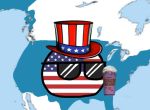 Grimace Shake real
 -
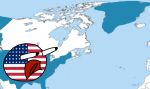 WHAT-
WHAT-


-
 By LB HD Mapper

-
 All historical flags of USA
 -
 Real USA flag
 -
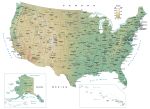 Map of USA


See Also
Navigation
States |  Alabama • Alaska • Arizona • Alabama • Alaska • Arizona •  Arkansas • California • Colorado • Connecticut • Delaware • Arkansas • California • Colorado • Connecticut • Delaware •  Florida • Georgia • Hawaii • Florida • Georgia • Hawaii •  Idaho • Idaho •  Illinois • Illinois •  Indiana • Indiana •  Iowa • Kansas • Kentucky • Iowa • Kansas • Kentucky •  Louisiana • Maine • Maryland • Massachusetts • Louisiana • Maine • Maryland • Massachusetts •  Michigan ( Michigan ( Yooper) • Minnesota • Yooper) • Minnesota •  Mississippi • Missouri • Mississippi • Missouri •  Montana • Nebraska • Nevada • New Hampshire • New Jersey • New Mexico • New York • North Carolina • Montana • Nebraska • Nevada • New Hampshire • New Jersey • New Mexico • New York • North Carolina •  North Dakota • Ohio • Oklahoma • Oregon • Pennsylvania • Rhode Island • South Carolina • North Dakota • Ohio • Oklahoma • Oregon • Pennsylvania • Rhode Island • South Carolina •  South Dakota • Tennessee • Texas • Utah • South Dakota • Tennessee • Texas • Utah •  Vermont • Virginia • Vermont • Virginia •  Washington • Washington •  West Virginia • West Virginia •  Wisconsin • Wisconsin •  Wyoming Wyoming | ||||
|---|---|---|---|---|---|
| Cities |
| ||||
| Historical Entities | |||||
| Historical Eras | |||||
| Military | |||||
| Theories | |||||
In | |||||


